
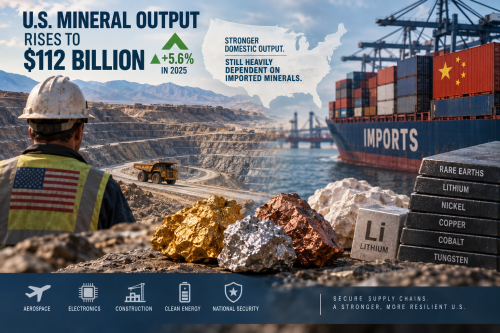
U.S. Mineral Output Climbs to $112 Billion as Import Dependence Remains a Strategic Concern
Higher precious-metal values lifted domestic production in 2025, while U.S. industries continued to rely heavily on imported critical minerals and processed materials
The value of mineral production in the United States rose 5.6% to $112 billion in 2025, supported in part by higher values for precious metals including gold and silver, according to the latest annual Mineral Commodity Summaries from the U.S. Geological Survey.
The figures underline the scale of minerals’ role beyond the mining sector itself. Industries dependent on nonfuel minerals — including aerospace, electronics and construction — accounted for an estimated $4.09 trillion in economic value during the year, equivalent to more than one-eighth of the U.S. economy.
At the same time, the report points to a continuing strategic vulnerability: substantial U.S. dependence on foreign supplies of critical minerals and processed materials.
China remains a major supplier of critical minerals
The United States continued to depend on China as a major source for 14 of the 33 critical minerals for which U.S. import reliance is greatest.
Trade restrictions have become an increasingly important part of that picture. The USGS report addresses 14 minerals, ranging from antimony to tungsten, whose export to the United States is restricted by China.
The issue has moved well beyond the mining industry, as many critical minerals are essential inputs for advanced manufacturing, electronics, defence technologies and other strategically important sectors.
USGS Director Ned Mamula said critical minerals had become increasingly important in U.S. policymaking and international relations. He also pointed to the mineral industry’s wider economic importance and the country’s long-running dependence on imported critical materials.
The latest report notes policies, international agreements and investments pursued by the Trump administration with the stated aim of reducing that reliance.
Processed-material imports rise sharply
One of the largest year-on-year changes recorded in the report concerns processed metals and mineral materials.
Net imports by value rose from $77 billion in 2024 to $185 billion in 2025, meaning the total more than doubled within a year. The Mineral Commodity Summaries identifies several factors affecting the increase, including industrial stockpiling.
The sharp rise adds another dimension to the U.S. minerals debate. Domestic mine output may be increasing in value, but downstream industries still depend heavily on materials and processing capacity located outside the country.
That distinction is particularly important for critical-mineral policy because access to raw mineral deposits alone does not guarantee control over refining, processing or the production of usable industrial materials.
Nevada remains the leading mineral-producing state
Nevada retained its position as the most valuable mineral-producing U.S. state for the second consecutive year.
Arizona moved into second place, overtaking Texas after the value of its copper, molybdenum, gold and silver production increased. Texas also recorded higher values for construction-related minerals, but those gains were not sufficient to match Arizona’s increase in base and precious metals.
The rankings have shifted repeatedly in recent years. Nevada led from 2015 through 2020 before Arizona took first place in 2021 and 2022. Texas became the leading state in 2023, while Nevada subsequently returned to the top position.
Across western states, changes in the value of copper, gold, molybdenum and silver production helped lift total mine-production value by $6.8 billion to $32.8 billion in 2025.
Lithium production expands worldwide
Lithium was among the commodities showing particularly strong international growth.
Global lithium production increased by 31% during 2025, while consumption rose by 20%. U.S. lithium output also increased, although the USGS withheld domestic production figures to protect proprietary commercial information.
Lithium remains strategically important because of its role in battery manufacturing and other advanced technologies, placing it alongside rare earth elements and nickel in broader U.S. efforts to strengthen critical-mineral supply chains.
Mineral policy moves higher on Washington’s agenda
The publication of the latest Mineral Commodity Summaries comes as the U.S. government increases its focus on mineral supply security.
The February release follows the President’s announcement of “Project Vault,” a planned critical-minerals stockpile centred on materials such as rare earths, lithium and nickel. Those resources are widely used in advanced manufacturing, defence systems and clean-energy technologies.
It also follows a presidential proclamation issued in January concerning imports of processed critical minerals and products derived from them.
Together, the measures reflect growing concern in Washington over the concentration of mining, processing and refining capacity in foreign markets and the potential economic and national-security consequences of supply disruptions.
Report covers 90 nonfuel mineral commodities
The Mineral Commodity Summaries is published annually by the U.S. Geological Survey and provides data on 90 nonfuel mineral commodities considered important to the U.S. economy and national security.
Beyond production figures, the report covers domestic industry structures, government programmes, tariffs, resources, reserves, global production and five-year statistical trends. It also tracks developments affecting mineral production, trade and consumption in the United States and internationally.
The 2025 figures present a mixed picture for the United States: domestic mineral production is becoming more valuable, particularly in several western states, while dependence on imported critical minerals and processed materials remains substantial.
That combination is likely to keep mineral security, processing capacity and supply-chain diversification high on the U.S. economic and industrial-policy agenda.
Source & Transparency
This article is published by Ireland Newspaper for editorial and informational purposes.
Published: 7 August 2026 · Updated: 7 August 2026

Newsroom Ireland Newspaper
Ireland Newspaper editorial team prepares daily news coverage for readers in Ireland and abroad.
Market data, financial news and economy content on Ireland Newspaper are provided for editorial and informational purposes only. They do not constitute financial advice, investment advice, trading advice or a recommendation to buy, sell or hold any financial product. Always verify live prices and consult a qualified professional before making financial decisions.