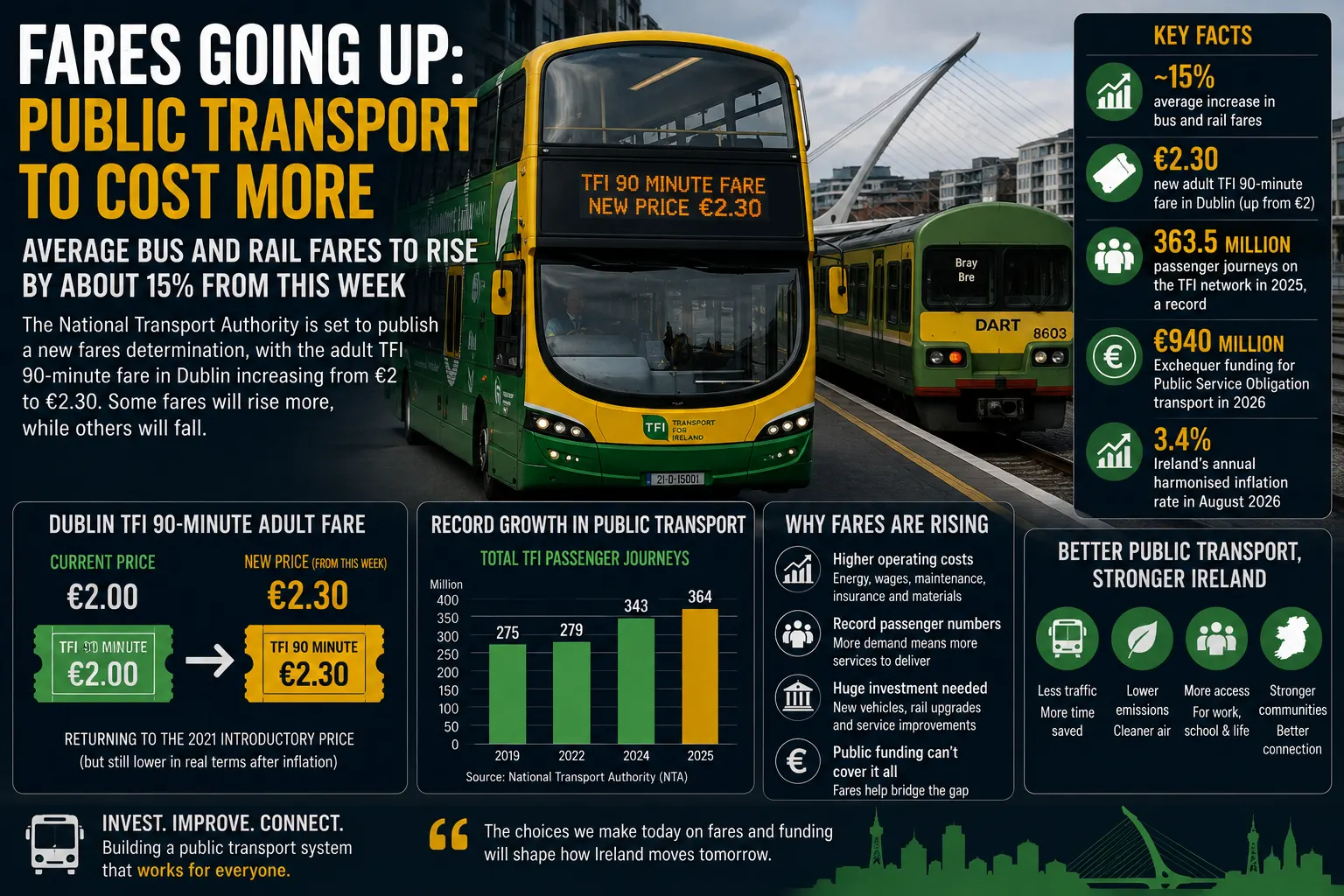
A fare that became one of the most recognisable cost-of-living supports in Ireland is set to become more expensive. The National Transport Authority is due to publish a new fares determination on Thursday, with average bus and rail prices expected to rise by about 15% and Dublin’s adult TFI 90-minute fare reportedly increasing from €2 to €2.30. Some individual fares could rise by considerably more, although reductions are also expected for certain children and young-adult journeys.
The increases arrive at an awkward moment. Irish household prices are rising again, with the Central Statistics Office estimating annual harmonised inflation at 3.4% in August. Energy prices were 11.8% higher than a year earlier, while renewed instability in global oil markets has created further uncertainty over transport and operating costs. For commuters, another increase in a recurring weekly expense will therefore land alongside wider pressure on household budgets.
Yet the fare decision is not simply another cost-of-living story. It exposes a structural problem in Irish transport policy. Passenger numbers have reached record levels and the State wants substantially more journeys to move from private cars to public transport, but the cost of operating and expanding subsidised services has risen even faster. The Exchequer is providing €940 million for Public Service Obligation services in 2026, an unprecedented level of support, while the National Transport Authority has said cost inflation has become severe enough to prevent it from adding planned new bus services this year.
That creates a difficult choice. Keeping fares exceptionally low helps commuters and can make buses, trains and trams more attractive relative to cars. Raising fares reduces the pressure on taxpayers and increases revenue available to operate the network. But if fares rise too quickly while reliability and capacity remain constrained, the State risks making public transport less attractive at precisely the moment its climate and mobility strategies require substantially greater use.
About 15%: the average public transport fare increase expected under the new measures.
€2.30: the reported new adult Dublin TFI 90-minute fare, up from €2.
€940 million: Exchequer funding allocated to Public Service Obligation transport in 2026.
363.5 million: passenger journeys made across the TFI network in 2025, a record.
3.4%: Ireland’s estimated annual harmonised inflation rate in August 2026.
The €2 Fare Was Born During a Very Different Cost-of-Living Crisis
The current fare structure is partly the legacy of policy decisions taken in 2022, when households were confronting rapidly rising energy and living costs after the pandemic and Russia’s invasion of Ukraine. The Government introduced an average 20% reduction in fares across subsidised Public Service Obligation services. In Dublin, the TFI 90-minute adult fare was cut from €2.30 to €2, allowing passengers to transfer between eligible Dublin Bus, Go-Ahead Ireland, Luas, DART and commuter rail services within the time window for one fare.
What was initially introduced as a temporary cost-of-living intervention became embedded in the transport system. The general fare reductions were repeatedly extended, while discounted travel for young adults was broadened. The 90-minute fare became an important component of Dublin’s integrated public transport model because it removed the financial penalty that had previously applied when a passenger needed more than one mode to complete a journey.
The policy therefore performed two functions at once. It reduced household transport costs during a period of exceptional inflation, but it also supported a longer-term transport objective by making transfers between bus, rail and Luas easier and cheaper. That dual role explains why reversing even part of the discount is politically more complicated than simply restoring a temporary emergency measure to its original price.
There is also an historical symmetry in the reported new fare. If the adult TFI 90-minute price rises to €2.30, it will return nominally to the introductory price charged when the integrated fare was launched in November 2021. But €2.30 in 2026 does not have the same purchasing-power value as €2.30 did five years earlier, meaning the real price of the journey remains lower after allowing for cumulative inflation.
Passenger Numbers Have Risen to Records
The increases are not being introduced because public transport has failed to attract passengers. The opposite is true. Preliminary NTA figures show that 363.5 million passenger journeys were made across the Transport for Ireland network during 2025, around 20 million more than in 2024 and an increase of 6% in a single year. The NTA’s subsequently published annual report also described 2025 as another record year for public transport use.
Dublin Bus alone carried approximately 164 million passengers during 2025. Rural services have expanded as well. More than 150 new or enhanced routes had been introduced under Connecting Ireland since 2022 by last year, while passenger numbers on rural services rose from about 1.76 million in 2015 to 5.8 million in 2024.
These increases reflect several developments rather than fares alone. Ireland’s population has grown strongly, employment remains high, new bus routes have been introduced and networks have been expanded. BusConnects, Connecting Ireland and improvements to rail services have increased the number of journeys that can realistically be made without a car. Reduced fares have operated alongside those service improvements.
This distinction has become important within Government. Department of Public Expenditure briefing material reported by The Irish Times argued that fare revenue had fallen by 26% over a period in which passenger numbers increased, while questioning how much of the growth could be directly attributed to lower fares. Officials suggested that service improvements and network expansion may have a greater influence on modal shift than fares alone.
That does not demonstrate that lower fares are ineffective. Transport demand is influenced simultaneously by price, frequency, reliability, journey time, convenience, parking costs and whether a viable service exists at all. A person cannot switch from a car to a bus that does not run at the time they need it, regardless of how cheap the fare is. Equally, a frequent service may attract fewer users if the fare becomes too expensive.
363.5 million passenger journeys were made across the TFI public transport network in 2025, approximately 6% more than in 2024.
The State Is Paying Far More to Keep the Network Running
The financial pressure is substantial. Budget 2026 allocated €940 million for Public Service Obligation services, described by the Department of Transport as a 43% increase in the core PSO allocation from 2025. These subsidies support services that the State considers socially or economically necessary but which cannot be provided at the desired scale on commercial fare revenue alone.
Public transport subsidies are not unusual. Railways and bus networks across Europe generally receive public funding because their benefits extend beyond the passengers who buy tickets. Public transport can reduce congestion, provide mobility to people without cars, connect rural communities, support employment and education, and reduce emissions where it replaces private vehicle journeys.
The question is therefore not whether public transport should be subsidised but how the total cost should be divided between passengers and taxpayers. A system financed almost entirely through fares can become expensive enough to discourage use and may fail to provide socially necessary routes. A system financed almost entirely through taxation can place a rapidly expanding obligation on the Exchequer and weakens the financial link between demand and service provision.
The balance has shifted significantly in recent years. Evidence given by the NTA to the Public Accounts Committee showed that operational costs associated with services rose from €982.1 million to €1.163 billion during 2024. The Authority attributed the increase to inflation in fuel and labour costs, additional service provision and the cost of maintaining reduced fares and concessionary schemes.
Those pressures have continued. NTA chief executive Anne Shaw told an Oireachtas committee in July that despite record public funding, no additional bus services could be introduced during 2026 because of cost inflation. Planned expansion in Cork and elements of the Dublin network redesign were among the developments affected by funding constraints.
The Funding Squeeze Behind the Fare Debate
| Indicator | Figure | What it shows |
|---|---|---|
| 2025 passenger journeys | 363.5 million | Record network demand |
| 2024 operating costs | €1.163 billion | Higher fuel, labour and services |
| 2026 PSO allocation | €940 million | Record State support |
| 2026 PSO funding increase | 43% | Increase in core allocation from 2025 |
Source: National Transport Authority, Department of Transport and Oireachtas records.
Why Running More Public Transport Costs More Even When Passenger Numbers Rise
A common assumption is that record passenger numbers should automatically make the system cheaper for the taxpayer. Public transport economics is more complicated. Adding passengers to an existing bus or train with empty seats can generate additional fare revenue at relatively little extra cost. Once services approach capacity, however, serving more passengers requires additional vehicles, drivers, maintenance, depots and infrastructure.
Ireland is increasingly operating in that second phase. Growing population and travel demand require more buses and trains, while the State is simultaneously trying to improve frequencies and extend service into areas where public transport was previously weak. Rural routes are particularly unlikely to recover their full operating cost from fares because lower population densities produce fewer passengers per vehicle kilometre.
Labour is one of the largest costs. Drivers, mechanics, railway workers, operations staff and maintenance teams are necessary regardless of whether fuel prices rise or fall. Ireland’s tight labour market has increased wage costs and made recruitment difficult in parts of the transport sector. The NTA’s 2025 customer research identified driver and mechanic availability as one factor affecting reliability.
Energy matters too. Diesel remains important across parts of the bus fleet, and electricity prices affect rail and Luas operations. Ireland is progressively introducing electric buses, which can reduce fuel and emissions exposure over time, but electrification also requires substantial expenditure on vehicles, charging infrastructure and depots.
The system is therefore being asked to perform three expensive tasks at once: carry more passengers, expand geographically and decarbonise its fleet and infrastructure. Lower passenger fares reduce one of the revenues available to finance that transformation.
What a €2.30 Dublin Fare Would Mean for a Regular Commuter
The effect of a 30-cent increase can appear small when viewed as a single journey, but recurring commuting costs accumulate. Consider a simplified example of an adult who currently pays one €2 TFI 90-minute fare going to work and another returning home, five days a week. The fare element of that commute is €20 a week before any applicable caps, period tickets or TaxSaver benefits are considered.
If the same two journeys cost €2.30 each, the equivalent calculation becomes €23 a week, an increase of €3. Over 20 commuting days in a representative month, the difference would be €12, with expenditure rising from €80 to €92. Over 48 working weeks, the simple model produces an increase of €144.
These figures are an illustration rather than a prediction of what every passenger will pay. Leap Card fare caps, TaxSaver tickets, hybrid working, different journey patterns and any changes contained in the final NTA determination can materially alter the result. Some passengers will also receive lower fares under the new structure.
Nevertheless, the model explains why comparatively small fare changes attract attention. Public transport is not an occasional purchase for many commuters; it is a recurring household expense comparable with electricity, broadband or insurance. A percentage change that appears modest on one trip can become meaningful over a full year.
Illustrative Cost of a Dublin Five-Day Commute
| Period | At €2.00 per trip | At €2.30 per trip |
|---|---|---|
| One workday | €4.00 | €4.60 |
| Five-day week | €20.00 | €23.00 |
| 20 commuting days | €80.00 | €92.00 |
| 48 working weeks | €960.00 | €1,104.00 |
Illustrative calculation only. Actual costs depend on final fares, Leap caps, TaxSaver products, transfers and individual travel patterns.
The Increase Comes While Household Inflation Is Rising Again
The timing increases the political sensitivity. Ireland’s harmonised consumer-price inflation rate was estimated at 3.4% in August 2026, up from 3.1% in July. Energy prices increased by an estimated 4.3% in a single month and were 11.8% higher than a year earlier.
Higher public transport fares do not by themselves determine the national inflation rate, but they add to the cost pressures experienced by households. The distributional effect also matters. Regular public transport users are disproportionately concentrated among commuters, students, younger adults and households that either choose not to own a car or cannot afford one.
The policy picture is not uniformly negative for those groups. Free travel for children up to the age of nine is expected to remain, as is the Free Travel Scheme for eligible older people and other qualifying passengers. The forthcoming fare package is also expected to contain reductions for some children and young adults. The eventual burden will therefore differ significantly by age, route and ticket type.
For working-age adults paying standard fares, however, the broader cost-of-living context is difficult to separate from the transport decision. Households do not experience inflation in policy categories. Rent, electricity, groceries, insurance and commuting costs all compete for the same disposable income.
The Climate Policy Creates an Apparent Contradiction
The fare increase also appears, at first sight, to conflict with Ireland’s climate policy. The National Sustainable Mobility Policy aims for a 130% increase in daily public transport journeys by 2030, alongside a 50% increase in active travel journeys and a 20% reduction in total vehicle kilometres travelled. Transport emissions are supposed to fall by 50% from their 2018 level by 2030.
Achieving those targets requires millions of journeys to move away from private cars. Price is one factor influencing that choice. If public transport becomes more expensive while driving costs remain unchanged, the financial incentive to switch can weaken.
But affordability is only part of modal shift. Frequency, reliability, travel time and network coverage can matter more than a relatively small fare difference. A suburban commuter may willingly pay €2.30 instead of €2 if a bus arrives every ten minutes and reaches work reliably. The same passenger may choose a car even at a €2 fare if the service is infrequent, overcrowded or repeatedly delayed.
This is the central argument behind a more financially sustainable fare model. If keeping fares artificially low consumes money that could otherwise finance more frequent services, the policy may eventually undermine the network expansion required to persuade drivers to change modes. Conversely, if fare increases simply reduce public subsidy without producing better services, the case becomes much weaker.
The relevant test will therefore be what happens to both fares and service quality. Price increases can be compatible with climate policy if they help finance a substantially more useful network while public transport remains cheaper than the full cost of driving. They become harder to reconcile with climate targets if passengers pay more while service expansion stalls.
Ireland Still Depends Heavily on the Car
The scale of the challenge is visible in commuting data. Census 2022 recorded approximately 1.28 million people travelling to work by car, accounting for around 63% of commuters. Public transport accounted for roughly 180,000 commuters, or about 9%, while walking and cycling together represented around 12%.
These figures pre-date some of the latest public transport expansion and record passenger growth, but they illustrate the structural dominance of the private car. Ireland’s dispersed settlement pattern makes that particularly difficult to change outside the larger cities. Many people in rural and peripheral areas do not have a practical public transport alternative for work, childcare or other daily journeys.
Government strategy therefore increasingly distinguishes between places where modal shift is realistic and places where car dependence will remain harder to avoid. Connecting Ireland has expanded rural services, while BusConnects and rail investment focus on corridors where high passenger volumes can support frequent transport.
Fare policy must operate across both environments. A low fare is particularly valuable to frequent urban users, while a rural passenger may care first about whether a service exists at all. Creating one nationally coherent system while meeting such different needs is one reason fare reform has become increasingly complex.
The NTA Has Already Been Rebuilding Ireland’s Fare System
The expected increases are also part of a broader restructuring rather than a simple across-the-board price adjustment. The NTA’s National Fares Strategy seeks to make fares more consistent and relate them more closely to the distance travelled, regardless of which operator or transport mode a passenger uses.
The Greater Dublin Area has already been reorganised into a Dublin City Zone and three surrounding commuter zones extending approximately 50 kilometres from the centre. The changes have produced substantial reductions on some journeys and increases on others as historically different Bus Éireann and Iarnród Éireann pricing structures are aligned.
For example, earlier reforms greatly reduced some rail fares from Drogheda and Newbridge to Dublin while increasing certain bus and shorter rail journeys. The policy objective was not initially to raise total fare revenue but to remove anomalies in which passengers travelling comparable distances could pay very different amounts depending on the operator or route.
This means an average increase of about 15% does not imply that every ticket will rise by exactly 15%. Reporting ahead of Thursday’s announcement indicates that some fares could increase by around 30%, while others will fall. Passengers will need the final fare tables to understand the precise effect on their individual journeys.
Young Adults and Children Remain Central to the Discount Strategy
One of the most significant changes to Irish fare policy during the past several years has been the move from universal discounts towards more targeted concessions. Young Adult Leap Card holders and qualifying students receive deeply discounted fares, while free travel has been extended to children aged five to eight in addition to the longstanding provision for younger children.
The policy rationale is partly social and partly behavioural. Younger people typically have lower incomes and are less likely to own cars. Encouraging them to become habitual public transport users may also influence longer-term travel behaviour after they enter full-time employment.
Targeted discounts can also be less expensive to the Exchequer than keeping every adult fare at an emergency cost-of-living level indefinitely. That makes them potentially attractive when Government wants to protect particular groups while rebuilding fare revenue from passengers with greater ability to pay.
The trade-off is complexity. A system with different adult, child, student, young-adult, Free Travel, TaxSaver and zonal arrangements can become difficult to understand. The NTA’s wider fare strategy therefore attempts simultaneously to simplify the geography of fares while maintaining concessions for selected groups.
Free Public Transport Would Not Make the Cost Disappear
The current debate sometimes produces calls for universally free public transport. That would remove the fare burden from passengers, but the operating cost would remain. A Department of Transport response to the Oireachtas in 2025 estimated that universal free public transport would require approximately €786 million in additional annual Exchequer funding before allowing for the extra demand generated by a zero fare.
That figure illustrates the fundamental funding issue. Public transport can be free to the passenger, but not free to provide. Drivers must still be paid, buses purchased, trains maintained, electricity supplied and infrastructure renewed. The cost simply moves from ticket revenue to general taxation.
There can be legitimate arguments for doing so. Free fares may improve mobility for low-income households and remove barriers to travel. But international experience suggests that service frequency and reliability are often at least as important as fares in persuading motorists to abandon their cars. If removing fares consumes money that could have financed additional capacity, the net transport benefit is not necessarily straightforward.
A more targeted model can therefore combine substantial State subsidy with passenger contributions and deeper discounts for groups considered particularly sensitive to price. Ireland has increasingly moved in that direction.
The Next Ticketing Revolution Is Already Being Built
Fare levels are changing while the technology used to pay them is also preparing for a major transition. The NTA plans to introduce contactless bank-card and mobile-phone payments from 2028, with new equipment beginning to appear during 2027. The system will initially be rolled out in the Greater Dublin Area before expanding more widely.
The planned account-based system will calculate fares after journeys and charge customers directly, while Leap Cards, discounted products and the Free Travel Scheme will continue to be supported. In principle, such technology can make complex zonal and multimodal pricing much easier for passengers because the system can automatically calculate the correct fare rather than requiring the traveller to understand every ticket product beforehand.
It could also make future fare policy more flexible. Daily and weekly caps, transfer discounts and different zonal prices become easier to administer when individual journeys are processed through a central account-based system. That does not determine how expensive travel will be, but it can reduce one of the frustrations associated with complex fare structures.
A More Expensive Fare Could Still Be a Better Deal Than Driving
Public transport affordability should also be assessed against the alternatives rather than in isolation. A car journey involves fuel, insurance, maintenance, depreciation, motor tax and often parking. Many of these costs are not visible at the moment the driver makes an individual trip, while a bus or rail fare is paid directly for each journey.
This difference can distort perception. A commuter may compare a €2.30 bus fare only with the petrol consumed on a particular drive, even though the true long-run cost of car ownership is substantially higher. Public policy similarly has to account for congestion, road maintenance, emissions and land used for parking and roads.
Yet this argument has limits. For a household that already owns a car and must keep it for other reasons, many ownership costs are fixed regardless of whether one commute shifts to public transport. The relevant decision may therefore genuinely be between an additional bus fare and the marginal fuel and parking cost of driving. Where public transport is slow or requires several connections, even a subsidised ticket may struggle to compete.
That is why transport economics repeatedly returns to service quality. Price can influence the decision, but it cannot compensate indefinitely for unreliable or poorly connected services.
What Happens Next Depends on More Than Thursday’s Price List
The immediate focus will be the NTA’s final determination: which fares increase, which groups receive reductions, how Leap caps and period tickets change and when the new prices take effect. Until the full determination is published, reported figures such as the approximately 15% average increase and €2.30 Dublin 90-minute fare should be understood as details expected ahead of the formal announcement rather than a substitute for the complete fare schedule.
The more important decisions will follow in Budget 2027. Government must decide how much additional PSO funding it is prepared to provide, whether passenger revenue should contribute a greater share of operating costs and how quickly planned service expansion can resume. Those decisions will determine whether higher fares are accompanied by a visibly improved network.
There are broadly three possible directions. The State could continue increasing subsidies rapidly and keep future fare increases limited. It could ask passengers to carry a progressively larger share of operating costs. Or it could combine moderate fare increases with more targeted concessions for children, younger adults and vulnerable households while concentrating Exchequer money on service expansion.
The third approach appears closest to the direction in which policy has already been moving, although future budgets and NTA determinations will decide how far it goes. It attempts to protect affordability without freezing prices indefinitely at levels created during an emergency cost-of-living intervention.
The Real Test Will Be What Passengers Receive in Return
A 15% increase in public transport fares would be significant, particularly when general household inflation is running at around 3.4%. Commuters are likely to ask why their fares should rise faster than the overall price level, especially after years in which public policy encouraged people to change how they travel.
The financial answer is that public transport costs are being driven by more than consumer-price inflation alone. The network is larger, labour costs have increased, new vehicles are being purchased, rural services are expanding and infrastructure investment is continuing. At the same time, discounted fares have reduced the proportion of operating costs recovered directly from passengers.
That explanation does not remove the State’s obligation to spend efficiently. Recent controversies surrounding the abandoned Irish Rail traffic-management system and the rising projected cost of the National Train Control Centre have intensified scrutiny of how transport money is managed. Passengers asked to pay more can reasonably expect strong governance alongside additional funding.
The policy challenge is consequently broader than choosing between cheap fares and expensive fares. Ireland needs a network that is affordable enough to attract passengers, reliable enough to replace car journeys and financially sustainable enough to expand as the population grows. Those objectives can reinforce one another when additional revenue delivers better service. They can conflict sharply when passengers pay more without seeing improvement.
The reported return of Dublin’s 90-minute fare to €2.30 is therefore a small price change with a much larger meaning. It marks the gradual end of an era in which emergency cost-of-living discounts could be maintained largely through ever-greater State support. The next phase of Irish public transport will require a more permanent answer to a question that temporary subsidies postponed: how much should the passenger pay, how much should the taxpayer pay, and what standard of service should both expect in return?
Sources
The Irish Times — Bus and Train Fare Hikes to Be Announced by Transport Authorities
National Transport Authority — Current Fares Determination
Transport for Ireland — Current Public Transport Fares
National Transport Authority — 2025 Annual Report and Financial Statements
National Transport Authority — Passenger Journeys Across the TFI Network in 2025
Department of Transport — Budget 2026 Transport Funding
RTÉ — NTA Funding Pressures and 2026 Service Expansion
Central Statistics Office — Flash Estimate for the Harmonised Index of Consumer Prices, August 2026
Department of Transport — National Sustainable Mobility Policy
Central Statistics Office — Census 2022 Employment, Occupations and Commuting
Department of Transport — Introduction of the 20% Public Transport Fare Reduction
RTÉ — Contactless Public Transport Ticketing Planned for 2028
Source & Transparency
This article is published by Ireland Newspaper for editorial and informational purposes.
Published: 3 September 2026 · Updated: 3 September 2026

Newsroom Ireland Newspaper
Ireland Newspaper editorial team prepares daily news coverage for readers in Ireland and abroad.