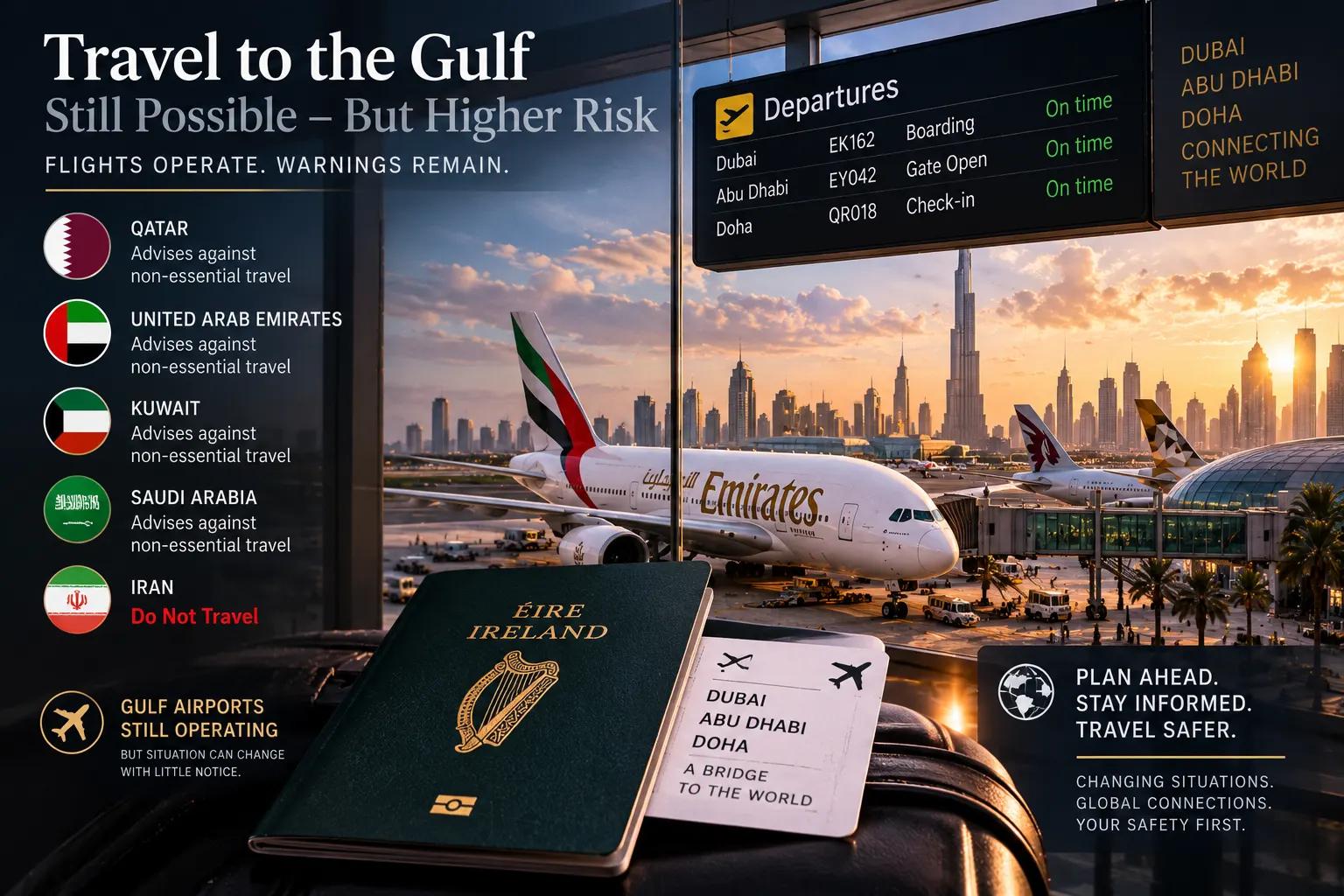
Dubai, Doha and Abu Dhabi are still functioning as international aviation hubs. Emirates is operating between Dublin and Dubai, Etihad continues selling Dublin-Abu Dhabi connections and Qatar Airways is rebuilding a global network through Doha. Yet as of 4 September 2026, Ireland advises against non-essential travel to both Qatar and the United Arab Emirates, as well as Kuwait and Saudi Arabia, while its highest warning — “Do Not Travel” — remains in place for Iran.
The apparent contradiction is one of the defining features of travel in the Gulf this year. An airport can be open, an airline can be selling tickets and thousands of passengers can pass safely through a terminal while the surrounding security environment remains sufficiently unstable for governments and aviation regulators to warn that conditions could deteriorate with little notice. The principal danger is not ordinary crime or unrest inside the major Gulf hubs. It is the possibility that missile and drone attacks, military interception, falling debris, sudden airspace closures or rapidly changing flight routes spill into one of the world’s busiest aviation regions.
For Irish travellers, the issue is unusually important because the Gulf is not merely a holiday destination. Dubai, Abu Dhabi and Doha form three of the most important connecting points between Dublin and Australia, New Zealand, India, South-East Asia, Africa and other long-haul destinations. A security disruption thousands of kilometres from an Irish traveller’s final destination can therefore cancel an entire journey.
The position for Irish travellers in early September 2026
- Ireland advises against non-essential travel to Qatar.
- Ireland advises against non-essential travel to the United Arab Emirates.
- Ireland advises against non-essential travel to Kuwait.
- Ireland advises against non-essential travel to Saudi Arabia.
- Ireland’s advice for Iran is “Do Not Travel”.
- Major Gulf airports including Dubai, Abu Dhabi and Doha continue to operate commercial flights.
- The latest EASA Gulf warning remains valid until 30 September 2026 unless reviewed earlier.
- EASA now permits necessary arrivals and departures at Gulf airports subject to appropriate risk assessment, while recommending airlines avoid defined airspace over Persian Gulf waters.
The Gulf Has Not Become a Conventional War Zone — but Its Airspace Has Become Part of the Conflict
The security change began with a conflict whose geographical consequences extended far beyond Iran itself. On 28 February 2026, the United States and Israel carried out military strikes against targets inside Iran. Iran responded with retaliatory attacks, creating risks not only over Iranian territory but also in neighbouring states hosting American military installations or affected by missile and drone operations.
That distinction matters. Qatar, the UAE, Kuwait and Saudi Arabia are not parties to the conflict in the same way as Iran, and their major cities have continued functioning. But the presence of strategic military bases, energy facilities, ports and transport infrastructure means Gulf states can be exposed when confrontation between Iran and the United States widens beyond Iranian territory.
The region also contains some of the world’s most densely interconnected civilian and military airspace. Commercial aircraft approach airports while military aircraft, missile-defence systems and surveillance platforms operate in the same wider environment. When ballistic missiles or drones are launched, air-defence systems may activate with little warning.
EASA’s assessment identifies several resulting hazards for civilian aviation: missile and drone overflights, interceptions, falling debris, possible misidentification of aircraft, rapidly activated military systems and sudden changes to available airspace. None requires a passenger terminal itself to be deliberately targeted for commercial aviation to be disrupted.
February Turned the Gulf’s Geography Into an Aviation Risk
The first months of 2026 demonstrated how quickly that risk could move from theoretical to practical. The conflict triggered widespread closures and restrictions across Middle Eastern airspace. Dubai, one of the world’s largest international passenger hubs, experienced severe disruption, while airlines cancelled or rerouted thousands of flights and passengers were stranded across the region.
The underlying problem is geography. A flight between Europe and South Asia does not simply travel in a straight line irrespective of politics. Airlines need usable flight corridors, permission from national aviation authorities, sufficient diversion airports and a route their internal security teams consider acceptable.
If Iranian, Iraqi or Gulf airspace becomes unavailable, aircraft have to be moved into alternative corridors. Those corridors can themselves become congested, while longer routings consume additional fuel and alter aircraft scheduling, crew hours and connections at hub airports.
For an airline built around connecting passengers, disruption can spread quickly. A delayed aircraft arriving into Doha or Dubai from Europe may be scheduled several hours later for another destination. A crew displaced by an earlier cancellation can affect subsequent flights. Passengers arriving after their onward departure may need seats on services that are already full.
A Ceasefire Reduced the Danger — but Did Not Remove It
EASA records that a temporary ceasefire between the United States and Iran was announced on 8 April. On 17 June, the sides signed a memorandum intended to extend the pause for another 60 days. For aviation, this created the possibility that restrictions introduced during the initial fighting could gradually be eased.
But the calm proved fragile. Fresh military action in July again demonstrated that Gulf states could become directly exposed. Following renewed American strikes against Iran, Iranian forces attacked American military infrastructure in the Gulf region. Kuwait reported missile and drone interceptions, while Iranian forces said they had targeted an early-warning site in Qatar and other American military assets in neighbouring Gulf states.
Ireland’s current Qatar and Kuwait travel advice explicitly refers to renewed strikes since 8 July, including attacks affecting military and civilian infrastructure. The Department warns that further attacks and additional escalation remain possible.
On 14 July, EASA consequently reinstated a more restrictive aviation warning covering Bahrain, Kuwait, Qatar, the UAE and part of the Gulf of Oman. That did not mean every civilian flight immediately stopped. It meant European aviation authorities believed the conflict environment created an unacceptable level of risk across specified airspace without stronger operational limitations.
The Risk Increased Again at the End of August
The situation shifted again on 31 August and 1 September when the United States and Iran exchanged major military attacks after a period of relative calm. American forces struck Iranian positions and Iran responded with attacks on American military facilities in the region. The UAE separately reported intercepting an Iranian-origin drone over its territorial waters.
Those events are particularly relevant to travellers because they occurred only days before the beginning of the busy autumn travel period. They demonstrate that a route appearing relatively stable when a ticket is purchased can change again before departure.
EASA updated its Gulf warning on 31 August and extended it until 30 September, unless reviewed earlier. Importantly, however, the new version is more geographically precise than the earlier blanket warning. Airlines are advised not to operate over the waters of the Persian Gulf within the relevant Bahrain, Kuwait, Doha and Emirates flight-information regions, except where necessary for arrivals or departures at airports within those regions.
Operations over the land territory of those states are not subject to the same blanket recommendation, although airlines are told to exercise caution. EASA also continues to advise operators to maintain current risk assessments and contingency plans because conditions can change at short notice.
Why Ireland’s Warning Is Stronger Than the Sight of Normal Flights Might Suggest
Travel advice and aviation regulation answer different questions. An airline’s safety department asks whether a particular flight can be operated along a particular route at a particular time with an acceptable level of risk. Ireland’s Department of Foreign Affairs and Trade asks whether an Irish citizen should undertake non-essential travel into a country whose overall security environment may deteriorate.
That explains why an aircraft can legally and operationally land in Doha while Ireland continues to advise against non-essential travel to Qatar. The existence of an operating flight is evidence that the airline and aviation authorities consider the individual operation manageable. It is not a guarantee that the wider regional security situation is normal.
Ireland describes “Avoid Non-Essential Travel” as its second-highest security level. The Department recommends postponing travel unless it is necessary and warns that serious and potentially life-threatening risks may exist. Consular assistance can also be more difficult in a severe regional crisis.
“Do Not Travel” is different again. It is the highest warning level. For Iran, Irish citizens outside the country are advised not to travel there under any circumstances, while citizens already there are strongly advised to leave if it is safe to do so.
Current Irish Travel Advice for Key Gulf and Middle Eastern States
| Country | Irish security status | Practical position |
|---|---|---|
| Qatar | Avoid Non-Essential Travel | Commercial flights operating; disruption possible |
| United Arab Emirates | Avoid Non-Essential Travel | Commercial flights operating; schedules can change |
| Kuwait | Avoid Non-Essential Travel | Reduced services and possible cancellations |
| Saudi Arabia | Avoid Non-Essential Travel | Commercial travel possible; temporary closures possible |
| Iran | Do Not Travel | Irish citizens advised not to travel |
Source: Department of Foreign Affairs and Trade travel advice, current in early September 2026.
Iran Is in a Completely Different Risk Category
Ireland’s warning for Iran should not be treated as equivalent to the advice for Dubai or Doha. The Department reports continuing American airstrikes against locations in Iran, primarily military targets but with reported damage to civilian infrastructure. It describes the security situation as highly volatile and unpredictable and says wider hostilities could resume at short notice.
The Department also warns foreign nationals, including Irish citizens, of the risk of arbitrary arrest and detention, including on allegations of espionage. Internet and communications restrictions create another potential difficulty in an emergency.
EASA’s position is similarly unambiguous. Its current conflict-zone bulletin recommends that operators do not fly within Iranian airspace at any altitude. That recommendation remains valid until 30 September unless reviewed sooner.
For travellers, the practical implication is that Iran should not be regarded simply as another potentially disrupted transit market. The Irish security status is a direct warning not to travel.
Why Dubai, Doha and Abu Dhabi Matter So Much to Ireland
The Gulf aviation model transformed Ireland’s access to Asia and the southern hemisphere. Instead of travelling from Dublin to London, Frankfurt or Paris before beginning a second long-haul journey, passengers can fly east to a Gulf hub and connect directly to dozens of destinations.
Emirates currently schedules 14 flights a week between Dublin and Dubai. Its network from Dublin markets onward connections to cities including Sydney, Melbourne, Perth, Brisbane, Auckland, Bangkok, Singapore, Manila and numerous destinations in India.
Etihad continues to offer Dublin-Abu Dhabi services and onward itineraries from Ireland to destinations such as Sydney, Bangkok, Bengaluru, Kochi and other Asian cities. Qatar Airways continues operating through Doha and has rebuilt a network of more than 160 destinations during the summer.
For Ireland, those networks effectively place Dubai, Abu Dhabi and Doha inside the country’s long-haul transport system. A disruption in the Gulf may therefore affect somebody travelling from Cork to visit family in Australia even if they never intended to leave the transit terminal in Dubai.
A Transit Passenger Is Still Exposed to the Aviation Disruption
Travellers sometimes assume that a government warning is irrelevant if they are merely changing aircraft and never passing immigration. From a security perspective, remaining airside is different from spending several days in the country. But it does not remove the principal aviation risk discussed in the current warnings.
Ireland’s Qatar and UAE advice specifically addresses passengers transiting through the Gulf. Travellers are told to remain vigilant, expect that flights may change and liaise directly with their airline. Qatar’s advice additionally tells transit passengers to prepare for possible cancellations and periodic airspace closures.
A passenger changing aircraft in Doha is dependent on Doha’s airspace remaining accessible. A traveller through Dubai depends on the Emirates flight-information region and neighbouring corridors being usable. If an airline suspends operations or a destination temporarily closes its airspace, remaining inside the terminal does not protect the onward itinerary.
Transit also creates practical complications during prolonged disruption. A short connection can become an overnight stay. Passengers may need accommodation outside the terminal, additional entry permission, medication, access to luggage or money for unexpected expenses.
The Biggest Mistake Is Treating a Confirmed Booking as a Guarantee
An airline reservation confirms that a flight is scheduled. It does not guarantee that the flight will operate if the security environment changes.
During an active conflict, airlines constantly reassess routes using government intelligence, NOTAMs, aviation-security information, air-traffic-control instructions, fuel requirements and internal safety thresholds. A service can therefore remain confirmed until comparatively close to departure before being delayed, rerouted or cancelled.
Qatar Airways explicitly warns that schedules can change or be cancelled because of operational, regulatory or safety circumstances. Its 2026 recovery schedule has also been accompanied by rebooking and refund arrangements for affected passengers.
That does not indicate that cancellation is expected on every flight. It reflects the unusually high level of operational uncertainty.
Airspace Closures Can Affect Flights That Never Intended to Land in the Conflict Area
The global aviation impact extends beyond Gulf carriers. Europe-to-Asia flights traditionally use multiple corridors across the Middle East. When Iran, Iraq or parts of Gulf airspace become unavailable, aircraft from other airlines must also reroute.
That can increase flight times and fuel consumption and place additional traffic into narrower areas regarded as safe. Air-traffic-control capacity can then become a constraint even where no attack is taking place.
The effect can be cumulative. An airline may have a safe alternative route but decide that the additional flight time causes crew-duty or fuel problems. Another service may remain viable but arrive late enough for passengers to miss connections. Aircraft that reach their destination hours later than planned may then begin their next rotation late.
Modern airline networks are efficient partly because aircraft and crews are used intensively. That efficiency means a severe regional shock can propagate through schedules far from the original incident.
Why Missiles and Air-Defence Systems Worry Aviation Authorities
The obvious danger to civilian aircraft is being struck directly by a weapon. Aviation regulators also worry about misidentification and interception, particularly when military forces are operating at high readiness.
EASA notes that activation of national and American air-defence systems increases the risk of unintended engagement or collateral effects. Missiles and drones may travel across airspace that is normally used by civilian aircraft, while defensive weapons are launched to intercept them.
Even a successful interception creates debris. Ireland’s advice for citizens in Saudi Arabia specifically warns about the danger from falling debris after interceptions and tells people to move indoors when instructed by local authorities.
Airlines therefore do not need evidence that somebody intends to target a passenger aircraft before deciding to avoid an area. The existence of high-speed weapons and air-defence activity in the same airspace can itself make a route unacceptable.
The Gulf’s Military Geography Is Part of the Problem
Qatar, Kuwait, Bahrain and other Gulf states host important American military infrastructure. That infrastructure has strategic importance in the confrontation with Iran and can therefore become a target even when the host government itself wants to remain outside the conflict.
Qatar is home to Al Udeid Air Base, a major American military facility. Kuwait and Bahrain also host significant US forces, while the wider region contains naval, air-defence and logistics infrastructure.
The result is an unusual geography in which civilian global hubs sit relatively close to strategically significant military installations. Doha can remain a prosperous, functioning commercial city while the presence of an American facility elsewhere in Qatar affects the country’s overall security risk.
This helps explain why Ireland’s advice can appear severe when compared with ordinary life visible on the ground. The risk is less about routine conditions on a shopping street and more about what could happen rapidly during another exchange of strikes.
The Strait of Hormuz Extends the Risk From Aviation to the Global Economy
The conflict is also centred on one of the world’s most important maritime chokepoints. The Strait of Hormuz sits between Iran and the Arabian Peninsula and carries a major share of global oil and gas exports.
Iranian efforts to control or restrict shipping through the strait, attacks on commercial vessels and American military responses have increased both maritime and aviation risk. EASA’s current Gulf bulletin specifically links repeated attacks on commercial shipping and military action around Hormuz with danger to the airspace above Gulf waters.
The economic consequences reach airlines through fuel prices as well as route disruption. Jet fuel is a major operating cost. A conflict that increases oil prices while simultaneously forcing aircraft onto longer routes creates pressure from both directions.
Those costs do not automatically appear immediately in the ticket price of an existing booking, but sustained instability can influence fares, capacity decisions and airline profitability over time.
Travel Insurance Has Become More Important — and More Complicated
A government travel warning does not automatically produce the same insurance outcome for every traveller. Policies differ substantially, and the date on which the policy was purchased can matter.
Ireland’s Department of Foreign Affairs strongly recommends comprehensive travel insurance but notes that obtaining suitable cover may not always be possible for countries classified under “Avoid Non-Essential Travel”. Travellers should therefore not assume that an ordinary annual policy continues unchanged if they deliberately travel against official advice.
War is another critical issue. Insurance Ireland says claims arising from war, civil war or a coup are normally among the general exclusions found in travel policies. That makes the wording of an individual contract particularly important during the present Gulf conflict.
A policy may distinguish between medical treatment unrelated to the conflict, trip cancellation following a government warning, airline disruption, terrorism and losses directly caused by war. The existence of insurance is therefore not the same as having insurance for the event that actually causes the loss.
Transit Cover Should Be Checked Explicitly
For people travelling to Australia or Asia through a Gulf airport, one of the most important questions is whether the insurer regards an airside transit through a country subject to an “Avoid Non-Essential Travel” warning as travelling to that country for policy purposes.
There is no safe universal answer because policy wording varies. Travellers should ask the insurer directly and preferably obtain the response in writing before departure. The same applies to policies supplied automatically through premium bank accounts or credit cards.
Useful questions include whether the policy covers transit through Doha, Dubai or Abu Dhabi under the current Irish advisory; whether cancellation caused by a new government warning is covered; whether war or regional conflict is excluded; and whether additional accommodation, missed connections or alternative transport following an airspace closure are covered.
A traveller who discovers the answer after becoming stranded may have considerably fewer options than one who clarified the position before leaving Ireland.
Do Not Cancel an Operating Flight Without Checking the Consequences
Another common problem occurs when passengers become worried and cancel their own booking even though the airline still intends to operate. Voluntary cancellation is legally different from the airline cancelling the flight.
If the passenger chooses not to travel, the fare conditions generally determine how much money can be recovered unless another legal protection applies. A non-refundable ticket does not automatically become refundable simply because the passenger feels uncomfortable about the regional situation.
This is why Irish consumer authorities recommend contacting the airline or travel organiser first. Travellers should establish whether the flight remains scheduled, whether alternative routing is available and what rebooking flexibility the company is offering before cancelling independently.
If the airline cancels, the passenger’s legal position is significantly clearer.
Flights Leaving Dublin Have Strong EU Passenger Protections
Flights departing from Ireland are covered by EU air-passenger legislation even when the operating airline is based outside the European Union. That is particularly relevant for Emirates, Qatar Airways and Etihad passengers leaving Dublin.
If a covered flight is cancelled, the airline must offer a choice between reimbursement and rerouting. Passengers choosing rerouting at the earliest opportunity are also entitled to care while waiting, which can include reasonable meals and refreshments and, where necessary, hotel accommodation and transport to the hotel.
The right to financial compensation is different. Political instability, security risks and air-traffic-management decisions can qualify as extraordinary circumstances. If an airline can show that the cancellation resulted from extraordinary circumstances that could not have been avoided despite reasonable measures, the standard EU cash compensation may not be payable.
That does not normally erase the basic rights to refund or rerouting and care. The distinction is important: a traveller may have no entitlement to an additional compensation payment yet still have strong rights concerning completion or reimbursement of the journey.
The Return Journey Can Have a Different Legal Position
EU passenger rights are easiest to apply to the outbound journey from Dublin because it departs an EU airport. A return flight to Ireland from a non-EU country is generally covered by the same EU regime when it is operated by an EU-licensed airline, but not merely because the passenger’s destination is Dublin.
That means a traveller returning from a Gulf hub on a non-EU carrier cannot automatically assume the same regulatory framework applies in exactly the same way as it did on departure from Ireland. Other contractual or local rights may still exist.
The position becomes even more important on multi-sector journeys. A Dublin-Dubai-Sydney ticket sold as a single reservation provides a very different practical level of protection from separate tickets purchased independently for each leg.
When the journey is on one booking, the airline has responsibility for transporting the passenger to the ticketed final destination when disruption occurs. With separate bookings, one airline may regard its responsibility as ending at the intermediate airport even if a delay causes the traveller to miss an independently purchased onward flight.
One Ticket Is Safer Than Building a Long-Haul Journey From Separate Reservations
This has always been a useful travel principle, but the current Gulf situation makes it more important. A self-transfer itinerary may appear cheaper because separate flights are purchased from different airlines. The saving can disappear rapidly if the first flight is delayed and the second carrier treats the passenger as a no-show.
A single through-ticket normally protects the connection within the airline’s itinerary. If a disruption causes a missed connection, the carrier can reroute the passenger towards the final destination subject to the applicable rules and conditions.
Checked baggage is another consideration. Through-ticket passengers can often have luggage transferred automatically. Self-transfer passengers may need to enter the transit country, collect baggage and check in again, potentially transforming an airside connection into an actual entry into a country under an Irish travel warning.
For passengers who have not yet booked, the price difference should therefore be compared with the financial risk of a disrupted self-transfer.
Package Holidays Give Travellers Another Layer of Protection
Irish travellers who booked flights and accommodation together as a qualifying package can have stronger rights than passengers who assembled every element separately.
Under the Irish implementation of EU package-travel rules, unavoidable and extraordinary circumstances at a destination or in its immediate vicinity can give travellers the right to terminate a package without a cancellation fee where those circumstances significantly affect the performance of the holiday or travel to the destination.
The Competition and Consumer Protection Commission has specifically addressed the Middle East conflict in 2026. It advises that war, serious disruption or airport closures may qualify depending on their effect on the particular trip. An official government warning against non-essential travel can strengthen a consumer’s case.
If the package organiser cancels the holiday or makes a major change, the consumer must generally be offered alternatives including an appropriate replacement or a refund. Travellers considering cancelling themselves should nevertheless speak to the organiser first and establish their rights in writing.
A Government Warning Does Not Mean Every Flight Must Be Cancelled
Travel advice is directed at citizens, not airlines. The Department of Foreign Affairs does not order Emirates, Qatar Airways or Etihad to stop flying because it raises a country’s security status.
Airline operations depend on aviation regulators, airspace availability and the carrier’s own safety assessment. That is why the current Irish advisory and the current EASA aviation position can coexist with substantial scheduled traffic.
EASA’s latest Gulf bulletin makes the distinction explicit. Risk over Persian Gulf waters remains high, but necessary arrivals and departures from airports in the affected flight-information regions may continue where airlines have sufficient mitigation and continuously updated risk assessments.
In practical terms, an aircraft can approach Dubai through an approved corridor even though another part of the surrounding flight-information region is being avoided.
Doha’s Recovery Shows How Aviation Can Operate Through Narrower Corridors
Qatar Airways has spent much of 2026 rebuilding its network following the severe disruption earlier in the year. The carrier has described operations through dedicated corridors coordinated with the Qatar Civil Aviation Authority and announced an expanded summer network of more than 160 destinations.
That provides an important lesson about modern conflict-zone aviation. An airport does not always move directly from fully open to fully closed. Capacity can be restricted, flights can be channelled into selected corridors and schedules can be rebuilt progressively as the threat assessment changes.
For passengers, however, reduced flexibility means less resilience when something goes wrong. If only a limited number of safe corridors are available, a new missile alert or airspace restriction can quickly reduce the number of flights that can operate.
A traveller should therefore distinguish between “my flight is currently operating” and “the network has returned permanently to normal”.
Dubai Has Continued Operating Through an Extraordinary Year
Dubai International illustrates the scale of the disruption. Passenger traffic fell sharply in the first half of 2026 after the conflict interrupted one of the world’s busiest connecting networks. Flights were cancelled, rescheduled and rerouted while foreign airlines reassessed their exposure to the region.
By late August, Gulf carriers had restored much of their capacity, although some international airlines remained more cautious. Emirates’ current schedule still shows twice-daily Dublin-Dubai service, demonstrating the extent to which Gulf aviation has recovered operationally despite the continued security warning.
The recovery should not be interpreted as proof that the earlier danger disappeared. It means airlines found routes and operating procedures they considered capable of managing the remaining risk.
The renewed military exchanges at the end of August underline how quickly that judgment may have to be reassessed.
Abu Dhabi Faces the Same Regional Risk Even When Etihad Is Operating Normally
Etihad’s Abu Dhabi hub occupies a similar position. Flights from Dublin continue to be marketed for September and beyond, including connections onward to Asia and Australia.
Ireland’s UAE warning nevertheless applies to the country as a whole rather than only Dubai. Irish citizens transiting the UAE are specifically advised that flights can change and should follow airline instructions.
The UAE also reported intercepting an Iranian-origin drone over its territorial waters during the late-August escalation. Such incidents help explain why official advice has not returned to ordinary precautions despite commercial aviation continuing.
The risk is low-frequency but potentially high-impact: a normal day may look entirely normal, while the consequences of renewed regional attacks could be substantial.
The Safest Route Is Not Necessarily the Shortest Route
Passengers sometimes notice that their aircraft takes an apparently inefficient path around a region. In an ordinary environment, airlines optimise strongly for distance and fuel. Conflict changes the calculation.
A longer route can be preferable if it avoids airspace exposed to missile launches, military aircraft or air-defence systems. Airlines may also avoid areas that are technically open if their internal assessment considers the remaining risk too high.
Different carriers can consequently make different routing decisions on the same day. One airline may fly while another cancels, and neither decision necessarily indicates that the other carrier is acting irresponsibly.
Operators have different aircraft types, diversion options, intelligence assessments, regulatory requirements and tolerance for operational uncertainty. Passengers should therefore avoid assuming that the existence of one operating flight proves another airline should operate the same route.
Longer Routes Can Mean Longer Delays Even Without a Cancellation
Rerouting affects more than fuel. Aircraft may arrive later, reducing the time available for the next departure. Crew members can exceed legally permitted duty periods and need replacing. Connecting passengers may miss onward services.
An airport receiving diverted traffic can become congested. Gates, baggage systems and ground crews are designed around an expected schedule, and several hours of disruption can place pressure on the entire operation.
For travellers heading to Australia, this is particularly significant because the onward flights are themselves extremely long. Missing one connection can mean waiting many hours for the next available service, especially if aircraft are full.
Allowing a longer connection than usual can therefore be sensible during periods of regional instability, although no connection time can eliminate the risk of a complete airspace closure.
Travellers Should Build Their Plans Around Disruption, Not Assume It Cannot Happen
Preparation does not require panic or automatic cancellation. It requires accepting that the journey may change.
Passengers should make sure their airline has a current mobile number and email address, use the airline’s app where available and check flight status before leaving for Dublin Airport. The status of the specific service is more useful than general reports that an airport is open.
Medication should be carried in hand luggage in quantities sufficient for an unexpected delay, subject to security and prescription requirements. Essential documents, chargers and basic overnight necessities should also remain accessible rather than being placed entirely in checked baggage.
Travellers should know whether their booking is a single through-ticket, whether baggage will be checked to the final destination and what happens if the connection is missed.
A Short Connection Can Become an Unplanned Stay in a Country Under a Warning
This possibility deserves more attention than it usually receives. A passenger may book a two-hour airside connection in Dubai or Doha with no intention of entering the country. If the onward flight is cancelled until the following day, the airline may offer a hotel outside the secure transit area.
At that point, passport validity, immigration permission, insurance and the traveller’s willingness to enter the country all become relevant. A passenger unable or unwilling to clear immigration may face fewer accommodation options.
Irish citizens travelling through the UAE should in any case ensure their passport satisfies the country’s entry requirements if an unexpected entry becomes necessary. Similar checks are sensible for every transit destination.
Families travelling with children, elderly passengers and people with medical needs should think especially carefully about how an overnight disruption would be managed.
Alternative Routes Have Their Own Risks and Costs
A traveller uncomfortable with Gulf transit may consider routing through Europe, North America or East Asia. Depending on the final destination, those alternatives can involve substantially longer journeys, different visa or transit rules and higher fares.
For Australia, Gulf hubs became dominant partly because their geography is efficient. Avoiding them can require an additional connection or significant diversion.
It is therefore misleading to describe the present situation as though every traveller can simply choose an equally convenient alternative. Some can. Others would incur considerable additional time or cost.
The sensible comparison is between the traveller’s individual tolerance for disruption and the practical alternatives available for their destination and dates.
Why Airlines May Continue Flying When Governments Say Avoid Non-Essential Travel
The phrase “avoid non-essential travel” is intentionally directed at discretionary travel. Governments recognise that people may still need to travel for work, family emergencies, residency, medical reasons or other essential purposes.
Airlines also carry people out of the region, not merely into it. Closing commercial services completely can make evacuation harder for citizens who need to leave.
Maintaining safe commercial corridors can therefore be valuable during a crisis. Ireland’s current Qatar, UAE and Saudi advice notes that commercial means remain available for people wishing to leave.
The existence of those flights is not evidence that the warning is unnecessary. It can be part of the mechanism allowing people to respond to the warning.
The Psychological Effect of Uncertainty Is Becoming Part of the Travel Market
Air travel normally depends on passengers believing that a booking made months in advance will broadly resemble the journey eventually taken. Repeated Gulf disruptions weaken that assumption.
A family booking Australia for Christmas may be less concerned about today’s flight status than whether the route will still be stable several months later. An airline cannot provide certainty about a military conflict whose future course it does not control.
This can affect booking behaviour even without widespread cancellations. Some passengers may postpone trips, select refundable fares, buy more flexible accommodation or choose different connections. Others may conclude that the continued operation of major Gulf carriers makes the risk acceptable.
These individual decisions can eventually affect airline capacity and prices, but it is too early to know whether the 2026 conflict will permanently alter Irish travellers’ preference for Gulf connections.
The Situation Is Not the Same Across the Entire Middle East
Regional headlines can make the Middle East appear to be one security environment. It is not. Ireland’s country ratings differ substantially, and aviation risk varies by airspace.
Iran is under a “Do Not Travel” warning. Qatar, the UAE, Kuwait and Saudi Arabia are at “Avoid Non-Essential Travel”. Oman is currently assessed at a lower “High Degree of Caution” level, although EASA’s Gulf warning includes specified waters within the Muscat flight-information region.
Airline routes can therefore pass near states with different government travel ratings without passengers entering those countries. Civil aviation risk assessments operate on three-dimensional airspace and specific flight corridors rather than the simple national colour coding used for passenger travel advice.
This is another reason travellers should consult both the Department of Foreign Affairs and their airline instead of relying solely on a map or general news headline.
What Happens if the Conflict Escalates Again?
The most disruptive plausible scenario is another rapid exchange of missile and drone attacks involving Gulf military facilities. In that situation, states could temporarily close airspace, airlines could suspend departures and aircraft already airborne could divert.
Such closures can occur with limited notice because authorities may prefer to clear civilian aircraft from an area before defensive systems are activated. EASA specifically warns that fast-moving military developments can make timely airspace management difficult.
For passengers, the first visible sign may therefore be a delayed departure rather than a government announcement made many hours in advance. Airlines may wait for clearer information before determining whether the service can proceed safely.
Travellers should resist travelling to the airport after an airline has told them not to do so. During major disruption, terminals can become overcrowded and airport staff may have little additional information beyond that available through official airline channels.
What Happens if the Security Situation Improves?
The opposite scenario is equally possible. A durable cessation of attacks and sustained diplomatic agreement could allow EASA to lower its aviation warnings and Ireland to reassess country security ratings.
The current EASA Gulf bulletin is explicitly temporary. It is valid until 30 September unless reviewed earlier, demonstrating that aviation authorities are prepared to change their assessment as evidence changes.
Ireland’s Qatar, UAE, Kuwait and Saudi warnings are also kept under review rather than being permanent classifications. A prolonged period without attacks, greater security around strategic sites and a reduction in military activity could eventually justify easing them.
But that is a scenario, not a forecast. The renewed fighting at the end of August shows why travellers should not assume that earlier de-escalation will necessarily continue.
What Irish Travellers Should Check Before Going Through the Gulf
The first check should be the latest Department of Foreign Affairs advice for the actual transit country, not merely the final holiday destination. A traveller going to Thailand through Doha has an itinerary involving Qatar even if Thailand itself has no comparable warning.
The second check is the airline’s own operational information for the specific flight. Travellers should also establish whether all sectors are on one booking and what rebooking conditions apply if the connection fails.
The third is insurance. Passengers should verify whether the policy remains valid under the present security status and whether war, government warnings, airspace closure and transit disruption are excluded. Where the answer is important to the decision to travel, written confirmation from the insurer is preferable to assumptions.
The fourth is practical resilience: sufficient medication, accessible travel documents, emergency funds and flexibility in accommodation or onward arrangements.
Finally, Irish citizens travelling into or spending time in an affected country should consider registering their details with the Department so they can be contacted during a major crisis.
For Many Travellers, the Most Important Decision Comes Before Booking
People who have not yet purchased a ticket have more flexibility than passengers already committed to a route. They can compare refundable and non-refundable fares, direct and connecting itineraries and the protections offered by a package booking.
They can also examine the financial consequences of disruption rather than comparing fares alone. A cheaper self-transfer with separate tickets may expose the traveller to accommodation and replacement-flight costs that a through-ticket would place on the airline.
Flexible fares have an economic value in an uncertain security environment. So does a travel policy whose exclusions have been read rather than assumed.
The cheapest booking on the day of purchase may therefore not be the least expensive booking if the regional situation changes.
For Travellers Already Booked, the Best Strategy Is Usually to Keep Options Open
If the airline is still operating and the passenger intends to travel, repeated checking is more useful than speculative cancellation. Flight schedules, government advice and aviation warnings can all change before departure.
If the traveller no longer feels comfortable going, the order of contact matters. Airline or travel organiser first, insurer second where relevant, and voluntary cancellation only once the financial consequences are understood.
Passengers should keep records of cancellations, messages, receipts and expenses if disruption occurs. Those documents can become important when claiming reimbursement from an airline, travel organiser or insurer.
During a major interruption, reasonable expenditure is also easier to justify than extravagant replacement arrangements. Consumer rights may allow reimbursement of necessary costs, but they are not an unlimited expense account.
The Future of Gulf Transit Will Depend on Security More Than Passenger Demand
Nothing in the current evidence suggests that Irish demand for travel to Asia or Australia has disappeared. Nor have the fundamental geographic advantages of Gulf aviation changed.
Dubai, Abu Dhabi and Doha remain exceptionally well positioned between Europe, Asia, Africa and Australasia. Emirates, Etihad and Qatar Airways have built fleets and networks specifically around that geography.
The weakness of the model is now equally visible. The same geography places those hubs close to one of the world’s most dangerous geopolitical confrontations and beside critical military and energy infrastructure.
If regional stability returns, the hubs’ network advantages are likely to reassert themselves quickly. If conflict repeatedly closes airspace, travellers and airlines may gradually place greater value on alternative routings even when they are less efficient.
The New Travel Risk Is Disruption as Much as Destination Safety
Traditional travel advice encourages people to think about what might happen after they arrive: crime, terrorism, political unrest, disease or local laws. The 2026 Gulf crisis adds another category. A traveller may face no direct security incident at all and still have a holiday substantially affected by the conflict.
The aircraft may be cancelled because the route becomes unsafe. A connection may disappear after an airspace closure. An insurer may exclude the event that causes the loss. An onward ticket bought separately may become unusable.
For Irish travellers using the Gulf as a bridge to somewhere else, that operational risk is now central. The question is no longer simply whether Dubai, Abu Dhabi or Doha is safe enough to visit. It is whether a long-haul journey built around those hubs remains resilient if the regional security situation changes overnight.
The Airports Are Open — but That Is No Longer the Whole Story
The most important conclusion for travellers is therefore more nuanced than either “do not use the Gulf” or “everything is operating normally”. Major Gulf airlines are flying, commercial routes remain available and tens of thousands of journeys continue without incident. Ireland nevertheless considers the surrounding security environment serious enough to advise against non-essential travel to several of the countries containing those hubs.
EASA’s latest position reflects the same complexity. The highest-risk Gulf maritime airspace is being avoided, while necessary arrivals and departures can continue with careful risk mitigation. Iran remains in an entirely different category, with European operators advised not to use its airspace at all.
For Irish passengers, the sensible response is not panic but precision: check the exact country warning, the exact flight, the exact ticket structure and the exact insurance policy. Understand what happens if the connection fails before boarding the first aircraft.
The Gulf built its aviation success on reliability, geography and seamless connections between continents. In 2026, those airports remain indispensable parts of the global network. What has changed is that travellers can no longer treat their stability as something that can simply be assumed.
Sources
Department of Foreign Affairs and Trade — Qatar Travel Advice
Department of Foreign Affairs and Trade — United Arab Emirates Travel Advice
Department of Foreign Affairs and Trade — Kuwait Travel Advice
Department of Foreign Affairs and Trade — Saudi Arabia Travel Advice
Department of Foreign Affairs and Trade — Iran Travel Advice
European Union Aviation Safety Agency — Persian Gulf and Gulf of Oman Conflict Zone Bulletin
European Union Aviation Safety Agency — Iran Conflict Zone Bulletin
Irish Aviation Authority — Passenger Rights for Cancelled Flights
Competition and Consumer Protection Commission — Travel Rights During Middle East Conflict
Competition and Consumer Protection Commission — Package Holiday Rights
Insurance Ireland — Travel Insurance
Source & Transparency
This article is published by Ireland Newspaper for editorial and informational purposes.
Published: 4 September 2026 · Updated: 4 September 2026

Newsroom Ireland Newspaper
Ireland Newspaper editorial team prepares daily news coverage for readers in Ireland and abroad.