A new roof, an accessible toilet, better insulation or a modern kitchen may not look like major national infrastructure. Yet Ireland is making €25 million available in 2026 to provide exactly those kinds of improvements in community centres across the country. The investment reflects a larger change that has taken place quietly in Irish towns, villages and urban neighbourhoods: buildings once associated mainly with meetings, dances, clubs or local sport are increasingly being asked to function as social hubs, youth spaces, venues for older people, places of integration, informal service points and the physical base for a large part of community life.
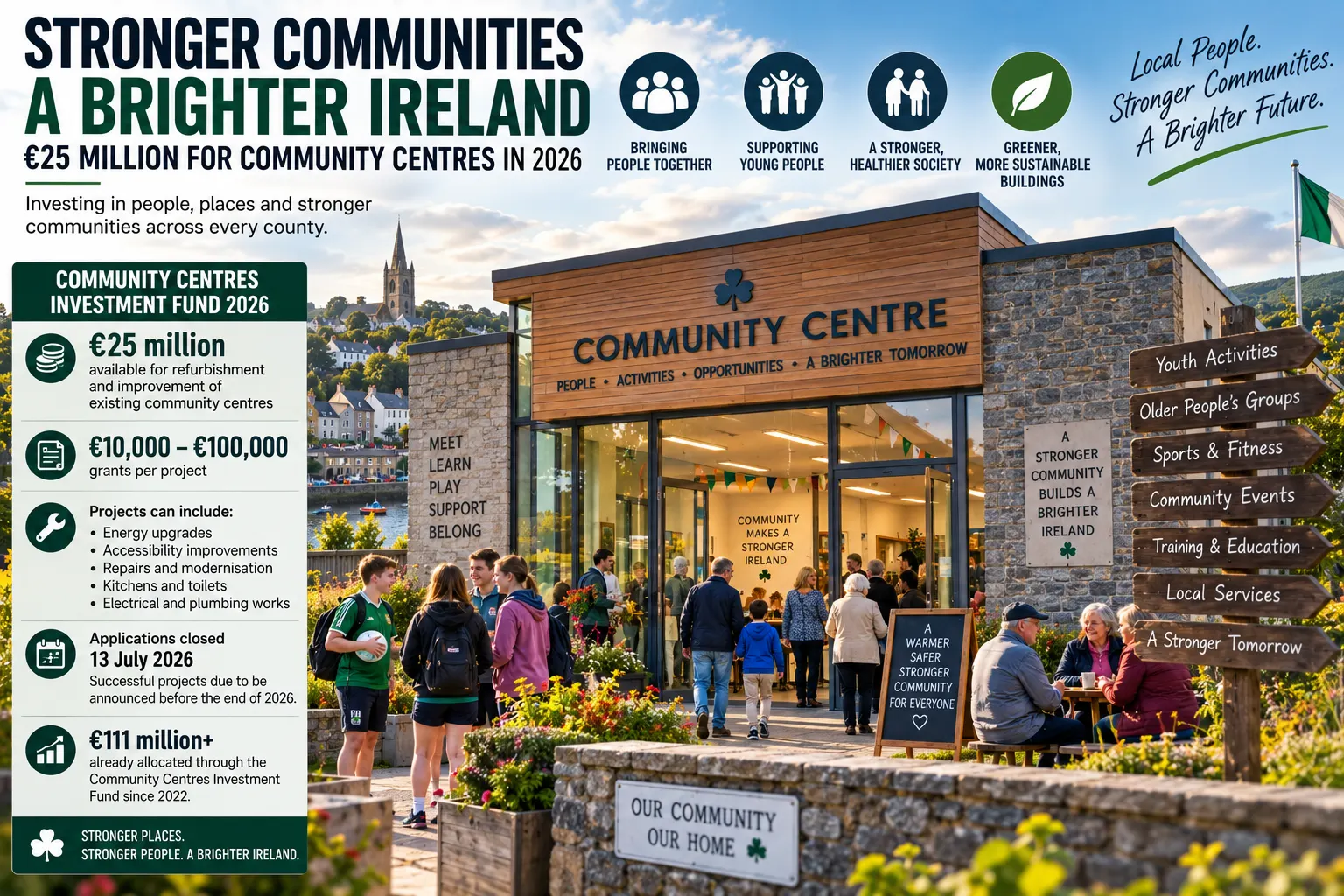
The Community Centres Investment Fund 2026 is not a programme for constructing prestige buildings. It is a capital refurbishment scheme for existing centres in rural and urban areas, offering grants of between €10,000 and €100,000. Applications opened on 29 May and closed on 13 July, with successful projects expected to be announced before the end of 2026. Eligible expenditure includes building renovation, heating and energy-efficiency measures, accessibility improvements, kitchens, bathrooms, electrical and plumbing works, essential repairs and other improvements needed to keep centres usable and safe.
The size of the latest fund makes more sense when viewed against what came before it. Since the dedicated Community Centres Investment Fund was introduced in 2022, more than €80 million has been provided for almost 1,650 refurbishment projects under the 2022 and 2024 rounds, while more than €30 million has been committed to 12 new community centres. By March 2026, the Government put the amount already allocated through the wider programme at approximately €111 million.
That level of public investment does not mean every community centre is in poor condition, nor that the State previously ignored community facilities. Ireland has long supported local buildings through a mixture of local authorities, LEADER, CLÁR, community development programmes, philanthropy, sports funding and local fundraising. What has changed is the recognition that the community centre itself needs a recurring national capital programme rather than being treated mainly as the responsibility of whichever local committee happens to occupy the building.
Community Centres Investment Fund 2026
- €25 million is available for refurbishment and improvement of existing community centres.
- Grants range from €10,000 to €100,000.
- Projects can include energy upgrades, accessibility measures, repairs, kitchens, toilets and building modernisation.
- Applications closed on 13 July 2026, with successful projects due to be announced before the end of the year.
- More than €111 million had already been allocated through the Community Centres Investment Fund before the 2026 round.
Ireland’s Community Centres Were Never a Single Type of Building
There is no standard Irish community centre. Depending on the place, the local social infrastructure may be a purpose-built centre, a parish hall, a former school, a scout hall, a family resource centre, a development association building, a sports clubhouse or a building gradually adapted for several purposes. Some centres have professional employees; others depend heavily on voluntary committees. Some generate income through room hire, childcare, cafés, classes or events, while others serve communities where the ability to raise money locally is much more limited.
This fragmented history is one reason the condition of buildings varies so widely. Many facilities were created incrementally rather than as part of a national construction programme with predictable replacement cycles. A roof might be repaired through fundraising, windows replaced several years later under a grant, and a kitchen upgraded only when another scheme becomes available. The result can be a building that remains heavily used while accumulating expensive work that cannot realistically be financed from weekly hall hire or local fundraising alone.
The first dedicated Community Centres Investment Fund, launched in 2022, exposed the scale of that demand. It was initially presented as a €15 million programme, but more than €45.5 million was ultimately allocated to almost 900 centres. The projects were not confined to cosmetic improvements. Government funding covered extensions, heating systems, energy retrofits, meeting rooms, counselling rooms, disability access, fire-safety work, roofs, rewiring, toilets, kitchens, windows, doors and facilities supporting meals for older people and youth activities.
The following year brought a different problem into focus: some communities did not have a suitable centre to refurbish at all. A new-build measure was therefore created, leading to more than €30 million being allocated for 12 new centres. The distinction matters. Ireland simultaneously has communities trying to preserve ageing facilities and other growing areas where the underlying social infrastructure never developed at the same pace as housing and population.
The 2026 Fund Is Primarily About Making Existing Buildings Work Better
The latest round returns the focus to existing centres. Smaller projects can receive between €10,000 and €25,000, with the State meeting up to 95% of eligible costs. Larger projects can receive between €25,001 and €100,000, with grant support of up to 90%. Applicants therefore still need their own contribution, and larger projects can require substantial local fundraising or reserves even when they secure government assistance.
Community Centres Investment Fund 2026
| Category | Grant | State funding | Minimum match |
|---|---|---|---|
| Category 1 | €10,000–€25,000 | Up to 95% | 5% |
| Category 2 | €25,001–€100,000 | Up to 90% | 10% |
Source: Department of Rural and Community Development and the Gaeltacht, Community Centres Investment Fund 2026.
What the scheme does not provide is equally important. It is a capital fund, not a general subsidy for electricity, heating, insurance, wages or everyday programme costs. A centre may therefore receive public money for insulation, new windows or a modern heating system because those investments reduce future expenditure, but the grant is not designed simply to pay the next electricity bill.
That separation between capital and operating costs explains much of the financial tension surrounding community infrastructure. A functioning centre needs both a sound building and an organisation capable of opening it, heating it, insuring it, cleaning it, scheduling it and supervising activities. Funding one without the other can leave a community with either an ageing building full of activity or a renovated building without sufficient resources to use its potential.
Ireland’s Population Has Changed Faster Than Many Local Facilities
The most fundamental pressure is demographic. Ireland’s usually resident population reached an estimated 5,525,600 in April 2026, an increase of 66,900 in a single year. The country is not merely larger than it was when many community halls were built; it is also older, more diverse and distributed differently between expanding cities, commuter settlements, regional towns and rural communities.
In the six years from 2020 to 2026, the population aged 65 and over increased by 165,000 to 891,100. Older people now represent 16.1% of the population, compared with 14.4% in 2020. At the other end of the age profile, the number of children aged under 15 has fallen below one million, while the population aged 15 to 24 has increased since 2020. These shifts create a more complicated pattern of local demand rather than a simple story of either ageing or youth growth.
Community infrastructure has to adjust accordingly. A building originally designed around evening meetings or occasional social events may now be expected to accommodate daytime activities for retired residents, accessible toilets, mobility needs, exercise classes, meals programmes and health or information sessions, followed later by youth clubs, sporting activities, training, cultural events and committee meetings. Accessibility that once might have been regarded as an optional improvement becomes fundamental when a growing share of the community has mobility limitations.
Ageing also changes the importance of distance. A service located 20 kilometres away may be manageable for somebody with a car and flexible working hours but much less accessible to a person who no longer drives, a household without a second car or somebody dependent on infrequent rural transport. The closer everyday social and community activities can be brought to where people live, the more valuable an existing local building becomes.
Social Isolation Gives Physical Meeting Places a New Importance
The case for community centres is sometimes discussed in vague language about bringing people together, but loneliness data show that social connection is a measurable issue. In the Central Statistics Office’s 2025 well-being survey, 14.6% of people aged 65 and over reported feeling lonely at least some of the time during the previous four weeks. The corresponding figure was 17.2% among people aged 25 to 49, 12.8% among those aged 50 to 64 and 12.4% among people aged 16 to 24.
A community centre cannot solve loneliness in the clinical or individual sense, and it would be misleading to claim that constructing a hall automatically produces social cohesion. What a functioning centre can provide is something more basic: repeated opportunities for contact. A weekly exercise class, cards group, men’s or women’s shed, meal, training course, parent group, drama rehearsal or coffee morning creates a reason to leave the house and a predictable setting in which relationships can develop.
The distinction between a building and what happens inside it is essential. Social infrastructure works only when there are organisations, volunteers, staff and activities capable of using the space. But without affordable physical space, many of those activities become more difficult to organise, particularly in communities where commercial premises are expensive or where alternative venues are limited.
This became particularly visible during and after the Covid-19 period. Restrictions disrupted the routines through which clubs, societies, older people’s groups and voluntary organisations sustained regular contact. The policy response that followed placed renewed emphasis on rebuilding community participation, and the dedicated capital fund announced in 2022 formed part of that broader recognition that local organisations needed usable places in which people could meet again.
Migration Has Expanded the Role of Community Infrastructure
Migration is another important change, but its effect on community centres requires careful interpretation. Immigration does not itself explain why an old roof needs replacement or why a heating system has reached the end of its life. It does, however, increase the number and diversity of people potentially using local facilities and creates additional demand for places where established residents and newcomers can access information, activities and one another.
In the 12 months to April 2026, an estimated 110,600 people immigrated to Ireland and 62,500 emigrated, producing net migration of 48,100. The CSO estimated that 931,000 people living in Ireland in April 2026 were non-Irish citizens, equivalent to 16.8% of the population. Those figures describe a society in which local integration is no longer a specialised issue affecting only a handful of large cities.
The geography matters. Census 2022 already showed large differences between communities: non-Irish citizens represented 21% of residents in Dublin City, 18% in Galway City and 17% in Fingal, while some smaller towns had even higher proportions. Ballyhaunis, Ballymahon and Edgeworthstown were among the towns with particularly large non-Irish populations. This makes integration a local planning issue as much as a national policy question.
Ireland’s current integration approach explicitly places considerable emphasis on local connections. Local Authority Integration Teams, Community Integration Forums, local development companies, sporting organisations and voluntary groups are used to help people navigate services, employment, English-language supports and community participation. Such work needs physical venues, particularly where people require face-to-face information rather than purely digital communication.
That does not mean community centres should become informal substitutes for the immigration system or other statutory services. Their value lies in being neutral, familiar and relatively accessible places where organisations can deliver activities without requiring every programme to maintain its own building. A language conversation group may use a room in the morning, a local older-person service at lunchtime and a youth or sports group in the evening. The same capital asset is therefore used by very different parts of the population.
Government funding has increasingly recognised the connection between population change and community capacity. The Community Recognition Fund was created specifically for areas hosting significant numbers of people arriving from Ukraine and other countries, with €100 million committed across its 2023 and 2024 rounds. Budget 2026 separately provides funding for integration work through social inclusion and community programmes. These programmes are distinct from the Community Centres Investment Fund, but together they illustrate a broader shift: integration policy increasingly depends on what communities are able to deliver locally.
Young People Need Places That Do Not Depend on Spending Money
The case for youth facilities is different from the case for services for older people. Teenagers and young adults are highly mobile in some respects but often have limited access to private space, cars or commercial venues. In smaller towns and rural areas in particular, the choice of somewhere to go after school or in the evening can be narrow. Even in cities, the cost of cafés, entertainment and organised activities can make informal social space inaccessible to some families.
A community centre can provide a comparatively low-cost environment for youth clubs, indoor sport, music, study groups, dance, drama, training and unstructured social activity. Government policy has separately been investing in dedicated recreational spaces for teenagers and in expanding youth services, reflecting recognition that young people need facilities designed around their own patterns of use rather than simply being accommodated when adult activities are finished.
There is also an intergenerational dimension. The same building that hosts a youth group can provide a place for older residents, parent-and-toddler activities, family support, local clubs and community meetings. That shared use can make an expensive asset more economically defensible than a series of narrowly specialised buildings used for only a few hours each week.
For families, community space often becomes the platform on which other services operate. Parenting programmes, childcare-related activities, counselling, information sessions, health promotion, disability supports, educational courses and social groups do not all require a dedicated permanent building. A modern, accessible centre with several usable rooms can make it possible for outside organisations to bring services into a community instead.
Rural Ireland Gives Community Centres an Additional Job
The function of a community centre is not identical in Dublin, Cork, a commuter town and a remote rural parish. The OECD’s 2026 Rural Policy Review of Ireland estimates that about 42.5% of Ireland’s population lives in rural regions and describes significant differences between communities close to urban labour markets and more remote areas. It identifies uneven access to transport, healthcare, childcare, education and other services as continuing rural challenges.
This changes the economics of local buildings. In a large city, a resident may have multiple libraries, sports facilities, cafés, educational providers, health services and public transport connections within a relatively small area. In a rural community, the local hall may be one of relatively few places capable of hosting a public meeting, training programme, visiting service, exercise class or community event without requiring participants to travel considerable distances.
The OECD specifically points to community centres and digital hubs as potential locations for services such as digital-skills support and health outreach. This is important because rural service delivery does not necessarily require every service to maintain a permanent standalone office. A multi-use building can provide the physical point at which different services periodically reach a dispersed population.
That model has advantages, but it also contains a risk. Community infrastructure can complement public services; it should not become the mechanism through which essential statutory responsibilities are quietly transferred to unpaid local volunteers. If a community centre becomes indispensable because several formal services have become more distant, government needs to consider both the building and the people required to deliver activities within it.
The Energy Crisis Exposed How Financially Fragile Some Centres Can Be
The need for refurbishment is not only about the age of buildings. Energy prices transformed poor insulation, old windows and inefficient heating from maintenance problems into operating risks. In 2022, the Government established a separate €10 million Community Support Fund specifically to assist community organisations affected by rising energy costs, allowing support with utilities, insurance and other operating expenses.
That intervention revealed an important weakness in the traditional model. A community centre may perform a valuable social function without having a business model capable of absorbing a sudden increase in electricity or heating costs. Raising room-hire charges can recover some expenditure, but doing so risks excluding exactly the low-income clubs, older residents, youth organisations or voluntary groups that the centre exists to serve.
Energy investment under the Community Centres Investment Fund therefore serves two purposes. Insulation, modern heating, windows, doors and efficient lighting can reduce emissions, but they can also reduce the building’s exposure to future energy-price shocks. For a volunteer-managed centre operating on narrow margins, lower recurring costs may be as important as the environmental benefit.
Accessibility work follows a similar logic. A lift, ramp, accessible bathroom or redesigned entrance may appear to be a building expense, but it determines who can actually use a publicly supported facility. As Ireland ages, the gap between nominally having a community centre and having one that can be used by people with limited mobility becomes increasingly significant.
The Hidden Infrastructure Is the Volunteer Committee
Buildings alone do not run Irish community life. Census 2022 recorded 711,379 people engaged in regular voluntary activity, equivalent to about 14% of the population. More than 226,000 people reported volunteering in their community, while almost 290,000 volunteered through sporting organisations. The scale of that contribution explains how Ireland is able to sustain such a wide range of clubs, halls, events and local services without staffing every activity through the public sector.
It also reveals a vulnerability. The OECD’s 2026 review describes Ireland’s volunteer infrastructure as strong by international standards but warns about heavy reliance on volunteers, recruitment difficulties and the potential for burnout. In some places, the same people sit on several committees, organise fundraising, manage buildings, apply for grants, arrange insurance, deal with tradespeople, meet regulatory requirements and still help deliver the activities that justified the building in the first place.
The Community Centres Investment Fund illustrates both sides of this model. High grant rates mean local groups can undertake work that would otherwise be unaffordable. At the same time, applicants must prepare projects, gather documentation, obtain prices, meet procurement requirements, contribute match funding and ultimately oversee the work. A sophisticated grant scheme can therefore favour organisations that already possess strong administrative capacity unless sufficient technical support is available.
That matters for equality between communities. A prosperous town with experienced volunteers and strong fundraising networks may find it easier to assemble a 10% contribution and prepare a professional application than a disadvantaged area where the centre is heavily used but the volunteer base and household incomes are weaker. Grant design therefore has to consider not only the quality of a proposed project but the ability of different communities to navigate the funding system.
Community Centres Are Increasingly Part of Ireland’s Service Architecture
The expansion of the Community Services Programme, SICAP, Family Resource Centres, youth services, integration programmes, volunteer supports and other locally delivered initiatives is gradually changing what community infrastructure means. Many services are administered nationally but delivered through local organisations. They need somewhere to meet people.
Budget 2026 provides €59.4 million for the Community Services Programme and almost €74 million for SICAP and related social-inclusion supports. Those figures should not be confused with funding for community-centre buildings; they support much wider programmes. Their significance is that Ireland is simultaneously investing in community organisations, locally delivered services and the physical infrastructure through which some of those services operate.
This can create economies of use. A room that is empty for much of the week represents sunk capital. A centre that combines community activities with training, outreach, family services, meals, cultural events, digital access and local meetings can spread fixed costs over many more users. Multi-purpose design is therefore not merely a social ambition; it can improve the economics of the building.
But greater utilisation creates additional wear, administration and supervision. The better a centre succeeds at becoming a local hub, the more pressure it places on toilets, kitchens, heating, parking, cleaning, accessibility, storage, booking systems and volunteers. Success can itself create the next capital requirement.
Why Demand on Community Centres Is Growing
| Change | Latest evidence | Local implication |
|---|---|---|
| Population growth | 5.526 million people in 2026 | More potential users |
| Ageing | 891,100 aged 65+ | Accessibility and local activities |
| Migration | 931,000 non-Irish citizens | Integration and information space |
| Loneliness | 14.6% of over-65s lonely at least sometimes | Need for regular social contact |
| Volunteering | 711,379 regular volunteers in Census 2022 | Strong capacity, but dependence on volunteers |
Sources: Central Statistics Office Population and Migration Estimates 2026, SILC Well-being 2025 and Census 2022 volunteering data.
What a Functioning Centre Changes for Older People
For older residents, the most obvious benefit is proximity. Social activities, meals, exercise classes, information events and local support can be accessed without travelling to a larger town. This can be particularly important for people who have stopped driving or whose mobility is restricted. A warm and accessible building also provides an environment in which voluntary and statutory organisations can reach people who might otherwise have relatively little regular contact outside their homes.
The effect should not be exaggerated. Older people are a diverse population, and the majority are not socially isolated or dependent on community services. But as the number of people over 65 rises, even a stable percentage requiring local support produces a larger absolute population to serve. Infrastructure planning therefore has to anticipate the demographic structure of the 2030s rather than merely respond to present demand.
What It Changes for Children, Teenagers and Families
For families, the value often lies in affordability and flexibility. Community facilities can host activities close to home without requiring each club, support organisation or class to own premises. They also make it possible to run programmes in smaller settlements where a standalone commercial venue would not be viable.
For teenagers, the issue can be even more basic: having somewhere legitimate to be. A well-used youth room or sports hall provides an alternative to either remaining at home or meeting in commercial and outdoor spaces not designed around young people’s needs. The quality of that provision depends on staffing, programmes and how seriously teenagers are involved in designing activities, but the physical space remains the starting point.
The benefits can extend beyond the immediate users. When sports clubs, youth groups and cultural organisations have reliable local facilities, parents may spend less time transporting children long distances and voluntary organisations can build more consistent programmes. These effects are difficult to value on a conventional balance sheet, yet they influence whether a place feels practical for families to live in.
What It Changes for New Arrivals
For somebody newly arrived in Ireland, community participation can provide something that formal administration cannot: local relationships. Sporting organisations, language activities, children’s groups, cultural events, volunteering and ordinary social contact offer ways of becoming part of a place rather than merely residing in it.
Community centres can provide the neutral venue where that interaction occurs, but successful integration requires participation from established residents as well as newcomers. If activities become segmented into separate groups that rarely interact, sharing a building does not automatically create cohesion. The strongest model is therefore one in which some targeted support exists where necessary but facilities remain genuinely shared community assets.
This is also why investment in areas experiencing rapid population change can benefit existing residents. An upgraded hall, playground, kitchen, meeting space or sports facility created partly in response to additional population remains available to the wider community. Ireland’s Community Recognition Fund was explicitly designed around this principle.
And What Happens Where No Suitable Centre Exists?
The consequences of missing community infrastructure are rarely dramatic enough to appear in a single national statistic. Instead, the effects accumulate. A youth club may struggle to find affordable premises. An older-person group may meet less frequently. A visiting service may decide that operating locally is impractical. Voluntary committees may compete for the same room, while families drive to neighbouring towns for activities that could otherwise take place locally.
In rapidly growing settlements, the problem can be particularly visible. Housing can be constructed much faster than the network of clubs, halls, sports facilities and local organisations required to turn a collection of homes into a functioning community. Residents may have schools and shops but relatively few neutral places to meet one another. The 2023 new-build element of the Community Centres Investment Fund was a recognition that refurbishment cannot solve a problem where no appropriate building exists.
In remote rural areas, the absence of a centre can have a different effect because alternative venues and services may already be distant. The OECD’s assessment of uneven rural service access strengthens the case for treating multi-purpose local facilities as part of wider spatial planning rather than simply as optional amenities.
€25 Million Is Significant — but It Does Not Resolve the Funding Model
The 2026 fund will repair and modernise a substantial number of buildings, but the deeper challenge is recurring. Roofs age again, heating systems need replacing, accessibility standards evolve, insurance remains payable and new activities create new requirements. The decision in 2025 to describe the Community Centres Investment Fund as a permanent rolling programme was therefore more significant than any one annual allocation.
A permanent programme acknowledges that community buildings are assets with life-cycle costs. Roads are not expected to be constructed once and maintained indefinitely through bake sales; neither is a public library. Community facilities occupy a more complicated position because many are not State-owned and are run by independent organisations, but the principle is similar: an asset that delivers a continuing public benefit eventually requires reinvestment.
The unresolved question is how responsibilities should be divided. A national capital fund can address major building work. Local authorities can support planning and local development. Community organisations can manage programming and local priorities. Separate programmes can contribute towards employment, inclusion or specific services. But relying on multiple schemes also creates administrative fragmentation, with local committees spending considerable time identifying which programme will fund which part of the same building or service.
The Next Stage Should Be About Capacity, Not Only Construction
If community centres are to carry a larger role over the next decade, Ireland will need to move beyond counting how many buildings receive grants. A more developed approach would ask which areas have no suitable facility, which centres are operating near capacity, which buildings are expensive to heat, which communities lack accessible space and where demographic change is likely to create the greatest additional demand.
Condition surveys and multi-year investment plans could reduce the cycle in which committees wait for a roof, heating system or electrical installation to become urgent before seeking funding. Energy performance could be measured before and after refurbishment, allowing the State to distinguish between projects that simply renew equipment and those that materially reduce running costs. Accessibility could similarly be assessed as part of the entire route through a building rather than through isolated improvements.
Administrative support is equally important. Volunteers managing a six-figure construction project face procurement, insurance, planning, building regulations, financial controls and contractor management that would normally be handled by professionals in a larger organisation. Providing shared technical expertise could improve project quality while reducing the burden on committees.
Operating sustainability also deserves greater attention. A highly efficient renovated centre is still ineffective if there is nobody available to open it, organise activities or administer bookings. In some locations, a modest amount of dependable staffing may produce more value from an existing building than another physical extension. Capital and current expenditure should therefore be planned together even when they continue to be financed through separate programmes.
Not Every Community Needs the Same Model
The future is unlikely to consist of identical community centres distributed according to population. A dense urban neighbourhood may need flexible rooms, youth provision and social-inclusion services but have little space for expansion. A commuter settlement may require evening and weekend capacity because much of its population works elsewhere during the day. A remote rural area may benefit more from combining social space with digital access, visiting services, training and community transport.
That is consistent with the broader direction recommended by the OECD in 2026: more place-sensitive rural policy based on better local evidence rather than treating all rural communities as equivalent. The same argument applies nationally. The question should not simply be how much money each county receives, but what kind of social infrastructure each community requires.
Population growth will make this more important. Even if migration slows from the exceptionally high levels seen in recent years, Ireland already has a substantially larger population than a decade ago. The number of older people will continue to influence demand, and existing buildings will continue to age. Community infrastructure therefore needs to be incorporated into housing and settlement planning before new neighbourhoods are complete, rather than added later when social gaps become obvious.
The Real Value of a Community Centre Is What It Allows to Happen
The strongest argument for the €25 million fund is not that community centres are intrinsically valuable buildings. It is that relatively modest buildings can enable a large amount of activity that would otherwise require multiple premises or not take place locally at all. A renovated kitchen can support meals and events; an accessible entrance can open a centre to people previously excluded; insulation can make winter activities financially viable; an extra meeting room can allow several organisations to operate simultaneously.
That makes community centres a form of social infrastructure. Like physical infrastructure, their value often becomes most visible when they are missing or failing. Unlike a road or water pipe, however, their output depends heavily on human participation. Public investment can provide the building, but local organisations, employees and volunteers create the community inside it.
The challenge for Ireland is to preserve the strengths of that volunteer-led tradition without assuming that goodwill can indefinitely replace predictable finance, professional support and long-term planning. More than 700,000 people already volunteer across Irish society. The objective should be to make their contribution easier and more productive, not to load additional public-service responsibilities onto the same small groups of highly active people.
The 2026 investment is therefore best understood as part of a wider transition. Ireland’s community centres are no longer merely halls that happen to host local activities. In many places they have become the physical junction at which demographic change, ageing, youth provision, integration, volunteering, local services and social connection meet. Keeping that junction functioning costs money because buildings deteriorate, energy costs money, accessibility requires investment and communities themselves are changing.
€25 million will not resolve every one of those pressures, and capital refurbishment alone cannot manufacture social cohesion. But the scale and recurrence of the investment reveal something important about modern Ireland: the places where people meet have become infrastructure in their own right. The next question is not whether community centres deserve maintenance, but how intelligently the country plans, finances and uses them as the population continues to change.
Sources
Department of Rural and Community Development and the Gaeltacht — Community Centres Investment Fund
Central Statistics Office — Population and Migration Estimates, April 2026
Central Statistics Office — Well-being, Survey on Income and Living Conditions 2025
Central Statistics Office — Census 2022 Spotlight Series: Volunteering in Ireland
OECD — Rural Policy Review of Ireland 2026
Department of Rural and Community Development and the Gaeltacht — Community Support Fund
Department of Justice, Home Affairs and Migration — Community Integration
Department of Rural and Community Development and the Gaeltacht — Community Recognition Fund
Source & Transparency
This article is published by Ireland Newspaper for editorial and informational purposes.
Published: 4 September 2026 · Updated: 4 September 2026

Newsroom Ireland Newspaper
Ireland Newspaper editorial team prepares daily news coverage for readers in Ireland and abroad.