
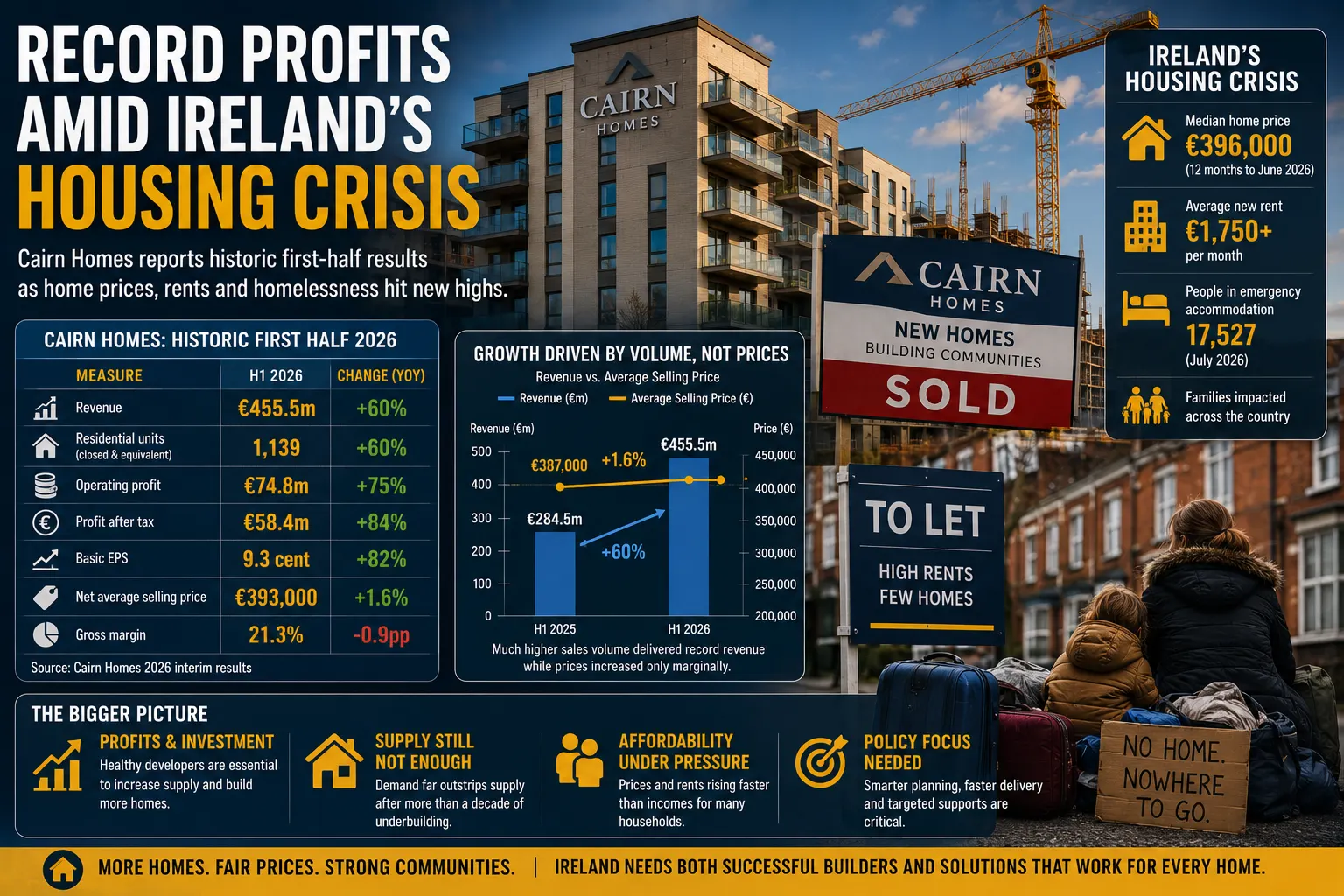
Cairn Homes has produced the strongest first-half financial performance in its history at almost precisely the moment Ireland’s housing shortage remains one of the country’s most serious economic and social problems. Revenue jumped 60 per cent to €455.5 million in the six months to June, operating profit increased 75 per cent to €74.8 million and profit after tax rose 84 per cent to €58.4 million. At the same time, the median Irish home now costs €396,000, new rents average more than €1,750 a month and 17,527 people were living in State-funded emergency accommodation in July.
Placed side by side, the figures create an uncomfortable political contrast: a listed housebuilder is generating record returns while many households cannot afford to buy or rent a home. But the relationship is more complicated than a simple story of corporate profit rising because housing is scarce. Cairn increased its first-half residential output by about 60 per cent, while its average selling price rose by only 1.6 per cent. Its gross profit margin actually declined.
The deeper issue is structural. Ireland needs profitable developers capable of financing land, construction and large projects if housing supply is to increase. Yet a profitable developer can expand rapidly while the wider market remains chronically undersupplied because the gap accumulated over more than a decade is far larger than any individual company can close. Scarcity can consequently coexist with rising construction, strong developer earnings, record public spending and deteriorating affordability.
Cairn’s results therefore provide a useful lens through which to examine Ireland’s housing system. They demonstrate that private homebuilding can be commercially successful and expanding at the same time as the national housing problem remains unresolved. The important questions are not simply whether Cairn earns too much or whether Ireland builds more homes, but whether total supply is increasing quickly enough, whether public support produces additional homes at acceptable cost and whether ordinary incomes can keep pace with the resulting purchase prices and rents.
Cairn’s First Half Was a Record One
The company’s results released on 2 September show a dramatic increase in scale. Revenue reached €455.5 million compared with €284.5 million in the first half of 2025. Residential sales accounted for €448.1 million of that total.
Cairn reported 1,139 closed and equivalent residential units during the six-month period, compared with 708 a year earlier. The company’s definition includes both completed sales and equivalent units recognised under forward-funding contracts, where revenue is recorded progressively as construction advances. The figure therefore should not be treated as directly identical to the CSO’s national dwelling-completion statistic.
Operating profit increased from €42.7 million to €74.8 million, while profit after tax rose from €31.7 million to €58.4 million. Basic earnings per share increased from 5.1 cent to 9.3 cent.
The company also ended June with substantially lower net debt than a year earlier. Net debt stood at €194.5 million, compared with €307.4 million in June 2025, while available liquidity including cash and undrawn facilities was €304.1 million.
Cairn Homes: First Half 2026
| Measure | H1 2026 | Annual Change |
|---|---|---|
| Revenue | €455.5m | +60% |
| Residential units | 1,139 | +60% |
| Operating profit | €74.8m | +75% |
| Profit after tax | €58.4m | +84% |
| Basic EPS | 9.3 cent | +82% |
| Net average selling price | €393,000 | +1.6% |
| Gross margin | 21.3% | -0.9 percentage points |
Source: Cairn Homes 2026 interim results. Residential units include closed and equivalent units under the company’s accounting methodology.
The Profit Increase Was Driven More by Scale Than by Higher Margins
The distinction between price and volume is central to understanding the results. Cairn’s net average selling price rose from €387,000 to €393,000, an increase of 1.6 per cent. Revenue, however, increased by 60 per cent because considerably more housing activity was recognised during the period.
Gross profit increased by 54 per cent to €96.9 million, but the gross margin fell from 22.2 to 21.3 per cent. This is not what would normally be expected if a dramatic increase in profitability were simply the result of extracting a larger margin from each home.
Operating profit rose more rapidly because overhead expenditure did not increase at anything close to the same rate as revenue. Cairn’s operating costs increased by about 7 per cent while revenue increased by 60 per cent. The result is operating leverage: once the management, technology, procurement and organisational platform already exists, additional housing can be delivered without increasing corporate overhead proportionately.
Its operating margin consequently increased from 15.0 to 16.4 per cent even while the gross margin on sales declined. The latest record profit is therefore primarily a story of higher output, sales mix and improved operating efficiency rather than evidence of a sudden increase in the percentage profit embedded in each home.
This matters because strong developer profitability is often interpreted as proof that high house prices are simply the result of excessive margins. Cairn’s own figures do not support such a simple conclusion for the first half of 2026. Profitability increased sharply while the gross margin narrowed.
The €393,000 Average Selling Price Needs Careful Interpretation
Cairn’s reported average selling price of €393,000 is stated net of VAT. It also reflects a changing mixture of houses, apartments, private sales and transactions involving State-funded partners. It is therefore not directly comparable with the €396,000 median price reported by the CSO for residential purchases nationally.
The similarity of the two numbers is striking but largely coincidental. The CSO figure includes both existing and new homes and represents the median transaction price including the characteristics of properties actually sold. Cairn’s figure is an accounting average for its own sales mix and excludes VAT.
There is nevertheless evidence that broader new-home prices remain under upward pressure. The CSO’s index for new dwellings increased by 6.0 per cent in the year to the second quarter of 2026. Existing-home prices increased by 5.9 per cent over the same period.
Cairn argues that keeping its own average selling-price increase to 1.6 per cent demonstrates the benefit of scale, standardisation and procurement efficiency. That may be relevant, but average selling prices are affected by the types and locations of homes sold. They cannot substitute for a like-for-like price index.
Ireland’s Housing Prices Are Still Rising Faster Than Supply Can Normalise the Market
National residential property prices were 5.6 per cent higher in June than a year earlier. Dublin prices increased by 4.6 per cent, while prices outside the capital rose by 6.4 per cent.
The median transaction price during the twelve months to June reached €396,000. In Dublin it was €500,000. Dún Laoghaire-Rathdown recorded a median of €682,334, while Wicklow stood at €475,000 and Kildare at approximately €450,000.
The national property-price index is now 26.5 per cent above its April 2007 peak and 182 per cent above its post-crisis trough. This comparison requires context because incomes, population and the quality and composition of housing have also changed. Even so, it illustrates how far the market has moved from the collapse that followed the financial crisis.
For a household attempting to buy its first home, affordability depends on the relationship between income, mortgage capacity and the purchase price rather than the percentage change in the housing index alone. A market can have slowing house-price inflation while still being extremely unaffordable if the starting price is already high.
Ireland’s Housing Pressure in 2026
| Indicator | Latest Figure | Reference Period |
|---|---|---|
| National median dwelling price | €396,000 | 12 months to June 2026 |
| Dublin median dwelling price | €500,000 | 12 months to June 2026 |
| Annual property-price growth | 5.6% | June 2026 |
| Average new-tenancy rent | €1,755/month | Q4 2025 |
| People in emergency accommodation | 17,527 | July 2026 |
| Children in emergency accommodation | 5,659 | July 2026 |
| Estimated population | 5.526m | April 2026 |
Sources: Central Statistics Office, Residential Tenancies Board and Department of Housing.
Renters Face an Even More Immediate Affordability Problem
The latest Residential Tenancies Board figures show a standardised average monthly rent of €1,755 for new tenancies in the fourth quarter of 2025, 5 per cent higher than a year earlier. Existing tenancies averaged €1,503.
The €252 monthly difference between existing and new tenancies highlights one of the distortions created by a market with limited available supply. A household that has to move can face a significant increase even before differences in property size, location and quality are considered.
Rent pressure matters to the ownership market because high rent makes saving for a deposit more difficult. A household paying close to €2,000 each month for accommodation may have sufficient income to service a mortgage but still struggle to accumulate the cash needed to purchase a home.
This helps explain why first-time buyers increasingly use State supports. The First Home Scheme reported that the average property purchased or built with its assistance cost approximately €392,000 by the second quarter of 2026. Average equity support was approximately €67,000, equivalent to about 17 per cent of the purchase or construction price.
Around two thirds of scheme users were also using the Help to Buy programme. For many purchasers, the modern route into a new-build property therefore combines personal savings, mortgage debt and one or more forms of public assistance.
First-Time Buyers Have Become Central to Cairn’s Growth
Cairn identifies first-time buyers as its core private customer group and says sales to this market increased significantly during the first half. Eight new private developments were launched in the period, contributing to a private sales rate of 3.7 homes a week for each active selling development.
Earlier this year, chief executive Michael Stanley said first-time buyers using Government supports represented roughly half of the company’s customer base. The precise mix can change from period to period, but the relationship between State affordability schemes and private developers has clearly become economically important.
This should not automatically be interpreted negatively. A purchaser whose income falls short of the mortgage required for a €390,000 home may be able to buy only because the State bridges part of the financing gap. Without that assistance, the household may remain in the rental sector.
The more difficult economic question is what happens when buyer support is introduced into a market in which supply cannot expand quickly. Additional purchasing capacity can help the individual recipient while simultaneously maintaining strong aggregate demand. Whether and how much such support is reflected in prices is difficult to isolate from other forces including population growth, wages, mortgage conditions, land values and construction costs.
There is insufficient evidence to attribute today’s new-home prices to any single support scheme. The broader lesson is that demand assistance works most effectively when accompanied by rapid expansion of supply. Otherwise, policy can improve access for supported households without making the market itself materially cheaper.
The State Is Increasingly Both Customer and Market Maker
Cairn is no longer operating solely as a builder selling houses directly to private households. Local authorities, Approved Housing Bodies and the Land Development Agency form an increasingly important part of Ireland’s housing-delivery system.
The company says social, cost-rental and affordable-purchase housing delivered to State-funded partners is a core element of its strategy. It was active on five forward-funded projects during the first half of 2026.
Forward funding changes the economics of development. Instead of a builder financing an entire project and waiting until completion to receive payment, land can be sold and construction payments made progressively as work proceeds. This reduces financing exposure and can allow large projects to proceed more quickly.
The model can benefit the State because it obtains housing without having to create the entire development capability internally. It benefits the developer because part of the sales and funding risk is reduced.
This relationship also creates a legitimate public-policy question about value for money. Where taxpayers provide land, infrastructure, buyer assistance, forward funding or direct purchase commitments, transparency around costs, sale prices and the additional housing created becomes particularly important.
Croí Cónaithe Is Helping Cairn Reopen the Apartment Market
Apartments are one of Ireland’s most difficult housing types economically because urban development typically involves expensive land, complex planning, underground parking, lifts, fire-safety systems and long construction periods before units can be occupied.
Cairn says the Government’s Croí Cónaithe Cities scheme is widening the pool of owner-occupiers able to purchase apartments. It has launched several developments under the programme and reported more than 350 apartments agreed for sale through three approved developments by the time of its interim results.
More than 200 of those agreements were at Exchange Square in Seven Mills in Dublin 22 after its June launch. The programme is intended to bridge part of the viability gap between apartment construction costs and prices that owner-occupiers can reasonably pay.
This intervention is particularly relevant because Ireland’s apartment output weakened in the most recent quarter. The CSO recorded 2,658 apartment completions in the second quarter, 12.2 per cent fewer than a year earlier.
Dublin, where apartments are most important, recorded a 16.4 per cent decline in total dwelling completions during the quarter. Almost three quarters of the country’s apartments were nevertheless completed in Dublin.
National Housing Output Has Improved Enormously Since Cairn Was Founded
Cairn’s history begins in the aftermath of Ireland’s property crash. The company commenced construction at Parkside in north Dublin in January 2015 and floated on the London Stock Exchange in June that year, raising hundreds of millions of euros in equity.
Housing construction at the time was extraordinarily weak. The CSO’s current new-dwelling series records only 7,219 completions nationally during 2015. Ireland had experienced a collapse in building activity after the financial crisis, while many established developers were financially impaired or had disappeared.
Cairn used public equity markets to create a new large-scale homebuilder during this period. In late 2015 it acquired the Project Clear residential loan portfolio from Royal Bank of Scotland for €378 million. The portfolio contained 20 residential sites with the potential to support approximately 12,500 homes.
The timing gave the company access to land during an unusual period in Ireland’s property cycle. Land and development assets had been repriced heavily after the crash and large portfolios were being sold by banks and distressed owners.
That does not mean today’s profits can simply be attributed to inexpensive post-crisis land. Cairn has continued buying sites, investing in infrastructure and expanding its land portfolio over the subsequent decade. It does mean the company’s emergence cannot be separated from the extraordinary restructuring of Irish property and banking that followed 2008.
The Housing Crash Destroyed Supply Capacity That Took Years to Rebuild
Ireland’s current shortage did not originate in 2026. Residential construction collapsed after the banking and property crisis. Developers failed, building workers left the industry, lending disappeared and banks became reluctant to finance speculative residential development.
The consequences lasted much longer than the recession itself. When population and employment began growing rapidly again, the construction industry’s capacity to deliver housing could not expand at the same speed.
Annual new-dwelling completions rose from fewer than 5,000 in 2013 to 7,219 in 2015, almost 10,000 in 2016 and more than 21,000 by 2019. The pandemic then interrupted construction, while material-price inflation, planning delays and higher interest rates created additional obstacles.
By 2025 output had reached 36,284 homes, the highest annual level since the current CSO completion series began in 2011. That represented an increase of more than 20 per cent from 2024.
The recovery is substantial. The problem is that demand increased during the same period and Ireland carried an accumulated shortage into the recovery.
Ireland’s Housing-Supply Recovery
| Year | New Dwelling Completions | Context |
|---|---|---|
| 2013 | 4,575 | Post-crisis trough |
| 2015 | 7,219 | Cairn begins building |
| 2019 | About 21,100 | Pre-pandemic recovery |
| 2024 | About 30,000 | Supply temporarily declines |
| 2025 | 36,284 | Record in current CSO series |
| H1 2026 | 16,679 | About 11% above H1 2025 |
Source: Central Statistics Office. Historical figures can be revised as methodologies and source data are updated.
The Second Quarter Shows Why One Strong Year Is Not Enough
The first half of 2026 demonstrates the uneven nature of the recovery. The first quarter was extremely strong, with 7,856 completions, 32.9 per cent more than a year earlier. The second quarter moved in the opposite direction.
There were 8,823 completions between April and June, 3.6 per cent fewer than during the same quarter of 2025. Scheme houses increased by 2 per cent, but apartments fell by 12.2 per cent and single dwellings by 3.7 per cent.
Combining both quarters gives 16,679 new homes in the first half, still around 11 per cent above the same period of 2025. The national direction is therefore positive, but the quarterly decline shows that the path towards 50,000 or 60,000 annual completions will not necessarily be smooth.
Cairn’s own performance was considerably stronger during the period, with its reported units increasing 60 per cent. This demonstrates that a large developer can gain output and market share even while parts of the wider industry stagnate or contract.
That is commercially positive for Cairn and potentially useful for national supply. It also illustrates Ireland’s increasing dependence on a relatively small number of large organisations capable of delivering multi-hundred-unit schemes.
Ireland Is Trying to Close a Housing Deficit Measured in Hundreds of Thousands
The Housing Commission estimated in 2024 that Ireland already had an underlying deficit of between 212,500 and 256,000 homes at the time of the 2022 Census. The calculation was not an estimate of people literally waiting for newly built houses; it sought to quantify the gap between the housing stock and the level that would be expected in a normally functioning system.
The Commission linked the deficit to exceptionally low construction in the decade following the financial crash, suppressed household formation and poor availability in both rental and ownership markets.
The estimate is now several years old and cannot simply be subtracted from subsequent housing completions because new demand is continuously being created by population growth, household formation and replacement of obsolete stock. It remains useful as an indication of how large the inherited shortage had become.
Ireland’s population reached an estimated 5.526 million in April 2026, increasing by 66,900 in one year. Net migration accounted for 48,100 of that increase, while natural population growth added almost another 19,000 people.
Population growth does not translate one-for-one into housing requirements because people live in households of different sizes. But adding tens of thousands of residents annually to a market that already has a substantial deficit means building merely enough homes for current population growth is not sufficient to restore balance.
The central problem is accumulated undersupply. Ireland can increase housing output every year and still experience high prices if the number of homes being added is insufficient to meet new demand while simultaneously reducing the housing deficit built up since the financial crisis.
The Government Now Wants More Than 300,000 Homes by 2030
The current national plan, Delivering Homes, Building Communities, targets more than 300,000 new homes by the end of 2030. It includes 72,000 social homes and 90,000 affordable-housing supports and is backed by major expenditure on housing and enabling infrastructure.
The Government had previously established a trajectory averaging approximately 50,500 homes annually and reaching 60,000 homes a year by 2030. These figures reflect a recognition that the earlier housing targets were no longer high enough for Ireland’s population and accumulated shortage.
Actual output in 2025 was 36,284 homes. That was a record for the current statistical series but still considerably below the annual average implied by the new programme.
A simple arithmetic exercise illustrates the scale of acceleration required. If exactly 300,000 homes were to be delivered between 2025 and 2030 and all 36,284 completions in 2025 counted towards that total, at least another 263,716 homes would be required over the remaining five years.
That would mean an average of approximately 52,700 homes annually from 2026 through 2030. Because the Government’s objective is stated as more than 300,000, the true requirement would be slightly higher.
The Scale-Up Required to Reach 300,000 Homes
| Measure | Homes | Meaning |
|---|---|---|
| 2025 completions | 36,284 | Actual CSO output |
| Six-year minimum target | 300,000 | 2025–2030 |
| Minimum remaining after 2025 | 263,716 | Illustrative arithmetic |
| Required annual average, 2026–2030 | About 52,700 | Illustrative minimum |
| 2030 policy trajectory | 60,000/year | Government objective |
Sources: Government housing plan and CSO. The remaining requirement is an Ireland Newspaper arithmetic illustration, not a separate Government forecast.
Cairn Can Become Much Larger Without Solving the National Problem
Cairn expects to deliver approximately 6,000 new homes across 2026 and 2027, including around 3,200 in 2027. Its forward order book has already reached 5,020 homes worth €1.89 billion net of VAT, extending into 2028.
The company now operates across 30 active developments and has a wholly owned landbank capable of supporting approximately 18,000 units. Nearly three quarters of that landbank either has effective full planning permission or is within the planning process.
Six new sites commenced during 2026 before the interim results and are expected to deliver more than 2,500 homes. Another four commencements representing approximately 950 homes are planned before year-end.
These are substantial figures for one company. They are also small relative to a national requirement moving towards 50,000 to 60,000 homes each year.
This is why Cairn’s growing profitability and Ireland’s continuing shortage are not mutually exclusive. Even if Cairn performs exactly as planned, the housing system remains dependent on thousands of homes from Glenveagh and other private developers, local authorities, the Land Development Agency, Approved Housing Bodies, self-builders and smaller construction companies.
No listed developer, regardless of profitability, has sufficient scale to close a national housing deficit measured in hundreds of thousands of units.
A €50 Million Share Buyback Makes the Political Contrast More Visible
Cairn’s board used the interim results to announce a new €50 million share-buyback programme. It also increased the interim dividend by 10 per cent to 4.5 cent per share and raised its forecast return on equity for 2026 to approximately 17 per cent.
The company had already paid €36.8 million to shareholders in May through its final 2025 dividend. During 2025 as a whole, total shareholder returns amounted to €54.7 million, primarily dividends. The previous year had included more than €70 million of share repurchases alongside dividends.
In social terms, the juxtaposition is inevitably striking. Fifty million euros will now be used to buy and cancel or hold company shares at a time when homelessness is at record levels and public authorities are spending billions trying to increase housing supply.
But a share buyback is not equivalent to withdrawing €50 million from a construction site. Cairn says its balance sheet has enough capacity both to fund growth and to return excess capital to shareholders. At the end of June it had more than €300 million of available liquidity, substantial construction work in progress and committed banking facilities.
Deploying another €50 million into housing would also require suitable land, planning permission, infrastructure, contractors and sufficient projects capable of producing an acceptable return. Capital is an essential constraint in development, but it is not the only one.
The legitimate public question is consequently narrower: when the State increasingly relies on private developers and supports both buyers and projects with public resources, what level of private return is required to maintain investment, and how should policymakers ensure that taxpayer support increases supply rather than simply improving private returns?
High Profits Are Not Necessarily Evidence That the Housing System Is Working Badly
Housing development is capital intensive and risky. Land may be purchased years before a sale occurs. Planning can be delayed, construction prices can change, interest rates can rise and a project can be exposed to market conditions long before the final buyer appears.
Investors will generally provide capital only if expected returns compensate them for those risks. If Ireland made residential development structurally unprofitable, private housing output would be more likely to fall than rise.
The existence of profit is therefore not in itself evidence of policy failure. Indeed, the Government’s own housing strategy explicitly requires major private investment because State entities cannot finance and build the entire national requirement alone.
The more difficult issue is the source of profit. High earnings generated because a company has become more efficient and delivers substantially more homes are economically different from earnings generated mainly through increasing prices in a fixed-supply market.
Cairn’s first-half figures point strongly towards the former mechanism. Output and revenue rose 60 per cent, operating costs increased only 7 per cent and the gross margin fell. That does not remove the affordability problem, but it changes the appropriate interpretation of the profit number.
Scarcity Still Creates a Powerful Commercial Environment
None of this means Cairn operates independently of the shortage. The company itself repeatedly describes demand for new housing as exceptional and Ireland’s structural undersupply as acute.
A developer operating in a market where demand greatly exceeds supply enjoys lower sales risk than one operating in a balanced or oversupplied market. Homes can be reserved rapidly, forward order books become larger and expensive completed inventory is less likely to remain unsold.
Cairn’s order book of more than 5,000 homes provides unusually strong visibility over future revenue. The company reported average private sales of 3.7 new homes per active selling site each week.
Scarcity therefore contributes to the commercial environment even when individual selling prices are being constrained. A builder does not need to increase prices aggressively if nearly everything it can produce has a buyer.
This is one reason a housing crisis can be highly profitable for efficient suppliers without implying that those suppliers created the crisis. The shortage reduces commercial demand risk while years of underbuilding create opportunities for companies capable of scaling production.
Cairn’s Landbank Is Both an Asset and a Supply Pipeline
At the end of June, Cairn’s wholly owned landbank represented approximately 18,000 potential homes. High-density sites accounted for around 6,800 units at an average historic site cost of approximately €47,000 per unit, while low-density housing sites represented roughly 11,200 units at around €31,000 per unit.
The word historic is important. These are accounting cost measures accumulated over multiple years rather than today’s market price for equivalent land.
A large landbank gives a developer the ability to plan activity several years ahead and reduces reliance on buying land immediately before construction. It also requires large quantities of capital and carries planning and market risk.
From a national housing perspective, owning land is not the same as delivering homes. Sites require planning, water, wastewater capacity, roads, electricity, schools and other infrastructure before large developments can function.
The Government’s current strategy increasingly recognises this problem. Tens of billions of euros of planned expenditure are aimed not just at constructing individual houses but at water, transport and energy infrastructure capable of unlocking entire areas for residential development.
Infrastructure Has Become One of the Critical Bottlenecks
During the earlier stages of the housing crisis, discussion frequently concentrated on planning permission and development finance. Both remain important, but infrastructure has become increasingly central.
A site with planning potential cannot accommodate thousands of residents without wastewater treatment capacity. A major suburban development requires road or public-transport connections. New electricity demand must be incorporated into the grid.
These investments involve institutions far beyond individual developers. Uisce Éireann, local authorities, transport agencies, energy networks and central government all influence how quickly land can become actual housing.
The result is a housing system in which private developer productivity can improve markedly without the national output number increasing at the same pace. One bottleneck can move only for another to become more important.
Construction Labour Has Recovered but Skills Still Matter
Another constraint is the workforce. Almost 196,000 people were employed in construction in the first quarter of 2026, substantially more than a year earlier. Yet rapid expansion towards 50,000 or 60,000 homes annually requires additional tradespeople as well as productivity improvements.
Cairn has attempted to address this through scale, standardisation, modern construction methods and its apprenticeship programme. Nearly 350 apprentices were either active or qualified through the programme by the interim reporting date.
The company has also opened an internal innovation hub at Seven Mills, intended to improve design standardisation, procurement and construction speed.
These initiatives matter because Ireland cannot solve its housing shortage merely by employing proportionately more people every time output rises. Labour is already competing with infrastructure, commercial construction, retrofitting and other sectors. Higher productivity per worker will increasingly determine how far housing output can expand.
The First Home Scheme Reveals the Affordability Gap Directly
The First Home Scheme is perhaps the clearest numerical demonstration of how far house prices and mortgage capacity have diverged for some households. The average assisted property cost approximately €392,000 in the latest quarterly update, while average State equity support was about €67,000.
In other words, the average participant required the State to bridge roughly 17 per cent of the purchase or build cost after considering the buyer’s own mortgage and deposit arrangements.
The scheme is designed precisely for households that are capable of sustaining home ownership but cannot obtain enough conventional mortgage finance to bridge the full price. The State becomes an equity participant and can later recover a proportionate share when its interest is redeemed.
This allows purchases that otherwise would not occur. It also demonstrates that affordability cannot be measured by asking whether homes are selling. A market can have exceptionally strong sales while purchasers need increasingly complex financial structures to participate.
For developers, such schemes increase the number of households able to complete purchases. For policymakers, their long-term success depends partly on whether housing supply expands sufficiently that permanent dependence on equity assistance does not become a normal prerequisite for home ownership.
Homelessness Shows the Crisis Is Not Confined to First-Time Buyers
The most severe housing pressure is experienced far below the new-build purchase market. Official figures recorded 17,527 people in emergency accommodation during the final full week of July, including 5,659 children.
The number increased again from June and remained significantly higher than a year earlier. These statistics exclude several categories of hidden homelessness, including people staying temporarily with family or friends and some forms of accommodation outside the official local-authority system.
Corporate homebuilder profits have no simple direct relationship with emergency homelessness. People entering emergency accommodation are frequently affected by rental supply, income, family circumstances and the availability of social housing rather than the purchase price of a newly built Cairn home.
The two nevertheless form parts of the same national housing system. Insufficient private rental supply increases rents. High rents can increase demand for social support. A shortage of social housing can extend stays in emergency accommodation. Limited home ownership can keep higher-income households in rented properties that would otherwise become available to others.
Additional supply can therefore transmit through multiple tenures over time even when the newly constructed home is not occupied by somebody who was previously homeless.
The Public and Private Sectors Have Become Increasingly Interdependent
Ireland’s housing debate is often framed as a choice between State construction and private developers. The reality in 2026 is increasingly hybrid.
The Land Development Agency can own land and commission private contractors. Local authorities can purchase homes built by private developers. Approved Housing Bodies can use State-backed funding to acquire or forward-fund housing. Private first-time buyers can combine mortgages with public equity assistance.
Cairn itself can build one development containing private homes, affordable purchase units, social housing and cost-rental accommodation funded through different mechanisms.
This interdependence can produce scale more quickly than attempting to create completely separate systems. It also makes it harder to identify where public intervention ends and the private housing market begins.
The appropriate measure of success is therefore not simply how many homes are classified as public or private. It is how many additional homes are produced, how quickly they are delivered, what they cost over their lifetime and whether the resulting rents or purchase prices are affordable to the households for whom they are intended.
Cairn’s Profitability Makes It Easier to Finance the Next Wave of Housing
A financially strong developer can invest through downturns, secure construction materials under longer contracts and fund planning work years before revenue is generated. This is one reason profitability can contribute positively to future supply.
Cairn invested €385.6 million in construction work in progress during the first half before releases associated with sales. Its net work-in-progress investment increased by €69.1 million to €482.9 million.
The company says procurement is already largely secured for its live 2026 developments and around half completed for 2027. That provides greater certainty over construction costs at a time when global energy and materials prices remain volatile.
Build-cost inflation is expected to be approximately 2.5 per cent for 2026. That remains a cost pressure but is considerably lower than the extreme material inflation experienced earlier in the decade.
Strong retained earnings, access to bank finance and a large forward order book can therefore support future output. The counterargument is that capital returned through buybacks is capital no longer retained within the company. Cairn’s board believes it can do both because its recent investment has reduced the amount of capital required for each additional unit of output.
The €50 Million Buyback Should Be Judged Against Capital Requirements, Not Emotion Alone
It is reasonable for the public to question a large capital distribution from a company operating inside a national emergency. But determining whether the buyback is economically harmful requires asking what alternative investment opportunities actually exist inside Cairn.
If the company has profitable, permitted projects capable of being accelerated by another €50 million, returning that capital could limit output. If development activity is already constrained by planning, infrastructure or project sequencing, retaining cash may simply enlarge the company’s balance sheet without producing additional housing.
Share buybacks can also reduce the number of shares outstanding and raise earnings per share for remaining investors. They are consequently a deliberate mechanism for transferring excess corporate capital to shareholders.
Cairn’s decision sends a clear financial message: management believes the company can finance its growth plans while simultaneously returning substantial capital.
The public-policy response should not be to assume that all profitable housebuilders must retain every euro. It should be to ensure that national conditions allow viable private capital to move quickly into additional housing rather than being constrained by systems outside the developer’s control.
A Profitable Industry Is Necessary — a Permanently Scarce Industry Is Not
There is an important distinction between allowing housing construction to be profitable and designing a housing system that requires scarcity to sustain profitability.
In a functioning market, developers should be able to earn acceptable returns while competing to increase supply. As production expands towards demand, extreme scarcity premiums should gradually diminish and affordability should improve relative to incomes.
If high profits depend primarily on continuous shortage, the incentives become more problematic. But Cairn’s latest results provide evidence that scale itself can generate returns: operating efficiency improved while gross margin declined.
This suggests that expanding output and maintaining profitability do not necessarily conflict. A developer can make more money by building more homes rather than by making dramatically more money on each home.
That is precisely the model Ireland needs if private-sector participation is to remain central to the housing strategy.
The Bigger Risk Is That Supply Growth Stalls Before Affordability Improves
The trajectory towards 2030 requires several years of uninterrupted expansion. One strong year followed by stagnation will not be enough to reduce the accumulated deficit.
Interest rates remain a risk. Higher borrowing costs affect developers, institutional investors and homebuyers. Energy prices can raise transport and material costs. Global trade disruption can affect construction products.
Planning reform must also translate from legislation into faster decisions and actual sites. Infrastructure spending must produce connections rather than simply larger budgets. Construction firms need enough skilled labour to increase output without creating another surge in wages and building costs.
Demand is unlikely to disappear. Ireland’s population is already above 5.5 million, employment remains high and migration continues to support population growth.
The danger is therefore not that Cairn cannot sell 3,200 homes in 2027. The greater risk is that the rest of the housing system cannot increase output sufficiently around it.
What Would Genuine Improvement Look Like?
A housing recovery should eventually appear in more than one statistic. Completions would consistently move beyond 40,000 and towards 50,000 or 60,000 annually. Apartment delivery would expand rather than fluctuate sharply from quarter to quarter.
House-price growth would begin running below household-income growth for a sustained period. This would improve affordability gradually without requiring a property crash.
New rents would stabilise relative to earnings, reducing the penalty paid by households forced to move. Emergency-accommodation numbers would begin falling rather than setting new records.
First-time buyers would increasingly be able to purchase through ordinary deposits and mortgages without requiring unusually large equity interventions. Public housing expenditure would shift gradually away from emergency accommodation and towards durable housing assets.
Developer profitability could remain healthy throughout such a transition. Indeed, sustained high-volume construction could allow efficient builders to maintain earnings even if price inflation moderates substantially.
Four Housing Paths Are Possible Through 2030
The first and most favourable path is a genuine supply breakthrough. Infrastructure investment, planning reform, State delivery and private development reinforce each other. National output moves above 50,000 homes annually and eventually approaches 60,000. Prices continue increasing more slowly than incomes and rental pressure gradually eases.
A second path is continued high-profit scarcity. Large builders such as Cairn increase output but total national supply remains below underlying demand. Developers with scale perform strongly, public support expands and buyers remain dependent on subsidies while affordability improves only marginally.
A third possibility is a construction slowdown caused by finance or cost pressures. Higher interest rates, energy prices or infrastructure constraints reduce the viability of projects. Housing output stalls, prices remain high because existing supply is still scarce and political pressure intensifies.
A fourth path is a progressively more State-anchored market. The Government, Land Development Agency, local authorities and Approved Housing Bodies increasingly guarantee demand and funding, while private companies become large-scale delivery partners. This could provide stability and output but would require rigorous controls to ensure long-term value for taxpayers.
Possible Housing-Market Paths to 2030
| Scenario | Supply | Affordability |
|---|---|---|
| Supply breakthrough | 50,000–60,000+ annually | Gradual improvement |
| High-profit scarcity | Rises but remains insufficient | Little improvement |
| Construction slowdown | Stalls or falls | Further pressure |
| State-anchored expansion | Public-private output rises | Depends on pricing and targeting |
Ireland Newspaper scenario analysis. These are plausible outcomes rather than official forecasts.
The Cairn Story Is Also a Story About How Ireland Rebuilt Its Construction Industry
When Cairn entered the market in 2015, Ireland was still emerging from one of the most destructive housing and banking collapses in its history. Annual residential construction had fallen to a fraction of Celtic Tiger levels and the development industry was severely undercapitalised.
A publicly listed builder able to raise hundreds of millions of euros provided one answer to that problem. Over its first decade Cairn says it delivered more than 12,000 homes. It now has sufficient land, planning activity and financial capacity to increase annual output further.
Seen from that perspective, strong profitability is partly evidence that Ireland succeeded in recreating investable large-scale homebuilding after the financial crash.
But rebuilding the development industry did not automatically rebuild housing affordability. The period in which construction recovered was also one of strong employment, population growth, migration and increasing household demand. Supply began the race far behind.
Record Builder Profits and a Housing Crisis Can Exist at the Same Time
Cairn’s record first-half results will inevitably attract criticism because housing is not an ordinary consumer product. A home is a basic social need as well as a financial asset, and the consequences of shortage extend far beyond conventional market inconvenience.
Yet describing the company’s profit as the cause of Ireland’s affordability crisis would confuse correlation with causation. The crisis predates Cairn’s current profitability and has roots in the collapse of post-2008 construction, planning and infrastructure constraints, population growth, financing conditions and years in which new supply failed to match underlying requirements.
Equally, strong housing-company results should not be treated as proof that the market is functioning successfully. A business can perform extremely well precisely because demand is exceptionally strong and supply remains scarce.
The appropriate test is whether the company’s expanding scale contributes to the transition away from scarcity. Cairn’s output growth of approximately 60 per cent during the first half is therefore at least as important as its 84 per cent profit increase.
The Most Important Number Is Not €58 Million of Profit
For Ireland, the decisive figures over the coming years will be national housing completions, rents, prices relative to incomes and the number of households in emergency accommodation.
Cairn can deliver 3,200 homes in 2027 and still leave Ireland dramatically short of its requirements. Conversely, forcing Cairn’s profit lower without increasing national output would provide little benefit to a household searching for somewhere to live.
The objective should be a system in which developers compete aggressively to build more homes, strong companies can earn sustainable returns and increasing supply gradually limits the price pressure produced by scarcity.
That requires something more difficult than choosing between public and private housing. It requires planning, finance, infrastructure, labour, land and State support to operate at sufficient scale simultaneously.
The Real Test Begins Now
Cairn has entered the second half of 2026 with a record €1.89 billion closed and forward order book, more than 5,000 homes already sold or agreed for future sale and upgraded full-year guidance. It now expects revenue of approximately €1.08 billion and operating profit of about €185 million for the year.
The company therefore appears positioned for another record financial period. Whether Ireland experiences an equally convincing housing improvement is much less certain.
The first half delivered 16,679 homes nationally, the strongest first-half output in the current statistical series, but the second quarter weakened and apartment completions fell. Prices continue increasing, rents remain high and emergency accommodation contains more than 17,500 people.
This is the housing paradox Ireland has yet to resolve. The country has more construction workers, more State funding, more large developers, more housing completions and more public support for buyers than it did a decade ago. Yet the accumulated shortage is so large that many households still experience the market primarily through scarcity.
Cairn Homes’ record profits are therefore neither proof of corporate wrongdoing nor evidence that housing policy has succeeded. They show that large-scale homebuilding in Ireland can now be commercially attractive and increasingly productive. The challenge for the State is to ensure that this commercial strength is translated into enough total supply to change the experience of the wider population.
If that occurs, profitable housebuilders and improving affordability need not be opposites. If it does not, Ireland may continue producing record developer earnings, record public housing budgets and record levels of construction while families still struggle to find a home they can afford. That would be the clearest sign that higher output alone has not yet become a functioning housing system.
Sources
Cairn Homes — 2026 Interim Results, 2 September 2026
Cairn Homes — Investor Relations
Cairn Homes — Annual Report 2025
Central Statistics Office — New Dwelling Completions Q2 2026
Central Statistics Office — New Dwelling Completions Q1 2026
Central Statistics Office — New Dwelling Completions 2025
Central Statistics Office — Residential Property Price Index, June 2026
Central Statistics Office — Population and Migration Estimates, April 2026
Residential Tenancies Board — Quarterly Update, May 2026
Department of Housing — Homelessness Report, July 2026
Government of Ireland — Delivering Homes, Building Communities 2025–2030
Source & Transparency
This article is published by Ireland Newspaper for editorial and informational purposes.
Published: 2 September 2026 · Updated: 2 September 2026

Newsroom Ireland Newspaper
Ireland Newspaper editorial team prepares daily news coverage for readers in Ireland and abroad.