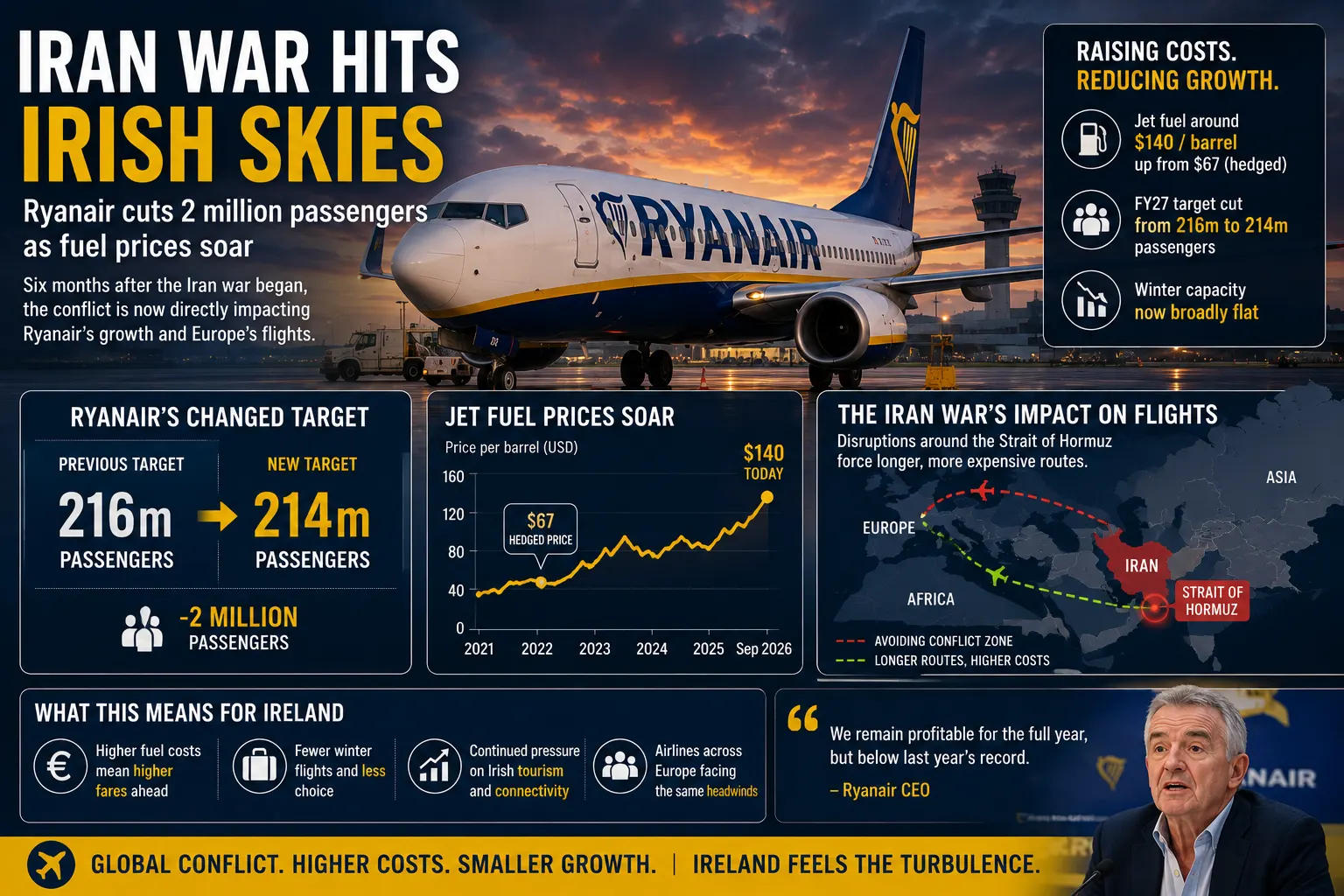
Two million passengers have disappeared from Ryanair’s growth plan in a single morning. The Dublin-based airline said on 2 September that it now expects to carry 214 million passengers in the financial year ending March 2027, down from its previous target of 216 million, as exceptionally expensive jet fuel makes additional winter flying less attractive. The change is relatively small beside the scale of Europe’s largest airline, but its significance is much greater: six months after the Iran war began, the conflict is now directly influencing how many flights European airlines are willing to operate.
Ryanair’s decision does not mean two million passengers or seats are being removed specifically from Ireland. The revised target applies across the entire Ryanair Group, whose network spans more than 220 airports and 35 countries. Nor does the announcement represent a collapse in demand. August traffic actually increased by 6 per cent to 22.2 million passengers and the airline filled 96 per cent of its available seats.
The issue is instead the economics of marginal capacity. Ryanair has approximately 80 per cent of its fuel requirement through March 2027 hedged at about $67 a barrel, protecting most of its consumption from current market prices. The remaining 20 per cent is exposed to a jet-fuel market that Ryanair says is trading around $140 a barrel. During the weaker winter months, when many European routes generate little or no profit, the cost of operating that unhedged portion can turn additional flights from commercially attractive into loss-making.
The airline therefore plans broadly flat winter capacity rather than the growth previously envisaged. Ryanair estimates that limiting its exposure could reduce winter losses by between €70 million and €100 million. It still expects to remain profitable over the full year, but now says profit will fall below the record achieved in the previous financial year and has declined to provide a precise full-year earnings forecast.
The Passenger Cut Is Small — but the Direction Has Changed
Ryanair carried a record 208.4 million passengers during the financial year to March 2026. Its original target of 216 million for the current year implied growth of approximately 3.6 per cent. The new 214 million target would still represent growth of about 2.7 per cent.
The two-million reduction therefore amounts to less than 1 per cent of the previous target. In numerical terms it is a correction rather than a retreat. Strategically, however, it represents an important change because Ryanair’s business model has been built around relentless traffic expansion and using lower costs to fill additional aircraft.
The airline had expected to grow throughout the current year as Boeing deliveries expanded its fleet and new routes were added. In July, management was still publicly maintaining the 216 million target. Less than seven weeks later, the fuel environment has become expensive enough for Ryanair to conclude that some planned winter growth is no longer worth operating.
That decision illustrates a central feature of airline economics. An aircraft does not have to be physically incapable of flying for a route to disappear. If the expected revenue from passengers is insufficient to cover the additional fuel, airport, crew, maintenance and operating cost, capacity can be withdrawn even while consumer demand remains relatively healthy.
What Ryanair Changed on 2 September
| Measure | Previous Position | New Position |
|---|---|---|
| FY27 traffic target | 216m passengers | 214m passengers |
| Growth vs FY26 | About 3.6% | About 2.7% |
| Winter capacity | Growth expected | Broadly flat |
| FY27 profit | No firm guidance | Below FY26 record |
| Jet fuel today | — | About $140/barrel |
Sources: Ryanair, Reuters and Ireland Newspaper calculations. Fiscal 2027 ends in March 2027.
The Iran War Has Become an Aviation-Fuel Crisis
The chain connecting Iran to an Irish airline begins at sea rather than at an airport. The current conflict began on 28 February with US and Israeli attacks on Iran and subsequently expanded into a prolonged confrontation involving Iranian retaliation, regional military operations and repeated disruption around the Strait of Hormuz.
Hormuz is one of the most important energy chokepoints on the planet. Before the current war, approximately 20.9 million barrels of crude oil and petroleum liquids passed through the strait each day during the first half of 2025. That was equivalent to about one fifth of global petroleum-liquids consumption and around one quarter of internationally traded maritime oil.
The physical geography is difficult to replace. Pipelines through Saudi Arabia and the United Arab Emirates can bypass Hormuz, but the US Energy Information Administration estimated their combined usable alternative capacity at roughly 4.7 million barrels a day before the conflict — far below normal volumes moving through the strait.
Flows collapsed as the war intensified. EIA estimates put average oil movement through Hormuz at only 4.9 million barrels a day during the second quarter of 2026, compared with approximately 21 million barrels a day in the same quarter a year earlier. Subsequent ceasefires and temporary shipping windows have produced periods of recovery, followed by renewed disruption.
The situation remains highly volatile rather than uniformly closed. Oil movements can surge for several days when conditions permit and then fall again when tankers, terminals or military installations are attacked. That volatility itself has economic value because refiners, shipping companies and airlines must price the risk that today’s available supply may not remain available next month.
Why Jet Fuel Can Cost $140 When Brent Oil Is Below $100
There is another important distinction in Ryanair’s announcement. The airline is not saying Brent crude itself costs $140 a barrel. Brent was trading at roughly $95 on 2 September after renewed US-Iran hostilities pushed prices sharply higher. The approximately $140 figure relates to aviation fuel.
Crude oil has to be refined before it can become jet fuel. When refining capacity or shipments of refined products are disrupted, the price of jet fuel can rise much faster than the underlying crude price. The difference between crude oil and the refined product is commonly described through the refining or crack spread.
This has become unusually important during the current conflict. The International Energy Agency reported in August that jet-fuel exports from Russia, the Middle East and Asia were around 670,000 barrels per day lower than a year earlier. That reduction was equivalent to approximately 34 per cent of global seaborne jet-fuel trade from those regions.
At the same time, refinery margins for diesel, aviation fuel and other middle distillates reached exceptionally high levels. Airlines are therefore facing two related pressures: crude oil is expensive because supply is constrained, and turning available crude into the specific fuel required by aircraft has also become more expensive.
IATA’s June industry forecast estimated an average 2026 jet-fuel price of $152 a barrel, almost 70 per cent higher than the $90 average recorded in 2025. It expected the premium over crude oil to average approximately $57 a barrel, an historically unusual spread.
Ryanair Is Better Protected Than Most Airlines — but Not Completely
Fuel hedging is the main reason Ryanair can respond by trimming growth rather than implementing much larger cuts. Airlines routinely use financial contracts to lock in future fuel prices, reducing exposure to sudden commodity-market changes.
Ryanair entered the current year with approximately 80 per cent of its required fuel hedged through March 2027 at about $67 a barrel. By comparison, IATA estimated that airlines globally had hedged roughly one third of their expected 2026 fuel consumption.
The difference is strategically important. If two airlines operate similar aircraft on similar routes but one has protected most of its fuel at pre-war prices while the other purchases a much larger proportion near today’s market price, their economics can diverge dramatically.
Hedging does not make fuel cheap indefinitely. Contracts expire, and an airline eventually has to purchase new protection at whatever prices the market offers. Ryanair had hedged only about 15 per cent of its following financial year’s fuel requirements at approximately $85 a barrel when it reported first-quarter results in July.
The current hedge therefore buys time rather than immunity. If fuel prices fall before Ryanair has to lock in much of its 2028 requirement, its cost protection can be renewed at tolerable levels. If jet fuel remains around $140 for many more months, the airline eventually faces the same higher-cost environment currently hitting less-hedged competitors.
Ryanair’s unusual advantage in the current crisis is timing. Approximately 80 per cent of its fuel through March 2027 was hedged near $67 a barrel before today’s extreme jet-fuel prices developed. The remaining 20 per cent is still sufficient to alter winter capacity decisions because aviation operates on comparatively thin margins.
The Financial Impact Was Already Visible Before Today’s Cut
Ryanair’s first-quarter results in July showed that the war was already affecting both sides of the airline’s income statement. Traffic increased by 6 per cent to 61.3 million passengers during the three months to June, yet profit after tax fell by 34 per cent from €820 million to €538 million.
Average fares were 6 per cent lower. Ryanair attributed the weakness partly to consumer hesitancy created by the Middle East conflict, initial fears of European fuel shortages, wider economic uncertainty and passengers booking later than usual.
At the same time, fuel and oil costs increased by 16 per cent to €1.69 billion. Ryanair said the price of its unhedged fuel had more than doubled to around $150 a barrel during the quarter. Total operating costs increased 11 per cent while revenue increased only 1 per cent.
This produced a difficult combination for the airline: higher operating costs at precisely the moment when fares had to be stimulated to persuade nervous consumers to book. Airlines can normally compensate for expensive fuel by charging passengers more, but doing so becomes harder when consumer confidence is already under pressure from the same geopolitical event.
The Iran War Was Already Visible in Ryanair’s Q1 Results
| Measure | Q1 FY27 | Annual Change |
|---|---|---|
| Passengers | 61.3m | +6% |
| Total revenue | €4.38bn | +1% |
| Average fare | — | -6% |
| Fuel and oil cost | €1.69bn | +16% |
| Operating costs | €3.81bn | +11% |
| Profit after tax | €538m | -34% |
Source: Ryanair Q1 FY27 results, quarter ended 30 June 2026.
Why Ryanair Is Cutting Winter Growth Rather Than Summer Flights
European aviation is highly seasonal. Summer combines school holidays, tourism and stronger demand, allowing airlines to fill large numbers of aircraft at commercially attractive fares. Winter is much more difficult.
A route that generates significant profit in July can lose money in January when fewer people travel and fares decline. Airlines may continue operating such services because they need to retain airport slots, crew networks or long-term market positions, but marginal winter capacity is generally the first place to cut when variable costs increase sharply.
That is exactly what Ryanair is doing. Rather than expanding as previously planned, the group intends to keep winter capacity broadly unchanged from last year. Management estimates that the change could reduce winter losses by between €70 million and €100 million.
This is fundamentally different from cancelling flights because there is no physical fuel available. Ryanair said earlier in the year that European jet-fuel supply had adapted better than initially feared, with additional volumes arriving from West Africa, the Americas and Norway. The present problem is predominantly price rather than an inability to obtain fuel at all.
The distinction is important for passengers. A supply emergency could force airlines to cancel flights already sold. A profitability-driven capacity reduction is more likely to appear through fewer future frequencies or routes being placed on sale in the first place.
No New Ireland-Specific Route Cuts Were Announced Today
Because Ryanair is headquartered in Dublin, the new traffic reduction can easily be read as an announcement of large cuts to Irish aviation. That is not what the company said.
The 214 million target applies to Ryanair’s entire European and North African network. The airline has not identified two million Irish passengers for removal, nor did today’s announcement specify a list of routes from Dublin, Cork, Shannon, Knock or Kerry that will be cancelled because of fuel prices.
Some previously announced network cuts have separate explanations. Ryanair’s decision in July to remove five aircraft and around two million seats from its Brussels and Charleroi schedules, for example, was publicly attributed by the company primarily to higher Belgian aviation taxes. Those particular cuts should therefore not be retrospectively described as being caused by the Iran war.
Fuel nevertheless changes the environment in which all future capacity decisions are made. When aircraft are scarce and fuel is expensive, Ryanair can allocate its fleet towards airports and countries offering the lowest costs and strongest expected returns.
The company had already said in its July results that it was moving scarce growth capacity towards markets such as Albania, Italy, Morocco, Slovakia and Sweden while reducing its emphasis on what it considers higher-cost locations, including Dublin, Austria and Germany. That allocation reflects airport charges, taxes and incentives as well as fuel.
For Ireland, the significance is therefore competitive rather than immediate. Dublin and other Irish airports compete for aircraft inside a group with hundreds of possible destinations. Higher fuel prices make every additional cost more important when management decides where the next aircraft should fly.
Irish Passengers May Eventually Feel the War Through Higher Fares
Ryanair’s most direct warning to consumers concerns summer 2027. If high oil and jet-fuel prices continue, the airline says European short-haul fares are likely to rise materially.
It has not specified a percentage. Any claim that Irish tickets will rise by 5, 10 or 20 per cent would therefore be speculative. Actual fares depend on demand, route competition, airport capacity, fuel costs and how many aircraft competing airlines are willing to operate.
Low-cost aviation uses dynamic pricing rather than a simple cost-plus formula. A flight with expensive fuel can still be sold cheaply if seats would otherwise remain empty. Conversely, if competitors remove capacity and only a limited number of seats remain available, fares can rise by more than the underlying increase in fuel cost.
This is why capacity may ultimately matter more to passengers than Ryanair’s own fuel bill. If Ryanair, easyJet, Wizz Air, IAG and other carriers collectively reduce planned growth, fewer seats compete for the same pool of passengers. That gives airlines greater pricing power.
Ryanair’s warning that less-hedged competitors could struggle to maintain capacity or even survive is the company’s own commercial assessment rather than an independent prediction of specific airline failures. The wider industry data nevertheless confirm that fuel is putting substantial pressure on profitability.
The Entire Airline Industry Is Being Squeezed
IATA dramatically revised its 2026 industry outlook after the Middle East conflict transformed fuel markets. Global airline fuel expenditure is now expected to reach approximately $350 billion this year, almost $100 billion more than the industry’s earlier outlook and about 39 per cent above 2025.
Fuel is forecast to consume 31.4 per cent of total airline operating expenditure in 2026, compared with 25.4 per cent last year. Airlines are expected to burn approximately the same total quantity of fuel as in 2025, meaning the enormous increase in expenditure is being caused almost entirely by price.
IATA expects industry net profit to fall from around $45 billion in 2025 to approximately $23 billion this year. The global net profit margin is forecast to decline from 4.2 to 2 per cent.
That margin illustrates why the sector reacts aggressively to fuel movements. Airlines generate enormous revenues, but only a small percentage remains as profit. A relatively modest cost shock can therefore remove a large proportion of earnings even without passenger numbers collapsing.
Ryanair’s cost structure and hedging position make it unusually resilient within that environment. Its financial year to March 2026 produced a record pre-exceptional profit after tax of €2.26 billion on 208.4 million passengers. The company calculated that result at only about €10.80 profit per passenger.
A few additional euros of cost on each passenger can consequently become hundreds of millions of euros when multiplied across more than 200 million journeys.
Fuel Is Not the Only Cost Moving Against European Airlines
It would nevertheless be inaccurate to attribute every future fare increase or capacity reduction solely to Iran. Airlines entered the conflict with several other cost pressures already building.
Ryanair expects its EU environmental costs to increase by approximately €300 million during the current financial year to around €1.4 billion. The airline also has higher crew costs under new multi-year pay agreements and increasing maintenance expenditure as parts of its older Boeing 737 fleet require heavier servicing.
Airport fees and national aviation taxes also influence route decisions. Aircraft leasing and financing costs remain higher for many competitors following the rise in global interest rates. Aircraft and engine shortages continue to restrict the number of available planes.
The Iran war is therefore an additional shock acting on an industry that already had limited capacity flexibility. It raises fuel costs at the same time as aircraft manufacturers remain behind delivery schedules and some European airlines have planes grounded for lengthy engine repairs.
That interaction matters because airlines cannot necessarily respond to higher demand by obtaining another aircraft quickly. When the supply of planes is constrained, removing marginal capacity in one part of the network can tighten fares elsewhere.
The Strait of Hormuz Is Affecting Europe Without Europe Being at War
The economic transmission demonstrates how geographically distant conflicts can affect Irish households without any direct interruption in Ireland itself. An Irish traveller flying from Dublin to Barcelona does not pass anywhere near the Persian Gulf. The fuel burned by the aircraft may not have originated there either.
Yet global petroleum markets are interconnected. Removing millions of barrels of Gulf production or refined products from world trade forces buyers elsewhere to compete for alternative supplies from Europe, Africa and the Americas. Prices rise across the system.
Refineries may switch production towards whichever product provides the strongest return. Tankers travel longer routes. Insurance and shipping costs increase around conflict zones. Inventories are drawn down to replace disrupted supply.
The IEA estimated in August that global observed oil inventories had fallen by about 410 million barrels since the beginning of the war. Gulf oil production in July remained around 8.3 million barrels a day below pre-war levels, despite a partial recovery.
International product markets have been particularly tight. This is why European aviation can experience a jet-fuel crisis even when fuel physically continues arriving at airports.
How the Iran War Reaches a European Airline
| Stage | Development | Aviation Effect |
|---|---|---|
| 1 | Hormuz and Gulf exports disrupted | Global oil supply tightens |
| 2 | Refined-fuel exports decline | Jet-fuel premium rises |
| 3 | Airline hedges absorb part of shock | Exposure differs by carrier |
| 4 | Unhedged fuel becomes expensive | Winter routes lose viability |
| 5 | Airlines restrict capacity | Fewer seats can raise fares |
Analytical summary based on Ryanair, IEA, EIA and IATA data.
Ryanair’s Hedging Strategy Could Become a Competitive Weapon
A crisis that damages Ryanair’s profits can simultaneously strengthen its relative position against competitors. This apparent contradiction reflects the difference between absolute and comparative costs.
Ryanair is paying more for its unhedged fuel than it expected before the war, so its own costs rise. But if another airline has 50, 70 or 100 per cent of its fuel exposed to current prices, that competitor’s costs can rise substantially more.
Ryanair can then maintain routes or fares that become unprofitable for a higher-cost competitor. If the rival reduces flights or exits a market, Ryanair may eventually gain passengers and stronger pricing.
The company has explicitly argued that its hedging, low operating costs, strong balance sheet and fuel-efficient aircraft could widen its competitive advantage during the crisis. That is a corporate forecast rather than a guaranteed market outcome, but the financial mechanism is straightforward.
There is precedent for shocks accelerating airline consolidation. The pandemic removed financially weak carriers and forced governments to support others. Fuel crises have historically produced similar pressure, particularly on airlines with high debt or inefficient fleets.
This means the Iran war could reduce Ryanair’s near-term profit while improving its longer-term market position if competitors are damaged more severely.
New Aircraft Have Become an Economic Hedge Against Expensive Oil
Ryanair’s large aircraft programme is usually discussed in terms of network growth and environmental efficiency. High fuel prices have made its financial importance more immediate.
The company now operates 210 Boeing 737-8200 aircraft, known within Ryanair as Gamechangers. Ryanair says these aircraft provide around 4 per cent more seats while using approximately 16 per cent less fuel than the older aircraft they replace.
A lower fuel burn reduces exposure to every dollar increase in the price of aviation fuel. The advantage becomes considerably more valuable when jet fuel costs $140 or $150 a barrel than when it trades at $70.
Ryanair also has 300 Boeing 737 MAX 10 aircraft on order. The first 15 were expected to arrive from spring 2027, subject to certification and Boeing’s delivery schedule. Ryanair says the MAX 10 will carry approximately 20 per cent more passengers while using about 20 per cent less fuel than the older 737 generation it will ultimately replace.
These figures are manufacturer and airline efficiency claims and actual savings depend on route length, configuration and operating conditions. The strategic direction is nevertheless clear: in an industry where fuel can represent nearly one third of all operating expenditure, fleet efficiency is becoming a form of financial protection.
Aircraft Shortages Could Amplify the Fare Effect
European aviation is simultaneously dealing with another problem: manufacturers have struggled to supply aircraft at the speed airlines originally expected. Boeing and Airbus backlogs are large, while engine inspection and repair programmes have temporarily grounded substantial numbers of aircraft across several carriers.
Ryanair says short-haul capacity across Europe is likely to remain constrained until at least 2030. That is the company’s assessment rather than an official European forecast, but aircraft availability is widely recognised as an industry constraint.
High fuel prices interact with this shortage in an unusual way. Normally, higher fares would encourage airlines to add flights until increased competition brought prices back down. If suitable aircraft cannot be delivered quickly, the supply response is slower.
This makes sustained high fares more plausible even if passenger demand grows only moderately. Capacity withdrawn because of fuel or financial stress cannot necessarily be replaced immediately by another carrier.
The War Has Also Changed How Passengers Book
The Middle East conflict initially affected Ryanair not only through fuel prices but through traveller psychology. Management reported that passengers were booking closer to departure than they did a year earlier.
This matters because airlines sell seats months in advance and continuously adjust fares according to how quickly each flight fills. A shorter booking window gives management less certainty about eventual revenues.
Ryanair responded during the early summer by stimulating demand with lower fares. That helped keep traffic growing but contributed to the 6 per cent decline in average fares during the April-June quarter.
As departure dates approached, some demand returned at higher prices. This demonstrates another complexity of the conflict: uncertainty can temporarily weaken fares even while expensive fuel eventually creates pressure for fares to rise.
The timing of passenger decisions therefore determines how quickly airlines can pass fuel costs into ticket prices.
Lower Traffic Does Not Automatically Mean Lower Demand
The reduction to 214 million passengers could be misinterpreted as evidence that European travellers are abandoning air travel because of the war. Current traffic numbers do not support that conclusion.
Ryanair carried 22.2 million passengers in August, up from 21 million a year earlier. Its load factor remained at 96 per cent and it operated more than 120,500 flights during the month.
More than 400 August services were cancelled because of eruptions at Mount Etna, illustrating that operational disruption continues independently of geopolitical events.
Demand can therefore remain strong while traffic targets fall. Ryanair is deciding not to make as much capacity available as previously planned because the cost of operating some winter flights has changed.
This distinction will become important if fares rise. Higher ticket prices in 2027 may result partly from continued consumer demand meeting constrained capacity rather than from airlines simply adding a fixed fuel surcharge to every seat.
Ireland Is Particularly Dependent on Affordable Air Connectivity
For an island economy on Europe’s western edge, aviation has a significance that extends beyond tourism. Business travel, foreign direct investment, migration, family connections and the ability of Irish residents to travel elsewhere in Europe all depend heavily on air services.
Unlike continental European countries, Ireland cannot substitute a large proportion of international air travel with high-speed rail. A traveller between Paris and Brussels can change mode relatively easily; a traveller between Dublin and Madrid cannot.
This gives fuel-driven aviation inflation a particularly Irish dimension. Higher European ticket prices function partly as an additional cost of geographic isolation.
The impact will not be identical across passengers. Holidaymakers can change destination or travel dates. Business travellers may have less flexibility. People visiting family abroad may continue travelling even when fares increase, reducing spending elsewhere instead.
Regional airports can also be more sensitive to capacity changes because thinner routes have fewer daily frequencies and smaller passenger markets. An airline deciding that one winter rotation is no longer economic can have a much larger effect on connectivity than reducing one of ten daily services at a major hub.
Dublin Must Compete for Ryanair Aircraft Like Every Other Airport
Ryanair’s Irish origins do not guarantee that additional aircraft will automatically be deployed in Ireland. The group allocates planes across its network according to expected returns.
The airline has repeatedly argued that aviation taxes and airport charges influence these decisions. In its July financial results, Ryanair specifically identified Dublin among markets from which it was shifting scarce growth capacity while expanding in countries and regions offering lower costs or stronger incentives.
Those statements reflect Ryanair’s commercial position and its longstanding disputes with airports and governments over charges. They should not be treated as independent evidence that Dublin is objectively uncompetitive under every measure.
But today’s fuel decision increases the importance of relative airport economics. When an aircraft can profitably operate almost anywhere, the difference between two airports’ charges may be secondary. When fuel makes marginal routes loss-making, relatively small differences can determine which market receives capacity.
Irish aviation policy therefore intersects with a geopolitical conflict in an indirect way: expensive fuel reduces the pool of economically attractive flying, increasing competition between airports for the flights that remain.
Could Airlines Simply Add a Fuel Surcharge?
Traditional network carriers have sometimes used explicit fuel surcharges, particularly on long-haul flights. Ryanair’s low-cost model generally relies instead on continuously changing fares according to supply and demand.
Whether an airline can pass higher fuel costs to customers depends fundamentally on competition. If five carriers fly between two cities with surplus seats, one airline attempting a large fare increase may simply lose passengers to rivals.
If three of those carriers cut capacity because fuel has become too expensive, the remaining airlines have greater ability to raise prices. The final fare increase can consequently be smaller or larger than the change in fuel cost itself.
This is why Ryanair’s prediction of materially higher European short-haul fares depends partly on its expectation that competitors will reduce capacity. Fuel is the initial shock; market structure determines the final consumer price.
The War Could Accelerate Consolidation in European Aviation
Europe’s airline market has already become more concentrated. Large groups including Ryanair, Lufthansa, IAG and Air France-KLM have considerable scale, while smaller operators face high aircraft, labour, financing and regulatory costs.
A prolonged period of exceptionally expensive fuel could widen the gap between airlines with strong balance sheets and effective hedging programmes and those without them.
IATA’s expected global airline net margin of only 2 per cent in 2026 demonstrates how little financial room exists for another major shock. An airline carrying substantial debt after the pandemic can find its cash position deteriorating rapidly when fuel costs increase faster than fares.
Consolidation would have contradictory effects for consumers. Financially stronger airlines can provide more reliable service and invest in new aircraft. Fewer competitors can also reduce fare competition on individual routes.
Ryanair openly expects industry consolidation and capacity constraints to strengthen its position. Whether that produces lower costs for the airline and higher or lower fares for passengers will depend on competition in each market.
Environmental Policy Becomes Harder During a Fuel Crisis
European aviation also faces the cost of decarbonisation. Airlines must purchase emissions allowances, comply with international carbon rules and gradually use more sustainable aviation fuel.
Those policies are designed for a long-term transition away from fossil-fuel dependence. In the short term, however, they arrive alongside an externally generated fuel-price shock.
Ryanair estimates that its European environmental costs will rise by approximately €300 million during the current year. The company is strongly critical of several EU aviation policies and taxation arrangements, so its interpretation should be understood as an interested commercial view.
The underlying cost exists regardless of the political argument. Airlines have to finance both expensive conventional fuel today and investment or regulatory costs associated with reducing emissions tomorrow.
The danger for policymakers is responding to a temporary oil shock by abandoning long-term transition incentives. The opposite danger is ignoring the affordability consequences when several cost increases occur at the same time.
Aviation’s Dependence on Oil Cannot Be Removed Quickly
Road transport has a rapidly expanding electric alternative. Aviation does not. Battery technology is not currently capable of replacing jet fuel on the large commercial aircraft operating most European routes.
Sustainable aviation fuel can reduce lifecycle emissions but remains scarce and significantly more expensive than conventional fuel. Hydrogen and electric aircraft technologies are being developed, but large-scale commercial deployment remains years away.
This means airlines remain unusually exposed to geopolitical petroleum shocks. They can improve fuel efficiency, hedge prices and adjust capacity, but they cannot simply stop using hydrocarbon-based aviation fuel in response to a crisis.
The sector’s vulnerability explains why the Strait of Hormuz matters to airlines thousands of kilometres away.
The Future Now Depends More on Duration Than Today’s Price
A short-lived spike in jet fuel would be manageable for Ryanair because the majority of its current-year requirement is already hedged. A prolonged period of high prices would be far more consequential.
Every month that passes brings the airline closer to the point at which it must hedge a larger proportion of its next financial year’s fuel. If contracts have to be secured at prices far above $67, today’s temporary shock becomes tomorrow’s structural cost base.
That is the reason summer 2027 has become critical. Ryanair can absorb much of the winter 2026 shock through its existing hedge and by reducing marginal capacity. Its next summer schedule will be much more exposed to where fuel markets settle over the coming months.
The company has warned that if high oil prices persist into summer 2027, fares will need to rise materially. That statement is conditional. It should not be presented as a confirmed ticket-price increase.
Three Scenarios Now Face Ryanair and European Travellers
The most favourable scenario is renewed de-escalation in the Middle East accompanied by sustained restoration of Gulf oil and refined-product exports. Jet-fuel prices decline, refining premiums narrow and Ryanair can hedge more of its future requirement at lower prices.
Under that outcome, the traffic reduction to 214 million could remain largely a one-year winter adjustment. Competitive pressure would limit fare increases and Ryanair could resume stronger growth as new Boeing aircraft arrive.
A second scenario is prolonged disruption without a major new escalation. Jet fuel remains expensive but physically available. Airlines continue operating, yet weaker competitors reduce capacity and Ryanair becomes increasingly selective about marginal routes. Short-haul fares rise because fewer seats are offered.
The third scenario is a significant escalation around Hormuz, Gulf production or regional refineries. Fuel prices could move substantially higher and supply concerns could return. Airlines with limited hedging and weak balance sheets could face much more severe capacity decisions.
These scenarios are not forecasts. Oil markets have repeatedly reversed direction during the conflict in response to ceasefires, military attacks and changes in shipping access, making precise price forecasts unusually unreliable.
Possible Aviation Paths Into 2027
| Scenario | Fuel Market | Likely Aviation Effect |
|---|---|---|
| De-escalation | Jet fuel falls | Growth resumes; fare pressure eases |
| Prolonged disruption | Fuel remains expensive | Lower capacity; higher fares |
| Major escalation | Prices and supply risk surge | Deeper cuts and financial stress |
Ireland Newspaper scenario analysis based on current Ryanair, IEA and IATA information. These are possibilities rather than forecasts.
Ryanair Still Intends to Reach 300 Million Passengers
The immediate traffic reduction has not changed Ryanair’s much larger strategic ambition. The airline continues to target more than 300 million annual passengers by the financial year ending March 2034.
That target depends heavily on its order for 300 Boeing 737 MAX 10 aircraft and the ability to replace older aircraft with larger, more fuel-efficient models. It also assumes European short-haul demand continues growing and Ryanair can find airports prepared to accommodate additional capacity at commercially attractive costs.
The Iran war therefore threatens the timing and profitability of expansion more clearly than the underlying long-term strategy. A two-million-passenger reduction against a 214 million total does not fundamentally alter the group.
But repeated external shocks can accumulate. Covid-19 closed much of aviation, the Ukraine war affected fuel and airspace, aircraft delivery delays constrained fleet growth and the Iran conflict has now transformed energy prices. Airlines have spent much of the decade adapting forecasts to events outside their control.
The Irish Airline’s Strength Is Also Ireland’s Exposure
Ryanair is one of Ireland’s most internationally successful companies. Its scale allows a Dublin-headquartered group to influence European aviation prices, airport strategies and aircraft purchasing on a level few Irish companies achieve.
That global scale also means Ireland is economically connected to events far beyond Europe. A military exchange near the Strait of Hormuz can alter a Ryanair winter schedule. A disrupted Gulf refinery can influence the price of a flight from Cork. A tanker attack thousands of kilometres away can affect how many aircraft management chooses to base at a European airport.
There is nothing uniquely Irish about the fuel shock; every European airline is exposed. But Ireland’s geography means affordable aviation matters particularly strongly to households, tourism and businesses.
Today’s Cut Is a Warning, Not an Aviation Crisis
The reduction from 216 million to 214 million passengers should not be exaggerated. Ryanair is still growing. August passenger numbers remain at record levels, aircraft are flying with very high load factors and the company expects another profitable year.
Europe is also not currently facing the widespread physical jet-fuel shortages that were feared when the war initially disrupted Hormuz. Supply chains have adapted and alternative sources have increased exports.
What has changed is the price at which those supplies are available. Jet fuel near $140 a barrel is sufficiently expensive to alter the economics of Europe’s largest low-cost airline even though four fifths of Ryanair’s current-year fuel is protected by hedging.
That makes today’s announcement a useful early indicator. If one of Europe’s lowest-cost and best-hedged airlines is beginning to remove planned winter growth, carriers with weaker hedging and higher operating costs face an even more difficult calculation.
The Real Risk for Travellers Comes Next Summer
For Irish passengers, the immediate consequence may be limited. Today’s announcement does not cancel two million Irish bookings, and it does not establish a fixed increase in fares.
The more consequential period begins when airlines price and finalise their summer 2027 schedules. If jet fuel has returned towards pre-war levels, the current adjustment may prove temporary.
If prices remain exceptionally high, Ryanair’s hedging advantage will gradually diminish as old contracts expire. Other European airlines may reduce capacity further. Ticket prices would then face upward pressure from both higher costs and lower seat supply.
The mechanism is therefore broader than a simple fuel bill. War disrupts oil flows; disrupted flows raise crude and refining prices; airlines face higher costs; marginal winter flights disappear; industry capacity tightens; passengers compete for fewer seats. The economic effect travels from Hormuz to Dublin without a single Ryanair aircraft entering Middle Eastern airspace.
The Iran War Has Reached Ireland Through the Price of Mobility
For the first months of the conflict, its Irish consequences were discussed mainly through petrol, diesel, heating costs and inflation. Ryanair’s new traffic target adds another channel.
Air travel is one of the clearest examples of how energy shocks spread through a modern economy. Fuel is purchased globally, aircraft are allocated internationally and fares respond to competition across hundreds of markets.
The two-million-passenger reduction is modest beside Ryanair’s overall scale. But it is significant because it shows behaviour has changed. Europe’s biggest airline has decided that some growth it intended to operate only weeks ago no longer makes economic sense at today’s fuel prices.
Whether that remains a limited winter correction or develops into a wider European airfare shock will depend less on Ryanair than on events around Iran, the Strait of Hormuz and the world’s refining system over the coming months.
For Ireland, the conflict is no longer only visible on television screens or in petrol-station prices. It has reached the economics of flying itself — and if high jet-fuel prices survive into 2027, Irish travellers may increasingly encounter the war through something much more ordinary: fewer flight choices and a more expensive ticket.
Sources
Ryanair — August Traffic and Revised FY27 Traffic Target, 2 September 2026
Reuters — Ryanair Trims Traffic Target as Fuel Costs Cloud Winter Outlook, 2 September 2026
Ryanair — Q1 FY27 Results, July 2026
Ryanair — Full-Year FY26 Results
International Energy Agency — Oil Market Report, August 2026
International Energy Agency — Middle East and Global Energy Markets
US Energy Information Administration — World Oil Transit Chokepoints
US Energy Information Administration — Energy Security and Strait of Hormuz Disruption, August 2026
International Air Transport Association — Global Outlook for Air Transport, June 2026
Reuters — Oil Markets and Renewed US-Iran Fighting, 2 September 2026
Reuters — Outbreak of the Current Iran Conflict, 28 February 2026
Source & Transparency
This article is published by Ireland Newspaper for editorial and informational purposes.
Published: 2 September 2026 · Updated: 2 September 2026

Newsroom Ireland Newspaper
Ireland Newspaper editorial team prepares daily news coverage for readers in Ireland and abroad.




Market data, financial news and economy content on Ireland Newspaper are provided for editorial and informational purposes only. They do not constitute financial advice, investment advice, trading advice or a recommendation to buy, sell or hold any financial product. Always verify live prices and consult a qualified professional before making financial decisions.