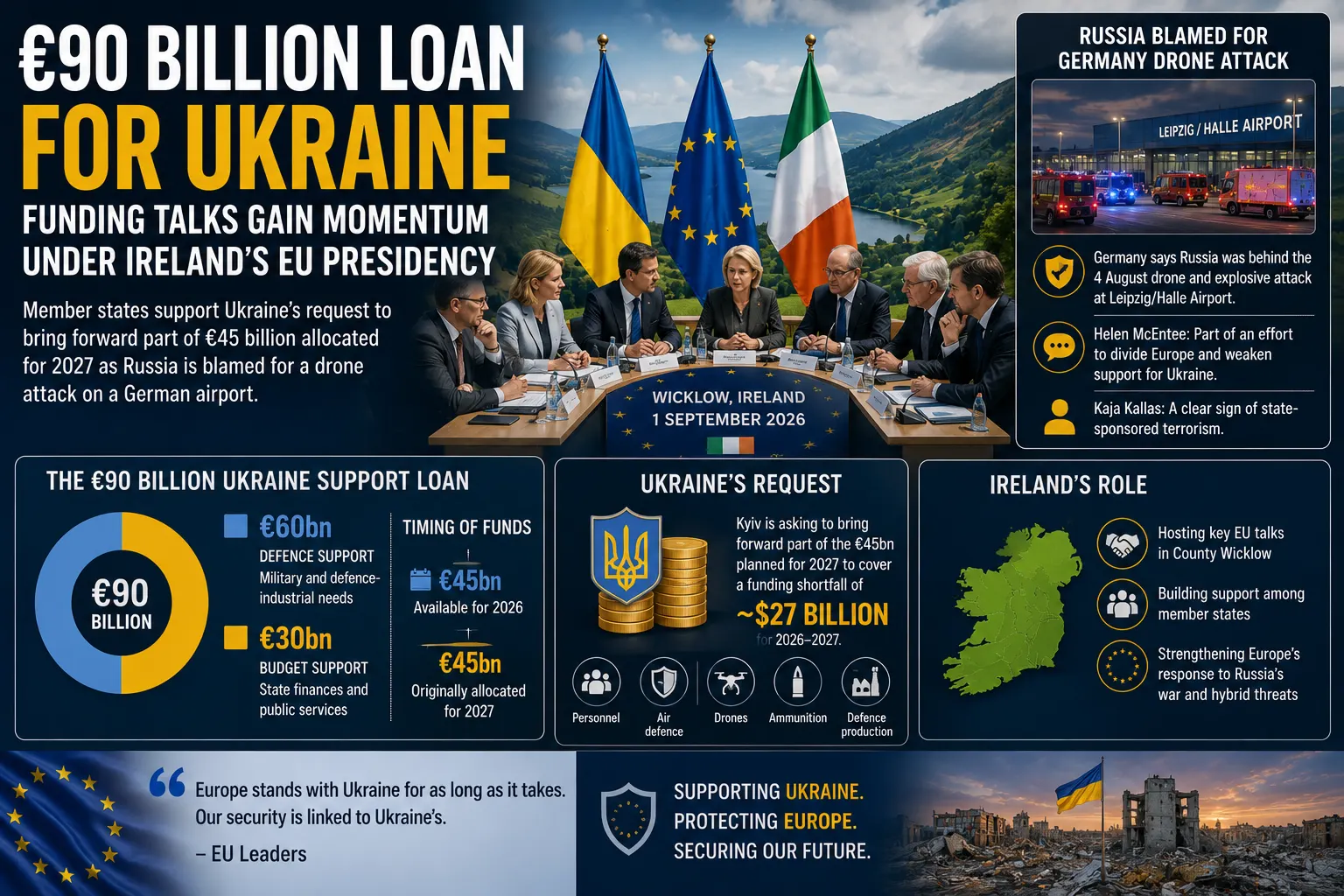
A €90 billion European loan designed to finance Ukraine across two years is already being reconsidered only months after the first money began to flow. At meetings hosted in County Wicklow under Ireland’s Presidency of the Council of the European Union, a significant number of member states have backed Ukraine’s request to bring forward part of the €45 billion currently reserved for 2027. The proposal reflects an increasingly urgent problem for Kyiv: the money exists within the European framework, but Ukraine argues that part of it is needed sooner.
The discussions are taking place as the war’s consequences increasingly extend beyond Ukraine itself. Germany has formally attributed an attempted explosive-drone attack at Leipzig/Halle Airport on 4 August to Russia, an allegation Moscow rejects. Irish Foreign Affairs and Defence Minister Helen McEntee has described the incident as part of an effort to divide Europe and weaken support for Ukraine, while EU foreign-policy chief Kaja Kallas said the attempted attack displayed characteristics associated with state-sponsored terrorism.
The two issues — financing Ukraine and responding to suspected Russian hybrid operations inside the European Union — are politically connected. Ukraine needs money for weapons, air defence, military production and the ordinary functioning of the state. European governments, meanwhile, increasingly view their support not only as assistance to a country under attack but as part of their own security strategy.
Ireland’s six-month EU presidency has placed that relationship near the centre of its security agenda. Yet the discussions in Wicklow also demonstrate the limits of what a Council presidency can do. Ireland can organise meetings, build coalitions and push proposals forward, but it cannot unilaterally release the additional money. Bringing forward part of the 2027 allocation would require further agreement at European level, involving member states and the European Commission.
Ukraine Wants Tomorrow’s Money Today
The immediate financial question concerns the Ukraine Support Loan agreed by EU leaders in December 2025. The programme makes up to €90 billion available for 2026 and 2027, financed through borrowing by the European Union on capital markets and backed by the EU budget.
The framework was deliberately constructed to provide Ukraine with predictable financing across both years. Approximately €60 billion is intended for defence-related support and €30 billion for general budget assistance, including the functioning of public services and economic stability.
For 2026, the EU has authorised up to €45 billion. Of that amount, €28.3 billion is intended to support Ukraine’s defence industrial capacity and procurement, while up to €16.7 billion is allocated to broader budgetary support.
The remaining €45 billion was intended to remain available during 2027. Ukraine’s latest request would alter that timing rather than automatically increase the overall €90 billion envelope.
Ukraine’s new defence leadership says the pressure is immediate. Kyiv is confronting a military funding shortfall estimated at about $27 billion while attempting to finance personnel, weapons, ammunition, air defence, drones and other requirements during another period of intensified Russian attacks. Bringing forward European money is therefore attractive because the financing framework has already been politically agreed.
How the €90 Billion Ukraine Support Loan Is Structured
| Component | Amount | Purpose |
|---|---|---|
| Total loan | €90bn | Support through 2026–2027 |
| Indicative defence support | €60bn | Military and defence-industrial needs |
| Indicative budget support | €30bn | State finances and public services |
| Available for 2026 | €45bn | Current-year financing |
| Originally remaining for 2027 | €45bn | Next-year financing |
Sources: Council of the European Union and European Commission.
A Significant Group of EU Governments Supports Frontloading
Ukraine’s Defence Minister presented the financing problem to EU defence ministers by video during their informal meeting in Wicklow on 1 September. McEntee said afterwards that a significant number of member states supported the request to accelerate part of the funding.
That is politically important but it is not yet a decision. Informal ministerial gatherings are designed to allow strategic discussion and coalition building; they do not themselves adopt binding Council legislation or implementing decisions.
McEntee explicitly acknowledged this distinction. Any change to the disbursement schedule would require work beyond the Wicklow meeting and agreement between European governments and the Commission.
The number of countries supporting frontloading has not been publicly identified in full, nor has an amount been agreed. It would therefore be premature to state that €45 billion will now be transferred early. Ukraine is asking for part of the money scheduled for next year rather than necessarily the entire remaining allocation.
No additional €90 billion package has been agreed. The current debate concerns whether part of the existing €45 billion earmarked for 2027 should be made available sooner. Accelerating payments changes the timing of financing; by itself, it does not increase the total size of the loan.
Europe Has Already Begun Paying Out the Loan
The Ukraine Support Loan is no longer merely a political promise. The Council completed the key legal framework in April and the Commission began disbursements in June.
Approximately €11.6 billion has so far been disbursed under the new loan framework, according to current EU figures. That includes €3.2 billion in macro-financial assistance and approximately €8.4 billion associated with defence procurement.
The Commission has progressively approved Ukrainian procurement plans covering drones, ammunition, missiles, air and missile-defence systems, radars and other military requirements. A further €6.1 billion package for defence procurement was approved on 24 August as Russian missile and drone attacks intensified.
Approval and disbursement are not identical. A procurement programme can be approved before the full amount has actually been paid. Ukraine submits contracts and procurement arrangements, which are then assessed before European funds are released under the agreed framework.
This distinction becomes important in the current debate. One route to helping Kyiv more quickly is simply accelerating implementation of money already allocated for 2026. A more significant step would be formally opening access to part of the 2027 envelope months earlier than originally intended.
The €45 Billion Authorised for 2026
| 2026 Component | Maximum Amount | Use |
|---|---|---|
| Defence industrial support | €28.3bn | Weapons and defence capacity |
| Macro-financial assistance | €8.35bn | General budget support |
| Ukraine Facility | €8.35bn | Budget, recovery and reforms |
| Total | €45bn | 2026 allocation |
Source: European Commission and Council of the European Union.
Frontloading Solves One Problem but Can Create Another
There is a compelling military argument for giving Ukraine money when it can still influence battlefield outcomes rather than preserving it for a later calendar year. Air-defence missiles needed during a large Russian attack have little value if the financing arrives several months afterwards.
The same applies to defence production. Manufacturers need advance orders to purchase materials, expand factories and hire workers. Earlier financing can therefore translate into earlier physical production rather than merely moving an accounting entry from one year into another.
But frontloading carries an obvious trade-off. If, for example, €10 billion scheduled for 2027 were transferred into 2026, the amount remaining inside the existing envelope for 2027 would fall by €10 billion unless the EU or other donors later provided additional support.
The policy choice is therefore not simply between paying and refusing to pay. It is a decision about when scarce financial resources provide the greatest strategic value and how confident European governments are that further financing can be found if the war continues deep into 2027.
This is particularly relevant because the original €90 billion programme was itself designed to close only part of Ukraine’s financing requirements. European leaders have repeatedly called on third countries and other partners to contribute additional resources.
Ukraine’s Financial Requirements Extend Far Beyond Weapons
A modern state at war has two overlapping financial systems to maintain. The first is military: salaries, ammunition, drones, missiles, vehicles, communications, fortifications, air defence and defence manufacturing. The second is civilian: hospitals, schools, pensions, public administration, energy infrastructure and basic government functions.
Those systems cannot be separated completely. Domestic tax revenue used to finance soldiers cannot simultaneously pay teachers or repair electricity networks. Foreign budget assistance allows Ukraine to maintain civilian services while redirecting more of its domestic financial capacity towards defence.
This explains why the EU loan contains both military and general-budget components. Approximately two thirds is aimed at defence, while the remainder provides financial assistance to the wider state.
The arrangements are also conditional. Budget support is tied to requirements involving the rule of law, anti-corruption measures, economic resilience and reforms connected with Ukraine’s path towards EU membership.
Financial urgency therefore does not eliminate oversight. The EU is attempting to reconcile rapid wartime disbursement with controls designed to ensure that money is spent for agreed purposes and that Ukraine continues institutional reforms.
The Loan Was Created Because Europe Needed a More Predictable System
Since Russia’s full-scale invasion in February 2022, Ukraine has relied on a combination of bilateral military assistance, grants, loans, EU programmes, IMF financing, World Bank support and assistance linked to profits from immobilised Russian assets.
This fragmented architecture delivered enormous resources but made long-term planning difficult. Governments frequently had to return to national parliaments for new packages, while the timing and scale of assistance changed with domestic political conditions.
The €90 billion support loan was designed to improve predictability over 2026 and 2027. The EU borrowed collectively rather than requiring every participating government to raise its share independently.
The programme was established through enhanced cooperation involving 24 member states. The arrangements were structured so that the Czech Republic, Hungary and Slovakia would not face financial obligations associated with the EU budget guarantee for the loan.
That structure allowed most of the Union to proceed despite the absence of full participation by all 27 member states. It also illustrates the political complexity behind apparently simple statements that “the EU” is lending €90 billion.
Ukraine Is Not Expected to Repay in the Manner of an Ordinary Sovereign Loan
The support package is described as a limited-recourse loan. Under the political framework agreed by EU leaders, Ukraine would repay it once reparations are received from Russia.
Russian central-bank assets frozen inside the European Union remain central to that debate. Approximately €210 billion of Russian central-bank assets are immobilised in the EU, with the majority held through the Belgium-based securities depository Euroclear.
The Union already uses extraordinary revenues generated by immobilised Russian assets for Ukraine-related support. More ambitious proposals to use the underlying assets or associated cash balances directly have generated difficult legal and financial questions.
Belgium has been particularly concerned that moving against the underlying assets without sufficiently robust guarantees could expose it or Euroclear to litigation or financial claims. Other member states have pushed for more aggressive use of the money.
The Leipzig incident and continued Russian attacks on Ukraine have revived calls from some governments to revisit the issue. It remains uncertain whether that will translate into a new agreement.
The Debate Is Shifting From Whether Europe Supports Ukraine to How Quickly
The conversation in Wicklow is notable because the central disagreement is no longer about creating the €90 billion framework. That decision has already been taken.
The current argument concerns speed. Ukraine says battlefield and budgetary pressures have moved faster than the original financing calendar. A significant group of EU governments appears sympathetic to that position.
This is one of the recurring problems of wartime finance. Annual public budgets are planned on predictable accounting cycles, while military requirements can change within weeks. A large Russian offensive, damage to power infrastructure or rapid depletion of air-defence missiles can create requirements that were not expected when a financing schedule was designed months earlier.
For European policymakers, flexibility therefore has strategic value. Too little flexibility risks making large financial commitments ineffective because assistance arrives after the immediate need has passed. Too much flexibility risks exhausting future allocations before policymakers know what conditions will exist next year.
Ireland’s Presidency Gives Dublin Influence — Not Command
Ireland assumed the Presidency of the Council of the European Union on 1 July and will hold the rotating role until 31 December. It is the eighth Irish Council presidency since the country joined the European Communities.
The presidency gives Ireland an unusually prominent position in the EU’s legislative and political machinery. Irish ministers chair many Council configurations, organise informal ministerial gatherings and work to build compromises between member states.
Foreign and security policy has a special institutional structure, however. The Foreign Affairs Council and related informal meetings are chaired by the EU’s High Representative, Kaja Kallas, rather than by the rotating presidency. Ireland nevertheless hosts the meetings, contributes to agenda preparation and can use its presidency to shape discussion and encourage agreement.
This distinction matters in the Ukraine financing debate. McEntee can advocate frontloading and identify support among governments, but Ireland cannot order the Commission to release next year’s money.
The presidency is consequently best understood as a political accelerator. It can turn an emerging concern into a structured European discussion and push national governments towards a common position.
Ukraine Support Was a Declared Irish Priority Before the Wicklow Meetings
Ireland’s presidency programme is built around three broad themes: competitiveness, values and security. Support for Ukraine cuts across the latter two.
The Government has said active support for Ukraine will be a defining priority of the presidency, including financial and political assistance, defence cooperation, further pressure on Russia and progress towards eventual EU membership.
Taoiseach Micheál Martin used his July address to the European Parliament to argue that political, financial, military and humanitarian support should continue alongside increasing pressure on Moscow.
Ireland’s position is notable because the State retains a policy of military neutrality. Participation in European security debates does not by itself remove that policy, and Ireland does not become part of NATO collective defence by holding the EU presidency.
At the same time, neutrality has not meant political neutrality over the invasion. Successive Irish governments have condemned Russia’s war, supported sanctions, accepted Ukrainians fleeing the conflict and contributed financial, humanitarian and non-lethal military assistance.
Ireland Is Also Contributing Directly
The Wicklow defence meeting included an Irish announcement alongside the broader European discussions. McEntee confirmed that Ireland would provide €10 million towards the EU Military Assistance Mission in support of Ukraine as part of a wider €125 million Irish support package.
The European mission supports training and capability development for Ukraine’s armed forces. Ireland’s participation remains shaped by its domestic defence and neutrality policies, but the contribution illustrates how the State’s role has evolved beyond purely humanitarian assistance.
The €125 million package forms part of a wider Ireland-Ukraine partnership extending into 2030. Dublin has also supported EU financial mechanisms and Ukraine’s accession process.
Compared with the €90 billion European loan, Ireland’s bilateral contributions are modest. Their political significance lies partly in demonstrating that the country holding the presidency is itself participating in the policies it is encouraging other governments to advance.
The Leipzig Drone Has Changed the Atmosphere Around the Meetings
The financing debate was already on the Wicklow agenda before Germany publicly attributed the Leipzig/Halle incident to Russia on 1 September. The timing has nevertheless intensified the security discussion.
On 4 August, airport workers discovered a drone carrying explosives and a detonator at Leipzig/Halle Airport. The airport is one of Europe’s major cargo centres, serves as an important logistics hub and hosts large Ukrainian Antonov cargo aircraft.
German investigators spent several weeks examining the incident before the Federal Government publicly assigned responsibility. On 1 September, Foreign Minister Johann Wadephul and Interior Minister Alexander Dobrindt said Germany’s evidence pointed to Russian involvement and announced a package of countermeasures.
Russia has rejected the attribution. Moscow has described accusations of its involvement as fabricated and part of what it characterises as anti-Russian political campaigning.
For an independent assessment, these positions have to remain distinct. Germany has formally concluded that Russia was responsible; Russia denies it. Publicly available information does not allow an outside news organisation to independently reproduce the classified intelligence and investigative evidence on which Berlin’s attribution rests.
Attribution matters: Germany now formally attributes the attempted Leipzig drone attack to Russia. Russia denies responsibility. The incident should therefore be described as a German government attribution rather than as independently proven Russian responsibility on the basis of publicly available evidence alone.
Germany Says the Incident Was More Than an Isolated Security Breach
Berlin’s response indicates that it views the attempted attack within a broader pattern of hybrid activity rather than as an isolated aviation incident. German officials have cited sabotage, cyber operations, disinformation and other efforts they attribute to Russia across Europe.
Wadephul said the Leipzig incident formed part of a longer pattern intended to destabilise and threaten European countries. The Government announced the closure of the Russian Consulate General in Bonn, termination of the lease for the Russian House cultural centre in Berlin, tighter immigration controls for Russian nationals and additional measures involving intelligence and Russia’s so-called shadow fleet.
Germany also intends to seek additional EU sanctions listings against Russian individuals connected with hybrid activities.
The response is politically significant because attribution transforms an investigation into a foreign-policy dispute. Once a government publicly identifies another state as responsible for an attempted attack on its territory, pressure builds for consequences beyond criminal investigation.
McEntee Says the Objective Is to Divide European Support for Ukraine
Before today’s informal meeting of EU foreign ministers, McEntee linked the Leipzig incident directly with European political cohesion. She characterised it as part of a pattern intended to divide the Union and weaken its support for Ukraine.
The logic is consistent with how European governments increasingly describe hybrid operations. The objective does not necessarily have to be military destruction on the scale of a conventional attack. A relatively limited incident can generate public fear, political argument and disagreements over the costs of continued support for Ukraine.
That interpretation is ultimately an assessment of Russian strategy rather than a directly measurable fact about the motive behind every incident. It is nevertheless shared by several European governments and security institutions that have warned about sabotage, cyberattacks, disinformation and influence operations.
For Ireland’s presidency, the issue cuts directly across its chosen theme of European security and resilience. The question is no longer only how the EU helps Ukraine defend its territory, but how member states protect infrastructure and political cohesion inside the Union itself.
Kallas Has Used Stronger Language Than Ireland
EU foreign-policy chief Kaja Kallas said on 2 September that the attempted Leipzig attack had characteristics associated with state-sponsored terrorism. She argued that European governments must coordinate their response as Russian pressure intensifies.
Kallas’s language is politically powerful but does not itself constitute a separate judicial finding. The investigation and attribution remain a German matter, while decisions on sanctions require European political and legal processes.
Foreign ministers gathering in Wicklow are discussing further pressure on Moscow. Germany has said work will continue in the coming weeks on additional sanctions against individuals associated with Russian activities.
The EU already maintains extensive sanctions against Russian political, military and economic actors. Adding further listings is easier politically than agreeing more economically disruptive measures affecting large sectors of trade, energy or finance.
The Leipzig incident may nevertheless strengthen governments arguing that sanctions should address not only Russia’s operations inside Ukraine but also alleged hybrid activities elsewhere in Europe.
Ukraine Is Asking Europe for More Air Defence at the Same Meeting
Ukrainian Foreign Minister Andrii Sybiha is participating in today’s discussions as Russia continues frequent missile and drone attacks. Kyiv is again pressing European countries to provide additional air-defence interceptors.
Ukraine says some European states possess interceptor missiles in storage that could be transferred more quickly than completely new systems can be manufactured. Air-defence supply has repeatedly become one of the most urgent constraints of the war because Russia can launch drones and missiles faster than some Western interceptor inventories can be replenished.
This adds another dimension to the financing debate. Money alone cannot immediately create a missile that takes months to manufacture. Effective support depends on both finance and the industrial capacity to convert finance into physical equipment.
Part of the €90 billion loan is explicitly designed to strengthen Ukrainian and European defence production for that reason. Long-term contracts can give manufacturers confidence to expand output, but the benefit arrives gradually.
The €90 Billion Loan Is Also an Industrial Policy
Two thirds of the loan is intended for military assistance, but its structure does more than finance purchases. It is designed to deepen links between Ukraine’s defence industry and Europe’s own industrial base.
Ukraine has developed substantial capabilities in drones and other battlefield technologies during the war. European funding can finance Ukrainian production as well as procurement from eligible European suppliers.
The first major defence component concentrated heavily on drones. Subsequent approvals have expanded towards air defence, missiles, ammunition and radar.
This means European taxpayers are financing Ukraine’s immediate defence while also placing orders that can expand defence-manufacturing capacity. The same factories may later contribute to wider European security requirements.
There are trade-offs. Defence production uses skilled labour, electronics, explosives, metals and public money that could be deployed elsewhere. Governments therefore have to balance urgent security requirements against competing fiscal priorities.
A Faster Payment Does Not Mean Ukraine Receives Unrestricted Cash
The phrase “accelerating the loan” can create the impression that Brussels can simply transfer billions of euros into a Ukrainian account and allow the government to spend the money without restriction. The framework is more structured.
Budget assistance is linked to agreed policy conditions. Defence funding is connected with procurement plans and contracts that are reviewed under the programme.
The Commission has also allowed limited derogations from normal sourcing rules where Ukraine demonstrates that urgent battlefield requirements cannot be met quickly enough by Ukrainian or European producers. The first such arrangements were particularly relevant to drone components.
This oversight can slow payments compared with completely unrestricted financing, but it is intended to protect European taxpayers and create an auditable connection between financing and agreed purposes.
If funds are brought forward from 2027, policymakers will have to determine which requirements are urgent enough to justify changing the planned financing sequence.
Europe Has Already Provided More Than €220 Billion in Wider Support
The €90 billion loan should also be understood within the much larger European response since 2022. EU institutions and member states have provided more than €220 billion in overall support to Ukraine and Ukrainians, including military, financial, humanitarian and refugee-related assistance.
Military support alone has reached tens of billions of euros. Separate programmes finance reconstruction, energy-system repair and the continued operation of Ukrainian public institutions.
These figures include different types of assistance and should not be interpreted as one large cash payment directly to the Ukrainian government. Some funding is spent within EU countries supporting displaced Ukrainians, while military assistance can include the value of equipment rather than cash.
The distinction is important in public debate because headline totals can make the amount of immediately available Ukrainian budget financing appear larger than it actually is.
Europe’s Support Is Becoming More Important as the War Continues
The longer the conflict lasts, the more difficult predictable financing becomes. Governments can donate existing military equipment quickly, but stockpiles are finite. Replacing donated material requires industrial production and additional budget allocations.
Ukraine’s own economy continues functioning under extraordinary conditions, but war expenditure is far beyond what ordinary domestic revenues can finance sustainably. External support remains essential.
The United States and other partners continue to matter, but European institutions have increasingly sought to create financing structures that reduce dependence on individual short-term political decisions outside the continent.
The €90 billion package is one of the clearest examples of that shift. Instead of waiting for a new funding debate every few months, the EU established a two-year framework backed by collective borrowing.
The fact that Ukraine already wants part of the second year’s money early demonstrates both the scale of the programme and the scale of the war consuming it.
Using More Money Now Raises the Question of What Happens in 2027
The central fiscal risk of frontloading is easy to describe but difficult to solve. Ukraine’s immediate need may be greater than policymakers anticipated, yet the war could still be continuing next year.
If Europe spends a significant part of the 2027 allocation during 2026, it may face another funding decision sooner than expected. Governments would then have to choose among additional EU borrowing, larger national contributions, greater use of Russian assets or increased assistance from other international partners.
Alternatively, a negotiated settlement or reduction in hostilities could lower military requirements next year. That possibility is one reason timing cannot be evaluated through arithmetic alone.
No government knows with certainty what the battlefield, negotiations or Russian military activity will look like twelve months from now. Frontloading is therefore partly a judgement about whether resources have greater strategic value while fighting is intense today than as financial insurance against an uncertain 2027.
Frozen Russian Assets Are Returning to the Political Debate
Some EU governments are again advocating greater use of immobilised Russian central-bank assets. The attraction is obvious: funding Ukraine from Russian sovereign resources could reduce the burden on European taxpayers and reinforce the principle that Russia should ultimately bear the financial consequences of destruction caused by the war.
The legal and financial questions are considerably harder. Sovereign assets receive strong protection under international law, and governments worry that confiscation could trigger lengthy litigation, retaliation against Western assets or broader consequences for the euro’s role as a reserve currency.
The concentration of around €185 billion of the immobilised Russian central-bank assets at Euroclear also creates an uneven risk for Belgium. Brussels has resisted arrangements it believes could leave the country or the financial infrastructure within its jurisdiction disproportionately exposed.
The existing loan framework therefore avoids simply confiscating the principal assets. They remain immobilised, while the EU reserves rights concerning their future use and already employs extraordinary revenues generated from them in support of Ukraine.
The political pressure to go further is likely to increase if Ukraine’s financing gap continues widening.
Leipzig Strengthens the Argument That Ukraine and EU Security Are Connected
For governments seeking continued support for Kyiv, the Leipzig incident reinforces a broader argument: constraining Russia in Ukraine is also intended to reduce risks to European states.
That interpretation is not universally accepted in the same way across all European societies. Political parties and voters in several countries question sanctions, military assistance or the scale of financial support.
Those disagreements are legitimate parts of democratic politics. They also create precisely the type of division European governments believe hostile influence and disinformation operations can seek to amplify.
The challenge is to avoid turning every domestic disagreement into evidence of foreign manipulation. Citizens can oppose a policy for their own economic, ideological or political reasons. Foreign interference is a separate claim that requires evidence.
European resilience therefore involves protecting democratic debate rather than treating dissent itself as suspicious, while still identifying covert sabotage, espionage and manipulation when evidence exists.
The Leipzig Attribution Comes at a Politically Sensitive Time in Germany
The German Government’s attribution arrives only days before a major state election in Saxony-Anhalt, where attitudes towards Russia and support for Ukraine are particularly contested.
The timing does not invalidate the German investigation, which had been running since the August incident. It does make careful evidence-based communication especially important because foreign-policy disputes can rapidly become part of domestic electoral arguments.
The German Government says the attribution is based on the findings of its security authorities and information from European partners. Russia rejects those conclusions.
For the wider EU, the appropriate response depends on the credibility of that evidence and agreement among governments over proportional measures. Sanctions, diplomatic restrictions and strengthened infrastructure protection are different instruments with different consequences.
Airports Have Become Part of Europe’s Critical-Infrastructure Debate
Leipzig/Halle is not simply a passenger airport. It is a major freight hub with importance for European logistics and connections to NATO and Ukrainian cargo operations.
An explosive drone at such a location therefore raises several security questions simultaneously: aviation safety, military logistics, critical infrastructure, drone detection and the vulnerability of civilian sites supporting Ukraine.
The incident also demonstrates how inexpensive unmanned systems can create disproportionately expensive defensive requirements. Airports cannot practically prevent every small drone from approaching a large perimeter using traditional physical barriers.
Governments are consequently investing more heavily in detection, electronic countermeasures and specialised drone-defence systems. Germany accelerated such discussions after the August incident.
For Europe more broadly, the same technological challenge applies to ports, energy installations, military bases and communications infrastructure.
Ireland Has Its Own Reasons to Focus on Hybrid Threats
Ireland is geographically distant from Russia’s border, but it hosts infrastructure of considerable European significance. Transatlantic telecommunications cables pass through or close to Irish waters, major technology companies operate data infrastructure in the country and Ireland sits beside important Atlantic shipping and aviation routes.
Maritime security and protection of critical undersea infrastructure were therefore major subjects at the Wicklow defence meeting alongside Ukraine.
These concerns do not mean there is evidence that Ireland currently faces an attack comparable with the Leipzig incident. They reflect the broader European assessment that modern security threats can target civilian infrastructure far from a conventional battlefield.
The Irish presidency has made maritime, cyber and hybrid resilience central elements of its security programme. This allows a militarily neutral state to play a substantial role in European security debates without adopting NATO membership or collective-defence obligations.
Today’s Wicklow Meeting Is Still Informal
EU foreign ministers are continuing their Gymnich discussions in County Wicklow on 2 September. The gathering is designed for strategic exchanges rather than formal legislative decisions.
The meeting is chaired by Kaja Kallas, with McEntee hosting in Ireland’s capacity as Council presidency holder. Ukraine’s Foreign Minister is participating in discussions alongside European ministers and several partner countries.
The agenda extends beyond Ukraine to wider geopolitical issues, but the Leipzig attribution and the renewed Russian attacks have given European security greater urgency.
Germany says EU work on further sanctions listings will continue in the coming weeks. There is not yet a final new sanctions package arising directly from today’s Wicklow discussions.
Likewise, the proposal to bring forward Ukraine financing remains under consideration rather than agreed policy.
What Could Happen Next on the €90 Billion Loan?
The most immediate scenario is accelerated implementation of the existing 2026 allocation. The Commission can continue processing approved defence contracts and budget-support payments so that as much as possible of the €45 billion already authorised for this year reaches Ukraine without unnecessary delay.
A second step would involve agreement to make part of the 2027 allocation accessible during 2026. That would require further European institutional action based on Ukraine’s financing needs and the existing legal framework.
A third possibility is that governments decide not to materially frontload the 2027 money but instead seek additional bilateral contributions from member states, the United Kingdom, Canada or other partners.
A fourth option is renewed movement on Russian assets. This could involve expanded use of revenues or a more ambitious financing mechanism based on immobilised assets, although substantial legal and political obstacles remain.
These approaches are not mutually exclusive. Europe could accelerate existing payments, bring forward a limited amount from 2027 and simultaneously search for additional international financing.
Possible Routes to Close Ukraine’s Immediate Funding Gap
| Option | Advantage | Main Constraint |
|---|---|---|
| Speed up 2026 payments | Uses agreed funding | Procurement and conditions |
| Frontload 2027 money | More cash available now | Reduces next year’s buffer |
| Additional partner support | Preserves EU 2027 envelope | Requires new commitments |
| Greater use of Russian assets | Reduces taxpayer burden | Legal and financial risk |
Ireland Newspaper analysis based on the existing EU financing framework and current ministerial discussions.
The Most Likely Outcome Is Partial Rather Than Complete Frontloading
No formal European decision has yet established how much of the 2027 allocation might be brought forward. A limited acceleration would offer a compromise between Ukraine’s immediate needs and Europe’s desire to maintain financing capacity for next year.
Moving the entire €45 billion forward would leave the existing programme without a dedicated 2027 envelope and would almost certainly force another major financing debate if the conflict continued. A smaller advance would preserve part of the buffer.
The final calculation will depend on Ukraine’s updated financing strategy, battlefield requirements, expected contributions from other partners and the Commission’s assessment of how much spending can realistically be absorbed during the remaining months of 2026.
There is little benefit in formally making billions available if defence manufacturers cannot produce the equipment quickly enough or contracts cannot be executed. The effective constraint can therefore shift from money to industrial capacity.
Ukraine’s Defence Industry Has Become Central to European Strategy
The EU increasingly views Ukraine not simply as a recipient of weapons but as a defence producer. Ukrainian companies have developed extensive drone-production and battlefield-innovation capabilities under wartime pressure.
European financing can allow more weapons to be manufactured inside Ukraine while simultaneously connecting Ukrainian producers with the European defence industrial base.
This approach has strategic attractions. Production closer to the battlefield can respond quickly to changing military requirements, while Ukrainian companies possess direct operational knowledge of how equipment performs under combat conditions.
But production facilities inside Ukraine are also exposed to Russian attack. European procurement therefore needs diversification between Ukrainian and EU-based manufacturing rather than dependence on a single location.
The €90 billion framework attempts to support both sides of that industrial relationship.
The Presidency Faces a Test of European Unity Rather Than Irish Power
Ireland’s influence over the coming months will be measured less by whether Dublin can dictate outcomes than by whether it can help 27 governments manage increasingly difficult disagreements.
Ukraine funding involves national budgets and different assessments of security risk. Russian sanctions affect economies unevenly. Defence integration raises particular sensitivities for militarily neutral states. Using frozen assets creates legal risks concentrated heavily in Belgium.
The role of the presidency is to find areas where those interests overlap sufficiently for common action.
The fact that a significant number of states already support faster Ukraine payments gives Ireland a starting coalition. Turning that into an implementable agreement will require defining an amount, legal mechanism and financing timetable that governments and the Commission can accept.
The Leipzig Incident Adds Pressure Against Delay
Without the Leipzig attribution, the argument for faster support would still rest on Ukraine’s military and financial requirements. The German findings add a wider European-security dimension.
If governments accept Berlin’s assessment that Russia authorised an attempted explosive-drone operation at a major German airport, the political distinction between the Ukrainian battlefield and European internal security becomes narrower.
This does not mean the EU is formally at war with Russia, nor does the Leipzig incident automatically trigger NATO collective-defence provisions. Germany has responded primarily through diplomatic, security and sanctions measures.
But an alleged state-directed attack inside EU and NATO territory changes the political context in which ministers decide whether support for Ukraine should be accelerated.
For governments advocating stronger action, the argument becomes that failing to support Ukraine does not necessarily insulate Europe from the conflict’s consequences.
Sanctions Are Likely to Expand Before the Loan Is Fully Rewritten
Additional sanctions against individuals linked to Russian military or hybrid operations may be easier to agree than a substantial alteration of a €90 billion financing programme.
Germany has already indicated that it wants further EU listings. Kallas said work is continuing around sanctions connected with Russia’s military-industrial complex.
Individual sanctions can involve asset freezes and travel restrictions. Broader sectoral measures affecting finance, trade or energy are economically more consequential and usually require more difficult negotiations among governments.
Today’s Wicklow discussions therefore may produce political momentum before they produce a large new financial decision. That is normal for informal Council gatherings, which often prepare compromises subsequently adopted through formal EU procedures.
The Question for Europe Is Increasingly One of Endurance
Russia’s full-scale invasion has entered its fifth year. European support has consequently moved from emergency assistance towards the financing of a prolonged conflict whose end date remains unknown.
That changes the nature of policymaking. Short-term packages can be assembled through political urgency; multi-year support requires debt capacity, industrial production, public consent and institutions capable of sustaining commitments through elections and changes of government.
The €90 billion loan is an attempt to create that durability. Frontloading it demonstrates the difficulty of predicting how quickly wartime resources will be consumed.
Europe may therefore need to decide sooner than expected what comes after the current programme if a political settlement remains elusive.
Three Broad Paths Now Face the EU
The first is controlled acceleration. Member states agree to bring forward a limited part of the 2027 allocation while retaining enough funding for next year. Additional defence contracts are approved and the remaining gap is shared with international partners.
The second is a much larger European commitment. Persistent fighting and growing Ukrainian financing needs lead the EU to supplement the existing €90 billion programme, potentially using more collective borrowing or a new mechanism linked to Russian assets.
The third is increasing financial strain. Political disagreements prevent major new commitments while the 2027 allocation is depleted early. Ukraine would then face greater pressure to reduce spending, raise domestic revenue or seek additional bilateral assistance.
A diplomatic settlement could significantly change all three scenarios, but there is currently no basis for treating such an outcome as assured.
Possible EU Financing Paths Through 2027
| Scenario | EU Response | Central Risk |
|---|---|---|
| Controlled acceleration | Part of 2027 funding moves forward | Smaller future reserve |
| Expanded support | New financing added | Political and fiscal resistance |
| Funding strain | Existing envelope exhausted faster | Renewed Ukrainian shortfall |
Ireland Newspaper scenario analysis. These are plausible pathways rather than official forecasts.
For Ireland, the Presidency Has Moved Quickly Into Hard Security
Ireland began its presidency in July with competitiveness, values and security as its organising themes. Within two months, some of the most difficult security questions facing the Union have arrived simultaneously on Irish soil for ministerial discussion.
One concerns how quickly Europe should finance a country fighting a large-scale war. Another concerns how governments should respond when a member state says Russia has attempted an explosive-drone attack inside the EU. A third concerns how Europe protects ports, airports, data infrastructure, energy systems and undersea cables from less conventional threats.
These issues are particularly significant for an Irish political system historically cautious about military integration. The presidency does not require Ireland to abandon neutrality, but it places Irish ministers at the centre of negotiations over a more security-focused European Union.
That role is likely to continue through December as work proceeds on Ukraine financing, sanctions, European defence production, maritime security and the Union’s wider security strategy.
The €90 Billion Figure Is Large — but Timing May Be More Important Than Size
European governments have already demonstrated that they can agree very large headline commitments. The harder challenge is ensuring that financing reaches Ukraine at the point when it can produce the greatest effect.
A missile interceptor delivered after an attack cannot protect the infrastructure already destroyed. A drone factory financed after a battlefield shortage has become critical cannot retroactively replace the equipment that was missing. Conversely, spending future allocations too rapidly can leave no buffer for another year of war.
This is why the argument now emerging under the Irish presidency is more sophisticated than simply asking whether Europe should give Ukraine more money. Ministers are deciding how to distribute risk across time.
Ukraine wants Europe to accept more of the financial risk now because Kyiv says its military requirement is immediate. European governments must decide how much future flexibility they are prepared to sacrifice in return.
Leipzig Makes the Debate About More Than Ukraine
Germany’s attribution of the Leipzig attempted attack gives the Wicklow discussions a wider significance. If Berlin’s assessment is accepted by its partners, European governments are confronting a security environment in which support for Ukraine and the protection of their own territory increasingly overlap.
McEntee’s warning about division reflects that concern. The strategic objective she attributes to Russia is not simply to damage one airport but to weaken the political cohesion that allows Europe to sustain Ukraine financially and militarily.
Moscow rejects the accusation, and independent observers do not have access to all the intelligence underpinning Germany’s conclusion. Responsible reporting therefore requires maintaining that distinction even while explaining the seriousness with which European governments are treating the incident.
The EU response will provide a test of whether Germany’s attribution produces lasting policy changes or primarily additional sanctions against a limited group of Russian individuals and organisations.
Ireland’s Presidency Is Now Testing Its Own Motto
Ireland chose Ní neart go cur le chéile — strength with unity — as the guiding principle of its 2026 Council presidency. Few issues test that proposition more directly than Ukraine.
European governments agree broadly that Ukraine should remain economically viable and capable of defending itself, but agreement becomes more difficult when decisions involve the timing of tens of billions of euros, national defence stocks, sanctions or legally contested Russian assets.
The meetings in Wicklow have not resolved those questions. They have, however, moved one significant issue forward: Ukraine’s request for earlier access to European money now has visible support from a substantial group of governments.
The next stage will determine whether that political support becomes an actual change in the financing calendar.
For Ukraine, that distinction is immediate. For Ireland, it is a test of what a small member state can achieve during six months at the centre of the EU’s negotiating machinery. And for Europe, the decision will help answer a larger question that has become harder with every year of the war: not merely how much support it is prepared to provide, but how quickly it can act when the security environment changes faster than its budgets.
Sources
Reuters — EU Countries Back Faster Ukraine Funding, 1 September 2026
Reuters — EU Foreign Ministers Discuss Leipzig Attack and Ukraine Support, 2 September 2026
Reuters — Germany Attributes Leipzig Drone Attack to Russia, 1 September 2026
German Federal Foreign Office — Statement on Leipzig and Measures Against Russia, 1 September 2026
Irish Presidency — Informal Meeting of EU Defence Ministers, 31 August–1 September 2026
Irish Presidency — Informal Meeting of EU Foreign Affairs Ministers, 1–2 September 2026
Irish Presidency — Outcome of Informal EU Defence Ministers Meeting
Irish Presidency — Priorities of Ireland’s Presidency of the Council of the EU
Council of the European Union — Council Finalises €90 Billion Ukraine Support Loan
Council of the European Union — EU Financial Assistance to Ukraine
European Commission — Ukraine Support Loan
European Commission — Financial Support Package for Ukraine 2026–2027
European Commission — €6.1 Billion Ukraine Defence Procurement Approval, 24 August 2026
Government of Ireland — Ireland and the €90 Billion Ukraine Support Loan
Source & Transparency
This article is published by Ireland Newspaper for editorial and informational purposes.
Published: 2 September 2026 · Updated: 2 September 2026

Newsroom Ireland Newspaper
Ireland Newspaper editorial team prepares daily news coverage for readers in Ireland and abroad.