
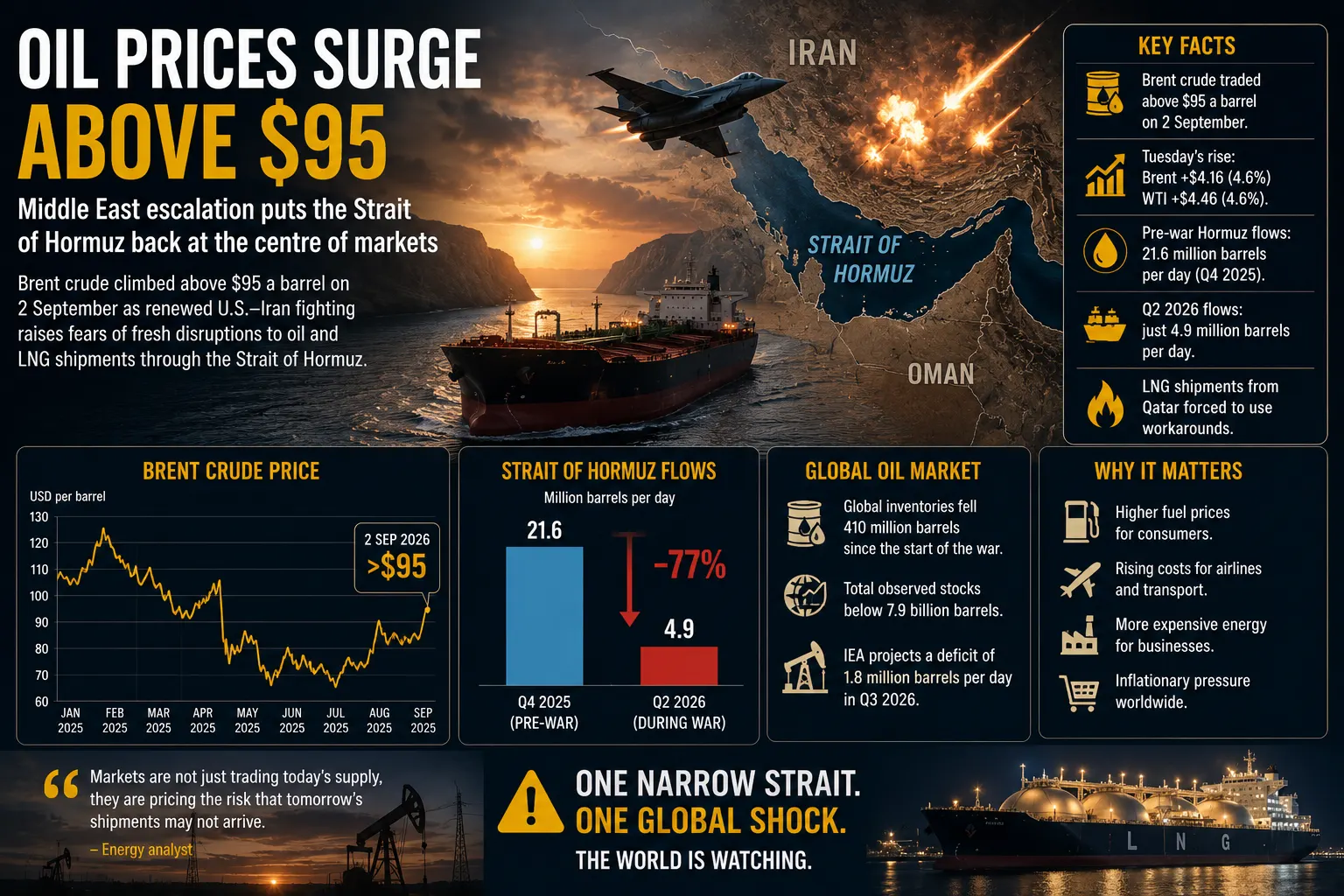
Brent crude climbed above $95 a barrel on Wednesday as renewed fighting between the United States and Iran returned the world’s most important oil chokepoint to the centre of financial markets. Prices had already jumped by more than $4 a barrel on Tuesday, when Brent settled at $94.65, and traded above $95 during the latest session as investors reassessed the possibility that a partial recovery in shipping through the Strait of Hormuz could again be interrupted.
The reaction is not simply a response to military headlines. Before the war, more than 20 million barrels a day of crude oil and other petroleum liquids routinely passed through Hormuz, an amount equivalent to roughly one-fifth of global petroleum consumption. During the second quarter of 2026, flows collapsed to an average of only 4.9 million barrels a day, according to the U.S. Energy Information Administration. That reduction has already made the conflict one of the largest disruptions to global energy supply in modern history.
Until this week, markets had begun to see signs of improvement. U.S. Energy Secretary Chris Wright said 17 million barrels of oil passed through the strait on Monday, the highest daily volume since the war disrupted normal traffic. Yet new U.S. attacks on Iranian military infrastructure, Iranian retaliation against American facilities around the Gulf and reports of mines damaging tankers have demonstrated how quickly that recovery can be threatened. Oil traders are consequently pricing not only today’s physical supply but the probability that tomorrow’s shipments may fail to arrive.
Brent crude: traded above $95 a barrel on 2 September after settling at $94.65 a day earlier.
Tuesday’s rise: Brent gained $4.16, or 4.6%, while U.S. WTI rose $4.46 to $90.22.
Pre-war Hormuz flows: 21.6 million barrels a day of crude and petroleum liquids in the fourth quarter of 2025.
Second-quarter 2026: Hormuz flows averaged just 4.9 million barrels a day.
The Oil Price Is Reacting to a Chokepoint, Not Just to Iran
The geography of the Strait of Hormuz explains why a conflict involving Iran can move prices paid by motorists, airlines, manufacturers and households thousands of kilometres away. The narrow waterway between Iran and Oman is the principal maritime exit from the Persian Gulf. Saudi Arabia, Iraq, Kuwait, the United Arab Emirates, Qatar and Iran all depend on it to varying degrees for energy exports.
Some production can bypass Hormuz. Saudi Arabia operates its East-West pipeline towards the Red Sea and the UAE has a pipeline carrying crude to Fujairah outside the strait. Other routes and storage facilities provide additional flexibility. But their combined spare capacity cannot simply replace the volumes that normally move through Hormuz, and rerouting oil can increase transport time and cost.
Liquefied natural gas adds another dimension. Qatar is one of the world’s largest LNG exporters and normally ships its cargoes through Hormuz. The conflict has forced extraordinarily unusual workarounds, including ship-to-ship transfers outside the strait involving Qatari and Emirati LNG cargoes. Asian spot LNG prices have risen sharply during the crisis, spreading the energy shock beyond oil into electricity and industrial gas markets.
21.6 million barrels a day of crude oil and petroleum liquids moved through Hormuz in late 2025 before the conflict disrupted the route.
A Market That Had Started to Recover Is Suddenly Fragile Again
The latest rise in crude is particularly significant because it follows several months of extraordinary volatility. Brent surged above $120 a barrel during earlier phases of the conflict before falling back as producers outside the Gulf increased output, emergency reserves were released, demand weakened and some shipments through Hormuz resumed. By August, crude was trading closer to $90, suggesting that the market had absorbed more of the initial shock than many analysts had feared.
That resilience depended on several buffers operating simultaneously. Governments released emergency oil stocks, non-Gulf producers raised supply, consumers and businesses reduced or delayed some energy use, inventories were drawn down and alternative transport routes carried what they could. Renewable electricity and lower energy intensity in many advanced economies also mean that a barrel of oil has less influence over economic output than during the energy crises of the 1970s.
But those buffers are finite. The International Energy Agency estimated in August that observed global oil inventories had fallen by 410 million barrels between the beginning of the war and the end of July. Total observed stocks had dropped below 7.9 billion barrels, while the agency projected a global oil-market deficit of 1.8 million barrels a day during the third quarter.
The IMF reached a similar conclusion in July: the global market had absorbed the initial shock better than expected, but much of the available cushion had already been used. That makes a renewed interruption potentially more damaging than an identical disruption would have been when inventories were larger and emergency measures had barely begun.
How the Oil Supply Shock Has Changed
| Indicator | Before or early in war | Latest available position |
|---|---|---|
| Hormuz petroleum flows | 21.6m b/d in Q4 2025 | 4.9m b/d average in Q2 2026 |
| Global oil supply | Above 2026 crisis levels | 101.5m b/d in July |
| Observed inventories | War starting point | Down 410m barrels by end-July |
| Brent crude | Around $70 average in 2025 | Above $95 on 2 September |
Source: U.S. Energy Information Administration, International Energy Agency and Reuters.
Why $95 Oil Matters Even Without a Complete Closure
A common misconception is that Hormuz must be completely closed before the global economy is affected. In reality, oil prices respond to expected future availability as much as to today’s physical shortage. Tanker owners consider the risk to crews and vessels, insurers adjust premiums, buyers compete for alternative cargoes and refiners pay more to secure reliable supply. Those costs can rise well before the final barrel stops moving.
Shipping data underline the instability. Preliminary information showed only four commodity vessels passing through Hormuz on Tuesday, compared with ten a day earlier and a ten-day average of about 13. Ship-tracking data are imperfect because vessels may disable transponders for security reasons, but the sharp variation illustrates how sensitive commercial traffic remains to developments on land and at sea.
The market therefore faces two very different possibilities. If shipping continues to recover and diplomacy contains the latest fighting, part of the current risk premium could disappear quickly. If mines, missile attacks or military action again substantially restrict passage, analysts cited by Reuters see a clear route for Brent to move above $100 a barrel.
Neither outcome can be treated as a forecast with certainty. Oil prices are influenced by global demand, inventories, OPEC+ production, U.S. output, sanctions, exchange rates and economic expectations as well as the conflict. But Hormuz has become the variable capable of overwhelming many of those normal market forces over short periods.
The First Economic Effect Appears at the Fuel Pump
Crude oil is an input rather than the final product bought by most consumers. Refineries convert it into petrol, diesel, jet fuel, heating oil, petrochemical feedstocks and other products, while transport, distribution, taxes and retail margins determine the final price. A $5 increase in Brent therefore does not translate mechanically into a fixed increase at every petrol station.
Nevertheless, sustained higher crude prices generally push wholesale fuel costs upward. Diesel is particularly important economically because it is used extensively in freight transport, agriculture, construction and industrial machinery. Jet fuel directly affects airlines, and fuel oil remains important in shipping. Energy inflation therefore enters the economy through businesses as well as household transport.
Refining has become an additional problem during the current crisis. The IEA said global refinery crude throughput in July remained almost five million barrels a day below the level a year earlier. Disruptions to Middle Eastern product exports, combined with attacks on Russian refineries, have tightened diesel and other middle-distillate markets. That means consumers can face higher prices even when crude itself is not at an historic record.
Energy Inflation Travels Through Almost Everything Else
The second stage of an oil shock is less visible but potentially more important. A supermarket product may have been manufactured with energy, transported by truck, stored in a distribution centre, refrigerated and delivered again before reaching the shelf. Farmers use diesel and energy-intensive fertiliser; airlines price fuel into tickets; manufacturers consume electricity, gas and petroleum products; logistics companies operate fleets whose costs change with diesel.
Businesses do not necessarily pass every additional euro of cost to customers. Some absorb part of it in profit margins, some improve efficiency and some have energy contracts that delay the impact. Where higher costs persist, however, the pressure to increase prices becomes stronger. That is how an oil shock can move from a commodity-market event into broader consumer inflation.
The danger is greater when an economy enters the shock with inflation already above target. The IMF said in July that the disinflation trend in place since early 2024 had stalled and raised its forecast for global headline inflation in 2026 to 4.7%. Euro-area inflation subsequently moved above 3% in August, making another sustained rise in energy prices particularly uncomfortable for central banks.
Central Banks Face the Worst Combination: More Inflation and Less Growth
An oil shock is different from the inflation created by exceptionally strong consumer demand. Higher energy prices can raise inflation while simultaneously reducing households’ real purchasing power. A family spending more on petrol and heating has less money available for restaurants, clothing, holidays or other goods. Businesses facing higher transport and production costs may postpone investment or hiring.
That creates a policy dilemma. Raising interest rates can restrain demand and prevent temporary energy inflation from spreading into wages and other prices, but higher borrowing costs can also weaken an economy already being slowed by the energy shock. Leaving rates unchanged may support growth, but policymakers risk allowing inflation expectations to rise if consumers and businesses begin assuming that rapid price increases will persist.
Financial markets are already reacting to that dilemma. Global bond yields rose sharply on Wednesday as investors combined renewed energy inflation with existing concerns about government borrowing and central-bank policy. U.S. ten-year Treasury yields moved close to three-year highs, while European government bond yields also increased. Expectations that major central banks may need to keep monetary policy restrictive for longer have consequently strengthened.
This is one reason today’s oil movement matters even though Brent remains well below the peak reached earlier in the war. The economic impact depends not only on the absolute price of a barrel but also on how long prices remain elevated, how businesses and wages respond and whether central banks believe the inflationary effect will become persistent.
Energy Importers Carry a Larger Burden Than Producers
The global effect is highly uneven. Countries that export more oil than they consume can receive larger revenues when prices rise, although they may still suffer from financial volatility, disrupted trade and weaker global demand. Net importers face the opposite arithmetic: the same quantity of imported energy suddenly costs more.
India is a particularly clear example. As one of the world’s largest crude importers, it faces a larger import bill when oil rises, pressure on its currency and a greater risk of domestic inflation. Indian financial markets fell on Wednesday as the renewed conflict pushed crude higher, illustrating how quickly an energy shock can affect currencies, bonds and equities in a major importing economy.
Europe is also a substantial net energy importer. Its exposure is lower than during earlier oil crises because energy efficiency and renewable electricity have expanded, while the region has diversified energy supplies since Russia’s invasion of Ukraine. Yet transport, aviation, industry and parts of heating remain dependent on fossil fuels. Higher oil and gas prices therefore still weaken household purchasing power and industrial competitiveness.
Lower-income economies can be more vulnerable still. Many have less fiscal capacity to subsidise energy, smaller foreign-exchange reserves and currencies that can depreciate when their import bills rise. If governments attempt to protect consumers through broad fuel subsidies, the shock may reappear as a larger budget deficit rather than disappearing from the economy.
Ireland Is Exposed Through Oil Even Without Buying Directly From Iran
Ireland illustrates how a distant conflict travels through international markets. Sustainable Energy Authority of Ireland data show that the State imported 78.2% of its overall energy requirement in 2025 and imported all of the oil it consumed. Oil supplied 47.3% of Ireland’s energy requirement, with transport accounting for much of that dependence.
The country does not need to buy Iranian crude for a disruption in Hormuz to matter. Oil trades in an integrated international market. When Gulf supply becomes harder to obtain, buyers compete more strongly for barrels from the North Sea, the Americas, Africa and elsewhere, lifting the benchmark prices against which many transactions are calculated.
There are buffers between Brent and the price paid by Irish households. Taxes form a substantial part of petrol and diesel prices, retailers and distributors have different purchasing arrangements, and inventories mean changes do not arrive instantaneously. But a prolonged period around or above $100 would place renewed upward pressure on transport, heating and business costs after several years in which inflation has already reduced household purchasing power.
Why This Shock Is Not Yet a Repeat of the 1970s
Comparison with the oil crises of the 1970s is tempting because both involve geopolitical conflict around critical petroleum supplies. The world economy, however, has changed profoundly. Advanced economies use less oil for each unit of economic output, electricity generation is less dependent on petroleum, vehicles are more efficient and renewable energy provides a much larger share of power.
Supply has also become geographically broader. The United States is now a major oil producer, Brazil, Canada, Guyana and other non-Gulf producers provide additional barrels, and strategic petroleum reserves give governments a temporary mechanism for responding to severe disruptions. These changes help explain why the enormous reduction in Gulf supply this year did not leave Brent permanently above $120.
The International Energy Agency has coordinated the largest release of emergency oil stocks in its history during the 2026 crisis. Governments have also encouraged conservation, fuel switching and additional production. Those actions do not create unlimited oil, but they reduce the probability that a temporary disruption immediately becomes an economic catastrophe.
The comparison nevertheless contains a warning. Emergency reserves can be released only once before they need replenishment, alternative pipelines have capacity limits and additional production cannot always be brought online rapidly. The longer a major chokepoint remains unreliable, the more the system depends on inventories rather than normal supply.
The World Economy Has Withstood the War Better Than Feared — So Far
The IMF’s July assessment projected global growth of 3% in 2026 and 3.4% in 2027. That outlook assumed a gradual reopening of Hormuz beginning in the summer and normalisation towards pre-war conditions by March 2027. It also assumed an average oil price of about $89 a barrel for 2026 based on market conditions available when the forecast was prepared.
The latest price rise does not automatically invalidate those forecasts. Brent would have to remain materially above the assumptions for an extended period, rather than merely trading there for several days, to produce a substantially different annual outcome. But renewed warfare increases the risk that the assumed recovery in shipping takes longer than economists expected.
The IMF has emphasised that the world economy has so far displayed considerable resilience. Strong activity in several large economies, greater energy efficiency, alternative oil production and inventory releases prevented the first phase of the war from turning into a global recession. Evidence of broad second-round inflation effects was also limited through the middle of the year.
The risk now is cumulative rather than instantaneous. Businesses and households can absorb a temporary shock more easily than six or twelve months of elevated energy costs. Inventories can compensate for missing barrels temporarily, but repeated draws reduce future protection. Monetary policy can tolerate a short-lived rise in headline inflation more easily than a sequence of shocks that repeatedly prevents inflation returning to target.
Three Oil Scenarios From Here
| Scenario | Oil-market effect | Economic implication |
|---|---|---|
| De-escalation | Hormuz flows continue recovering | Risk premium could fall |
| Prolonged instability | Oil remains elevated and volatile | Inflation stays higher for longer |
| Major new disruption | Flows fall sharply again | Oil above $100 becomes more plausible |
Scenarios are analytical illustrations based on current market conditions and are not price forecasts.
The Most Important Variable Is Duration, Not Today’s Price
A Brent price of $95 or $96 does not by itself determine the outlook for inflation or global growth. Markets have traded at comparable and higher levels before without producing a worldwide recession. The decisive questions are how long the price persists, whether refined fuels and gas rise with it, and whether the shock changes wage demands, corporate pricing and inflation expectations.
A rapid diplomatic de-escalation could produce the opposite movement almost as quickly. If ships can transit Hormuz reliably, insurance costs ease and Gulf production continues returning, the geopolitical premium embedded in crude could shrink. Additional supply from outside the region would reinforce that adjustment. Recent experience has shown that oil can fall rapidly when traders conclude that the probability of physical shortages has declined.
A prolonged conflict would create a more difficult outcome. Brent remaining near or above $100 into the northern-hemisphere winter would keep transport and industrial costs under pressure while central banks are already confronting stubborn inflation. Governments would then face renewed choices over fuel taxes, subsidies, strategic reserves and support for vulnerable households and businesses.
The most severe scenario would involve another substantial interruption of Hormuz combined with damage to Gulf production or export infrastructure. The economic impact would depend on the duration and scale of the disruption, but the remaining market buffers are smaller than they were at the beginning of the war. Under those conditions, the pressure would extend from energy prices into currencies, government bonds, corporate investment and consumer spending.
Hormuz Has Become an Economic Indicator in Its Own Right
For most consumers, the Strait of Hormuz was once a distant geographical reference. In 2026 it has effectively become a real-time indicator for the global economy. Every tanker that passes through increases confidence that supply is normalising; every mine, missile strike or military warning raises the probability that it will not.
That is why Wednesday’s movement above $95 matters more than the number alone suggests. Oil remains below the extreme levels reached earlier in the conflict, and significant volumes are again moving through Hormuz. The world economy has not run out of energy, nor does the latest escalation make recession inevitable.
But the margin for error has narrowed. Hundreds of millions of barrels have already been withdrawn from global inventories, emergency reserves have been used, and inflation has proved more persistent than central banks hoped. Renewed fighting is therefore arriving at a moment when the world’s capacity to absorb another prolonged disruption is weaker than it was six months ago.
The next decisive movement in oil may consequently occur not in a trading room but in the waters between Iran and Oman. If Hormuz keeps reopening, today’s price spike could become another temporary episode in an exceptionally volatile year. If the route contracts again, the consequences will travel rapidly from Gulf tankers to fuel pumps, inflation data, interest-rate decisions and household budgets around the world.
Sources
Reuters — Oil Prices Steady as Traders Weigh Supply Risks, 2 September 2026
Reuters — Oil Prices Rise More Than $4 on Renewed US-Iran Fighting, 1 September 2026
Reuters — Shipping Traffic Through the Strait of Hormuz, 2 September 2026
Reuters — 17 Million Barrels Transited Hormuz on Monday
U.S. Energy Information Administration — Global Oil Markets and Strait of Hormuz Flows
International Energy Agency — Oil Market Report, August 2026
International Energy Agency — 2026 Energy Crisis Policy Response Tracker
International Monetary Fund — The Oil Market Absorbed the War Shock, but Buffers Are Running Low
International Monetary Fund — World Economic Outlook Update, July 2026
European Central Bank — Energy Shock: Why Oil and Gas Prices Have Risen Less Than Expected
Sustainable Energy Authority of Ireland — Energy Supply and Security of Supply
Source & Transparency
This article is published by Ireland Newspaper for editorial and informational purposes.
Published: 2 September 2026 · Updated: 2 September 2026

Newsroom Ireland Newspaper
Ireland Newspaper editorial team prepares daily news coverage for readers in Ireland and abroad.




Market data, financial news and economy content on Ireland Newspaper are provided for editorial and informational purposes only. They do not constitute financial advice, investment advice, trading advice or a recommendation to buy, sell or hold any financial product. Always verify live prices and consult a qualified professional before making financial decisions.