Ireland’s Great Golf Landscape: Eight Courses Worth Travelling For
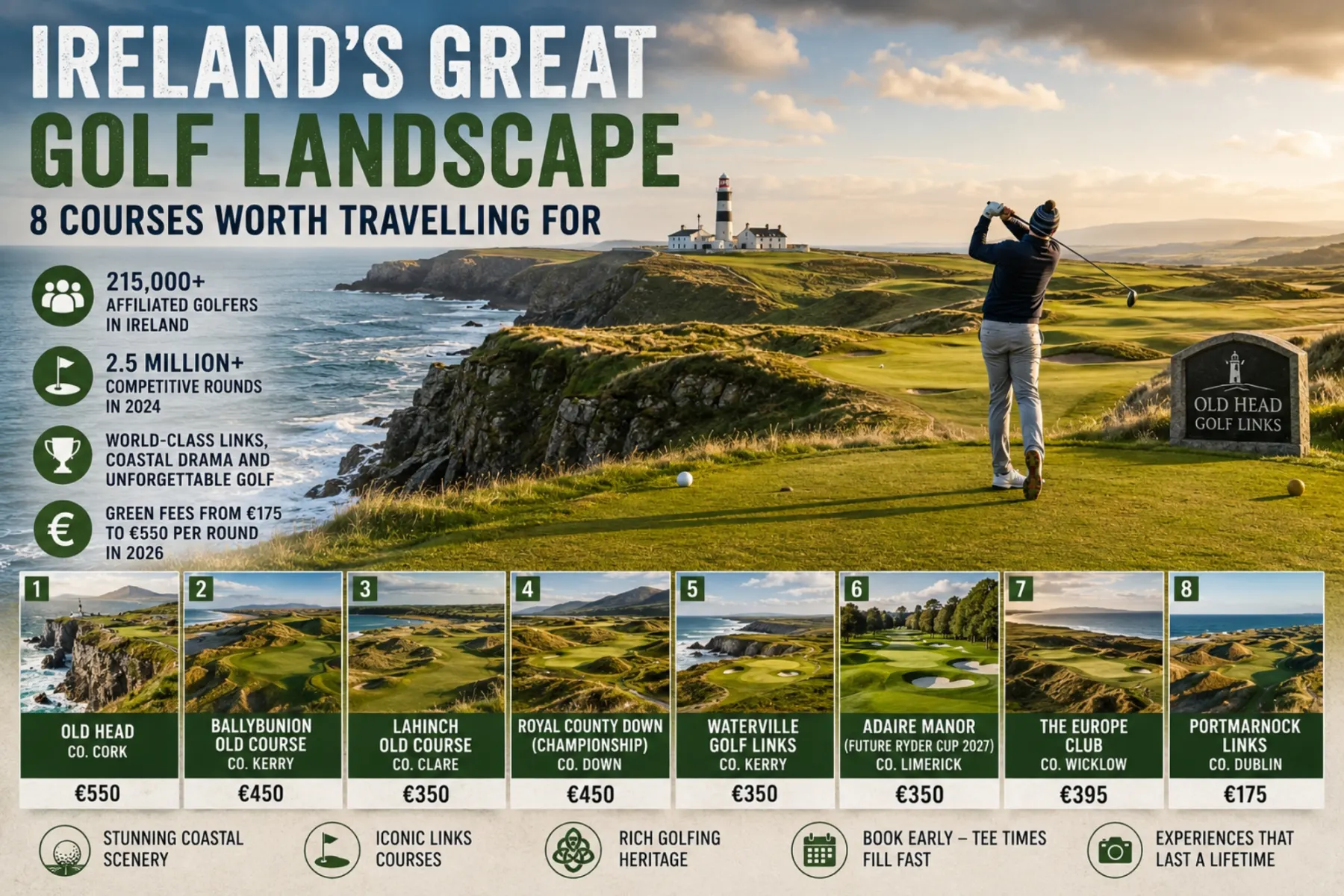
From the Atlantic cliffs of Old Head and the giant dunes of Ballybunion to the future Ryder Cup stage at Adare Manor, Ireland possesses an extraordinary concentration of world-class golf. More than 215,000 golfers belong to Golf Ireland-affiliated clubs across the island, while international visitors are prepared to pay €400, €450 and even €550 for a single round on the country’s most celebrated courses. Here is what the experience costs in 2026 — and where some of Ireland’s most memorable golf can be found.
There are places where a golf course has been constructed on a landscape.
And then there is Ireland, where some of the finest courses appear as though the landscape was simply waiting for somebody to place eighteen flags in it.
Fairways disappear between Atlantic dunes.
Greens sit above cliffs.
Golf balls move sideways in winds that seemed perfectly harmless five minutes earlier.
A drive that looks magnificent in calm conditions can become an entirely different proposition when the weather turns.
And on the best Irish links, the sea is rarely decoration.
It is part of the game.
This is why discussing Ireland’s most beautiful golf courses is difficult.
There are too many legitimate candidates.
The following selection is therefore not presented as an absolute ranking from first to eighth. Beauty in golf is subjective, and Ireland contains dozens of courses that could reasonably appear on such a list.
Instead, these are eight particularly memorable courses in the Republic of Ireland that combine scenery, international reputation and a distinctive Irish golfing experience — together with practical information for somebody actually considering playing them in 2026.
The prices below are the clubs’ published 2026 visitor rates available as of 10 August. Golf prices, tee-time availability and seasonal access can change, so advance reservation remains essential.
Golf Is Far More Than a Tourist Attraction in Ireland
Before travelling to the courses, it is worth understanding just how deeply golf is embedded in Irish sporting life.
Golf Ireland, which governs the sport on an all-island basis, has reported more than 215,000 affiliated members and a network of 376 affiliated clubs.
That makes golf considerably more than a luxury activity for overseas visitors.
It is a club sport played every week in communities across the country.
The scale of actual play is revealing.
Golf Ireland reported more than 2.5 million competitive rounds during 2024, an increase of 9% from the previous year. Around 40,000 golfers and 5,709 club teams participated in national and regional inter-club competitions.
A separate participation study produced with The R&A estimated 543,000 golfers in Ireland when people playing outside traditional club membership were included. Female participation had also increased substantially in the period surrounding the pandemic.
The introduction of Golf Ireland’s iGolf programme for golfers who do not belong to a conventional club is another sign that the sport is attempting to broaden access. By late 2025, iGolf subscribers had already registered more than 30,000 rounds and generated an estimated €1.4 million in green-fee revenue for clubs, while more than 240 participants subsequently moved into traditional club membership.
Golf in Ireland therefore operates on two levels simultaneously.
There is the spectacular international golf-tourism industry built around places such as Ballybunion, Lahinch and Old Head.
And beneath it is the much larger everyday world of club competitions, junior golf, weekend fourballs, societies and local memberships.
The two are closely connected.
Ireland Was Organising Golf Before Almost Anybody Else
The depth of the sport also has historical roots.
Golf Ireland is the successor to the Golfing Union of Ireland and Irish Ladies Golf Union, organisations created in 1891 and 1893 respectively.
Ireland consequently developed organised golf remarkably early.
That history remains visible today in clubhouses, competitions and courses whose origins stretch back more than a century.
But Irish golf’s greatest international asset may be geological rather than historical.
Ireland possesses exceptional links land.
True links courses develop on sandy coastal terrain, normally between farmland and the sea. The ground drains rapidly, grasses grow naturally in sand, dunes shape the fairways and wind becomes an essential part of strategy.
Ireland’s western coastline provides this terrain on an extraordinary scale.
That brings us to County Kerry.
Ballybunion Old Course: Where Irish Links Golf Becomes Theatre
Address: Sandhill Road, Ballybunion, Co. Kerry, V31 RX37
2026 high-season green fee: €450 per person
2026 mid-season green fee: €400
Visitor season: mid-April to early October
Visitor tee times: Old Course mornings, Monday to Friday; weekends reserved for member play
Two-round Old + Watson Cashen offer: €575 from 4 August to 2 October 2026
Few Irish golf names carry greater international recognition than Ballybunion.
The club was founded in 1893 and contains two links courses, but it is the Old Course that established the global reputation.
The experience begins among relatively gentle opening holes before the course gradually moves into enormous Atlantic dunes.
Then the character changes.
Fairways narrow between natural ridges.
The wind becomes increasingly important.
The sea appears.
Some greens seem almost to have been dropped into gaps between the dunes.
And the golfer begins understanding why generations of international players have travelled to this corner of Kerry.
Ballybunion’s own current listings note that its Old Course has repeatedly appeared in international rankings of the world’s leading golf courses.
The 2026 visitor price reflects that status.
The Old Course costs €450 per person during the high season from 1 May to 2 October. Mid-season play from 13 to 30 April costs €400.
The Watson Cashen course should not be treated merely as the secondary option. It occupies dramatic neighbouring links land and reopened on 4 August following upgrade work.
A two-round package combining the Old Course and Watson Cashen costs €575 from 4 August to 2 October.
Visitors need to plan carefully.
Morning visitor tee times on the Old Course are normally available Monday to Friday from mid-April to early October, excluding Bank Holiday Mondays. Weekends are principally retained for member play.
For the serious visiting golfer, Ballybunion is not cheap.
But it is one of the courses around which an entire Irish golf trip can reasonably be built.
Lahinch Old Course: Golf in the Dunes of County Clare
Address: Lahinch Golf Club, Lahinch, Co. Clare, V95 HD00
2026 Old Course green fee: €450
Castle Course: €60
Published 2026 visitor-fee period: 27 April to 16 October
Visitor access: seven days, subject to tee availability
Clubhouse food service: from 8:30am daily
Lahinch is different.
It is not simply a golf resort sitting beside a town.
The course and the town almost merge.
Surfers walk towards the Atlantic.
Golfers move through the dunes.
Visitors arrive for the Cliffs of Moher and the Burren.
And only a relatively short distance away sits one of Ireland’s great traditional links courses.
The Old Course contains the fingerprints of several important golf architects, most famously Alister MacKenzie, who later became associated with Augusta National.
But Lahinch has never been transformed into a perfectly predictable modern course.
Its character comes partly from the opposite.
There are dunes.
Changes of elevation.
Blind shots.
Natural contours.
Wind.
And golf holes that ask the player to accept that occasionally the landscape knows more than the scorecard.
For 2026, the Old Course visitor green fee is €450 every day of the week from 27 April through 16 October. The neighbouring Castle Course costs only €60, making it an interesting option for visitors who want to experience Lahinch without paying the premium Old Course rate.
Visitors on the Old Course are required to have at least one caddie within the group, another reflection of how unfamiliar traditional links terrain can be to first-time players.
The club’s catering service begins from 8:30am daily, with the kitchen remaining open to accommodate golfers completing their rounds later in the day.
Lahinch has additional significance in 2026.
The club will host the Walker Cup on 5 and 6 September, placing one of amateur golf’s great international contests on the Clare coast.
That alone makes 2026 an exceptional year for the club.
Old Head Golf Links: Golf on the Edge of the Atlantic
Address: Old Head Golf Links, Kinsale, Co. Cork, P17 CX88
2026 high-season green fee: €500
Low-season green fee: €250
High season: 22 April to 11 October
Low season: 12–31 October
Closed season: from 1 November 2026 until April 2027
Reservations: advance booking strongly required
There are golf courses with sea views.
Then there is Old Head.
The course occupies a headland extending into the Atlantic south of Kinsale, with enormous cliffs falling towards the sea.
From the air, the layout almost seems improbable.
Golf holes occupy a narrow piece of land surrounded by water.
The lighthouse stands near the far end.
Cliff-edge tees and greens create views so dramatic that the club’s own scorecard carries explicit safety warnings around some exposed areas.
Old Head is younger than the great nineteenth-century Irish links.
That does not make the landscape any less spectacular.
For many overseas golfers, it has become one of the defining photographs of Irish golf tourism.
The experience is priced accordingly.
The 2026 high-season green fee is €500 for 18 holes, applying from 22 April through 11 October.
From 12 to 31 October, the low-season rate falls sharply to €250.
A senior caddie costs €90 for a single bag or €70 per bag when double-bagging. Golf carts are €60, rental clubs €60 and push trolleys €10.
The course operates seasonally rather than throughout winter.
For golfers who enjoy dramatic landscapes as much as championship architecture, Old Head may be the most visually unforgettable course on this list.
There is another advantage.
Kinsale is one of Ireland’s best-known food and harbour towns.
Golf can therefore be only one part of the trip.
Waterville Golf Links: A Championship Course Between Ocean, River and Estuary
Address: Murreagh, Waterville, Co. Kerry, V23 W940
2026 main season: 1 April to 31 October
Monday, Tuesday, Thursday, Friday: €400
Wednesday, Saturday, Sunday and Bank Holidays: €425
Opening: every day during the season
Golf cart: €50
Club rental: €50
Waterville occupies an extraordinary piece of land.
The course lies on natural dune terrain bordered by the Atlantic on one side, the Inny River and estuary on others and bogland to the south.
The result is isolation without artificiality.
The holes move through high dunes, but unlike some older links courses, Waterville emphasises visibility: the club notes that there are no blind shots on the championship layout.
The course is a par 72 stretching to almost 7,350 yards from the back tees, although five sets of tees allow visitors to choose a more appropriate distance.
Waterville’s 2026 green-fee structure is slightly unusual.
During the main season from 1 April to 31 October, the fee is:
€400 on Monday, Tuesday, Thursday and Friday.
€425 on Wednesday, Saturday, Sunday and Bank Holidays.
Golf carts cost €50, electric trolleys €25, pull trolleys €5 and rental clubs €50.
A senior caddie costs €100 for a single bag.
The club describes itself as open every day, although actual tee times depend on the reservation schedule.
Waterville also works beautifully as part of a wider Kerry holiday.
The village sits on the Ring of Kerry, meaning non-golfing members of a family do not have to spend the day waiting in a clubhouse.
That matters more than golfers sometimes admit.
Tralee Golf Club: Arnold Palmer and the Atlantic Coast
Address: West Barrow, Ardfert, Tralee, Co. Kerry, V92 A406
2026 high-season green fee: €450
High season: 13 April to 9 October
Mid-season: €250 from 1–10 April
Regular visitor tee times: Monday, Tuesday, Thursday and Friday, 8:00am–3:00pm
Buggy: €60, normally for medical requirements
Club rental: €65
Tralee is perhaps the clearest demonstration of how little a golf architect sometimes needs to do when the land is already extraordinary.
Arnold Palmer designed the course on the Atlantic coast at Barrow, north-west of Tralee.
The opening nine is impressive.
The back nine is where the landscape becomes spectacular.
Dunes rise dramatically around the holes.
Clifftop sections provide views over the ocean.
Fairways twist through terrain that seems almost too complicated to have been designed.
The club famously attributes to Palmer the observation that he may have designed the first nine, but nature effectively designed the second. Whether repeated as golf folklore or architectural shorthand, it captures the experience remarkably well.
The current high-season visitor green fee is €450 from 13 April through 9 October.
A shorter mid-season window from 1 to 10 April is priced at €250.
Visitor tee times during the principal season are published for Monday, Tuesday, Thursday and Friday from 8am until 3pm.
Tralee is primarily a walking course.
Buggies cost €60 but are intended for medical requirements rather than general recreational use. Electric trolleys cost €25 and rental clubs €65.
For somebody building a serious South-West Ireland golf itinerary, Tralee combines naturally with Ballybunion, Waterville and Old Head.
The difficulty is not finding enough good golf.
It is deciding which course to leave out.
Enniscrone: Giant Dunes Without the €450 Price Tag
Address: Bartragh, Enniscrone, Co. Sligo, F26 PY54
Dunes Championship Links 2026: €290
Main visitor season: 17 March to 31 October
Scurmore Links: €40 for nine or 18 holes
Winter: available at separate rates
Buggy: €45
The north-west of Ireland contains some of the country’s most extraordinary links terrain, but it receives fewer international visitors than Kerry and Clare.
That makes Enniscrone particularly interesting.
The club contains 27 holes across roughly 400 acres of links land, with the par-73 Dunes Championship Links as its principal course.
The defining feature is exactly what the name suggests.
Dunes.
Large ones.
The course moves through enormous natural sand formations close to Killala Bay, giving many holes a sense of separation from everything around them.
The 2026 standard visitor fee on the Dunes course is €290 from 17 March through 31 October.
That is hardly inexpensive.
But compared with the €450–€500 charged by several of Ireland’s most famous South-West courses, Enniscrone begins to look almost like value.
The smaller Scurmore Links provides nine or 18 holes for €40, offering a dramatically cheaper alternative.
Buggies for 18 holes cost €45.
For golfers planning the Wild Atlantic Way, Enniscrone also provides a natural route towards County Mayo and Carne.
This is the side of Irish golf where the landscape can still feel remarkably empty.
Carne Golf Links: Perhaps Ireland’s Wildest Golf Landscape
Address: Carne, Belmullet, Co. Mayo
Courses: Original Hackett Course and Wild Atlantic Dunes
Caddie: €80 per bag
Buggy: €40
Electric trolley: €15
Club hire: €50
Visitor fee: dynamic booking rate; the club states that the 2026 €70 member-guest rate is less than half its standard visitor green fee
Carne deserves inclusion even though its current public website does not display a simple single standard 2026 visitor price in the same way as Ballybunion or Lahinch.
That uncertainty is preferable to inventing a number.
What can be established is that Carne states its 2026 member-guest price of €70 is less than half the standard visitor green fee, meaning ordinary visitor play costs more than €140. Exact rates are provided through the booking system for the selected date and course.
The reason to make the journey to Belmullet is the land.
Carne was the final course designed by celebrated Irish architect Eddie Hackett.
Its newer Wild Atlantic Dunes routing combines part of the original layout with later holes built among some of the most dramatic dunes on the property.
In May 2026, the club announced that the Wild Atlantic Dunes course had been placed 63rd in Golf Digest’s World’s 100 Greatest Courses for 2026–27.
That ranking is not an objective law of golf.
It does demonstrate the international reputation the course has developed.
The practical extras remain comparatively inexpensive.
A caddie is €80 per bag.
A buggy is €40.
An electric trolley is €15.
A pull trolley is €5.
Rental clubs cost €50.
Carne is not the convenient choice.
That is part of its attraction.
Belmullet is a long journey from Dublin and still a substantial trip from many other Irish tourist centres.
Golfers who make the journey are rewarded with something increasingly difficult to find at world-famous courses:
space.
Adare Manor: The Luxury Counterpoint to Ireland’s Links
Address: Adare Manor, Adare, Co. Limerick, V94 W8WR
2026 green fee: €550 per person
Access: resort residents and members
2026 playing season: 26 May to 18 October
Closed: Mondays except Bank Holidays
Golf cart: €70
Club hire: €75
Caddie: €120
Not every great Irish golf course sits beside the sea.
Adare Manor demonstrates the alternative.
Where Ballybunion and Lahinch are shaped by sand, wind and Atlantic rough, Adare is intensely manicured parkland.
The course sits within the Adare Manor estate in County Limerick and was redesigned by Tom Fazio.
Its immediate significance is obvious.
Adare Manor will host the Ryder Cup in 2027.
That gives anyone playing the course during 2026 an unusual opportunity to experience the venue before Europe and the United States contest one of world sport’s most recognisable team events there.
Access, however, is deliberately restricted.
For the 2026 season, only resort residents and members can play, with resident green fees priced at €550 per person.
The course is open from 26 May to 18 October and is closed every Monday except Bank Holidays.
Cart hire costs €70.
Rental clubs cost €75.
An electric trolley costs €25.
A caddie costs €120.
This is clearly not everyday club golf.
A couple playing one round while staying at the resort can spend more than €1,000 on green fees alone.
But Adare is selling a very different product from a local members’ course.
It is luxury golf tied to a luxury resort and an impending Ryder Cup.
Jameson Golf Links: The Accessible Dublin Coastal Option
Address: Strand Road, Portmarnock, Co. Dublin, D13 V2X7
2026 summer visitor green fee: €320
Summer: 1 April to 31 October
Winter visitor fee: €150
Winter: January–March and November–December
Visitor booking: available throughout the published summer and winter seasons
For visitors based in Dublin, one problem with Ireland’s greatest golf courses is geography.
Many of the most dramatic links are several hours away.
Portmarnock provides the answer.
The Jameson Golf Links at Portmarnock Resort offers genuine coastal links golf only a relatively short journey from Dublin city and airport.
The course occupies land beside the Irish Sea and provides an attractive introduction to links golf for visitors who cannot build an entire journey around Kerry, Clare or Mayo.
The official 2026 visitor rate is €320 during the summer season from 1 April to 31 October.
During the winter period, the visitor rate falls to €150.
Unlike courses whose visitor access is concentrated into certain weekdays, Jameson actively markets itself towards international visitor golf, with tee times booked through the resort’s golf operation.
The price also illustrates an increasingly clear pattern in Irish golf tourism.
The famous links are no longer inexpensive.
Premium green fees of €300 to €500 have become normal at many internationally recognised destinations.
And Then There Is Portmarnock Golf Club
No serious discussion of golf in the Republic of Ireland should ignore Portmarnock Golf Club itself.
Address: Golf Links Road, Portmarnock, Co. Dublin, D13 KD96.
It is one of Ireland’s great historic championship links and contains 27 holes beside Dublin Bay.
But it also demonstrates why a current golf guide needs to discuss availability, not simply reputation.
The club’s official visitor reservation system currently states that it is fully booked until 30 September 2026.
Visitors are normally welcomed between 1 April and 31 October, while the club closes to visitor golf from November through March.
Rather than publish a historic or third-party green fee that may not represent the next available dates, the safest approach is to check the official reservation system when October availability opens.
Portmarnock is also a walking course.
Visitor buggies are not generally available, and groups of visiting golfers are subject to caddie requirements.
For somebody planning well in advance rather than looking for a tee time next week, it remains one of the essential names in Irish golf.
Why Are Ireland’s Famous Courses So Expensive?
A green fee of €450 can initially appear extraordinary.
For many Irish club golfers, it is.
Most golfers in Ireland do not pay anything close to that every weekend.
They belong to local clubs or play open competitions and green-fee courses at much lower prices.
The €400-plus market represents the premium international golf-tourism segment.
Several factors support those prices.
Demand from North American visitors is substantial.
Tee-time supply is limited.
Traditional links cannot simply add another hundred golfers each afternoon without changing the playing experience and affecting course condition.
Maintenance standards are extremely high.
Caddie operations add another service layer.
And Ireland competes not only internally but with Scotland and other premium international golf destinations.
There is also scarcity.
Nobody can build another Ballybunion Old Course beside Ballybunion.
The dune system already exists.
The landscape itself is part of what visitors are buying.
The €450 Round Is Not the Only Way to Play Golf in Ireland
That distinction is important for families and ordinary holidaymakers.
A visitor does not need to spend €500 to enjoy Irish golf.
Enniscrone’s Scurmore course costs €40.
Lahinch’s Castle Course costs €60.
Hundreds of local clubs offer visitor rounds and open competitions at considerably lower prices.
Golf Ireland lists more than 376 affiliated clubs across the island.
The premium courses are therefore best understood in the same way as five-star hotels.
They represent one end of a much broader market.
Some of the most enjoyable golf holidays can mix both.
Play Ballybunion once.
Then spend the following day at a smaller local club where the green fee is a fraction of the cost and the conversation in the clubhouse may be every bit as memorable.
Golf Tourism Fits Ireland Particularly Well
Golf tourism has one economic advantage that distinguishes it from some forms of sightseeing.
Golfers tend to stay.
A visitor does not normally fly into Ireland, play Ballybunion and fly home that evening.
A South-West golf itinerary might include:
Ballybunion.
Tralee.
Waterville.
Old Head.
Perhaps Lahinch on the journey north.
That means hotel nights.
Restaurants.
Car hire.
Caddies.
Local transport.
Pubs.
Golf shops.
And spending in towns that might otherwise receive fewer international visitors.
The location of the courses distributes some of that tourism expenditure into rural and coastal regions.
Ballybunion is in north Kerry.
Waterville lies far down the Iveragh Peninsula.
Carne is outside Belmullet in Mayo.
Enniscrone is in County Sligo.
These are not simply Dublin tourist attractions.
The West Coast Is Ireland’s Great Golf Highway
The concentration of courses along the Atlantic can make an extraordinary road trip.
Start in County Cork.
Play Old Head.
Move towards Kerry.
Tralee.
Ballybunion.
Waterville.
Then north towards Clare.
Lahinch.
Continue eventually into Connacht.
Enniscrone.
Carne.
The route follows much of the Wild Atlantic Way and places the golfer beside some of Ireland’s most dramatic coastal scenery even when nobody is holding a golf club.
For a mixed group where only some travellers play golf, that matters.
Kinsale offers restaurants and harbour life.
Kerry provides mountains and the Ring of Kerry.
Lahinch sits near the Burren and Cliffs of Moher.
Enniscrone has its beach.
Mayo provides some of Ireland’s wildest Atlantic landscapes.
A good Irish golf holiday therefore does not need to be a holiday only about golf.
Weather Is Not an Inconvenience — It Is Part of Links Golf
Anybody booking Irish golf should understand this before arriving:
A sunny photograph is not a weather guarantee.
A coastal course can change character several times during one round.
A calm opening hole can become a strong crosswind by the tenth.
Rain can arrive.
Disappear.
And return.
This is not necessarily bad golf weather.
It is links golf.
Wind changes the strategy.
A low-running shot can become more useful than a high approach.
The ground becomes part of the game.
Golfers accustomed to soft inland courses can suddenly discover that a ball landing short of a green may travel onto it perfectly.
That unpredictability is one reason people return.
Walking Matters More Than Many Overseas Golfers Expect
Another practical difference is that many of Ireland’s traditional links are designed fundamentally as walking courses.
Lahinch does not offer visitor buggies on its Old or Castle courses.
Tralee describes itself as a walking course, with buggies normally reserved for medical requirements.
Portmarnock Golf Club likewise restricts visitor buggy use.
That is not accidental.
Links courses grew out of walking golf.
Caddies remain important because they read the wind, understand hidden contours and know where a shot can safely miss.
For visitors unfamiliar with the terrain, the caddie can be as valuable as another club in the bag.
Caddies Add Significantly to the Cost
Premium green fees are only the beginning of the budget.
At Old Head, a senior single-bag caddie costs €90.
At Waterville, the equivalent is €100.
At Tralee it is €110.
At Adare Manor it is €120.
Gratuities are generally additional.
Rental clubs can add another €50 to €75.
A golfer playing four major Irish links can therefore easily spend well above €2,000 before accommodation, food and transport are included.
Ireland has developed into a premium international golf destination.
The price structure now reflects that status.
For Value, Look Beyond the Famous Names
This creates an opportunity for less internationally famous clubs.
A golfer does not necessarily need another global ranking.
They may want good turf.
A sea view.
A friendly clubhouse.
A sensible price.
And a tee time that is actually available.
Ireland has hundreds of clubs capable of providing exactly that.
Open competitions are particularly useful for golfers resident in Ireland and affiliated through Golf Ireland.
They can make playing excellent courses substantially more affordable than the headline international visitor rates.
The Irish golf experience therefore changes dramatically depending on whether somebody arrives as a one-time overseas visitor in August or lives locally and plays through the club competition system.
Golf’s Popularity Survived the Pandemic Boom
Many sports experienced temporary participation changes during the pandemic.
Golf was unusually well positioned because it could be played outdoors with natural physical separation between participants.
Participation consequently rose sharply.
The more important question was whether golfers would continue playing afterwards.
The subsequent figures suggest a large amount of that interest remained.
The R&A/Golf Ireland participation research found significant post-pandemic participation, including particularly strong gains among women and younger players.
Golf Ireland’s later figures showing millions of competitive rounds and extensive inter-club participation indicate that club golf remains highly active.
This makes Ireland’s golf strength unusual.
It is simultaneously a tourism export and a domestic community sport.
Irish Professional Success Has Helped
The sport also benefits from an international visibility disproportionate to the country’s population.
Irish golfers have repeatedly won major championships and played decisive roles in Ryder Cups.
That success gives young Irish golfers recognisable figures to follow and gives overseas golf audiences another reason to associate Ireland with the sport.
The cycle reinforces itself.
Successful players create attention.
Attention encourages tourism and participation.
Strong clubs and junior programmes produce another generation of players.
International tournaments return to Ireland because the audience and infrastructure already exist.
2026 and 2027 Could Strengthen Ireland’s Golf Profile Further
Lahinch hosting the Walker Cup in September 2026 places the Clare links directly in front of an international golf audience.
Then comes the much bigger event.
The Ryder Cup returns to Ireland at Adare Manor in 2027.
That will turn County Limerick into one of the centres of world sport for a week.
The effect is likely to extend beyond Adare.
Visitors planning Ryder Cup trips will look at nearby courses.
International television coverage will showcase Ireland.
Golf-tourism companies will build itineraries.
And clubs across the country will benefit indirectly from renewed attention.
The courses themselves are fixed landscapes.
Their economic influence continues changing.
Which Course Should a First-Time Visitor Choose?
That depends entirely on the experience wanted.
For pure Atlantic drama, choose Old Head.
For classic historic Irish links golf, choose Ballybunion Old.
For quirky, strategic traditional golf, choose Lahinch.
For a magnificent Kerry destination course, choose Waterville.
For huge dunes and visual drama, choose Tralee.
For wild landscape at a lower premium price, choose Enniscrone or investigate Carne.
For luxury and the future Ryder Cup venue, choose Adare Manor.
For a high-quality links experience close to Dublin, choose Jameson Golf Links, while long-term planners should also consider Portmarnock Golf Club.
There is no universally correct answer.
That is the strength of Irish golf.
The Practical 2026 Price Picture
At the premium end, the current published rates tell their own story.
Adare Manor: €550, resort residents only.
Old Head: €500 high season.
Ballybunion Old: €450 high season.
Lahinch Old: €450.
Tralee: €450 high season.
Waterville: €400–€425, depending on day.
Jameson Golf Links: €320 summer.
Enniscrone Dunes: €290.
These are significant prices.
But they also reveal how strongly global golfers value Irish links.
Book Earlier Than You Think
For the famous courses, arriving in Ireland and deciding that morning where to play is increasingly unrealistic.
Portmarnock Golf Club is already fully booked for visitors until the end of September 2026.
Ballybunion restricts Old Course visitor play principally to weekday mornings.
Adare Manor requires the golfer to be a resort resident or member.
The more famous the course, the more important advance planning becomes.
For a serious golf trip, booking the tee times before finalising the route can make more sense than booking hotels first.
The golf availability may ultimately determine the journey.
Ireland’s Greatest Golf Asset Cannot Be Manufactured
Golf courses can be redesigned.
Clubhouses can be rebuilt.
Practice facilities can be improved.
Technology can measure every shot.
But the fundamental reason Ireland remains one of the great golf destinations is impossible to replicate.
The land.
The Atlantic dunes at Ballybunion.
The headland at Old Head.
The Clare coastline at Lahinch.
The dune system around Tralee.
The isolated landscape of Carne.
The ocean, river and estuary surrounding Waterville.
These places existed before golf arrived.
The best architects did not overpower them.
They used them.
That may explain why visitors accept the wind, the rain, the long drives across Ireland and increasingly high green fees.
They are not merely paying to play eighteen holes.
They are paying to play eighteen holes that could exist almost nowhere else.
Golf in Ireland Is Both Exclusive and Surprisingly Ordinary
There is a final contradiction worth understanding.
Golf tourism in Ireland can look extraordinarily exclusive.
A €500 round.
A caddie.
A luxury hotel.
A championship course.
But drive fifteen minutes from one of those destinations and there may be another club where local members are playing an evening competition for a fraction of that cost.
Both versions are Irish golf.
One attracts visitors from New York, Chicago, London and continental Europe.
The other is built around communities, families, juniors and weekend competitions.
Together they explain why the sport remains so significant.
Ireland does not simply possess beautiful golf courses.
It possesses a golf culture.
And when a game has spent more than a century embedding itself into the landscape, the club and the community, that distinction matters.
Ballybunion may provide the photograph.
Old Head may provide the cliff.
Adare Manor may provide the Ryder Cup.
But the enduring strength of golf in Ireland comes from something broader: hundreds of clubs, hundreds of thousands of players and a coastline that continues producing golf holes the rest of the world wishes it had.
Source & Transparency
This article is published by Ireland Newspaper for editorial and informational purposes.
Published: 10 August 2026 · Updated: 10 August 2026

Newsroom Ireland Newspaper
Ireland Newspaper editorial team prepares daily news coverage for readers in Ireland and abroad.