
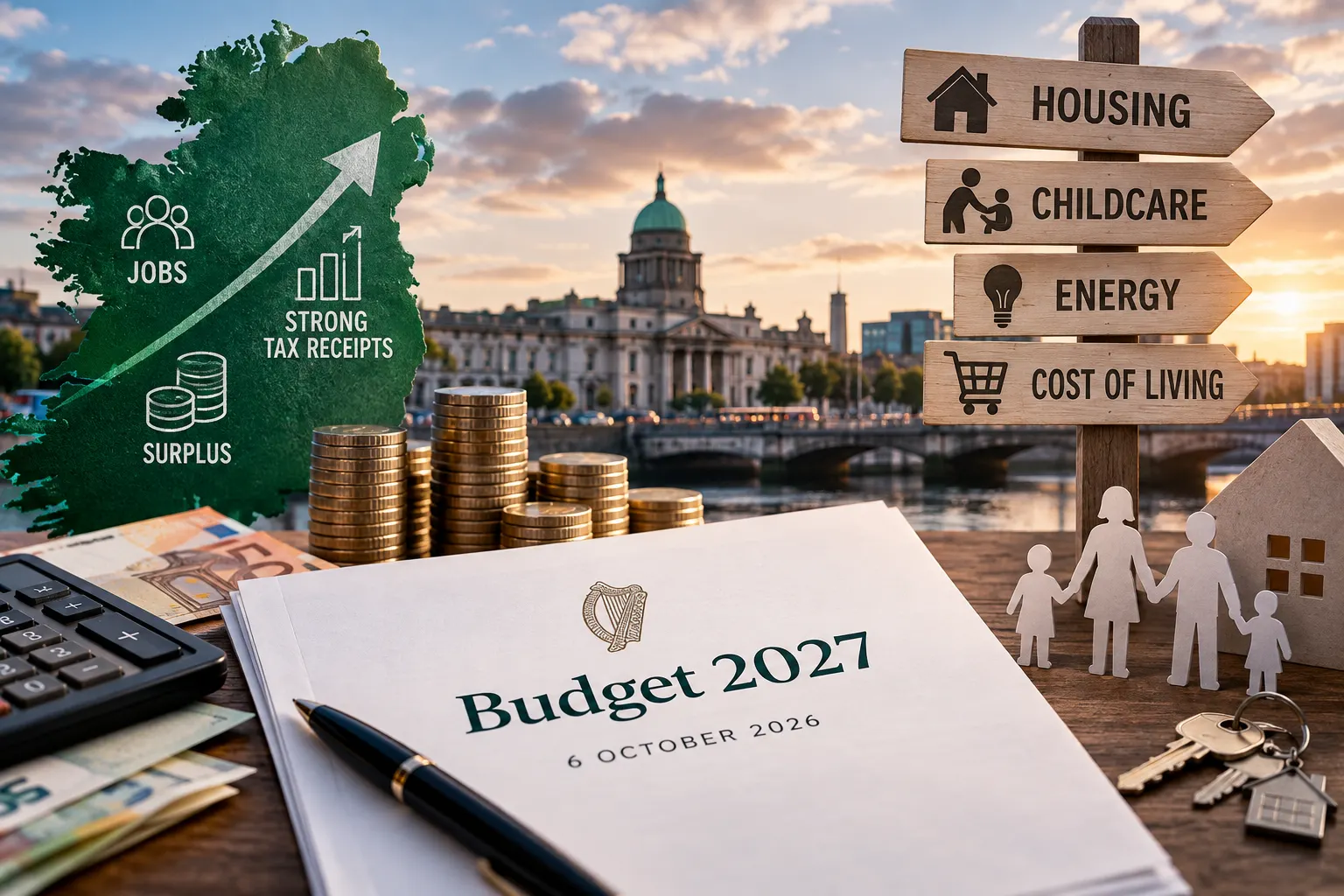
On paper, Ireland should be approaching Budget 2027 from an enviable position. Almost 2.84 million people were employed in the second quarter of 2026, unemployment was running at about 5%, tax receipts remained strong and the public finances were expected to record another substantial surplus. Yet the budget due on 6 October is proving difficult precisely because the national figures and the experience of individual households tell different stories. Economic activity is strong, but housing remains expensive, childcare consumes a substantial share of many family budgets, energy prices have risen again and years of inflation have permanently lifted the price level even where the annual inflation rate has moderated.
The Government’s Summer Economic Statement has set aside an overall Budget 2027 package of €8.5 billion, comprising €7 billion of additional expenditure and €1.5 billion for tax measures. That sounds generous. The Irish Fiscal Advisory Council argues that it is already larger than appropriate for an economy performing strongly and warns that actual expenditure may again exceed what is announced on Budget Day.
This produces the central tension around Budget 2027. A worker whose tax bill has risen as wages increased can reasonably ask for relief. A renter facing a high monthly payment can reasonably ask what a tax cut will do about housing. A parent paying hundreds of euro for childcare may value a subsidy more than a reduction in income tax. A pensioner or person unable to work may depend almost entirely on welfare increases, while the health service, housing system and infrastructure require billions that cannot simultaneously be returned to households through lower taxation.
There will therefore be no single answer to the question of who wins. Budget decisions operate differently depending on income, family structure, employment, housing tenure, childcare use, age and eligibility for existing schemes. The more revealing question is which kinds of policy produce gains for which groups — and who receives little from measures that can appear generous in national totals.
Budget 2027: the position before Budget Day
- Budget 2027 is scheduled for 6 October 2026.
- The planned budgetary package is €8.5 billion.
- €7 billion is allocated for additional expenditure and €1.5 billion for new tax measures.
- Government expenditure is planned to reach approximately €125.5 billion in 2027.
- Irish HICP inflation was estimated at 3.4% in August 2026.
- Energy prices in the August HICP flash estimate were 11.8% higher than a year earlier.
- The Irish Fiscal Advisory Council says the economy does not currently require a large budgetary stimulus.
The State Looks Rich — Until the Corporation Tax Is Examined
Ireland’s headline public finances are exceptionally strong by historical standards. The Fiscal Advisory Council projects a general government surplus of about €9 billion for 2026 and €8.4 billion in 2027. In another European country, figures of that scale might immediately generate demands for major tax cuts or new public programmes.
The difficulty lies beneath the headline. The Council estimates that around €20 billion of corporation tax revenue in 2026 may be potentially transitory — revenue that cannot safely be assumed to continue indefinitely. Excluding that amount, the underlying fiscal position would move from a large apparent surplus to a deficit of approximately €11 billion.
The concentration of corporation tax makes the risk more unusual still. Newly available company disclosures analysed by the Fiscal Council suggest that Apple, Microsoft and Eli Lilly together likely accounted for close to half of Ireland’s corporation tax receipts in 2025. This does not mean those receipts are about to disappear, and the companies remain major contributors to the economy. It means that permanent public expenditure cannot prudently be built on the assumption that a small number of extraordinarily profitable multinational groups will always generate taxes at today’s level.
This is why Ireland can simultaneously have billions in surplus and a budget watchdog urging restraint. A permanent €1 billion increase in annual spending continues in the following year and the year after that. A volatile €1 billion tax receipt may not.
Budget 2027 Is Not Starting From a Blank Sheet
The €8.5 billion headline also overstates the amount ministers can freely distribute between new tax cuts, welfare increases and services. Much of the additional spending is already needed to maintain existing commitments. Ireland has a growing and ageing population, public-service wage costs continue to rise and demand for health, education, disability services, social protection and housing increases even before a new initiative is announced.
The Fiscal Advisory Council estimates that current expenditure in 2026 is already heading for further overruns of around €1.4 billion beyond increases acknowledged by government. It points particularly to health, social protection, foreign affairs and housing. Over the decade since 2014, current expenditure overruns have averaged the equivalent of about €2.4 billion a year in today’s money, excluding the exceptional pandemic years from the Council’s comparison.
A new public-service pay agreement is another unknown. The previous agreement expired on 30 June 2026. If Budget 2027 does not provide realistically for whatever agreement follows, an apparent saving on Budget Day can simply reappear later as an overrun.
This distinction is fundamental. There is a difference between money required to keep today’s services operating for a larger and more expensive population and money available to provide a genuinely new service. A health budget can rise by hundreds of millions while patients still perceive little improvement if most of the increase pays for higher demand, staff costs and existing commitments.
The Economy Is Strong Enough to Make a Large Budget More Dangerous, Not Less
The usual argument for expansionary budgets is that government should support demand when the private economy is weak. Ireland in 2026 has almost the opposite problem. Employment remains historically high, the August monthly unemployment estimate was 5% and income tax receipts have continued to grow strongly.
The Fiscal Advisory Council therefore argues that the economy does not need broad budgetary stimulus. Additional tax cuts and government spending put more purchasing power into an economy already operating at high capacity. If the supply of homes, construction workers, childcare places, healthcare staff and other constrained services cannot respond quickly enough, part of the additional money can appear as higher prices rather than higher real living standards.
The Council has modelled the longer-term risk. It estimates that if government spending continued growing at around 9% annually rather than approximately 5%, the price level could be about 1.7% higher by 2030. Using average household expenditure, it equates that effect to roughly €1,000 of additional annual outgoings for an average household.
This does not mean every additional euro of public expenditure creates inflation or that spending should be cut indiscriminately. Investment that expands capacity can have the opposite long-term effect. Building homes, electricity networks, water infrastructure, public transport and childcare capacity can remove bottlenecks and allow the economy to grow without generating as much inflation. The composition of expenditure matters as much as its size.
Inflation Has Slowed From the Crisis Years — but Prices Have Not Gone Back
Public frustration with the cost of living can appear inconsistent with a strong economy because inflation is often misunderstood. A lower inflation rate does not mean prices return to their previous level. It means they are rising more slowly from a level that has already increased.
Ireland experienced a major series of shocks from the pandemic, supply-chain disruption and Russia’s invasion of Ukraine through to renewed energy-market instability in 2026. Households adjusted to much higher prices for food, energy, housing and many services. Wage growth compensated some workers, while social welfare rates and tax measures provided varying degrees of protection, but the experience differed dramatically between households.
By July 2026, the national Consumer Price Index was 3.4% higher than a year earlier. Housing, water, electricity, gas and other fuels were 7.7% higher, education services were up 8.9% and insurance and financial services had also risen substantially. The August HICP flash estimate subsequently put annual harmonised inflation at 3.4%, with energy prices 11.8% above their August 2025 level.
This is why another debate about energy assistance has returned even after the State deliberately moved away from universal electricity credits. What had looked like an appropriate withdrawal of emergency measures became harder as geopolitical disruption pushed energy prices higher again.
Housing Costs Divide Ireland More Sharply Than the Average Inflation Rate
Housing is one of the clearest examples of why a national average cannot describe household pressure. CSO data for 2025 found that 26.6% of households regarded their total housing costs as a heavy financial burden. Among households renting or living rent-free, the proportion was 35.8%. For single-parent households, 55% described housing costs as a heavy burden.
The poverty data show an even wider difference between owners and renters. In SILC 2025, 24.2% of people living in rented or rent-free accommodation were at risk of poverty compared with 7.4% of those in owner-occupied homes. Eight in ten people experiencing consistent poverty lived in rented or rent-free accommodation even though those households represented less than one-third of the population.
The figures should not be interpreted as meaning home owners have no financial difficulties. Mortgage interest, insurance, maintenance and energy costs can be substantial. The distinction is that ownership often provides greater housing-cost stability and an accumulating asset, while private renters can face higher mobility risk and exposure to prevailing market rents.
This creates a problem for Budget 2027. A general income-tax measure may put money into a renter’s pocket, but if housing supply remains severely constrained it does nothing directly to create an additional home. Some of the benefit can ultimately be absorbed by the underlying cost of accommodation.
Where Household Pressure Is Most Visible
| Indicator | Latest figure |
|---|---|
| Households finding housing costs a heavy burden | 26.6% |
| Rented/rent-free households finding housing costs a heavy burden | 35.8% |
| Single-parent households with heavy housing burden | 55.0% |
| People in enforced deprivation | 15.1% |
| Enforced deprivation: single adult with children | 48.7% |
| Households unable to set money aside at month end | 36.9% |
Source: Central Statistics Office, Survey on Income and Living Conditions 2025.
Income Tax Will Be One of the Biggest Budget Battles
The Government has allocated €1.5 billion for tax measures and has made increasing workers’ take-home pay a central theme of Budget 2027. The political argument is straightforward: if wages rise but tax bands and credits remain unchanged, more income is exposed to higher taxation even when the worker’s real purchasing power has increased much less.
Budget 2026 largely froze the main income-tax architecture. For a single person without qualifying children, the 20% standard-rate band remains €44,000 in 2026 before income above that level is generally taxed at 40%. The main personal and employee tax credits remain €2,000 each. The principal USC change was an increase in the ceiling of the 2% band, partly to accommodate the higher national minimum wage.
This produces what economists call fiscal drag. If a worker earns 4% more because wages across the economy have risen, but the tax thresholds do not increase, a larger share of the wage can become taxable at higher marginal rates. The worker may have received no substantial improvement in real living standards, yet the Exchequer collects more.
The Fiscal Advisory Council treats indexation of bands and credits in line with wages as broadly neutral rather than as a conventional tax cut because it prevents the average effective tax rate from rising automatically. Government estimates cited by the Council put the full-year cost of such indexation at approximately €1.2 billion.
That figure is important. If Budget 2027 has €1.5 billion available for tax measures, merely preventing fiscal drag could absorb most of the package before any large additional tax reduction is considered.
Changing the 40% Threshold Does Not Help Every Worker Equally
How the tax package is designed determines who benefits. Raising the point at which the 40% rate begins primarily helps workers whose incomes are high enough to cross that threshold. Someone whose taxable earnings remain substantially below it gains nothing directly from widening the band.
Increasing personal or employee tax credits has a broader reach among Income Tax payers because it reduces liability across a wider income range. Yet even ordinary non-refundable tax credits provide limited or no benefit to somebody whose Income Tax liability is already very small. Very low-paid workers can therefore receive little from an income-tax package even while being highly exposed to rent, food and energy costs.
This is why two tax packages with the same €1.5 billion Exchequer cost can have very different distributional outcomes. A package concentrated on the higher-rate threshold delivers larger gains towards the middle and upper parts of the PAYE distribution. A package concentrated more heavily on tax credits spreads relief further down, although workers with insufficient liability can still fall outside the benefit.
There is also a labour-supply argument for easing marginal taxation. Ireland competes internationally for skilled employees, and high marginal tax rates can influence overtime, promotion, second incomes and decisions about where to work. That consideration is economically relevant, but it is separate from the question of which households face the greatest immediate hardship.
PRSI Is Moving in the Opposite Direction
The tax debate becomes more complicated because Pay Related Social Insurance is already scheduled to rise. Most Class A employees earning above the relevant threshold currently pay 4.2% employee PRSI. From 1 October 2026 that rate rises to 4.35%, followed by a further 0.15 percentage-point increase from October 2027 under the previously agreed PRSI roadmap.
The increases are intended to help finance the social-insurance system, including measures such as pay-related Jobseeker’s Benefit and the cost of retaining the State pension age at 66. They therefore purchase social protection rather than simply disappearing into general taxation.
For a worker examining a payslip, however, the distinction can be less visible. A Budget 2027 income-tax reduction may partly offset an increase already occurring elsewhere in payroll deductions. Whether a worker feels substantially better off depends on the combined effect of Income Tax, USC, PRSI and wage growth rather than the headline value of the tax package alone.
Budget 2026 Chose Welfare Increases Over Another Round of Universal Payments
The previous budget marked an important change in strategy. During the cost-of-living crisis, the State repeatedly used once-off measures such as electricity credits, double social-welfare payments and other broad supports. These provided rapid relief but were expensive and, because many were universal, also benefited households that did not necessarily need assistance.
Budget 2026 moved more heavily towards permanent and targeted measures. Most weekly social-welfare payments increased by €10. Child Support Payments rose by €8 a week for children under 12 and €16 for those aged 12 and over. Fuel Allowance increased from €33 to €38 a week, Working Family Payment income thresholds rose by €60 a week and eligibility for Fuel Allowance was extended to Working Family Payment households.
The Carer’s Allowance income disregard was also substantially increased from July 2026, making it possible for more working carers to qualify. These measures improve support not merely for one winter but for future payment years unless later governments change them.
The trade-off was the disappearance of many temporary measures. ESRI analysis concluded that Budget 2026 left average household disposable income around 1.3% lower than it would have been under a tax-and-welfare system indexed to expected price growth. Welfare increases helped lower-income households, but the withdrawal of temporary cost-of-living supports produced losses across the distribution.
Temporary Supports Worked — Which Makes Them Difficult to Remove
There is strong evidence that temporary supports materially reduced poverty during the cost-of-living crisis. The CSO estimated that 12.6% of people were at risk of poverty in SILC 2025. Without cost-of-living measures, the estimated rate would have been 14.9%.
The effect was especially large among some vulnerable groups. For single-adult households with children, the at-risk-of-poverty rate was 17.1%; without cost-of-living measures it was estimated at 25.6%. Among renters, the measures reduced the estimated poverty rate by more than four percentage points. People unable to work because of long-standing health problems also received substantial protection.
This explains the political difficulty of moving from emergency supports back to a normal budget. A temporary payment may be economically intended to disappear when the shock passes. For the household receiving it, however, withdrawal feels exactly like a reduction in income.
Permanent welfare increases can provide a more stable response, but they create recurring expenditure. Once a €10 weekly increase is incorporated into the basic rate, the State pays it every subsequent year and future budgets must increase a higher starting amount.
Who Gains Most From Higher Welfare Rates?
Across-the-board welfare increases tend to have their greatest proportional effect on households whose income depends heavily on social transfers. Pensioners relying primarily on the State pension, unemployed people, carers, lone parents and people unable to work because of disability can therefore receive more meaningful relative gains from a €10 or €15 weekly payment increase than a high-income household would.
Targeted child-related payments can be still more concentrated. Budget 2026’s unusually large increases in Child Support Payments benefited about 330,000 children in families receiving qualifying welfare payments. Over the longer period since 2020, ESRI analysis found that increases in welfare payments for children had grown much faster than prices or average wages, improving the relative position of the lowest income decile and reducing child poverty compared with a system merely indexed over the period.
But gaps remain. CSO figures show an at-risk-of-poverty rate of 16.9% for children in SILC 2025 and consistent poverty of 7.8%. Almost half of people in single-adult households with children experienced enforced deprivation in the separate 2025 deprivation results.
The challenge for Budget 2027 is therefore not simply whether welfare rises, but whether resources are concentrated where poverty risk is highest or distributed equally across millions of recipients. Targeting increases the impact per euro on vulnerable households but can create eligibility boundaries where somebody just above an income threshold receives substantially less support.
The Squeezed Middle Is Difficult to Define — and Even Harder to Target
Households that earn too much to qualify for means-tested assistance but not enough to absorb large housing or childcare bills are a recurring focus of budget debate. They are often described as the squeezed middle, but the category covers very different circumstances.
A couple earning €90,000 jointly while paying a large private rent and full-time childcare for two children may have less discretionary income than a similar-income household with no childcare costs and a small established mortgage. A single person on €50,000 renting alone in Dublin faces a different budget from somebody on the same wage living in a lower-cost county. Gross income does not determine living standards on its own.
Tax reductions are one of the few ways to reach this group without constructing another complicated means test. The disadvantage is that the same tax reduction often flows to households with much greater disposable income.
Targeted subsidies can reflect need more closely, but they require rules. As thresholds are introduced, households just outside them can feel unfairly excluded even where their financial circumstances differ only marginally from households qualifying inside the scheme.
Childcare Shows How Government Can Target a Cost Directly
Childcare policy offers a different model from general tax relief. Instead of giving parents cash and allowing the market price to determine how much of it remains, the State combines provider funding, fee controls and subsidies under the National Childcare Scheme.
The universal National Childcare Scheme subsidy is currently €2.14 per hour for eligible registered childcare, up to 45 hours a week. Lower-income families can qualify for larger income-assessed subsidies. From September 2026, the lower income threshold used in the income-assessed system rises from €26,000 to €34,000 and the upper threshold from €60,000 to €68,000, with government expecting almost 47,000 families to benefit from additional support.
At the same time, new maximum fee caps for services participating in Core Funding reduce the highest permitted parental cost. For a typical 45-hour full-day place, the highest possible cost after the universal subsidy is expected to fall from about €198 a week to €183.70. Families qualifying for higher income-assessed subsidies can pay substantially less.
The policy demonstrates why service-specific measures can be more effective than tax cuts for particular households. A parent receiving a €20 weekly childcare reduction experiences that benefit directly. Someone without children receives nothing, which is precisely why targeted expenditure can concentrate scarce budget resources.
Affordability is not the only childcare problem, however. A subsidy has limited value to a parent who cannot find a place near home or work. Expanding capacity, retaining workers and improving wages in the sector therefore remain part of the cost problem. Budget 2027 can reduce prices administratively, but sustained improvement also depends on supply.
Families Already Receive Very Different Levels of Childcare Support
The structure of the National Childcare Scheme deliberately follows what government describes as progressive universalism. Every qualifying family using registered care receives a basic subsidy, while lower-income families receive larger payments. This prevents childcare support from becoming exclusively a poverty programme while directing more money towards families with fewer resources.
Yet some households remain less well served. Families using informal arrangements outside the registered system cannot necessarily obtain the same benefits. Parents whose working hours do not fit conventional provision can face access problems. Rural areas may have fewer providers, while families in rapidly growing commuter regions can encounter capacity constraints.
Budget 2027 will therefore be judged not simply on whether another childcare headline is announced but on whether the existing system becomes easier to access and whether capacity can grow without driving provider costs unsustainably higher.
Different Budget Measures Create Different Winners
| Measure | Likely main beneficiaries | Who may gain little |
|---|---|---|
| Higher 40% tax threshold | Middle and higher PAYE earners | Lower earners below threshold |
| Higher tax credits | Broad range of Income Tax payers | People with little Income Tax liability |
| Higher core welfare rates | Pensioners and welfare-dependent households | Most higher-income workers |
| Higher targeted child payments | Lower-income families with children | Households outside qualifying schemes |
| Childcare subsidy expansion | Families using registered childcare | Households without childcare or without access |
| Rent Tax Credit | Eligible private renters paying Income Tax | Supported tenants and renters with insufficient tax liability |
| Universal energy payment | Almost all eligible households | Few households, but targeting is weak |
| Fuel Allowance increase | Qualifying lower-income households | Households just outside eligibility |
Ireland Newspaper analysis based on current Revenue, Social Protection and childcare rules.
The Rent Tax Credit Helps Private Renters — but Not Every Renter
Ireland’s Rent Tax Credit is worth up to €1,000 a year for an eligible single taxpayer and up to €2,000 for a jointly assessed couple, subject to rent paid and Income Tax liability. Budget 2026 extended the scheme through 2028.
For many private renters it is an important direct reduction in tax. Yet its design illustrates the limits of tax credits as social policy. A person must have sufficient Income Tax liability to use the credit fully. A renter receiving State housing support such as the Housing Assistance Payment, Rent Supplement or the Rental Accommodation Scheme is classified as a supported tenant and cannot claim the credit, even where that person pays an additional rent contribution themselves.
This exclusion avoids subsidising the same housing cost through two State mechanisms, but it also means the household facing the lowest income can receive no Rent Tax Credit while a higher-income private renter receives the full amount. That is not necessarily unfair when the value of the underlying housing support is considered, but it shows why comparing budget benefits without including existing schemes can be misleading.
Most importantly, the credit does not increase housing supply. It reduces the after-tax cost for the qualifying renter. In a market where supply remains constrained, long-term affordability ultimately depends on the number, type and location of homes available.
Mortgage Relief Creates a Similar Boundary Between Households
Mortgage Interest Tax Relief was introduced as interest rates rose sharply after 2022 and has been extended on a tapered basis. Relief relating to interest paid in 2025 can provide a maximum tax credit of €1,250 per qualifying property. For interest paid in 2026, the maximum value falls to €625 and can be claimed in 2027, subject to the scheme’s conditions.
The policy targets a specific cohort: mortgage borrowers exposed to increased interest costs compared with the scheme’s 2022 reference point. Homeowners without qualifying mortgages receive nothing, while renters face their own separate supports.
This fragmentation reflects the reality that housing pressures are different across tenures. It also makes the tax-and-benefit system increasingly complicated, with assistance delivered through several credits, subsidies, social-housing supports and capital programmes rather than a single housing measure.
Energy Policy Has Shifted From Universal Credits to Targeting — Then the Shock Returned
Universal electricity credits were politically attractive because they were simple. Every eligible domestic account received assistance and there was little administrative burden on households. Their weakness was equally obvious: households on very high incomes received the same credit as households struggling to heat their homes.
Government policy moved away from that model in Budget 2026. The 9% VAT rate on gas and electricity was extended to the end of 2030, Fuel Allowance was increased and eligibility expanded, while the previous universal electricity-credit approach was not continued. The National Energy Affordability Taskforce explicitly described a move towards more targeted support and energy-efficiency investment.
The energy shock of 2026 complicated that strategy. Emergency measures were introduced, including reduced excise on petrol and diesel and an extension of Fuel Allowance coverage, as disruption in international energy markets raised costs again. The planned carbon-tax increase on certain heating fuels was also deferred.
With energy prices estimated 11.8% higher year on year in August’s HICP flash estimate, Budget 2027 faces renewed pressure for intervention. A universal payment would reach everyone immediately but cost substantially more. Targeted payments would direct more resources towards vulnerable households but inevitably leave some families with high energy costs outside eligibility.
Energy Assistance Can Lower the Bill Without Lowering the Underlying Cost
This distinction is important for long-term policy. An electricity credit makes a bill cheaper to the household because the State pays part of it. It does not necessarily reduce the economic cost of producing or importing the energy.
Measures such as retrofitting, renewable generation, stronger electricity networks and improved energy efficiency operate more slowly but can reduce energy demand and structural exposure to price shocks. The difficulty is political timing. A household facing a high bill this winter benefits much more immediately from €200 in cash than from an electricity-network investment that becomes operational several years later.
Budget choices therefore involve a tension between relief and resilience. Spending everything on immediate supports can leave the structural problem intact. Spending everything on infrastructure can leave vulnerable households unable to manage today’s bill.
Single-Parent Families Remain One of the Clearest Cases for Targeting
Few demographic groups show the interaction between income, childcare and housing costs as strongly as one-parent families. In the CSO’s 2025 deprivation data, 48.7% of people in single-adult households with children were experiencing enforced deprivation. More than half considered housing costs a heavy financial burden.
These households can benefit from several existing mechanisms, including welfare child payments, Working Family Payment where eligible, childcare subsidies and other targeted supports. Yet the combination of one adult income, childcare responsibilities and housing expenditure creates less capacity to absorb unexpected costs.
A broad tax reduction can help a lone parent in employment, but the amount depends on income and tax liability. A targeted child payment or childcare subsidy can deliver a greater proportional benefit to a lower-income household. From an anti-poverty perspective, these measures are therefore not interchangeable.
Pensioners Are Not One Financial Group Either
The term pensioner similarly conceals substantial differences. Some retired households own homes outright, hold private pensions and accumulated savings, while others depend heavily on the State pension and have little financial buffer.
Budget 2026 increased maximum State pension rates by €10 a week and Fuel Allowance by €5 for qualifying households. Pensioners can also benefit from schemes such as the Household Benefits Package depending on eligibility.
The case for protecting pension values is straightforward: retired people cannot generally increase working hours in response to inflation. But an across-the-board pension increase also goes to people with substantial other resources where the payment is contributory and not means tested.
This creates the same universality-versus-targeting dilemma seen elsewhere in the Budget. Universal pension increases are predictable and simple. Means-tested additions concentrate resources more strongly but add complexity and can create lower take-up among people who do not realise they qualify.
Workers on Lower Pay Can Fall Between the Tax and Welfare Systems
Employment is one of the strongest protections against poverty in Ireland: the CSO’s at-risk-of-poverty rate among employed people was 5.7% in SILC 2025. But being employed does not guarantee that a household is comfortable, particularly where one wage supports children or expensive housing.
Low-paid workers can gain relatively little from changes to the 40% tax threshold because they are nowhere near it. Their Income Tax liability may also be too small to benefit fully from some non-refundable credits. At the same time, earnings can place them above the thresholds for certain means-tested schemes.
The Working Family Payment is specifically designed to bridge part of that gap for families with children, and its weekly income thresholds were increased by €60 in 2026. Its recipients also became eligible for Fuel Allowance. Workers without children do not have an equivalent broad in-work payment.
That makes low-paid single adults one of the harder groups to reach through conventional budget policy. Minimum-wage increases can improve gross income but increase employer costs. Tax credits help only where liability exists. Housing assistance depends on separate eligibility rules. The interaction between these systems is as important as any one headline measure.
Tax Cuts Can Be Permanent Even When the Revenue Paying for Them Is Not
Fiscal policy becomes particularly risky when temporary revenue finances recurring tax reductions. Raising an income-tax credit or permanently widening a tax band reduces Exchequer receipts not just in 2027 but in every subsequent year unless reversed.
Reversing a tax cut is politically difficult. That creates an asymmetry: a government can introduce permanent relief when corporation-tax receipts are strong, only for a future government to discover that the revenue base has weakened while the lower personal-tax burden has become politically embedded.
The same applies to permanent welfare increases and new public services. This is why the Fiscal Advisory Council repeatedly separates temporary corporation-tax receipts from more dependable revenue streams such as income tax and VAT.
Ireland has attempted to manage that risk by transferring part of exceptional revenues into the Future Ireland Fund and the Infrastructure, Climate and Nature Fund. The objective is to convert some temporary fiscal strength into assets that can help meet future ageing, climate and infrastructure costs rather than consuming the entire windfall today.
Saving Money in a Fund While People Need Housing Is Not an Absurd Choice
The existence of enormous housing and infrastructure needs understandably raises the question of why the State should save money at all. The answer lies in the nature of the problem. Ireland needs both investment now and fiscal capacity later.
An ageing population will increase pension, healthcare and long-term care costs over the coming decades. Climate transition will require further capital expenditure. Corporation-tax revenue may not remain at present levels indefinitely. A State that spends every windfall at the peak of the economic cycle may have to raise taxes or cut services precisely when the economy weakens.
That lesson is particularly relevant in Ireland because the financial crisis demonstrated how rapidly the fiscal position can reverse. Capital investment was cut sharply after 2008 when government revenue collapsed. The Fiscal Advisory Council argues that a stronger domestic fiscal rule could help protect investment from being treated as the easiest expenditure to reduce in the next downturn.
Infrastructure Spending Is Different From Simply Injecting More Consumer Demand
Not every €1 billion of expenditure has the same macroeconomic effect. Giving households €1 billion that is spent quickly on goods and services can increase demand almost immediately. Investing €1 billion in electricity grids, water infrastructure or transport can also increase near-term demand, but over time it may expand the economy’s productive capacity.
Housing is the clearest example. Additional purchasing power does not solve a housing shortage if the number of dwellings remains fixed. Increasing supply can. But housing delivery requires land, planning, finance, construction workers, roads, water and electricity, meaning the solution cannot be confined to the housing department’s budget.
The Government’s case for continued capital expenditure is therefore stronger than the argument for using every available euro on current transfers. Capital projects can address the structural costs that household supports are otherwise repeatedly required to offset.
The difficulty is delivery. Allocating capital funding does not itself build infrastructure. Planning delays, procurement, skills shortages and capacity constraints can leave expenditure unspent or projects more expensive than anticipated. Budget 2027 therefore has to distinguish between announcing investment and ensuring that institutions can actually deliver it.
Who Would Win From a Large Income-Tax Package?
If most of the available €1.5 billion is devoted to indexing tax bands and credits, the principal beneficiaries would be workers paying Income Tax whose wages are increasing. Such a package would prevent part of their nominal wage growth from being absorbed by fiscal drag.
Employees earning enough to pay the 40% rate would benefit if the standard-rate threshold were widened. Middle-income workers around the existing €44,000 single-person threshold would be particularly sensitive to such a change because additional income can otherwise move from the 20% to 40% rate.
Higher earners also benefit in cash terms from many band changes because they necessarily have enough income to use the full value. That does not make indexation inherently regressive; it means the euro value of tax relief and its percentage value relative to income are different concepts.
People outside employment, many pensioners and workers with very low Income Tax liabilities would receive comparatively little. Their Budget outcome would depend more heavily on welfare, energy, housing or service measures.
Who Would Win From a Welfare-Led Budget?
A package concentrated more heavily on core social-welfare rates and targeted supplements would shift the distribution towards lower-income and fixed-income households. A €10 or €15 weekly increase can represent a meaningful percentage of disposable income for somebody relying on a State payment.
Families receiving qualifying Child Support Payments could receive additional targeted gains, while increases to Fuel Allowance could concentrate assistance on households more exposed to energy poverty. Measures for carers and people with disabilities could address groups with costs that are not captured by ordinary consumer-price averages.
The corresponding losers would be taxpayers expecting substantial relief from fiscal drag. They might see strong headline public revenues without a comparable increase in take-home pay. Employers could also argue that the tax system remains a barrier to attracting and retaining skilled employees.
The budget therefore cannot maximise both objectives without becoming larger. And making the package larger is exactly what the Fiscal Advisory Council argues the current economic position does not justify.
Who Would Win From Another Universal Cost-of-Living Package?
Universal measures have one enormous advantage: almost nobody eligible falls through the net. Electricity credits demonstrated this. The payment required no income assessment and reached households quickly.
The disadvantage is cost and weak targeting. A household with €200,000 of annual income can receive exactly the same universal energy credit as a pensioner living primarily on a State payment. If the policy objective is to prevent hardship rather than compensate the entire population, a substantial share of expenditure goes to households that could manage without it.
Universal measures can still be justified during acute shocks when speed and administrative simplicity are paramount. They become harder to defend as permanent features of the budget because their recurring cost is large relative to their anti-poverty impact.
Who Could Lose From Excessive Budget Generosity?
The concept sounds counter-intuitive because almost every budget measure has an identifiable beneficiary. The potential losers from an excessively expansionary budget are diffuse and appear later.
If additional demand contributes to higher domestic prices, households can lose part of the value of the assistance they received. Renters can face higher costs if purchasing power rises without housing supply. Businesses can face wage and input pressure. The European Central Bank can maintain higher interest rates for longer if inflation across the euro area remains persistent, although Ireland alone does not determine ECB policy.
There is also an intergenerational risk. Permanent commitments financed by temporary corporation-tax receipts can leave future taxpayers funding today’s decisions after the original revenue has disappeared. Conversely, under-investing in infrastructure passes a different bill to the next generation through inadequate housing, transport, water and energy systems.
Responsible fiscal policy therefore does not mean simply spending less. It means distinguishing temporary money from permanent money and consumption from investment.
The Budget Debate Often Confuses Tax Fairness With Living Standards
A tax system can become more generous while a household feels worse off. That is not a contradiction. Taxes are only one component of disposable living standards.
Imagine a worker receiving an extra €500 a year through tax changes while rent rises by €150 a month. The worker is clearly better off than they would have been without the tax relief, yet living standards may still deteriorate overall. The tax measure has not failed; it is simply smaller than the housing shock.
The same applies to childcare and energy. This is why governments can spend billions on household supports without creating the subjective impression that people are becoming significantly more prosperous. Public policy is sometimes compensating for costs rather than producing a net improvement.
The Most Vulnerable Are Not Always the Same People in Every Crisis
Energy shocks disproportionately affect households spending a high share of income on heating and transport. Housing inflation affects renters and new buyers more than mortgage-free owners. Childcare costs are concentrated among families with younger children. Income-tax drag affects workers but not people whose income is entirely below the taxable threshold.
A well-targeted budget therefore cannot rely on one definition of vulnerability. It needs different instruments for different cost pressures. The complication is that every additional scheme introduces eligibility rules, administration and the possibility that some households fall just outside the boundary.
This is why a combination of universal baseline supports and targeted supplements is often attractive. It reduces the risk of complete exclusion while directing additional resources towards need. Ireland’s childcare system increasingly follows this model, as does the combination of universal social-insurance entitlements and means-tested welfare.
Budget 2027 Will Also Decide What Is Not Funded
Budget coverage naturally concentrates on what households receive: a tax credit, pension increase, childcare reduction or energy payment. Less visible is the opportunity cost. Every recurring €500 million used for one measure cannot simultaneously employ healthcare workers, construct social housing, expand disability services or reduce the national debt.
The State faces particular pressure in services where population growth changes demand mechanically. Ireland’s usually resident population reached about 5.526 million in April 2026. More people require healthcare, schools, transport and housing. The population aged 65 and over is also growing rapidly, adding pressure to pensions and health services.
A budget that protects take-home pay while allowing service quality to deteriorate can leave households buying more privately. A modest tax saving can lose much of its value if a family must pay privately for childcare, healthcare or transport because public provision is unavailable.
This is why tax-and-benefit analysis cannot be separated completely from service delivery. Living standards are determined partly by disposable income and partly by what households receive collectively through the State.
There Is No Neutral Choice Between Tax Cuts and Better Services
Supporters of tax reductions argue that individuals are generally better placed to decide how to spend their own income. They also point to work incentives and Ireland’s need to remain attractive to mobile skilled workers.
Supporters of greater public expenditure point to problems that individuals cannot solve alone. A household cannot build a water-treatment plant, national electricity grid, rail line or hospital. A €1,000 tax reduction cannot purchase a childcare place that does not exist.
Both arguments can be true. The relevant balance changes with the economic cycle and the condition of public infrastructure. Ireland’s unusually strong labour market combined with severe infrastructure constraints gives a stronger economic case for capacity-enhancing investment than would exist during a recession with widespread unemployment.
Budget 2027 Is Really About Permanent Policy After Years of Emergency Budgets
The budgets following the pandemic and the energy crisis became accustomed to extraordinary interventions. Electricity credits, double payments and other once-off supports allowed the State to respond rapidly without permanently increasing every expenditure line.
That period created expectations as well as protection. Once households become accustomed to an annual package of exceptional payments, a budget without them can feel austere even if core welfare spending and public services increase substantially.
Budget 2026 began the transition away from that model by placing greater emphasis on permanent welfare measures and targeted supports. Budget 2027 will test whether government can continue that shift while energy costs have once again become politically urgent.
The temptation will be to combine permanent tax cuts, permanent welfare increases and another round of temporary supports. The Fiscal Advisory Council’s warning is essentially that the State cannot repeatedly add all three at the current pace without increasing fiscal and inflationary risks.
So Who Is Most Likely to Gain?
As of 4 September, the final Budget 2027 measures have not been announced, so definitive winners and losers do not yet exist. The Summer Economic Statement establishes the size of the package rather than its final distribution. Political commitments and public statements indicate that income tax and the principle of making work pay will receive substantial attention, while childcare affordability, public services and infrastructure are also prominent priorities.
If the €1.5 billion tax allocation is used substantially to index Income Tax bands and credits, PAYE workers will be among the clearest beneficiaries. Those paying the higher rate could see particularly visible gains from movement in the standard-rate band.
Parents using registered childcare are already beginning to benefit from September 2026 changes and could gain further if Budget 2027 expands subsidies or capacity. Lower-income families would gain more if income-assessed support is prioritised rather than purely universal relief.
Welfare-dependent households will depend heavily on the level of core payment increases. The current 3% to 4% inflation environment means that a nominal increase can still represent little real improvement if it merely keeps pace with prices.
Renters paying Income Tax can continue to benefit from the €1,000 Rent Tax Credit, but supported tenants remain outside it. Households facing renewed energy pressures could gain if targeted energy measures are extended, while those just above Fuel Allowance and other means-test thresholds can again find themselves in the difficult space between universal and targeted assistance.
And Who Risks Being Left Behind?
Low-paid workers without significant Income Tax liability can miss much of a tax package focused on bands and ordinary credits. Single adults without children have fewer targeted family supports. Private renters can receive a tax credit but remain exposed to housing costs far larger than the value of that credit.
Households just above welfare or childcare income thresholds can receive substantially less support than otherwise similar households below them. People unable to access registered childcare may receive little practical benefit from subsidy increases. Supported tenants cannot claim the Rent Tax Credit even where they pay part of the housing cost themselves, although their existing housing support must be considered in any fair comparison.
Young adults attempting to establish independent households can also be difficult to assist through the traditional tax-and-benefit framework. They may be working full time and therefore appear financially secure while facing exceptionally high rents and saving for a deposit. Their principal problem may be the price and scarcity of housing rather than an inadequate welfare payment.
The Best Budget May Be the One Whose Benefits Are Least Visible on Budget Night
A tax cut appears immediately on a payslip. A welfare increase appears in a weekly payment. An electricity credit appears on a bill. These are politically tangible.
Investment in water capacity, electricity networks, housing infrastructure, public transport or childcare supply is slower and less personal. Yet these projects can have greater effects on living standards over a decade because they expand the supply of things households need.
Ireland’s recurring cost-of-living problem is partly an income problem but increasingly a capacity problem. Strong employment and high wages have created substantial demand in an economy where housing and several public services have not expanded quickly enough. Continually adding purchasing power without addressing those constraints risks treating symptoms while reinforcing prices.
October 6 Will Answer the Short-Term Question, Not the Long-Term One
Budget 2027 will produce the familiar calculations: how much more a single worker keeps, how much a pensioner receives, how a family with two children fares and whether energy or housing relief changes. Those calculations matter because household finances are real and immediate.
But Ireland’s more difficult fiscal question reaches beyond a single year. The country has exceptional corporate-tax revenues, an ageing and growing population, major infrastructure deficits and household costs that remain high despite strong economic growth. Using the current opportunity well requires balancing relief today against resilience tomorrow.
A budget that is too restrictive could leave households under unnecessary pressure while the State has ample resources. A budget that is too expansive could add to inflation, deepen dependence on volatile corporation-tax receipts and create permanent commitments that become difficult to finance in a downturn. Neither extreme is costless.
The real winners from Budget 2027 will therefore not necessarily be the households receiving the largest cheque or tax reduction in October. If Ireland can protect vulnerable people, prevent unnecessary tax drag, expand childcare and housing capacity, maintain public services and preserve part of today’s fiscal strength for the future, the benefits will be spread far beyond a single Budget Day.
Sources
Irish Fiscal Advisory Council — Pre-Budget 2027 Statement
RTÉ News — Summer Economic Statement 2026 and Budget 2027 Fiscal Parameters
Department of Finance — Annual Progress Report 2026
Central Statistics Office — Flash Estimate for the Harmonised Index of Consumer Prices, August 2026
Central Statistics Office — Survey on Income and Living Conditions: Enforced Deprivation 2025
Central Statistics Office — Survey on Income and Living Conditions 2025
Central Statistics Office — Labour Force Survey, Quarter 2 2026
Revenue Commissioners — Income Tax Rates, Bands and Credits 2026
Department of Social Protection — Budget 2026 Social Welfare Measures
Department of Children, Disability and Equality — Childcare Fee Caps and Core Funding 2026
Department of Climate, Energy and the Environment — Government Energy Supports 2026
Source & Transparency
This article is published by Ireland Newspaper for editorial and informational purposes.
Published: 4 September 2026 · Updated: 4 September 2026

Newsroom Ireland Newspaper
Ireland Newspaper editorial team prepares daily news coverage for readers in Ireland and abroad.