
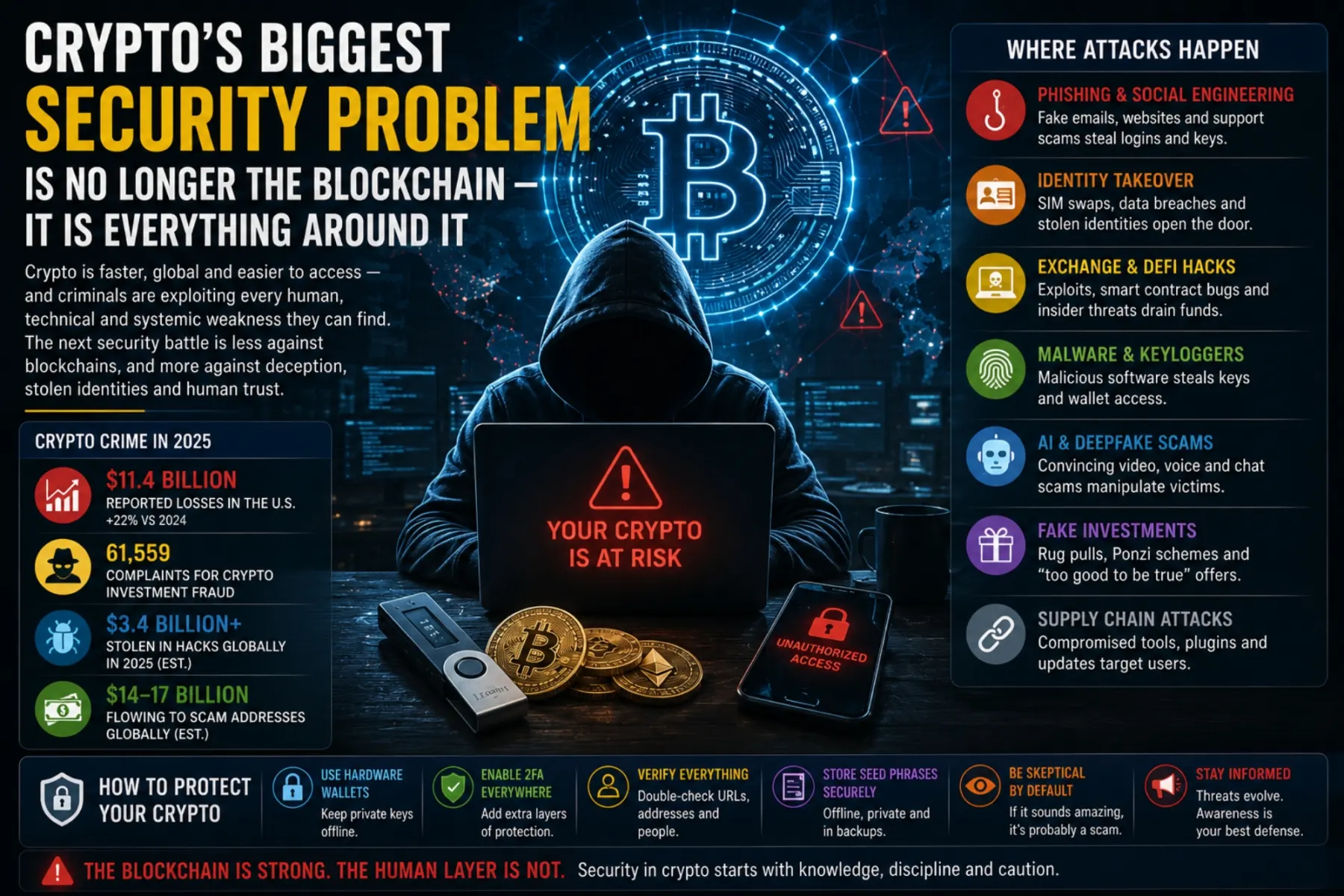
Crypto’s Biggest Security Problem Is No Longer the Blockchain — It Is Everything Around It
Cryptocurrency has become harder to dismiss and easier to access, but the same characteristics that make digital assets fast, global and programmable also make them attractive to organised fraud networks, hackers and state-backed cyber actors. US authorities recorded $11.4 billion in reported losses involving cryptocurrency during 2025, while private blockchain analysis points to billions more stolen through hacks and scams worldwide. Artificial intelligence is now making deception more convincing, and the next security battle may be fought less against broken blockchains than against fake identities, compromised wallets and human trust.
A blockchain can work exactly as designed while somebody loses everything.
That apparent contradiction explains much of the modern cryptocurrency security problem.
Bitcoin can confirm the correct transaction. Ethereum can execute the correct smart-contract instruction. A digital wallet can create a mathematically valid signature. The network can reach consensus.
And the money can still end up in the hands of a criminal.
The reason is simple: security of the blockchain is not the same thing as security of the person, wallet, exchange, application or computer using it.
As cryptocurrency has moved closer to mainstream finance, criminals have increasingly attacked those surrounding layers rather than attempting to break the fundamental mathematics underneath major blockchains.
They impersonate customer-support employees. Create fake investment platforms. Steal passwords. Compromise private keys. Convince victims to sign malicious transactions. Take over mobile-phone numbers. Build fake relationships. Deploy deepfakes. Exploit vulnerabilities in exchanges and decentralised-finance protocols.
And, increasingly, they operate fraud as an industrial business spread across several countries.
The scale has become enormous.
The FBI’s Internet Crime Complaint Center recorded 181,565 US complaints involving cryptocurrency during 2025, with reported losses of $11.366 billion. Complaints increased 21% from 2024 and losses increased 22%. The average reported loss was $62,604, while 18,589 complainants said they had lost more than $100,000.
Cryptocurrency investment fraud alone accounted for 61,559 complaints and $7.228 billion in reported US losses, 25% more losses than in 2024.
Those are reported American losses, not an estimate of worldwide crime.
Global blockchain analysis paints another part of the picture. Chainalysis estimated that more than $3.4 billion in cryptocurrency was stolen through hacks during 2025, while separately identifying at least $14 billion flowing to known scam addresses and projecting that the figure could eventually exceed $17 billion as additional illicit addresses are identified.
These datasets use different methodologies and overlap with other crime statistics, so they should not simply be added together.
What they collectively show is more important than one headline number.
Crypto crime is no longer a niche security problem.
It has become part of global organised crime.
The First Misunderstanding: Bitcoin Has Not Been “Hacked”
When a cryptocurrency investor reads that billions of dollars of crypto have been stolen, it is easy to conclude that blockchain technology itself is fundamentally insecure.
That is too simple.
Major blockchains such as Bitcoin derive security from cryptography, decentralised consensus and networks containing many independent participants.
Most large crypto thefts do not occur because somebody has discovered how to rewrite Bitcoin’s transaction history.
Instead, criminals attack the places where humans and software interact with the blockchain.
The analogy is imperfect but useful.
If a criminal steals the password to an online bank account, that does not mean the banking system’s accounting mathematics has failed.
If somebody steals a cryptocurrency private key, the blockchain can still operate perfectly.
It simply receives a valid digital signature authorising a transfer.
The blockchain does not know whether the person creating that signature is the legitimate owner or a thief who obtained the key.
That distinction changes how users should think about crypto security.
The blockchain may be the strongest component in the chain.
The surrounding infrastructure can be much weaker.
The Private Key Is the Real Asset
Cryptocurrency ownership is ultimately controlled through cryptographic credentials.
The most important is the private key.
Anyone who possesses the necessary private key can generally authorise transactions from the corresponding wallet.
That creates extraordinary independence.
A person can hold assets without relying on a bank to approve each transfer.
But independence has a cost.
Traditional banking contains mechanisms for reversing certain unauthorised transactions, freezing accounts, resetting passwords and investigating disputed payments.
Self-custodied cryptocurrency can operate very differently.
If somebody steals a private key and transfers the assets away, there may be no bank manager capable of cancelling the transaction.
The network has done precisely what it was instructed to do.
This is why criminals do not necessarily need to break encryption.
They only need to persuade or trick the owner into giving them the information that encryption protects.
The Seed Phrase Has Become the Keys to the Vault
Many self-custody wallets can be recovered using a sequence of words generally known as a recovery or seed phrase.
That phrase is extremely powerful.
It can allow a wallet to be reconstructed on another device.
It also means anybody obtaining it may be able to reconstruct the wallet themselves.
This creates one of crypto security’s simplest rules:
A seed phrase is not a password to be shared with technical support. It is effectively control of the wallet.
A criminal pretending to be an exchange employee, wallet developer, security specialist or regulator may therefore ask a victim to “verify” a wallet by entering the recovery phrase into a website.
The page can look professional.
The logo can be correct.
The domain name can differ from the genuine site by one character.
The conversation can sound convincing.
Once the phrase is entered, however, the attacker may no longer need anything else.
The Most Dangerous Crypto Scam Can Begin Without Mentioning Crypto
The dominant modern investment scam often begins innocently.
A message arrives.
Perhaps through WhatsApp.
Telegram.
Facebook.
Instagram.
A dating application.
A professional network.
Or an apparently accidental text.
The conversation may continue for days or weeks before anybody mentions investing.
Sophisticated cryptocurrency investment fraud is increasingly built around psychological manipulation and the appearance of legitimacy. Victims may eventually be directed towards fake investment platforms displaying fabricated profits and encouraged to transfer progressively larger amounts of cryptocurrency.
The sophistication is important.
An obvious message promising to turn €500 into €50,000 tomorrow is relatively easy to recognise.
The modern operation may spend weeks establishing trust before asking for meaningful money.
That makes the scam less technological than psychological.
The cryptocurrency is primarily the payment and laundering infrastructure.
Fake Profits Are One of the Most Effective Weapons
A fraudulent trading platform can look remarkably convincing.
The user sees an account balance.
Transactions.
Charts.
Investment returns.
Perhaps even customer support.
An early withdrawal may sometimes be permitted.
That small payment can become one of the criminal’s most effective investments.
The victim concludes:
The platform works.
The profits are real.
The money can be withdrawn.
A larger amount follows.
Then another.
Eventually the victim attempts to withdraw a substantial balance.
The rules suddenly change.
A tax must be paid.
A compliance deposit is required.
An account has allegedly been frozen.
A security fee is necessary.
More cryptocurrency must be sent before the existing balance can be released.
There was never a profitable account.
The numbers on the screen were part of the deception.
The Victim Can Then Be Scammed a Second Time
Losing money is sometimes only the beginning.
Criminals know that somebody who has just lost a large amount of cryptocurrency is desperate to recover it.
That creates another market:
recovery scams.
A company appears claiming it can trace stolen cryptocurrency.
A supposed lawyer contacts the victim.
A “blockchain investigator” says the assets have been found.
A government official supposedly needs a fee before releasing them.
The victim pays again.
US authorities recorded more than 10,000 complaints associated with recovery scams during 2025, with reported losses running into the billions when original scam losses were included.
The pattern reveals something important about fraud.
The criminal is not merely targeting money.
The criminal is targeting emotion.
Hope can be exploited almost as effectively as greed.
Criminals Are Impersonating the People Supposed to Protect Victims
The recovery problem has become sophisticated enough that scammers impersonate government regulators and law-enforcement bodies themselves.
Fraudsters may send fake staff identification, fabricated badges and convincing-looking official documents.
That creates a disturbing escalation.
The victim learns to distrust scammers.
The scammer then disguises themselves as the authority warning against scammers.
Fraud becomes recursive.
The solution is not attempting to judge whether a digital badge looks authentic.
It is independently contacting an institution using contact information obtained from its official website rather than using the telephone number, email address or link provided by the person making contact.
Crypto ATMs Have Become a Payment Rail for Fraud
Cryptocurrency ATMs create another unusual vulnerability.
They allow users to convert cash into cryptocurrency and send it to a digital wallet.
That is legitimate technology.
But it can also turn physical cash into an irreversible digital transfer very quickly.
US authorities recorded 13,460 complaints involving cryptocurrency ATMs or kiosks during 2025, with approximately $389 million in reported losses.
Losses increased sharply from the previous year.
Older users were particularly affected.
People aged 60 and over accounted for more than 6,000 of those complaints and approximately $257.5 million of the reported losses.
The fraud often begins with an alarming story.
Your bank account has been compromised.
A government agency is investigating you.
Your money needs to be protected.
An unpaid bill requires immediate settlement.
The victim is instructed to withdraw cash, visit a crypto kiosk, scan a QR code and deposit the cash.
The QR code points to the criminal’s wallet.
The machine itself has not malfunctioned.
It has faithfully sent the money where the victim instructed.
“Move Your Money to Keep It Safe” Is One of the Biggest Warning Signs
One scam instruction should immediately create suspicion:
Move your money somewhere else to protect it.
Banks do not need customers to transfer their savings into a stranger’s cryptocurrency wallet to secure them.
Governments do not collect fines by demanding Bitcoin.
Law-enforcement agencies do not require somebody to empty a retirement account into a cryptocurrency kiosk.
The urgency is deliberate.
Scammers do not want a victim to sleep on the decision.
Call a family member.
Contact the bank independently.
Search the company name.
Or ask another person whether the story makes sense.
Time is the enemy of many scams.
Artificial Intelligence Is Changing the Economics of Fraud
The next transformation is already underway.
Artificial intelligence allows criminals to create more convincing deception at much lower cost.
A fraudulent message no longer needs obvious spelling mistakes.
Language models can produce polished business correspondence in almost any major language.
A voice can be cloned.
A photograph can be generated.
A face can be placed into a video call.
A fake chief executive can appear to give instructions.
A fake investment adviser can publish convincing content every day.
A fake celebrity can appear to recommend a cryptocurrency.
International law-enforcement agencies now warn that AI-enhanced fraud is becoming significantly more effective and is increasingly being used across investment scams, impersonation and other forms of financial crime.
The security challenge has therefore changed.
Seeing is no longer necessarily believing.
Hearing may not be either.
Deepfakes Remove One of the Human Brain’s Oldest Defences
For most of history, seeing a person and hearing their voice provided powerful evidence that the person was real.
Digital manipulation weakens that assumption.
Imagine receiving a video call from somebody who appears to be a senior executive at a cryptocurrency exchange.
They know your name.
They discuss your account.
Their face moves naturally.
Their voice sounds correct.
They explain that suspicious activity has been detected and ask you to transfer your assets into a “secure wallet”.
In an earlier generation of scams, video calling the person might have exposed the fraud.
In the emerging generation, video itself can be part of the fraud.
The appropriate defence becomes procedural rather than intuitive.
Do not verify a person using the same communication channel through which the suspicious request arrived.
Call the organisation independently.
Use known contact information.
Require a second form of confirmation.
For significant transfers, introduce delay.
Security increasingly depends on process because appearance itself has become unreliable.
AI Also Allows Criminals to Target More People at Once
Traditional relationship scams are labour intensive.
A criminal can maintain only so many believable conversations.
Artificial intelligence changes that constraint.
Software can translate.
Generate personalised messages.
Remember previous conversations.
Respond at any hour.
Analyse the victim’s interests.
Adapt tone.
Create images.
And potentially operate conversations at a scale previously requiring large teams.
The danger is not that AI invented fraud.
It industrialises persuasion.
Scam Centres Have Turned Fraud Into an International Industry
Some of the largest online fraud operations are not groups of teenagers working from bedrooms.
They resemble companies.
Employees.
Scripts.
Supervisors.
Technical teams.
Recruitment.
Payment infrastructure.
Money laundering.
Performance targets.
Call centres.
And, in some cases, compounds containing people who have themselves been trafficked and forced to commit fraud.
International law-enforcement organisations have documented scam-centre operations involving victims and perpetrators across dozens of countries.
This complicates the traditional picture of victim and perpetrator.
The person sending the fraudulent message may also be operating under coercion.
The organisers behind the system can be several layers removed.
Europe Is Seeing the Same Industrialisation
This is not only an Asian or American problem.
European law-enforcement operations have targeted cryptocurrency fraud networks accused of laundering hundreds of millions of euro linked to investment scams.
Other investigations have identified thousands of victims worldwide and criminal proceeds running into hundreds of millions.
Individual cases should not be treated as measurements of total global crime.
They demonstrate organisational scale.
Modern fraud operations can span advertising companies, telephone centres, fake trading websites, crypto wallets and laundering infrastructure across multiple jurisdictions.
Closing one website does not necessarily dismantle the business behind it.
Social Media Has Become the Recruitment Department
The modern investment scam often needs no expensive advertising campaign.
The victim can be found where people already spend their time.
Social networks.
Messaging applications.
Dating platforms.
Video sites.
Investment discussion groups.
Fraudulent advertisements can imitate newspapers or financial television.
Fake screenshots can show impossible trading returns.
Influencers may promote assets they do not understand.
Synthetic influencers may not even exist.
The problem is particularly acute because social proof is powerful.
If an investment group appears to contain hundreds of people celebrating successful withdrawals, a new participant can assume the evidence is overwhelming.
Some or all of those participants may be controlled by the scam operator.
The Group Chat Can Be Fake Too
One of the cleverest features of modern investment fraud is manufactured consensus.
The victim joins a messaging group.
Members discuss trades.
Some post screenshots of profits.
Others thank the supposed investment expert.
Someone announces they have withdrawn €50,000.
Another says they have just invested more.
The victim feels cautious.
Everyone else appears confident.
But there may be no independent investors in the group at all.
Ten apparent participants can be controlled by one criminal operation.
Artificial intelligence makes manufacturing that environment even easier.
The fraud is not only a fake investment.
It is a fake community.
Romance and Investment Fraud Are Increasingly Merging
Another boundary is disappearing.
A relationship begins online.
Trust develops.
The other person appears financially successful.
They mention an investment opportunity casually.
They do not immediately ask for money.
Eventually they offer to teach the victim.
The investment then becomes inseparable from the relationship.
International authorities warn that romance, investment and other fraud methods are increasingly being combined, with AI-generated content making these hybrid schemes more convincing.
This is psychologically powerful because questioning the investment can feel like questioning the relationship.
The scammer is no longer selling a cryptocurrency.
They are exploiting attachment.
Older People Can Lose the Largest Amounts
Crypto scams are sometimes imagined as a problem affecting younger, technology-focused investors.
The statistics show something more complicated.
Among US victims reporting cryptocurrency investment fraud in 2025, people aged 60 and over reported $2.764 billion in losses, the largest amount of any age group.
Those aged 50 to 59 reported another $1.383 billion.
That does not mean older people are inherently less capable of recognising fraud.
They may simply have more accumulated savings to lose.
Retirement accounts.
Property proceeds.
Investment portfolios.
Cash reserves.
Fraudsters understand this.
A criminal targeting a 65-year-old with significant savings can potentially extract far more money than from a 19-year-old student.
The Exchange Itself Can Also Be Attacked
Not every crypto loss involves deceiving an individual.
Large centralised exchanges and custodians hold enormous concentrations of value.
That makes them attractive targets.
The most dramatic recent example occurred in February 2025.
The FBI attributed the theft of approximately $1.5 billion in virtual assets from cryptocurrency exchange Bybit to North Korean cyber actors.
It became one of the largest crypto thefts ever recorded.
The incident matters for a broader reason.
A user can follow every personal-security recommendation correctly and still be exposed if the institution holding their assets is compromised.
Custody concentrates risk.
A large exchange may invest far more in security than an individual can.
It also represents a vastly larger prize.
North Korea Has Turned Crypto Theft Into a Strategic Activity
Crypto hacking is not exclusively conventional organised crime.
Nation states have entered the market.
Private blockchain analysis estimated that North Korean-linked attackers stole at least $2 billion in cryptocurrency during 2025, heavily influenced by the Bybit theft.
This changes the threat model.
An exchange is not merely defending itself from lone hackers seeking personal profit.
It can be defending against state-supported operators with considerable resources, patience and technical expertise.
Cybersecurity therefore becomes part of geopolitical security.
The Attack May Begin With a Job Interview
One of the more disturbing developments concerns social engineering aimed at employees inside crypto companies.
The attacker may not begin by trying to penetrate a firewall.
They may apply for a job.
Pretend to recruit an employee.
Arrange a technical interview.
Send malicious code as part of a programming test.
Approach an executive as a supposed investor.
Or obtain access through a trusted third party.
That exposes another modern security reality.
Companies can spend millions securing computer systems.
A convincing human interaction can still become the entrance.
Smart Contracts Create an Entirely Different Type of Risk
Decentralised finance removes some traditional intermediaries.
It replaces them with software.
That creates advantages.
It also means software errors can have financial consequences.
A vulnerability in a smart contract can potentially allow funds to be extracted automatically.
Cross-chain bridges can become particularly attractive targets because they may hold large amounts of assets while connecting different blockchain systems.
The security challenge becomes closer to software engineering than traditional bank fraud.
Code must be audited.
Administrative privileges must be controlled.
Emergency mechanisms need testing.
Dependencies on external systems must be understood.
And updates can introduce new vulnerabilities.
Decentralisation does not mean absence of technology risk.
It can concentrate that risk in code.
A Smart Contract Can Be Secure and Still Be Dangerous
There is another important distinction.
A smart contract may contain no exploitable software vulnerability whatsoever.
The user can still lose money by intentionally interacting with a malicious contract.
A website may ask the user to connect a wallet.
The user sees a request to sign something.
They assume the signature simply proves ownership.
The permission may actually authorise the contract to transfer tokens.
This is the world of malicious approvals and wallet drainers.
The attacker does not steal the private key.
The owner uses the private key personally.
The owner simply signs the wrong instruction.
From the blockchain’s perspective, the transaction is legitimate.
From the victim’s perspective, the wallet has been emptied.
“Sign” Does Not Mean “Log In”
This is one of the hardest concepts for ordinary users.
Traditional websites train people to click.
Accept.
Continue.
Log in.
Blockchain applications turn clicking into potentially irreversible financial authorisation.
A wallet signature can represent anything from proving ownership of an address to approving movement of valuable assets.
The interface may not always make the distinction obvious.
Crypto security therefore increasingly requires users to understand what they are authorising rather than simply whether the website looks legitimate.
That is a demanding standard for mass adoption.
If ordinary users need to interpret complex smart-contract permissions every time they interact with an application, the technology remains too easy to misuse.
Better wallet design may ultimately be as important as better blockchains.
SIM Swapping Attacks the Telephone Network Instead
Another threat begins outside cryptocurrency entirely.
A criminal convinces or compromises a mobile operator into transferring a victim’s telephone number to a SIM card under the attacker’s control.
The attacker can then receive calls and text messages intended for the victim.
If SMS is being used for account recovery or two-factor authentication, the telephone number may become the gateway to an exchange account.
The lesson is broader than crypto.
A telephone number was never designed to function as a high-security identity credential.
For significant financial accounts, stronger authentication methods are preferable to relying solely on SMS.
Email Security Can Be Wallet Security
The same applies to email.
An exchange account may be protected by a strong password.
But if the associated email account is compromised, the attacker may be able to initiate password resets.
Receive security notifications.
Intercept recovery instructions.
Or impersonate the user.
That means cryptocurrency security begins much earlier than the cryptocurrency application.
The email account.
The telephone.
The computer.
The browser.
The cloud backup.
The password manager.
Every layer can become part of the attack surface.
The digital asset may be decentralised.
The user’s digital life usually is not.
Address Poisoning Exploits Familiarity
Blockchain addresses are long strings of characters.
Humans are bad at checking them.
Criminals can exploit that.
An attacker may create an address resembling one a victim has previously used and generate transactions designed to make that address appear in transaction history.
Later, the victim copies an address from the history rather than from a trusted source.
The funds go to the attacker.
Again, there is no failure of the blockchain.
The network has processed the submitted destination correctly.
The vulnerability exists in human pattern recognition.
For large transfers, the safer approach is to verify the complete destination through an independent trusted method and consider a small test transaction before moving a substantial amount.
Malware Can Replace the Address Before the User Notices
Malware creates an even simpler version of the same attack.
A victim copies a legitimate wallet address.
Malicious software monitors the clipboard and substitutes the attacker’s address before the user pastes it into the transaction.
If the user checks only the first and last few characters — or checks nothing at all — the payment is sent to the criminal.
Crypto makes this especially damaging because transactions can be irreversible.
The correct security response is unglamorous:
Verify.
Then verify again.
Speed is one of cryptocurrency’s advantages.
Speed is also one of fraud’s advantages.
Fake Tokens Can Look Completely Real
Creating a digital token can be technically easy.
That allows legitimate experimentation.
It also enables fraud.
A scammer can create a token using the name of a well-known company.
A celebrity.
An artificial-intelligence project.
A political movement.
Or another established cryptocurrency.
A professional website can be produced.
Social-media accounts can appear.
An online community can be manufactured.
Early price increases can attract additional buyers.
Then liquidity disappears.
Developers sell their holdings.
Or the token’s smart contract contains controls allowing outsiders to buy but preventing them from selling.
The existence of a token on a blockchain proves that the token exists.
It does not prove the promises surrounding it are true.
A Rising Price Is Not Evidence of Legitimacy
Fraudulent markets can rise spectacularly.
That is sometimes part of the design.
If a small token begins at a negligible valuation, relatively modest purchases can create enormous percentage increases.
A 1,000% rise can then be advertised as evidence that sophisticated investors have discovered the project.
More buyers arrive.
The original holders sell into the demand.
Price therefore cannot be used as a substitute for due diligence.
Markets contain information.
They can also contain manipulation.
Influencers Create Another Conflict
Crypto promotion increasingly mixes entertainment, financial commentary and advertising.
An online personality can present themselves as an independent enthusiast while receiving compensation or already holding the token being promoted.
The economic incentive is obvious.
If a creator with millions of followers can move demand in a thinly traded asset, attention itself becomes valuable.
The most important question is not whether the promoter sounds confident.
It is what financial interest they have in the audience buying.
Regulation Helps — but It Cannot Eliminate Crypto Crime
Europe’s MiCA regime is now bringing cryptocurrency service providers under more consistent rules covering authorisation, governance and consumer information.
That should strengthen parts of the market.
Regulation can make it harder for an irresponsible exchange to operate legally.
It can impose custody standards.
Require complaints procedures.
Improve governance.
Strengthen operational resilience.
Make marketing more accountable.
It cannot stop somebody from voluntarily transferring Bitcoin to a fake romantic partner.
Nor can a regulator guarantee that a token purchased through a legitimate exchange will retain its value.
Security and investment risk remain different problems.
An Authorised Platform Is Safer in One Sense — Not Every Sense
A regulated platform may provide stronger governance and legal recourse than an unknown offshore website.
That does not make the platform immune to hacking.
It does not make every crypto asset listed there safe.
It does not guarantee that a user will never make a mistaken transfer.
It does not eliminate phishing sites copying the platform’s branding.
And it does not stop criminals from pretending to be the platform’s support staff.
Authorisation should therefore be treated as one security layer.
Not as a substitute for every other layer.
Cold Storage Solves Some Problems and Creates Others
Investors often hear that cryptocurrency should be placed in a hardware or “cold” wallet.
That can reduce exposure to certain online attacks because private keys can remain separated from internet-connected environments.
But cold storage creates responsibility.
The device can be lost.
The recovery phrase can be stolen.
A fake hardware wallet can be purchased from an untrusted source.
A fraudulent software update can be installed.
Family members may have no idea how to recover the assets if the owner dies.
Security becomes a trade-off.
Keeping assets on an exchange creates counterparty risk.
Holding them personally creates self-custody risk.
There is no universal configuration appropriate for every user.
The Most Secure Wallet Is Useless If Nobody Can Recover It
This becomes particularly important with inheritance.
A traditional bank knows the customer exists.
Assets can enter an estate.
Legal representatives can eventually obtain access.
A cryptocurrency wallet controlled solely by a secret recovery phrase can disappear economically even though the assets remain permanently visible on the blockchain.
If the owner dies without leaving a secure recovery process, the coins may become inaccessible forever.
Crypto security therefore includes estate planning.
The challenge is creating a recovery method that heirs can use later without creating a secret that criminals can exploit today.
That is not merely a computer-security problem.
It is a legal and organisational problem.
Institutional Custody Is Growing Because Self-Custody Is Hard
The rise of regulated crypto investment products and institutional custodians partly reflects this reality.
Many investors do not want responsibility for private keys.
They would rather pay a professional institution to manage the operational security.
That recreates a familiar financial arrangement.
The crypto network may be decentralised.
Ownership is intermediated again.
The future market is therefore unlikely to be purely self-custodial or purely institutional.
Different users will choose different balances between control and protection.
The key is understanding which risk is being transferred and to whom.
Blockchain Transparency Is Also a Weapon Against Criminals
Crypto’s role in crime contains another paradox.
Transactions can be difficult to reverse.
But many major blockchains are highly transparent.
Once an address is linked to criminal activity, investigators may be able to trace subsequent movement across the blockchain.
Criminals therefore attempt to complicate tracing through multiple addresses, cross-chain bridges, decentralised exchanges, mixers and laundering services.
Yet the permanent blockchain record can also preserve evidence long after the original crime occurred.
Cash does not normally publish its transaction history.
Bitcoin does.
Law Enforcement Is Becoming Better at Following the Money
The global response is also becoming more sophisticated.
International law-enforcement agencies are increasingly cooperating across borders and using blockchain analytics to trace illicit financial flows.
The FBI’s Operation Level Up provides one example.
The programme identifies people believed to be in the process of being defrauded through cryptocurrency investment schemes and contacts them before additional payments are made.
During 2025, the FBI reported notifying 3,780 victims and estimated that intervention prevented approximately $225.9 million of additional losses.
Remarkably, 78% of those contacted were reportedly unaware they were being scammed.
That statistic may be one of the most revealing in the entire crypto-fraud debate.
The hardest scam to stop is the one the victim still believes is an investment.
Recovery Becomes More Difficult With Every Hour
Speed matters enormously after a suspected theft.
Cryptocurrency can move through multiple wallets and blockchains within minutes.
A victim who waits several weeks because they are embarrassed or still hoping the investment platform will respond gives criminals more time to move or convert the assets.
Recovery is never guaranteed.
But silence almost never improves the chances.
Fast reporting to the relevant police, financial institution, exchange and regulatory authorities can increase the possibility that funds are identified before they disappear through multiple layers of transactions.
The Human Cost Is Bigger Than the Financial Number
Loss statistics can make fraud sound abstract.
$7.2 billion.
$11.4 billion.
$17 billion.
The figures become so large that individual consequences disappear.
Behind them can be retirement savings.
Mortgage deposits.
College funds.
Business capital.
Borrowed money.
Proceeds from selling a home.
Fraud can also create severe emotional consequences.
Victims may experience shame, fear, isolation and serious psychological distress.
That shame helps the criminal.
Reporting quickly should be understood as a security response rather than an admission of foolishness.
Sophisticated criminal organisations succeed because they are sophisticated.
The Basic Security Rules Have Become More Important, Not Less
Technology continues changing, but the most effective defences remain remarkably practical.
Unexpected urgency should create suspicion.
Guaranteed returns should create suspicion.
A stranger who develops a relationship before recommending cryptocurrency should create suspicion.
Anyone requesting a seed phrase should be treated as a threat.
A demand to move money to a “safe wallet” should stop the transaction.
Large transfers deserve independent verification and, where appropriate, a small test transfer first.
Important accounts should use strong unique passwords and robust multi-factor authentication rather than relying only on SMS.
Providers should be checked against official regulatory registers rather than trusted because of advertising.
And somebody who has already lost money should be exceptionally suspicious of anyone charging an advance fee to recover it.
None of these precautions is technologically impressive.
That is precisely the point.
The most sophisticated cryptography in the world cannot protect a transaction the legitimate owner has been manipulated into approving.
The Future Threat Is Personalised Fraud at Industrial Scale
The next stage could be considerably more difficult.
Artificial intelligence can already create convincing text, voices and images.
The logical next development is continuous personalised fraud.
A criminal system could analyse public social-media profiles.
Determine occupation.
Age.
Interests.
Friends.
Financial interests.
Travel.
Family relationships.
Then create a tailored approach.
The supposed investment opportunity shown to a 25-year-old software engineer may look completely different from the one shown to a retired business owner.
Language.
Tone.
Platform.
Timing.
All can be adapted automatically.
The economics are troubling.
Personalisation once required expensive human labour.
AI makes it cheap.
Fake People May Become More Convincing Than Fake Websites
The scam website is becoming the easy part.
The more important asset could be the synthetic person attached to it.
A realistic digital investment adviser may have:
a LinkedIn profile;
years of fabricated social-media history;
professional photographs;
videos;
a cloned voice;
an apparent office;
references;
news articles;
and hundreds of followers.
None need be genuine.
This could transform the concept of online due diligence.
Searching a person’s name may no longer be enough if the search results themselves were created as part of the fraud.
Verification will increasingly need to rely on authoritative external records rather than the volume of information visible online.
AI Could Also Become Part of the Defence
The same technology is not exclusively useful to criminals.
Financial institutions can use machine learning to identify unusual transaction patterns.
Crypto companies can screen addresses associated with known illicit activity.
Wallet software can warn when a user is about to approve unusually broad permissions.
Banks can detect sudden large transfers inconsistent with previous behaviour.
Platforms can identify coordinated fake accounts.
Law-enforcement agencies can analyse transaction networks more rapidly.
The future security contest will therefore involve AI on both sides.
Fraud becomes faster.
Detection becomes faster.
The decisive question may be which system recognises the pattern first.
Wallets Will Need to Become Much Smarter
For cryptocurrency to reach genuinely mass adoption, users cannot be expected to behave like professional cybersecurity engineers.
Future wallets may need to explain transaction risk in ordinary language.
Instead of displaying:
“Approve contract 0x84F…”
they may need to say:
“This transaction would allow this application to transfer all of your USDC. Do you want to continue?”
Instead of merely showing an address, the wallet could warn:
“This destination has never been used by you before.”
Or:
“This address has been associated with reported fraud.”
Or:
“The website requesting this signature was registered recently.”
The next major breakthrough in crypto security may therefore be less about cryptography than interface design.
Exchanges May Need Banking-Style Fraud Friction
Crypto culture historically valued instant, unrestricted transactions.
Fraud prevention sometimes benefits from the opposite.
Delay.
Verification.
Withdrawal limits.
Cooling-off periods.
Additional checks for unusual transactions.
Confirmation through another device.
Telephone verification for exceptionally large withdrawals.
Those controls can irritate legitimate users.
They can also interrupt a scam at precisely the moment when a victim is under psychological pressure.
Traditional finance learned that some friction protects customers.
Crypto is gradually learning the same lesson.
The fastest possible financial system is not necessarily the safest possible financial system.
Regulation Will Probably Become More International
Criminals exploit borders.
A victim may live in Ireland.
The fake exchange may appear to be registered in London.
The server can operate in another country.
The messaging account may be controlled from a scam centre in Asia.
Cryptocurrency can move through ten wallets before reaching an exchange in a fourth jurisdiction.
No national regulator can address that structure alone.
International police agencies, financial-intelligence units, national regulators and crypto companies are therefore increasing cross-border cooperation.
The future of crypto enforcement is likely to resemble the technology itself:
global.
Privacy and Crime Prevention Will Continue to Collide
Greater security often means greater surveillance.
Know-your-customer requirements make it harder for criminals to cash out anonymously.
Blockchain analytics can identify suspicious flows.
Transaction-reporting rules can connect identities to transfers.
But legitimate users can also value financial privacy.
This creates one of the enduring political tensions around digital assets.
How much transaction monitoring is necessary?
How much privacy should remain possible?
Can decentralised finance remain meaningfully decentralised while satisfying anti-money-laundering requirements?
There is no universal answer.
Different jurisdictions are likely to draw the line differently.
Quantum Computers Are Not the Immediate Threat Most Users Should Fear
Longer-term technological discussions sometimes focus on whether sufficiently powerful quantum computers could eventually threaten cryptographic systems used by cryptocurrencies.
That is a legitimate research issue.
It is not the dominant security problem facing ordinary crypto holders in 2026.
The immediate threats are considerably more mundane:
deception;
stolen credentials;
malware;
phishing;
compromised exchanges;
malicious smart contracts;
and weak operational security.
Preparing cryptographic systems for future computing advances matters.
But a user worrying about hypothetical future quantum attacks while storing a seed phrase in an unprotected email account is defending against the wrong threat first.
The Safest Crypto Transaction Is the One That Survives Ten Minutes of Doubt
Fraud succeeds through momentum.
The victim is excited.
Or frightened.
Or in love.
Or ashamed.
Or worried that an opportunity will disappear.
The criminal wants action before reflection.
The simplest countermeasure is often time.
Stop.
Do not click the link.
Do not send the money.
Do not continue the call.
Do not rely on the telephone number shown on the screen.
Contact the bank, exchange, company or authority independently.
Discuss the request with another person.
Security technology matters.
So does refusing to be rushed.
Crypto Is Becoming Safer and More Dangerous at the Same Time
That may sound contradictory.
It is not.
The legitimate industry is becoming more sophisticated.
Regulation is strengthening.
Institutional custody is improving.
Wallets are improving.
Blockchain analytics are improving.
Law enforcement is gaining experience.
Crypto businesses increasingly operate within conventional financial-supervision frameworks.
At the same time, criminal operations are also improving.
AI makes impersonation easier.
Scam centres operate at industrial scale.
State-backed hackers target exchanges.
Professional laundering networks move stolen assets internationally.
And the growing value held in cryptocurrency creates a larger financial incentive for attackers.
Both sides are becoming stronger.
The Next Security Battle Will Be About Trust
The first generation of cryptocurrency security was largely framed around mathematics.
Can a decentralised network prevent double spending?
Can transactions be verified without a central authority?
Can digital scarcity exist?
Those questions produced Bitcoin and the blockchain systems that followed it.
The next generation of security problems is different.
Is the person messaging you real?
Is the trading platform real?
Is the support employee real?
Is the video real?
Is the investment balance real?
Is the wallet address correct?
Does the transaction signature mean what you think it means?
Can the exchange holding the assets protect its own systems?
Those are not purely cryptographic questions.
They are questions of trust.
Crypto’s Greatest Strength Creates Its Greatest Scam Risk
Cryptocurrency allows money to move internationally without requiring every transaction to pass through the traditional banking system.
That can be extraordinarily useful.
It can also remove some of the intervention points that historically allowed fraudulent transactions to be stopped.
Once cryptocurrency reaches a wallet controlled by a criminal, recovery can become extremely difficult.
That makes prevention disproportionately valuable.
In conventional finance, security can sometimes begin after an unauthorised payment.
In crypto, security often has to happen before the signature.
The Industry’s Future Depends on Solving This
Cryptocurrency is no longer sufficiently small for security failures to be dismissed as the cost of experimentation.
The FBI’s 2025 figures alone show more than $11 billion in reported US losses involving cryptocurrency, while private blockchain analysis estimates that hacks and global crypto scams continue moving billions more through blockchain networks.
The industry cannot become ordinary financial infrastructure if ordinary users need expert-level knowledge simply to avoid losing their money.
Regulators can make companies more accountable.
Exchanges can strengthen custody.
Wallet developers can make transactions easier to understand.
Banks can identify suspicious transfers.
Police can become better at tracing stolen assets.
Technology companies can remove fraudulent advertising more rapidly.
But the fundamental challenge remains unusually human.
Cryptocurrency created a financial system capable of transferring value without asking permission.
Criminals discovered that they often do not need to defeat that system.
They only need to persuade the rightful owner to give permission first.
The great security challenge of crypto’s next decade is therefore unlikely to be protecting blockchains from mathematics they cannot withstand.
It will be protecting people from deception they cannot see.
Source & Transparency
This article is published by Ireland Newspaper for editorial and informational purposes.
Published: 11 August 2026 · Updated: 11 August 2026

Newsroom Ireland Newspaper
Ireland Newspaper editorial team prepares daily news coverage for readers in Ireland and abroad.




Market data, financial news and economy content on Ireland Newspaper are provided for editorial and informational purposes only. They do not constitute financial advice, investment advice, trading advice or a recommendation to buy, sell or hold any financial product. Always verify live prices and consult a qualified professional before making financial decisions.