
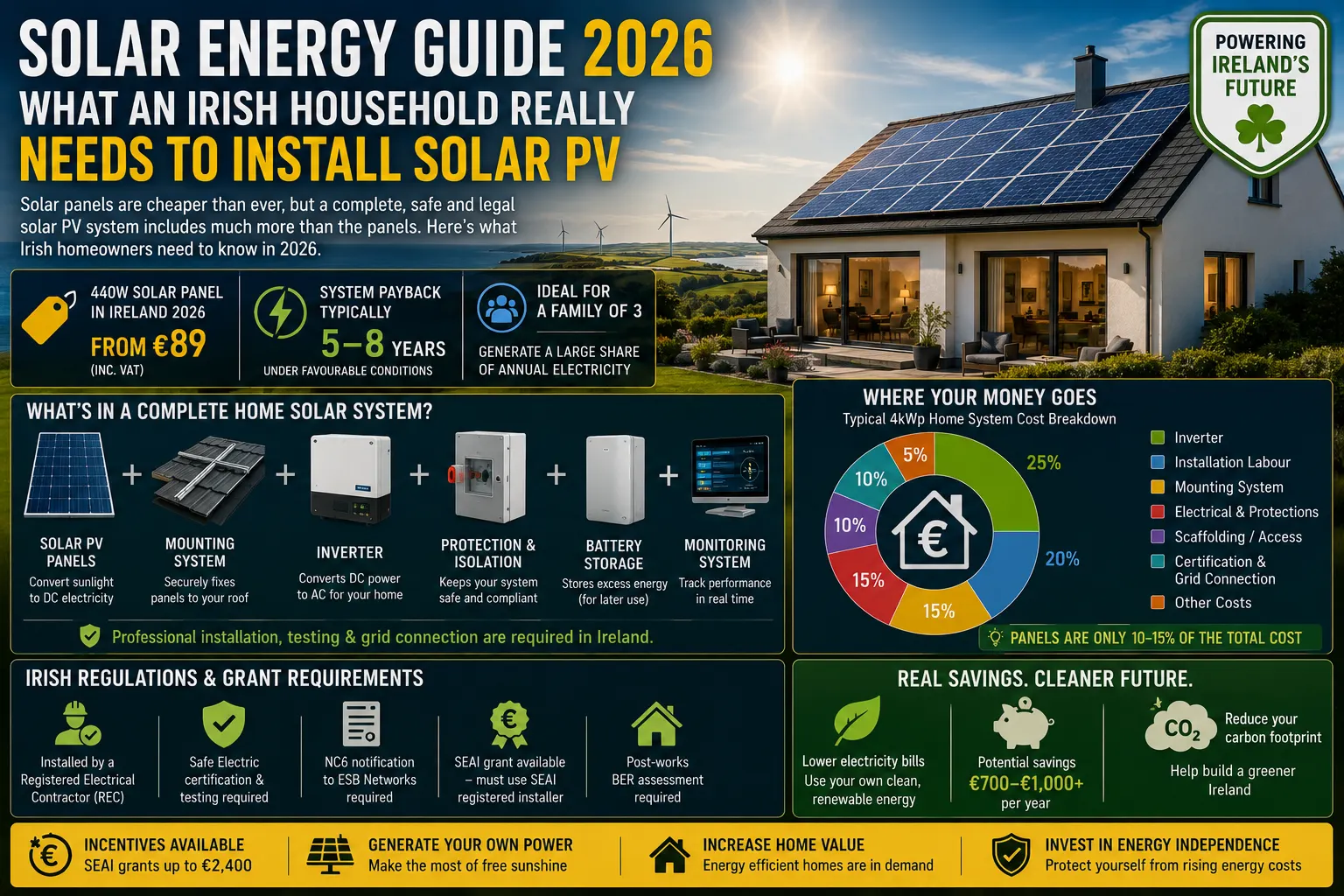
Solar Energy Guide 2026: What an Irish Household Really Needs to Install Solar PV
Solar panels themselves have become surprisingly inexpensive. In Ireland in 2026, a modern 440-watt module can retail for less than €100, yet a complete home installation still costs several thousand euro. The difference lies in everything around the panel: the inverter, roof mounting, protection equipment, electrical certification, scaffolding, grid registration and professional labour. For a family of three, however, a correctly sized system can now generate a large share of annual household electricity and potentially recover its cost within roughly five to eight years under favourable conditions.
There is a revealing contradiction in the Irish solar market in 2026. A homeowner can currently find an individual 440W solar panel for around €89 including VAT, while a professionally installed household solar system typically costs thousands of euro. At first glance, that can make a do-it-yourself installation look extraordinarily attractive. Ten panels costing less than €1,000 appear capable of creating a 4.4kWp rooftop power station.
But the panels are only one part of a safe, legal and productive domestic solar installation.
A grid-connected Irish system also needs an inverter, compliant roof mounting, DC and AC protection, suitable cabling, isolation equipment, monitoring, connection to the home electrical installation, commissioning, testing and notification to ESB Networks. A battery and hot-water diverter are optional additions rather than essential components. Most importantly, the electrical side of a grid-connected system cannot simply be treated as an ordinary DIY project.
ESB Networks states that a micro-generator must be installed by a Registered Electrical Contractor, while the inverter must comply with IS EN 50549-1 with the appropriate Irish settings. Safe Electric additionally requires grid-connected PV systems to undergo commissioning tests and inspections on both the AC and DC sides, with the required testing carried out by the qualified certifier for the Registered Electrical Contractor responsible for the work.
For homeowners seeking the SEAI grant, the requirements go further. The installation must be managed through an SEAI-registered solar PV company, completed by a registered installer and supported by a Declaration of Works, inspection and commissioning documentation, a Safe Electric certificate, an NC6 grid notification and a post-works BER assessment.
So the practical Irish version of “installing solar yourself” is not normally doing every electrical connection yourself. It is better understood as self-managing the project, understanding and selecting the equipment, comparing prices, preparing the house and potentially carrying out appropriate non-electrical work while leaving the regulated installation, testing and grid connection to qualified professionals.
That distinction can make the difference between a cost-effective solar project and an expensive mistake.
What a Complete Home Solar System Actually Contains
A domestic solar PV installation looks simple from the street. Panels sit on the roof and electricity comes out. Behind that simple appearance is a complete small generating station.
SEAI describes the principal components as the PV modules themselves, a mounting system of rails, clamps and hooks, cabling from the array, and an inverter that converts the panels’ direct-current electricity into alternating current suitable for the home. Batteries, hot-water diverters and monitoring systems can then be added depending on how the household wants to use its electricity.
For a typical Irish family installation, the shopping list broadly looks like this:
| Component | What it does | Essential? |
|---|---|---|
| Solar PV panels | Convert daylight into DC electricity | Yes |
| Roof mounting rails, hooks and clamps | Secure the array to the building structure | Yes |
| Solar inverter | Converts DC solar power to household AC electricity | Yes |
| Hybrid inverter | Inverter capable of working with battery storage | Optional unless battery planned |
| Solar DC cable and approved connectors | Carry electricity between array and inverter | Yes |
| DC isolation and protection | Allows the PV array to be safely isolated | Yes |
| AC isolation and protection | Protects and isolates the household side of the system | Yes |
| Fire-safety / rapid-isolation equipment where required by design | Provides additional PV isolation and safety | System-dependent |
| Energy meter / monitoring equipment | Measures generation, consumption and export | Strongly recommended |
| Battery | Stores electricity for later use | Optional |
| Hot-water diverter | Sends surplus solar electricity to an immersion heater | Optional |
| Registered electrical installation and certification | Makes the grid-connected system compliant and safe | Yes |
| ESB Networks notification | Registers the micro-generator with the distribution network | Yes |
| Post-installation BER | Required to draw down the SEAI grant | Grant-dependent |
The important lesson is that the panel itself has become one of the cheapest major components.
The Panels Can Cost Less Than Many People Expect
Current Irish retail pricing shows how dramatically solar hardware costs have fallen.
Electrical Wholesaler Ireland lists a 440W bifacial panel at €89.18 including VAT. Solar Hub has advertised 415W bifacial modules at around €69 each, although prices, availability and tax treatment can vary between trade and consumer sales.
At the €89.18 retail figure, ten 440W modules providing 4.4kWp of peak capacity would cost only about:
10 × €89.18 = €891.80
Twelve panels would provide 5.28kWp and cost about:
12 × €89.18 = €1,070.16
That does not mean a 5kWp solar system costs €1,070. It means the modules themselves have become relatively inexpensive.
The inverter, mounting, electrical protection, certification, roof work and labour now represent a very significant part of the overall investment.
Inverter Prices: Around €700 to More Than €1,100
The inverter is effectively the electrical heart of the system.
A basic grid-connected string inverter is appropriate for a household that does not intend to install a battery. A hybrid inverter costs more but can integrate battery storage and is often worth considering if a battery might be added later.
Current Irish retail examples illustrate the difference. A 5kW standard single-phase inverter has been advertised at approximately €682.86 including VAT, while a 5kW Solis hybrid inverter has been listed at approximately €957.52. Another 5kW hybrid model has been listed at approximately €1,182.97.
For a family installing around 4–5kWp, it is therefore reasonable to expect the inverter alone to account for roughly €700–€1,200 at current retail prices, depending on brand, battery compatibility and specification.
Choosing the cheapest inverter is not necessarily the best approach. The inverter is one of the components most likely to need replacement during the lifetime of a PV system, while software support, warranty arrangements and access to spare parts can matter considerably over 10 or 15 years. SEAI advises homeowners to ask explicitly about equipment warranties, maintenance and after-sales support.
Roof Mounting Is Cheap in Parts — but Critical in Practice
Individual mounting components are also inexpensive.
Current Solar Hub prices include approximately €16.90 for a 3.7-metre aluminium mounting rail, around €6.10–€6.50 for roof hooks, and roughly €1.50 each for middle and end clamps. A specialised slate-roof mounting system has been advertised at €299 for a box of 30 fixing sets.
A simple ten-panel array may therefore use only a few hundred euro of mounting hardware.
But this is one area where the apparent simplicity of the parts can be misleading.
The array has to withstand decades of Irish wind and rain without damaging the roof. SEAI advises that the roof should be inspected for condition and notes that installations may require additional timber roof support. It also specifically warns that watertightness must not be compromised and that installers should not simply drill through roof tiles in ways that can create future leaks.
Saving €500 on labour becomes poor economics if the installation later causes several thousand euro of water damage.
Working on a roof also introduces a fall hazard independent of the electrical risk. Scaffolding, roof access and weather conditions are therefore genuine parts of the installation cost rather than unnecessary extras.
The Small Electrical Components Add Up
A modern solar installation requires more than panels and an inverter.
Current Irish retail examples include a 32A DC isolator at around €30, an AC isolator at around €18, MC4-type solar connectors at approximately €18 for a pack of ten, PV cable from roughly €1.10 per metre, and a firefighter safety switch from approximately €99, depending on the required configuration.
These individual prices look small, but a compliant system also requires correctly specified circuit protection, earthing or bonding where applicable, labelling, suitable enclosures, monitoring equipment and installation materials.
The exact design cannot safely be reduced to a universal shopping list because cable lengths, inverter location, roof arrangement, string design, household distribution board and electrical characteristics differ from property to property.
This is also where genuine electrical danger exists. Solar panels produce DC electricity whenever sufficient light reaches them. Unlike an appliance plugged into a wall socket, the array itself is the generating source. Safe Electric requires specific DC tests including polarity, open-circuit voltage, current, insulation resistance and functional testing before a grid-connected PV installation is commissioned.
Those procedures belong with the qualified professional responsible for certification.
The Battery Question: Spend Another €1,500 to €3,000?
A battery is not required for a solar PV system to work.
During daylight, the panels can supply electricity directly to household loads. Surplus power can then be exported to the grid and paid for through Ireland’s Clean Export Guarantee. A battery simply allows some of that surplus to be stored for use later, usually during the evening or night.
Current retail pricing illustrates how much storage adds to a project. A 5.12kWh battery has been advertised by an Irish electrical wholesaler at approximately €1,703.80 including VAT, while another Irish solar supplier lists a 5kWh battery around €1,550. Wider 2026 market estimates place many 5kWh home batteries in approximately the €1,700–€3,000 range depending on manufacturer and system design.
A battery can be useful where the house is empty while the sun is shining but consumes considerable power in the evening. It can also be charged from the grid during cheap night-rate periods and discharged when electricity is expensive.
But batteries are not automatically the fastest way to recover a solar investment.
Electric Ireland currently pays 19.5 cent per kWh for qualifying exported microgeneration, while Energia advertises 18.5 cent per kWh. That means surplus solar electricity no longer has zero financial value simply because it leaves the property.
A household should therefore compare the additional value of storing a kilowatt-hour against the export payment it would otherwise receive.
A Hot-Water Diverter Can Be a Simpler Alternative
For households with an immersion cylinder, a hot-water diverter offers another option.
The device monitors solar generation and sends surplus electricity into the immersion heater rather than exporting it. SEAI describes this as a cost-effective way of increasing the amount of solar generation used within the home.
Current retail pricing for a well-known solar energy diverter is around €414, although installation is additional.
For some households, particularly those using electricity, oil or gas to heat domestic hot water, spending a few hundred euro on a diverter can make more financial sense than immediately spending several thousand euro on battery storage.
For others — particularly homes with an EV, heat pump, smart tariffs or high evening electricity consumption — a battery can have greater value.
There is no universal answer.
What Can a Homeowner Actually Do Themselves?
This is the part of the Irish solar discussion that needs particular clarity.
A homeowner can absolutely take control of the project. You can analyse your electricity bills, determine how much roof space is available, compare equipment, obtain several quotations, research panel and inverter warranties, decide whether a battery is worthwhile and monitor the finished installation.
What a homeowner should not assume is that a grid-connected solar system can legally be wired into the house and then simply presented to an electrician for a signature afterwards.
ESB Networks says the micro-generator must be installed by a Registered Electrical Contractor to Safe Electric standards. For grant-funded work, SEAI requires a registered company and registered installer, and the installer must certify that the system has been designed, installed, tested and commissioned in accordance with the applicable rules.
The safest practical division looks like this:
| Project stage | Homeowner can manage? | Professional involvement |
|---|---|---|
| Analyse electricity consumption | Yes | Not normally required |
| Compare panels and inverter specifications | Yes | Installer advice useful |
| Obtain competing quotations | Yes | Strongly recommended |
| Check planning status | Yes | Local authority if uncertain |
| Roof condition assessment | Limited | Roofer / installer recommended |
| Structural mounting design | Limited | Professional design recommended |
| Scaffolding / working at height | Not advisable without competence | Professional strongly recommended |
| Solar DC electrical installation | No DIY route should be assumed | Registered Electrical Contractor |
| Connection to distribution board | No | Registered Electrical Contractor |
| Commissioning and electrical testing | No | Qualified certifier / REC |
| NC6 grid notification | Managed through installer for SEAI work | Installer / ESB Networks |
| SEAI Declaration of Works | No | Registered installer |
| Post-works BER | No | Registered BER assessor |
The distinction is particularly important for anyone buying a product marketed as a “DIY solar kit”. A retailer may legitimately sell the hardware as a package, but the existence of such a product does not override Irish grid-connection, electrical-safety or SEAI requirements.
Ireland’s NC6 Rule Sets an Important Household Limit
Most domestic systems fall within Ireland’s microgeneration connection process.
ESB Networks defines microgeneration as generation of up to approximately 6kVA on a single-phase connection or approximately 11kVA on a three-phase connection. The simpler NC6 process is used for qualifying microgenerators. Larger installations move into the mini-generation process, where an NC7 application is required.
A common 4–6kWp domestic array is therefore generally within the normal microgeneration category when correctly designed around a compliant inverter.
There is currently no ESB Networks connection charge for qualifying microgeneration using the normal “inform and fit” route.
For a family considering a larger array because of an EV or heat pump, however, it is important not to assume that adding panels is the same thing as increasing permitted inverter export capacity. Array size, inverter size and export capacity are related but not identical.
Planning Permission Is Much Easier Than It Used to Be
Planning rules are no longer the obstacle many Irish homeowners remember.
Since the 2022 changes, houses can generally install solar panels across their rooftops without the former 12-square-metre or 50% roof-area limit. Government guidance says there is now no rooftop-area limit for houses, subject to the conditions attached to the exemption.
Special situations still require care. SEAI advises owners of protected structures, heritage homes and properties in relevant conservation areas to contact the local planning authority before proceeding.
That should be done before panels or mounting equipment are purchased.
The 2026 SEAI Grant Is Worth Up to €1,800
For an eligible home, the current domestic grant is straightforward.
SEAI pays:
| Solar PV capacity | Grant |
|---|---|
| First 2kWp | €700 per kWp |
| 3kWp | €1,600 total |
| 4kWp and above | €1,800 maximum |
The maximum grant remains €1,800 in 2026. The home must have an MPRN, must have been built and occupied before 2021 and cannot previously have received solar PV funding at that MPRN. The grant must be approved before work starts.
Installing 5kWp or 6kWp does not prevent a homeowner receiving the grant, but the support does not continue increasing above the 4kWp grant ceiling.
A 5kWp installation therefore receives the same maximum €1,800 PV grant as a qualifying 4kWp system.
There is currently no additional domestic SEAI payment simply for adding a battery under the standard Solar PV grant structure.
The Hidden DIY Tax Problem
There is another financial detail that makes a genuine self-installation less attractive than it first appears: VAT.
Ireland applies a zero rate of VAT to the supply and installation of solar panels on private dwellings where they are provided as the qualifying supply-and-install service. However, Revenue states that the supply of solar panels by itself is subject to the standard VAT rate. Ireland’s standard VAT rate in 2026 is 23%.
That creates a counter-intuitive result.
A homeowner buying loose solar equipment to install themselves may pay VAT on the hardware, while a qualifying professional supply-and-install contract can benefit from zero VAT.
A current Irish retailer, for example, advertises a package containing 12 × 450W panels, a 5kW hybrid inverter, a 5.12kWh battery, mounting rails, roof interfaces, cable, isolators, energy meter, safety switch and labels for €3,999 excluding VAT.
At the standard 23% VAT rate, that becomes approximately:
€3,999 × 1.23 = €4,918.77
And that is still only the hardware package.
The homeowner would still need to account for appropriate professional electrical installation and certification, any scaffolding, roof alterations, commissioning and other project costs.
More importantly, a completely self-installed project should not be assumed to qualify for the €1,800 SEAI grant because the grant rules require the registered company and installer process.
Suddenly, the difference between “DIY hardware” and a professionally installed system can become much smaller than the headline component prices suggest.
What Does a Professionally Installed System Cost in 2026?
No single national price exists because roof type, access, scaffolding, inverter specification, panel quality and electrical work vary from house to house.
Current 2026 supplier estimates nevertheless provide useful benchmarks.
Energia says a typical Irish household installation currently costs approximately €6,000 to €9,000 after the SEAI grant, and gives an example of a three-bedroom home with 10 panels or approximately 4.4kWp costing roughly €6,000–€6,600 after grant support.
Another Irish solar contractor publishes an indicative 2026 price of approximately €7,200–€8,200 before grant for a 4.5kWp, ten-panel installation, giving an estimated €5,400–€6,400 after the €1,800 grant.
Electric Ireland currently says its residential solar PV installations begin at approximately €6,800 before the SEAI grant, with the final price depending on system size and additional equipment.
These are supplier estimates rather than an official national tariff, but together they provide a useful 2026 benchmark.
For a straightforward family home, a professionally installed 4–4.5kWp system without a large battery can reasonably sit somewhere around the mid-€5,000s to mid-€6,000s after grant in competitive published examples, while more complex systems, premium equipment and batteries can take the price substantially higher.
A Real Calculation for Two Adults and One Child
The most useful way to understand solar is to model an ordinary household.
The following calculation is a model, not a promise. A family’s actual electricity use depends on heating, cooking, appliances, whether someone works from home, EV ownership and many other variables.
For the example, assume:
- Two adults and one child
- Annual electricity consumption: 4,200 kWh
- Ten 440W panels
- Solar capacity: 4.4kWp
- Well-oriented, largely unshaded roof
- No heat pump or EV included
- Current electricity purchase rate used for the model: 29.86c/kWh
- Export payment used: 18.5c/kWh
- Standing charges excluded because the household pays them with or without solar
The 4,200kWh consumption figure is the benchmark currently used for the average Irish household in Estimated Annual Bill calculations.
SEAI states that a well-located 3kWp system can generate approximately 2,600kWh per year in Ireland. Scaling that indicative output to 4.4kWp gives approximately:
2,600 ÷ 3 × 4.4 = 3,813 kWh per year
Actual generation can be lower or higher depending on location, orientation, roof pitch, shading and weather. SEAI also notes that approximately 75% of Irish solar PV generation occurs between May and September.
Our model family therefore has:
Annual household use: 4,200 kWh
Estimated solar generation: 3,813 kWh
On paper, the panels generate electricity equal to approximately 91% of the household’s annual consumption.
But that does not mean the family becomes 91% independent from the grid.
Solar generation and household consumption occur at different times.
Scenario One: Only 40% of Solar Is Used Directly
Suppose both adults are away much of the weekday, the child is at school and the household does little to shift appliances into daylight hours.
Assume only 40% of the solar electricity is used inside the house, with the remaining 60% exported.
Direct use:
3,813 × 40% = 1,525 kWh
Value at 29.86c/kWh:
1,525 × €0.2986 ≈ €455
Export:
3,813 × 60% = 2,288 kWh
Value at 18.5c/kWh:
2,288 × €0.185 ≈ €423
Estimated annual electricity value: approximately €879
This is one reason export payments have materially changed solar economics. Electricity that cannot be consumed immediately is not simply wasted.
Scenario Two: The Family Uses 60% of Its Solar
Now suppose the household operates washing machines and dishwashers during solar hours, someone works from home part of the week and consumption is more closely aligned with production.
Direct use:
3,813 × 60% = 2,288 kWh
Value:
2,288 × €0.2986 ≈ €683
Export:
3,813 × 40% = 1,525 kWh
Value:
1,525 × €0.185 ≈ €282
Estimated annual value: approximately €965
That relatively small behavioural change increases annual solar value without adding another panel.
Scenario Three: Battery or Excellent Daytime Usage Reaches 80%
If the household can use or store approximately 80% of generated electricity and export only 20%, the calculation becomes:
Direct use:
3,813 × 80% = 3,051 kWh
Value:
3,051 × €0.2986 ≈ €911
Export:
3,813 × 20% = 763 kWh
Value:
763 × €0.185 ≈ €141
Estimated annual value: approximately €1,052
The improvement from 60% to 80% self-consumption is therefore only about €87 per year in this particular model, because exported electricity already earns 18.5c/kWh.
That is an important consideration before spending €2,000 or €3,000 solely to avoid exporting solar power.
A battery can still be worthwhile because it can also exploit cheap night electricity, reduce expensive peak-period imports or provide appropriately designed backup functionality. But the economics should be calculated rather than assumed.
What Does That Mean for Payback?
Suppose a professionally installed 4.4–4.5kWp system costs between €5,400 and €6,600 after the SEAI grant, broadly spanning current published examples.
Using the three modelled consumption patterns:
| Solar use pattern | Approx. annual value | Payback at €5,400 system cost | Payback at €6,600 system cost |
|---|---|---|---|
| 40% self-used / 60% exported | €879 | 6.1 years | 7.5 years |
| 60% self-used / 40% exported | €965 | 5.6 years | 6.8 years |
| 80% self-used / 20% exported | €1,052 | 5.1 years | 6.3 years |
These are simple model calculations, not guaranteed returns.
They assume current electricity and export prices remain unchanged, no finance cost, no unexpected repairs and generation close to the illustrative SEAI yield. They also exclude any cost of adding a battery.
Electricity tariffs can change considerably over the lifetime of a system. Energia’s current discounted standard electricity plan is around 29.86c/kWh, while its present microgeneration payment is 18.5c/kWh; both can change.
The main conclusion is therefore not that every system will pay back in exactly six years. It is that a well-priced, well-positioned domestic array can now reach a financially credible payback period even without assuming enormous increases in electricity prices.
Should the Family Choose 4.4kWp or Go Larger?
For our 4,200kWh family, ten modern 440W panels provide a sensible starting point.
But installing somewhat more panel capacity can be attractive because the incremental price of extra modules is now relatively low. Once scaffolding, inverter installation, electrical work and administration are already being paid for, adding two or four panels may cost disproportionately little compared with returning several years later to expand the system.
A family planning to buy an electric car or heat pump should therefore consider future electricity demand, not only last year’s bill.
An EV travelling 15,000km annually can easily add several thousand kilowatt-hours of annual electricity consumption depending on efficiency. A heat pump can also materially change household electricity use.
Oversizing the panel array relative to present consumption may therefore make sense where the roof is suitable and future electrification is expected.
The limiting factor is not simply the number of panels. The inverter and grid-export arrangements also have to be correctly designed within Ireland’s microgeneration rules.
South-Facing Is Best — but East-West Can Be Very Useful
Solar panels do not need an Irish house to face perfectly south.
SEAI identifies south-facing, unshaded roofs as producing the greatest annual energy, but east- and west-facing arrays can still be effective. East-facing panels produce more strongly in the morning, while west-facing panels shift generation later into the afternoon and evening.
For a working family, that can actually be useful.
A perfectly south-facing array may reach its highest output while the house is empty. An east-west arrangement can spread production across more of the day, increasing the chance that breakfast loads or early-evening household demand are met directly by solar.
Total annual generation may be lower, but self-consumption can be better aligned with real family life.
Shade Matters More Than Irish Clouds
Ireland’s weather is often cited as an argument against solar power, but modern photovoltaic panels do not require hot temperatures or uninterrupted blue skies. They generate electricity from daylight and continue operating under cloud, although at reduced output.
Local shading can be more damaging than Ireland’s general climate.
A chimney, mature tree or neighbouring building casting a shadow across part of an array can significantly reduce production. Modern optimisers and microinverter systems can reduce the effect in some installations, but they add cost.
Current retail pricing for individual panel optimisers can be around €40 per panel, meaning fitting ten of them can add roughly €400 in hardware before labour.
They therefore make most sense where the roof genuinely needs them rather than as an automatic addition to every system.
Solar Does Not Automatically Keep the Lights On During a Power Cut
Another common misunderstanding concerns backup power.
A conventional grid-connected solar PV system normally disconnects when the electricity network fails. This prevents a household generator from feeding electricity back onto network lines that engineers may believe are de-energised.
Having panels and a battery therefore does not automatically mean the house continues operating during an outage.
ESB Networks allows solar PV and batteries to be used for standby power where the system is specifically designed for island or backup operation, but it requires appropriate isolation from the public network and installation and testing by a Registered Electrical Contractor.
Anyone who wants blackout protection should make that requirement clear before purchasing the inverter or battery. Adding proper backup capability later can be significantly more complicated than designing it into the system from the beginning.
A Smart Meter Makes Export Much More Useful
A smart meter is not required simply to qualify for the SEAI solar PV grant, but it becomes important for measured export payments.
SEAI explains that the Clean Export Guarantee allows householders to receive payment for excess electricity exported to the grid and says a smart meter is needed to avail of measured CEG arrangements.
Once the system is operating, the household can therefore think of solar energy in three destinations:
Use it immediately.
This usually gives the highest value because it replaces electricity that would otherwise be purchased at the full retail unit rate.
Store it.
A battery allows the electricity to be used later but involves the capital cost of the battery and some conversion losses.
Export it.
The electricity leaves the home and earns the supplier’s microgeneration payment.
Modern solar economics is essentially about finding the best balance among those three routes.
The Most Cost-Effective Installation May Be Simpler Than Expected
For a two-adult, one-child household using approximately 4,200kWh annually, a sensible value-focused system in 2026 might consist of:
10–12 modern panels providing roughly 4.4–5.3kWp
A high-quality 5kW inverter
Proper roof mounting and electrical protection
Energy monitoring
No battery initially unless the consumption pattern clearly justifies one
Optional hot-water diverter where an immersion cylinder is available
That approach keeps the capital investment relatively modest while retaining the option of installing a battery later if a hybrid inverter is chosen at the outset.
For a household expecting an EV, heat pump or significantly higher future electricity use, installing additional panel capacity from the beginning can be more sensible.
The Cheapest Hardware Is Not Necessarily the Cheapest Solar System
The 2026 solar market creates an unusual situation for homeowners.
Ten high-output panels may cost less than €1,000 at retail. An inverter can cost another €700–€1,200. Rails, hooks and electrical accessories may add only several hundred euro more. Looking at those figures alone, a €6,000 professional quotation can appear expensive.
But that comparison omits the expensive and valuable parts that do not arrive in cardboard boxes.
A proper installation includes design, roof access, labour, scaffolding where required, weatherproof mounting, electrical integration, regulatory compliance, testing, documentation, insurance exposure, warranties, grant administration and professional responsibility if something goes wrong.
There is also the VAT advantage of a qualifying supply-and-install contract and the potential €1,800 SEAI grant — benefits a true DIY purchase cannot simply assume.
The intelligent way to reduce solar costs is therefore not necessarily to eliminate the installer.
It is to understand enough about the system to buy intelligently.
Ask three or four installers to quote the same capacity. Compare panel wattage rather than panel count alone. Compare inverter brands and warranties. Ask whether the quotation includes scaffolding, BER, NC6 administration, monitoring and all electrical work. Establish whether the advertised price is before or after the SEAI grant. Ask what happens if the inverter fails in seven years. And obtain a written estimate of annual production for the actual roof.
SEAI itself recommends shopping around, requesting detailed written contracts and asking installers to specify annual generation, total cost, maintenance requirements, warranties and suitability of the roof and electricity demand.
For a Family of Three, Solar Can Already Cover Most Annual Electricity on Paper
The most remarkable part of the calculation is perhaps not the payback period but the amount of electricity obtainable from a relatively small roof.
Our model 4.4kWp installation produces approximately 3,800kWh a year using SEAI’s indicative output for a well-located Irish system. Against a 4,200kWh household benchmark, that is equivalent to around nine-tenths of annual electricity consumption.
The family will still import substantial electricity from the grid because production and consumption do not occur simultaneously, especially during winter evenings.
But that is fundamentally different from being dependent on the electricity supplier for every kilowatt-hour.
A decade or two ago, producing thousands of kilowatt-hours of electricity on an ordinary Irish suburban roof was still unusual and expensive. In 2026, the panel hardware itself has become a relatively low-cost manufactured product.
The challenge has shifted from whether solar works in Ireland to how intelligently it is designed, installed and integrated into household energy use.
The Best “DIY” Strategy Is to Become an Informed Project Manager
For Irish homeowners tempted by cheap solar hardware, there is a sensible middle ground between knowing nothing about the installation and attempting to become a solar electrician overnight.
Understand the equipment.
Know approximately how many panels the home needs.
Measure the roof.
Study annual electricity consumption.
Decide whether future EV or heat-pump demand matters.
Compare panel, inverter and battery retail prices so that quotations can be judged intelligently.
Then use the regulated professionals where regulation, electrical safety and certification require them.
That approach can preserve much of the economic advantage people associate with DIY — informed purchasing, avoiding unnecessary equipment and comparing prices aggressively — without taking on electrical and roof risks that could outweigh the savings.
For our model family of two adults and one child, a well-designed 4.4kWp installation costing somewhere around €5,400–€6,600 after grant could generate close to 3,800kWh in a favourable year and produce an estimated annual financial benefit approaching €900–€1,050 under the assumptions used here.
That does not make solar a guaranteed investment. Roof orientation, shading, household consumption, electricity prices, export tariffs, equipment life and installation cost all matter.
But the economics have reached an important point. The solar panel itself is no longer the expensive technology it once was. The real value now lies in combining inexpensive generation hardware with good design, professional electrical work and a household that knows how to use the electricity it produces.
For many Irish families in 2026, the question is therefore no longer whether their roof can generate meaningful electricity.
It is how much of that roof they should use, how intelligently they can use the power beneath it, and how carefully they choose the people who turn a collection of inexpensive components into a safe generating system designed to operate for decades.
Source & Transparency
This article is published by Ireland Newspaper for editorial and informational purposes.
Published: 13 August 2026 · Updated: 13 August 2026

Newsroom Ireland Newspaper
Ireland Newspaper editorial team prepares daily news coverage for readers in Ireland and abroad.