From Cork Roots to a National Grocery Institution: The SuperValu Success Story
From a retail tradition that began in Cork in the nineteenth century to a modern supermarket network generating billions of euro in annual sales, SuperValu has become one of Ireland’s most recognisable grocery brands. Its development is built on an unusual combination: national purchasing power, logistics and technology on one side, and independent local retailers, Irish suppliers and community connections on the other.
Walk through towns across Ireland and one feature of SuperValu quickly becomes apparent. The name above the door may be national, but many stores retain a strong connection with the family or independent retailer operating them. That distinction explains much of the brand’s history and helps account for its continued relevance in a grocery market that has changed dramatically over several decades.
SuperValu was not built simply by creating a centrally controlled supermarket estate. Its development has relied heavily on independent retailers operating within a national retail and distribution system supported by Musgrave. This gave individual store owners access to purchasing power, logistics, technology, marketing and product development that would have been difficult to create independently, while allowing them to maintain a close relationship with their own communities.
It is a model that has survived major changes in Irish society: the expansion of international supermarket groups, the arrival and rapid growth of discount retailers, economic recessions, rising household incomes, periods of high inflation, the development of online grocery shopping and increasingly sophisticated consumer expectations. More than four decades after the SuperValu name was established, the brand remains one of the most important participants in Irish grocery retail.
The Story Begins in Cork in 1876
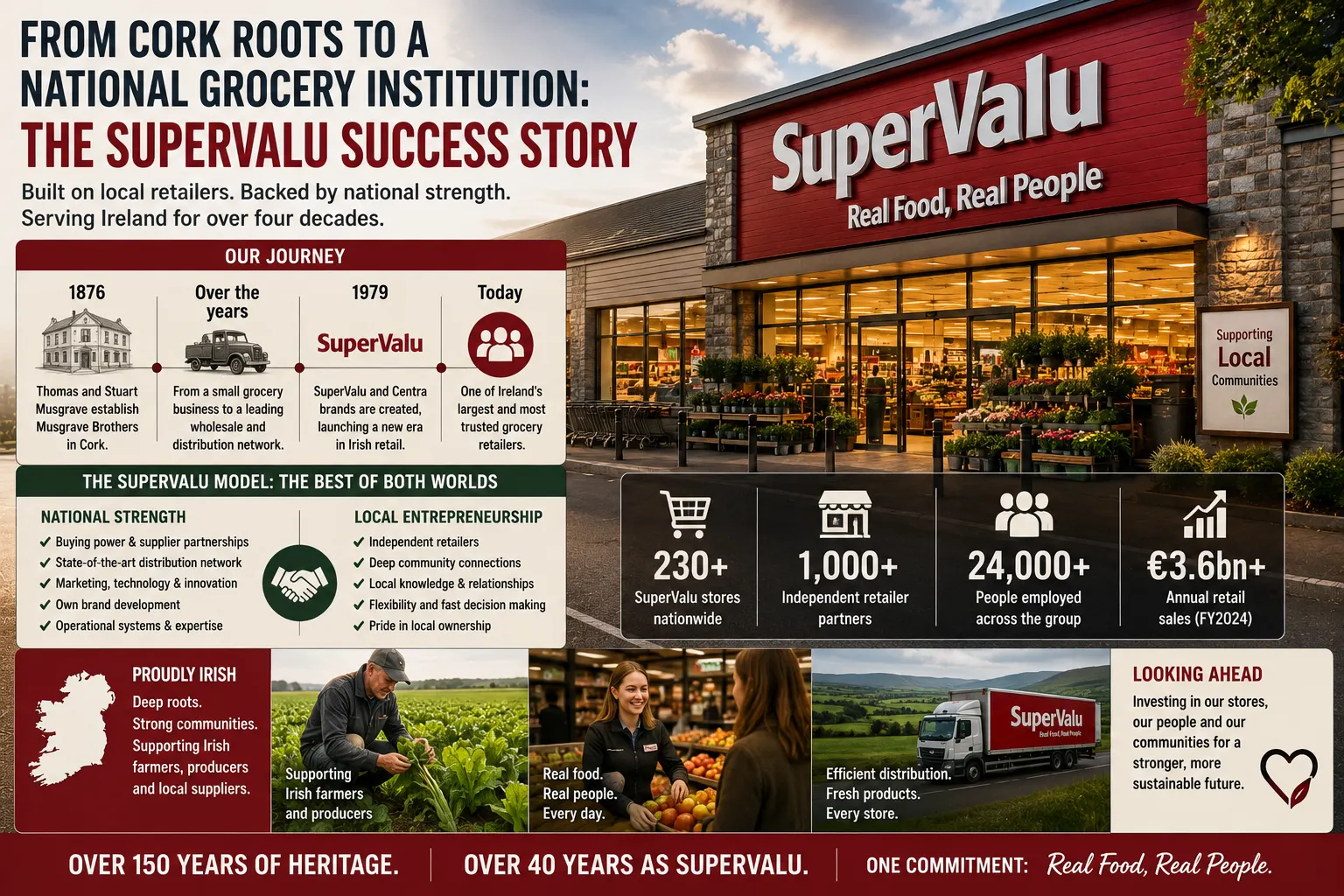
The deeper roots of SuperValu lead back to Cork, where brothers Thomas and Stuart Musgrave established Musgrave Brothers in 1876. What began as a relatively small grocery enterprise developed over generations into a substantial wholesale and distribution business serving independent food retailers.
That evolution became fundamental to the later SuperValu model. Rather than attempting to replace independent shopkeepers, Musgrave increasingly provided them with the infrastructure required to compete in a retail market that was becoming larger, more organised and more demanding. Purchasing, warehousing, distribution and supplier relationships could be handled at scale, while individual retailers continued operating their own businesses locally.
SuperValu itself would not appear until more than a century after Musgrave was founded, but the commercial foundations had already been established. The network of retailers, suppliers and logistics operations that developed during those earlier decades created the structure from which a national supermarket brand could eventually grow.
1979: The SuperValu Brand Is Born
The modern SuperValu story begins in 1979, when the SuperValu and Centra brands emerged within Musgrave’s retail network. Over time, the two formats developed distinct positions in the market. Centra became closely associated with convenience retailing, while SuperValu developed as the larger supermarket format aimed at households carrying out more substantial grocery shopping.
The model offered independent retailers an important competitive advantage. A store owner could remain closely connected with a town or neighbourhood while gaining the support of a much larger organisation behind the scenes. Musgrave could negotiate with major suppliers, manage distribution, develop own-brand products, invest in marketing and introduce common technology, while individual retailers concentrated on operating stores and understanding their local customers.
This combination of national infrastructure and local entrepreneurship became one of SuperValu’s defining characteristics. It allowed stores to gain many of the efficiencies associated with large supermarket groups without completely removing the local business owner from the retail relationship.
National Scale Without Losing Local Character
Large supermarket chains normally gain efficiency through centralisation, standardisation and volume. Independent retailers traditionally have a different strength: they understand the communities in which they operate. SuperValu’s model attempts to combine these advantages.
A supermarket in rural Kerry does not necessarily serve precisely the same customer base as a large suburban store in Dublin. A store in a tourism-heavy town may emphasise different products from one in an agricultural region, while individual retailers can develop relationships with nearby producers or respond quickly to local preferences.
This flexibility has become increasingly valuable as Irish grocery retail has grown more competitive. Customers today have several large supermarket groups to choose from, while price comparison is easier and brand loyalty can no longer be assumed. A strong national supply chain is therefore essential, but local knowledge can still provide an important point of difference.
Supermarkets Changed — and SuperValu Changed With Them
Ireland’s grocery market transformed significantly during the final decades of the twentieth century. Traditional small shops increasingly competed with larger supermarkets, household car ownership expanded, consumers expected wider product ranges and retailers required much more sophisticated logistics.
SuperValu expanded within this transformation. Its success depended not simply on adding more stores, but on developing the infrastructure necessary to keep independent retailers competitive. Warehousing, distribution, central purchasing, marketing, store design and eventually information technology became critical elements of the business.
The result was a structure in which a locally operated supermarket could participate in a national-scale grocery system. That became increasingly important as competition moved beyond local shopkeepers and towards large domestic and international supermarket organisations.
The Superquinn Acquisition Became a Major Turning Point
One of the most significant developments in SuperValu’s modern history followed the financial crisis. In 2011, Musgrave acquired Superquinn, one of Ireland’s best-known supermarket businesses, after the company entered receivership. The Superquinn name continued for a period before the remaining stores were converted to SuperValu in 2014.
The move substantially strengthened SuperValu’s presence in larger urban and suburban markets, particularly around Dublin. Before that point, the brand already had a powerful position across regional Ireland, but the former Superquinn estate gave it additional access to areas where Superquinn had developed strong customer recognition and established supermarket locations.
The acquisition represented more than an increase in the number of stores. It marked another stage in SuperValu’s transition from a successful network of local and regional supermarkets into one of Ireland’s principal national grocery brands.
Competition Became Much Tougher
SuperValu’s expansion did not take place in a protected market. Irish grocery retail became increasingly competitive as Dunnes Stores strengthened its food business, Tesco remained a major national player and Lidl and Aldi expanded rapidly across the country.
Consumers also changed the way they shopped. Many households became more willing to divide their weekly grocery spending among several retailers. Discount supermarkets improved their ranges, own-brand products became more sophisticated, online shopping developed and customers became increasingly sensitive to price.
This environment placed pressure on every established retailer. SuperValu therefore had to compete simultaneously on value, quality, range, convenience and service. Its continued position as one of Ireland’s largest grocery retailers is significant precisely because the market has become so competitive.
By 2026, SuperValu continued to account for close to one-fifth of Irish grocery spending. While other retailers have at times held larger national market shares, maintaining such a substantial position after decades of structural change remains an important commercial achievement.
A Multi-Billion-Euro Retail Business
The scale of modern SuperValu is very different from the network that emerged in 1979. SuperValu retail sales reached approximately €3.6 billion in 2025, while Musgrave as a wider group generated turnover of around €5.5 billion.
These figures demonstrate how large the business infrastructure behind the local supermarket has become. Yet the contrast remains striking: a store can still be closely associated with a particular independent retailer or family while participating in a retail system operating at national scale.
That combination is unusual in modern grocery retail. It allows local entrepreneurship to remain part of the brand while benefiting from central purchasing, distribution, technology and marketing capabilities that would normally be associated with a much more centrally owned supermarket organisation.
Irish Food Became an Important Competitive Strength
SuperValu has long placed considerable emphasis on Irish food and domestic suppliers. This strategy fits naturally within the Irish market, where agriculture and food production remain closely connected with the national economy and where customers increasingly want to understand the origin of the food they buy.
For retailers, local sourcing can also create differentiation. Supermarkets may sell many of the same international brands, but relationships with smaller Irish producers can give individual stores or retail networks products that are less easily replicated by competitors.
The challenge is that moving from small-scale production into supermarket retail is not simple. Producers need reliable manufacturing, food-safety systems, appropriate packaging, consistent quality and the ability to deliver products at commercial scale. A business may have an excellent product but still require significant development before it is ready for mainstream retail distribution.
Food Academy: From Small Producer to Supermarket Shelf
SuperValu’s Food Academy became one of the most visible responses to that challenge. Developed in cooperation with the Local Enterprise Office network, the programme helps emerging Irish food and drink businesses understand how to operate within a professional retail environment.
By 2026, the programme had entered its thirteenth year, and participating producers had generated more than €300 million in cumulative sales. That makes Food Academy more than a promotional initiative. For successful suppliers, supermarket access can provide the foundation for production expansion, additional employment, investment in equipment and wider distribution.
SuperValu benefits as well. Locally produced products give the network opportunities to offer ranges that do not necessarily look identical to those found in every competing supermarket. The programme therefore demonstrates an important commercial principle: supporting small Irish producers can be both a community initiative and a competitive retail strategy.
Independent Retailers Remain at the Centre
Many SuperValu retailers have their own capital invested directly in their stores. That creates strong incentives to understand local customers, protect the reputation of the business and invest in the long-term strength of the store.
At the same time, independence brings responsibility. Modern supermarkets require constant investment in refrigeration, energy efficiency, store layouts, fresh-food counters, digital systems and customer service. A supermarket cannot remain commercially competitive in 2026 by operating exactly as it did twenty or thirty years earlier.
SuperValu stores therefore continue to undergo substantial redevelopment and refurbishment. Multimillion-euro investments in individual locations illustrate how the network has evolved: the business has not survived by preserving an older supermarket format, but by repeatedly modernising it.
Technology Has Become Part of Grocery Retail
To the customer, supermarket shopping can still look relatively simple. People enter the store, choose products and pay. Behind that process is now a highly sophisticated technological operation.
Retailers need to forecast demand, monitor stock, coordinate deliveries, manage promotions, process online orders and reduce waste. Data increasingly influence decisions about product ranges, pricing, staffing and supply chains.
SuperValu has consequently had to evolve far beyond traditional grocery retail. Online ordering, home delivery and collection have become part of the wider offer, while digital systems increasingly support store operations behind the scenes.
For a network involving independent retailers, this transformation is particularly important. Technology has to provide national-scale efficiency while remaining flexible enough to support stores serving very different local markets.
A New Generation of Premium Irish Products
SuperValu has also moved increasingly into premium Irish food propositions. One example came in 2026 with a €2.4 million investment involving Kepak and Warrendale Wagyu to develop an Irish Wagyu beef programme.
The initiative illustrates how a national supermarket network can help organise an entire domestic supply chain. Farmers need predictable demand, processors need sufficient volume and retailers require consistency and quality. Bringing those elements together at scale creates opportunities that would be difficult for any one participant to develop alone.
For SuperValu, such programmes reinforce another longstanding element of its identity: connecting supermarket retailing closely with Irish agriculture and food production.
Community Became Part of the Brand
SuperValu’s relationship with Irish communities extends well beyond the supermarket shelf. The most visible example is its long-running sponsorship of TidyTowns, which in 2026 reached its 35th year.
The longevity of that relationship is significant. It fits particularly well with a retail network whose stores are embedded in towns and communities across Ireland. A local supermarket benefits when the area around it is attractive, active and economically healthy.
Individual retailers also support sports clubs, schools, charities and community organisations. These activities contribute to something that is difficult to quantify but highly valuable in grocery retail: familiarity and local trust.
In a market where several major retailers can sell similar everyday products at comparable prices, a genuine connection with the local community can provide an advantage that is difficult to reproduce through advertising alone.
Success Has Required Constant Adaptation
A positive company history should not suggest that SuperValu has faced no challenges. Grocery retail operates on relatively tight margins, customers can change stores easily and international competitors possess enormous purchasing power. Wages, energy, insurance and construction costs have also increased, while online shopping requires significant investment.
Discount retailers have permanently changed consumer expectations around price, while traditional supermarkets have had to improve own-brand ranges, promotions and convenience. SuperValu therefore operates in a market where almost every household has several credible alternatives.
Its success is not based on permanently dominating that market. The more important achievement is remaining one of its largest participants while adapting repeatedly to changing competition and consumer behaviour.
Why the SuperValu Model Has Lasted
Several factors help explain that durability. Independent retailers provide local knowledge and entrepreneurial commitment, while Musgrave supplies the purchasing power, logistics and technology required to compete nationally. Irish and locally sourced food gives the network opportunities for differentiation, while continual investment helps stores remain modern.
Community integration strengthens local relationships, and strategic decisions such as the acquisition of Superquinn demonstrate a willingness to expand when significant opportunities arise. None of these factors alone explains SuperValu’s position. Together, they have created a business model capable of evolving without abandoning its basic structure.
From Cork Beginnings to Billions in Retail Sales
The scale of the transformation is remarkable. Musgrave began in Cork in 1876. The SuperValu brand emerged in 1979. Today, SuperValu generates billions of euro in annual retail sales and remains responsible for close to one euro in every five spent in the Irish grocery market.
Yet the most interesting achievement is not simply the turnover. It is that the underlying structure remains recognisable. SuperValu continues to combine national infrastructure with independently operated local retail businesses.
At a time when much of international retail has moved towards greater centralisation, that model remains distinctive. It has allowed local retailers to compete using a level of purchasing, distribution and technological support that individual businesses would struggle to build independently.
The Next Chapter Will Be Different
The forces shaping SuperValu’s future will differ from those that created the original supermarket network. Price competition will remain intense, online grocery shopping is likely to continue expanding and customers will expect greater convenience and more personalised services.
Artificial intelligence and increasingly sophisticated data analysis are also likely to influence stock management, pricing, promotions and demand forecasting. Sustainability requirements will affect refrigeration, packaging, transport and energy consumption, while consumers are likely to demand greater transparency about how food is produced and where it comes from.
SuperValu therefore cannot rely on history alone. Its future will depend on whether its traditional strengths — independent retailing, Irish food and community presence — can continue to work alongside increasingly advanced technology and national-scale efficiency.
There are strong indications that this adaptation is continuing. Food Academy has developed into a substantial route to market for Irish producers, new premium supply chains are being created, stores continue to receive major investment and online shopping has become part of mainstream grocery retail.
An Irish Retail Success Story
SuperValu’s success can easily be expressed through numbers: billions of euro in annual retail sales, a nationwide store network and a substantial share of the Irish grocery market. But the more interesting achievement is structural.
The brand found a way to give independent retailers many of the advantages normally associated with a large national supermarket organisation without completely removing the local entrepreneur from the business. That model has helped retailers respond to economic, technological and competitive changes that would have been extremely difficult to confront individually.
It has also created routes to market for emerging Irish food producers, connected a major retail brand closely with communities across the country and enabled a business whose origins stretch back to Cork in 1876 to remain a significant force in Irish food retail 150 years later.
SuperValu’s history is therefore more than a story of supermarkets becoming bigger. It is a story of scale without completely abandoning local ownership, modernisation without discarding community identity, and an Irish retail business repeatedly adapting as the country around it changed.
The challenge ahead is essentially the same one that has accompanied SuperValu throughout much of its development: remain local enough to be different, while becoming modern and efficient enough to compete at national scale.
So far, that balance has proved remarkably durable.
Source & Transparency
This article is published by Ireland Newspaper for editorial and informational purposes.
Published: 13 August 2026 · Updated: 13 August 2026

Newsroom Ireland Newspaper
Ireland Newspaper editorial team prepares daily news coverage for readers in Ireland and abroad.



Market data, financial news and economy content on Ireland Newspaper are provided for editorial and informational purposes only. They do not constitute financial advice, investment advice, trading advice or a recommendation to buy, sell or hold any financial product. Always verify live prices and consult a qualified professional before making financial decisions.