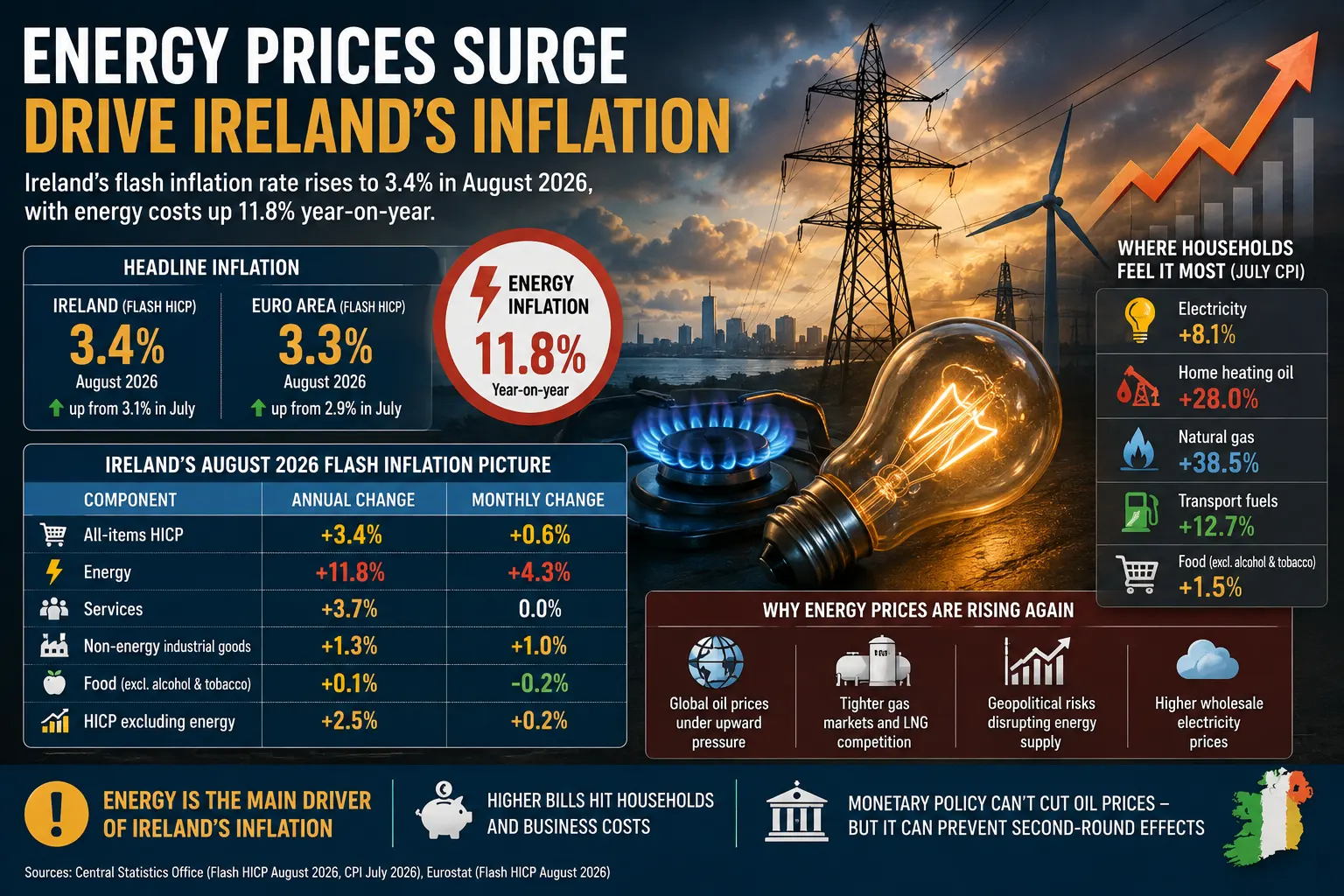
Energy prices in Ireland rose an estimated 11.8 per cent in the twelve months to August and 4.3 per cent in August alone. The increase has pushed Ireland’s flash harmonised inflation rate to 3.4 per cent, up from 3.1 per cent in July, turning energy once again from a declining component of inflation into one of the most important economic risks facing households, businesses and policymakers.
The change is significant not because Ireland has returned to the extraordinary inflation rates seen after Russia’s invasion of Ukraine, but because the source of inflation has shifted. Food inflation in the August flash estimate was almost absent, while the index excluding energy and unprocessed food rose by a much more moderate 2.6 per cent. Energy, by contrast, is again transmitting an international shock directly into an economy that imports most of the fuel it consumes.
The Central Statistics Office’s August figure is a preliminary estimate using the EU Harmonised Index of Consumer Prices, or HICP, and will be revised if necessary when final data are published. Ireland’s separate Consumer Price Index, the official domestic measure of inflation, was already running at 3.4 per cent in July. The two indices differ in methodology and coverage, meaning their identical headline figure should not be interpreted as measuring exactly the same basket.
The wider European picture has deteriorated at almost the same time. Eurostat’s flash estimate published on 1 September put euro-area inflation at 3.3 per cent in August, up sharply from 2.9 per cent in July. Energy inflation across the currency union accelerated to an estimated 14.3 per cent. Ireland is therefore not experiencing an isolated domestic price shock; it is participating in a renewed European inflation cycle with energy at its centre.
Ireland’s August Inflation Number Is Primarily an Energy Story
The composition of Ireland’s latest inflation estimate is unusually revealing. Overall HICP inflation stood at 3.4 per cent, but prices excluding energy increased by only 2.5 per cent. Excluding both energy and unprocessed food, inflation was 2.6 per cent. Food excluding alcohol and tobacco was only 0.1 per cent more expensive than a year earlier.
Services inflation remained more persistent at 3.7 per cent, demonstrating that Ireland still has domestic price pressure beyond imported energy. Non-energy industrial goods rose by just 1.3 per cent, while processed food prices increased by 0.5 per cent. The contrast between those figures and the 11.8 per cent rise in energy makes the new source of pressure unusually clear.
The monthly movement strengthens that conclusion. Overall HICP rose by 0.6 per cent between July and August. Energy increased 4.3 per cent in a single month, while services prices were unchanged and food prices declined slightly. A relatively small part of the consumer basket is consequently producing a disproportionate change in the headline number.
This distinction matters because different types of inflation require different policy responses. Inflation caused by excessive domestic demand can potentially be reduced by suppressing spending through higher interest rates. A sudden rise in imported oil or gas cannot be reversed by raising mortgage rates in Ireland. Monetary policy can instead try to stop the initial energy shock from becoming embedded in wages, services and inflation expectations.
Ireland’s August 2026 Flash Inflation Picture
| Component | Annual Change | Monthly Change |
|---|---|---|
| All-items HICP | +3.4% | +0.6% |
| Energy | +11.8% | +4.3% |
| Services | +3.7% | 0.0% |
| Non-energy industrial goods | +1.3% | +1.0% |
| Food excluding alcohol and tobacco | +0.1% | -0.2% |
| HICP excluding energy | +2.5% | +0.2% |
Source: Central Statistics Office, Flash Estimate for the Harmonised Index of Consumer Prices, August 2026. Figures are preliminary.
The Detailed July Data Show Where Households Are Already Feeling It
The August flash estimate does not yet contain the same detailed consumer-price breakdown available for July. The July CPI therefore provides the clearest current picture of how higher energy prices are reaching individual household expenses.
Electricity prices were 8.1 per cent higher than a year earlier. Home heating oil had increased by 28 per cent. Natural gas prices were up a more modest 1.7 per cent, while the broader category covering electricity, gas and other household fuels was 9.4 per cent higher.
The entire housing, water, electricity, gas and other fuels division of the CPI rose 7.7 per cent over the year and contributed 1.2 percentage points to Ireland’s 3.4 per cent July CPI rate. That category includes more than energy: rents, mortgage interest and other housing costs also contributed. Private rents were 4.5 per cent higher than a year earlier.
Transport costs were also under pressure. The CSO recorded a national average petrol price of €1.77 per litre in July, five cent higher than a year before, while diesel averaged €1.76, an annual increase of six cent. The CSO cautioned that those prices were collected in the middle of July and could therefore fail to capture subsequent movements in international fuel markets.
For rural households the effect can be greater than national averages suggest. Longer driving distances increase exposure to petrol and diesel, while homes outside the gas network frequently depend on heating oil. A household simultaneously facing higher electricity, heating-oil and motor-fuel costs experiences a very different inflation rate from an urban household living in a highly efficient apartment and relying mainly on public transport.
A National Inflation Rate Does Not Describe Every Family’s Inflation
The 3.4 per cent headline number is an average derived from a representative basket. Individual households consume different combinations of goods and services, meaning their personal inflation can be considerably higher or lower.
An older rural house heated with oil is more exposed to the current shock than a recently built A-rated home with a heat pump. A commuter driving 25,000 kilometres a year is more exposed to oil prices than someone who walks to work. A household with children in third-level education faces another pressure altogether: education services were 8.9 per cent more expensive in the July CPI.
Low-income households can also be disproportionately affected by essential-price increases because food, heating, electricity and transport account for a larger share of disposable income. A high-income household may experience the same increase in its electricity bill but have considerably greater financial capacity to absorb it.
This is one reason headline inflation can decline while cost-of-living pressure remains severe, or rise moderately while particular households experience a much larger shock. The distribution of inflation can matter almost as much as the national average.
A Simple Household Model Shows How an Energy Shock Can Become Hundreds of Euros
Consider a purely illustrative household spending €3,000 annually across electricity, heating fuel and other energy-related household costs. If that entire expenditure increased by 11.8 per cent, matching the August HICP energy aggregate, the additional annual cost would be €354.
This is not a forecast of any real household’s bill. The HICP energy category contains different products with different weights, and individual tariffs, consumption patterns and government measures vary. Electricity increased by a different amount from gas, while heating oil has been much more volatile.
The model nevertheless illustrates why relatively small changes in headline inflation can have a substantial cash effect. An extra €350 or €500 spent on energy is money that cannot simultaneously be spent in restaurants, shops, holidays or savings. Across hundreds of thousands of households, that reduction in discretionary spending can become economically significant.
Energy inflation therefore operates through two channels. It increases the consumer-price index directly, but it can also weaken other parts of the economy because households have less purchasing power available for non-essential consumption.
Ireland Remains Unusually Exposed to Imported Energy
The structural reason Ireland is vulnerable is straightforward. Despite rapid growth in renewable electricity, the country remains dependent on imported fossil fuels for most of its overall energy needs.
SEAI estimates that 78.2 per cent of Ireland’s total energy requirement was supplied through imports in 2025. The latest comparable EU average was 57.3 per cent, making Ireland one of the Union’s more import-dependent energy systems.
Ireland imported all of its oil and coal requirements and more than 82 per cent of its natural gas during 2025. Oil alone accounted for 47.3 per cent of Ireland’s total energy requirement, while natural gas represented another 29.9 per cent. Fossil fuels collectively still provided 79.2 per cent of the country’s overall energy requirement.
This does not mean Ireland has made little progress on renewable energy. Renewable sources supplied 40.9 per cent of electricity in 2025, and renewable energy use continued increasing. Wind remains the largest domestic renewable resource, while solar generation and heat pumps are expanding rapidly.
The difficulty is that electricity is only one part of the energy economy. Transport remains heavily dependent on liquid fuel, many buildings use gas or oil for heating and parts of industry require fossil energy. Ireland can therefore produce a large share of its electricity from wind while still being economically exposed to a shock in the international oil market.
Ireland’s Energy Exposure
| Indicator | 2025 | Why It Matters |
|---|---|---|
| Overall import dependency | 78.2% | Global prices transmit rapidly into Ireland |
| Oil import dependency | 100% | Transport highly exposed |
| Natural gas import dependency | 82.3% | Important for heating and electricity |
| Fossil share of energy requirement | 79.2% | Price shocks remain economically important |
| Renewable share of electricity | 40.9% | Reduces but does not remove exposure |
Source: Sustainable Energy Authority of Ireland, 2025 National Energy Balance and Energy Supply and Security of Supply analysis.
The Middle East Shock Has Reversed the Inflation Outlook
The Central Bank of Ireland substantially changed its inflation forecast after disruption to Middle Eastern energy supplies pushed international oil and gas prices higher during 2026. Its June Quarterly Bulletin projected Irish HICP inflation of 3.5 per cent for the full year, compared with 2.1 per cent in 2025.
The difference between current inflation and the outlook anticipated before the energy shock is substantial. The Central Bank raised its 2026 inflation forecast by 0.6 percentage points relative to its previous bulletin, primarily because energy-price assumptions had deteriorated.
Its technical oil-price assumption for 2026 was more than 30 per cent higher than in the previous forecast and roughly 55 per cent higher than the assumption made in December 2025. Gas-price assumptions had also been revised sharply upwards.
The consequences extend beyond petrol stations and household heating. Oil is embedded in freight, aviation, agriculture, plastics and industrial production. Natural gas influences electricity generation and industrial energy costs. Higher transport costs can eventually appear in the price of imported food, consumer goods and construction materials.
This transmission is slow and uneven. A rise in crude oil can affect pump prices comparatively quickly, while businesses may absorb higher transport costs temporarily before increasing consumer prices. Electricity and gas suppliers may buy energy forward under hedging arrangements, delaying the moment when wholesale changes reach household bills.
Energy Is a Supply Shock, Not Simply Another Cost-of-Living Increase
Economically, a large increase in imported energy prices is particularly uncomfortable because it can raise inflation while reducing growth. Ireland sends more income abroad to purchase essentially the same quantity of fuel, leaving households and companies poorer in real terms.
A domestically generated boom can produce higher prices alongside stronger business revenues and employment. An imported energy shock can do the opposite: prices rise while real purchasing power declines.
For households, the mechanism appears in electricity bills, heating costs and transport. For businesses, it appears through fuel, freight, refrigeration, machinery and electricity. Companies then choose between reducing profit margins, raising prices, cutting other expenditure or improving productivity.
When businesses increase their own prices, the initial energy shock spreads into non-energy inflation. That second stage is what central banks monitor particularly closely because it can make a temporary external shock much more persistent.
Ireland Has Seen This Process Before
The inflation shock following Russia’s full-scale invasion of Ukraine demonstrated how rapidly international energy disruption can reach Irish households. CPI inflation exceeded 9 per cent during parts of 2022, with electricity, gas, heating oil and motor fuel among the major drivers.
Inflation subsequently declined as wholesale energy prices normalised, supply chains improved and the unusually large year-on-year increases dropped out of the calculation. By 2024 HICP inflation averaged only 1.3 per cent, helping restore purchasing power.
The new shock differs in important ways. Ireland enters it with services inflation still elevated, housing costs high and several years of cumulative price increases already embedded in household budgets. A new 3 or 4 per cent inflation rate is therefore applied to a much higher general price level than before the pandemic.
This distinction is frequently misunderstood. Falling inflation does not mean prices return to their former level. It means prices are increasing more slowly. A second inflation shock builds on the higher prices created by the first.
Wages Are Only Just Staying Ahead of Recent Inflation
Average weekly earnings reached €1,046.88 in the second quarter of 2026, 3.9 per cent higher than a year earlier. Over the same period the CSO calculated consumer-price inflation of 3.6 per cent. Average wages therefore recorded only a modest real increase.
Those averages conceal substantial differences between workers and industries. Employees receiving pay increases above 5 per cent may still gain purchasing power, while workers whose wages are unchanged are experiencing a direct real-income reduction.
If inflation remains around 3.5 per cent while wage growth moderates, real income could stagnate or fall. The Central Bank expects nominal wages not to keep pace fully with inflation in the near term, one reason it has reduced its expectations for consumer spending.
The alternative creates another problem. If workers across the economy demand larger pay increases to compensate for energy prices and businesses then pass those wage increases into consumer prices, inflation can persist even after the original oil shock fades.
The Central Bank says there is not yet evidence of widespread second-round effects. The risk nevertheless becomes more important the longer energy prices remain elevated.
The Threat Is Not Only Higher Inflation but Weaker Household Spending
The Central Bank expects personal consumption growth of about 1.8 per cent in 2026, weaker than it had previously anticipated. Higher energy prices reduce real disposable income, meaning households either cut consumption, reduce saving or both.
There are already signs that consumers are responding. Confidence weakened markedly during the first half of the year as the geopolitical crisis developed. The Central Bank expects the household savings ratio to fall temporarily as families use more of their income or savings to maintain spending despite higher prices.
This coping mechanism cannot continue indefinitely. A household can absorb a temporary €400 energy shock from savings; repeated annual increases are more likely to alter behaviour. Restaurants, retailers, tourism operators and other consumer-facing businesses can then experience weaker demand even though they are not directly connected with the energy industry.
Inflation therefore creates an economic chain: energy becomes more expensive, disposable income falls, discretionary spending weakens and domestic businesses experience lower demand. If companies are simultaneously paying more for their own energy, margins can be squeezed from both sides.
Small Businesses Have Less Room to Absorb the Shock
Large multinational companies can often absorb a temporary increase in energy or transport costs more easily than smaller domestic firms. Their profit margins, global supply chains and access to finance are generally larger. The picture for an independent restaurant, small manufacturer, haulage company or rural retailer can be very different.
Businesses have already entered 2026 with rising labour costs. Average hourly total labour costs were 4.1 per cent higher in the second quarter than a year earlier. The national minimum wage increased to €14.15 in January and employer pension costs began rising with the launch of MyFutureFund.
Energy therefore arrives as an additional cost rather than an isolated one. A hospitality company may face higher wages, electricity, food deliveries and insurance simultaneously. A manufacturer can face higher power and freight costs. A farmer can experience higher diesel, fertiliser and contractor costs.
Companies able to raise prices can transfer some of the burden to customers. Those operating in highly competitive markets may have little capacity to do so, leaving profits or investment to absorb the difference.
Agriculture Is Particularly Exposed to Fuel and Input Costs
Farming is one of the sectors where international energy shocks move through several channels simultaneously. Tractors and agricultural machinery consume marked gas oil, contractors use substantial quantities of fuel and natural gas is an important international input into fertiliser production.
The scale of the early 2026 shock was sufficiently large for the Government to establish a €100 million fuel-support package for farmers, agricultural contractors and fishers. When the scheme was announced in April, the Department of Agriculture said marked gas oil had risen from approximately €0.97 a litre in late February to about €1.80 during the subsequent crisis period.
High energy prices can therefore influence Irish food production even when supermarket food inflation remains temporarily low. Farmers may initially absorb additional costs, but sustained increases can eventually influence production decisions and prices further along the supply chain.
The Central Bank expects higher energy and other input costs to contribute to stronger food inflation later, forecasting food inflation of 3.8 per cent in 2027 under its baseline outlook. That is a forecast rather than an already observed development.
Transport Costs Spread Through Almost Every Part of the Economy
Ireland’s geography makes road transport economically important. Goods entering Dublin, Cork, Rosslare or other ports frequently complete their journey by road. Rural businesses and households have fewer public-transport alternatives than those in large urban areas.
The Government responded during the spring with temporary reductions in fuel taxation and a €120 million Road Transporters Support Scheme covering haulage and some passenger operators. The maximum Diesel Rebate Scheme repayment has also been increased to 12 cent a litre until the end of September 2026.
These measures can reduce the immediate transmission of international oil prices into business costs, but they do not alter the underlying wholesale price. The State effectively absorbs part of the shock through lower tax receipts or public expenditure.
That creates a fiscal trade-off. Temporary intervention can be justified during an exceptional external shock, particularly where essential supply chains are threatened. Maintaining broad subsidies indefinitely becomes expensive and can weaken incentives to reduce fuel consumption or invest in alternatives.
Government Can Cushion Energy Inflation but Cannot Set the World Oil Price
Ireland has already deployed several mechanisms to reduce household and business exposure. Electricity and gas continue to benefit from a reduced 9 per cent VAT rate, which is scheduled to remain in place until 2030. Fuel Allowance has been increased and eligibility broadened.
During the acute phase of the 2026 energy shock, the Government temporarily reduced excise on petrol, diesel and marked gas oil. It also cut the NORA levy and postponed the planned May increase in carbon taxation on non-propellant fuels.
Revenue records the deferred carbon-tax increase as now scheduled for 14 October 2026. That future change has to be considered alongside the evolution of international energy markets and the decisions expected around the Budget.
The Government faces a difficult balance. Removing support while energy remains expensive can produce an immediate increase in household and business costs. Extending broad support can be expensive for the Exchequer and reduce the normal price signal encouraging energy efficiency.
Targeted support for low-income households and highly exposed essential sectors generally costs less than subsidising every unit of energy consumed throughout the economy. It is also less likely to stimulate overall demand at a time when inflation is already above target.
Higher Inflation Has Already Changed European Interest-Rate Policy
Ireland does not control its own policy interest rate. Monetary policy is set by the European Central Bank for the entire euro area, meaning Irish borrowers are affected by inflation developments from Germany, France, Italy and the other members of the currency union as well as Ireland itself.
The ECB responded to the renewed inflation shock in June by raising all three key policy rates by 25 basis points. The deposit facility rate increased to 2.25 per cent, the main refinancing rate to 2.40 per cent and the marginal lending rate to 2.65 per cent.
In July the Governing Council left rates unchanged, saying that energy prices remained highly volatile and that the full inflationary consequences of the shock had yet to become visible. It specifically identified indirect and second-round effects as risks requiring continued monitoring.
The next monetary-policy meeting takes place on 9 and 10 September. The ECB has explicitly said it is not committing in advance to a particular interest-rate path. Each decision will depend on new inflation data, underlying price pressure, economic activity and evidence of how earlier rate changes are affecting the economy.
Euro-area inflation reaching an estimated 3.3 per cent in August strengthens the case for caution. It does not automatically mean another rate increase will occur, because policymakers must distinguish temporary energy inflation from persistent underlying inflation.
Inflation and Interest Rates Entering September 2026
| Indicator | Current Figure | Context |
|---|---|---|
| Ireland August HICP | 3.4% | Flash estimate |
| Euro-area August HICP | 3.3% | Flash estimate |
| Ireland August energy inflation | 11.8% | Year on year |
| Euro-area August energy inflation | 14.3% | Year on year |
| ECB deposit rate | 2.25% | Since 17 June 2026 |
| Next ECB decision | 10 September | Data-dependent |
Sources: CSO, Eurostat and European Central Bank.
Higher-for-Longer Rates Would Create a Second Household Cost
Energy inflation can affect mortgage borrowers even if they consume relatively little fuel. If the inflation shock causes the ECB to maintain higher interest rates for longer, financing costs throughout the economy can remain elevated.
The effect is strongest for variable-rate borrowers and households approaching the end of fixed-rate mortgage periods. New buyers can also face higher repayments because mortgage pricing reflects the interest-rate environment and banks’ funding costs.
Businesses experience the same transmission through loans for buildings, machinery, vehicles and working capital. Investment that appeared profitable at one interest rate may be postponed when financing becomes more expensive.
This creates another uncomfortable feature of supply-driven inflation. Households can first pay more for electricity and fuel and then face tighter monetary policy designed to prevent those price increases spreading through the rest of the economy.
Central banks accept this cost because allowing inflation expectations to become unanchored can be more damaging. The objective is not to reverse the original oil shock but to prevent temporary inflation becoming permanent.
Services Inflation Is the Number to Watch Once Energy Is Removed
Energy can rise and fall rapidly. Services prices tend to be more persistent because they are influenced heavily by wages, rents and domestic operating costs. Ireland’s services HICP was still increasing by 3.7 per cent annually in August.
That does not prove energy has already triggered a wage-price spiral. Services inflation was elevated before the most recent energy shock and reflects Ireland’s strong labour market, housing costs and domestic demand as well as imported inputs.
The danger emerges if the two forces reinforce each other. Employees facing higher living costs seek larger pay rises. Businesses facing both higher energy and higher labour costs increase prices. Those higher prices then influence future wage negotiations.
Once that process becomes established, falling oil prices alone may no longer return inflation quickly to target. This is why the Central Bank and ECB distinguish headline inflation from measures that strip out volatile components.
Ireland’s August HICP excluding energy and unprocessed food stood at 2.6 per cent. That is considerably less alarming than the 11.8 per cent energy increase, but it remains above the ECB’s medium-term 2 per cent objective.
The Central Bank Still Expects Inflation to Fall Again
The Central Bank’s baseline does not assume permanently high inflation. Its June forecast expects HICP inflation to average 3.5 per cent in 2026 before easing to 2.9 per cent in 2027 and approximately 2 per cent in 2028.
Energy inflation itself is forecast at 9.6 per cent for 2026 before slowing substantially in 2027. This assumes international oil and gas markets gradually normalise rather than continuing to experience major supply disruption.
The 2027 forecast is nevertheless important because it shows that the effect does not disappear immediately. Energy costs can feed into food, services and manufactured goods with a delay, while utilities and businesses frequently operate through contracts that spread price changes over several months.
Even when international oil prices begin falling, the price of a restaurant meal, repair service or delivery contract that previously increased may not fall by an equivalent amount. Inflation can therefore remain above target after the original commodity shock begins to reverse.
A Worse Energy Scenario Would Change Ireland’s Economic Outlook Materially
The Central Bank has modelled a severe scenario precisely because the geopolitical outlook remains uncertain. In that scenario, energy and food commodity prices remain substantially higher for longer rather than converging towards the baseline.
Applying those assumptions to its central forecast would raise Irish HICP inflation to approximately 4.4 per cent in 2026 and 4.8 per cent in 2027. Modified domestic demand growth would fall to approximately 3 per cent this year and 1.8 per cent in 2027.
These figures are scenarios, not predictions. They are intended to show sensitivity rather than describe what the Central Bank expects to happen.
The significance is nevertheless substantial. Inflation approaching 5 per cent alongside materially weaker domestic growth would resemble the classic difficulty created by an energy shock: policymakers would be confronted with high prices and weaker activity at the same time.
There is also a more favourable possibility. A durable reduction in geopolitical tension and restoration of energy supply could push oil and gas prices below the assumptions incorporated into current forecasts. Inflation would then fall more rapidly and household purchasing power would recover sooner.
Central Bank Inflation Scenarios
| Scenario | 2026 Inflation | 2027 Inflation |
|---|---|---|
| Central forecast | 3.5% | 2.9% |
| Severe energy scenario | About 4.4% | About 4.8% |
| Faster normalisation | Below baseline | Below baseline |
Source: Central Bank of Ireland Quarterly Bulletin Q2 2026. Severe and faster-normalisation outcomes are scenarios, not forecasts.
Renewable Electricity Reduces Risk but Does Not Yet Insulate Ireland
Ireland’s long-term answer to imported energy volatility is partly structural rather than fiscal. Every additional unit of electricity generated from domestic wind or solar reduces the volume that needs to be produced from imported fuel or imported electricity, although balancing and grid requirements remain important.
Renewables already supplied more than 40 per cent of electricity in 2025. Wind resources give Ireland an advantage unavailable to many other European countries, while solar capacity has expanded rapidly from a small base.
But high renewable electricity penetration does not automatically make electricity bills independent of gas prices. Gas-fired generation remains crucial when wind and solar output are insufficient and wholesale electricity prices can be strongly influenced by the cost of the marginal generator needed to balance the system.
Electrifying transport and heating can eventually reduce direct dependence on imported oil, especially where the additional electricity is produced domestically from renewable sources. Heat pumps, electric vehicles, building insulation and expanded public transport can all reduce fossil-fuel exposure.
The transition itself requires major investment in electricity networks, generation, storage and interconnection. Energy resilience therefore involves expenditure today in exchange for lower exposure to international fuel markets later.
Ireland’s Declining Domestic Gas Supply Adds Another Long-Term Challenge
The Corrib gas field transformed Ireland’s gas-security position when production began in 2015 and 2016. Domestic production sharply reduced reliance on imported natural gas during the early years of operation.
That advantage is gradually declining as Corrib production naturally falls. Ireland’s gas import dependency rose to more than 82 per cent in 2025 and is likely to remain high without new domestic supply, major reductions in gas demand or alternative infrastructure.
Most imported gas reaches Ireland through interconnection with Britain, creating a different kind of exposure from direct dependence on one overseas producer. Britain itself participates in international gas and LNG markets, meaning global price movements can still transmit into Ireland even when physical supplies remain secure.
SEAI emphasises that Ireland’s energy supply chains have remained robust. The current risk is therefore primarily price vulnerability rather than evidence that homes are about to lose access to fuel.
Businesses Need to Distinguish Temporary Volatility From a Structural Cost Increase
Companies making investment decisions face a difficult question: should they treat the current energy shock as temporary or redesign their operations for permanently higher energy costs?
A manufacturer can postpone investment if it expects electricity or fuel prices to normalise quickly. If high prices persist, investment in efficiency, renewable generation, storage or different production processes becomes more attractive.
The same applies to transport fleets. A temporary diesel shock may justify operating support, while structurally expensive oil strengthens the business case for alternative fuels, electric commercial vehicles where practical and more efficient logistics.
Investment decisions depend not only on today’s price but expectations about the next ten or twenty years. Extreme energy-price volatility is therefore damaging even when the average price eventually falls because uncertainty itself can postpone investment.
Inflation Also Changes Government Finances
Higher nominal prices can initially increase some tax receipts because VAT is collected on larger monetary values and wages may rise. But government expenditure is also affected. Public-sector pay, welfare payments, construction contracts, transport and energy costs can all become more expensive.
Cost-of-living interventions add another fiscal burden. Cutting fuel duties or providing direct payments protects households and businesses but reduces revenue or increases expenditure.
Ireland currently has strong public finances supported by exceptional corporation-tax receipts, giving the State more capacity to respond than during many earlier economic crises. Dependence on volatile corporate tax revenues, however, creates its own risk.
The Central Bank has argued that fiscal policy should retain sufficient buffers rather than permanently increasing spending in response to temporary revenue or price shocks. Broad fiscal stimulus during an inflationary period can also work against monetary policy if it substantially boosts demand.
The policy challenge is therefore targeting: protect households genuinely unable to absorb the shock without attempting to compensate every household fully for every increase in the world energy price.
The Inflation Shock Is Not Equally Bad for Every Part of the Economy
Higher energy prices create obvious losers among energy-intensive consumers and businesses, but economic effects are rarely entirely one-directional. Renewable-energy projects can become more commercially attractive when fossil alternatives are expensive. Energy-efficiency investments deliver larger savings when electricity and heating costs rise.
Companies supplying insulation, heat pumps, solar panels, energy-management systems and grid infrastructure can therefore experience stronger demand. Households with highly efficient homes are comparatively protected.
Ireland’s domestic renewable generation also retains more energy expenditure within the economy than imported fossil fuel. A euro spent importing oil represents a payment abroad, whereas domestic wind generation supports assets, employment and investment located partly within Ireland.
This does not mean high fossil-fuel prices are economically desirable. The transition becomes most difficult when prices rise rapidly before households and firms have had time or capital to change technology.
Energy Poverty Becomes a Greater Risk as Winter Approaches
The timing of the renewed inflation pressure matters. Household heating consumption rises sharply during autumn and winter, meaning wholesale and retail price developments over the coming months will have a greater effect on household budgets than identical increases during summer.
Fuel Allowance has been increased to €38 per week and eligibility expanded, providing targeted assistance to hundreds of thousands of households. The Household Benefits Package provides further electricity or gas support for eligible groups.
These mechanisms are particularly important because lower-income households often live in less energy-efficient housing. A poorly insulated home requires more energy to maintain the same indoor temperature, meaning the household most vulnerable to high prices can also be the household required to purchase the most heating energy.
Retrofitting therefore acts as both climate policy and social policy. Reducing the amount of energy required permanently can provide more protection than compensating households repeatedly for volatile fuel prices.
The October Carbon-Tax Decision Will Arrive in a Difficult Environment
Ireland has legislated for a gradual increase in the carbon-tax rate through 2030 as part of its climate policy. The scheduled May 2026 increase affecting heating oil, natural gas and other non-transport fuels was postponed during the energy shock.
Revenue records the deferred increase as due on 14 October. By then policymakers will have more information about energy markets, inflation and the durability of the geopolitical shock.
There is a genuine policy tension. Carbon pricing is intended to make fossil fuels progressively less attractive and support the transition towards lower-emission alternatives. Raising the tax during an externally generated surge in fuel prices adds another cost to households and businesses precisely when affordability is under pressure.
Repeatedly postponing legislated increases would weaken the credibility and intended price signal of long-term climate policy. Applying them regardless of market conditions could intensify short-term energy poverty. There is no cost-free option.
A more durable solution is to make alternatives accessible before fossil-fuel costs increase further: efficient homes, viable public transport, affordable electric vehicles where suitable and sufficient renewable electricity.
The Most Important Future Indicator May Be Energy Inflation Rather Than Headline Inflation
For the next several months, Ireland’s 3.4 per cent headline figure will tell only part of the story. Energy prices should be watched separately because they can change far more rapidly than the rest of the consumer basket.
If energy inflation falls from 11.8 per cent towards zero while underlying inflation remains around 2.5 per cent, headline inflation could decline relatively quickly. That would improve household real incomes and reduce pressure on the ECB to maintain tighter monetary policy.
If energy inflation remains in double digits, the risk changes. Businesses will have more time to pass costs into prices, wage demands may strengthen and household expectations of future inflation can rise.
Services inflation will then become particularly important. Persistent services inflation above 3 per cent combined with sustained energy inflation would provide much stronger evidence of broadening price pressure than energy alone.
Three Paths Now Matter for Ireland
The most favourable scenario is a durable normalisation of international energy supply. Oil and gas prices decline, the August increase proves temporary and inflation begins converging back towards 2 per cent during 2027 and 2028. Household purchasing power improves and interest-rate pressure eases.
The second scenario is prolonged but manageable disruption. Energy remains expensive without another major surge. Irish inflation stays around 3 per cent or somewhat higher for longer, wages struggle to generate significant real gains and the ECB maintains a relatively restrictive stance. Economic growth continues but households remain cautious.
The third is renewed escalation. Oil, gas, shipping and other commodity prices rise sharply again and remain elevated. Inflation moves towards the severe Central Bank scenario, domestic demand weakens and businesses face simultaneous cost and financing pressure.
None of these outcomes can currently be treated as certain. Energy markets can reverse extremely rapidly because they respond not only to physical supply but to inventories, geopolitical expectations, shipping conditions and anticipated future demand.
What Different Energy Paths Could Mean
| Scenario | Inflation Effect | Economic Effect |
|---|---|---|
| Rapid normalisation | Falls towards target sooner | Real incomes and consumption improve |
| Prolonged high energy prices | Inflation remains elevated | Slower consumption and higher-for-longer rates |
| Major renewed escalation | Potentially towards 5% | Weaker growth and broader cost pressure |
Scenario analysis based on Central Bank of Ireland projections. Outcomes are illustrative rather than predictions.
Ireland’s Strong Domestic Economy Provides Some Protection
The renewed inflation shock arrives while Ireland still has high employment and continuing domestic investment. Almost 2.84 million people were employed in the second quarter, and modified domestic demand continues to expand.
Large investment in data centres, artificial intelligence infrastructure and other capital projects is supporting economic activity even while consumer spending is under pressure. The Central Bank expects modified domestic demand to grow by approximately 3.3 per cent in 2026 under its central forecast.
This makes Ireland more resilient than an economy already entering the energy shock in recession. Strong employment means most households continue receiving labour income, while government finances provide capacity for targeted intervention.
But resilience is not immunity. Unemployment has already risen to around 5.1 per cent, hiring indicators have cooled and energy inflation reduces the real value of wages. A persistent external shock could gradually weaken these buffers.
The Real Risk Is a Combination of Several Moderate Pressures
Ireland does not need oil prices to reach an unprecedented level for energy to become economically damaging. A prolonged combination of 3 to 4 per cent consumer inflation, expensive housing, modestly higher unemployment and interest rates above the levels expected before the crisis could materially affect household finances.
A family paying higher rent or mortgage costs has less capacity to absorb electricity and fuel increases. A small business already paying higher wages has less capacity to absorb transport and power costs. A farmer facing drought-related feed pressure has less capacity to absorb expensive diesel or fertiliser.
Economic vulnerability therefore depends on the interaction between pressures rather than one statistic in isolation. The renewed energy shock is important because it arrives before several earlier affordability problems have disappeared.
Energy Security Is Becoming an Economic Policy Issue as Much as a Climate Issue
For years, Ireland’s energy transition was discussed predominantly through the lens of emissions reduction. The repeated shocks since 2022 have made another argument increasingly important: domestic renewable energy can reduce exposure to geopolitical commodity markets.
Wind and solar do not eliminate every energy-security problem. Their variability requires networks, storage, flexible generation and interconnection. Renewable infrastructure also depends on international supply chains and significant upfront investment.
But the fuel itself is domestic and does not need to be purchased repeatedly from international markets. That changes Ireland’s long-term exposure fundamentally.
The more transport and heating can be electrified using a progressively cleaner domestic electricity system, the smaller the direct effect of an international oil shock becomes. The transition therefore has a potential economic-security dividend alongside its environmental objective.
The August Figure Is a Warning Rather Than a Return to the 2022 Crisis
Ireland’s 3.4 per cent HICP rate remains far below the inflation peaks recorded during the previous energy crisis. Food inflation is currently exceptionally subdued, core inflation remains much lower than energy inflation and employment is still historically high.
Those conditions argue against describing Ireland as entering another full-scale cost-of-living crisis on the basis of one flash estimate. August data are preliminary and energy prices can reverse quickly.
But dismissing the number would be equally unwise. Energy inflation of 11.8 per cent is large enough to reduce household purchasing power, raise business costs and influence monetary policy. The euro area has simultaneously moved to 3.3 per cent inflation, confirming that the problem is broader than Ireland.
The economic question over the coming months is therefore not simply whether the headline rate rises from 3.4 to 3.5 per cent or falls to 3.2 per cent. It is whether the energy shock remains concentrated in fuel and electricity or begins to spread persistently into wages, food, services and other prices.
Ireland Can Cushion the Shock, but Its Vulnerability Is Structural
Tax reductions, fuel supports and social-welfare measures can protect households and businesses temporarily. Interest-rate policy can prevent inflation from becoming embedded. Neither can remove Ireland’s underlying exposure to international fuel prices.
That exposure comes from an energy system still meeting almost four-fifths of its requirements through fossil fuels and almost four-fifths of its total energy requirement through imports. As long as those numbers remain high, events thousands of kilometres from Ireland can rapidly change the cost of driving to work, heating a home, transporting food or running a business.
The longer-term answer therefore combines affordability and resilience: more efficient buildings, additional renewable generation, stronger electricity networks, energy storage, transport alternatives and reduced dependence on imported fossil fuel. These investments take years, which is precisely why temporary emergency supports cannot substitute for them.
For now, Ireland enters autumn with inflation again above 3 per cent, household energy prices accelerating and the ECB preparing for another crucial interest-rate decision. The economy remains resilient, but the source of the new inflation matters. Unlike a domestic spending boom, Ireland cannot negotiate with the world oil market. It can only reduce how much power that market has over its economy.
Sources
Central Statistics Office — Flash Estimate for the Harmonised Index of Consumer Prices, August 2026
Central Statistics Office — Consumer Price Index, July 2026
Central Statistics Office — Earnings and Labour Costs Q2 2026
Eurostat — Euro Area Annual Inflation Flash Estimate, August 2026
Central Bank of Ireland — Quarterly Bulletin Q2 2026
Central Bank of Ireland — Inflation and Middle East Energy Shock Outlook, June 2026
European Central Bank — Monetary Policy Decision, 11 June 2026
European Central Bank — Monetary Policy Decision, 23 July 2026
European Central Bank — Governing Council Meeting Calendar
Sustainable Energy Authority of Ireland — Energy Import Dependence and Security of Supply 2025
Sustainable Energy Authority of Ireland — National Energy Balance
Sustainable Energy Authority of Ireland — Ireland’s Energy Supply and Security of Supply
Government of Ireland — Energy Supports 2026
Government of Ireland — Emergency Fuel Support Package, April 2026
Government of Ireland — Road Transporters and Fuel Support Schemes
Department of Agriculture — €100 Million Fuel Support Package
Revenue — Diesel Rebate Scheme Rates 2026
Revenue — 2026 Mineral Oil Tax Reductions and Deferred Carbon Tax Increase
Source & Transparency
This article is published by Ireland Newspaper for editorial and informational purposes.
Published: 1 September 2026 · Updated: 1 September 2026

Newsroom Ireland Newspaper
Ireland Newspaper editorial team prepares daily news coverage for readers in Ireland and abroad.




Market data, financial news and economy content on Ireland Newspaper are provided for editorial and informational purposes only. They do not constitute financial advice, investment advice, trading advice or a recommendation to buy, sell or hold any financial product. Always verify live prices and consult a qualified professional before making financial decisions.