Beyond Blarney: How County Cork Is Building a Broader Tourism Economy
Strong air connectivity, a growing cruise business, food tourism and the extraordinary variety of Cork City, the harbour and West Cork are giving the county a powerful position in Irish tourism. The next challenge is not simply attracting more visitors, but persuading them to stay longer, explore further and travel outside the traditional summer peak.
County Cork has a tourism advantage that is difficult to reproduce elsewhere.
A visitor arriving in the morning can walk through one of Ireland’s best-known food markets, reach a medieval castle before lunch, travel through one of Europe’s great natural harbours in the afternoon and finish the day in a fishing town overlooking the Atlantic.
Stay longer and the landscape changes again.
West Cork offers peninsulas, islands, beaches, cliffs and small coastal communities. East Cork combines wildlife, whiskey, maritime history and heritage towns. Kinsale has developed an identity around food and the sea, while Cobh connects Cork directly with the history of emigration, ocean liners and the harbour.
The result is not one tourism destination but several destinations capable of being combined into a single journey.
That distinction is becoming increasingly important as Cork attempts to turn its geographic diversity into a stronger year-round visitor economy.
Cork Already Has a Large Tourism Economy
Detailed county tourism statistics are published with a delay, so the latest Fáilte Ireland Cork factsheet covers 2024 rather than the current year.
Those figures nevertheless demonstrate Cork’s scale.
Fáilte Ireland estimated that approximately 981,000 overseas tourists visited Cork in 2024, alongside 1.8 million domestic visitors.
Overseas visitors spent an average of about €790 per person and stayed 6.7 nights on average, compared with €206 and 2.2 nights respectively for domestic visitors.
The difference is economically important.
Domestic tourism provides volume and resilience, particularly during periods of weaker international travel. Overseas tourists, however, generally remain longer and spend considerably more per trip.
The strategic objective for Cork is therefore not merely increasing visitor numbers but increasing the number of nights and the amount of local economic activity generated by each journey.
The wider South-West remains one of Ireland’s strongest tourism regions.
In 2025 it accounted for 20 per cent of domestic overnight trips but 24 per cent of domestic tourism spending, with an average domestic stay of 2.9 nights compared with 2.2 nationally.
Dublin and the South-West together also generated a substantial proportion of Ireland’s overseas tourism revenue.
That puts Cork in a favourable position — but also means expectations are high.
2026 Has Started Against a More Positive National Background
The national tourism picture improved significantly during the first half of 2026.
Ireland welcomed more than 3.2 million overseas visitors between January and June, around 15 per cent more than during the same period in 2025.
Their reported spending reached approximately €2.6 billion, an increase of around 18 per cent.
County Cork will not necessarily move at exactly the same rate as the national market, but the recovery is relevant because Cork depends heavily on international access.
And in that area, the county has become considerably stronger.
Cork Airport Has Changed the Tourism Equation
Perhaps the most important structural development in Cork tourism has been the expansion of Cork Airport.
The airport handled 3.46 million passengers in 2025, its busiest year on record and around 13 per cent more than in 2024.
Passenger numbers were also substantially higher than a decade earlier.
That growth matters for more than aviation.
Every additional direct route reduces Cork’s dependence on visitors first entering Ireland through Dublin and then travelling south.
It allows Cork to compete as a starting point for an Irish holiday rather than simply a destination added somewhere in the middle of one.
The picture in 2026 is more nuanced.
Through the end of May, Cork Airport had handled approximately 1.28 million passengers, slightly below the exceptionally strong equivalent period of 2025.
May itself recorded more than 323,000 passengers and remained well above pre-pandemic levels.
Services through major European hubs such as Paris and Amsterdam have also strengthened Cork’s international connectivity.
For tourism businesses in West Cork, Cork City, Kinsale, Cobh and East Cork, that accessibility can be as important as another new attraction.
Cork Harbour Is Becoming a Tourism Gateway of Its Own
Air travel is only half of Cork’s access story.
The harbour has become a major cruise destination.
During 2025, Cork welcomed more than 170,000 cruise passengers aboard around 90 cruise vessels, with additional calls in Bantry Bay.
The Port of Cork estimated the local economic contribution of cruise tourism at approximately €17 million.
The programme is even larger in 2026.
A total of 93 cruise ships are scheduled to call at Cork Harbour, with the majority due at Cobh and additional calls planned for Ringaskiddy and Cork City.
This gives Cork something relatively unusual: a major tourism destination can effectively arrive at the county’s front door carrying thousands of potential customers at once.
But cruise tourism also demonstrates the difference between visitor numbers and visitor value.
A passenger who spends six hours ashore contributes very differently to the local economy from an international visitor who remains in Cork for four nights, stays in hotels, eats in restaurants and travels through several towns.
The opportunity is therefore to persuade more visitors — whether arriving by ship or air — to see Cork Harbour as the beginning of a wider Cork experience.
The New Strategy Is About Staying Longer
Fáilte Ireland’s five-year tourism plan for Cork City, Cork Harbour and East Cork makes that objective clear.
Rather than concentrating purely on increasing arrivals, the strategy seeks to increase the value of tourism, reduce seasonality and increase visitor spending.
It envisages stronger connections between Cork City, the River Lee, Cork Harbour and East Cork, while developing harbour experiences, tourism towns, cultural attractions, trails, greenways, food tourism and outdoor activities.
This is a significant shift in tourism thinking.
A destination can become economically stronger without necessarily putting dramatically more people into the same famous attraction at the same time.
If somebody who previously spent one night in Cork stays for three, the effect can spread through accommodation, restaurants, transport, retail, attractions and rural businesses.
Cork’s geography makes this particularly realistic.
The attractions already exist.
The challenge is connecting them.
Cork City: The Natural Starting Point
For many visitors, Cork City provides the most logical base.
The city is compact enough to explore on foot while offering a mixture of food, architecture, museums, pubs, cultural venues and historic streets.
The English Market remains particularly important because it represents something tourism increasingly values: an attraction that is still part of everyday local life.
It is not simply a museum showing visitors how Cork once ate.
It remains a working food market.
That distinction strengthens Cork’s wider positioning around gastronomy.
The city also offers Shandon, St Fin Barre’s Cathedral, Elizabeth Fort, Cork City Gaol, the Butter Museum and cultural institutions that make it possible to construct a substantial city break without leaving the urban area.
But the strength of Cork City is increased considerably by what lies immediately outside it.
Blarney Castle: Cork’s Internationally Recognisable Landmark
A short distance northwest of Cork City sits the attraction that may have the strongest international name recognition in the county.
Blarney Castle and Gardens combines the castle and famous Blarney Stone with extensive gardens, parkland, avenues, arboretums and waterways.
Its strategic importance to Cork tourism extends beyond the attraction itself.
Blarney is close enough to the city to work as a half-day excursion, accessible to independent travellers, organised tours and cruise passengers.
That makes it an important bridge between Cork City and the county’s wider tourism economy.
The challenge for Cork is to ensure that Blarney is not the visitor’s only experience of the county.
A tourist who visits the castle and immediately leaves has very different economic value from one who continues into Cork City, Kinsale, Cobh or West Cork.
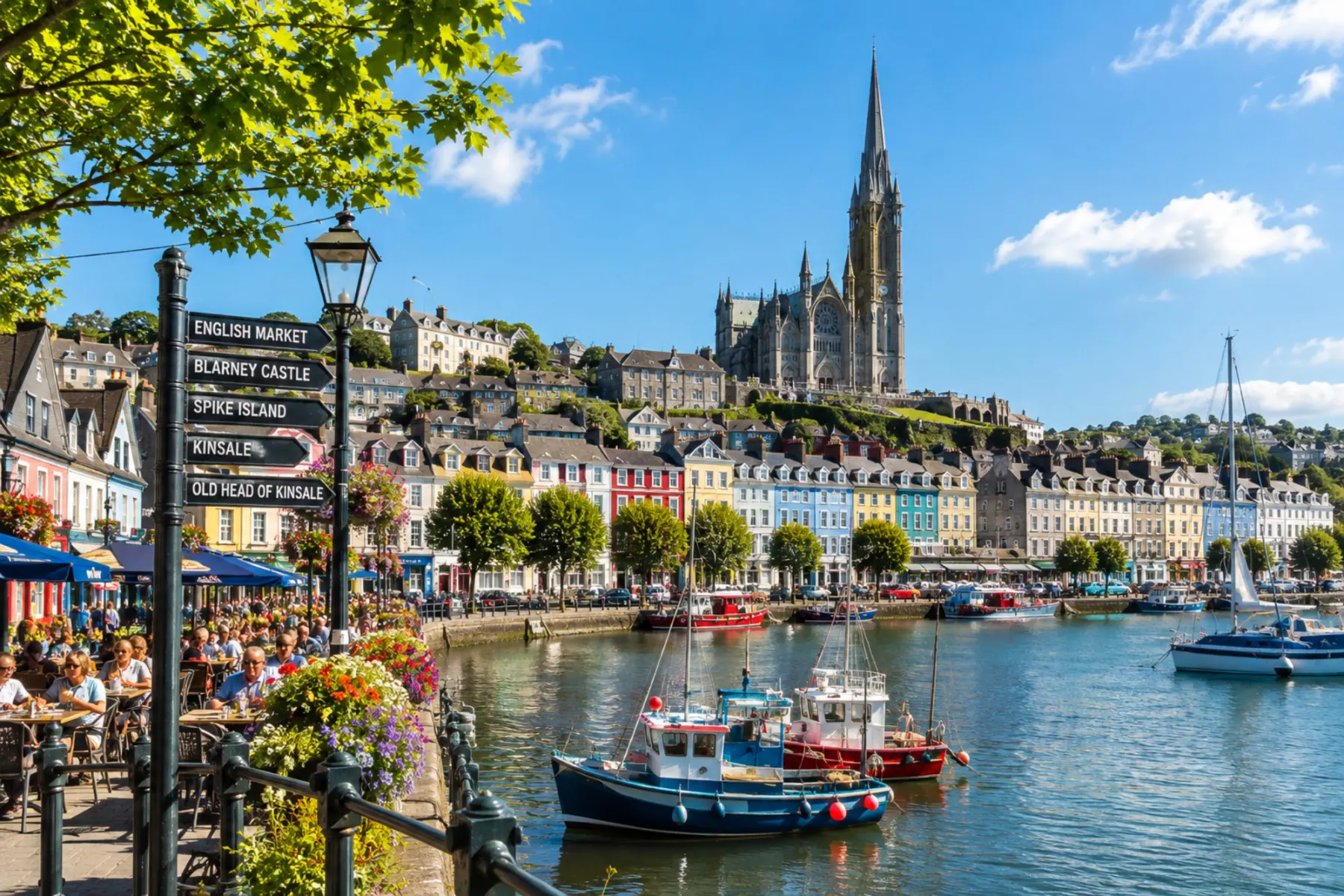
Cobh and Spike Island: Cork Harbour’s Strongest Heritage Combination
Few places explain Cork’s tourism potential better than Cobh.
The town’s harbour setting, steep streets, colourful waterfront and maritime heritage make it visually distinctive before a visitor enters a single attraction.
Its position beside Cork’s principal cruise terminal makes that appeal even more important.
From Cobh, visitors can also travel by ferry to Spike Island, creating one of Cork Harbour’s strongest combined experiences.
Spike Island contains around 1,300 years of recorded history, including a seventh-century monastery, military use, a major fortress and its period as a Victorian convict depot.
Today Fort Mitchel dominates the island and the attraction combines exhibitions, guided interpretation and walking routes around Cork Harbour.
The tourism value is obvious.
Cobh provides the town experience.
Spike Island provides the major heritage attraction.
The harbour itself provides the landscape connecting them.
This is precisely the type of cluster Cork’s tourism strategy is attempting to develop more widely.
Fota Wildlife Park: A Major Family Attraction
A short distance away, Fota Wildlife Park adds an entirely different market.
The park covers approximately 100 acres on Fota Island, around 10 kilometres east of Cork City, and attracts hundreds of thousands of visitors annually.
Its work combines tourism with conservation, education and research.
Its importance lies partly in audience diversity.
Castles and maritime museums may appeal strongly to cultural tourists.
Coastal landscapes attract walkers and touring visitors.
Fota can draw families who might structure an entire day around one attraction.
That makes the Cork Harbour and East Cork area unusually versatile.
Within a relatively compact region, visitors can combine wildlife, maritime heritage, whiskey, historic towns and Cork City itself.
Midleton: Whiskey Becomes a Visitor Experience
East Cork also contains one of the county’s most valuable links between tourism and an internationally recognised Irish product.
The Midleton Distillery Experience is associated with brands including Jameson, Redbreast, Powers and Midleton Very Rare and offers guided experiences and tastings at the historic distillery site.
This illustrates a major evolution in modern tourism.
Visitors increasingly want more than a product.
They want to understand where it comes from, how it is made and why a particular place became associated with it.
Food and drink production can therefore become part of destination infrastructure.
For Cork, whiskey complements a much broader food identity extending from the English Market and city restaurants to seafood, artisan production and farming throughout the county.
Kinsale: Where Food, Heritage and the Sea Meet
South of Cork City, Kinsale has developed one of Ireland’s strongest small-town tourism identities.
Its harbour, restaurants, galleries, colourful streets and coastal setting give visitors several reasons to stay rather than simply pass through.
The major historic attraction is Charles Fort, approximately three kilometres from Kinsale.
The extensive star-shaped military fortress at Summer Cove overlooks Kinsale Harbour and remains one of the area’s most important heritage attractions.
Kinsale’s broader importance lies in the combination.
Heritage alone can create a day trip.
Restaurants alone can create an evening visit.
A harbour, fort, coastal walks, accommodation and established food reputation can create a multi-night destination.
That is economically much more valuable.
West Cork Is the County’s Great Landscape Product
Travel further west and Cork changes character.
Population density falls.
Roads become smaller.
The Atlantic becomes increasingly dominant.
This is where County Cork connects directly with the Wild Atlantic Way, and where tourism becomes less about individual attractions and more about landscapes, journeys and communities.
Among the most important destinations are Mizen Head, Clonakilty, Inchydoney, Glengarriff, Garnish Island, the Beara Peninsula and Dursey Island.
For international visitors, this part of Cork offers something increasingly valuable: space.
The tourism product is not simply what tourists can enter.
It is what they can move through.
Mizen Head: Tourism at the Atlantic Edge
Mizen Head is one of the strongest examples.
The attraction combines dramatic cliffs, Atlantic scenery and maritime history around the signal station, reached across the well-known arched bridge.
Its appeal is particularly strong because the journey forms part of the experience.
Visitors travelling from Cork City through West Cork pass villages, coastal landscapes and smaller communities where tourism spending can be distributed far beyond a single attraction.
This is also where Cork faces a delicate balance.
The more successful remote destinations become, the more important parking, roads, waste management, environmental protection and community acceptance become.
Growth that weakens the landscape or quality of life on which tourism depends would ultimately undermine the product itself.
Glengarriff and Garnish Island: A Different Side of West Cork
Further north around Bantry Bay, Glengarriff and Garnish Island offer a softer coastal landscape.
The sheltered setting supports the island gardens for which Garnish is known, while the ferry crossing creates another experience in its own right.
This corner of Cork can also operate as a gateway toward the Beara Peninsula, giving visitors an alternative to the better-known routes through neighbouring counties.
That matters strategically.
Successful tourism destinations benefit when travellers have multiple reasons to disperse across a region rather than converging on a small number of heavily visited locations.
Cork has sufficient geographic scale to do exactly that.
Clonakilty and Inchydoney: Town and Coast Together
Clonakilty provides another model.
The town has developed a visitor identity around food, music, local culture and its position in West Cork, while Inchydoney Beach adds one of the county’s best-known coastal experiences nearby.
Again, the important factor is combination.
A beach alone can be highly seasonal.
A town with restaurants, accommodation, culture, retail and surrounding coastal attractions has greater potential to draw visitors outside the hottest weeks of summer.
This ability to build tourism around functioning towns rather than isolated attractions is likely to become increasingly important if Cork wants stronger year-round demand.
Food Is Becoming an Attraction in Its Own Right
Cork’s tourism development is increasingly tied to food.
That strategy is particularly visible in August 2026.
Cork on a Fork Fest runs from 12 to 16 August 2026, with food trails, dining events, demonstrations, tastings, markets and producer-focused experiences across Cork City.
The significance is wider than a five-day festival.
Food has several characteristics that make it valuable to tourism.
It works in bad weather.
It works after museums close.
It can operate throughout the year.
It creates demand for agricultural produce and local suppliers.
And unlike a photograph of a famous landmark, it encourages visitors to spend money repeatedly during a trip.
Food and drink also represent a major share of tourism spending in Ireland.
For Cork, building a reputation around food is therefore not simply branding.
It has a direct economic logic.
The Biggest Challenge Remains Seasonality
The tourism industry’s longstanding problem is that demand is not evenly distributed through the year.
A large proportion of overseas arrivals and visitor nights remain concentrated between June and September.
January and February are considerably quieter.
Cork cannot change Ireland’s climate.
But it can change the reasons people visit.
Food tourism, festivals, whiskey experiences, heritage, business events and city breaks are less dependent on sunshine than beaches or coastal touring.
This helps explain why current tourism strategy emphasises cultural attractions, the evening economy, events, connected routes and stronger urban experiences alongside traditional landscape tourism.
The objective should not necessarily be making February look like August.
It is making February economically stronger than it used to be.
The Other Challenge Is Getting Visitors to Explore More of Cork
Cork’s size is simultaneously an advantage and a problem.
Blarney Castle, Cobh, Kinsale and Cork City can be combined relatively easily.
Mizen Head, Beara and the furthest parts of West Cork demand more time.
For a visitor without a car, those distances can become considerably more important.
This is why trails, greenways, public transport connections and linked itineraries matter.
Current tourism strategy identifies opportunities around connected experience corridors, greenways, trails, water-based activities and slower tourism that encourages visitors to explore the wider destination.
In practical terms, Cork needs to make it easier for a visitor to answer a simple question:
What should I do after the attraction I already know about?
If the answer is clear, visitors stay longer.
If it is difficult, they move on.
Growth Also Has to Work for Local Communities
Tourism development is sometimes discussed as though the only desirable number is more visitors.
That is increasingly outdated.
A destination can receive more people while creating relatively little local economic benefit if stays are short, spending is concentrated in a few places or infrastructure becomes overwhelmed.
Conversely, moderate visitor growth combined with longer stays, local purchasing and greater geographical distribution can create substantially greater value.
Cork’s tourism strategy therefore places growing emphasis on sustainable tourism, community benefits, slower exploration and spreading activity through the destination rather than simply maximising footfall.
That approach is particularly relevant in West Cork and harbour communities where the qualities that attract tourists — landscape, character, heritage and local life — are also the qualities residents want preserved.
Tourism succeeds in the long term when visitors strengthen those places rather than displace what made them attractive.
Cork’s Tourism Advantage Is Its Variety
Many destinations depend overwhelmingly on one product.
A beach resort depends on weather.
A historic city depends on heritage.
A rural region depends on scenery.
Cork does not face the same limitation.
It has a city-break product.
It has one of Ireland’s best-known castles.
It has a major natural harbour and cruise market.
It has maritime and emigration heritage.
It has wildlife tourism.
It has whiskey.
It has one of Ireland’s strongest food identities.
It has Kinsale.
It has beaches.
It has islands.
It has West Cork and the Atlantic.
Few counties can place such different experiences within one destination.
That is Cork’s greatest tourism asset.
What the Next Stage Could Look Like
The next phase of tourism development is therefore unlikely to depend on discovering a previously unknown attraction capable of transforming the county.
Cork already has the attractions.
The greater opportunity lies in connecting them more effectively.
Improved international access can bring visitors directly into the county.
Cruise traffic can introduce large numbers of travellers to Cork Harbour.
Cork City can become a stronger leisure base rather than merely a starting point.
Cobh, Fota and Midleton can operate as an integrated East Cork cluster.
Kinsale can connect food and maritime tourism.
West Cork can encourage slower, multi-day travel.
Greenways and trails can create reasons to visit smaller communities.
And festivals can extend demand beyond the traditional summer sightseeing market.
This is broadly the direction already embedded in Cork’s current five-year destination strategy.
From More Visitors to Better Tourism
Cork’s tourism story in 2026 is therefore not simply one of rising numbers.
The county is moving toward a more sophisticated question.
What is each visit worth — economically, culturally and socially?
The latest detailed county figures already show substantial domestic and international demand.
Cork Airport has established a much larger international network than it possessed a decade ago.
Cruise ships are delivering large numbers of passengers directly into Cork Harbour.
Food is becoming an increasingly marketable experience, while West Cork continues to provide the landscapes for which international visitors come to Ireland in the first place.
The remaining weaknesses are equally clear: seasonality, transport between dispersed attractions, cost pressures and the need to convert short visits into longer stays.
None has a single solution.
But Cork possesses an unusual advantage when addressing them.
It does not need to invent a reason for tourists to come.
From the English Market to Blarney, from Cobh and Spike Island to Fota and Midleton, from Kinsale to Clonakilty and from Mizen Head to the Beara Peninsula, those reasons already exist.
The next stage of Cork tourism will be determined by how successfully the county turns those individual attractions into one connected experience — and whether visitors who arrive planning to see one part of Cork leave wishing they had allowed time for the rest.
Source & Transparency
This article is published by Ireland Newspaper for editorial and informational purposes.
Published: 11 August 2026 · Updated: 11 August 2026

Newsroom Ireland Newspaper
Ireland Newspaper editorial team prepares daily news coverage for readers in Ireland and abroad.