
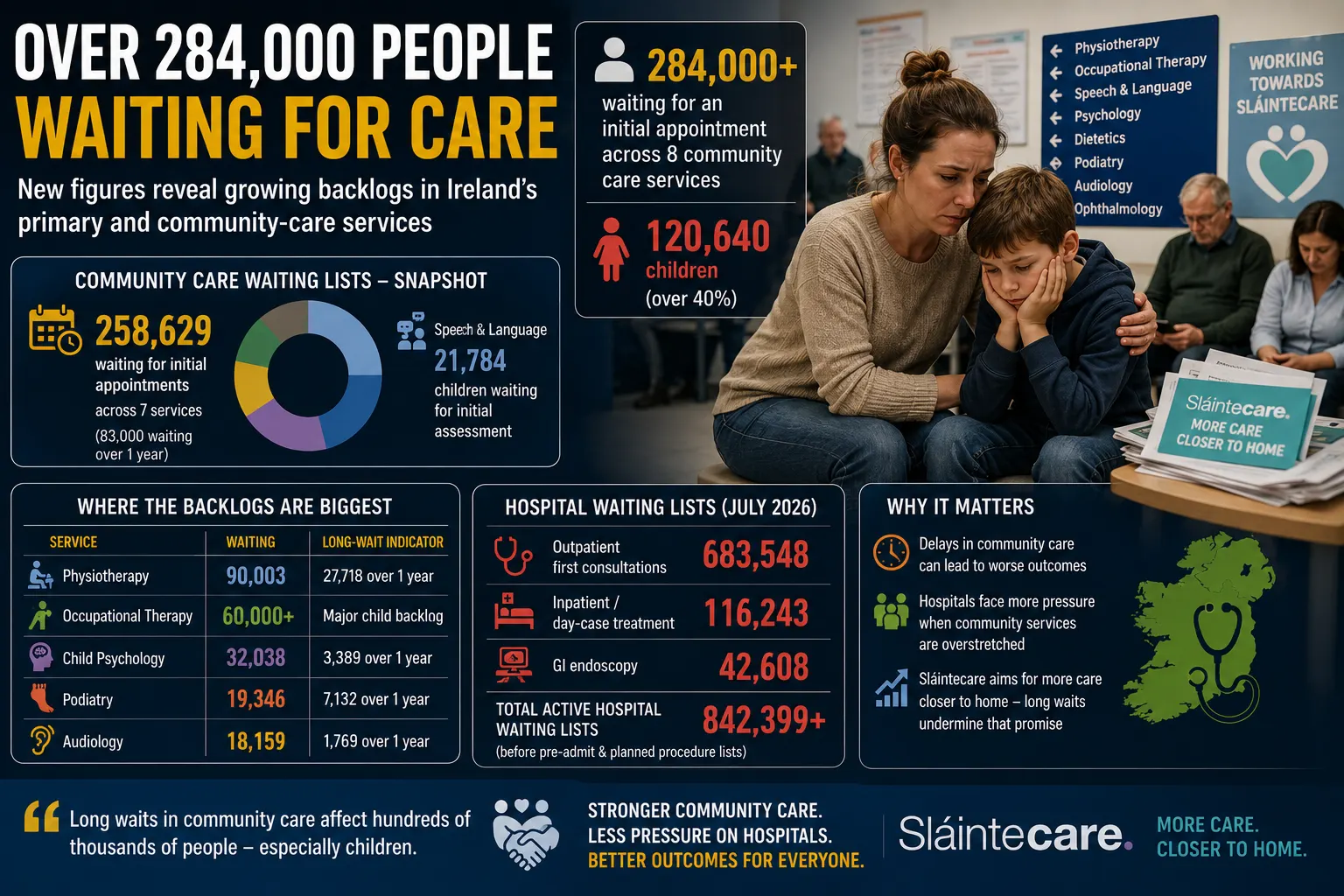
More than 284,000 people are waiting for an initial appointment across eight primary and community-care services in Ireland. More than 40 per cent of them — 120,640 patients — are children. The figures published on 2 September expose a part of Ireland’s healthcare waiting-list problem that receives less regular public attention than hospital queues but is fundamental to whether Sláintecare’s central promise of providing more care close to home can work.
The scale becomes more significant when placed alongside the acute hospital system. At the end of July, 683,548 people were waiting for a first hospital outpatient consultation, 116,243 for inpatient or day-case treatment and 42,608 for gastrointestinal endoscopy. Those three active categories alone represented 842,399 waiting-list positions, before separate pre-admit and planned-procedure lists are included.
The figures should not simply be added together to claim that a particular number of unique Irish people are waiting for healthcare. Hospital and community datasets use different definitions, patients can move through different stages of treatment and some lists concern continuing or future planned care rather than a first untreated condition. What they do show is that capacity pressure is no longer confined to one point in the system. It stretches from physiotherapy and occupational therapy in the community to specialist consultations, diagnostics and procedures in hospitals.
This matters because primary and community care are supposed to prevent some patients from needing hospital treatment, help others recover after discharge and provide assessment and therapy without requiring an acute-hospital appointment. When these services themselves accumulate long queues, one of the mechanisms intended to relieve hospitals becomes constrained.
The New Figures Reveal a Queue of More Than a Quarter of a Million
The latest information was supplied by the Health Service Executive in response to a parliamentary question and covers eight primary and community-care disciplines. Waiting lists across those services have been increasing gradually during 2026.
For seven services — audiology, dietetics, occupational therapy, ophthalmology, physiotherapy, podiatry and psychology — 258,629 people were awaiting an initial appointment. Almost one third, or close to 83,000, had already been waiting for more than a year.
Speech and language therapy adds further substantial waiting lists. Among children alone, 21,784 were awaiting an initial speech and language assessment. A further 6,475 children were waiting for initial therapy after assessment and 9,593 were awaiting further therapy.
These are not interchangeable stages. An assessment establishes needs, while therapy is the subsequent intervention. The distinction demonstrates why a single national waiting-list number cannot describe the patient’s full journey. Access can be delayed before the first assessment and again between assessment and treatment.
Physiotherapy Has the Largest Overall Initial-Assessment Queue
Physiotherapy accounts for the largest national waiting list identified in the new figures, with 90,003 people waiting for an initial assessment. Of those, 27,718 had waited more than 52 weeks.
That means almost one in three people on the physiotherapy assessment list had been waiting for at least a year. The clinical reasons for referral can vary widely, from musculoskeletal injuries and post-operative rehabilitation to mobility problems and long-term conditions, so the urgency of individual cases cannot be inferred from the waiting-list number alone.
The list is nevertheless important because physiotherapy frequently sits between hospital and community care. Timely rehabilitation can support recovery after surgery, help manage chronic conditions and provide an alternative pathway for some musculoskeletal problems that otherwise continue to generate demand elsewhere in the system.
A long physiotherapy queue therefore represents more than inconvenience. It can delay access to assessment, prolong dependence on other health services and leave GPs attempting to manage patients while they wait for specialist community support.
Selected Primary and Community-Care Waiting Lists
| Service | Waiting | Long-Wait Indicator |
|---|---|---|
| Physiotherapy | 90,003 | 27,718 over one year |
| Occupational therapy | More than 60,000 | Major child backlog |
| Child psychology | 32,038 | 3,389 over one year |
| Child speech assessment | 21,784 | 1,647 over two years |
Source: HSE data reported on 2 September 2026. Categories are not directly comparable because some figures cover all ages while others refer specifically to children.
Children Account for More Than 40 Per Cent of the Waiting Population
The proportion of children is one of the most striking aspects of the new data. Of the more than 284,000 people waiting for initial primary and community-care appointments, 120,640 are children.
Occupational therapy presents one of the largest child-specific pressures. A total of 30,148 children are waiting for a first occupational-therapy assessment and 17,319 of them have already waited more than a year.
Occupational therapists can support children whose difficulties affect activities such as dressing, feeding, handwriting, sensory regulation, movement and participation in school or everyday family life. The precise needs of individual children differ, but delays can mean families and schools spend extended periods without the assessment required to establish what support is appropriate.
Psychology services face another large queue. There are 32,038 children awaiting an initial psychology appointment, including 3,389 waiting more than a year.
Speech and language therapy shows how waiting can continue across several stages. Of the 21,784 children waiting for an initial assessment, 1,647 have waited longer than two years. Among the 6,475 awaiting initial therapy after assessment, 681 have waited more than two years, while 751 of the 9,593 children waiting for further therapy have crossed the same threshold.
The figures do not mean every child waiting will experience permanent harm or that every referral has equal clinical urgency. They do demonstrate that years-long waits exist in services that are often sought during important periods of childhood development and education.
Ireland Does Not Have One Waiting List — It Has a Chain of Them
Public debate frequently reduces healthcare access to the headline hospital waiting-list number. The new community data show why that approach is incomplete.
A patient may begin with a GP, require physiotherapy or occupational therapy, later need a hospital specialist consultation and ultimately require a procedure. Another patient may move in the opposite direction, leaving hospital but needing rehabilitation or therapy in the community.
Pressure at one point therefore affects other parts of the system. If community services cannot accept people quickly, hospital specialists may have fewer alternatives for onward care. If patients wait longer for specialist hospital appointments, GPs continue managing them in primary care. If rehabilitation capacity is insufficient, discharge from acute care can become more difficult.
This interdependence is one of the core ideas behind Sláintecare. Healthcare should increasingly be organised around the patient rather than around institutional boundaries, with more appropriate treatment delivered in community settings where possible.
The latest figures reveal the difficulty of implementing that objective. Moving activity away from hospitals requires sufficient staff, facilities and diagnostic access in the community. A reform that changes where care is supposed to occur without creating enough capacity merely moves the bottleneck.
Hospital Waiting Lists Are Rising at the Same Time
The National Treatment Purchase Fund’s latest hospital data reinforce the scale of the broader challenge. At the end of July, 683,548 people were waiting for their first outpatient consultation.
A further 116,243 were waiting for an appointment for inpatient or day-case treatment and 42,608 were waiting for gastrointestinal endoscopy. Together, those active lists contained 842,399 waiting positions.
There were also 35,626 patients in the pre-admit category who had been assigned a date for inpatient, day-case or endoscopy treatment. Another 112,854 were recorded on the planned-procedure list, generally involving patients who have previously received treatment and require clinically scheduled future treatment or surveillance.
Adding the active, pre-admit and planned categories produces almost 991,000 hospital waiting-list positions. It would be misleading, however, to describe all of these as nearly one million people waiting untreated for a first appointment. Planned-procedure patients, for example, can be appropriately scheduled for future surveillance after earlier treatment.
A further 35,997 patients were classified as suspended because they were temporarily unable or unfit to attend, or because they were being managed through certain insourcing or outsourcing initiatives. The NTPF reports these separately.
National Public Hospital Waiting Lists at End-July 2026
| Category | Waiting-List Positions | Meaning |
|---|---|---|
| Outpatient | 683,548 | First hospital consultation |
| Inpatient / Day Case | 116,243 | Treatment appointment awaited |
| GI Endoscopy | 42,608 | Endoscopy appointment awaited |
| Pre-admit | 35,626 | Treatment date assigned |
| Planned Procedure | 112,854 | Future clinically planned care |
| Suspended | 35,997 | Reported separately |
Source: National Treatment Purchase Fund, July 2026. Categories have different clinical and administrative meanings and should not be treated as one homogeneous queue.
The New Community Figures Should Not Simply Be Added to the Hospital Total
A tempting calculation would combine more than 284,000 community waits with nearly one million hospital positions and announce that more than 1.2 million Irish people are waiting for healthcare. The available data do not justify that conclusion.
The datasets are built differently. A person may interact with more than one service, hospital lists include different stages of treatment, and community-care figures can distinguish assessment from subsequent therapy. The reporting systems were not designed as a single national register of unique individuals.
The more defensible conclusion is still serious: Ireland has very large waiting populations in both acute and community care, with some patients waiting for years before accessing particular services.
Improving transparency will therefore be important. Hospital waiting lists are published by the NTPF every month using standardised categories. Primary and community-care waiting-list information remains more fragmented and is frequently obtained through parliamentary questions or individual HSE reports.
This makes it harder for patients, clinicians and policymakers to compare regions, identify deteriorating services early and measure whether interventions are genuinely reducing waits.
Where a Patient Lives Can Have an Extraordinary Effect on the Wait
The national total conceals large geographical differences. Some of the most severe examples in the new data are found in Waterford and Wexford.
There are 13,309 people waiting for an initial physiotherapy assessment across those counties. Of them, 8,484 have been waiting for more than a year — almost 64 per cent of the entire regional physiotherapy list.
The podiatry figures are even more extreme. Of 429 people waiting for an appointment in Waterford and Wexford, 422 had been waiting for more than a year.
In the Midlands, approximately two thirds of the 2,494 people waiting for a dietetics appointment had been waiting longer than twelve months.
These differences cannot automatically be attributed to one cause. Local staffing levels, vacancies, referral patterns, population characteristics, historical backlogs, service organisation and the availability of alternative providers can all affect waiting times.
What the figures do show is that a national entitlement to public healthcare does not necessarily translate into nationally uniform access. Two patients with similar needs can face very different waiting experiences depending on where they live.
Examples of Regional Waiting-List Pressure
| Area and Service | Total Waiting | More Than One Year |
|---|---|---|
| Waterford & Wexford Physiotherapy | 13,309 | 8,484 |
| Waterford & Wexford Podiatry | 429 | 422 |
| Midlands Dietetics | 2,494 | About two thirds |
Source: HSE figures reported 2 September 2026.
The Backlog Was Growing Before 2026
The latest numbers are not the result of a sudden deterioration during one summer. Research published by the Economic and Social Research Institute in May examined longer-term waiting-list trends in primary and community care and found that pressure had been building across most major therapy services after the pandemic.
In December 2024, approximately 83,500 people were already waiting for physiotherapy, 51,000 for occupational therapy, 30,000 for audiology, 24,000 for dietetics, 25,000 for speech and language therapy and 9,000 for podiatry.
The ESRI found that, with the exception of dietetics, both waiting-list numbers and the proportion of people experiencing longer delays generally increased after the pandemic. The organisation cautioned that changes in service structures and data collection complicate direct historical comparisons.
The establishment of Children’s Disability Network Teams from 2021 is one example. Some children who would previously have appeared in primary-care therapy figures may now be recorded through disability services, particularly affecting comparisons involving speech and language therapy.
The historical direction is nevertheless clear enough to identify a structural problem. Ireland entered 2026 with substantial community-care backlogs already in place, meaning new recruitment has to serve today’s referrals while simultaneously addressing patients accumulated from previous years.
Demand Is Rising Faster Than a Simple Population Count Suggests
Ireland’s population is growing and ageing simultaneously. The CSO estimates that 5,525,600 people were usually resident in the State in April 2026, 66,900 more than a year earlier.
The number of people aged 65 and over reached 891,100, increasing by 30,000 in a single year. Since 2020, this age group has expanded by 165,000 people, or 22.7 per cent.
Ageing has particular implications for services such as physiotherapy, occupational therapy, audiology, podiatry, community nursing and rehabilitation. Older populations are more likely to require ongoing support for mobility, hearing, chronic disease and independent living.
Children create a different pattern of demand. Although Ireland’s population aged under 15 has recently declined, greater awareness, earlier identification of developmental needs and more complex referrals can increase demand for therapy and psychology services even without an increase in the number of children.
Health Minister Jennifer Carroll MacNeill told the Dáil in July that 1.3 million patients were seen by primary-care therapists during 2025, while also acknowledging rising demand and increasing complexity, particularly in children’s services.
This is important context. The large waiting lists do not indicate that community services are inactive. They are delivering a very high volume of care. The problem is that referrals and existing backlogs are large enough for waiting populations to remain substantial despite that activity.
A System Can Treat More Patients and Still Develop a Longer Queue
Waiting lists are fundamentally a flow problem. Every month patients enter the system through new referrals while others leave because they are assessed, treated, no longer require the service or are removed after validation.
If 10,000 people leave a waiting list during a month but 12,000 new referrals are accepted, the queue increases by 2,000 even though thousands of people have received care.
This explains why higher activity does not automatically produce a smaller waiting list. Additional staff can increase the number treated, but population growth, greater recognition of unmet need and more referrals can increase arrivals simultaneously.
Long-standing backlogs make the problem harder because services effectively have two jobs: deal with today’s demand and work through yesterday’s queue.
That is why focusing solely on annual appointment volumes can present an incomplete picture. A service can report record activity and still leave patients waiting too long if demand rises even faster.
Workforce Capacity Is Becoming the Central Constraint
The most detailed current analysis of Ireland’s future community-care workforce comes from the ESRI’s Hippocrates model. The May 2026 report examined audiology, dietetics, occupational therapy, physiotherapy, podiatry, speech and language therapy, community nursing and associated support staff.
Those selected services employed approximately 5,650 whole-time-equivalent workers in 2022. Even without attempting to clear today’s waiting lists, demographic change alone is expected to require substantial expansion by 2040.
The ESRI estimates that an additional 300 to 383 occupational therapists could be required, alongside 242 to 315 physiotherapists, 117 to 208 speech and language therapists, 70 to 90 dietitians, 58 to 66 podiatrists and 30 to 34 audiologists.
The largest absolute increase is projected in public health and community nursing, where another 2,075 to 2,231 whole-time-equivalent staff could be required by 2040.
The projections vary according to population and workforce assumptions. Crucially, the ESRI could not incorporate current waiting-list backlogs into its workforce model because the available data were insufficient. It concluded separately that additional staffing would be required to deal with those existing queues.
This creates a difficult policy arithmetic. Ireland needs more staff simply to keep pace with future demographic demand. Clearing the present backlog requires capacity above that future baseline.
Projected Additional Community-Care Workforce Required by 2040
| Profession | Additional WTE | Important Context |
|---|---|---|
| Occupational therapists | 300–383 | Demographic demand only |
| Physiotherapists | 242–315 | Demographic demand only |
| Speech & language therapists | 117–208 | Demographic demand only |
| Dietitians | 70–90 | Demographic demand only |
| Podiatrists | 58–66 | Demographic demand only |
| Public & community nurses | 2,075–2,231 | Largest projected increase |
Source: ESRI Hippocrates workforce projections, May 2026. Existing waiting-list backlogs were not included in the workforce projections because of data limitations.
Recruitment Cannot Be Solved Overnight
The HSE says it is developing new measures to address the community backlog, including recruitment involving 202 additional staff across therapy, case coordination and student placements. The Government has also referred to approximately 200 additional primary-care posts during 2026 and increased training places intended to strengthen the future workforce pipeline.
Creating funded positions is only the first stage. Qualified occupational therapists, physiotherapists, psychologists and speech and language therapists require years of education and clinical training. Ireland is competing with hospitals, disability services, private providers and healthcare systems abroad for many of the same professionals.
Recruiting internationally can increase supply more quickly in some professions, but registration, relocation, housing and retention become important. Ireland’s wider housing-cost problem can itself affect the ability of public services to recruit professionals into expensive regions.
Retention is equally important. Adding new graduates while experienced staff leave produces much less net capacity than the headline recruitment number suggests.
Workforce planning therefore needs a longer horizon than one annual health budget. University and training places created today can influence staffing several years from now rather than immediately reducing a list in Waterford, Wexford or the Midlands.
The Long Waiters Initiative Is Beginning to Remove Patients From Queues
The Government and HSE are also attempting to address existing backlogs through a national Primary Care Therapy Waiting List programme. Its current Long Waiters Initiative is focused particularly on physiotherapy, occupational therapy and speech and language therapy.
The Department of Health says the programme now aims to remove more than 80,000 long-waiting patients from these lists. By the end of July, almost 24,000 had been removed in areas where the initiative was operating.
This is evidence that targeted intervention can change waiting-list numbers. It should also be interpreted carefully. Removing someone from a waiting list is an important administrative and service measure, but the aggregate number alone does not show whether every person completed a full course of therapy, received an assessment, was redirected to a more appropriate pathway or was removed through validation.
The more meaningful long-term test will be whether waiting times fall and remain lower after the special initiative ends. A backlog-clearing programme that removes old cases but is followed immediately by another accumulation would provide temporary rather than structural improvement.
The HSE’s own performance committee has noted that the primary-care therapy initiative has produced measurable improvements in some regions despite implementation challenges. The uneven regional picture suggests the effectiveness of the programme may depend heavily on local staffing and service organisation.
Transparency Is Weaker in Community Care Than in Hospitals
One reason today’s figures have attracted attention is that they are not part of the same routine monthly reporting system used for hospital waiting lists. The NTPF publishes extensive acute-hospital data every month, including hospital, specialty and waiting-time breakdowns.
Community waiting-list information is less standardised in the public domain. Parliamentary questions frequently reveal detailed figures for individual therapies, age groups or health regions, but this makes systematic comparison more difficult.
The lack of a single transparent monthly dataset also complicates accountability. If a physiotherapy list increases substantially in one region, the deterioration may be visible internally before it becomes obvious nationally.
More consistent publication would not itself create additional therapists. It could, however, identify persistent regional inequalities, improve workforce planning and allow the public to distinguish genuine progress from changes produced primarily through reclassification or list validation.
The ESRI’s inability to incorporate waiting-list backlogs into its 2040 workforce projections because of data limitations demonstrates that this is not merely a communications problem. Weak data can directly constrain long-term planning.
The Health Budget Is Large — but So Is the System It Must Support
The HSE’s National Service Plan for 2026 operates within an allocated budget of €29 billion. It includes major expenditure across hospitals, disability services, community care, mental health, older-person services and public health.
The plan allows for a year-end workforce limit of 136,606 whole-time-equivalent staff. It also includes 428 additional community beds, 177 acute beds and five new surgical hubs, alongside digital and service reforms.
These numbers illustrate why Ireland’s health debate cannot be reduced to a simple claim that the system receives no additional resources. Public health expenditure and staffing have expanded substantially.
The harder question is whether capacity is increasing faster than demand and whether new resources are placed where they reduce bottlenecks most effectively.
Healthcare demand does not remain fixed while government increases spending. Population growth, ageing, new treatments, improved diagnosis and rising public expectations continually create additional activity. A larger budget can therefore finance considerably more care without necessarily eliminating queues.
Hospital Waiting-Time Reform Has Produced Some Improvement Even as Volumes Rise
The hospital picture also contains an important distinction between the number of people waiting and the length of time they wait. Government waiting-list strategies since 2021 have increasingly focused on reducing extreme waits rather than promising that the total number on every list will immediately fall.
The 2026 Waiting Time Action Plan contains 36 actions covering clinical pathways, referral management, digital systems, outsourcing, surgical capacity and productivity. Its targets include having half of outpatient patients waiting less than the Sláintecare benchmark of ten weeks and half of inpatient and day-case patients waiting less than twelve weeks.
For gastrointestinal endoscopy, the plan aims for 65 per cent of patients to be within the twelve-week benchmark. Weighted average waiting times are targeted below 5.5 months for outpatient and inpatient or day-case care and below 3.5 months for GI endoscopy.
This approach recognises that a waiting list containing 100,000 people waiting several weeks is clinically and socially different from one containing the same number of people waiting several years.
The same principle is especially relevant to today’s community figures. A national list of more than 284,000 is concerning, but the strongest warning signal is the number waiting beyond one or two years and the enormous differences between regions.
Primary Care Is Supposed to Reduce Pressure on Acute Hospitals
The strategic logic of Sláintecare is that many health needs can be managed more effectively outside large hospitals. A person should not require a hospital-based pathway when appropriate treatment can be provided by a GP, therapist, community nurse or multidisciplinary team closer to home.
That approach can improve convenience for patients and preserve expensive hospital capacity for cases that genuinely require acute or specialist treatment.
But community capacity has to exist before activity can shift. A patient referred away from hospital does not experience meaningful reform if the alternative service has a twelve-month waiting list.
This creates a sequencing problem for healthcare reform. Moving demand out of hospitals and expanding referrals to community services before community workforces are large enough can initially increase community waiting lists. That does not necessarily mean the strategic direction is wrong, but it means reform has to be accompanied by sufficient staffing and infrastructure.
It also means success cannot be measured simply by reducing hospital activity. Policymakers have to follow the patient across the entire pathway.
Long Community Waits Can Create Costs Elsewhere
A delayed community appointment does not mean healthcare demand disappears while the person waits. Patients can continue returning to general practitioners, emergency departments or other services if symptoms remain unresolved.
Parents waiting for child assessments may seek support through schools, private therapy or additional GP consultations. Adults waiting for rehabilitation may continue needing pain management or assistance with everyday activities.
Some households can purchase private assessment or therapy and leave the public queue. Others cannot. Long public waiting times therefore risk creating a two-speed pattern of access in which disposable income determines whether a family can bypass the delay.
The precise extent of this private substitution is difficult to quantify from the current waiting-list data. The economic mechanism is nevertheless straightforward: where public supply is scarce and a private alternative exists, households with sufficient resources have more choices.
For a universal public system, the policy challenge is to make clinical need rather than ability to pay the dominant determinant of access.
The Regional Differences Suggest Staffing Alone Is Not the Entire Explanation
Recruiting more therapists is essential, but the extraordinary spread in regional waiting times indicates that organisation also matters. If every area faced exactly the same national shortage, waiting-list performance would be expected to be more uniform.
Referral pathways, triage, staff skill mix, vacancies, caseload complexity and local service models can influence how many patients each team is able to assess and treat.
The ESRI’s workforce research also emphasises skill mix. Different combinations of senior clinicians, advanced practitioners, therapy assistants and other support grades can alter how much service capacity a given number of employees produces.
A qualified therapist does not necessarily need to perform every administrative or routine part of a patient’s pathway. Expanding assistant grades, digital triage and advanced-practice roles may allow scarce professionals to concentrate on work requiring their highest level of expertise.
Such reforms are not a substitute for adequate staffing, but they can determine whether new staff translate into proportionate increases in patient access.
There Is No Single Number That Defines Whether the Health Service Is Working
The latest waiting lists invite dramatic conclusions, but healthcare performance cannot be fairly measured by one statistic. Ireland is treating large and increasing numbers of patients, expanding the workforce and investing billions of euros while simultaneously maintaining queues that remain far too long in several services.
Those facts are not contradictory. A system can become more productive while demand rises even faster. It can reduce extremely long hospital waits while the total outpatient list increases. It can clear thousands of community cases while new referrals replace them.
The appropriate assessment therefore requires several measures at once: the number waiting, the duration of the wait, new referrals, patients treated, workforce availability, regional variation and whether patients receive the right care at the appropriate stage.
The patient experience ultimately matters more than whether a particular administrative target appears favourable. Someone waiting two years for an occupational-therapy assessment does not experience system improvement because another part of the health service has become more productive.
Ireland’s Ageing Population Means the Pressure Will Not Resolve Naturally
The demographic outlook makes one conclusion unavoidable: waiting lists are unlikely to disappear simply because the current backlog is eventually reduced.
Ireland’s population aged 65 and over increased by 3.5 per cent in only one year to April 2026. The ESRI consequently projects some of the fastest workforce growth requirements in services particularly associated with older people’s community care, including occupational therapy, audiology, podiatry and community nursing.
This means today’s recruitment programme cannot be treated as a temporary response after which workforce requirements stabilise. Ireland will need continuing expansion simply to maintain service availability as the population changes.
The alternative would be steadily increasing productivity. Technology, better referral systems, prevention, self-management pathways and greater use of assistants can all contribute, but there are limits to how far labour-intensive therapy and care can be automated.
Many community services ultimately require one trained professional spending meaningful time with one patient. That makes workforce supply a structural constraint rather than an administrative problem alone.
The Hospital and Community Queues Are Now One Policy Problem
For years, Ireland’s healthcare debate treated hospital overcrowding, elective waiting lists, GP access and community therapy as largely separate issues. The latest figures demonstrate why this division is increasingly unhelpful.
A healthcare system is a network of connected capacity. Acute beds depend partly on patients being discharged safely. Discharge depends on rehabilitation, home support and community services. GPs depend on being able to refer patients onwards. Hospitals depend on GPs and community teams treating conditions that do not require acute care.
If one part of this network is overloaded, demand migrates towards another.
This is why adding hospital beds alone cannot solve every access problem, just as hiring additional community therapists cannot eliminate surgical waiting lists. Improvements have to occur across the pathway in a coordinated way.
What Would Genuine Improvement Look Like?
The first sign would be a sustained reduction in long waiters rather than merely a slower increase in total lists. The number of children waiting more than a year for occupational therapy and more than two years for speech and language services should decline consistently across successive reporting periods.
Regional disparities would also narrow. A patient in Waterford or Wexford should not routinely face a dramatically different access period from someone with comparable needs elsewhere because one local service has accumulated an extraordinary backlog.
More transparent monthly reporting would make those changes visible. Community services would ideally have nationally standardised information comparable in clarity, although not necessarily identical in structure, to NTPF hospital reporting.
The workforce pipeline would need to expand fast enough to fill newly funded posts as well as replace departures. Training increases would therefore have to translate into registered professionals who remain in the Irish health service.
Finally, community waiting-list improvement should coincide with better hospital access. If one falls only because demand has been displaced into the other, the health system has moved the queue rather than solved it.
The 284,000 Figure Is a Warning About the Direction of Reform
Sláintecare’s ambition to move care closer to people’s homes remains economically and clinically logical. Hospitals are the most expensive and complex part of the healthcare system and should not be the default location for services that can be delivered appropriately in the community.
But the new figures show that community care cannot simply be assumed to have unlimited capacity to absorb additional demand. More than a quarter of a million people are already waiting for initial appointments, and large numbers of them have waited longer than a year.
The problem is particularly acute for children. The presence of 120,640 children in the overall initial-appointment waiting population, combined with years-long waits in some therapy services, means community capacity has become a central healthcare issue rather than a secondary support problem.
There are also positive signs. The Long Waiters Initiative has begun reducing backlogs in areas where it is operating, the HSE is adding staff and training capacity, and the health service delivered around 1.3 million primary-care therapy contacts or patient episodes during 2025. The system has significant activity and resources on which to build.
What remains uncertain is whether improvement can occur faster than demand grows. Ireland’s population is expanding, the number of older residents is rising rapidly and children’s referrals are becoming more complex. Workforce research already indicates that hundreds of additional therapists and thousands of community nursing staff will be required over the longer term even without counting today’s backlog.
Ireland’s Healthcare Challenge Is Increasingly About Access, Not Simply Spending
A €29 billion health service with more than 136,000 whole-time-equivalent staff is not a small system. Ireland has expanded healthcare resources substantially, yet the newest figures demonstrate how difficult it is to convert spending into timely access across every region and speciality.
That does not establish that the resources are inherently insufficient or that they are being used inefficiently in every service. It shows that expenditure, workforce supply, productivity and demand must be considered together.
Hiring without organisational reform can produce less improvement than expected. Efficiency measures without sufficient staff can reach their limits. Increasing community referrals without expanding community teams can create longer community queues. Expanding hospitals without improving discharge and rehabilitation can leave acute beds occupied by patients who could be cared for elsewhere.
The system therefore needs more than another isolated waiting-list initiative. It needs reliable information about the whole patient pathway and enough flexibility to move workforce and capacity towards the places where delay is accumulating most severely.
The Most Important Number Is How Long the Patient Waits
The figure of more than 284,000 will dominate today’s discussion because of its scale. But the most consequential information within the data is found deeper inside it.
More than 27,000 people have waited over a year merely to receive a physiotherapy assessment. More than 17,000 children have waited that long for an occupational-therapy assessment. More than 1,600 children have crossed two years waiting for an initial speech and language assessment. In parts of Waterford and Wexford, most patients on specific therapy lists have already waited beyond twelve months.
These are the numbers that distinguish manageable queuing from structural delay.
Ireland’s health service is delivering more care than these waiting lists alone suggest, and targeted programmes are beginning to remove some long waiters. But today’s data make equally clear that community care can no longer be regarded merely as the solution to pressure elsewhere in the health system.
It has become one of the places where that pressure is most visible.
Sources
National Treatment Purchase Fund — July 2026 National Public Hospital Waiting List Data
National Treatment Purchase Fund — National Waiting List Reports
Health Service Executive — National Service Plan 2026
Department of Health — Waiting Time Action Plan 2026
Department of Health — Waiting Time Action Plan 2026 Announcement
Economic and Social Research Institute — Community-Care Workforce Findings, May 2026
Health Service Executive — Performance Committee, Primary Care Therapy Waiting List Update
Central Statistics Office — Population and Migration Estimates, April 2026
Source & Transparency
This article is published by Ireland Newspaper for editorial and informational purposes.
Published: 2 September 2026 · Updated: 2 September 2026

Newsroom Ireland Newspaper
Ireland Newspaper editorial team prepares daily news coverage for readers in Ireland and abroad.