
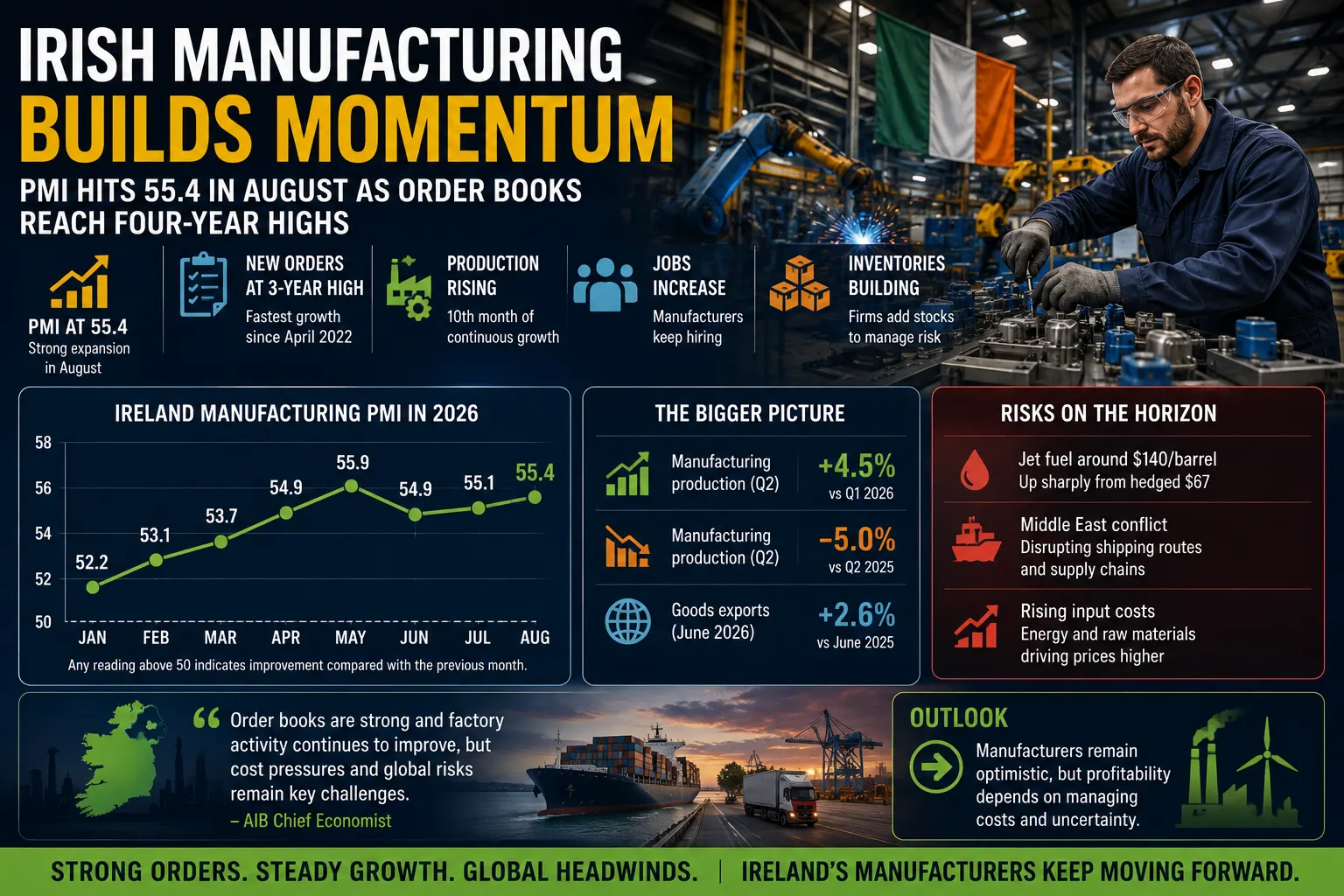
Irish factories entered the final third of 2026 with some of their strongest order books in more than four years. The AIB Ireland Manufacturing Purchasing Managers’ Index rose to 55.4 in August from 55.1 in July, remaining close to the four-year high of 55.9 reached in May. New orders increased at their fastest rate since April 2022, production rose for a tenth consecutive month and manufacturers continued hiring. Yet beneath the strength lies a second story: export demand remains comparatively subdued, supply chains are being disrupted by the Middle East conflict and companies are again paying more for energy and raw materials.
The combination makes August’s survey unusually important. Ireland is not experiencing a conventional manufacturing expansion in which stronger demand simply produces higher output and employment. Firms are simultaneously trying to increase production, protect inventories and manage a renewed external cost shock. Some are building safety stocks precisely because they fear components or materials may take longer to arrive in future.
For the wider economy, the distinction matters because manufacturing occupies an unusual position in Ireland. Pharmaceuticals, chemicals, medical technology, electronics, food, machinery and other industrial activities support exports, employment and regional economies, but headline industrial statistics are heavily influenced by multinational companies and contract manufacturing taking place outside the State. A strong PMI therefore provides valuable evidence of business conditions while still requiring comparison with official production, employment and trade data.
Those comparisons reveal a recovery that is real but not uniform. Official CSO manufacturing production increased by 4.5 per cent between the first and second quarters, supporting the direction signalled by the PMI, yet it remained 5 per cent below the equivalent period of 2025. June goods exports were higher than a year earlier, but exports over the entire first half of 2026 were dramatically lower than the exceptional levels recorded in early 2025. Ireland’s industrial economy is strengthening month by month while continuing to carry substantial volatility from multinational trade and international shocks.
A PMI of 55.4 Signals Strong Expansion — Not 5.4 Per Cent Growth
The headline PMI is a survey indicator rather than a direct measure of the number of goods produced. Any reading above 50 indicates that manufacturing conditions improved compared with the previous month, while a reading below 50 indicates deterioration. A figure of 55.4 does not mean Irish manufacturing output increased by 5.4 per cent.
The index is compiled by S&P Global from responses by purchasing managers at Irish manufacturing businesses. New orders carry the largest weight in the headline calculation, followed by output and employment, while supplier delivery times and inventories also contribute.
That structure explains why the August result is more informative than the headline number alone. Incoming orders strengthened markedly, output accelerated, employment increased and firms continued purchasing inputs. At the same time, worsening supplier delivery times can push the PMI upwards because historically such delays often occurred when factories were operating under unusually strong demand.
During a geopolitical supply shock, however, slower deliveries may reflect disruption rather than economic strength. A container arriving late because of shipping problems in the Middle East is economically different from a supplier taking longer because its factory is overwhelmed by new orders. Interpreting the PMI therefore requires looking at the individual components.
Ireland’s Manufacturing PMI in 2026
| Month | PMI | Broad Signal |
|---|---|---|
| January | 52.2 | Moderate expansion |
| February | 53.1 | Growth strengthens |
| March | 53.7 | Momentum improves |
| April | 54.9 | Strong expansion |
| May | 55.9 | Four-year high |
| June | 54.9 | Growth remains strong |
| July | 55.1 | Further acceleration |
| August | 55.4 | Strongest in three months |
Source: AIB Ireland Manufacturing PMI and S&P Global.
New Orders Are the Strongest Signal in the Survey
The most encouraging development is not the three-tenths rise in the headline PMI but the acceleration in new business. Manufacturers reported the fastest increase in new orders since April 2022, giving factories a stronger pipeline of work for the coming months.
Production responded accordingly. Output increased for the tenth consecutive month and at the strongest rate since April 2025. Manufacturers frequently linked the increase to robust order books and the need to meet higher customer demand.
This sequence is economically important. Higher output based largely on inventories or clearing old backlogs can fade quickly. Higher output accompanied by accelerating new orders has a stronger foundation because fresh work is entering factories while existing production increases.
The August result also continues a broader improvement visible since the beginning of the year. The PMI stood at 52.2 in January before moving steadily higher. May’s 55.9 reading was the strongest for four years, and the index has remained close to that level throughout the summer rather than falling back towards stagnation.
That persistence makes the improvement more credible than a one-month surge. Businesses have faced war-driven fuel increases, shipping disruption and trade uncertainty throughout much of 2026, yet survey respondents continue reporting overall expansion.
Domestic Demand Appears Stronger Than Export Demand
The composition of orders introduces an important warning. Total new business accelerated sharply in August, but export-order growth remained comparatively muted. Manufacturers cited geopolitical uncertainty as a headwind to business from overseas customers.
This suggests that the strongest part of the current expansion is not necessarily coming from the international economy. Irish domestic demand and existing customer pipelines appear to be providing significant support even while external trade conditions remain less predictable.
That differs from May, when manufacturers reported strong gains in both domestic and overseas demand and export orders increased at their fastest pace since August 2021. By July, export-order growth had weakened substantially, and August did not fully reverse that loss of momentum.
The distinction matters for the durability of the cycle. Ireland is a small open economy whose manufacturing base depends heavily on international customers. Domestic demand can sustain a period of industrial growth, but a prolonged international slowdown would eventually affect exporters and the suppliers serving them.
There is some encouragement from the rest of Europe. The euro-area manufacturing PMI rose to 52.7 in August, its highest in more than four years, with new orders recording their strongest increase since early 2022. Germany, France, Austria and the Netherlands contributed to the improvement, although conditions remained weaker in Italy and Spain.
Ireland’s 55.4 reading consequently sits within a broader European manufacturing recovery rather than representing a completely isolated national surge. It is also materially above the euro-area aggregate, indicating stronger current momentum among the Irish firms surveyed.
Manufacturers Are Hiring — but Not as Aggressively as in July
Irish manufacturing employment increased again during August, extending a sequence of job creation that has now continued for nine months. Firms have been expanding staffing as order books strengthen and production requirements increase.
The pace of hiring slowed from July, when the PMI survey reported the strongest manufacturing employment growth in more than four years. This should not automatically be interpreted as deterioration. Employment was still expanding in August; it was simply doing so less rapidly.
Official payroll data provide a broader check. The CSO estimated approximately 277,700 payroll employees across industry in June, covering manufacturing as well as mining, utilities and related activities. That was 0.4 per cent higher than a year earlier.
The relatively modest annual increase in official employment compared with the strong recent PMI hiring signal can be explained partly by timing. The PMI indicates the direction of change from one month to the next, while the CSO figure compares a much larger administrative population with a year earlier. A hiring acceleration that began recently may therefore take time to become substantial in the annual employment numbers.
For workers and regional economies, continued manufacturing hiring is significant because many industrial operations are located outside Dublin. Pharmaceutical, medical-device, food and engineering clusters support substantial employment across Cork, Limerick, Galway, Waterford, the Midlands and other regions.
Factories Are Building Safety Stocks Again
The strongest order books are also changing purchasing behaviour. Manufacturers increased their buying activity during August, partly to support higher production but also because some companies were deliberately accumulating precautionary stocks.
Inventories of purchased materials rose modestly. Stocks of finished goods also increased for a fourth consecutive month. The combination suggests that businesses are attempting to create buffers on both sides of the production process.
Such stock building is rational when delivery reliability deteriorates. A manufacturer dependent on a specialist chemical, electronic component, packaging product or imported raw material can face much larger losses from stopping production than from holding several additional weeks of inventory.
But resilience has a cost. Inventories consume working capital, require storage and can lose value if demand changes. Companies therefore normally prefer efficient supply chains in which inputs arrive shortly before they are required.
The repeated shocks of the past several years — pandemic disruption, the war in Ukraine, international trade restrictions and now the Middle East conflict — have changed that calculation. Businesses increasingly have to balance efficiency against security of supply.
Middle East Disruption Is Still Lengthening Delivery Times
Supply-chain problems remained severe in August. Manufacturers reported transportation delays, with some directly linking them to the conflict in the Middle East. Broader capacity constraints among suppliers were also reported.
Average supplier lead times lengthened again. The deterioration was slightly less pronounced than in July but remained substantial, continuing a problem visible throughout much of 2026.
The consequences are already moving beyond inventory management. Delays in receiving purchased materials contributed to another accumulation of unfinished work. Backlogs increased for the fifth time in six months.
A backlog can initially be positive because it indicates factories have orders waiting to be completed. Persistent backlogs caused by missing materials are less favourable because businesses can have customers and production capacity but still be unable to convert them into finished goods on schedule.
Ireland is exposed largely through indirect rather than direct trade with the Middle East. Central Bank analysis shows that direct Irish merchandise imports from the region are comparatively small, but the Gulf is globally important for oil, gas, petrochemicals, aluminium, fertiliser inputs and specialist products including helium and hydrocarbon derivatives used in advanced manufacturing.
Disruption therefore raises the global price faced by an Irish company even when that business purchases its material from a supplier in another European country rather than directly from the Gulf.
Hormuz Matters to Irish Factories Far Beyond Oil
The Strait of Hormuz is usually discussed as an energy chokepoint, but its industrial importance extends further. Before the current conflict, it carried a major share of global seaborne crude oil, liquefied petroleum gas and other petroleum products. Gulf states are also significant suppliers of chemicals and industrial raw materials.
Central Bank research has highlighted the Gulf’s role in products such as hydrocarbon derivatives used in pharmaceuticals and helium used in semiconductor manufacturing. Ireland may import only relatively small quantities of these products directly from the region, but global shortages can affect prices wherever an Irish company ultimately sources them.
The war has also raised transport costs and created greater uncertainty over shipping schedules. A manufacturer may therefore face higher costs even when the physical material remains available.
The latest geopolitical deterioration makes the risk current rather than theoretical. Brent crude was trading around $95 a barrel on 2 September after renewed fighting between the United States and Iran pushed oil sharply higher. The market remains highly sensitive to developments around Hormuz.
For manufacturers, the relevant variable is not simply today’s oil quotation. Electricity, diesel, freight, plastics, chemicals and numerous other inputs can respond to energy-market movements with different delays.
Higher Input Prices Have Returned as a Major Risk
The August PMI reported an acceleration in manufacturers’ input-cost inflation after some easing during the summer. Businesses again cited higher energy and raw-material costs, with the Middle East conflict an important factor.
The pace of increase remained below the near four-year peak recorded in May, suggesting the industry is not experiencing the most severe cost shock of the year. But the reversal from July matters because it raises the possibility that the relief manufacturers experienced during early summer may not continue.
Official price data point in the same direction. CSO figures show wholesale electricity prices were 56.2 per cent higher in July than a year earlier. The broader index for energy fuels was up 19.1 per cent.
Producer prices across manufacturing were 7.3 per cent higher than in July 2025. Prices charged by domestic manufacturers increased by 4.5 per cent, while producer prices for exported manufactured goods rose by 7.6 per cent.
These figures do not mean every Irish manufacturer has experienced a 7.3 per cent cost increase. Producer-price indices measure selling prices at the manufacturing stage and sectoral experiences differ considerably. They nevertheless confirm that price pressure is present well before products reach consumers.
Industrial Cost Signals Entering Autumn 2026
| Price Measure | Annual Change | Latest Period |
|---|---|---|
| Wholesale electricity | +56.2% | July 2026 |
| All energy fuels | +19.1% | July 2026 |
| Manufacturing producer prices | +7.3% | July 2026 |
| Domestic manufacturing prices | +4.5% | July 2026 |
| Export manufacturing prices | +7.6% | July 2026 |
| Consumer energy prices | +11.8% | August 2026 flash estimate |
Sources: Central Statistics Office Wholesale Price Index July 2026 and August 2026 HICP flash estimate.
Strong Demand Is Allowing Firms to Pass on Some Costs — but Not All
The interaction between input prices and selling prices may become one of the most important manufacturing indicators this autumn. Strong order books give companies more freedom to raise prices because customers have fewer reasons to resist or delay purchases.
Manufacturers did increase factory-gate prices again during August. However, the rate of output-price inflation eased to a five-month low even while input-cost inflation accelerated.
That combination suggests competitive pressure is limiting the extent to which businesses can transfer every additional cost to customers. If the pattern persists, profit margins can be squeezed even while sales volumes increase.
A manufacturer can therefore experience what appears externally to be an excellent trading period — more orders, more production and higher revenue — while profitability improves much less because energy, freight and materials absorb a growing share of income.
The alternative is eventually increasing selling prices more aggressively. That would protect corporate margins but transmit the industrial cost shock further into the economy.
Ireland’s August harmonised consumer inflation rate has already risen to an estimated 3.4 per cent, with energy prices 11.8 per cent higher than a year earlier. Inflation excluding energy was substantially lower at 2.5 per cent, illustrating how strongly the latest headline increase is still being driven by energy.
The Strong PMI Does Not Mean Official Industrial Output Is at a Record
The latest official CSO industrial-production figures provide an important counterweight to an overly enthusiastic interpretation of the PMI. Manufacturing production increased by 4.5 per cent during April to June compared with the first three months of 2026, but remained 5 per cent lower than during the same quarter of 2025.
Manufacturing turnover increased by 6.8 per cent from the previous three-month period but was 7.2 per cent below its level a year earlier.
The apparent contradiction is partly explained by timing. The official production data currently extend only through June, while the latest PMI describes conditions during August. A rapid improvement occurring in July and August would not yet appear in the second-quarter CSO data.
There is also a major methodological difference. The PMI asks companies whether conditions such as production or orders increased, decreased or remained unchanged. The CSO industrial index attempts to measure actual production volumes.
A broad group of manufacturers recording modest increases can therefore produce a strong diffusion index even if one very large company experiences a major reduction in measured production. Conversely, a small number of multinational operations can cause enormous movements in official Irish industrial statistics without changing conditions for most manufacturing businesses.
Two indicators, two different questions: the August PMI of 55.4 says that manufacturing conditions improved strongly from July. The latest CSO figures say measured manufacturing production in April-June was 5 per cent below the same period of 2025. Both can be correct.
Ireland’s Industrial Statistics Are Unusually Volatile
The CSO itself advises caution when interpreting short-term industrial-production movements. Ireland’s multinational sector relies heavily on contract manufacturing and outsourcing, including production carried out abroad on behalf of Irish-resident enterprises.
Under international statistical rules, some of that production can appear in Irish industrial data even though the physical manufacturing takes place in another country. Large changes in the activity of a small number of multinational businesses can therefore move national industrial indices dramatically.
The CSO consequently emphasises rolling three-month periods rather than individual monthly changes. It has also developed a separate Domestic Industrial Production series intended to provide additional insight into manufacturing physically located within Ireland.
This statistical complexity is more than an academic problem. Ireland can simultaneously report an enormous movement in headline GDP, a large fall in merchandise-export values and strong employment or PMI data. None necessarily means the other indicators are wrong.
Understanding the Irish economy requires separating multinational accounting and highly concentrated export activity from the conditions experienced by domestically operating companies and workers.
The Modern and Traditional Sectors Both Entered the Summer Below Last Year
The CSO divides manufacturing into a highly globalised Modern sector and a Traditional sector. The Modern category includes chemicals, pharmaceuticals, computers, electronics and related activities, while Traditional manufacturing covers most other industries.
Production in the Modern sector increased by 6.3 per cent between the first and second quarters of 2026, yet remained 5.4 per cent below the same period a year earlier. Traditional production increased only 0.3 per cent quarter on quarter and was 5.2 per cent lower annually.
Individual industries were highly uneven. Basic metals and fabricated metal production increased strongly from the previous quarter, as did transport equipment and rubber and plastic products. Dairy production, by contrast, weakened substantially.
This sectoral variation matters because the economic effects differ by region and workforce. An increase in pharmaceutical output in one multinational facility cannot automatically compensate a local community for weakness in food processing or engineering elsewhere.
The PMI’s broad improvement is encouraging precisely because it suggests expansion is not confined to one exceptionally large statistical transaction. But the survey does not provide enough information to claim that every manufacturing industry is now growing strongly.
Ireland’s Dual Industrial Economy Changes Who Bears the Risk
The difference between multinational and indigenous manufacturing is particularly important when energy and supply-chain costs rise. Central Bank analysis estimates that pharmaceutical and ICT manufacturing together account for roughly three quarters of Irish goods exports but less than 5 per cent of employment.
Those industries generally produce high-value goods with relatively high profit margins. Energy and transport costs matter, but a modest increase in the cost of moving a high-value pharmaceutical product is often easier to absorb than an equivalent increase on a low-margin manufactured food or building product.
Indigenous firms account for a much smaller share of headline export value but the majority of manufacturing employment. Their margins can be narrower and their exposure to electricity, fuel, packaging, transport and imported raw materials more immediate.
This means a Middle East energy shock can produce relatively limited effects on Ireland’s headline high-value exports while still placing serious pressure on domestic industrial employers.
The resilience of the overall economy should therefore not be assessed only by whether multinational pharmaceutical exports remain strong. The ability of smaller Irish manufacturers to maintain employment, investment and margins is equally important for the domestic economy.
Export Statistics Show Why Ireland Needs More Than One Indicator
Ireland exported €18.1 billion of goods in June, 7.1 per cent more than in June 2025. Chemicals and related products accounted for €9.1 billion, while machinery and transport equipment contributed €4.8 billion.
Viewed in isolation, those figures suggest a healthy export sector. The six-month comparison produces a very different picture. Goods exports between January and June were valued at €103.6 billion, 30.5 per cent lower than during the first half of 2025.
Exports to the United States fell by approximately €48.9 billion, or 65.1 per cent, to €26.2 billion. This extraordinary movement should not be interpreted as evidence that two thirds of normal Irish-American industrial trade simply disappeared.
Early 2025 included exceptionally large pharmaceutical and polypeptide-related exports, creating a very high comparison base. The Central Bank has highlighted these movements as one of the reasons Irish headline GDP and export statistics have been unusually volatile.
Exports to Great Britain moved in the opposite direction, increasing by 42.6 per cent to €10.3 billion during the first half of 2026.
For manufacturers, the key point is that aggregate trade values can be dominated by a handful of products and multinational decisions. The PMI’s weaker export-order signal may therefore be more useful for understanding the breadth of current overseas demand than the percentage change in total Irish exports alone.
Recent Official Manufacturing and Trade Signals
| Indicator | Change | Period |
|---|---|---|
| Manufacturing production | +4.5% | Q2 vs Q1 2026 |
| Manufacturing production | -5.0% | Q2 2026 vs Q2 2025 |
| Manufacturing turnover | +6.8% | Q2 vs Q1 2026 |
| June goods exports | +7.1% | Year on year |
| H1 goods exports | -30.5% | Year on year |
| Industry payroll employment | +0.4% | June year on year |
Sources: Central Statistics Office Industrial Production, Goods Exports and Imports, and Monthly Payroll Employees releases.
Europe’s Manufacturing Recovery Could Strengthen Irish Export Orders
The strongest argument for continued improvement is the change taking place across the euro area. Manufacturing has been one of Europe’s weakest major sectors since the energy shock following Russia’s invasion of Ukraine, with high costs and weak demand particularly damaging German industry.
August produced the clearest evidence in years that this environment may be changing. The euro-area manufacturing PMI increased to 52.7 from 51.9, marking its fastest expansion in more than four years. New orders grew at their strongest pace since early 2022.
Germany and France contributed strongly to the improvement. Intermediate-goods industries including chemicals and electronic components were among the areas showing better momentum.
This matters for Ireland because European economies are both customers and suppliers. Stronger continental manufacturing can increase demand for Irish-produced chemicals, components, food products and specialised industrial goods while improving activity among companies integrated into European supply chains.
There is also a potential negative side. A stronger euro-area economy can maintain demand for commodities and industrial inputs at the same time energy supply is constrained. This can make it more difficult for inflation to decline quickly.
Global AI Investment Is Creating Another Source of Industrial Demand
Manufacturing strength is not confined to Europe. August factory data from several Asian economies were supported by extraordinary demand for semiconductors, servers and other equipment associated with artificial intelligence and data-centre investment.
Ireland is connected with that cycle in several ways. The country hosts semiconductor and technology manufacturing operations, while enormous quantities of computing equipment are being imported for AI and data-centre investment.
The Central Bank estimates that modified machinery and equipment investment reached a record €15.2 billion in 2025 and continued accelerating into 2026. Imports of office machines and data-processing equipment increased sharply during the first quarter.
June trade data provide another indication. Irish exports of office machines and automatic data-processing equipment reached approximately €1.1 billion, almost double their value a year earlier.
AI investment can therefore support manufacturing directly through electronics and indirectly through construction, electricity infrastructure, engineering and business investment. It also introduces concentration risks because exceptionally large capital programmes can make aggregate Irish economic statistics even more dependent on decisions by a relatively small number of global corporations.
Higher Energy Costs Threaten the Strong Industrial Outlook
The most immediate downside risk remains energy. Ireland imports most of its overall energy requirements, leaving industry exposed to global oil and gas markets even when companies do not purchase fuel directly from the Middle East.
Wholesale electricity prices being more than 56 per cent above their level a year earlier illustrate how quickly international energy developments can enter domestic business costs.
The effect varies dramatically by industry. Energy-intensive manufacturers producing metals, construction materials, food or other comparatively low-margin goods can face substantial exposure. High-value pharmaceutical or medical-device manufacturers may be better positioned to absorb the same percentage increase.
Electricity is only part of the calculation. Diesel affects transport and distribution. Oil prices feed into plastics and chemicals. Natural gas influences industrial heat and international fertiliser and chemical production.
A prolonged energy shock can therefore erode competitiveness even without causing factories to close. An Irish manufacturer bidding against a producer in a country with cheaper energy can gradually lose orders if the cost difference persists.
Inflation Could Turn Strong Manufacturing Into a Monetary-Policy Problem
The rebound in manufacturing is welcome for growth and employment, but it arrives while inflation is moving upwards again. Ireland’s flash HICP rate reached 3.4 per cent in August, while euro-area inflation rose to 3.3 per cent.
Energy is currently the dominant driver. Euro-area energy inflation accelerated to 14.3 per cent, while Irish energy prices were up 11.8 per cent. Core measures remain considerably lower.
That distinction reduces the case for responding to every increase in headline inflation with aggressive interest-rate rises. Central banks cannot produce oil or accelerate cargo ships by making borrowing more expensive.
But strong manufacturing demand complicates the picture if businesses successfully pass higher costs to customers and workers seek compensation through wages. A temporary energy shock can then become broader domestic inflation.
The ECB has already raised its deposit rate to 2.25 per cent and another increase in September is widely expected, although no decision has yet been made. A prolonged combination of stronger economic activity and persistent cost inflation could keep financing conditions tighter for manufacturers planning investment.
Smaller Manufacturers Face a Different Financial Equation
For a multinational with substantial cash reserves, higher borrowing costs may influence investment decisions without threatening everyday operations. A smaller Irish manufacturer dependent on bank credit can feel the change much more directly.
Working capital becomes especially important during a supply-chain shock. Building larger stocks requires a company to pay suppliers before the finished product has been sold. If borrowing rates are high, the cost of holding protective inventory rises.
This creates an unusual interaction between monetary and geopolitical conditions. The Middle East conflict encourages manufacturers to hold more stock, while higher interest rates make financing that stock more expensive.
Larger businesses can negotiate longer payment terms or finance inventory from cash. Smaller firms have fewer options and may ultimately reduce investment or employment to protect liquidity.
The August Survey Contains a Positive Signal on Corporate Confidence
Despite the cost and supply risks, manufacturers became more optimistic in August. Confidence in output over the coming twelve months rose to its highest level since January.
Around half of surveyed manufacturers expect production to increase over the next year, while only about 7 per cent anticipate a decline. Businesses linked their optimism primarily to stronger new orders and expectations that demand will continue improving.
This is meaningful because corporate confidence had weakened sharply earlier in the year when the Middle East conflict first disrupted energy and shipping markets. Companies are now demonstrating greater confidence even though many of those risks have not disappeared.
That may indicate firms believe customer demand is strong enough to offset the disruption. It may also reflect adaptation: supply chains have been adjusted, inventories increased and businesses have had several months to understand how the conflict affects their individual operations.
Confidence can change rapidly, however. A new escalation around Hormuz, a sharp energy-price increase or deterioration in major export markets could alter investment and hiring decisions before the end of the year.
The Strong Order Book Should Support Production Into Autumn
Manufacturing indicators tend to contain some information about the immediate future because today’s new orders become tomorrow’s production. The exceptional August increase therefore provides a degree of visibility into the coming months.
Backlogs also offer a limited cushion. Companies already have unfinished work waiting to be completed, meaning output can remain supported even if new business moderates temporarily.
The difficulty is execution. If backlogs are rising because suppliers cannot deliver required materials, a full order book does not automatically become finished production.
This makes supplier lead times one of the most useful indicators to watch alongside September and October’s headline PMI. Faster deliveries combined with strong new orders would provide a much healthier signal than continued order growth accompanied by worsening bottlenecks.
A Manufacturing Boom Would Have Wider Benefits for Ireland
Sustained industrial growth can produce economic effects far beyond factory gates. Manufacturers purchase transport, maintenance, professional services, packaging, construction, software and energy. Additional production can therefore support employment in surrounding businesses.
Industrial jobs also have particular regional significance because production facilities are more geographically dispersed than many financial and technology services concentrated in Dublin.
Increased manufacturing output can strengthen exports and the trade balance while producing corporation tax, income tax and local economic activity. Indigenous exporters can also become larger and less dependent on the domestic market.
But the quality of growth matters. Expansion produced primarily through one multinational product can create enormous headline economic gains with relatively limited employment. Growth distributed across food, engineering, medical technology, electronics and indigenous manufacturing produces a broader domestic effect.
The PMI’s Strength Should Not Be Mistaken for an End to Industrial Risk
It would be easy to present 55.4 as evidence that Ireland’s manufacturing problems have been resolved. That would overstate what the survey shows.
The PMI measures current momentum and is clearly positive. It does not determine future energy prices, global demand, US trade policy or the duration of the conflict in the Middle East.
Official production remains below last year’s level on the latest three-month comparison. First-half goods exports have been extraordinarily volatile. Industry employment is increasing only modestly in the broader administrative data.
The survey should therefore be interpreted as evidence of a strong acceleration from the conditions prevailing earlier in the year, not as proof that every measure of the Irish industrial economy is at a four-year high.
Three Different Manufacturing Paths Are Possible Through 2027
The most favourable scenario would combine continued domestic demand with a stronger European manufacturing cycle and gradual normalisation of Middle East supply chains. New export orders would accelerate, supplier delays would shorten and input-cost inflation would decline. Ireland’s current order-book strength could then translate into sustained output, employment and investment growth.
A second scenario would involve continued expansion accompanied by persistent cost pressure. Orders remain healthy, but oil, electricity, freight and materials stay expensive. Manufacturing output grows while margins are squeezed and firms increase selling prices selectively. This would still represent economic growth, but a less profitable and more inflationary version of it.
The third scenario would involve renewed geopolitical escalation or a wider global slowdown. Supply disruptions intensify, overseas customers become cautious and energy costs rise faster than manufacturers can pass them on. Order growth would eventually weaken and the current high PMI readings could reverse relatively quickly.
Possible Manufacturing Paths Into 2027
| Scenario | Main Development | Likely Effect |
|---|---|---|
| Broad recovery | Exports strengthen and supply chains improve | Higher output and employment |
| Costly expansion | Orders stay strong but energy remains expensive | Growth with margin and inflation pressure |
| External shock | War or global demand deteriorates | Orders and production weaken |
Ireland Newspaper scenario analysis. These are plausible outcomes rather than forecasts.
The Central Bank Still Expects Ireland’s Domestic Economy to Grow
The broader economic outlook remains supportive. The Central Bank of Ireland expects modified domestic demand to increase by 3.3 per cent in 2026, followed by 2.8 per cent in 2027 and 3.3 per cent in 2028.
Much of that resilience reflects unusually strong investment, including multinational spending connected with artificial intelligence and data centres. Consumer spending is expected to grow more slowly because higher energy prices reduce household purchasing power.
The Central Bank has simultaneously raised its inflation forecast to 3.5 per cent for 2026 and 2.9 per cent for 2027. It describes the risks to growth as tilted downwards and inflation risks as tilted upwards.
That combination mirrors the challenge visible in the PMI. Ireland has genuine demand and investment momentum, but the same Middle East conflict that threatens supply chains is raising the cost of producing and consuming goods.
Manufacturers Have Become More Resilient Since the First Shock
One of the most striking aspects of the August result is how strongly manufacturing has continued expanding despite repeated disruption during the year. When the Middle East war intensified in early 2026, manufacturers responded by bringing purchases forward, building inventories and searching for alternative suppliers.
Those actions were defensive at first. By late summer they increasingly look like part of a new operating environment in which businesses expect supply chains to remain less predictable than before the pandemic.
Redundancy is more expensive than efficiency. Holding additional materials, using several suppliers and maintaining extra transport options all raise costs. They can also prevent a production shutdown when one route or supplier fails.
The lesson from recent industrial shocks is that the cheapest supply chain during normal conditions is not necessarily the most economical one across an entire crisis cycle.
The Next Test Is Whether Export Demand Joins the Domestic Recovery
The August PMI already answers one question convincingly: Irish manufacturing has entered autumn with strong overall demand. The more important question is where the next phase of growth comes from.
If export orders accelerate towards the pace seen in May, the current expansion will become more balanced and provide stronger evidence that Ireland is benefiting from a wider international industrial recovery.
If total orders remain strong while export demand stays muted, manufacturing can still expand, but the sector becomes more dependent on domestic customers and existing project pipelines.
That would be a less secure foundation for a small exporting economy over the longer term.
The Four-Year Comparison Is Encouraging — but It Comes With a Warning
Ireland last experienced similar new-order growth in the spring of 2022, a period when global manufacturing was emerging from pandemic disruption but simultaneously confronting the energy and commodity shock associated with Russia’s invasion of Ukraine.
Four years later, the resemblance is uncomfortable. Demand is strengthening again, but businesses are once more dealing with geopolitical conflict, expensive energy and unreliable international supply chains.
The difference is that Irish manufacturers have had several years to adapt. Inventory policies are more defensive, supply chains have been diversified and companies understand more clearly how rapidly external events can affect production.
That greater resilience is one reason the manufacturing sector can post a PMI of 55.4 while transportation delays and energy inflation remain severe.
Resilience, however, should not be confused with immunity. Every additional buffer has a financial cost, and a sufficiently large or prolonged external shock can eventually overwhelm even well-prepared companies.
Ireland Enters Autumn With Industrial Momentum — and an Expensive Insurance Policy
The August manufacturing data are among the more encouraging economic signals Ireland has received this year. New orders are increasing at their fastest pace since April 2022, output growth is the strongest since April 2025 and manufacturers continue adding workers. Confidence about the coming year has improved substantially.
Those numbers suggest the industrial economy has genuine momentum rather than simply recovering from one weak month. They are supported by improving manufacturing conditions across the euro area and by continuing investment in technology and industrial capacity.
But the strength is being purchased in a more expensive operating environment. Companies are holding additional inventory, paying more for energy and raw materials, waiting longer for supplies and absorbing part of those increases because competition prevents all costs being transferred to customers.
The Middle East conflict has therefore not stopped Ireland’s manufacturing expansion. Instead, it has changed the nature of that expansion.
The industry’s near-term prospects will depend on whether strong demand can outrun those costs. If export orders strengthen and supply chains gradually normalise, today’s order-book surge could become a broader industrial recovery extending into 2027. If energy and transport costs remain elevated, Ireland may instead experience something more complicated: factories producing and selling more while simultaneously fighting harder to protect their margins.
For now, 55.4 is a strong number. The more important question is whether Ireland can keep it strong once the cost of resilience is fully reflected in corporate accounts.
Sources
S&P Global — AIB Ireland Manufacturing PMI, August 2026
AIB — Ireland Manufacturing PMI Reports and Archive
Central Statistics Office — Industrial Production and Turnover, June 2026
Central Statistics Office — Wholesale Price Index, July 2026
Central Statistics Office — Goods Exports and Imports, June 2026
Central Statistics Office — Monthly Estimates of Payroll Employees, June 2026
Central Statistics Office — HICP Flash Estimate, August 2026
Central Bank of Ireland — Quarterly Bulletin Q2 2026
Eurostat — Euro Area Inflation Flash Estimate, August 2026
Reuters — Euro-Area Manufacturing Growth, 1 September 2026
Reuters — Oil Markets and Renewed US-Iran Fighting, 2 September 2026
Source & Transparency
This article is published by Ireland Newspaper for editorial and informational purposes.
Published: 2 September 2026 · Updated: 2 September 2026

Newsroom Ireland Newspaper
Ireland Newspaper editorial team prepares daily news coverage for readers in Ireland and abroad.




Market data, financial news and economy content on Ireland Newspaper are provided for editorial and informational purposes only. They do not constitute financial advice, investment advice, trading advice or a recommendation to buy, sell or hold any financial product. Always verify live prices and consult a qualified professional before making financial decisions.