
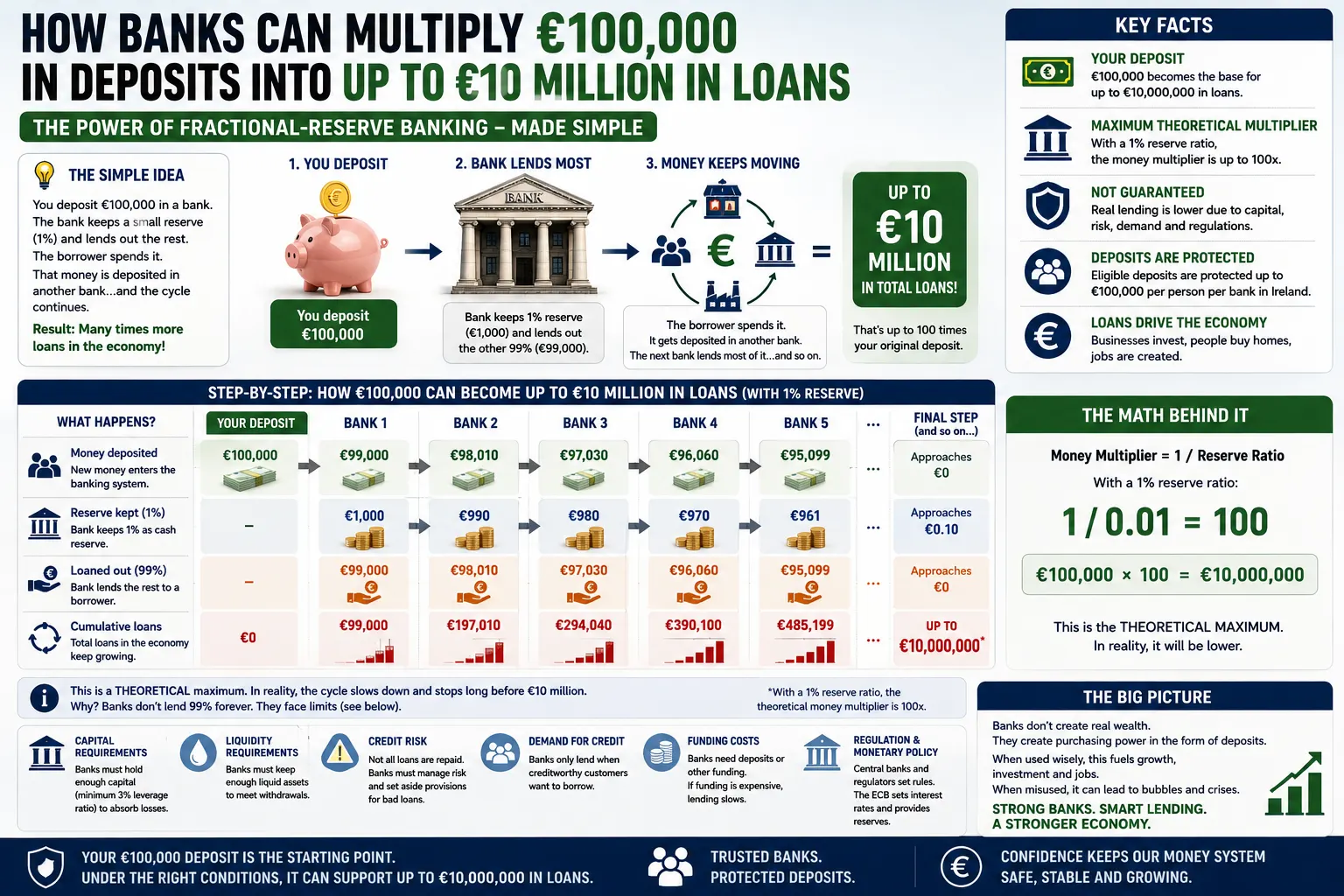
Imagine 1,000 customers each place €100 in the same Irish bank. The bank now has €100,000 of customer deposits. A common explanation says that the bank keeps a small fraction in reserve, lends the remainder, another bank lends most of what it receives, and the process repeats until the original €100,000 has been multiplied many times. That story captures one historical intuition about fractional-reserve banking, but it does not accurately describe how modern banking in Ireland, the euro area or most advanced economies actually works. Commercial banks can create new deposit money when they lend, yet they cannot create unlimited wealth: their expansion is constrained by capital, liquidity, regulation, credit risk, funding costs, borrower demand and ultimately monetary policy.
The distinction matters because most of the money used every day is not physical cash. Salaries arrive as entries in bank accounts, mortgages are advanced electronically and businesses pay suppliers by transferring bank deposits. Those deposits are money from the customer’s perspective, but from the bank’s perspective they are liabilities — promises by the bank to pay the customer in central-bank money when required.
This produces one of the most important features of the modern monetary system. A commercial bank can create a new deposit without first finding an equivalent deposit from another customer. When it grants a loan, it normally creates an asset on one side of its balance sheet — the borrower’s obligation to repay — and a deposit liability of the same amount on the other. New bank money has been created, although no new real wealth has appeared.
Commercial bank lending can create money: a new loan is normally accompanied by a new bank deposit.
Customer deposits are liabilities of a bank: the bank owes that money to its customers.
Loans are assets of a bank: borrowers owe principal and interest to the bank.
Euro-area minimum reserves are currently based on a 1% ratio for specified short-term liabilities: this is not a rule saying that banks may lend exactly 99% of deposits.
The EU leverage ratio provides a separate backstop: Tier 1 capital must generally equal at least 3% of the relevant exposure measure.
Irish eligible deposits are generally protected up to €100,000 per person per institution under the Deposit Guarantee Scheme.
Money Is Ultimately a System of Trusted Claims
Money has taken many forms. Early societies used commodities with recognised value, including precious metals. Coins standardised those commodities. Later, merchants and banks issued receipts and notes promising payment in gold or silver. Those paper claims were easier to transport than metal and gradually became accepted as money themselves.
Modern currencies have moved beyond that structure. The euro is fiat money: it is not redeemable for a fixed quantity of gold, silver or another commodity. Its value depends principally on confidence that it will continue to be accepted for payments and that the institutions responsible for the currency will preserve monetary stability over time.
Ireland’s own monetary history illustrates this evolution. The Saorstát pound was introduced in the late 1920s and remained closely linked with sterling for most of its existence. Ireland ended the one-for-one sterling link in 1979 and later joined European Monetary Union. The Irish pound was irrevocably fixed to the euro in 1999, while euro banknotes and coins entered circulation in 2002.
Today an Irish resident using euros is operating inside a monetary system shared with the rest of the euro area. Monetary policy is determined by the European Central Bank, while the Central Bank of Ireland forms part of the Eurosystem and participates in issuing central-bank money, supervising institutions and implementing monetary policy.
There Are Different Kinds of Euro Money
To understand money creation, three forms need to be separated. The first is physical cash: euro banknotes and coins. The second is central-bank reserves, which commercial banks hold in accounts with the Eurosystem. The third is commercial bank deposits, which households and companies hold in ordinary bank accounts.
Cash and central-bank reserves are forms of public central-bank money. Commercial bank deposits are private money created within the banking system. A €100 balance in an Irish current account is therefore economically different from a €100 banknote, even though both are normally treated as perfectly interchangeable.
This equivalence is fundamental to the monetary system. A customer expects €100 at Bank A to be worth precisely the same as €100 at Bank B and precisely the same as five €20 banknotes. Regulation, central-bank settlement, deposit protection, bank capital and the ability to convert deposits into central-bank money help maintain that one-for-one relationship.
The euro area’s money statistics reflect this structure. The ECB’s narrow monetary aggregate M1 includes currency in circulation and overnight deposits. Broader measures such as M2 and M3 include additional deposits and short-term financial instruments. In July 2026, euro-area M3 was growing at an annual rate of 3.4%, while adjusted lending to households was growing by 3.1% and lending to non-financial companies by 4.4%.
What Actually Happens When 1,000 Customers Deposit €100 Each?
Now return to the example. One thousand customers each deposit €100, giving the bank €100,000 in customer deposits. If the money came by transfers from other banks, the receiving bank obtains central-bank reserves from those banks through the payment system. If customers instead lodge physical cash, the composition is different, but the economic principle is similar: the bank acquires a liquid asset while simultaneously owing customers €100,000.
It is important to understand that the deposits are not the bank’s own capital. They belong economically to customers and are debts of the bank. If a customer asks to transfer €100 elsewhere, the bank must honour that claim.
A functioning bank also requires its own capital supplied by shareholders or accumulated through retained profits. To make the example realistic, assume the owners have contributed an additional €20,000 of equity. The simplified starting balance sheet can then be shown as follows.
Simplified Bank Before Any New Lending
| Assets | Amount | Liabilities and equity |
|---|---|---|
| Cash and central-bank reserves | €120,000 | Customer deposits: €100,000 |
| Bank equity: €20,000 | ||
| Total assets | €120,000 | Total: €120,000 |
Illustrative model. The €20,000 equity assumption is introduced solely to demonstrate how a bank balance sheet works.
The balance sheet reveals something that is often missed in everyday descriptions of banking. The €100,000 deposited by customers appears on the liability side because the bank owes it back. The bank’s capital is separate and absorbs losses before ordinary depositors do.
If the bank made no loans, it could simply keep all €120,000 in liquid form. It would then have very little credit risk but might struggle to earn enough income to cover staff, technology, regulation, branches, payment systems, cybersecurity and interest paid to depositors. Banking exists partly because institutions transform relatively liquid funding into longer-term assets such as mortgages and business loans.
The Moment a Bank Makes a Loan, New Deposit Money Can Appear
Suppose the bank approves an €80,000 business loan. A widespread misunderstanding is that somebody in the bank physically takes €80,000 from the €100,000 deposited by other customers and hands it to the borrower. Modern accounting normally works differently.
The bank records an €80,000 loan as a new asset because the borrower now owes the bank €80,000. At the same moment, it credits the borrower’s current account by €80,000. The bank has therefore also created an €80,000 deposit liability.
The balance sheet has expanded by €80,000 on both sides.
Immediately After the Bank Creates an €80,000 Loan
| Assets | Amount | Liabilities and equity |
|---|---|---|
| Cash and reserves | €120,000 | Original deposits: €100,000 |
| New loan | €80,000 | Borrower’s new deposit: €80,000 |
| Bank equity: €20,000 | ||
| Total assets | €200,000 | Total: €200,000 |
Illustrative balance-sheet example.
The original customers still have their €100,000. The borrower now also has €80,000. Measured as bank deposits held by non-banks, the banking system has created an additional €80,000 of money.
But society has not suddenly become €80,000 richer. The borrower has an €80,000 financial asset in the bank account and an €80,000 debt. The bank has an €80,000 loan asset and an €80,000 deposit liability. Money has increased, but net wealth has not increased merely because the balance sheet expanded.
This distinction is central to understanding credit booms. Bank lending can increase purchasing power rapidly. If much of that credit flows into a fixed supply of property, land or financial assets, prices can rise without an equivalent increase in real productive capacity. If credit finances productive machinery, housing construction or viable businesses, it may simultaneously support future economic output.
What Happens When the Borrower Spends the €80,000?
Suppose the borrower uses the entire €80,000 to purchase equipment from a company whose account is at Bank B. The payment does not merely change two customer account numbers. Bank A and Bank B must settle the transaction between themselves.
Bank A reduces the borrower’s deposit by €80,000 and transfers €80,000 of central-bank reserves to Bank B. Bank B receives those reserves and credits its customer’s account by €80,000. The transfer is ultimately settled in central-bank money through the Eurosystem’s payment infrastructure.
After settlement, Bank A may therefore hold €40,000 of cash and reserves and an €80,000 loan. It still owes its original customers €100,000 and retains €20,000 of equity. Bank B now has an additional €80,000 reserve asset and owes the equipment seller an additional €80,000 deposit.
After the Borrower Pays a Customer at Bank B
| Institution | Key change | Result |
|---|---|---|
| Bank A | Transfers €80,000 reserves | Keeps €80,000 loan asset |
| Bank B | Receives €80,000 reserves | Creates €80,000 seller deposit |
| Banking system | Deposit moved from borrower to seller | €80,000 of newly created money remains |
Illustrative model of interbank settlement.
The significant point is that spending the loan does not destroy the money created by the loan. It moves the deposit to another person and usually to another bank. The corresponding reserves move between banks so that the payment can settle.
This is why a bank must manage liquidity even though it can create deposits when lending. Creating the loan is an accounting operation. Making sure payments leaving the bank can settle requires reserves or other sources of liquid funding.
Does the 1% Euro-Area Reserve Requirement Mean the Bank Can Lend 99%?
No. This is one of the most persistent misconceptions about modern banking. Euro-area banks are required to maintain minimum reserves based on certain liabilities on their balance sheets. The principal reserve coefficient is currently 1% for specified short-term liabilities, including many customer deposits.
If the simplified €100,000 deposit base were entirely subject to that coefficient, the arithmetic would suggest a reserve requirement of roughly €1,000 before other technical adjustments. It would be tempting to conclude that the bank can therefore lend €99,000. That conclusion is wrong.
The minimum-reserve rule is not a lending permission formula. A bank with €100,000 of deposits may be able to lend substantially more or substantially less than €99,000 depending on its capital, liquidity position, funding structure, loan risks, profitability, regulatory requirements and demand for credit.
Required euro-area reserves are also assessed on an average basis over a maintenance period rather than as a rigid requirement that exactly the same quantity be held every minute. In the current maintenance period running from 29 July to 15 September 2026, required reserves are remunerated at 0%.
The United States provides an even clearer demonstration that reserve requirements are not the modern lending constraint. The Federal Reserve reduced reserve requirement ratios to zero in March 2020. American banks did not thereby acquire an ability to create literally infinite amounts of credit. Capital, liquidity, funding, risk management and monetary-policy conditions still constrain them.
Why the Famous Money-Multiplier Example Is Too Simple
The traditional textbook model begins with a quantity of central-bank money and assumes every bank lends all funds above a mandatory reserve ratio. If the reserve ratio were 10%, an initial €1,000 could theoretically support a chain of deposits approaching €10,000. With a hypothetical 1% ratio, the mathematical multiplier would be 100.
Applied mechanically, that would suggest that €100,000 of reserves might ultimately support €10 million of deposits. This calculation is useful for understanding a stylised historical model of fractional-reserve banking. It should not be presented as a description of how a modern euro-area bank decides whether to approve a mortgage tomorrow morning.
Banks generally choose lending first according to profitability, risk, capital and expected funding conditions. If the resulting payments create a need for reserves, banks obtain them through incoming payments, financial markets, transactions with other banks or central-bank operations. The central bank influences the cost and availability of that liquidity, most importantly through monetary-policy interest rates.
The Bank of England has explicitly described the mechanical reserve-multiplier story as a misconception in modern banking. The ECB similarly explains that commercial-bank money is created when banks expand their balance sheets, including when they make loans.
The Real Leverage Comes Primarily From Bank Capital
There is nevertheless substantial leverage in banking. But the most important denominator is not the customer’s deposit. It is the bank’s own capital.
If shareholders provide €20,000 of genuine loss-absorbing capital, the bank can operate a balance sheet much larger than €20,000 by financing assets with deposits, bonds and other liabilities. This is financial leverage. It magnifies returns when loans perform well and magnifies losses when loans fail.
The EU has a binding leverage-ratio requirement of 3% as a backstop. Expressed very simply, a 3% minimum implies that Tier 1 capital must be at least three cents for every euro of relevant exposure. Viewed from the opposite direction, the theoretical leverage corresponding to exactly 3% is roughly 33.3 times capital.
€20,000 ÷ 3% = approximately €666,667
A purely mechanical 3% leverage-ratio calculation would allow an exposure measure of about €666,667 against €20,000 of Tier 1 capital. This is not a real-world lending limit because numerous additional rules apply.
A bank cannot therefore conclude that €20,000 of capital automatically authorises €666,667 of loans. Cash, securities, derivatives and off-balance-sheet commitments can be included in exposure measures. Risk-weighted capital requirements can become binding much earlier. Banks also face supervisory requirements above universal minima, liquidity standards, stress tests and internal risk limits.
Basel standards require Common Equity Tier 1 capital of at least 4.5% of risk-weighted assets, Tier 1 capital of at least 6% and total capital of at least 8%. A 2.5% capital conservation buffer sits on top, with additional countercyclical, systemic and institution-specific requirements potentially raising the effective requirement considerably further.
The practical banking system therefore operates with substantially more capital than the bare 3% leverage backstop might suggest. ECB-supervised significant banks had an aggregate Common Equity Tier 1 ratio of 15.99% of risk-weighted assets in the first quarter of 2026.
Credit Risk Determines How Much Capital Different Loans Consume
Not every €100 loan is treated as equally dangerous. A well-secured residential mortgage, an unsecured consumer loan, a loan to a heavily indebted company and a government bond have different risk characteristics. Banking regulation therefore uses risk-weighted assets in addition to the non-risk-based leverage ratio.
This means that the same amount of bank capital can support different nominal quantities of assets depending on their regulatory risk treatment. A bank concentrated in lower-risk assets may be able to hold a larger nominal balance sheet than a bank making riskier loans, even if both have identical capital.
The system is designed this way because expected and unexpected losses matter more to solvency than the face value of assets alone. If a borrower repays in full, the bank receives its money back plus interest. If the borrower defaults, the bank can lose part or all of the outstanding principal after collateral recoveries. Those losses ultimately reduce the bank’s profits and capital.
Liquidity Creates Another Limit
Capital answers the question of whether a bank can absorb losses. Liquidity answers a different question: can the bank meet payments when they fall due?
A bank can be solvent on paper yet fail if too many depositors demand their money simultaneously and it cannot turn assets into cash quickly enough. A thirty-year mortgage may be valuable, but it cannot necessarily be converted into central-bank money instantly without a price concession or financing arrangement.
European banks therefore face liquidity requirements as well as capital rules. The Liquidity Coverage Ratio requires sufficient high-quality liquid assets to withstand severe short-term outflows. The Net Stable Funding Ratio addresses the stability of funding over a longer horizon.
ECB-supervised significant banks reported an aggregate Liquidity Coverage Ratio of 153.93% and a Net Stable Funding Ratio of 125.63% in the first quarter of 2026. Those figures demonstrate why comparing bank lending purely with a 1% reserve requirement gives a deeply incomplete picture of modern regulation.
Why Customer Deposits Are Still Extremely Valuable to Banks
If banks can create deposits when making loans, it might appear that they have no reason to want customers’ savings. That conclusion is equally wrong. Customer deposits are an extremely important source of stable and often relatively inexpensive funding.
Once a borrower spends a newly created deposit and the money moves to another bank, the lending bank loses reserves. If this happens repeatedly, the bank needs replacement funding. Attracting household deposits is one of the main ways to obtain stable funding without relying heavily on volatile wholesale markets.
This explains why banks compete for current accounts, savings accounts and fixed-term deposits even though the accounting act of making a loan does not require a particular saver to deposit the same amount first. Deposits help fund the balance sheet after loans are made and help satisfy liquidity and stable-funding requirements.
The scale is considerable in Ireland. Household deposits at Irish resident banks stood at €176.4 billion at the end of July 2026. They had increased by €9.3 billion, or 5.5%, over the preceding twelve months.
How a Bank Makes Money From €100,000 of Customer Deposits
The simplest commercial banking model is to obtain funding at one interest rate and hold assets that earn a higher average return. The difference is part of what is commonly called the interest margin. It is not pure profit because banks also face loan losses, staffing costs, technology expenditure, regulation, taxes, deposit-protection contributions and the cost of maintaining capital.
Consider the original €100,000 of customer deposits. To isolate the economics of this funding, assume the bank effectively uses €80,000 to support a portfolio of loans and €20,000 to support liquid assets. This does not mean that individual customers’ euros are placed into individually identified loans; banks manage their funding collectively across the balance sheet.
Now make three purely illustrative assumptions. The bank pays an average annual interest rate of 1.5% on the deposits. The €80,000 loan portfolio earns 6%. The €20,000 liquid portfolio earns 2%.
Illustrative Annual Interest Calculation on €100,000 of Deposit Funding
| Item | Calculation | Annual amount |
|---|---|---|
| Loan interest income | €80,000 × 6% | €4,800 |
| Liquid-asset income | €20,000 × 2% | €400 |
| Total interest income | €5,200 | |
| Interest paid to depositors | €100,000 × 1.5% | -€1,500 |
| Gross interest margin | €3,700 |
Illustrative model only. The interest rates are assumptions and are not presented as current market averages.
The bank has therefore generated €3,700 of gross annual interest margin from this simplified €100,000 funding block. But it has not earned €3,700 of profit. Suppose 2% of the €80,000 loan portfolio is ultimately lost with no recovery. That would cost €1,600, reducing the remaining margin to €2,100 before staff, technology, premises, regulation, tax and other expenses.
One severe bad loan can therefore erase the income earned from many performing loans. That is why credit assessment is essential to banking. The spread between deposit and lending rates is partly compensation for operating costs and partly compensation for the risk that some borrowers will not repay.
Banks also generate revenue from fees, payments, investment services, asset management, securities and other activities. The relative importance of these businesses varies substantially between institutions.
The ECB Rate Influences the Entire Calculation
The central bank cannot dictate exactly how many mortgages an individual bank will issue, but it can strongly influence the economics of lending. In the euro area, the ECB’s deposit facility rate is currently 2.25%, the main refinancing operations rate is 2.40% and the marginal lending facility rate is 2.65%, following the June 2026 increase and July decision to leave rates unchanged.
The deposit facility matters because eligible banks can place excess liquidity with the Eurosystem. The main refinancing rate influences the cost at which banks can obtain central-bank liquidity against eligible collateral through regular operations. The marginal lending facility provides overnight liquidity against collateral at a higher rate.
If central-bank and market interest rates rise, banks typically demand higher returns from new lending. Some potential borrowers then decide not to borrow, while others fail affordability tests. Credit creation slows. If rates fall, borrowing becomes cheaper and demand can increase.
This is one of the principal channels through which monetary policy influences money creation. The central bank does not normally announce that the banking system may create exactly €20 billion of new money next month. It changes financial conditions in a way that influences banks and borrowers across the economy.
What Happens When Banks Lend to Each Other?
Banks do indeed lend to other banks, sometimes overnight and sometimes for longer periods. But this is another area where the idea of an endlessly multiplying money machine becomes misleading.
Suppose Bank B has excess reserves while Bank A requires liquidity after customers have transferred large payments elsewhere. Bank B can lend reserves to Bank A. Bank B acquires an interbank loan asset; Bank A acquires an interbank borrowing liability. Central-bank reserves move between the institutions.
This transaction redistributes liquidity within the banking system. It does not by itself create a new €100 deposit belonging to a household or ordinary company. In ECB monetary statistics, positions between monetary financial institutions are netted out when the consolidated banking-sector balance sheet is constructed.
Bank A could subsequently use its improved liquidity position to support further customer lending. If it then approves a €50,000 business loan and creates a €50,000 customer deposit, broad money can increase by €50,000. The money creation occurs through the bank’s transaction with the non-bank borrower, not simply because one bank lent reserves to another bank.
A Second Bank Can Create More Money — but Not Because It Received the First Deposit
Return again to Bank B, which received the €80,000 payment from the original borrower. Bank B now has €80,000 of additional customer deposits and €80,000 of additional reserves. Could it make another loan? Yes, potentially.
Suppose Bank B makes a new €60,000 loan to another customer. At origination it records a €60,000 loan asset and a €60,000 deposit. System-wide bank deposits have now increased by another €60,000. The original €80,000 loan created money, and the second €60,000 loan created additional money.
It can therefore look from the outside as though the first €100,000 of deposits has triggered repeated rounds of ever-greater money creation. But the causal mechanism is not that every bank mechanically receives money and lends 99% of it. Each additional loan requires a bank willing and legally able to expand its own balance sheet and a borrower willing and able to take on debt.
If Bank B lacks spare capital, considers prospective borrowers too risky, expects deposits to leave, is already close to liquidity limits or believes interest rates do not compensate for the risk, it may make no new loan at all despite holding the €80,000 of reserves.
Why Banks Cannot Create Infinite Money
In pure accounting terms, entering a loan and matching deposit is easy. In economic terms, maintaining a bank that performs this operation repeatedly is difficult. At least seven constraints prevent unlimited expansion.
Capital: every expansion of assets can increase regulatory capital requirements. Shareholder capital is expensive and finite.
Liquidity: newly created deposits can leave immediately. Banks must be able to settle those outflows in central-bank money.
Credit risk: bad borrowers produce losses. A bank that expands indiscriminately can destroy its own capital.
Funding: banks need stable sources of financing once payments created by lending move to other institutions.
Profitability: the expected return on a loan must justify funding costs, capital costs, operational expenditure and possible losses.
Regulation and supervision: capital buffers, leverage limits, liquidity requirements, large-exposure rules, stress tests and bank-specific supervisory requirements constrain expansion.
Demand: banks cannot force solvent households and companies to take economically sensible loans. Money creation requires borrowers as well as lenders.
These constraints interact. Raising interest rates can reduce borrower demand and increase debt-service risk. Falling asset prices can weaken collateral. A recession can increase defaults. Deposit outflows can make funding more expensive. When several constraints tighten simultaneously, credit creation can slow dramatically.
What Happens When a Loan Is Repaid?
The process also operates in reverse. Suppose a borrower has €10,000 in a current account and uses it to repay €10,000 of loan principal to the same banking system. The bank reduces the borrower’s deposit by €10,000 and reduces the outstanding loan asset by €10,000.
The deposit money created through the original lending has therefore been extinguished. The bank’s balance sheet contracts.
This is why economists frequently say that banks create money when loans are made and destroy money when loan principal is repaid. The word “destroy” can sound dramatic, but it simply means the deposit liability and loan asset disappear from the balance sheet.
Interest is different from principal. Interest paid by borrowers becomes income to the bank and contributes to wages, operating expenses, taxes, retained earnings or dividends. Much of it is subsequently spent back into the economy.
A Default Does Not Simply Reverse the Original Money Creation
Another subtle point arises when a loan fails. Suppose a bank creates a €100,000 loan, the borrower spends the money and the recipient now holds that €100,000 deposit at another bank. If the borrower subsequently defaults completely, the recipient does not lose the deposit merely because the original loan has failed.
The lending bank instead suffers an asset loss. The loan may be written down and the loss reduces the bank’s profits and ultimately its capital. This demonstrates why banking crises can become dangerous: the deposits created during years of credit expansion can remain in the financial system while the assets supporting bank balance sheets deteriorate.
If losses become sufficiently large relative to capital, the bank can become insolvent. Regulation therefore focuses intensely on the quality of bank assets and the amount of capital available to absorb losses.
Why Deposit Insurance Is Necessary
A customer’s deposit is a claim on a private bank, not a sack of individually labelled banknotes stored in a vault. That creates an obvious question: what happens if the bank itself fails?
In Ireland, the Deposit Guarantee Scheme protects eligible deposits up to €100,000 per person per institution. The scheme is administered by the Central Bank of Ireland and financed by participating credit institutions.
This protection helps maintain confidence and reduces the incentive for ordinary depositors to withdraw money immediately because of rumours about a bank. Deposit insurance is therefore not merely consumer protection; it forms part of the institutional architecture that allows private bank money to trade at parity with central-bank money.
It does not mean the bank keeps each protected €100,000 untouched. The protection concerns the customer’s claim if a covered institution can no longer repay eligible deposits.
Central Banks Create a Different Kind of Money
Commercial banks create deposit money. Central banks create central-bank money. In the euro area, the Eurosystem can create electronic reserves through monetary-policy operations. It can lend reserves to eligible banks against collateral or create reserves when purchasing assets.
If the ECB or a national central bank creates €1 billion of new reserves, that does not necessarily mean households suddenly have €1 billion more to spend. Reserves are primarily held between banks and the central bank. They are settlement money for the financial system.
The distinction became especially important during quantitative easing. When central banks purchase securities, they pay by creating reserves. If the seller is a non-bank investor, the investor’s commercial bank account can also be credited, creating a corresponding bank deposit. In such a transaction both central-bank reserves and broad money may increase.
Conversely, when central-bank assets run off or are sold and reserves are withdrawn, central-bank liquidity can decline. The effect on broad money depends on how commercial banks, governments, investors and borrowers respond.
Governments Do Not Normally Create Euros Simply by Spending
Public debate often uses phrases such as “the government printed money” when government expenditure rises. In the euro area, this is technically imprecise. The Irish Government does not possess an independent power to create euros in the way a sovereign central bank creates its monetary base.
Government expenditure is financed through taxation, borrowing and other revenues, with transactions passing through government accounts and the banking system. Monetary financing of governments is restricted under the European institutional framework.
Fiscal policy can nonetheless strongly influence money and credit. Government borrowing creates securities that banks and investors can hold. Government spending shifts deposits into private accounts. Central-bank purchases of securities can alter reserves and financial conditions. The fiscal and monetary systems are therefore interconnected even though they are institutionally distinct.
Why Credit Creation Can Push Up House Prices
The ability of banks to create deposit money makes the allocation of credit economically important. If banks expand mortgage lending rapidly while the number of homes changes slowly, buyers can bid more money for roughly the same stock of property. Credit supply can therefore amplify house-price increases.
This does not mean bank lending is the sole cause of rising house prices. Population, incomes, interest rates, construction, land supply, planning, taxation and investor demand also matter. Credit is an influence that interacts with those factors.
Ireland experienced the dangers of excessive credit expansion before the financial crisis. Rapid lending, property development and rising valuations reinforced one another. When property prices collapsed and borrowers failed, Irish banks suffered severe losses because assets that had appeared profitable during the boom were no longer worth their book values.
The post-crisis regulatory system consequently places much greater emphasis on capital, liquidity, mortgage lending standards, supervision and resolution planning. The lesson was not that credit creation should disappear. Modern economies require credit. The lesson was that money creation through banking must be accompanied by realistic assessment of the assets created on the other side of the balance sheet.
Banking Creates Money, but It Cannot Create Real Resources
This is the crucial boundary. Banks can create monetary purchasing power. They cannot create a house, a nurse, a tonne of wheat, a power station or an engineer merely by increasing account balances.
If new money and credit increase faster than an economy’s ability to produce goods and services, more purchasing power may compete for limited supply. Depending on circumstances, that can contribute to consumer-price inflation, property-price inflation or financial-asset inflation.
If additional credit finances productive capacity, the economy may instead produce more goods and services in future. The economic effect of money creation therefore depends heavily on where the credit goes.
This is also why creating money is not equivalent to creating wealth. Genuine wealth depends on productive assets, skills, technology, infrastructure, natural resources and institutions capable of producing useful goods and services.
Why Bank Profits Can Rise Sharply When Interest Rates Change
The interaction between deposits and interest rates helps explain why bank profits can move sharply during monetary-policy cycles. When central-bank rates rise, banks can often charge higher rates on variable-rate or newly issued loans relatively quickly. Deposit rates may adjust at a different speed because the degree of competition for deposits varies.
If the average yield on bank assets rises faster than the average interest cost of deposits and other funding, net interest income expands. If competition later forces banks to pay significantly more for savings or funding, the margin can narrow again.
Higher interest rates are therefore not automatically positive for banks. They can simultaneously raise interest income and increase borrower defaults, weaken property markets, reduce loan demand and create losses on securities purchased when yields were lower.
The 2023 failures of several US banks demonstrated the importance of this distinction. A bank can appear well funded while being exposed to rapid deposit withdrawals or large unrealised losses on long-duration securities. Modern bank regulation therefore examines asset-liability management and liquidity alongside conventional credit risk.
The Banking System Is Highly Interconnected
A modern bank rarely operates solely with household deposits and customer loans. Banks hold government securities, issue bonds, use derivatives, borrow from financial markets, place money with other banks and interact continuously with the central bank.
This interconnectedness allows liquidity to move efficiently through the economy. It also creates channels through which stress can spread. If one institution loses access to wholesale funding, counterparties may become cautious. If many banks simultaneously sell the same assets to raise liquidity, market prices can fall and losses can increase.
Central banks therefore act as the ultimate providers of settlement liquidity to solvent institutions that meet the necessary conditions and provide eligible collateral. This lender-of-last-resort function is one reason modern monetary systems can operate with far less physical cash than the nominal value of deposits circulating through the economy.
Why Banks Normally Hold Far Less Cash Than Customer Deposits
If an Irish bank has billions of euros of customer deposits, it does not keep the same amount in banknotes in vaults. Doing so would make ordinary banking almost impossible. The bank instead owns a portfolio of assets: central-bank reserves, cash, mortgages, corporate loans, government securities and other investments.
Most depositors also do not request physical cash simultaneously. Payments mainly move electronically between accounts and institutions. Banks therefore manage the statistical probability of withdrawals and payment outflows while maintaining regulatory liquidity buffers.
A bank run occurs when this normal assumption breaks down. If a very large proportion of depositors demand central-bank money simultaneously, even a solvent institution can face a liquidity crisis because long-term loans cannot immediately be converted into cash at full value.
Deposit insurance, central-bank liquidity facilities, prudential supervision and resolution systems exist partly to reduce that risk.
The €100,000 Example Shows Why There Is No Single Lending Limit
The original question — how much can a bank lend when 1,000 customers deposit €100 each? — therefore has no single correct numerical answer.
Knowing that the bank has €100,000 of customer deposits is not enough. We would also need to know its capital, existing loans, loan risk weights, liquidity buffer, securities portfolio, expected payment flows, wholesale funding, deposit stability, profitability, regulatory buffers and prospective borrowers.
A bank with €100,000 of deposits and almost no capital might be unable to increase lending at all. Another bank with €100,000 of deposits, substantial equity and a large liquidity buffer could potentially operate with a loan portfolio considerably larger than €100,000. A third could have ample capital but decline to lend because suitable borrowers are unavailable.
The mistake is therefore to treat deposits as a pile of money that mechanically determines lending. Deposits are one component of bank funding. Capital and risk determine how far the balance sheet can safely expand.
The Textbook Story and the Modern Banking Reality
| Common simplification | Modern banking reality |
|---|---|
| Banks first collect savings and then lend them | A bank loan can create a new deposit at the moment it is granted |
| A 1% reserve ratio means 99% may be lent | The reserve requirement is not the main lending limit |
| Reserves mechanically multiply into deposits | Capital, liquidity, risk, funding, demand and monetary policy determine expansion |
| An interbank loan creates household money | It mainly reallocates liquidity within the banking system |
| A bank creates wealth when it lends | It creates money and debt simultaneously |
| Loan repayment merely moves money | Repayment of principal can extinguish deposit money |
Summary based on modern central-bank descriptions of commercial bank money creation.
The Current Irish System Is Extremely Deposit Rich
The figures for Ireland illustrate how substantial the private monetary system has become. Irish-resident household deposits reached €176.4 billion in July 2026. Non-financial corporate deposits stood at €86.3 billion. These balances are part of the funding structure through which banks provide mortgages, business lending and other financial services.
They should not be interpreted as hundreds of billions of euros lying idle in Irish bank vaults. The assets backing those liabilities are spread across loans, securities, central-bank reserves and other balance-sheet positions.
The stability of those deposits matters greatly. A bank funded primarily by a broad base of relatively stable household deposits behaves differently from an institution dependent on a small number of large uninsured corporate depositors or short-term wholesale borrowing. Funding concentration was one of the lessons highlighted by the international banking stresses of 2023.
The Future May Add a New Form of Public Money
The next major structural change may come from central-bank digital currency. The Eurosystem is developing the technical foundations for a possible digital euro, which would be a digital form of public money rather than an ordinary commercial-bank deposit.
No final decision to issue a digital euro has yet been taken. The ECB has selected payment service providers for a pilot planned to begin in the second half of 2027 and run for twelve months. Under the current working timetable, the Eurosystem aims to be technically ready for a possible first issuance during 2029, subject to legislation and a later Governing Council decision.
A digital euro could alter the composition of money because households would have access to another form of central-bank money besides cash. That raises important questions about bank funding. If very large quantities of deposits moved permanently from commercial banks into digital central-bank money, banks might need to replace those deposits with other forms of funding.
For this reason, the design of any future digital euro has been closely linked to financial-stability considerations. The objective is not to abolish commercial banking but to preserve public access to central-bank money as payments become increasingly digital.
Private and Public Money Are Likely to Continue Existing Together
The most probable future is therefore not one in which commercial banks lose the ability to create money entirely. The two-tier structure — central banks providing public money and commercial banks providing private deposit money — remains deeply embedded in modern economies.
What may change is the technology, the degree of competition and the speed at which funds can move. Instant payments allow deposits to leave an institution within seconds. Digital banking has reduced the practical friction that historically slowed bank runs. Tokenised assets and new forms of digital money may further accelerate financial flows.
That makes liquidity management increasingly important. A bank that once had hours or days to react to deposit movements may now face enormous transfers almost immediately. Regulation will consequently continue evolving even if the basic accounting mechanism of bank money creation remains unchanged.
The Fundamental Mechanism Is Simpler Than It First Appears
The monetary system can appear mysterious because enormous quantities of money move electronically without any corresponding movement of banknotes. Yet the central mechanism can be reduced to a few balance-sheet relationships.
When a customer deposits money, the bank gains funding and owes the customer a deposit. When the bank makes a qualifying new loan, it records a loan asset and can simultaneously create a new customer deposit. When that customer pays somebody at another bank, central-bank reserves move between the institutions. When loan principal is repaid, the corresponding bank money can disappear.
Banks earn income because the average return on loans and other assets can exceed the average cost of deposits and other funding. They can operate with assets many times larger than shareholder capital because much of the balance sheet is financed with deposits and other liabilities. That leverage makes banking economically powerful, but it also makes capital, liquidity and supervision essential.
The banking system as a whole can therefore create quantities of deposit money far exceeding the stock of physical notes and coins. But it does not do so through an automatic chain in which every €100 deposit is repeatedly multiplied by a fixed reserve formula. Each stage requires a balance-sheet decision, regulatory capacity, liquidity and somebody willing to borrow.
This is the central paradox of modern money. Commercial banks possess an extraordinary ability to create purchasing power, yet that power is not unlimited. The bank can create an €80,000 deposit by making an €80,000 loan, but it cannot create the real income required to repay that loan, the house purchased with it or the productive capacity that ultimately gives money its value.
Understanding that difference — between creating money and creating wealth — is the key to understanding banking, credit booms, inflation, financial crises and the role of central banks in the modern economy.
Sources
European Central Bank — What Is Money?
European Central Bank — What Are Minimum Reserve Requirements?
European Central Bank — Calculation of Minimum Reserve Requirements
European Central Bank — Monetary Developments in the Euro Area, July 2026
European Central Bank — TARGET Services
ECB Banking Supervision — Supervisory Banking Statistics, First Quarter 2026
European Commission — Prudential Requirements for Banks
Bank for International Settlements — Basel Framework Minimum Risk-Based Capital Requirements
Central Bank of Ireland — Reserve Requirements
Central Bank of Ireland — Deposit Guarantee Scheme
Central Bank of Ireland — Bank Balance Sheets and Money and Banking Statistics
Source & Transparency
This article is published by Ireland Newspaper for editorial and informational purposes.
Published: 3 September 2026 · Updated: 3 September 2026

Newsroom Ireland Newspaper
Ireland Newspaper editorial team prepares daily news coverage for readers in Ireland and abroad.




Market data, financial news and economy content on Ireland Newspaper are provided for editorial and informational purposes only. They do not constitute financial advice, investment advice, trading advice or a recommendation to buy, sell or hold any financial product. Always verify live prices and consult a qualified professional before making financial decisions.