When a Young Child Cannot Breathe: An Emergency Guide for Parents in Ireland
Breathing difficulty in a baby or young child can worsen quickly and can have many causes, from asthma and viral infections to croup, bronchiolitis, choking or a severe allergic reaction. Parents do not need to diagnose the cause before seeking help. The priority is to recognise the danger signs, call Ireland’s emergency services when necessary, keep the child as calm and safe as possible, and know what to do if the child has asthma, is choking or stops breathing.
Few situations are more frightening for a parent than seeing a young child struggle for breath. Small children cannot always explain what is happening, and symptoms can change rapidly. A child may begin with a cough or wheeze and then develop visibly laboured breathing, or a previously well toddler may suddenly be unable to breathe properly after choking on food or a small object.
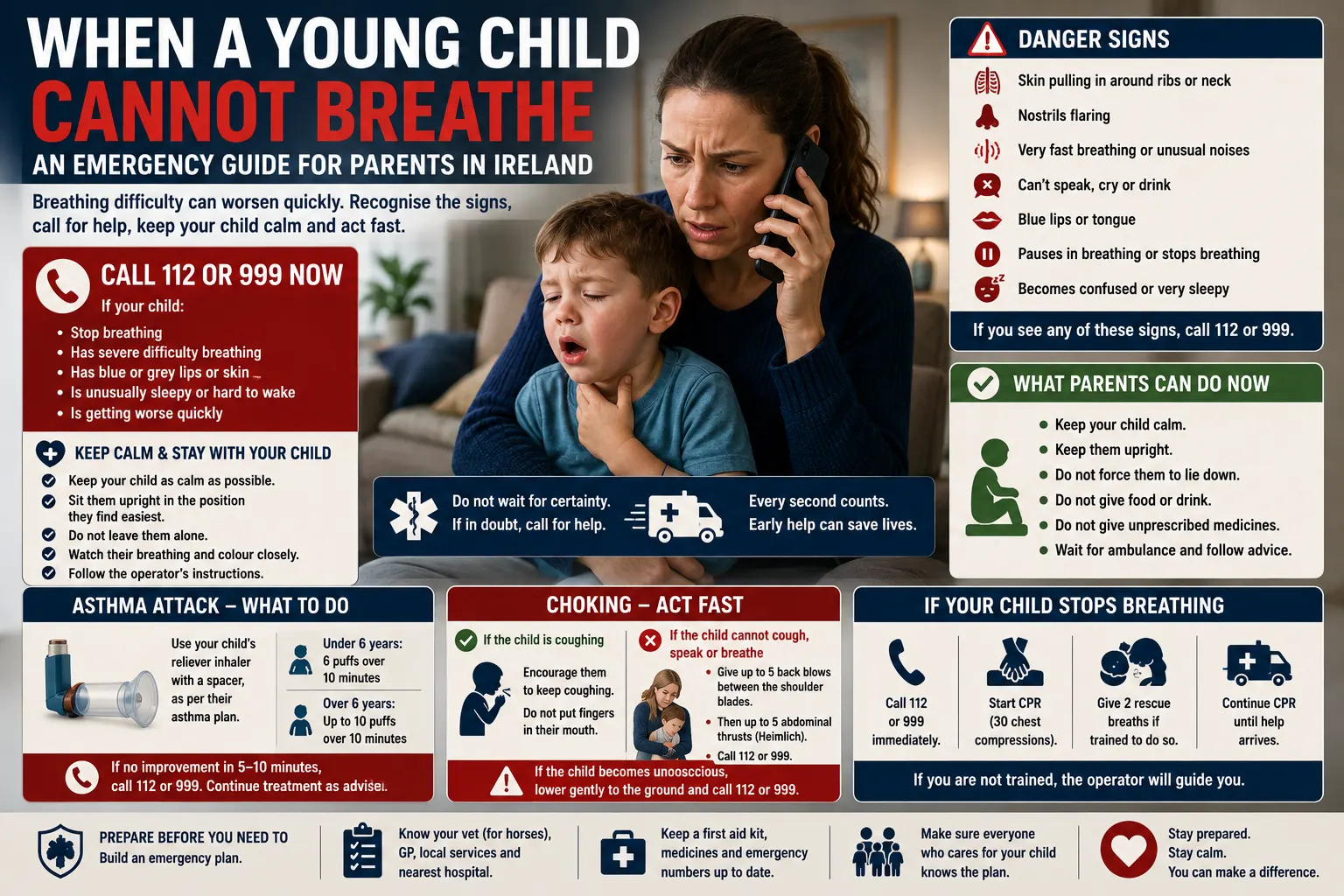
The most important principle is that parents should not wait for certainty when a child appears seriously unwell. In Ireland, parents should call 112 or 999 and ask for an ambulance if a child stops breathing, develops severe difficulty breathing, becomes blue or grey around the lips or skin, becomes unusually sleepy or difficult to wake, or appears to be deteriorating rapidly.
The Signs That Mean: Call 112 or 999 Now
Breathing difficulty is not simply a child breathing slightly faster after running, playing or crying. Parents should be particularly concerned when they can see the effort required to breathe. The skin may pull inward between or underneath the ribs, the nostrils may flare, the child may breathe extremely quickly or make unusual grunting, wheezing or high-pitched noises.
A child who cannot speak or cry normally because of breathlessness, cannot drink because breathing is too difficult, develops blue lips or tongue, becomes confused or unusually sleepy, has pauses in breathing or stops breathing needs emergency assistance.
In a life-threatening situation, call 112 or 999 and ask for an ambulance. Give the emergency operator the child’s age, exact location and Eircode where possible, and explain clearly that the child is having difficulty breathing. Keep the telephone available and follow the operator’s instructions.
Do not delay an ambulance call while searching online for a diagnosis or attempting several different home treatments.
What Parents Can Do Immediately While Help Is Coming
If the child is conscious and breathing, stay with them and try to keep them calm. Distress and crying can increase the work of breathing, particularly during asthma attacks and some other respiratory conditions.
Allow the child to remain in the position in which breathing feels easiest. Many children with breathing difficulty naturally prefer to sit upright. Do not force a child who is struggling to breathe to lie flat unless instructed to do so by emergency professionals.
Watch the child continuously. Pay attention to the colour of the lips and skin, whether they remain alert, whether they can speak or cry normally and whether breathing is becoming more difficult.
If an ambulance has already been requested and the child’s condition worsens, tell the emergency service immediately.
Do not give medicines that have not been prescribed or recommended for that child in an attempt to treat unexplained breathing difficulty.
Asthma: Prepare Before the Emergency Happens
Asthma is a condition in which the airways become inflamed and narrowed. In children, symptoms can include coughing, wheezing, chest tightness and shortness of breath.
During a severe asthma attack, a child may become too breathless to finish a sentence, eat or drink. They may breathe much faster than usual, become exhausted or appear frightened and distressed. Blue lips, severe difficulty speaking, confusion, unusual drowsiness or extreme breathing effort are emergency warning signs.
Every child with diagnosed asthma should ideally have an individual asthma action plan prepared with their GP, asthma nurse or other healthcare professional. Parents, grandparents, teachers, childcare staff and other regular carers should know that the child has asthma, where the medicines are kept and what to do during an attack.
Young children are frequently prescribed a spacer or face mask to use with their inhaler. Parents should know how to assemble and use this equipment before an emergency occurs.
What to Do During a Child’s Asthma Attack
If a child is having an asthma attack, keep them calm and sit them upright. Use the child’s prescribed reliever inhaler with their spacer or face mask according to the child’s asthma action plan.
Under current HSE guidance, children under six can be given six puffs of their reliever inhaler over approximately ten minutes, with one puff given at a time through the spacer. Children over six can receive up to ten puffs over ten minutes, unless the child’s own medical plan provides different instructions.
If symptoms do not improve within approximately five to ten minutes, call 112 or 999 and ask for an ambulance. Reliever treatment can be repeated while waiting according to the child’s asthma plan and emergency medical instructions.
If the child is already severely breathless, becoming blue, unable to speak or drink normally, exhausted, confused, very sleepy or difficult to wake, do not wait to see whether the inhaler solves the problem. Call 112 or 999 immediately.
Stay with the child throughout the attack. If hospital treatment becomes necessary, take the child’s inhalers, spacer, medicines and asthma action plan with you where this can be done without delaying emergency care.
A Preventer Inhaler Is Not the Same as an Emergency Reliever
Parents should understand the difference between the medicines used to manage asthma.
A reliever inhaler is intended to relax the muscles around the airways and provide rapid relief during symptoms or an attack. A preventer inhaler is taken regularly to reduce inflammation and lower the risk of future asthma symptoms.
Preventer medication does not normally provide immediate relief during a sudden severe attack.
Children prescribed preventer treatment should generally continue taking it as directed even when they feel well. Increasing reliance on the reliever inhaler, repeated night-time coughing, frequent wheezing or difficulty participating in normal exercise can indicate that asthma control needs to be reviewed by a healthcare professional.
Breathing Difficulty Is Not Always Asthma
A child who has asthma can still develop other respiratory illnesses. Parents should therefore avoid assuming that every breathing problem is simply another asthma attack.
Young children may also develop bronchiolitis, croup, pneumonia, severe allergic reactions, respiratory infections or airway obstruction caused by a foreign object.
Parents do not need to identify the exact disease before seeking help. If a child is visibly struggling to breathe, the seriousness of the breathing problem matters more than making the correct diagnosis at home.
Bronchiolitis: Particularly Important in Babies
Bronchiolitis commonly affects babies and children under two years of age. It often begins like an ordinary cold before progressing to coughing, wheezing or faster breathing.
Parents should seek urgent medical help if a baby or young child is visibly struggling to breathe, develops blue lips or tongue, has significant pauses in breathing, becomes difficult to wake, appears pale and sweaty or is breathing much faster than normal.
Feeding can also be affected because babies need to coordinate breathing and swallowing. A baby who cannot feed because of breathing difficulty or is showing signs of dehydration should be medically assessed.
Croup: The Barking Cough That Can Become Serious
Croup frequently produces a distinctive barking cough, a hoarse voice and noisy breathing. Many cases are mild, but some children can develop significant breathing difficulty.
Keep the child calm because crying can make the noisy breathing worse. Sitting upright may help the child breathe more comfortably.
Emergency assistance is needed if the child is struggling significantly for breath, develops marked pulling-in around the ribs or neck, turns blue or grey, becomes unusually sleepy or has difficulty swallowing accompanied by drooling.
Steam inhalation should not be relied upon as emergency treatment.
If the Problem Started While Eating or Playing, Think About Choking
Choking requires a different response from asthma or respiratory infection.
If a child is coughing strongly and effectively, encourage them to continue coughing. Do not interfere unnecessarily because coughing is the body’s most effective way of clearing a partially obstructed airway.
If a child aged one year or older cannot breathe, speak, cry or cough effectively, support them leaning forward and give up to five firm back blows between the shoulder blades.
Check after each blow to see whether the obstruction has cleared. If it has not, give up to five abdominal thrusts.
If the airway remains blocked, call 112 or 999 and continue alternating five back blows and five abdominal thrusts while following the emergency operator’s instructions.
Choking in Babies Under One Year Is Different
For a baby under one year, abdominal thrusts should not be used.
If the baby cannot breathe or cough effectively, support the baby safely with the head lower than the body and give up to five back blows between the shoulder blades.
If these do not clear the obstruction, turn the baby carefully and give up to five chest thrusts.
If the object remains lodged, call 112 or 999 and continue repeating the sequence while following emergency instructions.
Do not blindly put fingers inside a baby or child’s mouth. If an object is clearly visible and easy to remove, it may be carefully taken out. Blind finger sweeps can push an object deeper into the airway.
If the Child Becomes Unresponsive or Stops Breathing
If a child becomes unresponsive and is not breathing normally, call 112 or 999 immediately and begin CPR.
Put the emergency call on speaker where possible so the operator can guide you while help is on the way.
For a child aged one year or older, open the airway and begin 30 chest compressions followed by two rescue breaths. Chest compressions should be performed in the centre of the chest, pressing approximately one-third of the depth of the chest.
Continue cycles of 30 compressions and two breaths until the child begins breathing normally again, professional help takes over or an automated external defibrillator instructs you otherwise.
If rescue breaths cannot be given, continue chest compressions rather than doing nothing.
CPR techniques are slightly different for babies, so parents and carers of infants are strongly encouraged to complete an accredited paediatric first-aid or CPR course before an emergency ever occurs.
Ireland’s Emergency Numbers and Children’s Emergency Departments
For life-threatening breathing difficulty anywhere in Ireland, the most important numbers are:
112 or 999 — Ambulance and Emergency Services
Both numbers can be used free of charge for genuine emergencies.
In Dublin, Children’s Health Ireland operates dedicated paediatric emergency services.
| Emergency Service | Address / Contact |
|---|---|
| CHI at Crumlin Emergency Department | Cooley Road, Crumlin, Dublin 12, D12 N512. Emergency Department: 01 409 6326 |
| CHI at Temple Street Emergency Department | Temple Street, Dublin 1, D01 YC67. Emergency Department: 01 878 4274 |
| CHI at Tallaght Emergency Care | Belgard Square North, Tallaght, Dublin 24, D24 TN3C. 01 693 7500 / 01 693 7501 |
| HSE Live | 1800 700 700 for general HSE information |
| Ambulance / Emergency Services | 112 or 999 |
The direct hospital telephone numbers can be useful for hospital-related information, but they should not be used instead of 112 or 999 when a child is experiencing life-threatening breathing difficulty.
Outside Dublin: Use the Nearest Appropriate Emergency Department
Families elsewhere in Ireland do not need to travel to Dublin simply because the patient is a child. Children can be assessed in emergency departments around the country, with transfer to specialist paediatric services arranged where necessary.
If the child is severely short of breath, becoming blue, losing consciousness or deteriorating rapidly, calling an ambulance is generally safer than attempting a long journey by car.
Paramedics can begin treatment, monitor the child and determine the most appropriate hospital destination.
When a GP or GP Out-of-Hours Service May Be More Appropriate
Not every cough or wheeze requires an ambulance.
If a child is breathing comfortably, remains alert, has normal skin colour, can speak and drink normally and is not deteriorating rapidly, contacting the family GP may be appropriate.
When the regular GP practice is closed, the practice’s recorded telephone message normally provides details of the local GP out-of-hours service. Ireland does not use one single national GP out-of-hours telephone number for every region.
GP out-of-hours services normally work by telephone triage and appointment rather than as walk-in clinics.
The distinction is simple: a child with mild but concerning respiratory symptoms may need a GP assessment. A child visibly struggling for breath requires emergency care.
Parents of Children With Asthma Should Create an Emergency Routine
Asthma emergencies become easier to manage when everyone caring for the child already knows what to do.
Keep the reliever inhaler and spacer accessible rather than buried in a cupboard. Check regularly that the inhaler has not run out and that prescribed medicines remain in date.
A copy or photograph of the child’s asthma action plan should be available to parents and other carers. Schools, crèches, grandparents and anyone regularly responsible for the child should know where emergency medication is stored and how it should be given.
Parents should also understand the child’s common triggers. Respiratory infections, cold air, exercise, allergies, air pollution and tobacco smoke can all worsen asthma symptoms.
Smoking around a child with asthma should be avoided. Smoke residue carried on clothing and hair can also contribute to exposure.
After an Asthma Attack, Arrange a Review
An asthma attack that resolves is still medically important. It can indicate that the child’s treatment is no longer providing adequate control, that inhaler technique needs to be corrected or that new triggers have appeared.
Parents should arrange follow-up with the child’s GP or asthma healthcare professional after a significant attack, particularly where emergency treatment was needed or the reliever inhaler had to be used repeatedly.
The child’s inhaler technique, medication dose and asthma action plan can then be reviewed.
Repeated attacks, frequent night coughing or constant dependence on a reliever inhaler should not simply be accepted as an unavoidable part of childhood asthma.
Teach Everyone in the Household Basic First Aid
Emergency numbers and medicines are important, but practical skills can be just as valuable. Parents, grandparents, babysitters and older family members who regularly care for young children should consider completing paediatric first-aid training.
Knowing how to identify ineffective breathing, perform age-appropriate choking first aid and begin CPR can make an enormous difference during the minutes before professional help arrives.
The techniques should ideally be learned practically from an accredited instructor rather than for the first time during an emergency.
A Simple Emergency Guide for the Fridge Door
| Situation | Immediate Action |
|---|---|
| Child severely struggling to breathe | Call 112 or 999 |
| Blue or grey lips or skin | Call 112 or 999 |
| Child unusually sleepy, confused or difficult to wake | Call 112 or 999 |
| Child stops breathing normally | Call 112 or 999 and start CPR |
| Severe asthma attack | Sit child upright, use prescribed reliever and spacer, call 112 or 999 if severe or not improving |
| Child over one choking and cannot cough/breathe | Up to 5 back blows, then up to 5 abdominal thrusts |
| Baby under one choking | Up to 5 back blows, then up to 5 chest thrusts |
| Effective cough during choking | Encourage coughing and monitor closely |
| Mild breathing symptoms but child otherwise well | Contact GP or GP out-of-hours service |
| Rapid deterioration at any stage | Call 112 or 999 |
When in Doubt, Look at the Child — Not Just the Diagnosis
Parents are often understandably focused on identifying whether a breathing problem is asthma, croup, bronchiolitis or an infection. In an emergency, however, the most important question is simpler: how sick does the child look right now?
A child who is alert, drinking, talking and breathing comfortably can usually be assessed differently from one who is visibly fighting for every breath.
If the child is blue, very sleepy, unable to speak or drink because of breathlessness, visibly pulling in underneath the ribs, breathing extremely rapidly, making severe abnormal breathing noises, choking, unresponsive or no longer breathing normally, call 112 or 999 immediately.
For a child with known asthma, use the prescribed reliever inhaler and spacer according to the child’s individual action plan. For choking, use the age-appropriate first-aid procedure. If the child stops breathing normally, begin CPR while emergency help is on the way.
Parents do not need absolute certainty before calling an ambulance. Young children can deteriorate rapidly, and waiting for unmistakable evidence of a life-threatening emergency can lose valuable time.
The most useful preparation can therefore be completed long before a child becomes ill: save 112 and 999, know the nearest appropriate emergency department, keep prescribed asthma medication and spacers accessible, maintain an up-to-date asthma action plan and learn paediatric choking first aid and CPR.
When a young child cannot breathe properly, the most important task is not to make a perfect diagnosis at home. It is to recognise danger quickly, begin the appropriate first aid and get professional help without delay.
Source & Transparency
This article is published by Ireland Newspaper for editorial and informational purposes.
Published: 13 August 2026 · Updated: 13 August 2026

Newsroom Ireland Newspaper
Ireland Newspaper editorial team prepares daily news coverage for readers in Ireland and abroad.