
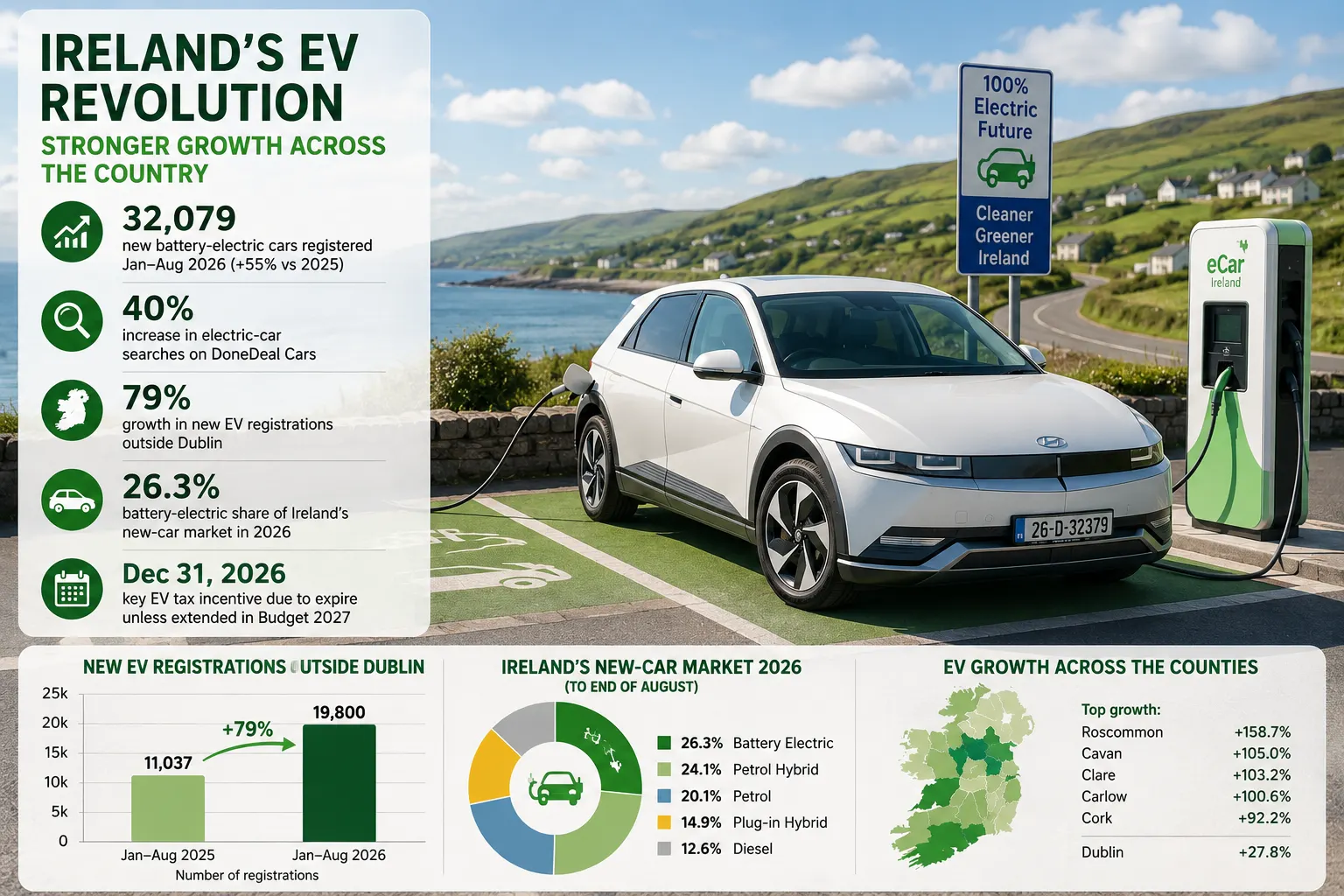
Ireland registered 32,079 new battery-electric cars in the first eight months of 2026, 55% more than during the same period last year. Yet the more significant change is geographical. Outside Dublin, new electric-car registrations have risen by almost 80%, compared with 28% in the capital, while searches for electric cars on DoneDeal Cars are up 40% nationally. A market once concentrated heavily around Dublin and its commuter belt is beginning to look much more like a national transition.
Battery-electric vehicles now account for 26.3% of all new cars registered in Ireland this year, making them the largest single powertrain category in the new-car market for the first time. Petrol-electric hybrids account for 24.1%, conventional petrol cars 20.1%, plug-in hybrids 14.9% and diesel just 12.6%. That represents a striking reversal for a country in which diesel dominated new-car sales little more than a decade ago.
The shift is not being driven by one factor. Higher petrol and diesel prices have changed the running-cost calculation, the selection of electric models has widened, second-hand EV prices have fallen substantially and the public charging network is expanding. Government grants and tax relief remain significant. At the same time, improvements in driving range have reduced one of the main objections to electric ownership for motorists outside cities.
There are reasons for caution. August itself produced only 7% annual growth in new battery-electric registrations, far below the 55% increase recorded across the year to date, showing that adoption will not rise in a straight line. More importantly, one of the principal tax incentives supporting new EV purchases is due to expire at the end of December unless the Government extends it in Budget 2027.
32,079: new battery-electric cars registered between January and August 2026.
55%: increase in new battery-electric registrations compared with the same period in 2025.
40%: increase in electric-car searches on DoneDeal Cars during the first eight months of 2026.
79%: approximate growth in new EV registrations outside Dublin.
26.3%: battery-electric share of Ireland’s new-car market in 2026 to the end of August.
The Most Important Change Is Happening Outside Dublin
Dublin still buys more new electric cars than any other county. A total of 12,279 battery-electric cars were registered in the capital during the first eight months of 2026. But Dublin’s dominance is diminishing rapidly because registrations elsewhere are growing much faster.
In the same period of 2025, Dublin accounted for 46.5% of national battery-electric registrations. Its share has fallen to 38.3% this year. Subtracting Dublin from the national figures shows that approximately 19,800 new battery-electric cars were registered elsewhere between January and August, compared with 11,037 during the same months last year. That is growth of roughly 79%.
Every county recorded an increase. Roscommon produced the largest percentage rise, with registrations increasing by 158.7%. Cavan was up 105%, Clare 103.2% and Carlow 100.6%. Cork, which has enough market size for percentage growth to translate into substantial absolute numbers, registered 3,869 new electric cars, 92.2% more than a year earlier.
Dublin’s increase of 27.8% would itself represent strong growth in many markets. In 2026 Ireland it was the slowest percentage increase of any county and the only one below the 55% national rate. The figures therefore support the conclusion that the current expansion is no longer principally a Dublin phenomenon.
Where New Electric-Car Registrations Are Growing Fastest
| County | Jan–Aug 2026 | Annual change |
|---|---|---|
| Roscommon | 269 | +158.7% |
| Cavan | 246 | +105.0% |
| Clare | 699 | +103.2% |
| Carlow | 361 | +100.6% |
| Mayo | 437 | +97.7% |
| Cork | 3,869 | +92.2% |
| Galway | 1,235 | +78.5% |
| Dublin | 12,279 | +27.8% |
Source: Society of the Irish Motor Industry, new electric-car registrations January to August 2026.
DoneDeal Searches Show the Same Regional Shift
Registration statistics describe cars that people have actually bought. Search activity offers an earlier indication of where potential demand is developing, and the latest DoneDeal Cars figures point in the same direction.
Searches for electric cars on the platform increased by 40% during the first eight months of 2026 compared with the same period last year. Searches for diesel cars fell 22%, while hybrid searches increased by a much more modest 4%. DoneDeal reported that EV interest accelerated particularly strongly during the spring fuel-price crisis, when electric-car searches almost doubled during March and April.
Some of the strongest growth was associated with listings outside the capital. Searches for electric cars in Galway increased by 67%, followed by Cork at 56%, Clare at 39%, Limerick at 35% and Kerry at 27%. Dublin increased by 25%.
Search data should not be confused with vehicle registrations. Browsing an advertisement does not mean a purchase follows, and searches for cars located in a particular county do not necessarily identify the buyer’s home address. But taken together with the registration figures, the data provide stronger evidence that interest is broadening geographically.
Why Rural Electric Driving Can Make More Economic Sense Than It First Appears
Electric cars were initially associated strongly with cities, where shorter journeys appeared ideally suited to battery power. In practice, some characteristics of rural and commuter driving can make electrification particularly attractive. Longer annual distances magnify the savings from cheaper energy, while households outside dense urban centres are more likely to have private driveways where a car can charge overnight.
Home charging changes the economics substantially. An owner who can plug in overnight can buy electricity at domestic rates and begin most mornings with a charged vehicle. That removes much of the need to visit public charging stations during normal day-to-day driving.
ZEVI estimates that between 80% and 90% of EV owners are likely to do most charging at home. DoneDeal similarly identifies driveways, access to home chargers and predictable commuting patterns as reasons EVs can work particularly well across Ireland’s commuter counties.
The economics become more noticeable as annual mileage increases. A household travelling 18,000 kilometres a year experiences the difference between the cost of electricity and liquid fuel many more times than an urban household using a car only occasionally.
The Fuel-Cost Difference Is Now Large
Official SEAI figures provide an indication of the scale. Its fuel-price comparison for the third quarter of 2026 estimates that travelling 100 kilometres in a representative C-segment electric vehicle costs approximately €3.27 in energy. The equivalent estimate is €9.80 for petrol and €10.02 for diesel.
The EV calculation assumes 90% of charging occurs at home on a night electricity rate and 10% on fast or high-powered public chargers. A driver who relies heavily on expensive public rapid charging would therefore have higher costs than the example, while a household with favourable domestic tariffs could experience a different result.
Using the official figures as a simple model, an 18,000-kilometre annual driving distance would generate energy costs of about €589 for an EV, €1,764 for petrol and €1,804 for diesel. The implied annual energy saving would be around €1,175 relative to petrol and €1,215 relative to diesel.
This is an illustrative calculation based on SEAI’s Q3 2026 fuel-cost assumptions and 18,000 kilometres of annual driving. It excludes purchase price, insurance, finance, depreciation, servicing and other ownership costs. Actual electricity and fuel costs vary by vehicle, tariff, charging pattern and driving conditions.
That calculation helps explain why a temporary jump in fossil-fuel prices can cause a much larger change in EV interest than the price increase alone might suggest. A motorist does not need to believe petrol will remain expensive forever. A period of unusually high prices can prompt the first serious comparison of lifetime operating costs.
€3.27 per 100km is SEAI’s current representative energy-cost estimate for electric driving, compared with €9.80 for petrol and €10.02 for diesel.
The Used Market Has Removed Another Important Barrier
For several years, the strongest argument against electric cars was the purchase price. New battery-electric vehicles often carried substantial premiums over comparable petrol or diesel models, limiting adoption even when running costs were lower. That gap has narrowed as manufacturers have introduced more models and battery costs have declined.
The second-hand market has changed even more dramatically. DoneDeal Cars reported in March that used electric vehicles were approximately 11% cheaper than comparable diesel cars after controlling for factors such as age, mileage and model. A typical three-year-old EV had a median asking price of €28,825, compared with €35,893 for a diesel vehicle of the same age.
Petrol remained cheaper on the raw median comparison, at approximately €22,900 for a three-year-old car. Electric vehicles therefore have not become the least expensive option in every part of the market. The important change is that buyers no longer necessarily have to pay a premium over diesel to obtain a relatively recent EV.
The fall in used-electric prices has been painful for some earlier owners because rapid depreciation reduced resale values. For the next generation of buyers, however, the same price correction makes entry into electric motoring considerably easier. A market transition often produces precisely that distributional effect: lower residual values hurt sellers while making the technology more accessible to subsequent buyers.
A Larger New-EV Market Is Beginning to Feed the Used Market
The relationship between new and used vehicles matters because most Irish households do not buy a new car every time they change vehicle. A sustainable transition therefore requires electric cars to move through leasing, company fleets and first owners before reappearing several years later at lower prices.
The rapid growth in new registrations during 2025 and 2026 will gradually increase that supply. Vehicles being registered today will form part of the three-, four- and five-year-old market later in the decade. If new EV sales remain strong, second-hand choice should become broader geographically and across price bands.
That could be particularly important outside Dublin, where buyers may have fewer specialist EV dealers nearby and traditionally rely heavily on used vehicles. More stock creates competition between sellers and makes it easier for buyers to find a battery size, body style and price appropriate to their needs.
There are still additional considerations with a used electric car. Buyers need information about battery condition, remaining battery warranty, charging speed and real-world range. A car designed a decade ago with a relatively small battery can be perfectly suitable for local journeys but fundamentally different from a newer model capable of travelling several hundred kilometres between charges.
Range Anxiety Has Not Disappeared, but the Infrastructure Has Changed
The public charging network remains one of the most important determinants of regional confidence. ZEVI reported 3,428 public charging points across 1,150 locations by June 2026. The network now extends far beyond Dublin and the major motorways.
Government investment is increasingly concentrated on high-powered chargers along national and regional roads. ZEVI says €20 million is being invested during 2026 and early 2027 to deliver 266 additional high-power recharging stations. Earlier programmes have funded motorway, dual-carriageway and national-road hubs, while regional and local plans are intended to expand destination and neighbourhood charging.
The objective is not that every driver should regularly use public charging. Home charging is expected to remain dominant. The public network instead needs to perform several different jobs: support long-distance journeys, provide charging for people without driveways, serve tourists and commercial fleets, and offer confidence that an unexpected journey will not leave a driver without electricity.
This is especially important beyond Dublin. A household in Galway, Kerry or Donegal may make most journeys within the range of a modern EV, but occasional trips across the country make the availability and reliability of fast charging psychologically and practically important.
The network is therefore becoming less about the total number of plugs and more about their location, power and reliability. A cluster of slow chargers in one car park does not provide the same mobility function as several high-power chargers on an interurban route.
Ireland’s EV Charging Expansion
| Measure | Current or planned position |
|---|---|
| Public charging points | 3,428 |
| Public charging locations | 1,150 |
| New high-power stations | 266 during 2026–early 2027 |
| Expected home-charging share | 80%–90% |
| 2030 private-car objective | 30% electric |
Source: Zero Emission Vehicles Ireland and Department of Transport.
Drivers Without Driveways Remain the Harder Problem
The same factors helping EV adoption in commuter and rural areas reveal an important weakness in cities. Home charging is simplest for households with their own driveway. Apartment residents, tenants and people living in terraced streets without dedicated parking can face a much more complicated transition.
Government supports include apartment-charging programmes and local-authority plans for neighbourhood infrastructure, but installation requires more coordination than simply mounting a charger on the wall of a private house. Electricity connections, parking rules, ownership structures and access to shared spaces can all intervene.
This may help explain why the next phase of EV growth does not necessarily have to be led by central Dublin. The capital contains large numbers of apartment residents and households without private off-street parking, while many commuter and regional households have precisely the parking arrangement that makes an EV easiest to operate.
That should not be overstated. Dublin still registered more than 12,000 new battery-electric cars in eight months and remains the largest market by a considerable margin. The point is that some of the physical characteristics once assumed to favour cities can work in the opposite direction when charging at home becomes the central part of EV ownership.
Government Support Still Makes a Material Difference
Despite falling vehicle prices, Ireland’s EV market is not operating without substantial public support. Private buyers of qualifying new battery-electric passenger cars can receive an SEAI grant of up to €3,500. The maximum eligible purchase price for new applications has been reduced to €50,000 as policy increasingly directs support towards more affordable models.
Battery-electric vehicles also receive VRT relief of up to €5,000. For cars with an Open Market Selling Price of up to €40,000, the available relief can eliminate the VRT liability up to the €5,000 ceiling. The relief tapers between €40,000 and €50,000 and is unavailable above €50,000.
A €300 grant remains available towards qualifying smart home-charger installations, while electric cars also benefit from an annual motor-tax rate of €120. Company electric cars have preferential Benefit-in-Kind treatment under the new zero-emission category introduced this year.
These incentives affect different buyers in different ways. The €3,500 purchase grant is not available for used cars, while VRT treatment depends on vehicle value. Company-car incentives matter primarily to employees and businesses rather than private cash buyers. The combined effect nevertheless lowers the relative cost of electric ownership across important parts of the market.
The Scrappage Pilot Filled Its 2,000 Places
A new policy experiment launched in July provides another indication of demand. Under the ICE2EV pilot scrappage scheme, an eligible owner of a petrol or diesel car from 2013 or earlier could receive a €5,000 scrappage payment on top of the €3,500 standard EV grant when replacing it with a qualifying new battery-electric car.
The scheme had a €10 million budget and a target of 2,000 applications. It has already reached that target and is closed to new applicants. SEAI and the Department of Transport are due to review the pilot’s uptake, emissions impact and value for money before deciding whether it should inform future policy.
Its design is particularly relevant to the regional shift. Sixty-five per cent of the scrappage budget was reserved for rural applicants and 35% for urban applicants. That allocation was a policy choice rather than evidence that precisely 65% of actual EV demand is rural, but it shows that Government is now deliberately trying to move EV adoption beyond its early urban base.
The pilot also targeted an important emissions issue. Replacing a relatively old combustion car with an electric vehicle can reduce fleet emissions more directly than subsidising a household that might otherwise have bought a newer low-emission car anyway. Whether the additional €5,000 payment delivered sufficient extra purchases to justify its cost is precisely what the post-scheme evaluation will need to determine.
Budget 2027 Has Become the Next Major Test
The most immediate uncertainty concerns VRT. The current relief was extended for one year in Budget 2026 and expires on 31 December 2026 unless another extension is legislated. The motor industry is already pressing Government to retain it, alongside the €3,500 SEAI grant and favourable company-car taxation.
The timing matters because the market has only recently accelerated. SIMI argues that withdrawing incentives immediately after battery-electric cars became the largest single new-car powertrain could damage consumer confidence. DoneDeal has made a similar argument, particularly in relation to the emerging demand outside Dublin.
That argument must be weighed against the purpose of subsidies. Purchase incentives are normally intended to help a technology through an early adoption period rather than remain indefinitely once it becomes competitive. The Government has already reduced the private purchase grant from €5,000 to €3,500 and lowered the vehicle price ceiling, while shifting more funding towards charging infrastructure.
A gradual reduction in support is therefore consistent with the long-term policy direction. The more difficult question is timing. Removing a tax advantage too early can slow adoption; maintaining it for too long can subsidise purchases that would have happened without public money.
Budget 2027 will consequently have to assess whether Ireland’s current sales surge has become self-sustaining or whether it still depends materially on incentives. The answer may differ between a Dublin household purchasing a second premium vehicle and a rural family replacing an ageing diesel car.
August Shows Why One Strong Year Should Not Be Treated as a Guaranteed Trend
The year-to-date figures are exceptionally strong, but monthly data show more volatility. July produced 9,682 new battery-electric registrations, 98% more than July 2025 and a record month. In August, 2,265 were registered, only 7% more than a year earlier.
Ireland’s two-part registration year, dealer ordering cycles and individual incentive deadlines can produce large monthly movements, so neither July’s near-doubling nor August’s slower increase should be extrapolated directly into the future. The more informative measure is the cumulative trend across a longer period.
That cumulative trend remains strong. Total new-car registrations rose only 5% between January and August, while battery-electric registrations increased 55%. Electric cars are therefore gaining market share rather than merely rising alongside a generally expanding car market.
The test will come in 2027, particularly if fiscal support changes and fuel prices become less volatile. A genuinely mature EV market should continue gaining buyers even when external shocks no longer provide an immediate incentive to reconsider petrol and diesel.
The Top-Selling Models Show How the Market Is Broadening
Ireland’s EV market is also becoming less dependent on a small number of early electric models. The Volkswagen ID.4 is currently the country’s best-selling new battery-electric car, followed by the Tesla Model Y, Skoda Enyaq, Skoda Elroq and Toyota bZ4X. Kia, Volkswagen, Hyundai, Skoda and Tesla are the five leading electric brands.
The composition matters because mainstream manufacturers now offer electric cars in the vehicle categories Irish buyers already purchase in large numbers, particularly crossovers and SUVs. Consumers no longer have to move to an unfamiliar manufacturer or unusual body style simply to choose battery power.
Competition is also increasing from newer Chinese manufacturers and from lower-priced models being introduced by established European groups. The range of EVs approaching or entering lower price bands is expanding as battery costs fall and manufacturers scale production.
Greater choice can reduce another barrier that grants alone cannot solve. A household may accept electric propulsion but still require a seven-seat vehicle, a large boot, towing capability or a particular price point. Market adoption becomes easier as manufacturers offer electric alternatives across those practical categories.
Electric Cars Do Not Solve Every Transport Problem
The rapid growth in sales supports Ireland’s climate strategy, but electrification should not be confused with the complete decarbonisation of transport. An electric car still occupies road space, contributes to congestion, requires roads and parking, and produces emissions associated with manufacturing and electricity generation. Its principal climate advantage is eliminating tailpipe carbon emissions and allowing road transport increasingly to run on a decarbonising electricity system.
Ireland’s legally binding transport challenge is considerably larger. The sector is required to reduce greenhouse-gas emissions by 50% by 2030 compared with 2018. EPA projections published in 2026 indicate that transport emissions would fall only 15.5% under measures already in place and approximately 27.6% under a scenario incorporating additional planned measures.
The EPA’s additional-measures scenario assumes approximately 750,000 electric vehicles by 2030. Even at that scale, electrification alone does not deliver the required sectoral reduction. Biofuels, public transport, walking, cycling, freight policy and lower dependence on car journeys remain part of the climate strategy.
This is particularly important when interpreting strong EV sales as climate progress. Replacing a diesel car with an electric one reduces emissions. Replacing a journey that could efficiently be made by public transport with another private car does not address congestion or the amount of road space required. Ireland’s policy consequently combines electrification with a broader attempt to change how people travel.
Ireland Still Has a Long Way to Go to 2030
The Government’s current policy objective is for approximately 30% of the private car fleet to be electric by 2030. Ireland has already passed its interim EV target: Government reported more than 212,000 registered electric vehicles by February 2026, while ZEVI’s latest vehicle data show 266,253 vehicles categorised as electric under current taxation and fuel-type records at the end of August.
Those wider EV totals include categories beyond the new battery-electric passenger cars measured in SIMI’s monthly BEV sales figures, so the two datasets should not be treated as equivalent. They nevertheless demonstrate how rapidly the electrified fleet has expanded from a very small base.
The next stage is harder because early adopters are no longer enough. Reaching roughly one-third of the private fleet requires participation from households buying ordinary family cars, people who purchase second-hand vehicles, businesses operating fleets and motorists in every county.
That is precisely why the regional shift in 2026 matters. A technology concentrated among relatively affluent Dublin households could grow rapidly without ever transforming the national fleet. Growth in Cork, Galway, Clare, Roscommon, Cavan, Mayo and the rest of the country indicates that EV ownership is moving into a broader phase.
Regional Charging Will Determine Whether the Growth Persists
The sustainability of that trend will depend increasingly on infrastructure rather than marketing. Ireland’s new draft National EV Charging Infrastructure Strategy for 2026–2028 explicitly prioritises geographical balance and compliance with the EU Alternative Fuels Infrastructure Regulation. A final strategy is expected later in 2026.
The programme covers three distinct needs. High-powered en-route charging is required for interurban journeys. Destination chargers are useful where cars remain parked for longer periods at hotels, shops, workplaces and public facilities. Neighbourhood charging is needed for households that cannot install their own private equipment.
The distinction is particularly important for regional Ireland. A rapid charger on a motorway can remove range anxiety during a cross-country trip but does little for a renter who cannot charge outside their home every night. Conversely, rows of slower town-centre chargers cannot replace high-powered infrastructure required on long routes.
Local authorities will therefore play an increasingly important role. The transition is moving from a largely consumer-led market towards one requiring coordinated planning of electricity connections, parking, road corridors and local charging demand.
The Electricity System Can Accommodate EVs Differently From Other Large Loads
Rapid electrification inevitably raises questions about whether Ireland can generate enough electricity. Electric vehicles add demand to the grid, but their charging profile has an important characteristic: much of it can be moved in time.
A car parked at home for ten hours overnight may need only a few hours of charging. Smart chargers can increasingly schedule that demand when electricity is cheaper and system load is lower. In future, dynamic tariffs could encourage drivers to consume more electricity during periods of abundant wind generation and less during evening peaks.
This flexibility differentiates EV demand from loads that must operate continuously. It does not remove the need for stronger local distribution networks, particularly in neighbourhoods where many vehicles charge simultaneously, but it provides system operators with more options for managing growth.
The Government’s home-charger grant now supports smart chargers specifically. That reflects a transition from simply increasing the number of charge points towards integrating vehicles intelligently with the electricity system.
The Economics Are Strongest for Some Households and Weaker for Others
The national sales figures can disguise how different the decision looks from one household to another. A homeowner with solar panels, a driveway, a night electricity tariff and a 100-kilometre daily commute can potentially realise substantial operating savings from an EV. A city-centre renter relying entirely on expensive rapid charging may see a much smaller advantage.
Finance also matters. A lower energy bill does not compensate a household that cannot afford the vehicle’s purchase price or monthly repayment. Depreciation matters to buyers who regularly change cars, while it matters less to someone intending to keep a vehicle for ten years.
Driving pattern is equally important. Someone covering 25,000 kilometres a year has more opportunity to recover a higher purchase cost through energy savings than somebody travelling 5,000 kilometres. The economic case for EV ownership therefore cannot accurately be reduced to a single national payback period.
This variation is one reason the emergence of a more affordable used market may ultimately be more important than record new-car registrations. Mass adoption requires a technology to work not only for households able to purchase a new €40,000 vehicle but for motorists buying cars at €10,000, €15,000 and €20,000.
Diesel’s Decline Is Becoming Structural
The other side of Ireland’s electric growth is a remarkable decline in diesel. Diesel represented just 12.6% of the new-car market during the first eight months of 2026, behind battery electric, conventional hybrid, petrol and plug-in hybrid vehicles. DoneDeal’s 22% decline in diesel searches provides another indication that buyer interest is moving away from the fuel.
This does not mean diesel is disappearing from Irish roads. The existing fleet turns over slowly, diesel remains prominent in second-hand imports and it continues to offer practical advantages for some heavy-duty and high-mileage uses. The transition of the national fleet will therefore lag the transformation in new-car sales by many years.
But new-car purchasing shapes that future fleet. Every year in which electric registrations rise while diesel registrations decline changes the composition of vehicles that will later enter the second-hand market. The structural effect accumulates even if the annual change appears gradual.
That is another reason regional purchasing matters. Rural Ireland historically became especially associated with diesel because motorists often travelled longer distances. If those same high-mileage households begin moving towards electric vehicles, one of diesel’s strongest remaining passenger-car markets begins to weaken.
The Transition Has Reached a More Important Stage Than the Early Sales Boom
Ireland has experienced periods of rapid EV growth before. What differentiates 2026 is the combination of market share, geography and economics. Battery-electric cars are now the largest single new-car powertrain. Used EVs have become cheaper than comparable diesels on a like-for-like basis. Public charging is moving beyond a small network centred on major routes. Regional registrations are increasing substantially faster than Dublin’s.
None of those developments guarantees that Ireland will meet its 2030 climate or fleet targets. Incentives could change, fuel prices could fall, charging bottlenecks could emerge and consumer concerns about depreciation or battery longevity could return. The much slower August growth rate is a reminder that demand can fluctuate sharply.
The decisive question is whether EVs are moving from an incentivised specialist purchase towards becoming a normal option in the mainstream car market. The latest evidence suggests Ireland is closer to that point than it was a year ago.
The strongest signal may not be the 40% rise in DoneDeal searches or even the 55% increase in new registrations. It is that Dublin’s share of new electric cars has fallen from 46.5% to 38.3% while the national market has accelerated. Electric-car adoption is growing not because the capital is retreating, but because the rest of Ireland is catching up.
Budget 2027 Could Decide Whether Catch-Up Becomes a Lasting Shift
That leaves the Government with an unusually delicate policy decision. Maintaining every existing subsidy indefinitely would be expensive and increasingly difficult to justify as electric cars become mainstream. Removing support abruptly could undermine a regional market that has only recently started accelerating.
A plausible longer-term direction is a gradual shift from broad purchase subsidies towards infrastructure, targeted support and incentives for difficult parts of the market. The reduction in the EV grant’s eligible price ceiling, the limited rural-weighted scrappage pilot and increased charging investment already point in that direction.
Budget 2027 will show whether the €5,000 VRT relief is extended again, modified or allowed to expire. Any of those decisions could affect new-car pricing from January 2027. It will also indicate how Government balances direct vehicle subsidies against investment in the charging network needed for a much larger fleet.
The regional evidence gives that decision greater significance than it would have had several years ago. Electric-car policy is no longer principally about persuading early adopters in Dublin to try new technology. It increasingly concerns whether ordinary motorists across Ireland can buy, charge and economically operate the cars that are expected to replace much of the petrol and diesel fleet.
For the first time, the market data suggest that transition is becoming genuinely national. Whether it continues at the speed required will depend less on enthusiasm alone and increasingly on price, second-hand supply, charging access and the policy choices made as Ireland moves from subsidising an emerging technology to building a permanent electric transport system.
Sources
RTÉ News — Electric Car Searches on DoneDeal Cars Up 40% as Regional Ireland Drives the Switch
Society of the Irish Motor Industry — New Car Registrations and Battery-Electric Sales, August 2026
RTÉ News — Used EVs Priced Below Comparable Diesel Cars
Sustainable Energy Authority of Ireland — Electric Vehicle Grant Values
Revenue Commissioners — Vehicle Registration Tax Relief for Electric Vehicles
Sustainable Energy Authority of Ireland — EV Home Charger Grant
Sustainable Energy Authority of Ireland — Q3 2026 Fuel Price Comparison
Sustainable Energy Authority of Ireland — ICE2EV Scrappage Scheme
Zero Emission Vehicles Ireland — National EV Fleet and Charging Infrastructure Data
Department of Transport — Draft National EV Charging Infrastructure Strategy 2026–2028
Department of Finance — Budget 2026 EV Tax Measures
Environmental Protection Agency — Transport Emissions and 2030 Projections
Source & Transparency
This article is published by Ireland Newspaper for editorial and informational purposes.
Published: 3 September 2026 · Updated: 3 September 2026

Newsroom Ireland Newspaper
Ireland Newspaper editorial team prepares daily news coverage for readers in Ireland and abroad.




Market data, financial news and economy content on Ireland Newspaper are provided for editorial and informational purposes only. They do not constitute financial advice, investment advice, trading advice or a recommendation to buy, sell or hold any financial product. Always verify live prices and consult a qualified professional before making financial decisions.