A few cents of tax on a pint has become one of the more complicated questions facing Budget 2027. Taoiseach Micheál Martin has declined to rule out a reduction in alcohol excise duty after calls for relief for pubs, particularly drink-led businesses that received little direct benefit from the hospitality VAT reduction introduced in July. But he has also made clear that no decision has been taken and that ministers have not yet entered detailed negotiations on the measure.
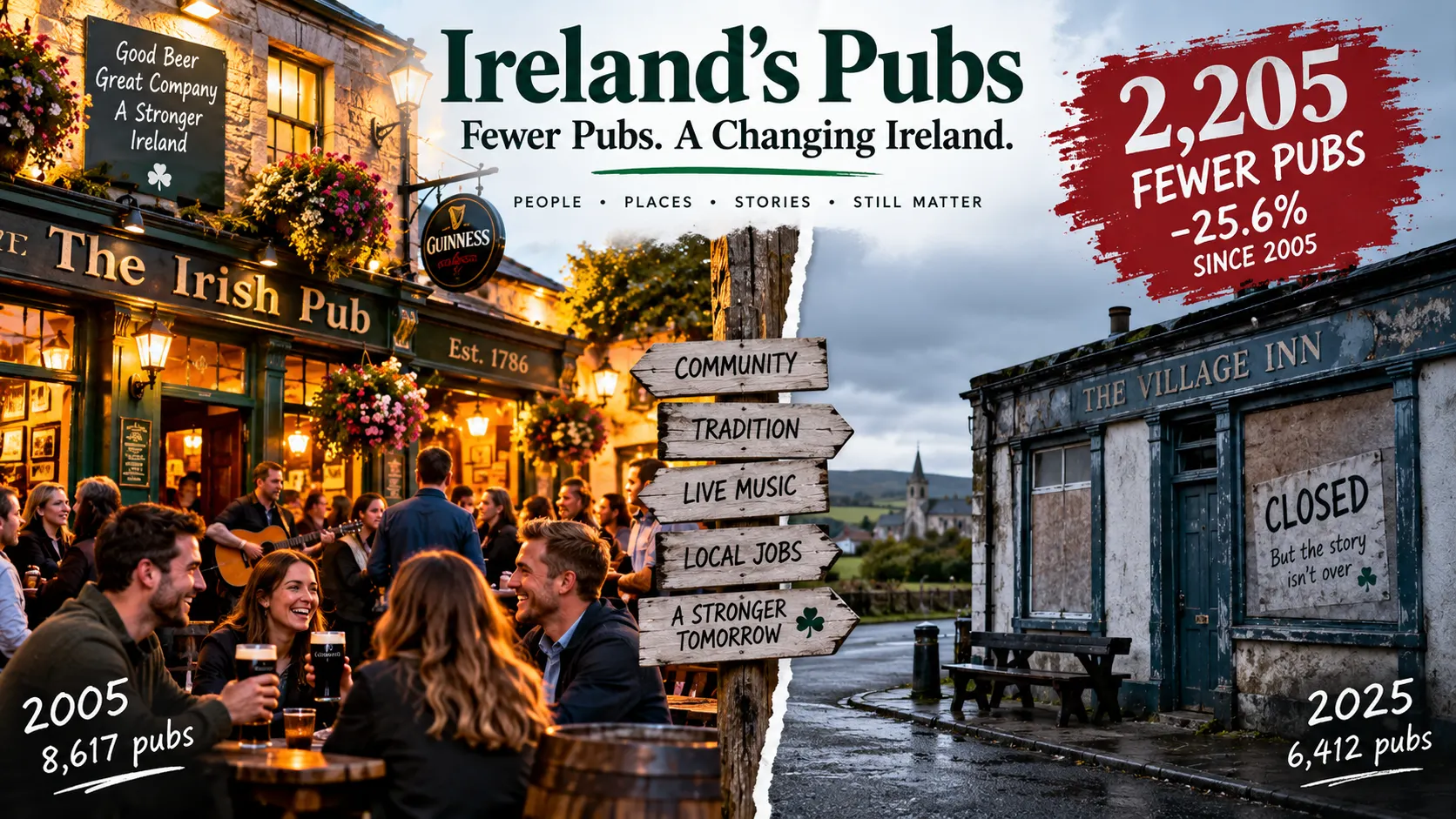
The debate arrives days after new research showed the number of publican licences in Ireland falling from 8,617 in 2005 to 6,412 in 2025, a net decline of 2,205, or 25.6%. The contraction has been overwhelmingly concentrated outside Dublin and has intensified arguments that rural pubs are being squeezed by labour costs, energy bills, changing drinking habits and taxation. Yet the same Budget decision also touches one of Ireland’s central public-health policies: using price and taxation to reduce harmful alcohol consumption.
Those two realities are not mutually exclusive. A rural pub can be economically fragile at the same time as alcohol creates measurable health and social costs. The difficulty for Government is deciding whether a broad excise cut is an efficient way of supporting vulnerable pubs when the tax applies to alcohol products across the market, including drinks sold through supermarkets and off-licences, rather than only across a publican’s counter.
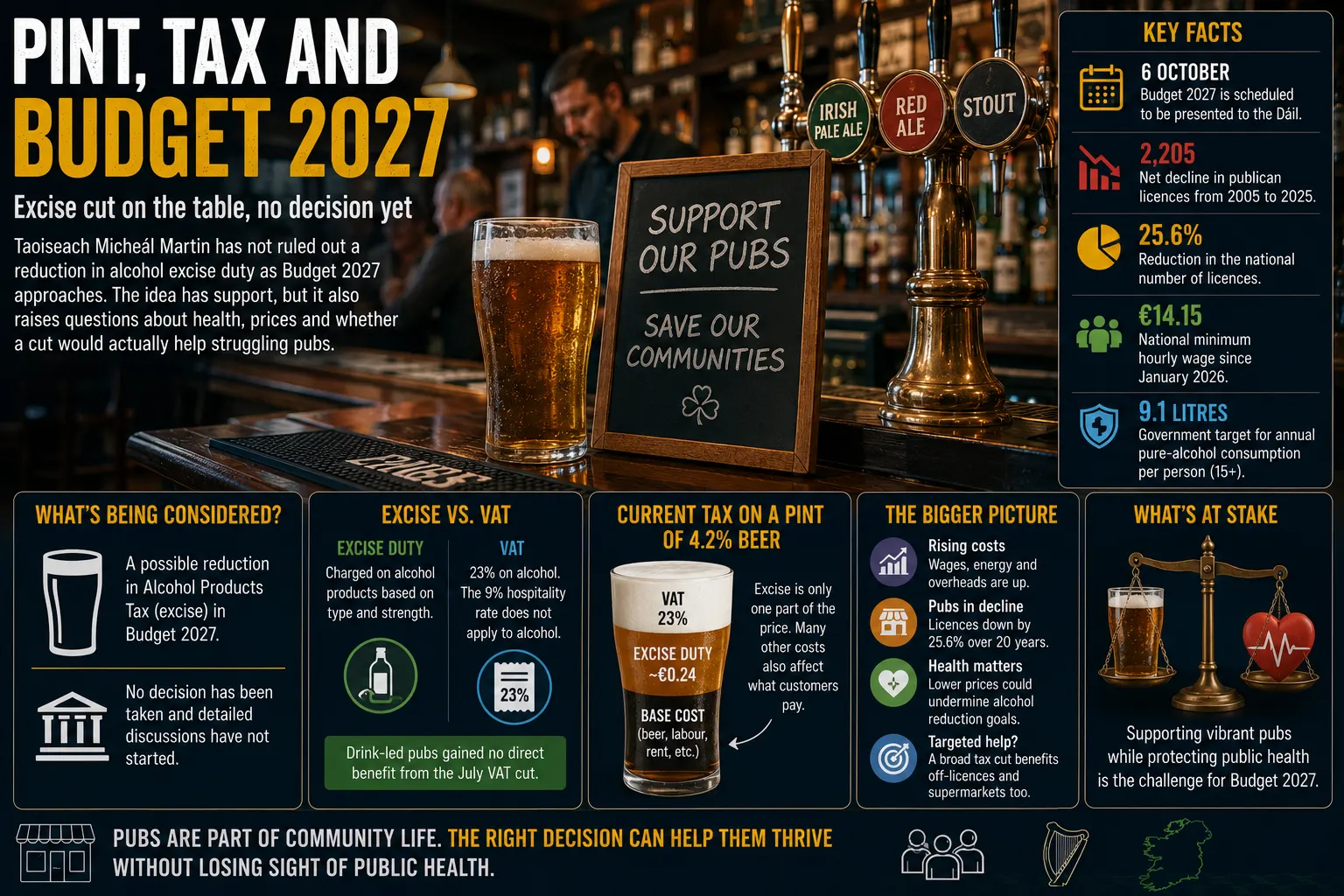
6 October: Budget 2027 is scheduled to be presented to the Dáil.
2,205: net decline in publican licences between 2005 and 2025.
25.6%: reduction in the national number of publican licences over those two decades.
€14.15: national minimum hourly wage since January 2026.
9.1 litres: Government public-health target for annual pure-alcohol consumption per person aged 15 and over.
What Micheál Martin Actually Said
The most important point at this stage is that an excise reduction has not been agreed. Martin said ministers had discussed broad taxation questions in advance of the Budget but had not yet moved into detailed discussions on alcohol excise. Asked about possible support for the sector, he said Government would examine different sectors in the round and consider whether other mechanisms could help them.
His comments followed reports that Minister for Enterprise Peter Burke is supportive of an excise reduction, particularly as a measure for rural pubs. Burke’s interest reflects a specific gap in the support provided through Budget 2026. From 1 July this year, VAT on restaurant and catering services was reduced from 13.5% to 9%, but alcoholic drinks remain subject to the standard 23% VAT rate.
A restaurant or food-led pub therefore benefits more directly from the VAT measure than a traditional premises deriving most of its revenue from beer, wine and spirits. That difference is especially relevant in smaller towns and rural areas where some pubs have limited or no food business. An excise reduction has consequently emerged as one possible way of reaching a part of the hospitality sector that the VAT change largely bypassed.
Martin nevertheless introduced another question into the debate: whether lower tax would translate into lower prices for customers. He pointed to increases in the price of a pint by the industry itself and indicated that the Government would have to consider the sector’s position in its entirety. That issue is central because a tax reduction can increase a business’s margin, reduce a consumer’s price or be divided between the two depending on how producers, wholesalers and retailers respond.
Excise and VAT Are Two Different Taxes
The terminology can obscure what is actually being discussed. Ireland’s Alcohol Products Tax is an excise duty charged when alcohol products are released for consumption in the State. The amount depends on the category of drink and, for products such as beer and spirits, its alcoholic strength.
Beer above 2.8% alcohol by volume is currently taxed at €22.55 per hectolitre for every percentage point of alcoholic strength. Spirits are taxed at €42.57 for each litre of pure alcohol. Still wine between 5.5% and 15% alcohol is taxed at €424.84 per hectolitre of finished product. These duties are embedded in the cost of the drink before it reaches the customer.
VAT is separate. Alcohol is subject to Ireland’s standard 23% VAT rate. The new 9% hospitality rate applies to qualifying restaurant and catering supplies but expressly excludes alcohol, as well as soft drinks and bottled water. A publican consequently pays into a tax structure that combines product-specific excise with VAT on the final taxable sale.
Current Tax Treatment of Selected Alcohol Products
| Product | Alcohol Products Tax | VAT |
|---|---|---|
| Beer above 2.8% ABV | €22.55 per hl per % ABV | 23% |
| Still wine, 5.5%–15% | €424.84 per hl | 23% |
| Spirits | €42.57 per litre of pure alcohol | 23% |
| Qualifying restaurant food | No alcohol excise | 9% |
Source: Revenue Commissioners. Rates shown are those applying in 2026.
A 10% Excise Cut Would Not Mean a 10% Cheaper Pint
The distinction matters when assessing the proposal being promoted by the drinks industry. The Drinks Industry Group of Ireland is seeking a 10% reduction in alcohol excise in Budget 2027. A 10% reduction in the tax does not mean the retail price of beer falls by 10%, because excise represents only one component of the final price.
Consider a representative 568ml pint of beer at 4.3% alcohol by volume. Applying Revenue’s current beer duty produces an excise component of approximately 55 cent. A 10% cut in the excise rate would therefore reduce that component by roughly 5.5 cent. If every cent of the tax reduction were passed through and the associated VAT saving were also reflected in the price, the theoretical consumer reduction would be around 7 cent.
This is an illustrative calculation, not a forecast of future pint prices. It assumes a 568ml pint at 4.3% ABV, a 10% reduction in the current excise rate and complete pass-through of the tax saving. Actual pricing would remain a commercial decision and would vary by product and premises.
Seven cent can still matter to a business selling large volumes over a year, particularly where margins are narrow. But the example shows why an excise cut should not be presented as a mechanism that would automatically reverse the much larger increases consumers have seen in pub prices over recent years. Nor can Government guarantee that the saving would reach drinkers rather than being retained elsewhere in the supply chain.
The opposite argument is also important. Publicans seeking relief are not necessarily asking for the entire saving to be passed through. If the purpose of the policy is to improve business viability, preserving part of the reduction as margin may be exactly what supporters intend. That creates a choice about the objective: is the measure principally supposed to reduce the cost of a pint for consumers or reduce the cost base of the business selling it?
An Excise Cut Is Not Naturally Targeted at Rural Pubs
There is another structural problem with using excise as a rural-pub support. Alcohol Products Tax is levied on the alcohol product when it is released for consumption, not as a special tax collected only when somebody orders a drink in a licensed premises. A conventional reduction in the national rate would therefore benefit qualifying alcohol entering both the on-trade and off-trade markets.
A bottle of spirits sold in a supermarket and a comparable bottle ultimately poured into measures behind a pub counter are subject to the same underlying excise framework. European excise rules allow certain differentiated rates for categories such as low-strength products and independent small producers, but the system is fundamentally based on the product rather than whether it is later consumed at home or in a pub.
That does not make an excise reduction ineffective. It does mean that part of its fiscal cost would support alcohol sold outside pubs. If the Government’s precise objective is preserving small rural licensed premises, a more targeted business measure could theoretically direct a greater proportion of each euro of support towards those businesses.
Targeting creates complications of its own. Government would have to decide which premises qualify, how rurality or vulnerability is defined, whether profitable businesses should receive the same support and how any scheme complies with State-aid and taxation rules. Broad tax reductions are administratively simpler partly because they do not attempt to answer those questions.
The Pub Decline Is Large — but the Number Needs Careful Interpretation
The political momentum behind the proposal has been strengthened by a report published at the end of August showing a 20-year decline in publican licences. The study, commissioned by the Drinks Industry Group of Ireland and prepared by economist Anthony Foley, uses the Revenue licence register analysed by the Vintners Federation of Ireland.
The national total fell from 8,617 licences in 2005 to 6,412 in 2025. That is a net reduction of 2,205, or 25.6%, equivalent to an average net decline of about 110 licences for every year in the period. The geographical distribution is striking: Dublin recorded a decline of just 1.1%, meaning virtually the entire national reduction occurred elsewhere.
The figures are strong evidence that Ireland has substantially fewer publican licences than it did 20 years ago. They should not, however, be treated as a survey proving why 2,205 individual businesses closed. A net licence count records the difference between the number of licences at two points in time; it does not establish a single cause for every licence that disappeared, nor does it capture every opening and closure that occurred in between.
The report itself identifies a combination of changing consumer behaviour, higher business costs and taxation as important pressures. The influence of those factors varies from premises to premises. A village pub serving a small population operates under a very different business model from a high-volume city-centre venue.
Where the Long-Term Pub Decline Has Been Deepest
| County | Change in publican licences, 2005–2025 |
|---|---|
| Limerick | -40.2% |
| Offaly | -34.1% |
| Monaghan | -33.9% |
| Tipperary | -33.5% |
| Cork | -32.8% |
| Roscommon | -32.7% |
| Dublin | -1.1% |
Source: The Decline in the Number of Public Houses 2005 to 2025, commissioned by the Drinks Industry Group of Ireland and based on Revenue licence data.
Rural Ireland Has Taken Almost All of the Decline
The regional pattern explains why the debate is about more than hospitality-sector profitability. Limerick’s publican licence total fell by 40.2% over the two decades. Offaly, Monaghan, Tipperary, Cork, Roscommon, Laois, Longford and Clare all recorded declines of more than 30%. Dublin, by contrast, was almost unchanged on the same measure.
Rural pubs often operate with smaller potential customer bases, fewer tourists and less passing trade than major urban venues. Population density affects how many customers can realistically reach a premises, while stricter drink-driving norms and changing attitudes towards drinking and driving have changed the economics of travelling to a pub in places without frequent public transport.
Demographic and social changes also matter. Entertainment has become more diverse, younger people drink differently from previous generations and alcohol bought from supermarkets or consumed at home competes with the licensed trade. The growth of zero-alcohol products adds another change to the traditional model, although pubs can also benefit from that expanding market.
The community role of a pub can nevertheless exceed its direct economic output. In smaller villages it may provide one of the few remaining informal meeting places after the loss of shops, post offices, bank branches and other services. That social function is difficult to put into a tax model, but it helps explain why a rural pub closure can generate political concern out of proportion to the number of jobs directly involved.
The Industry’s Own Forecast Is a Scenario, Not an Official Prediction
The DIGI-commissioned report estimates that another 600 to 1,000 pubs could disappear over the next decade under its projected scenarios. The figures have attracted attention because they imply that the long decline could continue well into the 2030s.
They should be described accurately. The projection is not a Government, Revenue or CSO forecast. It comes from research commissioned by an industry organisation that is simultaneously campaigning for lower alcohol excise. That does not invalidate the analysis, but its assumptions and institutional context matter when assessing the result.
Actual numbers will depend on factors that cannot be known with certainty: population growth, tourism, household income, wages, energy prices, changing alcohol consumption, business succession, rural transport and future taxation. Policy itself can change those outcomes.
There is also evidence that the surviving bar sector is not experiencing a uniform collapse in demand. The CSO’s latest Retail Sales Index showed the volume of bar sales in July 2026 running 4.1% above July 2025, while the value of sales was 6.2% higher. A positive month or year does not reverse the 20-year contraction in licences, but it demonstrates why national averages should not be interpreted as though every pub is following the same trajectory.
Labour Has Become One of Hospitality’s Biggest Cost Pressures
Tax is only one component of a pub’s finances. Labour is particularly important because hospitality is service-intensive: pouring drinks, serving customers, cleaning premises and providing security cannot be automated to the same extent as some other activities. A pub must also staff evening and weekend periods when customer numbers can be uncertain.
The national minimum wage increased by 65 cent to €14.15 an hour on 1 January 2026, a rise of 4.8%. That is an income gain for low-paid employees and a deliberate labour-market policy, but it also raises payroll costs for employers with large numbers of workers close to the statutory rate.
Broader CSO figures show average weekly earnings in accommodation and food services rising by 7.7% in the year to the second quarter of 2026, from €470.59 to €506.78. Average hourly total labour costs in the sector were €20.27. These statistics cover accommodation and food service activities generally rather than pubs alone, but they illustrate the wage environment in which licensed premises are operating.
Energy, insurance, maintenance, security, food inputs and regulatory compliance add further costs. The impact is not identical across businesses. A debt-free family pub in its own building has a different cost structure from a leased city venue with a large payroll and substantial food operation.
The 9% VAT Rate Created Winners and Gaps
Budget 2026 attempted to relieve some of those pressures by restoring the 9% VAT rate for qualifying food and catering services from July 2026. Government presented the measure as support for labour-intensive hospitality businesses facing rising costs and competitiveness pressures.
Its design inevitably produced different effects within the pub sector. A premises with a substantial lunch and dinner trade benefits from the lower VAT rate on qualifying food. A small rural pub that sells almost nothing except drinks receives little direct benefit because alcoholic beverages remain at 23%.
That is the strongest economic argument for reopening the tax discussion so soon after a substantial hospitality measure has already taken effect. The Government can say it has supported hospitality generally, while drink-focused publicans can reasonably respond that the principal product they sell was explicitly excluded.
The policy question is whether alcohol excise is the right instrument to correct that imbalance. Cutting the tax is straightforward and reaches every sale of the affected products. But precisely because it is broad, the benefit is not limited to the businesses that missed out on the VAT change.
Public Health Policy Pulls in the Opposite Direction
Ireland’s alcohol policy is not designed solely around raising revenue. The Public Health Alcohol Act 2018 established reducing consumption and alcohol-related harm as explicit State objectives. Government policy seeks to bring annual consumption down to 9.1 litres of pure alcohol per person aged 15 and over, delay drinking among younger people and regulate the availability, promotion and price of alcohol.
The policy framework includes minimum unit pricing, advertising restrictions, structural separation of alcohol in mixed retail premises and health-information requirements. Minimum unit pricing has been in operation since January 2022 and prevents alcohol being sold below a floor calculated from its alcohol content.
Consumption has been moving downward over the longer term. The Department of Health’s latest Key Trends report says per-capita annual alcohol consumption declined by 12.2% between 2015 and 2024. The 2025 Healthy Ireland Survey found that 71% of people aged 15 and over had consumed alcohol during the previous 12 months, down from 73% in 2024, while 35% reported drinking at least weekly.
The same survey found that 26% reported binge drinking on a typical drinking occasion. The national trend is therefore not simply one of declining consumption and a solved public-health problem. Average consumption has fallen while patterns associated with higher risk remain significant among parts of the population.
Why Health Authorities Care About the Price of Alcohol
The public-health objection to lower excise rests on an extensively studied relationship between price and consumption. The World Health Organization describes alcohol taxation as one of the most cost-effective measures available to reduce alcohol-related disease and injury. Its evidence base finds that, other factors being equal, higher alcohol prices reduce consumption while lower prices tend to increase it.
That does not mean a small Irish excise reduction would produce an easily predictable increase in drinking. The size of the effect would depend on how much of the tax reduction reaches retail prices, which products are affected, household incomes, minimum unit pricing and consumer behaviour. If pubs kept the saving as additional margin rather than lowering prices, the direct public-health effect through affordability would be smaller.
Alcohol Action Ireland has taken the opposite position to the drinks industry in advance of Budget 2027. It is calling for excise rates to rise by at least 15%, arguing that nominal rates have been unchanged for years and that inflation has reduced their real value. The organisation views higher taxation as both a health intervention and a way to recover part of the public costs associated with alcohol-related harm.
The contrast illustrates the core policy dispute. Publicans tend to view excise as a cost placed on a difficult business environment. Public-health organisations view that same tax partly as a deliberate mechanism for maintaining the price of a harmful product. Both assessments can be internally consistent because they are measuring different outcomes.
12.2% decline in per-capita alcohol consumption was recorded between 2015 and 2024, according to the Department of Health’s latest Key Trends report.
Minimum Unit Pricing Does Not Resolve the Pub Question
It might appear that Ireland could reduce excise while relying on minimum unit pricing to preserve public-health safeguards. In practice, the two mechanisms operate differently. Minimum unit pricing establishes the lowest legal selling price according to the quantity of pure alcohol in a product. It mainly affects cheap, high-strength alcohol sold in the off-trade.
Typical pub prices sit far above the statutory minimum. A reduction in excise could therefore be passed through at a pub without minimum unit pricing preventing it. At the cheapest end of the off-trade market, by contrast, a product already sitting on its legal minimum price could not fall further simply because its underlying tax cost had declined.
That creates a potentially unusual distribution of the benefit. For alcohol constrained by minimum pricing, part of a tax reduction could increase commercial margin unless the statutory floor also changed. For more expensive products and most on-trade drinks, businesses would have greater freedom to decide whether to lower the retail price.
The interaction means Government cannot assume that excise, VAT and minimum unit pricing are interchangeable instruments. They affect different parts of the market and pursue different policy objectives.
The State Also Has to Count the Revenue It Gives Up
Budget 2027 has a defined fiscal envelope. The Government’s Summer Economic Statement provides for an overall package of €8.5 billion, including €1.5 billion in new taxation measures and €7 billion in additional spending. The Budget will be presented on 6 October.
An alcohol excise reduction would therefore compete with personal income-tax changes and other proposed reliefs for a finite amount of fiscal capacity. The direct cost would depend on the percentage reduction, the products included and how consumption responds. Revenue’s pre-Budget Ready Reckoner demonstrates that even changes measured in cents per drink can have full-year Exchequer effects running into tens of millions of euro.
The calculation is also more complex than simply multiplying the current excise yield by the percentage cut. Lower duty alters the VAT base, consumer behaviour can change and producers or retailers can alter prices. Revenue itself cautions that its ready-reckoner estimates generally assume no behavioural change unless otherwise specified.
A tax reduction can generate indirect benefits if it preserves viable businesses and employment, but those effects are harder to estimate. A pub that remains open continues paying payroll taxes, VAT, commercial rates and other charges. The relevant fiscal question is therefore the net effect, not merely the immediate reduction in alcohol-duty receipts.
Tax Is Only One Reason a Pub Survives or Closes
The temptation in a budget debate is to search for a single lever capable of reversing the long decline. The evidence suggests the problem is too complex for that. Excise can affect margins and prices, but it cannot create customers in a village whose population has changed, solve the absence of late-night transport or provide a successor for an ageing publican who wants to retire.
Nor would a tax cut directly resolve labour shortages, insurance costs, energy efficiency or the fixed costs of maintaining an older building. It could improve the economics at the margin, and for a vulnerable business that margin may be important, but it would not remove the underlying structural changes in how and where people socialise.
The opposite argument also deserves caution. A decline in pub numbers is not automatically evidence that Ireland has too few pubs or that every closure should have been prevented. Markets change, consumer preferences evolve and some businesses cease to be viable. Public policy has to distinguish between normal economic restructuring and the loss of businesses that provide wider community value but cannot generate enough private revenue to reflect that value.
That distinction is particularly relevant in rural communities. If Government concludes that a small local pub provides social infrastructure analogous in some respects to a community facility, a broad national alcohol-tax cut may be a relatively imprecise way of supporting it.
The Consumer Has a Different Interest Again
For drinkers, the question is simpler: would a tax reduction make going to the pub meaningfully cheaper? The illustrative 4.3% pint calculation shows that a 10% excise reduction would create only a small amount of room for a retail price reduction. Pub prices are driven by far more than excise.
Staff wages, rent or property costs, utilities, insurance, supplier prices and the margin required to keep a business viable all sit inside the final price. VAT at 23% is then charged on the taxable sale. A reduction in one component can therefore be overwhelmed by increases in another.
This helps explain Martin’s caution about assuming a tax cut would be passed on. If a pub faces a new wage or supplier increase larger than the excise saving, its proprietor could reduce the tax burden and still raise the menu price. The observable fact would be a more expensive pint despite lower excise, without necessarily demonstrating that the publican had simply retained the tax saving as additional profit.
Equally, there would be no legal requirement under a conventional excise reduction for a publican to lower prices by a particular amount. The Government would be providing a reduction in tax, not administering the final selling price of a pint.
Lower Excise Could Help Producers as Well as Pubs
The debate also extends beyond licensed premises. Ireland has breweries, distilleries, cider makers and other drinks producers whose products are taxed through the same system. Smaller producers already benefit in some circumstances from specific excise reliefs allowed under Irish and European law.
A broad national cut could therefore affect producers, importers, wholesalers and retailers as the benefit moves through the supply chain. Exported products are treated differently from products released for consumption in Ireland, meaning the principal impact would concern the domestic market.
For indigenous drinks businesses, lower domestic tax could improve market conditions, but the commercial result would depend on contracts and pricing behaviour throughout distribution. Again, the headline rate change does not reveal who ultimately captures the economic benefit.
The Debate Is Really About Three Different Objectives
Much of the controversy arises because three policy objectives are being discussed as though they were one. The first is keeping socially important pubs open. The second is improving the competitiveness of the hospitality sector. The third is controlling alcohol consumption and the health harms associated with it.
An excise reduction can contribute to the first two by lowering the tax embedded in alcohol, but it can conflict with the third if it makes alcohol materially more affordable. A public-health tax increase works in the opposite direction. It strengthens the price signal but increases costs in a sector already arguing that its economics are difficult.
A targeted business support could theoretically separate the two questions by helping specific premises without reducing the tax on alcohol itself. But that would require new eligibility rules, administration and expenditure and could create disputes about which businesses deserve support.
There is no policy instrument that removes every trade-off. The Government’s task is to decide which objective it is trying to achieve and then choose the instrument that reaches it most directly.
Three Broad Budget Approaches
| Approach | Potential advantage | Principal trade-off |
|---|---|---|
| Reduce alcohol excise | Broad reduction in alcohol tax burden | Also benefits off-trade; weaker price signal |
| Keep current rates | Preserves revenue and health policy | No new tax relief for drink-led pubs |
| Target business support | Can focus on vulnerable premises | More complex and requires eligibility rules |
These are policy scenarios for explanation and do not represent announced Government decisions.
The Rural Transport Question Sits Behind the Tax Debate
One of the long-term changes affecting rural pubs cannot be addressed through the price of beer at all. Drinking and driving has become socially and legally unacceptable, as public policy intended. In places where evening public transport and taxis are scarce, that reduces the geographical area from which a pub can safely draw customers.
Improved rural transport can therefore function indirectly as pub support while serving much broader social objectives. Local Link and other rural transport expansion can enable people to socialise without driving, while also providing mobility for older people, workers and households without cars.
That does not mean transport policy can recreate the pub market of 2005. Social habits have changed independently of transport. But it demonstrates how the viability of a rural business can depend on infrastructure outside the business itself.
The same logic applies to rural population, tourism and housing. A pub in a growing town can absorb cost increases differently from one in a shrinking catchment area. National tax policy inevitably treats those businesses more similarly than their local economic conditions warrant.
Falling Alcohol Consumption Is Both a Public-Health Success and a Commercial Challenge
Ireland has spent years attempting to reduce harmful drinking. A long-term decline in per-capita consumption is therefore partly the intended outcome of public policy, not merely evidence of weakness in the drinks market. This creates an unavoidable tension when the State simultaneously seeks to preserve businesses whose principal product is alcohol.
The contradiction is less stark than it appears if pubs diversify. Food, coffee, live music, tourism, accommodation, community events and no- or low-alcohol products can reduce dependence on the volume of alcoholic drinks sold. The Healthy Ireland Survey found that a quarter of respondents consumed non-alcoholic beer, wine or spirits, illustrating the emergence of a market that barely existed at comparable scale a generation ago.
Not every pub can adopt the same model. A small traditional premises may lack a commercial kitchen, tourist demand or the floor space required for events. Policy designed around a diversified urban hospitality business can therefore fail to match the economics of a rural public house.
The industry’s challenge is ultimately to remain viable in a country that may continue drinking less alcohol per person. A tax cut could ease the transition, but it would not reverse that underlying social trend.
Budget 2027 Will Have to Decide Whether This Is a Tax Issue or a Rural-Business Issue
That may be the most important distinction before 6 October. If ministers conclude that alcohol taxation itself is excessive for the whole economy, a general excise reduction is logically consistent. It would lower the duty burden across beer, wine, spirits or whichever categories Government selects.
If the problem is defined more narrowly as the disappearance of small rural pubs, the case for a universal cut becomes less straightforward. Much of the benefit would necessarily flow to alcohol sold in places that are not at serious risk of closing, including large urban venues and the off-trade.
If the objective is primarily consumer affordability, Government would also have to consider whether a few cents of excise reduction is likely to alter the price people actually pay. A larger reduction would have a more visible consumer effect but would also carry a greater fiscal and public-health consequence.
And if the objective is hospitality competitiveness, policymakers must assess excise alongside wages, VAT, energy, insurance, commercial rates and regulation rather than treating one tax as the whole problem.
What Happens Next
The immediate political development is modest but important: alcohol excise has entered the range of measures that may be considered for Budget 2027. Martin has not endorsed a reduction, but neither has he closed the door. Burke’s support gives the proposal an advocate within Cabinet, while publicans and drinks-industry organisations are intensifying their campaign.
Public-health organisations will push in the opposite direction. Their argument is strengthened by Ireland’s existing statutory policy, which treats alcohol price as part of an integrated strategy to reduce consumption and harm. International health authorities similarly support taxation as an evidence-based intervention.
The Department of Finance will have to evaluate another question altogether: cost and effectiveness. A tax change has to fit inside the Budget’s fiscal parameters and compete with other measures. Officials will also need to assess whether a broad excise reduction delivers sufficient economic benefit to justify revenue that could otherwise fund targeted business relief or public services.
There is therefore a substantial distance between the Taoiseach refusing to rule out a tax cut and a lower excise rate appearing in the Finance Bill. The next month will determine whether the proposal survives that scrutiny.
The Pub Debate Cannot Be Reduced to the Price of a Pint
The decline from 8,617 to 6,412 publican licences is too large to dismiss, and its concentration in rural Ireland raises legitimate questions about the future of community businesses. At the same time, the evidence does not support the conclusion that alcohol taxation alone produced that decline. Population patterns, changing consumer behaviour, labour costs, transport, the pandemic and the economics of small hospitality businesses have all contributed to the environment in which pubs operate.
Public-health policy also has evidence on its side. Alcohol consumption has fallen over the past decade, but risky drinking remains present and Government has deliberately used price regulation as part of its response. Lowering excise would represent at least a partial change in the direction of that policy, even if the resulting retail price movement were small.
The strongest case for any Budget measure will therefore depend on precision. If Government wants to keep vulnerable rural pubs alive because they provide social and economic value beyond the drinks they sell, it should assess whether a general alcohol-tax reduction is the most direct way to achieve that goal. If it chooses excise, it should be clear about who benefits, what it costs and whether lower prices are actually expected.
Budget 2027 will not determine the future of the Irish pub on its own. But the decision will reveal how Government now weighs three interests that increasingly pull against one another: preserving local businesses, protecting public revenue and maintaining a health policy built partly on making alcohol less affordable rather than more so.
Sources
RTÉ News — Taoiseach Not Ruling Out Cutting Excise on Alcohol as Part of Budget
The Irish Times — Taoiseach Does Not Rule Out Cutting Excise on Alcohol in Budget
Revenue Commissioners — Alcohol Products Tax Rates
Revenue Commissioners — VAT Treatment of Food, Drink and Alcohol Products
Revenue Commissioners — Pre-Budget 2027 Ready Reckoner
HRB National Drugs Library — The Decline in the Number of Public Houses 2005 to 2025
Central Statistics Office — Earnings and Labour Costs, Q2 2026
Central Statistics Office — Retail Sales Index, July 2026
Department of Health — Health in Ireland: Key Trends 2025
Healthy Ireland — Healthy Ireland Survey 2025
World Health Organization — Alcohol Taxation and Public Health
Department of Finance — Budget 2027 and the National Economic Dialogue
Source & Transparency
This article is published by Ireland Newspaper for editorial and informational purposes.
Published: 3 September 2026 · Updated: 3 September 2026

Newsroom Ireland Newspaper
Ireland Newspaper editorial team prepares daily news coverage for readers in Ireland and abroad.