
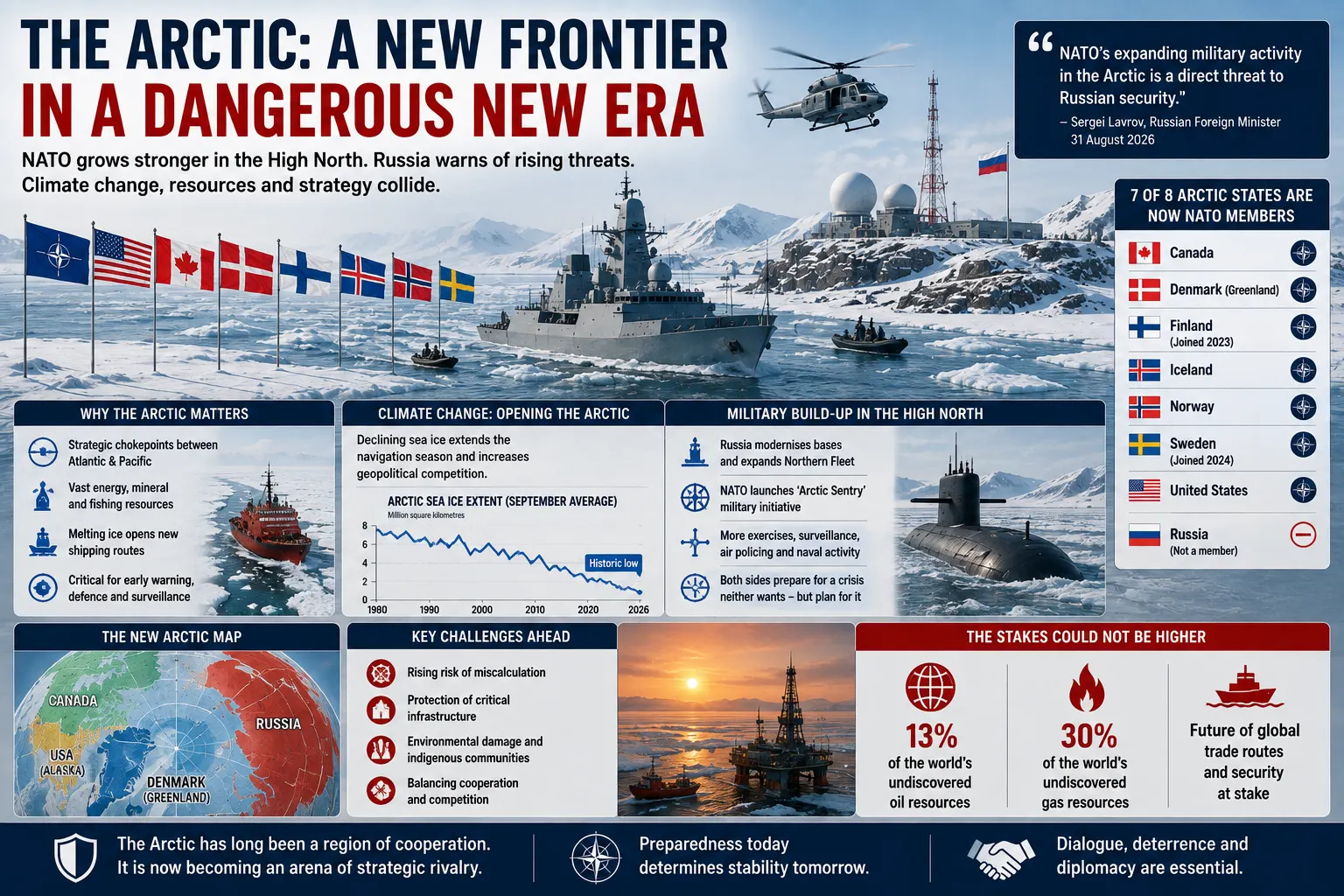
Seven of the eight countries with territory inside the Arctic are now NATO members. The eighth is Russia. That simple geographical fact, created when Finland and Sweden abandoned longstanding military non-alignment after Russia’s full-scale invasion of Ukraine, has transformed the strategic map of the High North. On 31 August 2026, Russian Foreign Minister Sergei Lavrov described NATO’s expanding military activity in the region as a direct threat to Russian security, warning that the growth of exercises and deployments increased the risk of a confrontation whose consequences could be exceptionally severe.
NATO presents the same development from almost the opposite perspective. The Alliance says Russia has reopened and modernised Arctic bases, expanded military infrastructure and maintained some of its most important nuclear forces on the Kola Peninsula, while China is increasing its economic and strategic activity in cooperation with Moscow. In February, NATO launched Arctic Sentry, bringing exercises, surveillance, air policing, naval activity and national Arctic operations into a more coherent military framework. Neither development means that conflict in the Arctic is inevitable, and NATO said as recently as 30 August that it saw no imminent threat of a direct attack against the Alliance. The more important change is that both sides increasingly plan for the possibility that a region once associated with exceptional international cooperation could become part of a wider Russia-NATO confrontation.
The military competition is only one layer of the transformation. Arctic sea ice has declined substantially over recent decades, lengthening seasonal navigation opportunities along Russia’s Northern Sea Route. Moscow is redirecting energy exports towards Asia, China is using Arctic routes and purchasing sanctioned Russian liquefied natural gas, and South Korea has begun testing commercial Arctic shipping. At the same time, oil, gas, minerals, communications infrastructure and strategically important passages connecting the Atlantic and Pacific are increasing the economic value attached to the region.
The resulting contest is not simply a race for territory. Most Arctic land and maritime jurisdictions are already governed by national sovereignty and international law. The strategic question is increasingly about access: who can detect aircraft and submarines, protect shipping and undersea infrastructure, reinforce northern territory, operate despite ice and extreme weather and maintain sea routes between North America, Europe and the Pacific during a crisis.
The Arctic’s Security Map Changed After 2022
For much of the post-Cold War period, the Arctic was deliberately treated as an area where practical cooperation could continue despite disagreements elsewhere. Russia worked with the United States, Canada and Nordic countries through the Arctic Council on environmental protection, scientific research, search and rescue and sustainable development. Military security was deliberately excluded from the Council’s mandate, helping to insulate many civilian issues from broader geopolitical rivalry.
Russia’s full-scale invasion of Ukraine in February 2022 fundamentally altered that arrangement. The other seven Arctic states suspended much high-level cooperation with Moscow, although scientific and working-level Arctic Council activities have subsequently resumed in limited virtual formats. Political-level meetings remain paused. The Council’s 2026 leadership has stressed that diplomatic channels remain open, but it is operating in a markedly more difficult strategic environment.
The largest structural change came from Finland and Sweden. Finland joined NATO in April 2023 and Sweden followed in March 2024. Finland brought a 1,340-kilometre land border with Russia into the Alliance, while Sweden connected NATO territory more completely across Scandinavia and strengthened access between the Baltic Sea, Norway and the Arctic approaches.
The result is an Arctic political geography dominated numerically by NATO: Canada, Denmark through Greenland, Finland, Iceland, Norway, Sweden and the United States are all members. Russia remains the only Arctic state outside the Alliance and possesses by far the longest Arctic coastline. That asymmetry helps explain why the same NATO integration described in Western capitals as defensive appears much more threatening when viewed from Moscow.
The Eight Arctic States
| Arctic State | NATO Status | Strategic Importance |
|---|---|---|
| Russia | Not a member | Largest Arctic coastline, Northern Fleet and major energy resources |
| United States | Member | Alaska, missile defence and North American defence |
| Canada | Member | Arctic archipelago, NORAD and Northwest Passage |
| Denmark | Member | Greenland and North Atlantic access |
| Norway | Member | Direct Russian border and gateway to Barents Sea |
| Finland | Member since 2023 | Long Russian border and northern land operations |
| Sweden | Member since 2024 | Air, naval and logistical integration of Nordic region |
| Iceland | Member | North Atlantic air and maritime surveillance position |
Sources: NATO, Arctic Council and national defence authorities.
Russia’s Most Important Arctic Assets Are Connected to Nuclear Deterrence
The Arctic matters to Russia for reasons considerably more serious than oil exploration or commercial shipping. The Kola Peninsula in north-western Russia is home to the Northern Fleet and a large part of the country’s nuclear second-strike capability — the forces designed to survive an enemy nuclear attack and retaliate afterwards.
According to data cited by Reuters from the International Institute for Strategic Studies, the Northern Fleet operates six of Russia’s twelve nuclear-armed ballistic-missile submarines. Independent security assessments cited by Reuters estimate that roughly two-thirds of Russia’s second-strike nuclear capabilities are associated with the wider Kola region. Russia also maintains important airfields, naval bases, radar installations and missile infrastructure across its Arctic territory.
Moscow has been rebuilding that network for years. Since approximately 2005, Russia has reopened or modernised dozens of Soviet-era military facilities along its northern mainland and Arctic islands. These include airfields, deep-water ports, radar and air-defence installations. Novaya Zemlya remains an important military testing area and the location from which Russia has tested advanced weapons, including the nuclear-powered Burevestnik cruise missile.
The strategic geography makes the Barents Sea particularly sensitive. Northern Fleet submarines and surface vessels based around the Kola Peninsula must pass through waters between northern Norway, Svalbard and the wider North Atlantic approaches if they are to operate farther west. NATO’s ability to monitor that movement is important to the Alliance; Russia’s ability to keep those approaches accessible is equally important to Moscow.
That creates a classic security dilemma. NATO surveillance intended to track Russian submarines can be interpreted by Moscow as an effort to threaten its strategic deterrent. Russian efforts to protect those submarines can require stronger naval, air and missile forces close to NATO territory. Each side can therefore view an action described as defensive by the other as a reason to strengthen its own military position.
Russia Has Continued Building in the North Despite the War in Ukraine
The scale of Russia’s war in Ukraine has consumed enormous military resources, but Norwegian officials say Moscow has continued strengthening important capabilities around the Kola Peninsula. Norway’s Defence Minister Tore Sandvik said in January that Russia was increasing the availability of frigates and submarines to its Northern Fleet despite military and economic pressures elsewhere.
This does not mean that Russia currently possesses spare capacity for a large conventional Arctic war. Norwegian authorities and Finnish President Alexander Stubb have both argued that Moscow’s continuing commitment of forces to Ukraine substantially limits its ability to open another major front. NATO likewise said on 30 August that it saw no imminent threat of attack against Alliance territory.
There is nevertheless an important difference between immediate capability and long-term military planning. Submarine bases, runways, radars, ports and missile installations can remain strategically relevant for decades. Governments therefore plan around what an adversary may be able to do in several years rather than only around forces available today.
The war in Ukraine has also demonstrated the growing importance of long-range drones, missiles, satellite communications and attacks on infrastructure far behind conventional front lines. These lessons are increasingly relevant to Arctic defence because bases separated by hundreds or thousands of kilometres may still be vulnerable to precision weapons, while the region’s limited roads and ports make replacing damaged infrastructure unusually difficult.
NATO’s Answer Is Arctic Sentry
NATO’s most significant institutional response came in February 2026 with the launch of Arctic Sentry. Rather than creating an entirely separate permanent Arctic army, the initiative places existing national deployments, exercises and Alliance capabilities inside a more integrated operational framework led by NATO’s Joint Force Command Norfolk.
Its purpose is partly organisational. Arctic countries already operated fighter aircraft, submarines, radars, military bases and cold-weather forces before Arctic Sentry existed. NATO now wants planners to see those activities as part of one connected theatre extending from North America through Greenland and Iceland to Scandinavia and the Russian border.
The structure coordinates with the North American Aerospace Defense Command, US Northern Command and US European Command. That is strategically significant because threats approaching across the Arctic do not respect the traditional administrative boundary separating continental North American defence from European defence.
NATO says the activity is defensive and intended to protect Allied territory, maintain access across the North Atlantic and improve its ability to operate in extreme northern conditions. Russia disputes the benign interpretation. Lavrov said on 31 August that the Alliance’s expanding military activity represented a direct threat to Russia and warned against transforming the Arctic into an arena of confrontation.
Cold Response Demonstrated the New Nordic Military Geography
The practical scale of NATO’s new posture became visible during Cold Response 2026. More than 32,000 personnel from 14 Allied countries participated in the exercise in northern Norway and Finland during March, according to NATO. Approximately 25,000 operated in Norway and 7,000 in Finland.
The location mattered as much as the numbers. Finnish territory now allows NATO armies to exercise east of Sweden and close to Russia’s northern border, while Norway provides access towards the Norwegian and Barents seas. Swedish territory and airspace connect those theatres more effectively than before Stockholm joined the Alliance.
The exercises tested more than combat. Norway designated 2026 as a year of “total defence”, integrating hospitals, civilian authorities, transport networks and businesses into preparations for a major crisis. One scenario involved managing large numbers of wounded soldiers arriving from an imagined front in Finland.
Arctic warfare creates unusual logistical demands. Vehicles, batteries, communications equipment and weapons must function in extreme cold. Long distances create dependence on a small number of roads, railways, airfields and ports. Reinforcing northern Norway or Finland during conflict could therefore depend as heavily on civilian infrastructure as on frontline military units.
NATO’s Expanding Arctic Posture in 2026
| Activity | Development | Purpose |
|---|---|---|
| Arctic Sentry | Launched February 2026 | Integrates Arctic and High North military activities |
| Cold Response 26 | More than 32,000 personnel | Tests reinforcement and Arctic warfare |
| Task Force X-Arctic | Launched June 2026 | Tests autonomous surveillance systems |
| Forward Land Forces Finland | Established June 2026 | Strengthens northern and eastern land defence |
| Iceland Air Policing | Swedish Gripens deployed in 2026 | Protects strategically important North Atlantic airspace |
Source: NATO, 2026.
Surveillance May Be More Important Than Troop Numbers
The geography of the Arctic makes knowing what is happening across enormous distances unusually difficult. Much of the region is sparsely populated, satellite coverage has historically been less comprehensive than at lower latitudes and conventional ground-based radar is limited by the curvature of the Earth.
This is why NATO is investing heavily in sensors rather than simply deploying more soldiers. Task Force X-Arctic, launched in June, is testing networks of uncrewed maritime and aerial systems capable of providing persistent surveillance across the North Atlantic and High North. NATO says the project will combine autonomous technologies with human command to identify potentially threatening activity more rapidly.
Canada is making an even larger investment. Ottawa has committed more than C$6 billion to its Arctic Over-the-Horizon Radar programme as part of the broader modernisation of NORAD. The system uses radar signals refracted through the ionosphere to detect targets beyond the normal radar horizon and is intended to improve warning of aircraft and maritime threats approaching North America from northern directions.
Canada formalised an acquisition partnership with Australia in June 2026 and expects an initial capability by December 2029. Its wider NORAD modernisation programme involves C$38.6 billion of investment over two decades, including space systems, command networks and northern infrastructure.
The emphasis reflects a change in strategic technology. During much of the Cold War, northern warning networks were designed primarily around bombers and ballistic missiles. Modern systems must also consider low-flying cruise missiles, hypersonic weapons, drones, submarines and potential attacks on communications infrastructure.
Greenland Sits at the Centre of North American and European Defence
Greenland’s importance comes from location rather than population. The enormous autonomous territory within the Kingdom of Denmark lies between North America and Europe and below approaches used by missiles, satellites and aircraft crossing polar routes. The United States has operated military facilities there since the Second World War and today maintains Pituffik Space Base in north-western Greenland.
Pituffik supports missile warning, space surveillance and satellite operations. Its position makes Greenland relevant to both existing North American defence and proposed future missile-defence architecture. Denmark simultaneously operates its Joint Arctic Command from Greenland and has substantially increased spending on ships, surveillance and other Arctic capabilities.
The issue became unusually politically sensitive in early 2026 because US President Donald Trump renewed demands for greater American control over Greenland. Denmark and Greenland rejected any transfer of sovereignty. NATO subsequently focused its discussions on increasing Arctic defence through Alliance cooperation rather than changing territorial ownership.
The disagreement itself demonstrated another feature of Arctic geopolitics: strategic competition can create tensions inside NATO as well as between NATO and Russia. Western governments agree broadly that Arctic surveillance needs to improve but do not always agree on sovereignty, investment, military basing or how responsibility should be divided between the United States and European allies.
The Arctic Connects Directly to the North Atlantic
The region’s importance cannot be understood by looking only at maps centred on the North Pole. Northern waters connect the Atlantic and Pacific and sit beside some of the routes required to reinforce Europe from North America during a war.
The waters between Greenland, Iceland and the United Kingdom have historically formed an important anti-submarine corridor commonly known as the GIUK gap. Russian submarines leaving the Barents Sea for the broader North Atlantic may need to pass through or close to areas monitored by NATO aircraft, ships and undersea sensors.
Iceland therefore has strategic importance disproportionate to its population. It possesses no standing military but hosts rotating NATO fighter deployments at Keflavik and provides an important location for maritime and air surveillance. Swedish Gripen fighters led an Icelandic air-policing rotation during 2026 as part of the wider Arctic Sentry framework.
On 31 August, Iceland’s government said it would seek deeper security partnerships with countries including Finland, Norway and Canada after voters rejected reopening negotiations to join the European Union. The announcement reflected a wider Nordic trend: national defence structures that were once comparatively separate are increasingly becoming interconnected.
The Northern Sea Route Is Becoming an Economic and Strategic Corridor
Russia’s Northern Sea Route follows the country’s Siberian Arctic coast between the Barents Sea approaches in the west and the Bering Strait in the east. Under favourable conditions, it can significantly shorten voyages between northern Asian and European ports compared with routes through the Suez Canal or around Africa.
The route remains seasonal and operationally demanding. Sea ice, rapidly changing weather, limited rescue infrastructure, specialised ship requirements and high insurance costs prevent it from functioning like the Suez route. Yet its commercial use is expanding, particularly for Russian energy exports and Chinese trade.
A Chinese container vessel completed a voyage from China to Britain through the Arctic in 2025 in approximately 20 days, roughly half the transit time associated with some conventional routes to Europe. In 2026, South Korea launched its first government-supported commercial Arctic trial, with a container ship carrying 837 TEU of cargo towards Britain, the Netherlands and Poland. Reuters reported that 103 transit voyages used the Arctic route during 2025, predominantly involving Russian and Chinese vessels.
For Russia, the strategic value has grown further because sanctions and wars have made other shipping corridors less reliable. Moscow wants the route to become part of a broader Trans-Arctic Transport Corridor connecting Siberian resources with Asian markets. Disruption to the Black Sea during 2026 has even led Russian exporters to examine Arctic routes for commodities not traditionally associated with northern shipping.
Commercial interest should nevertheless not be confused with an imminent replacement for Suez. Traffic remains tiny compared with the world’s established shipping arteries. Ice conditions vary significantly between years and the route remains geographically dominated by Russia, which controls navigation rules across its Northern Sea Route waters and provides much of the specialised icebreaker support.
Russian Oil Is Already Moving East Through the Arctic
Energy provides the strongest existing commercial justification for Arctic shipping. Reuters vessel-tracking data showed that by early August 2026, seven tankers had already carried approximately six million barrels of Russian crude to Asia through the Northern Sea Route. That was almost half the quantity shipped through the route during the entire 2025 season.
The voyage can shorten delivery to China by roughly two weeks compared with conventional routes, depending on origin, destination and ice conditions. This matters financially for sanctioned Russian exporters because shorter journeys reduce fuel use and tanker time while avoiding some congested or politically sensitive maritime chokepoints.
Russia’s planned Vostok Oil development could increase that role further if production grows as Moscow intends. The project is designed around large oil resources in northern Siberia connected to new terminals on the Arctic coast. Its eventual scale remains dependent on investment, sanctions, technology, infrastructure and global energy demand.
Russian gas is undergoing a similar eastward adjustment. Arctic LNG 2, a $21 billion project led by Novatek, has faced extensive Western sanctions but has increasingly found a market in China. Reuters reported in June that one Chinese terminal had received 41 cargoes totalling about 2.6 million tonnes from the project since August 2025, while China was preparing another terminal capable of receiving sanctioned Russian LNG.
This strengthens the link between Arctic development and Russia-China relations. Western sanctions reduce Russia’s access to traditional investors, shipping services and customers, creating stronger incentives to secure Chinese finance, technology and demand. China in turn gains access to energy and transport routes less dependent on maritime passages dominated by US allies.
China Is Not an Arctic State, but It Is Becoming an Arctic Power
China’s northernmost territory lies far south of the Arctic Circle, yet Beijing has described itself as a “near-Arctic state” and has steadily increased scientific, commercial and strategic engagement in the region. It is an observer in the Arctic Council and has invested in polar research, ice-capable shipping and resource relationships.
NATO increasingly treats this activity as a security consideration. Its current Arctic policy says China is seeking greater access to energy, critical minerals and sea lines of communication and argues that closer Russia-China cooperation has implications for Alliance defence planning.
Not every Chinese Arctic activity is military. Most visible cooperation involves commercial shipping, energy and research. There is also little evidence of a Chinese military presence comparable with Russia’s bases or NATO’s forces. Denmark’s Arctic commander said in January that there were no Russian or Chinese naval vessels operating close to Greenland at that time.
The strategic concern is therefore predominantly about the future. Civilian ports, satellites, telecommunications, research stations, mapping and commercial access can acquire military relevance during a crisis, particularly in remote regions where infrastructure is scarce. Western governments increasingly scrutinise Chinese investment in Arctic infrastructure for precisely this reason.
From Beijing’s perspective, Arctic diversification offers economic advantages. A usable northern shipping corridor can reduce dependence on the Strait of Malacca, Suez Canal and other maritime chokepoints. Russian energy also provides an overland and northern supply source less exposed to potential interdiction in the Indo-Pacific.
Climate Change Is Altering the Geography but Not Removing the Ice
The strategic transformation is occurring alongside rapid environmental change. Copernicus reported that average Arctic sea-ice extent in July 2026 was approximately 8.3 million square kilometres, about 9.6 per cent below the 1991–2020 July average and the sixth-lowest July value in the satellite record beginning in 1979.
Sea ice was particularly below average in the northern Barents Sea around Svalbard and Franz Josef Land, as well as parts of the Kara and Greenland seas. That matters to shipping because reduced seasonal ice can lengthen navigation windows along some routes and make areas accessible for longer periods.
But the phrase “opening Arctic” can be misleading. Ice remains a serious navigational hazard, particularly outside the late-summer season. Conditions can change quickly, multi-year ice can drift into shipping lanes and vessels may require ice-class construction or icebreaker assistance. Climate change makes Arctic navigation more feasible without making it easy or predictable.
It also creates new military difficulties. Thawing permafrost can damage roads, runways, pipelines and buildings. Coastal erosion threatens northern settlements and installations. Weather remains extreme, communications are difficult and search-and-rescue infrastructure is sparse. The military value of the Arctic may therefore increase at the same time that maintaining infrastructure there becomes more expensive.
Why the Arctic’s Economic Value Is Increasing
| Asset | Strategic Value | Important Constraint |
|---|---|---|
| Northern Sea Route | Shorter seasonal Europe-Asia voyages | Ice, insurance and Russian regulatory control |
| Oil and gas | Large Russian production and export potential | Sanctions, cost and environmental risk |
| Critical minerals | Inputs for defence and advanced technology | Remote deposits and expensive infrastructure |
| Greenland | Location, minerals and missile-warning geography | Infrastructure and political sovereignty |
| Undersea infrastructure | Communications and energy connectivity | Difficult monitoring and repair |
Sources: US Geological Survey, NATO, national governments and international shipping assessments.
The Arctic’s Resource Wealth Is Real but Frequently Exaggerated
The most widely cited estimate of Arctic petroleum resources remains the US Geological Survey’s Circum-Arctic Resource Appraisal. Published in 2008, it estimated that areas north of the Arctic Circle could contain about 90 billion barrels of undiscovered conventional oil, 1,669 trillion cubic feet of natural gas and 44 billion barrels of natural-gas liquids. Approximately 84 per cent of those estimated resources were offshore.
The age and meaning of that estimate matter. These were probabilistic estimates of technically recoverable resources that had not yet been discovered, not confirmed reserves ready for commercial production. Prices, technology, sanctions, environmental restrictions and infrastructure determine whether an identified resource is economically viable.
The assessment nevertheless remains useful for understanding geography. It estimated that the Arctic may contain around 13 per cent of the world’s undiscovered conventional oil and roughly 30 per cent of its undiscovered conventional natural gas, with much of the gas potential concentrated in Russian territory.
Minerals add another dimension. Greenland, northern Canada, Scandinavia and Russia contain deposits of materials relevant to batteries, renewable-energy systems, electronics and defence production. As Western countries attempt to reduce dependence on Chinese mineral processing, Arctic and sub-Arctic resources have acquired greater strategic visibility.
Extraction is rarely straightforward. Mines require ports, electricity, roads, workers and processing capacity, often in environments where construction is expensive. Indigenous rights and environmental impacts can also determine whether projects proceed. The existence of a deposit therefore does not automatically translate into geopolitical power.
Svalbard Is Strategically Sensitive but Governed by an Unusual Treaty
The Norwegian archipelago of Svalbard occupies a particularly sensitive position between mainland Norway and the North Pole. Norway exercises sovereignty under the 1920 Svalbard Treaty, while citizens and companies from other treaty parties receive specified rights of access and economic activity. The treaty also restricts certain military uses of the islands.
Russia maintains a long-established presence through the mining settlement of Barentsburg. Relations periodically become contentious over logistics, fisheries and Norway’s interpretation of its treaty responsibilities, but there is no present evidence that Moscow is preparing to seize the archipelago. Norway said earlier in 2026 that it did not consider an attack on Svalbard imminent.
Its geography nevertheless makes the islands strategically relevant. Svalbard lies close to routes between the Barents Sea and central Arctic Ocean and near operating areas important to Russia’s Northern Fleet. Military activity around the archipelago therefore attracts far greater attention than its small population might suggest.
The challenge for Norway is to maintain sovereignty and situational awareness while respecting the treaty framework and avoiding unnecessary escalation. This makes Svalbard an example of why Arctic governance cannot be reduced simply to conventional military deterrence.
Undersea Cables Are Becoming Part of the Security Debate
Modern economies depend on fibre-optic cables, energy pipelines and other infrastructure crossing northern seas. Damage can isolate communities, interrupt financial and communications traffic and complicate military operations. The series of suspicious cable and pipeline incidents in the Baltic Sea since 2022 has increased NATO’s concern that similarly vulnerable infrastructure exists farther north.
Attributing an underwater incident is difficult. Fishing vessels, anchors, natural events and technical failures can damage cables without hostile intent. NATO governments have also investigated suspected deliberate sabotage in European waters, while Russia has repeatedly rejected allegations that it conducts attacks against civilian infrastructure.
The uncertainty itself has strategic consequences. NATO’s Task Force X programmes use drones and sensors partly because maintaining persistent awareness across enormous maritime areas with crewed ships alone is expensive. Similar technologies are likely to become increasingly important for monitoring pipelines, cables and unusual vessel activity in the Arctic.
This creates another grey zone between peace and conventional war. Damage to one cable may be an accident. Repeated damage affecting several countries could be interpreted as a hostile campaign. Governments therefore require both technical evidence and crisis-management channels capable of preventing ambiguous incidents from escalating prematurely.
The Arctic Council Shows That Cooperation Has Not Completely Collapsed
Despite the military deterioration, the region retains institutions designed around practical cooperation. The Arctic Council, founded in 1996, includes all eight Arctic states and six organisations representing Indigenous Peoples as Permanent Participants. Its work covers pollution, climate, biodiversity, shipping safety, scientific research and sustainable development rather than military security.
High-level diplomatic meetings have remained paused since Russia’s invasion of Ukraine, but working groups resumed virtual cooperation beginning in 2024. Under the Kingdom of Denmark’s 2025–2027 chairship, scientific and technical engagement has continued, and consultations during 2026 have again brought representatives from Arctic states and Indigenous organisations into shared discussions.
The Council itself says diplomatic channels remain open even though the geopolitical environment is difficult. Russia has called for a full restoration of political-level cooperation, arguing that the institution cannot work effectively indefinitely in its reduced form.
The continued contact matters because several Arctic problems cannot be managed through military alliances. Search and rescue, oil spills, fisheries, scientific monitoring, wildfire smoke and maritime accidents can cross national boundaries. A tanker accident in Arctic waters would not become easier to manage because the governments involved were political rivals.
That creates a strong structural incentive to preserve at least limited cooperation. The question is whether growing military tension can remain separated from scientific and civilian Arctic governance if Russia-NATO relations deteriorate further.
Indigenous Communities Risk Being Overlooked in a Strategic Competition
Approximately four million people live across the Arctic, including around half a million Indigenous people according to Arctic Council figures. Their communities are often discussed only after military bases, shipping routes and mineral deposits, even though they experience many of the consequences directly.
New infrastructure can provide employment, transport connections and public investment to remote regions. Mining and ports can increase local economic activity. Improved military infrastructure can also create better runways, communications and emergency capabilities with civilian uses.
The same developments can disrupt traditional hunting, fishing and reindeer-herding areas, increase pollution risk and place pressure on fragile ecosystems. Military training grounds and strategic installations can restrict access to land, while increased shipping can affect marine mammals and coastal communities.
The Arctic Council gives Indigenous organisations a formal role unusual in international diplomacy, but decisions concerning defence remain primarily in the hands of national governments. As military and commercial investment accelerates, disputes over local consent, environmental protection and economic benefit are likely to become more politically important.
Russia and NATO Describe the Same Military Cycle in Opposite Terms
From NATO’s perspective, the sequence begins with Russia. Moscow restored Soviet-era bases, strengthened the Northern Fleet, deployed advanced weapons and demonstrated through Ukraine that it was prepared to use large-scale military force to change borders. Finland and Sweden then joined NATO because their governments concluded that non-alignment no longer offered sufficient security.
Russia reverses the causal emphasis. Moscow argues that NATO has expanded towards Russian territory, absorbed Finland and Sweden, increased exercises near its borders and integrated military infrastructure across Scandinavia. It says these moves require Russia to protect its northern approaches and nuclear deterrent.
Both narratives contain observable facts but draw different conclusions about causality and legitimacy. Russia did modernise its Arctic forces before 2022, and NATO has substantially strengthened its northern posture since then. Finland and Sweden voluntarily applied for NATO membership after Russia invaded Ukraine. Moscow sees that enlargement as a security loss regardless of why the two governments made the decision.
This is precisely how security dilemmas become self-reinforcing. The more one side attempts to reduce its vulnerability, the more threatening it may appear to the other. Without credible communication and limits, deterrence can gradually require larger deployments simply because both parties expect the other to continue strengthening.
The present Arctic confrontation is not evidence that either Russia or NATO has decided to begin a northern war. NATO says it sees no imminent threat of a direct attack, while Moscow says it poses no threat to NATO. The risk comes from expanding military capabilities, weakening political trust and the increasing number of places where forces from both sides may operate close to one another.
The Greatest Military Risk May Be Miscalculation Rather Than Planned Invasion
A deliberate Russian attack on a NATO Arctic state would engage the Alliance’s collective-defence system and could escalate into a conflict involving nuclear-armed powers. That enormous cost makes a planned attack fundamentally different from operations in non-NATO Ukraine. The same logic provides NATO with strong deterrence.
More plausible near-term dangers lie below the threshold of deliberate war. Aircraft can approach restricted airspace, submarines may operate close to surveillance systems, military exercises can be misinterpreted and drones can cross borders unintentionally. Undersea infrastructure can fail under circumstances that initially look suspicious.
Electronic warfare creates another problem. GPS interference has already affected parts of northern Europe during the wider Russia-West confrontation. Navigation problems in Arctic aviation or shipping can have serious consequences because alternative infrastructure is limited. Attribution can again be difficult.
A crisis could also originate outside the Arctic. A confrontation between Russia and NATO in the Baltic region, around Ukraine or elsewhere in Europe would immediately change military conditions in the High North because Russian nuclear submarines and the routes connecting North America to Europe would become strategically critical.
This is why the Arctic cannot be treated as an independent theatre. Its most dangerous military role would probably emerge as part of a wider conflict rather than from a dispute over an Arctic island or resource deposit.
Nuclear Weapons Make the High North Fundamentally Different From an Ordinary Resource Dispute
Discussion of Arctic oil and minerals sometimes creates the impression that governments are militarising the region primarily to seize resources. That interpretation understates the security logic. Russia’s Arctic nuclear forces would remain strategically important even if no additional barrel of oil or tonne of minerals were ever extracted.
Ballistic-missile submarines are designed to remain hidden. Their survivability contributes to nuclear deterrence because an adversary cannot confidently destroy them in a first strike. Russia consequently has a powerful incentive to protect the waters around Northern Fleet bases and submarine operating areas.
NATO simultaneously needs to understand where Russian submarines are operating, particularly during a crisis. Anti-submarine aircraft, surface vessels, underwater sensors and intelligence networks therefore become essential Alliance capabilities.
The danger is that conventional military operations can interact with nuclear deterrence. Russia could interpret intensive efforts to track strategic submarines during a crisis as preparation to neutralise its nuclear retaliatory capability. NATO could interpret Russian efforts to protect those submarines as part of preparations for wider military action.
Managing this relationship requires communication as well as military strength. Cold War adversaries developed procedures intended to prevent individual encounters between ships and aircraft from escalating uncontrollably. Renewing effective military-to-military risk-reduction mechanisms could become increasingly important as Arctic operations intensify.
The Arctic Will Probably Become More Militarily Important Through 2035
Several developments already decided or under construction make a return to the security environment of the 2010s unlikely. Finland and Sweden will remain NATO members. Arctic Sentry is integrating northern operations. Canada is building new surveillance capabilities. Denmark is increasing Arctic defence spending, while Norway continues modernising bases and forces intended for High North operations.
Russia is unlikely to abandon the Northern Fleet or its nuclear infrastructure on the Kola Peninsula because those capabilities are fundamental to national deterrence. Moscow’s Northern Sea Route strategy and energy projects also require long-term ports, icebreakers, communications and security infrastructure along its Arctic coastline.
Climate trends are likely to increase seasonal accessibility further, although year-to-year ice variability will remain substantial. More ships, research activity and infrastructure mean more reasons for governments to maintain surveillance and emergency capabilities. That does not automatically imply militarisation, but civilian and strategic interests increasingly occupy the same geography.
China-Russia cooperation is another likely long-term factor. Western sanctions have given Russia additional incentives to turn east, while China benefits from access to Russian energy and a northern transport corridor. Whether that commercial relationship eventually develops into a substantially greater Chinese military presence in the Arctic remains uncertain and should not be assumed.
Possible Arctic Security Paths to 2035
| Scenario | Main Development | Likely Consequence |
|---|---|---|
| Managed deterrence | Military strength rises but communication survives | High tension with relatively stable boundaries |
| Deep militarisation | More bases, patrols and weapons with limited dialogue | Higher risk of incidents and miscalculation |
| Selective cooperation | Security rivalry continues while civilian Arctic institutions recover | Competition coexists with practical cooperation |
| Wider Russia-NATO conflict | European confrontation spreads north | Arctic becomes critical naval and nuclear theatre |
Scenario analysis based on current strategic developments. These are plausible paths, not predictions.
A Wider Russia-NATO War Would Transform the Arctic Immediately
The most severe scenario is also the one governments are attempting to deter. If open conflict developed between Russia and NATO elsewhere in Europe, the Arctic would acquire immediate strategic importance regardless of where the fighting began.
Russia would need to protect the Kola Peninsula, Northern Fleet bases and ballistic-missile submarines. NATO would need to secure northern Norway and Finland, protect Atlantic reinforcement routes and monitor Russian submarine movements. Greenland, Iceland and Canadian Arctic surveillance systems would become increasingly important to missile warning and North American defence.
Airfields and ports that appear peripheral during peacetime could become critical logistical nodes. The ability to move fuel, ammunition and forces through Scandinavian territory would become part of the wider European defence system. Long-range missiles could place fixed Arctic installations at risk without requiring opposing ground forces to cross the region.
Such a scenario would also threaten commercial Arctic shipping. Insurance would rise or disappear, foreign vessels could avoid Russian-controlled routes and energy projects might face further disruption. The economic promise associated with shorter northern voyages depends fundamentally on political stability.
The presence of major nuclear forces would impose an additional escalation danger. Military activity near strategic submarine bases can carry implications extending far beyond the conventional battlefield. This is one reason the Arctic could become both exceptionally important and exceptionally dangerous during a wider European war.
The More Likely Future Is Competitive Coexistence
A less dramatic but more plausible scenario is a prolonged period in which Russia and NATO continue strengthening their northern forces without fighting directly. Patrols increase, surveillance becomes more sophisticated and exercises become larger, while both sides avoid deliberate crossings of established territorial boundaries.
This would resemble deterrence relationships seen during parts of the Cold War, but with significant modern differences. Finland and Sweden are now inside NATO, China is an important Arctic economic participant, autonomous surveillance systems can operate persistently and climate change is increasing commercial access to regions previously dominated by ice.
Civilian cooperation could continue alongside that rivalry. Search and rescue, environmental monitoring, fisheries and scientific research create practical incentives for Arctic governments to communicate. The Arctic Council’s survival through the breakdown in Russia-West relations demonstrates that some institutional foundations remain.
Such coexistence would still be expensive. Russia and NATO members would devote more resources to northern bases, submarines, aircraft, sensors, infrastructure and ice-capable vessels. Indigenous communities and civilian governments would need to manage increasing strategic activity alongside environmental and economic priorities.
Arctic Shipping Could Grow Without Becoming a New Suez Canal
Commercial forecasts for the Northern Sea Route should also be treated cautiously. A voyage saving ten or twenty days can be economically attractive, particularly when southern chokepoints are disrupted. The rapid increase in Russian oil movements to Asia during 2026 demonstrates that the route already has genuine commercial value.
Yet a shipping company values reliability as much as distance. Container logistics operate on fixed schedules connecting numerous ports. Ice conditions, specialised vessel requirements and Russian regulations make the Arctic less predictable than established routes. Sanctions further restrict insurance, finance and port services for vessels associated with Russian trade.
The strongest near-term use case is therefore likely to remain Russian energy and bulk commodities linked directly to Arctic production, supplemented by seasonal Asian transit services. Regular large-scale container shipping could expand if ice conditions, infrastructure and insurance improve, but it is not yet equivalent to the Suez-based system.
Geopolitics could be decisive. Cooperation between Russia, China and potentially other Asian economies may produce one commercial Arctic network while many Western shipping companies remain reluctant to use Russian waters. The route could consequently become economically more important while simultaneously becoming politically less international.
Resources Will Increase Competition, but They Do Not Require Conflict
Much public discussion assumes that retreating sea ice will trigger an uncontrolled race to seize previously inaccessible oil and mineral deposits. International maritime law makes that picture too simple. Arctic states already possess extensive exclusive economic zones and continental-shelf rights, while overlapping claims can be resolved through negotiation and legal procedures.
Russia and Norway demonstrated this in 2010 when they settled a decades-old maritime boundary dispute in the Barents Sea through treaty rather than force. Denmark, Canada and other Arctic states have similarly used negotiated arrangements to address territorial or maritime differences.
The more likely resource competition concerns investment, infrastructure and market access. Which country can finance a remote mine, construct an ice-capable LNG terminal or provide the shipping required to make a project viable may matter more than military possession of the deposit.
Sanctions make this particularly visible in Russia. Western companies have withdrawn from or reduced involvement in Arctic energy projects, while Russia has looked increasingly towards Chinese customers and alternative technology providers. TotalEnergies announced in July that it would exit its 10 per cent interest in Arctic LNG 2, illustrating the continued restructuring of international participation.
The commercial development of resources can therefore reinforce geopolitical blocs without requiring military seizure of territory. An Arctic energy system increasingly connected to China rather than Europe would itself represent a significant strategic change.
The Future of the Arctic Depends on Whether Deterrence and Cooperation Can Coexist
For most of the three decades after the Cold War, Arctic governments promoted the idea of “High North, low tension”. That formula was never entirely separate from military realities, particularly around Russian and American nuclear forces, but it reflected a genuine attempt to protect practical northern cooperation from disputes elsewhere.
The security environment of 2026 is different. Russia views NATO enlargement and Arctic Sentry as direct threats. NATO identifies Russia as its most significant long-term security threat and is preparing more seriously to defend northern territory. China has become an economically important Arctic participant, while Russian energy and shipping strategy is becoming more closely connected to Asia.
At the same time, several facts argue against treating war as inevitable. NATO says it sees no imminent attack. Senior Nordic leaders have publicly questioned predictions of an approaching Russian assault on the Alliance. Moscow says it does not threaten NATO. The Arctic Council continues limited cooperation among all eight Arctic states.
The greatest danger lies instead in the gradual accumulation of military activity under conditions of very low trust. More aircraft, ships, submarines, drones and sensors operating across the same region create more opportunities for misunderstanding. New infrastructure produces additional assets that governments believe they must defend. An incident that would once have been handled as a navigation problem can acquire strategic significance when relations are already adversarial.
The most effective protection against that risk is not demilitarisation alone, which neither side currently appears willing to pursue. It is a combination of credible defence, transparent exercises, reliable communications, rules for military encounters and continued cooperation in fields where national interests still overlap.
By 2035, the Arctic is likely to be more accessible, more economically developed and more heavily monitored than it is today. Russia’s northern nuclear forces will remain central to its deterrence, NATO’s Nordic members will be more deeply integrated and Asian commercial activity may be considerably larger. Whether that produces a stable balance or a dangerous new frontier will depend less on who reaches the Arctic first than on whether the countries already there can prevent strategic competition from destroying the mechanisms that have kept direct conflict out of the High North.
Sources
Reuters — Russia describes NATO’s Arctic expansion as a direct security threat, 31 August 2026
Reuters — NATO says it sees no imminent threat of a direct attack, 30 August 2026
Reuters — Military assets of Arctic states, January 2026
Reuters — Cold Response 2026 and Nordic total-defence preparations
Reuters — Russian oil exports to Asia through the Northern Sea Route, August 2026
Reuters — South Korea’s 2026 commercial Arctic shipping trial
Reuters — Chinese imports from Russia’s Arctic LNG 2 project
Reuters — TotalEnergies withdrawal from Arctic LNG 2, July 2026
NATO — Arctic Security, updated July 2026
NATO — Launch of Arctic Sentry, February 2026
NATO — Cold Response 26 in Norway and Finland
NATO — Task Force X-Arctic, June 2026
NATO — Alliance Maritime Strategy
Government of Canada — Arctic Over-the-Horizon Radar programme, June 2026
Arctic Council — 2026 status of cooperation and diplomatic engagement
Arctic Council — Strategic consultations, June 2026
Arctic Council — Kingdom of Denmark Chairship 2025–2027
Copernicus Climate Change Service — Arctic sea-ice conditions, July 2026
US Geological Survey — Circum-Arctic Resource Appraisal
President of Russia — Northern Sea Route and Trans-Arctic Transport Corridor development, March 2026
Source & Transparency
This article is published by Ireland Newspaper for editorial and informational purposes.
Published: 1 September 2026 · Updated: 1 September 2026

Newsroom Ireland Newspaper
Ireland Newspaper editorial team prepares daily news coverage for readers in Ireland and abroad.