
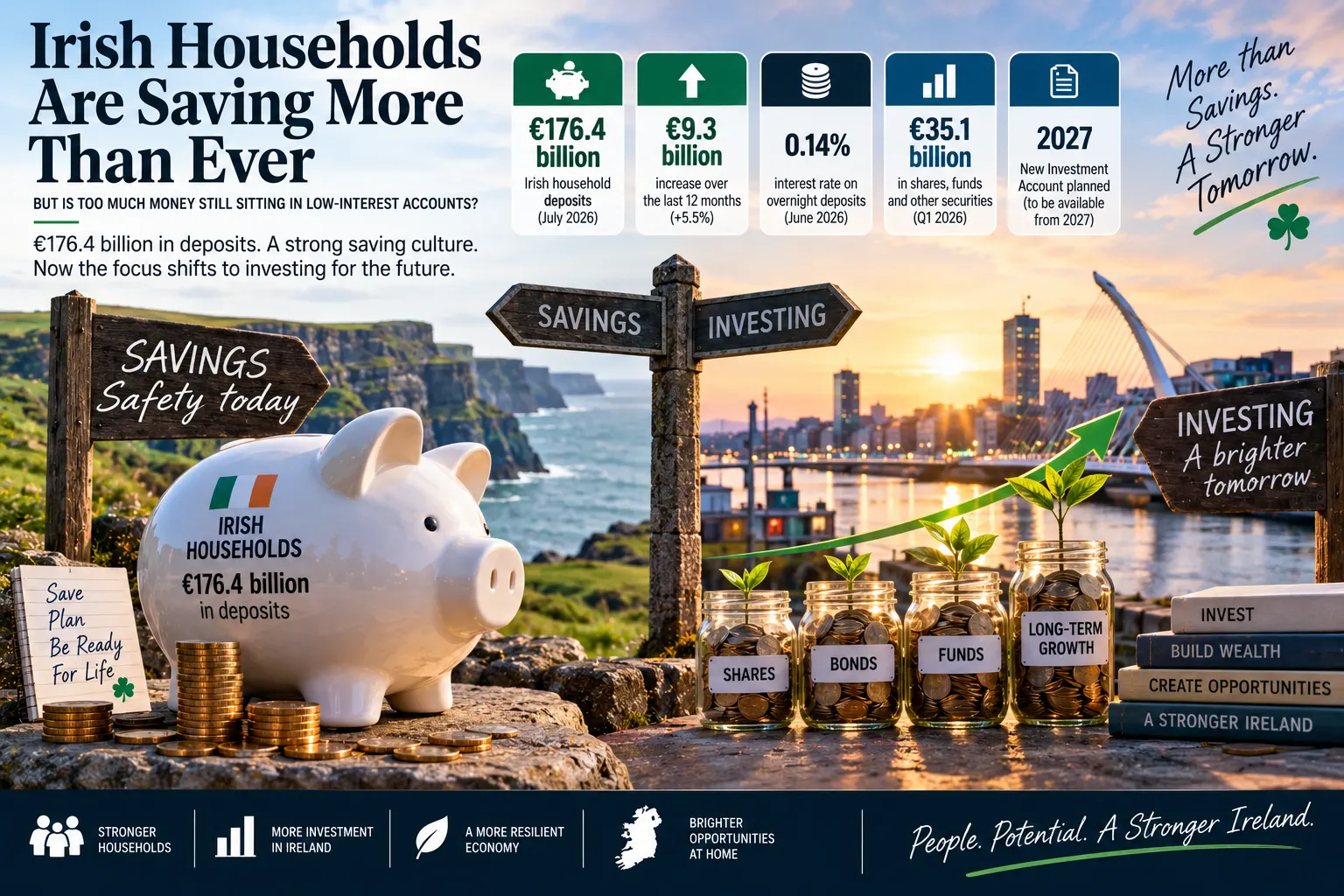
Irish households are not short of money to invest. At the end of July 2026, they held €176.4 billion in deposits with Irish credit institutions, after adding another €9.3 billion over the previous 12 months. Most strikingly, €7.4 billion of that annual increase went into overnight deposits — accounts on which the weighted average interest rate was only 0.14% in June. Ireland has developed a formidable culture of saving, but comparatively little of that money makes its way directly into shares, bonds and investment funds.
The contrast has become an economic policy issue. At the end of the first quarter of 2026, the Central Bank’s expanded data showed Irish households holding €35.1 billion in directly measured securities, including shares, fund units and debt securities. By comparison, financial-market instruments accounted for only about 6% of Irish household financial assets at the end of 2025, against roughly 20% across the euro area. Ireland can be one of the world’s major centres for administering investment funds while many Irish households themselves remain cautious participants in capital markets.
The Government now wants to alter that relationship. It is developing a new Investment Account intended to provide ordinary individuals with a simpler route into investing. The stated aim is to legislate for the framework during 2026 and allow providers to begin offering accounts in 2027. It is being developed alongside a broader review of retail-investment taxation, including the controversial eight-year deemed-disposal regime applying to many funds and exchange-traded funds.
But the policy is not simply an attempt to persuade people to take more financial risk. Cash has an essential role in household finances, particularly for emergency reserves, near-term spending and people who cannot tolerate capital losses. Investments can fall sharply and are not substitutes for guaranteed bank deposits. The real policy question is whether Ireland has tilted the balance too far towards cash, property and pensions by making ordinary long-term investing unnecessarily complex, expensive or intimidating.
Ireland’s savings and investment divide
- Irish household bank deposits stood at €176.4 billion at the end of July 2026.
- Deposits increased by €9.3 billion, or 5.5%, over the preceding 12 months.
- The weighted average interest rate on household overnight deposits was 0.14% in June 2026.
- Irish households held €35.1 billion in measured securities at the end of Q1 2026.
- ETFs accounted for €5.6 billion of those measured holdings.
- The Government intends to legislate for an Investment Account framework in 2026, with accounts planned to become available from 2027.
- The investment-fund tax rate for individuals was reduced from 41% to 38% from 1 January 2026, but the eight-year deemed-disposal rule remains in force.
Ireland Is Saving a Remarkably Large Share of Household Income
The stock of deposits is not merely a legacy accumulated over decades. Irish households continue to save substantial amounts from current income. Following revisions to the national accounts, the Central Statistics Office estimated the seasonally adjusted household saving rate at 19.1% in the first quarter of 2026, similar to the revised average of 18.5% since the beginning of 2023. That means households collectively were adding close to €1 to their wealth for every €5 of disposable income during the quarter.
Those savings do not all end up in ordinary bank accounts. Households also contribute to pensions, repay debt, purchase property, buy financial assets and hold money through institutions outside the domestic banking system. Central Bank financial accounts valued total household financial assets at €643.8 billion at the end of Q1 2026, of which €222.5 billion consisted of currency and deposits and €312 billion of insurance and pension entitlements.
The €222.5 billion financial-accounts measure is broader than the €176.4 billion domestic-bank deposit figure and the two should not be treated as competing estimates. They cover different institutional and asset scopes. What both demonstrate is the same underlying pattern: liquid savings and deposit-type assets occupy an unusually important position in Irish household balance sheets.
There are rational reasons for this. Ireland has experienced repeated periods of economic uncertainty, and precautionary saving provides resilience when employment, energy costs, interest rates or family circumstances change. Younger households also have a particular reason to accumulate cash: saving for a housing deposit. Central Bank research has identified saving for housing and precautionary motives among factors contributing to Ireland’s relatively elevated saving rate.
A Great Deal of the Money Is Earning Very Little
The location of those savings matters because not all deposits generate the same return. The weighted average rate on new household term deposits was 1.86% in June 2026. Overnight deposits, by contrast, paid an average of just 0.14%. Yet overnight deposits were responsible for the entire €1.5 billion increase in household bank deposits during July and for most of the €9.3 billion annual increase.
The difference is economically important. Overnight money provides immediate access and carries very little nominal volatility, but a very low interest rate may fail to preserve purchasing power once tax and inflation are considered. Deposit interest received by most Irish-resident individuals is subject to Deposit Interest Retention Tax at 33%.
The comparison does not mean that €10,000 held for emergencies should automatically be placed in the stock market. Money needed next month or next year should not generally be exposed to an asset that could fall sharply before it is needed. The policy concern is different: some households are maintaining large amounts of long-term money in low-yielding cash even when part of those savings may not be required for years.
Ireland Invests — but Often Through Pensions and Property Rather Than Brokerage Accounts
It would be wrong to describe Irish households as financially inactive. They invest heavily, but the structure of that investment is distinctive. Pensions and insurance products are major components of household financial wealth, while residential property dominates the wider balance sheet. At the end of Q1 2026, housing represented 59.5% of total household assets and 66.1% of household net wealth.
Housing has therefore performed several roles simultaneously in Irish household finances. It is a place to live, a form of retirement security, a leveraged investment and, for many families, the largest asset they will ever own. Rising property values consequently create large increases in measured household wealth without households ever opening a brokerage account.
The importance of housing is visible across the wealth distribution. The Central Bank estimated total household net wealth at €1.43 trillion in Q1 2026, a record in the series. Yet portfolios become increasingly diversified towards financial assets among wealthier households, while households lower down the wealth distribution rely more heavily on property and deposits.
This helps explain why encouraging retail investing cannot be reduced to a campaign telling people that shares provide better returns. A household still struggling to accumulate a first-home deposit faces a different financial decision from an established homeowner with €100,000 of surplus cash. Available income and wealth are themselves major determinants of whether somebody can afford to accept investment risk.
Where Irish Household Wealth Sits
| Measure | Q1 2026 |
|---|---|
| Total net household wealth | €1,429.5bn |
| Total financial assets | €643.8bn |
| Currency and deposits | €222.5bn |
| Insurance and pension entitlements | €312.0bn |
| Housing share of total assets | 59.5% |
| Housing share of net wealth | 66.1% |
Source: Central Bank of Ireland Household Wealth, Q1 2026.
The Financial Crisis Left More Than a Balance-Sheet Legacy
Ireland’s preference for property was already deeply established before the financial crisis. The credit boom of the 2000s strengthened that relationship as households borrowed heavily to buy increasingly expensive homes and investment properties. When the property market collapsed and the banking system entered crisis, Irish households experienced an extraordinary reversal in housing wealth while unemployment and mortgage distress increased.
In the years that followed, households deleveraged significantly. Mortgage debt declined, banks rebuilt their balance sheets and regulation became much tighter. The experience helped produce a financially stronger household sector by the 2020s, but it also provided a powerful reminder that apparently safe assumptions about asset prices can fail.
It would be too strong to claim that the crash directly caused today’s low retail-investment participation. The Central Bank’s recent consumer research identifies a broader mixture of barriers, including perceived lack of money, lack of knowledge, fear of investment losses, distrust and inadequate access to advice. But Ireland’s relatively recent experience of bank failure, property collapse and financial losses forms part of the historical environment in which attitudes towards financial risk developed.
There is an interesting paradox in that history. A household may regard a diversified investment fund as risky because its price is visible every day, while simultaneously concentrating most of its wealth in one property in one local market. The house does not display a continuously flashing market price, which can make its volatility psychologically less visible even though property is not risk-free.
The Tax System Made the Difference Between a Share and a Fund unusually Important
Taxation is one of the clearest structural obstacles. Ireland does not tax every investment product in the same way, and the distinctions can be difficult for an inexperienced investor to understand. An individual buying ordinary company shares is generally operating within the Capital Gains Tax system. An investor buying many Irish-domiciled funds or equivalent offshore funds can instead fall under the investment-undertaking tax regime.
For most capital gains, the CGT rate is 33%. Individuals receive a personal annual exemption of €1,270 of chargeable gains, and qualifying capital losses can generally be used within the CGT rules. Dividends are treated differently again: dividend income is included in taxable income and can be subject to Income Tax, USC and PRSI. Irish companies normally deduct Dividend Withholding Tax at 25%, which is then credited against the investor’s ultimate Irish income-tax liability.
For Irish investment funds and equivalent offshore funds covered by the relevant regime, the rate applying to individuals was reduced from 41% to 38% on 1 January 2026. That reduction represented the first major step in the Government’s current retail-investment tax reform, but it did not remove the feature that has attracted the greatest criticism: deemed disposal.
Deemed Disposal Means Tax Can Arise Even When an Investor Has Not Sold
Under the deemed-disposal regime, an investor in a qualifying fund is generally treated for tax purposes as though the investment had been disposed of when an eight-year period from acquisition ends. Tax can therefore become payable on the gain at that point even though the investor continues to own the fund. Similar events can arise after subsequent eight-year periods.
The mechanism was designed partly as an anti-deferral measure. Without it, investors in accumulating investment funds could potentially allow income and gains to build within a fund for very long periods without an Irish tax event occurring. Deemed disposal ensures that tax is collected periodically rather than waiting indefinitely for the investor to sell.
For long-term retail investors, however, it has significant disadvantages. Paying tax before the final sale reduces the amount remaining invested and therefore the capital available for future compounding. It can also create a cash-flow problem if the investor has no cash distribution from which to meet the tax liability.
The administrative burden can be more frustrating still for somebody investing a small amount every month. Each purchase can have its own eight-year anniversary, requiring records to be maintained across many acquisition dates. Online investing has become almost frictionless technologically, yet the tax treatment can remain sufficiently complicated that an investor needs detailed spreadsheets or professional assistance merely to hold a diversified ETF over several decades.
ETF taxation is particularly important to describe accurately because an ETF’s tax treatment depends on where it is domiciled and the legal regime under which it falls. It is not correct to assume that every security displaying the letters ETF receives identical Irish tax treatment. Investors need to establish the status of the specific product they buy.
The Government’s Own Review Recommended Much Larger Changes
The Funds Sector 2030 review concluded in 2024 that the retail-investment tax framework should be substantially simplified. Among its recommendations were removing deemed disposal and moving the tax rate on relevant funds and life-assurance products towards the 33% rate applying to most capital gains.
Those recommendations were significant because they acknowledged that tax does more than determine how much an investor eventually pays. Complexity itself influences behaviour. If one investment requires relatively straightforward CGT calculations while another diversified product requires knowledge of fund domicile, exit-tax rules and eight-year deemed disposals, taxation can shape the products consumers choose before the relative investment merits are even considered.
The Government has moved only part of the way so far. Budget 2026 reduced the relevant rate from 41% to 38%. The Department of Finance is working on a wider retail-investment tax roadmap, with deemed disposal explicitly among the issues under consideration. As of 4 September 2026, however, deemed disposal has not been abolished and the proposed further alignment with CGT has not become law.
How Common Investments Are Taxed in Ireland in 2026
| Investment | Main tax treatment | Important feature |
|---|---|---|
| Bank deposit | 33% DIRT on interest | Capital itself not market-exposed |
| Direct shares | Usually 33% CGT on gains | €1,270 annual personal CGT exemption |
| Share dividends | Income Tax, USC and PRSI | 25% Irish DWT normally credited |
| Qualifying funds and ETFs | 38% fund tax regime | Eight-year deemed disposal can apply |
Source: Revenue Commissioners. Exact treatment depends on the investment, investor and fund domicile.
The table also demonstrates why a simple claim that direct shares are always more tax-efficient than funds would be misleading. Dividends can face relatively high marginal taxation, individual shares expose an investor to company-specific risk, and a properly diversified fund may provide risk reduction that is difficult for a small investor to reproduce manually. Tax is important, but it should not be the only consideration determining portfolio construction.
The New Investment Account Is Intended to Make Those Decisions Simpler
The proposed Investment Account is the most visible part of the Government’s attempt to change the system. Tánaiste and Minister for Finance Simon Harris told the first Annual Savings and Investment Forum in March that the Government intends to legislate for a framework in 2026 and enable accounts to be offered from 2027. The intention is for the account to function as a simple, one-stop investment option for individuals.
The project follows the European Commission’s Savings and Investment Account initiative, part of the wider Savings and Investments Union. The European model is intended to make ordinary capital-market investing easier through simple accounts offered by regulated banks, brokers, investment firms and potentially digital providers. The Commission recommends broad investment choice, straightforward taxation, competition between providers and the possibility of tax incentives.
The Irish Government has discussed implementation with the main domestic banks and has linked the account to its National Financial Literacy Strategy. The objective is not simply to create a new product label but to reduce the practical steps between somebody having surplus savings and being able to place part of them into a regulated investment portfolio.
There is one essential qualification. As of 4 September 2026, the final Irish account rules have not been published in sufficient detail to state what its exact annual contribution limit will be, which investments will qualify, what tax relief will apply, whether gains will be exempt or merely taxed more simply, what withdrawal conditions will exist or how existing portfolios might be treated. Those details are expected to form part of the forthcoming budget and legislative process.
Any description of the Investment Account today as an Irish equivalent of a specific foreign tax-free account would therefore be premature. Its policy direction is clear; its final tax architecture is not.
Sweden Helps Explain What Ireland Is Trying to Build
The European debate is influenced by countries where retail participation is far more established. Sweden is particularly relevant. Its investment-savings-account system has helped make ownership of financial assets more routine among ordinary households, while Australia demonstrates how strong pension structures can familiarise a broad population with long-term investment.
The Central Bank’s 2025 review concluded that successful retail-investment cultures do not result from one tax break. They combine suitable products, competition between providers, access to advice, financial literacy, consumer protection, sufficient disposable income, a supportive pension system and a tax structure people can understand.
That finding is important for Ireland. Abolishing deemed disposal tomorrow would not suddenly convert every saver into an investor. Some households lack spare capital. Some prefer guaranteed deposits. Others do not understand markets or do not trust financial firms. A successful Investment Account would therefore need to reduce complexity without encouraging people to take risks they cannot afford.
Online Brokers Are Already Beginning to Change Irish Behaviour
Policy is not starting from zero. Digital brokerage platforms have made investing dramatically easier over the past several years, often allowing customers to buy shares or ETFs from a phone with small amounts of money and relatively low transaction charges.
New Central Bank data published in August 2026 shows how rapidly cross-border platforms have become relevant. Irish households held €6.1 billion of securities through custodians elsewhere in the euro area at the end of Q1 2026, compared with only €950 million in Q1 2020. Germany, Lithuania, Luxembourg and the Netherlands account for most of these foreign-custodian holdings, reflecting the location of several major digital investment platforms and neobanks.
Total measured household securities holdings reached a record €35.1 billion. Investment fund shares accounted for €17.6 billion, while direct listed shares accounted for €14.2 billion. ETFs alone represented €5.6 billion, up from €3 billion in early 2023.
The increase requires another qualification. Much of the rise in the market value of household securities has come from asset-price appreciation rather than households suddenly transferring enormous amounts of new cash into investments. Growing portfolio values and growing investor participation are related but not identical.
Irish Investors Are Not Necessarily Investing in Ireland
The Government’s policy has two economic objectives that are related but should not be confused. One is to improve household financial resilience and give savers greater opportunities to build long-term wealth. The other is to deepen capital markets so that businesses can obtain more financing outside the banking system.
A household investing through a globally diversified ETF may achieve the first objective while contributing only indirectly to the second in Ireland. Much of the portfolio may consist of US, European or Asian companies. Buying an existing share on a stock exchange also does not mean that the purchase price flows directly into the issuing company’s bank account.
Capital markets nevertheless depend on a broad and liquid investor base. Greater participation can improve demand for securities, support market liquidity and provide an environment in which companies find it easier to raise equity and debt. At European level, the Savings and Investments Union is explicitly intended to connect the continent’s large pool of household savings with investment in businesses, infrastructure, innovation and the green and digital transitions.
Ireland may face a particular challenge because its domestic listed-equity market is small compared with larger countries. A successful Irish retail-investment system therefore cannot sensibly require households to concentrate their portfolios in Irish companies merely to support national economic policy. Diversification and the interests of the investor have to remain central.
More Investing Would Create New Risks as Well as Opportunities
The case for increasing retail participation is often framed around the long-term return available from productive assets compared with cash. But returns are compensation for risk. Shares can lose 20%, 30% or considerably more during market crises. Individual companies can fail completely. Bonds can fall when interest rates rise or when borrowers encounter financial difficulty. Fund values can decline even when the fund itself is well diversified.
An Investment Account cannot remove those risks. Tax advantages, simple interfaces and government support for the framework should never be interpreted as a government guarantee that the investments inside the account will make money.
This becomes particularly important when investing is delivered through mobile technology. A well-designed app can reduce fees and make diversified long-term investment accessible. The same technology can also make constant trading feel like entertainment, encourage excessive concentration in fashionable stocks or lead inexperienced users towards leveraged products.
The distinction between investment and speculation matters. Buying a diversified portfolio intended to be held for 20 years is economically very different from repeatedly trading short-term price movements, leveraged contracts for difference or highly volatile crypto-assets. A policy intended to move households from saving towards investing should not inadvertently move them from saving towards gambling on markets.
Financial Literacy Has Become Part of the Reform for a Reason
The Central Bank’s consumer research found that non-investors face several overlapping obstacles. Some believe they do not have enough money. Some describe investment as too difficult. Fear of losing money and distrust of providers are significant psychological barriers, while others lack access to advice or do not know where to begin.
Participation is also socially uneven. Wealthier households account for the great majority of direct and indirect capital-market participation. Irish retail investors are more likely to have higher education and incomes, to be employed, to be between 35 and 54, to be male and to live in the greater Dublin area.
That creates a distributional challenge. A generous tax incentive for investment may disproportionately benefit households that already possess surplus capital unless the system is designed to be usable by people starting with very small amounts. The European Commission’s model explicitly envisages contributions that can begin at low monthly levels rather than requiring substantial initial wealth.
The Government’s National Financial Literacy Strategy is therefore being developed alongside the Investment Account. More than 100 actions in its 2026–2027 plan cover saving, pensions, fraud prevention and investing. The objective is to ensure that making an investment technically easy does not leave consumers unable to judge whether it is financially appropriate.
A Brokerage Account Is Not the Same as a Bank Deposit
One of the most important distinctions for a new investor concerns protection. Eligible bank deposits are protected by the Deposit Guarantee Scheme up to €100,000 per person per institution if a covered institution is unable to repay deposits. That protection does not mean the interest rate is attractive, but the nominal deposit balance within the limit receives a powerful form of institutional protection.
Investment protection works differently. The value of shares, bonds and funds can fall because markets fall, and no investor-compensation scheme reimburses an investor merely because an investment performed badly. The Investor Compensation Scheme can apply in specific circumstances when an authorised investment firm cannot return client money or assets, subject to its rules and limits, but it is not insurance against market losses.
This distinction will remain important even if the new Investment Account carries government-approved tax advantages. The account would be a regulatory and tax wrapper around investments, not a guarantee of their future value.
What an Irish Investor Should Check Before Choosing a Broker
The growth of online brokerage means consumers now have more choice than they did a decade ago. Traditional Irish stockbrokers, banks, investment firms and cross-border European platforms can provide access to markets. Competition can reduce costs, but the cheapest-looking platform is not automatically the best or safest option for every investor.
The first question is regulatory status. Investors should establish which legal company actually holds their account, where that company is authorised and which regulator supervises it. Firms authorised in another European Economic Area country may legally provide services in Ireland through passporting arrangements, meaning their home-state regulator can play an important role.
The second question is asset custody. Investors should understand how client assets are held, whether securities are segregated from the firm’s own assets and what happens if the provider becomes insolvent. Protection against provider failure should never be confused with protection against changes in the market price of the securities themselves.
Costs need to be examined in their entirety rather than through a headline claim of commission-free trading. Relevant charges can include dealing commissions, foreign-exchange conversion, custody or platform fees, withdrawal charges, spreads and the ongoing expense ratio inside an investment fund. A small recurring percentage difference can become material when applied to a portfolio for several decades.
Tax reporting is another consideration specific to Ireland. Some providers make records readily available but do not calculate or pay an Irish investor’s tax liabilities. A platform located elsewhere in Europe may provide an excellent trading interface while leaving the Irish customer responsible for determining whether CGT, dividend taxation, fund taxation or deemed disposal applies.
Finally, the available products matter. A platform designed primarily around frequent trading can create a very different investor experience from one built around regular long-term contributions. Access to leverage, CFDs, options or crypto-assets is not automatically an advantage for somebody whose objective is simply to build a diversified long-term portfolio.
Seven Questions to Ask Before Opening an Investment Account
| Question | Why it matters |
|---|---|
| Who regulates the provider? | Determines legal oversight and protections |
| How are my assets held? | Important if the provider fails |
| What are the total fees? | Costs compound over time |
| Who handles Irish tax? | Reporting obligations may remain with the investor |
| What products are available? | Determines diversification and risk |
| Can I transfer the portfolio? | Reduces dependence on one provider |
| Does the platform encourage leverage? | Leverage can multiply losses |
Sources: Central Bank of Ireland and Competition and Consumer Protection Commission consumer guidance.
The First Investment Decision Is Often How Much Not to Invest
A national policy encouraging investment needs to preserve a basic principle of household finance: liquidity has value. Money for the next rent payment, a tax bill, a home deposit needed shortly or an emergency should not be treated in the same way as money that genuinely will not be required for ten or twenty years.
Investment markets reward patience only imperfectly. Even diversified global equity markets experience major declines. A person forced to sell during one of those periods can turn a temporary market fall into a permanent financial loss. Maintaining sufficient cash can therefore make long-term investing safer by reducing the likelihood that investments have to be sold at an inconvenient moment.
Debt matters as well. An investor paying a very high interest rate on consumer debt faces a different calculation from a debt-free household deciding what to do with long-term surplus savings. The existence of a tax-advantaged investment account will not make every household financially ready to use one.
This is why the language of moving Ireland “from saving to investing” needs qualification. Saving and investing are complements, not substitutes. The objective is not to empty Irish bank accounts into the stock market. It is to create a more rational division between cash required for security and long-term money that households may choose to expose to productive assets.
Diversification Is the Difference Between Investing in Companies and Betting on One Company
For small investors, funds and ETFs became internationally popular largely because they can provide diversification at relatively low cost. Instead of trying to identify a handful of winning companies, an investor can potentially hold hundreds or thousands of businesses through one product.
That does not make a diversified fund safe in the sense of a guaranteed bank deposit. A broad equity portfolio can still decline heavily when global markets fall. Diversification reduces company-specific and concentration risk; it does not eliminate market risk.
The irony in Ireland is that the tax rules have historically made this relatively simple diversification tool more complicated than its underlying investment concept. The Government’s Funds Sector review effectively acknowledged that contradiction when recommending the removal of deemed disposal and closer alignment of tax rates.
Central Bank data suggest households are already moving in this direction despite the tax regime. Funds represented approximately half of measured household securities holdings at the end of Q1 2026. Within that category, equity funds were the largest component, while ETFs accounted for almost one-third of fund holdings.
Irish Investors Display a Home Bias — but Their Portfolios Are Becoming More International
The Central Bank’s enhanced securities data also shows that 44% of measured household holdings were issued by Irish-originated entities. A preference for domestic investments is not uniquely Irish; investors in many countries exhibit home bias because local companies and institutions are more familiar.
Yet investment funds can significantly broaden exposure. Looking through the assets held inside Irish households’ funds shows that much of the underlying investment is in international equities and debt securities. This allows a household based in Ireland to spread economic risk across countries and sectors far beyond the domestic economy.
There is a strong argument for such diversification in a small open economy. An Irish worker may already depend on the Irish economy for employment, own an Irish home and receive pension income connected with Irish institutions. Concentrating the remainder of a family’s investments exclusively in domestic assets can amplify exposure to the same national economic shocks.
The Government Has a Second Reason to Care: Europe Needs Capital
The investment-account debate extends beyond household returns. European policymakers are concerned that a large amount of household wealth sits in deposits while European companies rely heavily on banks for finance. The United States has substantially deeper capital markets and greater household participation in equities, venture capital and investment funds.
The European Savings and Investments Union is intended to close part of that gap. The argument is that better capital-market participation could simultaneously give households access to higher-returning long-term assets and supply businesses with more equity and bond financing for innovation, infrastructure, digitalisation and decarbonisation.
Ireland is an unusual participant in this debate because it already hosts one of the world’s largest fund-management and administration industries. The domestic problem is not the absence of financial expertise. It is that the infrastructure serving global capital developed more successfully than a simple retail-investment culture for Irish households.
Government therefore sees the Investment Account as both consumer policy and capital-market policy. If designed successfully, it could broaden household wealth ownership while connecting a larger population with the financial-services industry already operating around them.
But Investment Gains Would Not Be Shared Equally
Any policy encouraging household investment has to confront inequality. The wealthiest 10% of Irish households held 47.2% of total net wealth at the end of Q1 2026. Central Bank analysis also found that the top decile accounts for approximately four-fifths of existing direct and indirect capital-market participation outside pensions.
The reason is straightforward. Investments require money that can be put at risk. Lower-income households devote a greater share of their resources to housing, bills and precautionary deposits. Wealthier households can maintain emergency liquidity while simultaneously holding property, pensions, shares and investment funds.
A tax incentive can therefore increase inequality if most of its financial value goes to people already able to invest substantial sums. Conversely, a simple low-cost account that allows very small regular contributions could broaden ownership more effectively than a complicated relief primarily useful to sophisticated investors.
The eventual Irish design will therefore be judged partly on its limits and incentives. A generous unlimited tax shelter would produce very different distributional effects from a capped account intended to normalise modest regular investment among middle-income households.
The Details the Government Has Not Yet Answered Will Determine Whether the Account Works
Several design questions remain unresolved publicly. The first is taxation. If investments inside the new account remain subject to existing fund rules and deemed disposal, administrative simplification alone may not be sufficient to produce a large change in behaviour. If the account receives a substantially more favourable tax regime, the Government must decide how large that benefit should be and who should receive it.
The second is eligible investments. An account restricted to a narrow list of products may be easy to supervise but limit competition and diversification. A completely unrestricted account could expose inexperienced customers to highly speculative products. The European Commission’s recommendation favours a broad selection of shares, bonds and funds while excluding particularly complex or high-risk investments.
The third is competition. Allowing banks, brokers and digital providers to compete could push charges down. Restricting distribution too narrowly could instead create an account that is simple in theory but expensive in practice. Portability between providers will also be important if consumers are to avoid becoming locked into an uncompetitive platform.
The fourth is tax administration. An account becomes considerably more attractive if the provider calculates and reports tax automatically rather than requiring every household to become familiar with multiple Revenue regimes. Simplified administration may prove almost as important to participation as a lower headline tax rate.
The fifth is the relationship with pensions. Ireland’s MyFutureFund automatic-enrolment pension scheme began in 2026, bringing hundreds of thousands of employees into retirement investment. The new Investment Account is expected to serve a different purpose: accessible investment outside the pension system, potentially for medium- and long-term objectives where people want more flexibility over their money.
The Most Successful Outcome Would Not Be a Rush Into Shares
Financial reform can go wrong if success is defined purely by the amount of money transferred into markets. A sudden wave of inexperienced investors chasing recent winners at inflated valuations would not represent financial resilience. Nor would an increase in speculative trading driven by social-media tips and app notifications.
A healthier outcome would be less dramatic: more households understanding the difference between saving and investing, maintaining appropriate cash reserves, using regulated providers, keeping costs low, diversifying long-term investments and recognising that market losses are part of the price of potential long-term returns.
That requires the State to remain neutral about individual investment decisions. The Government can remove unnecessary barriers, simplify taxation and improve financial education. It should not imply that a particular market or product will outperform, and it cannot guarantee that somebody investing in 2027 will be wealthier five or ten years later.
The Central Bank has made a similar point in its research. Greater participation requires suitable products, advice, financial literacy and strong consumer protection working together. Tax reform alone is not enough.
The €176.4 Billion Figure Is Powerful — but It Should Not Become a Target
It is tempting to look at €176.4 billion of household bank deposits and imagine a vast pool of idle capital waiting to be released into investment markets. That interpretation would be wrong. Some deposits belong to people saving for homes. Some finance future tax bills, education or retirement spending. Some are emergency reserves. Some are held by elderly households for whom capital security and immediate liquidity are more valuable than maximising long-term return.
The aggregate figure also conceals inequality. Ten households each holding €10,000 are financially very different from one household holding €100,000. Public policy based purely on the national deposit stock risks assuming that every household possesses surplus investable cash.
Nevertheless, the direction of the data is difficult to ignore. Deposits continue to grow rapidly, overnight balances dominate new flows and direct capital-market participation remains low by European standards. At the same time, digital platforms have demonstrated that some Irish households are ready to invest when access becomes easier.
The opportunity for government is therefore not to drain deposits from banks but to make the next financial decision less distorted. A person who chooses cash should do so because liquidity and security suit their circumstances, not because investment taxation is incomprehensible. A person who chooses a diversified fund should do so because the risk and time horizon are appropriate, not because a tax break disguises those risks.
Ireland Is Moving From a Savings Debate to a Wealth-Building Debate
The reform represents a broader change in how personal finance is being discussed. For decades, mainstream Irish household wealth-building revolved heavily around buying a home, paying down the mortgage, contributing to a pension and keeping remaining savings in the bank. That model produced substantial wealth for many homeowners, particularly as property values recovered after the financial crisis.
It works less well for people who enter adulthood later, rent for longer, cannot buy property or work in increasingly mobile careers. A diversified financial portfolio can provide a form of asset ownership that does not require a six-figure mortgage or a permanent connection to one property. That potentially makes capital-market participation relevant to debates about intergenerational wealth as well as financial services.
The Government’s challenge is to modernise that system without replacing one form of concentration with another. Ireland does not need households to abandon property and cash and put everything into equities. It needs more routes through which ordinary people can accumulate assets appropriate to their stage of life.
2027 Could Be the Beginning of a Different Investment Culture — but Only if the Tax Reform Matches the Account
The Government has now established the direction of travel. It has reduced fund taxation from 41% to 38%, created an annual Savings and Investment Forum, incorporated investment into its financial-literacy strategy and committed to a new Investment Account that it wants providers to offer from 2027. The next budget is expected to provide much more of the architecture.
The decisive question is whether the reform deals with the reason Ireland’s retail-investment framework became so difficult in the first place. A beautifully designed Investment Account sitting on top of complicated tax rules would improve the user interface without fully solving the underlying problem. Removing or materially reforming deemed disposal and simplifying reporting would represent a much deeper change.
The trade-off is real. The Exchequer has an interest in preventing indefinite tax deferral and ensuring different forms of saving are not given unjustifiably different treatment. Consumers have an interest in rules that can be understood without becoming tax specialists. The future framework will have to reconcile both objectives.
If it succeeds, Ireland may gradually move towards a system in which property, pensions, cash and market investments all play complementary roles in household wealth. If it fails, another product could be added to an already complicated financial landscape without changing behaviour very much.
The €176.4 billion sitting in domestic household deposits is therefore not merely a pool of money. It is evidence of how Irish families think about security. Convincing more of those families to accept investment risk will require more than promising higher potential returns. It will require a system that is simple enough to understand, inexpensive enough to use, well regulated enough to trust and tax-efficient enough to make long-term investing worthwhile.
Sources
Central Bank of Ireland — Bank Balance Sheets and Household Deposits, July 2026
Central Bank of Ireland — Retail Interest Rates, June 2026
Central Bank of Ireland — Household Wealth, Q1 2026
Central Bank of Ireland — Retail Investments by Irish Households, August 2026
Central Bank of Ireland — Retail Investor Participation in Ireland
Central Statistics Office — Institutional Sector Accounts: Household Saving, Q1 2026
Department of Finance — Annual Savings and Investment Forum 2026
Department of Finance — Investment Account Framework and Retail Investment Tax Reform
Department of Finance — Funds Sector 2030 Review and Retail Investment Recommendations
Revenue Commissioners — Investment Undertaking Tax Rate Change, 2026
Revenue Commissioners — Capital Gains Tax Rates and Personal Exemption
Revenue Commissioners — Taxation of Dividend Income
European Commission — Savings and Investment Accounts
Central Bank of Ireland — Deposit Guarantee Scheme
Competition and Consumer Protection Commission — Choosing Investment Providers
Source & Transparency
This article is published by Ireland Newspaper for editorial and informational purposes.
Published: 4 September 2026 · Updated: 4 September 2026

Newsroom Ireland Newspaper
Ireland Newspaper editorial team prepares daily news coverage for readers in Ireland and abroad.