Ireland’s Jobs Market in 2026: Record Employment Gives Way to a More Selective Labour Market
Ireland still has almost 2.8 million people at work and unemployment remains low by historical standards, but the extraordinary post-pandemic hiring surge has clearly slowed. Construction and transport are expanding strongly, healthcare remains the country’s largest employment sector, multinational investment is still generating thousands of planned jobs, while parts of technology are going through a noticeable adjustment. The result is not a jobs crisis, but a labour market becoming more selective by industry, skill and region.
Ireland’s labour market has spent several years breaking records.
Businesses expanded.
Multinational companies hired.
Construction recovered.
Public services recruited.
The population grew.
Thousands of workers arrived from abroad.
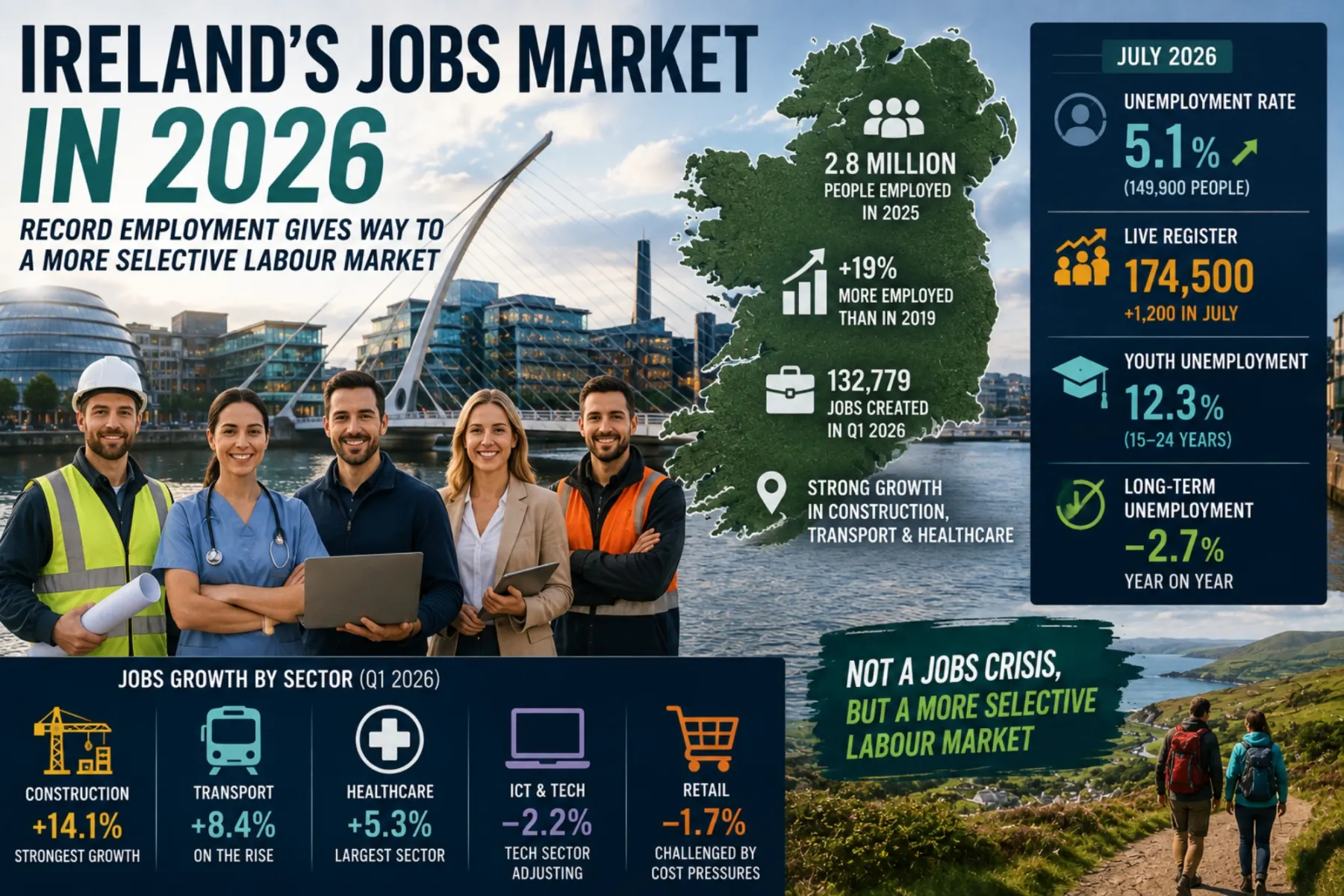
And by the end of 2025, the number of people employed had reached approximately 2.8 million — roughly 19% more than at the end of 2019.
In 2026, that story is changing.
Not reversing.
Changing.
The latest monthly figures show Ireland’s seasonally adjusted unemployment rate at 5.1% in July, compared with 5.0% in June and 5.0% a year earlier. Around 149,900 people were classified as unemployed in July.
The latest Live Register figures, released on Monday, 10 August, point in the same direction. The seasonally adjusted register increased by 1,200 during July to 174,500 people. The unadjusted number was 191,880, 3.4% higher than a year earlier.
Those numbers do not indicate a severe downturn.
They indicate a labour market that is no longer tightening at the extraordinary rate seen during the previous expansion.
The Headline Number: Almost 2.8 Million People Still Have Jobs
The most recent fully published Labour Force Survey sectoral data cover the first quarter of 2026.
They show 2,794,500 people in employment, almost unchanged from 2,794,100 one year earlier.
That flat annual comparison is significant because only a year earlier employment had still been expanding rapidly.
In Q1 2025, Ireland had added almost 90,000 workers in only twelve months.
By Q1 2026, the annual increase was just 400.
The labour market has therefore moved from rapid expansion towards something much closer to stabilisation.
The employment rate for people aged 15 to 64 also fell from 74.7% in Q1 2025 to 73.3% in Q1 2026.
That does not mean 2026 has produced a sudden collapse in employment.
It means employers are becoming more cautious and the exceptional pace of labour absorption seen after the pandemic has faded.
July’s Unemployment Increase Is Small — but Worth Watching
Ireland’s unemployment rate rose to 5.1% in July.
Male unemployment stood at 4.9%.
Female unemployment was slightly higher at 5.3%.
The more noticeable figure concerns younger workers.
The unemployment rate among people aged 15 to 24 reached 12.3% in July, up from 11.8% in June.
Among people aged 25 to 74, the rate was much lower at 4.1%.
Youth unemployment is naturally more volatile because young people move frequently between education, temporary employment and the labour market.
Nevertheless, the difference demonstrates that Ireland’s employment environment is not equally strong for every age group.
An experienced engineer, nurse, electrician or construction manager may still encounter intense employer demand.
A young person seeking a first permanent job may experience a considerably more competitive market.
The Live Register Shows More Recent Joblessness — but Less Long-Term Joblessness
Monday’s Live Register report provides an especially interesting detail.
The number of people on the register for less than one year reached 137,103 in July, an increase of 7,756, or 6%, compared with July 2025.
By contrast, the number registered for a year or longer fell by 1,503, or 2.7%, to 54,777.
That is an important distinction.
A weakening labour market in which long-term unemployment rises sharply can indicate workers are becoming detached from employment for extended periods.
That is not what the latest numbers currently show.
Instead, Ireland is seeing more people entering the unemployment system relatively recently while the stock of longer-term claimants has fallen.
The pattern is therefore more consistent with increased labour-market turnover and cooling demand than with entrenched mass unemployment.
Beneath the Flat Headline, Companies Are Still Creating Large Numbers of Jobs
The fact that total employment barely changed year on year can create the impression that nothing is happening.
In reality, Ireland’s labour market is extraordinarily dynamic.
CSO administrative data show 132,779 jobs were created during Q1 2026, while 113,880 jobs were destroyed.
Job creation was 25.5% higher than in the first quarter of the previous year, while job destruction was 19.4% lower.
These administrative measures are different from the Labour Force Survey measure of people in employment, so they should not be treated as identical statistics.
But they reveal the amount of movement hidden underneath the national employment total.
Businesses open positions.
Other positions disappear.
People change employer.
Companies restructure.
New enterprises grow while others contract.
The Irish labour market can therefore look stable in aggregate while tens of thousands of individual jobs are being created and eliminated every quarter.
Irish-Owned Companies Are Doing Most of the Hiring
One particularly important detail in the job-churn data is the role of domestic enterprise.
Of the 132,779 jobs created in Q1, 112,209 — or 84.5% — were created by Irish-owned enterprises.
That challenges the common assumption that Ireland’s labour-market story is almost entirely driven by foreign multinationals.
Multinationals remain enormously important.
But the majority of recorded job creation in this dataset came from Irish-owned businesses.
That includes everything from construction companies and hotels to professional services firms, shops, manufacturers, transport operators and rapidly scaling technology businesses.
Ireland’s employment base has therefore become broader than the familiar image of large US technology and pharmaceutical employers alone.
Construction Is the Stand-Out Growth Sector
If one sector captures the strongest employment expansion in the latest Labour Force Survey, it is construction.
Employment in construction increased by 20,500 people, or 11.7%, in the year to Q1 2026.
The growth was concentrated particularly in specialised construction activities, which added 12,700 workers, and civil engineering, which added approximately 5,400.
This is not difficult to understand.
Ireland is trying simultaneously to build:
homes;
roads;
electricity infrastructure;
water infrastructure;
public transport;
data centres;
industrial facilities;
schools;
health facilities;
and renewable-energy projects.
All of them compete for many of the same engineers, tradespeople, site managers and specialist contractors.
The construction sector therefore sits at the intersection of several national investment programmes at once.
Construction Still Has a Skills Problem
Strong employment growth does not mean employers can easily find everybody they need.
SOLAS continues to identify recruitment pressure in areas including civil engineers, construction project managers, quantity surveyors and carpenters, while plumbers are identified as a potential future shortage area.
Ireland’s updated Critical Skills Occupations List also includes construction-related occupations such as site managers, while planning specialists have been added to the employment-permit system as the State attempts to strengthen planning capacity.
This creates an unusual problem.
Ireland needs additional construction to solve housing and infrastructure shortages.
But increasing construction itself creates additional demand for workers who are already scarce.
The labour supply therefore becomes part of the infrastructure constraint.
Transport and Storage Is Growing Even Faster in Percentage Terms
Another sector producing striking growth is transportation and storage.
Employment increased by 20,400 people, or 18.2%, in the year to Q1 2026.
This sector includes activities connected with freight, warehousing, logistics and passenger transport.
Its expansion reflects several underlying trends.
Ireland’s population has grown.
Online retail has increased logistics requirements.
Export-oriented businesses need more sophisticated supply chains.
Tourism and air travel remain important.
Large industrial investments require materials to be moved.
And an island economy depends structurally on ports, airports, road freight and distribution systems.
The jobs associated with economic growth do not all appear in technology laboratories or office towers.
Many are created by moving the products, people and materials that the wider economy depends upon.
Technology Is Going Through the Most Interesting Adjustment
The most striking employment decline occurred in Information and Communication.
Employment in the sector fell by 20,300 people, or 10.7%, in the year to Q1 2026.
The largest contributor was computer programming and consultancy, where employment fell by approximately 16,200.
That is a substantial movement for a country that has built an international reputation as a major European technology centre.
But the number requires careful interpretation.
It does not mean Ireland’s technology industry is disappearing.
Nor does it mean there is no demand for technology workers.
The picture is much more selective.
Ireland Can Lose Tech Jobs and Still Have a Tech Skills Shortage
This apparent contradiction is one of the most important developments in the current Irish labour market.
SOLAS continues to identify shortages in roles such as software developers and engineers and IT analysts and engineers.
Ireland’s Critical Skills Employment Permit system similarly continues to treat numerous ICT occupations as strategically important skills for which domestic supply is insufficient.
Meanwhile, Information and Communication had the second-highest job vacancy rate of any broad sector in Q1 2026 at 2.1%.
How can employment fall while skills shortages remain?
Because “technology jobs” are not one homogeneous category.
A company may reduce general headcount while simultaneously struggling to recruit AI engineers, cybersecurity specialists, cloud architects, data scientists or experienced software developers.
Automation can reduce demand for some functions while increasing it for others.
A multinational can restructure an operation in Dublin while another company opens a specialist engineering team in Cork or Galway.
The modern technology labour market is therefore increasingly about which skills, not simply how many jobs.
Artificial Intelligence Is Likely to Accelerate That Divide
AI is unlikely to affect every occupation in the same way.
Routine digital tasks can increasingly be automated.
At the same time, businesses need people who can build AI systems, secure them, integrate them into existing operations and redesign workflows around them.
Enterprise Ireland reported that 87% of its surveyed clients were either already integrating AI or planning to do so.
This means the next stage of Irish employment growth may be less about adding large numbers of general office positions and more about increasing productivity with smaller numbers of highly specialised workers.
That shift would help explain why a country can continue attracting major technology investment even while employment in the broad ICT category becomes more volatile.
Technology Jobs Still Pay Far Above the National Average
The reduction in ICT employment has not removed the sector’s importance to Irish earnings.
Average weekly earnings in Information and Communication stood at approximately €1,824.62 in Q1 2026.
That compares with an economy-wide average of €1,075.58.
Information and Communication also recorded the highest average hourly total labour costs of any sector at €62.65.
Financial, insurance and real-estate activities followed at €58.88.
These figures help explain why relatively modest changes in high-paid multinational employment can have economic effects extending beyond the number of people directly affected.
High-income technology employees support housing demand, restaurants, professional services, retail and tax revenues.
Changes in the sector therefore matter disproportionately.
Healthcare Is Now Ireland’s Largest Employment Sector
The largest sector of Ireland’s labour market is no longer necessarily the one many people would first imagine.
By Q4 2025, Human Health and Social Work employed approximately 390,000 people — around 13.9% of total employment.
That makes healthcare and social care an enormous employer in its own right.
The reasons are structural.
Ireland’s population is growing.
It is also ageing.
Hospitals need staff.
Community care needs staff.
Disability services need staff.
Residential care needs staff.
Home-care services need staff.
Mental-health services need staff.
And many of these roles require people physically to be present.
They cannot simply be automated or relocated abroad.
Healthcare Is Still Creating Jobs
The administrative churn data recorded 14,873 jobs created in Human Health and Social Work in Q1 2026, compared with 6,573 jobs destroyed.
That does not translate directly into an identical increase in Labour Force Survey employment, but it shows significant hiring activity.
Healthcare-related managers and numerous medical occupations also remain on Ireland’s Critical Skills list, reflecting persistent shortages.
This is one sector where demographic trends make sustained long-term demand particularly plausible.
An ageing population increases healthcare requirements at the same time as a larger proportion of the existing workforce itself approaches retirement.
The labour problem therefore has two sides.
Ireland needs more healthcare workers.
And it needs enough new workers to replace those leaving.
Ireland’s Workforce Is Getting Older
People aged 55 and over represented approximately 20% of Ireland’s labour force by Q4 2025.
At the end of 2000, the equivalent share was only 10%.
That represents a profound long-term change.
An older workforce can provide enormous experience.
But it also means succession is becoming more important in occupations ranging from medicine and education to engineering, farming and skilled trades.
The country therefore cannot plan employment needs solely around new economic growth.
It must also replace workers reaching retirement.
In some professions, replacement demand may eventually become as important as expansion demand.
Migration Has Become Part of Ireland’s Employment Infrastructure
Ireland’s recent employment expansion would have been extremely difficult without migration.
Between 2019 and 2024, the number of employees increased by approximately 355,000.
Non-Irish nationals accounted for 218,261 — or 61% — of that increase.
By 2024, non-Irish nationals represented 27.5% of employees across the enterprise economy.
Their presence was particularly high in:
Administrative and Support Services — 45.6%;
Accommodation and Food Services — 45.1%;
and Information and Communication — 41.4%.
These figures show how closely migration and the labour market are now connected.
Migration is not occurring alongside Ireland’s economic model.
It has become part of the workforce supporting that model.
Hospitality Depends Especially Heavily on International Workers
Restaurants, hotels, cafés and tourism businesses are among the sectors most reliant on workers born outside Ireland.
That is partly because hospitality requires large numbers of employees, frequently operates outside conventional office hours and contains many entry-level and relatively mobile occupations.
The sector also has exceptionally high labour turnover.
In Q1 2026, Accommodation and Food Services recorded 18,797 job creations and 13,515 job destructions.
Those figures illustrate a sector that is constantly recruiting.
The challenge for hospitality employers is therefore not merely finding workers once.
It is retaining enough employees through seasonal and business-cycle changes.
Wages Are Still Rising Strongly
A cooling jobs market has not yet stopped wage growth.
Average weekly earnings reached €1,075.58 in Q1 2026, an increase of 4.4% from €1,029.81 a year earlier.
Average hourly earnings increased 4% to €33.14.
Pay increased across 11 of the 13 broad economic sectors.
The largest percentage increase in average weekly earnings was in Administrative and Support Services at 7.7%, followed by Education at 6.7%.
Healthcare and social work weekly earnings increased 6%.
Transport and storage increased 6.5%.
Accommodation and food services increased 4.6%.
The wage picture therefore remains relatively strong despite slower employment growth.
Higher Pay Helps Workers — but Raises the Cost of Hiring
Ireland’s national minimum wage increased to €14.15 per hour on 1 January 2026, a rise of 65 cent.
For low-paid employees, this improves gross hourly income.
For businesses in labour-intensive industries, it increases payroll costs.
Restaurants, hotels, retailers, cleaning companies, childcare providers and smaller service businesses feel these changes particularly directly because employee costs represent a large proportion of operating expenditure.
Businesses may respond through a mixture of higher prices, greater productivity, reduced hours, automation or slower hiring.
That does not mean minimum-wage increases automatically destroy employment.
It means the impact depends heavily on each company’s margins, productivity and ability to pass costs on to customers.
Ireland Still Has Vacancies — Just Fewer Than a Year Ago
The national job vacancy rate stood at 1.1% at the end of Q1 2026.
That was down from 1.3% a year earlier.
The CSO estimated approximately 26,500 vacant positions, compared with 31,000 in Q1 2025.
This is another indication of gradual cooling.
Employers are still recruiting.
They simply have fewer unfilled positions overall than they did twelve months earlier.
Public Administration and Defence had the highest vacancy rate, at 3.5%.
Information and Communication followed at 2.1%.
The figures reinforce the idea that recruitment difficulties have become increasingly concentrated in particular occupations rather than existing uniformly across the economy.
Public-Sector Recruitment Remains an Important Part of the Market
The high vacancy rate in public administration shows that the State itself remains an important employer.
Government departments, local authorities, regulators, healthcare providers, schools, policing and other public services all require staff.
As Ireland’s population expands, demand for many public services naturally rises with it.
More homes require planners.
More children require teachers.
More patients require healthcare workers.
More infrastructure requires engineers and project managers.
Public-sector workforce planning therefore increasingly intersects with the private-sector skills shortage.
The same engineer sought by a construction consultancy might also be required by a local authority.
The same cybersecurity specialist can work for a technology company, bank or government agency.
The labour market becomes a competition for talent rather than simply a competition between unemployed people for jobs.
Foreign Investment Continues to Produce a Strong Job Pipeline
The slowdown in headline employment has not stopped foreign companies committing to future investment.
IDA Ireland secured 190 investments during the first half of 2026, associated with planned creation of 10,410 jobs.
That included 54 first-time investors and 39 expansions by existing companies.
Importantly, 98 of the investments — 52% of the total — were regional projects outside the traditional concentration of investment in Dublin.
These are planned jobs rather than workers already on payroll.
Not every announced position necessarily appears immediately or even ultimately.
But they provide evidence that the underlying pipeline of foreign investment remains substantial.
Multinational Employment Remains Above 300,000
Employment in IDA-supported multinational companies reached approximately 312,468 in 2025, an increase of 1.5% from the previous year.
Regional employment in those companies reached a record 169,967.
This is a major structural strength for Ireland.
Multinationals have diversified well beyond Dublin.
Cork has major pharmaceutical, technology and financial-services operations.
Galway has a powerful medical-technology cluster.
Limerick and the Mid-West have technology, manufacturing and life-sciences employers.
Waterford and the South-East have pharmaceuticals and advanced manufacturing.
The employment map remains uneven, but multinational jobs are no longer synonymous with Dublin alone.
Irish Companies Are Also Adding Employment Across the Regions
Enterprise Ireland-supported companies employed 232,425 people at the end of 2025.
They created 12,608 new jobs during the year, producing a net employment increase of 2,938.
Almost 69% of the new jobs were created outside Dublin, and all nine regions recorded net growth.
Within Enterprise Ireland’s client base, Industrial and Life Sciences companies employed 101,747 people.
Food and Sustainability accounted for 69,295.
Technology and Services employed 61,383.
Some smaller sub-sectors expanded particularly strongly.
Climate technology and renewable-energy employment increased 6.5%.
Fintech and financial services rose 4.9%.
Housing-related employment increased 4%.
High-tech construction increased 2.5%.
The future jobs story is therefore becoming increasingly diversified across construction, climate technology, financial technology and advanced industry.
Small Businesses Matter More Than the Headline Announcements Suggest
Jobs announcements involving hundreds of new positions receive national headlines.
Ireland’s smaller businesses collectively employ far more people than any single announcement suggests.
The Local Enterprise Office network supported more than 40,000 jobs in its client companies during 2025 and recorded thousands of new positions during the year.
This matters particularly outside Dublin.
A factory creating 30 jobs in a regional town can have a larger local effect than a much bigger jobs announcement in the capital.
Employment supports shops.
Schools.
Housing demand.
Local services.
Sports clubs.
Restaurants.
And other businesses.
Regional job development therefore has effects well beyond the immediate employee count.
Financial and Professional Services Remain High-Value Employers
Ireland’s financial-services sector continues to produce some of the highest wages in the economy.
Average weekly earnings in Financial, Insurance and Real Estate Activities reached approximately €1,688 in Q1 2026.
Professional, Scientific and Technical Activities averaged approximately €1,311 per week.
These sectors benefit from Ireland’s international financial centre, multinational corporate base, professional-services industry and growing demand for compliance, legal, consulting, scientific and technical expertise.
The Critical Skills system continues to include specialised finance, business and scientific occupations, demonstrating that parts of these markets remain difficult to staff domestically.
Remote Work Is Retreating — but It Is Not Disappearing
Another major change concerns where people work.
Approximately 990,100 people worked from home at least some of the time in Q1 2026.
That was 44,800 fewer than a year earlier.
The number saying they never worked from home rose to almost 1.8 million.
Among those working remotely, around 525,200 said they usually worked from home, far below the pandemic-era peak of 846,700 in Q1 2021.
Remote work is therefore settling into a permanent but smaller place in Irish employment.
It remains especially common in Information and Communication and in financial and real-estate activities.
For employers, hybrid working has become part of the competition for skilled staff.
For regional Ireland, it has also weakened the assumption that a high-value Dublin job always requires living in Dublin five days per week.
Self-Employment Is Growing
Another underappreciated development is the increase in self-employment.
The number of employees fell by approximately 24,400, or 1%, in the year to Q1 2026.
At the same time, the number of self-employed people increased by 25,900, or 7.3%, to 379,000.
This almost completely offsets the decline in employee numbers.
The reasons are likely varied.
Construction traditionally contains substantial self-employment.
Consulting and professional contracting have expanded.
Some workers may prefer independent work.
Technology has made small-business formation easier.
And changes in corporate employment can push experienced professionals towards consulting or entrepreneurship.
The Irish labour market is therefore not simply shifting between employment and unemployment.
Some workers are moving between salaried employment and independent economic activity.
Women Have Experienced a Weaker Recent Employment Trend
The overall employment number also hides a gender difference.
Male employment increased by approximately 17,100 in the year to Q1 2026.
Female employment fell by approximately 16,800.
The employment rate for men aged 15 to 64 was 77.3%.
For women it was 69.3%.
Female unemployment has also recently been somewhat higher, standing at 5.3% in July compared with 4.9% for men.
The reasons cannot be reduced to one cause.
Sectoral employment changes matter.
Care responsibilities matter.
Participation patterns matter.
And recent changes affecting people from Ukraine also influence some monthly unemployment estimates, as the CSO explicitly cautions.
The gender figures therefore require careful interpretation rather than a simple conclusion about employer demand.
Regional Ireland Is Not Experiencing One Labour Market
The Live Register also shows meaningful regional differences.
In the year to July, Wexford recorded the largest percentage increase among counties at 7.2%.
Longford increased 6.2%.
By contrast, Monaghan’s total fell 4.1% and Clare’s fell 4%.
County-level numbers can move for many reasons and should not automatically be interpreted as a direct measure of economic strength.
But they demonstrate that Ireland does not possess one uniform jobs market.
Dublin has technology, finance and professional services.
Cork combines pharmaceuticals, food, technology and tourism.
Galway has medical technology and services.
The Midlands are gaining logistics, construction and increasingly technology investment.
Rural counties remain more exposed to agriculture, food processing, hospitality and public employment.
The national unemployment rate averages together very different local economies.
Immigration Policy Is Now Labour-Market Policy
Ireland updated its employment-permit system again in May 2026.
The Critical Skills Occupations List includes areas such as medicine, ICT, engineering, science, finance and business, along with selected construction and planning occupations.
The purpose of that system is explicitly economic: to allow employers to recruit internationally where qualifications, experience or skills are insufficiently available within the domestic labour force.
That makes immigration policy directly connected to housing delivery, healthcare capacity, digitalisation and industrial investment.
A country can approve a new hospital, housing programme or semiconductor investment.
But the project still requires people.
Where those people cannot be recruited domestically, international labour becomes part of the economic infrastructure.
Ireland Has an Educational Advantage
One factor supporting higher-value employment is Ireland’s unusually educated workforce.
Around 55% of people aged 25 to 74 had a third-level qualification in 2025, the highest proportion in the EU and well above the EU average of 34%.
Participation in lifelong learning is also comparatively strong.
This matters in a labour market increasingly affected by artificial intelligence, automation, energy transition and changing business models.
The jobs that disappear are not necessarily replaced by identical jobs.
Workers increasingly need to move between functions and technologies during their careers.
Education therefore matters not only at age 21.
It becomes a lifelong labour-market asset.
The Next Jobs Challenge Is Productivity
For much of the recent expansion, Ireland solved economic growth partly by adding workers.
That strategy becomes harder as the labour market matures.
Housing shortages restrict labour mobility.
Infrastructure is constrained.
Skilled workers are scarce.
The population is ageing.
And employers face rising wage and operating costs.
The next phase of growth will therefore depend increasingly on productivity.
A construction company must build more efficiently.
A hotel needs technology that reduces administration.
A manufacturer needs greater automation.
Healthcare must use staff more effectively.
Retailers need better logistics.
Professional-services firms need AI tools that allow skilled workers to handle more work.
Productivity growth does not eliminate the need for employees.
It determines how much economic output each employee can support.
Automation Will Change Jobs Before It Eliminates Entire Industries
Ireland’s technology adjustment also offers a preview of a wider transformation.
Artificial intelligence can automate parts of software development, administration, customer support, financial analysis, marketing and professional services.
Robotics and automation can affect manufacturing, warehouses and logistics.
Yet technological change usually transforms occupations before it removes them entirely.
Accountants used spreadsheets instead of disappearing.
Factories became more automated while engineers and maintenance specialists became more valuable.
Modern construction uses sophisticated machinery while still suffering labour shortages.
AI may follow a similar pattern.
Some routine positions could shrink.
Demand for specialised technical, interpersonal and supervisory skills could increase.
The important labour-market question is therefore not simply how many jobs technology removes.
It is whether Ireland can retrain workers quickly enough for the jobs technology creates.
The Central Bank Expects Further Cooling — Not a Jobs Collapse
The Central Bank has already been warning that employment growth is moderating.
Its latest analysis noted that the Q1 Labour Force Survey showed effectively no annual employment growth, while other payroll indicators had not weakened as sharply.
Earlier projections anticipated employment growth averaging around 1.8% annually over the medium term, with unemployment gradually moving around the 5% level rather than returning to the extremely tight conditions seen earlier in the decade.
Forecasts are not certainties.
Energy prices, international trade, US investment, interest rates and geopolitical developments could all change the outlook.
But the baseline picture is one of a labour market normalising after an exceptional expansion rather than falling into deep recession.
The Biggest Risk Is a Mismatch Between Workers and Jobs
Ireland may increasingly face an unusual form of labour-market tension.
There can be unemployed workers.
And unfilled jobs.
At the same time.
A restaurant needs chefs.
A hospital needs nurses.
A construction company needs electricians.
A technology firm needs cybersecurity specialists.
A planning authority needs planners.
But the people looking for work may live in the wrong region, possess different qualifications or be unable to relocate because accommodation is unavailable.
This is a skills and mobility mismatch.
It cannot be solved simply by creating more vacancies.
The country also needs:
training;
housing;
transport;
childcare;
recognition of international qualifications;
employment permits;
and regional infrastructure.
Labour policy therefore increasingly overlaps with housing, education and infrastructure policy.
The Housing Shortage Is Also a Jobs Problem
Ireland’s housing shortage is normally discussed as a social problem.
For the labour market, it is also an economic constraint.
A hospital may have a vacancy in Dublin.
A hotel may need workers in West Cork.
A factory may recruit in Galway.
A construction company may need tradespeople in Kildare.
But accepting the job requires somewhere affordable to live.
When rents become too high or rental availability too limited, labour mobility falls.
Companies may be willing to employ people who simply cannot afford to move to the location where the job exists.
That makes housing supply part of Ireland’s competitiveness.
An economy cannot indefinitely create jobs faster than it creates places for workers to live.
Which Sectors Look Strongest?
On the evidence currently available, several areas appear especially important for employment demand.
Construction is expanding rapidly and continues to face specialist shortages.
Healthcare and social care already form the country’s largest employment sector and face structural demand from population growth and ageing.
Transport and logistics recorded one of the strongest recent increases in employment.
Advanced manufacturing and life sciences remain important sources of internationally traded employment, supported by both foreign and Irish-owned firms.
Climate technology, renewable energy and high-tech construction are emerging growth areas among Enterprise Ireland companies.
Specialised technology jobs remain in demand even as overall ICT employment adjusts.
Financial and professional services continue offering some of the economy’s highest earnings and remain integral to Ireland’s international business model.
Where the Market Looks More Competitive
Other parts of the economy deserve closer watching.
Broad Information and Communication employment has declined significantly, particularly in programming and consultancy.
The overall national vacancy rate has fallen.
Youth unemployment has increased.
The Live Register contains more short-duration claimants than a year ago.
Those indicators suggest employers have become more selective.
The days when labour demand appeared to rise almost everywhere simultaneously are giving way to a market where qualifications, location and sector matter much more.
The Next Phase of Ireland’s Jobs Story Will Be About Quality as Much as Quantity
For years, one number dominated discussion of the Irish labour market:
How many jobs were created?
The next phase requires more questions.
What do those jobs pay?
Are they permanent?
Where are they located?
Can workers find accommodation nearby?
Do they offer progression?
Can employees be retrained when technology changes?
Are enough workers available in healthcare and construction?
Can Irish-owned businesses compete with multinationals for skilled staff?
Are younger workers able to enter the market successfully?
Can older workers remain economically active if they wish?
And can productivity rise quickly enough to support higher wages without making Irish businesses uncompetitive?
Those questions will increasingly determine whether Ireland’s employment success proves sustainable.
Ireland’s Labour Market Has Not Broken — It Has Entered a New Stage
The latest figures need perspective.
An unemployment rate of 5.1% remains low by the standards of much of Ireland’s economic history.
Almost 2.8 million people remain employed.
Foreign investors are still committing to thousands of future positions.
Irish-owned exporters continue adding jobs.
Construction and logistics are growing strongly.
Healthcare remains an enormous source of employment.
Wages continue to rise.
And employers still report shortages in several strategically important professions.
But the direction has changed.
Employment is no longer expanding at the extraordinary pace seen during the earlier recovery.
Vacancies have fallen.
The unemployment rate has edged upwards.
Technology employment is undergoing restructuring.
Youth unemployment deserves attention.
And the combination of housing costs, skills shortages and an ageing workforce is making labour supply increasingly complicated.
The most accurate description of Ireland’s jobs market in August 2026 is therefore neither “boom” nor “crisis”.
It is transition.
The country has moved from a period in which the central challenge was generating enough jobs to one in which the challenge is increasingly matching the right workers to the right jobs — in the right place, with the right skills and at a wage both employee and employer can sustain.
Ireland’s next employment success will not be measured simply by whether the workforce becomes larger.
It will be measured by whether construction can find the people needed to build, hospitals can recruit the staff needed to care, technology can create new specialised roles as older ones change, regional businesses can compete for talent and workers can continue moving towards more productive and better-paid employment.
After years of relentless expansion, the Irish labour market is becoming more complicated.
That may ultimately be the clearest sign that it is maturing.
Source & Transparency
This article is published by Ireland Newspaper for editorial and informational purposes.
Published: 10 August 2026 · Updated: 10 August 2026

Newsroom Ireland Newspaper
Ireland Newspaper editorial team prepares daily news coverage for readers in Ireland and abroad.