Haiti: Fifteen Years of Crisis, Resilience and the Struggle to Rebuild a State
From the devastating earthquake of 2010 to political paralysis, economic decline and the expansion of armed gangs, Haiti has endured a succession of crises that have increasingly reinforced one another. In 2026, millions of people face hunger and displacement while large parts of the capital remain beyond effective state control. Yet new security efforts and preparations for national elections offer a narrow opportunity to change the country’s direction.
For much of the outside world, Haiti appears only intermittently.
An earthquake. A hurricane. Political unrest. Gang violence. Hunger. Another humanitarian appeal.
Then international attention moves elsewhere.
But Haiti’s present situation cannot be understood as a collection of isolated disasters. Over the past 15 years, natural catastrophes, weak public institutions, political instability, economic contraction, inadequate infrastructure and the growing territorial power of armed groups have increasingly become connected.
Each new shock has arrived before the damage from the previous one was fully repaired.
The result in 2026 is one of the most serious political and humanitarian emergencies in the Western Hemisphere. Nearly 1.5 million people have been internally displaced by violence. Around half of the population faces acute food insecurity, while millions require humanitarian assistance.
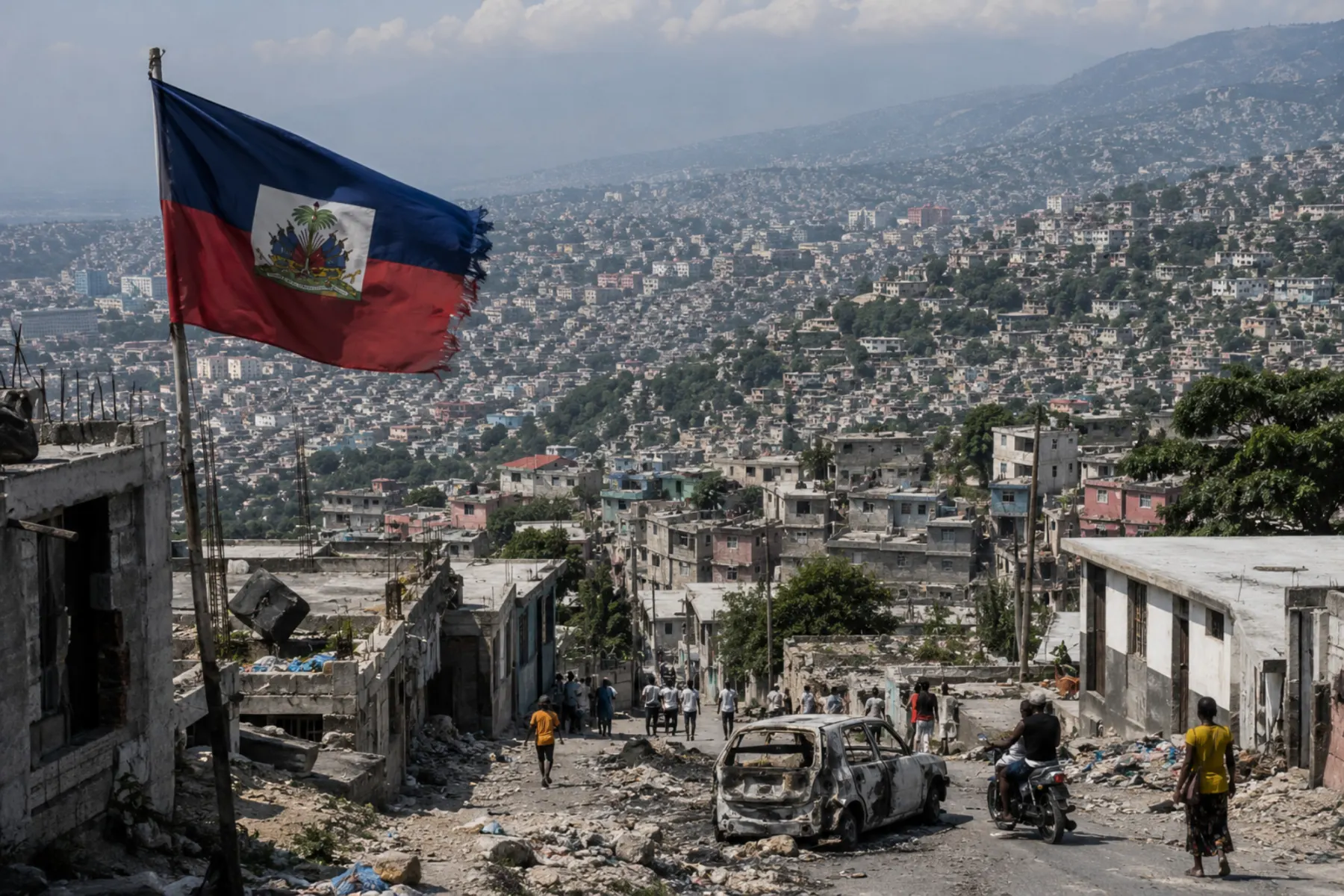
The security situation remains extraordinary. Armed groups control or influence large parts of the metropolitan area around Port-au-Prince, restricting movement, disrupting economic activity and weakening access to schools, hospitals and public services.
At the same time, there are limited signs that Haitian authorities and their international security partners are attempting to regain control in parts of the capital.
Haiti is therefore entering another decisive period.
The question is no longer simply how the country reached this point. It is whether security, political legitimacy and economic life can begin recovering at the same time.
The Disaster That Changed Everything
To understand modern Haiti, it is necessary to return to 12 January 2010.
A magnitude 7.0 earthquake struck close to Port-au-Prince, devastating one of the most densely populated parts of the country.
More than 200,000 people are estimated to have died, while around 1.5 million were displaced. Homes, schools, hospitals, roads and government buildings were destroyed on an enormous scale.
The economic damage was comparable to a substantial share of Haiti’s entire annual economic output.
The catastrophe was particularly severe because it did not strike a country with strong institutions and large financial reserves.
Haiti entered 2010 with deep poverty, limited infrastructure, weak administrative capacity and considerable vulnerability to natural disasters.
The earthquake therefore destroyed not only physical assets but also parts of the institutional machinery required to organise reconstruction.
International assistance arrived on a huge scale.
Roads were repaired, neighbourhoods rebuilt and public services gradually restored. Aid agencies, foreign governments, development banks, charities and Haitian organisations participated in reconstruction.
Much was achieved.
But rebuilding structures proved easier than building institutional resilience.
Haiti simultaneously needed reconstruction, economic development, stronger government institutions, employment, better public services and greater protection against future disasters.
Those objectives required years of political continuity and sustained investment.
Haiti rarely received either for long.
Reconstruction Without a Lasting Transformation
The years following the earthquake brought visible improvements to many communities, but the broader economy remained fragile.
Electricity remained unreliable. Transport infrastructure was limited. Poverty remained widespread. Government finances left little room for large-scale public investment.
The country’s geography created another difficulty.
Haiti is highly exposed to hurricanes, floods, landslides and earthquakes. A new storm can therefore destroy infrastructure and livelihoods that may have taken years to rebuild.
Reconstruction was never simply a matter of replacing what had been destroyed.
New infrastructure also needed to be stronger than what existed before.
That requires more money, stronger planning and more capable institutions — precisely the resources that were already limited.
Meanwhile, economic opportunities, universities, government institutions and major services remained heavily concentrated around Port-au-Prince.
This encouraged continued migration towards an urban area already struggling with housing, transport, sanitation, employment and public services.
Haiti was rebuilding, but many of its underlying vulnerabilities remained.
Hurricane Matthew: Another Major Setback
In October 2016, Hurricane Matthew struck Haiti’s southern peninsula.
The Category 4 hurricane caused widespread destruction, particularly in communities heavily dependent on agriculture.
Crops, livestock, homes, roads and bridges were damaged or destroyed across large parts of the south.
Agriculture is especially important in Haiti because many rural households depend directly on local production for both food and income.
When a major storm destroys a road in a wealthy country, the primary problem may be transportation.
In rural Haiti, the same event can simultaneously cut access to markets, destroy a family’s harvest, reduce food supplies, eliminate income and isolate communities from healthcare.
Hurricane Matthew therefore represented more than another natural disaster.
It demonstrated how environmental vulnerability, poverty and weak infrastructure could reinforce one another.
At almost the same time, Haiti was experiencing another difficult political transition.
A disputed election process had to be repeated, and Michel Martelly left the presidency in 2016 without an elected successor immediately ready to take office.
An interim administration followed before Jovenel Moïse ultimately became president in February 2017.
Once again, a country requiring long-term development planning was operating under political uncertainty.
When Political Crisis Became Economic Crisis
By 2018 and 2019, Haiti entered another period of severe unrest.
Demonstrations, political disputes, fuel shortages and wider dissatisfaction repeatedly disrupted normal economic activity.
A term became associated with this period: “peyi lòk”, meaning roughly “country locked”.
Roads were blocked. Schools closed. Businesses struggled to operate. Transport between different parts of the country became difficult.
This period is crucial for understanding today’s Haiti because 2019 marked the beginning of a prolonged economic decline.
What began as political disruption increasingly became a structural economic problem.
Businesses operating in unstable conditions reduce investment.
Transport interruptions raise prices.
Investors demand greater returns for taking risks or decide not to invest.
Skilled workers leave.
Government tax revenues weaken.
That, in turn, makes it more difficult for the state to finance police, courts, roads, electricity networks, schools and hospitals.
A dangerous feedback loop begins to form.
Weak institutions contribute to instability.
Instability weakens the economy.
A weaker economy reduces the resources available to strengthen institutions.
2020 and 2021: Crises Begin to Overlap
The COVID-19 pandemic arrived while Haiti was already economically vulnerable.
Instead of recovering from the disruption of 2019, the country experienced another setback.
Then came one of the most consequential events in Haiti’s recent political history.
President Jovenel Moïse was assassinated at his residence on 7 July 2021.
His killing deepened an already serious constitutional and institutional crisis.
Haiti subsequently entered a prolonged period without an elected president, while elections that could renew democratic institutions repeatedly failed to take place.
Barely five weeks later, another major earthquake struck.
The magnitude 7.2 earthquake of 14 August 2021 hit Haiti’s southern peninsula, killing more than 2,000 people and injuring thousands more.
Hundreds of thousands required humanitarian assistance.
The timing could hardly have been worse.
Haiti was simultaneously dealing with a presidential assassination, an institutional vacuum, economic contraction, pandemic effects, rising insecurity and another natural disaster.
It was during this period that the country’s security deterioration began moving into a fundamentally different phase.
From Criminal Gangs to Territorial Power
Haiti had experienced organised crime and armed groups long before 2021.
What changed was their scale, organisation, firepower and ability to control territory.
As the authority of the state weakened, armed groups expanded into areas where police presence was limited.
They increasingly controlled neighbourhoods, strategic roads and transport corridors.
That gave them something more powerful than weapons alone: economic leverage.
Controlling a road can mean controlling the movement of food.
Controlling access to a port can affect imports.
Controlling neighbourhoods can enable extortion.
Controlling transport corridors can isolate communities from jobs, schools and hospitals.
A security problem therefore became an economic and humanitarian problem.
In 2022, armed groups blockaded access to the Varreux fuel terminal, contributing to severe fuel shortages.
The effects spread far beyond transport.
Hospitals, generators, telecommunications networks, businesses and water systems all depended on fuel supplies.
Gang violence also increasingly damaged infrastructure directly.
Electricity, telecommunications, roads and water systems became harder to maintain as insecurity restricted the movement of technicians and supplies.
The state was not simply losing control of streets.
It was losing the ability to guarantee the systems that allow a modern city to function.
2024: The Security Crisis Reaches a New Level
The beginning of 2024 marked another major escalation.
Armed groups launched coordinated attacks on police stations, prisons, government facilities and critical infrastructure in Port-au-Prince.
Thousands of prisoners escaped after attacks on detention facilities.
The airport and port were disrupted.
Movement around the capital became extraordinarily dangerous.
Prime Minister Ariel Henry eventually left office as negotiations supported by the Caribbean Community produced a new transitional arrangement.
A Transitional Presidential Council was established with the task of improving security and preparing the country for elections.
But the new authorities inherited a state whose effective control over the capital had already been severely reduced.
International assistance consequently shifted increasingly towards security.
A Kenya-led multinational security mission began deploying to support the Haitian National Police.
Its impact was limited by the scale of the challenge, available personnel, financing and equipment.
Further international security structures were subsequently developed in an effort to increase operational support for Haitian forces.
Whether this becomes a lasting turning point remains uncertain.
Haiti’s Political Situation in 2026
Haiti remains outside a normal constitutional political cycle.
The Transitional Presidential Council reached the end of its mandate in February 2026.
Government responsibility subsequently remained with the interim executive structure led by Prime Minister Alix Didier Fils-Aimé and the Council of Ministers.
The immediate priorities are security, elections and economic and social stabilisation.
Haiti still has no elected president, and democratic institutions have been weakened by years without national elections.
The most important political objective is therefore the return to an elected government.
A national electoral calendar has been prepared, with presidential and legislative elections planned for late 2026.
The importance of elections goes beyond choosing political leaders.
They represent a potential route back towards constitutional legitimacy.
But the challenge is considerable.
Credible elections require security.
Candidates must be able to campaign.
Electoral staff need access to communities.
Voters must be able to reach polling stations.
Ballot materials must move safely.
Results need to be transmitted and protected.
In parts of Haiti, those conditions cannot yet be taken for granted.
The existence of an electoral timetable is therefore significant, but it is not a guarantee that the transition will proceed exactly as planned.
What Daily Life Looks Like
Political structures can make Haiti’s crisis sound abstract.
For ordinary households, it is anything but.
Security determines whether a parent can travel to work.
It determines whether food reaches a market.
It determines whether a child can attend school.
It determines whether an ambulance can reach a neighbourhood.
It can even determine whether a family can remain in its home.
By 2026, nearly 1.5 million Haitians had been displaced inside the country by violence.
Many moved in with relatives or host families.
Others live in temporary shelters.
Some families have been displaced several times as violence moves from one district to another.
Food insecurity has also reached severe levels.
Around half the population faces acute food insecurity, with millions struggling to obtain enough food reliably.
Food insecurity does not necessarily mean that food has completely disappeared.
It means that many families cannot consistently afford or access enough of it.
A household may reduce the number of meals it eats.
Adults may eat less so children can eat.
Families may sell possessions.
School spending may be postponed.
Relatives abroad may be asked to send more money.
These coping mechanisms can keep households functioning temporarily.
But they become increasingly difficult to sustain.
A Health System Under Extraordinary Pressure
The healthcare system provides another measure of the crisis.
Many medical facilities in and around Port-au-Prince have closed, been damaged or are operating with reduced capacity.
Healthcare workers face the same problems as everyone else.
They must travel through insecure areas.
Medicines and equipment must reach hospitals.
Ambulances need safe roads.
Electricity and fuel are required to keep facilities operating.
The consequences extend far beyond people injured in violence.
Pregnant women still need maternity care.
Children require vaccinations.
Patients with diabetes, heart disease or hypertension need medicines.
Infectious diseases require surveillance and treatment.
When healthcare facilities close because staff cannot reach them or supplies cannot be delivered, ordinary medical conditions become more dangerous.
Haiti’s health emergency is therefore another example of how security failure multiplies existing development problems.
Seven Years of Economic Decline
The economic figures reveal how prolonged the deterioration has become.
Haiti’s economy contracted for a seventh consecutive year in 2025.
Real economic output declined again, while inflation remained extremely high.
Food, housing and transport costs have placed particular pressure on households.
Government revenue remains very low relative to the size of the economy, severely restricting the state’s ability to finance public services and reconstruction.
These numbers have practical consequences.
High inflation is especially damaging to poorer households because basic necessities account for a larger share of their spending.
If food prices rise sharply, a wealthier household may save less.
A poor household may eat less.
Businesses face their own difficulties.
Operating a company becomes considerably harder when employees cannot safely reach work, transport routes are periodically blocked, electricity is unreliable and imported goods are delayed.
Security costs rise.
Insurance becomes more difficult.
Investment decisions are postponed.
Some skilled Haitians leave the country, reducing the pool of experienced workers available to businesses and public institutions.
At the same time, the government collects less revenue from a shrinking formal economy.
Again, the different elements of the crisis reinforce one another.
The Importance of Haiti’s Diaspora
There is another side to the economic story.
Haiti possesses one of the Caribbean’s most important diasporas.
Large Haitian communities live in the United States, Canada, France, the Dominican Republic and elsewhere.
Money sent home by Haitians abroad has become an essential source of household income.
For many families, remittances help pay for food, education, healthcare and housing.
The diaspora also represents something more than financial transfers.
It is a pool of capital, professional expertise, entrepreneurial networks and international connections that could become particularly important in any future reconstruction.
Haiti also has a young population, proximity to major North American markets and potential in agriculture, manufacturing and services.
Those advantages remain real.
But potential cannot substitute for security and functioning institutions.
Why Haiti Cannot Simply Defeat the Gangs and Move On
It is tempting to view Haiti’s situation primarily as a policing problem.
There is no doubt that security is the immediate priority.
Without secure roads, economic activity cannot normalise.
Without secure communities, displaced families cannot safely return.
Without security, elections cannot be reliably organised.
But removing armed groups from territory would not by itself solve Haiti’s deeper problems.
A functioning security system requires police officers who are properly trained, equipped and paid.
Arrests require functioning courts.
Courts require judges, prosecutors, administrators and secure buildings.
Convictions require prisons capable of holding offenders safely.
Communities require public services if the state is to maintain legitimacy after security forces return.
Young people require educational and economic alternatives if armed organisations are not simply to recruit another generation.
Security operations therefore have to be combined with functioning justice institutions, controls on illegal weapons, stronger public administration and economic recovery.
Haiti’s crisis developed systemically.
Its recovery will have to be systemic as well.
Why Geography Matters
Another mistake is to describe all of Haiti as though conditions were identical everywhere.
They are not.
Port-au-Prince is the centre of the security emergency, and the concentration of political institutions, economic activity, ports and transport links gives developments there national significance.
But conditions outside the metropolitan area vary considerably.
Some regions remain more stable.
Others have come under growing pressure as armed groups expand along strategic corridors.
Rural communities face a different combination of challenges, often involving agricultural losses, limited market access, weak infrastructure and poor access to healthcare and education.
Meanwhile, communities receiving internally displaced people must support larger populations without a comparable increase in housing, jobs, schools or medical capacity.
Displacement therefore transfers part of the crisis from violent areas into relatively safer ones.
The absence of gunfire does not necessarily mean the absence of pressure.
The First Signs of a Possible Change
Despite the scale of the crisis, 2026 has produced some developments that deserve attention.
Haitian authorities and international security partners have attempted to regain control over parts of Port-au-Prince.
Some government institutions have been able to resume activities in locations that had previously become inaccessible.
International security forces are also expanding their operational presence alongside Haitian police.
These remain limited developments.
They are not evidence that the crisis has been resolved.
Armed groups remain powerful.
Violence continues.
Insecurity continues to disrupt schools, healthcare and economic activity.
But after years in which territorial control appeared to move overwhelmingly away from the state, even limited reversals are politically important.
The second development is electoral.
The preparation of a national electoral calendar gives Haiti a potential route back towards elected national institutions.
Neither development guarantees success.
Together, however, they create something Haiti has lacked for some time: a possible sequence.
Security improvements could make elections possible.
Elections could restore political legitimacy.
Greater legitimacy could support institutional reconstruction.
Institutional improvement could encourage investment.
Investment could create employment and strengthen government revenue.
That is the positive version of the cycle that has operated in reverse for much of the past decade.
Why Recovery Will Still Take Years
Even under an optimistic scenario, Haiti’s problems cannot be repaired quickly.
A country that has experienced years of economic contraction cannot replace lost investment overnight.
A health system with closed hospitals cannot rapidly replace experienced doctors and nurses who have left.
A child who has missed years of education cannot simply return to the classroom without consequences.
Infrastructure damaged or neglected over many years requires financing and time.
Businesses need evidence that security improvements are durable before committing substantial capital.
Political trust cannot be restored through one election alone.
This is perhaps the most important lesson of Haiti’s past 15 years.
Short-term improvements have repeatedly occurred.
The difficulty has been turning them into durable institutions capable of surviving the next shock.
What Could Happen Next
Several broad possibilities now exist.
In the more favourable scenario, Haitian police and international security forces gradually secure major roads, infrastructure and population centres.
If security improves sufficiently, national elections could proceed and begin restoring political authority based on an electoral mandate.
That would not immediately solve Haiti’s economic and security problems.
But it could make longer-term reforms easier to organise and international assistance easier to coordinate.
Economic activity could then begin recovering gradually as transport routes reopen, businesses regain confidence and investment becomes less risky.
A second scenario is a prolonged transition.
Security could improve in some areas while remaining poor in others.
Elections might become difficult to organise nationwide.
Investment could remain weak, while humanitarian needs stay extremely high.
Haiti would then continue operating in the uncomfortable space between emergency management and political reconstruction.
The most damaging scenario would involve another major expansion of gang control.
Further disruption of ports, roads or government institutions could increase displacement, push food prices higher and undermine electoral preparations.
A major hurricane or earthquake could compound those problems further.
Haiti’s future therefore remains unusually dependent on several developments moving in the same direction at the same time.
A Country That Is More Than Its Crisis
There is a danger in discussing Haiti almost exclusively through catastrophe.
A country of millions of people cannot be reduced to gangs, earthquakes or humanitarian statistics.
Every day, Haitians operate businesses, cultivate farms, teach children, treat patients, trade in markets, build homes and support relatives.
Families organise ordinary lives under extraordinary conditions.
Haiti also possesses considerable long-term advantages.
It is close to the world’s largest consumer market.
It has a large diaspora.
It has a young population.
It has agricultural potential, manufacturing experience and a culture whose influence reaches far beyond its borders.
These advantages help explain why Haiti continues to function despite circumstances that might suggest otherwise.
But resilience should not be confused with development.
The ability of people to survive repeated crises is not the same as having the institutions and economic opportunities required to escape them.
Fifteen Years That Explain the Present
Haiti’s current situation was not created by one government, one president, one international organisation, one earthquake or one group of criminals.
It developed through accumulation.
The earthquake of 2010 devastated physical and institutional capacity.
Reconstruction produced progress but did not eliminate structural vulnerability.
Hurricane Matthew destroyed livelihoods and infrastructure just as the country was attempting to move forward.
Political instability disrupted investment and governance.
The economic crisis beginning in 2019 reduced opportunity and government revenue.
President Jovenel Moïse’s assassination in 2021 deepened the constitutional vacuum.
Another earthquake arrived weeks later.
As state authority weakened, armed groups expanded.
As armed groups expanded, businesses, infrastructure and public services suffered.
As the economy weakened, the state’s ability to respond became still more limited.
By 2026, these developments had converged into a crisis involving security, politics, economics, food, healthcare and displacement simultaneously.
That explains why there is no single solution.
More police without functioning courts will not be enough.
Elections without security will be difficult.
Security without economic opportunity may prove temporary.
Economic investment without political stability will remain limited.
International assistance without stronger Haitian institutions cannot substitute indefinitely for a functioning state.
Yet the reverse is also true.
If security can gradually improve, economic activity can return.
If economic activity returns, employment and government revenues can increase.
If institutions strengthen, security gains can become more durable.
And if credible elections take place, Haiti could begin restoring the democratic legitimacy needed to make long-term decisions.
For perhaps the first time in several years, elements of such a pathway are visible.
They remain fragile.
Nearly 1.5 million displaced people cannot wait for institutional reform.
Millions facing hunger need assistance now.
Hospitals, schools and businesses need security now.
Haiti therefore enters the final months of 2026 with an unusual combination of danger and possibility.
The security crisis remains severe.
Democratic institutions remain incomplete.
Poverty and hunger remain widespread.
But parts of the state are attempting to re-establish themselves, international security support is expanding and an electoral timetable offers a possible route back towards democratic government.
After 15 years of repeated setbacks, Haiti’s central challenge is no longer simply surviving the next emergency.
It is whether security, political legitimacy, economic recovery and functioning public institutions can finally begin reinforcing one another rather than collapsing together.
Haiti’s crisis was not created overnight, and it will not disappear through a single election, security mission or development programme.
The country’s future will depend on whether a fragile opening in 2026 can become something Haiti has repeatedly been denied over the past 15 years: enough stability, for long enough, to begin building beyond the next crisis.
Source & Transparency
This article is published by Ireland Newspaper for editorial and informational purposes.
Published: 11 August 2026 · Updated: 11 August 2026

Newsroom Ireland Newspaper
Ireland Newspaper editorial team prepares daily news coverage for readers in Ireland and abroad.