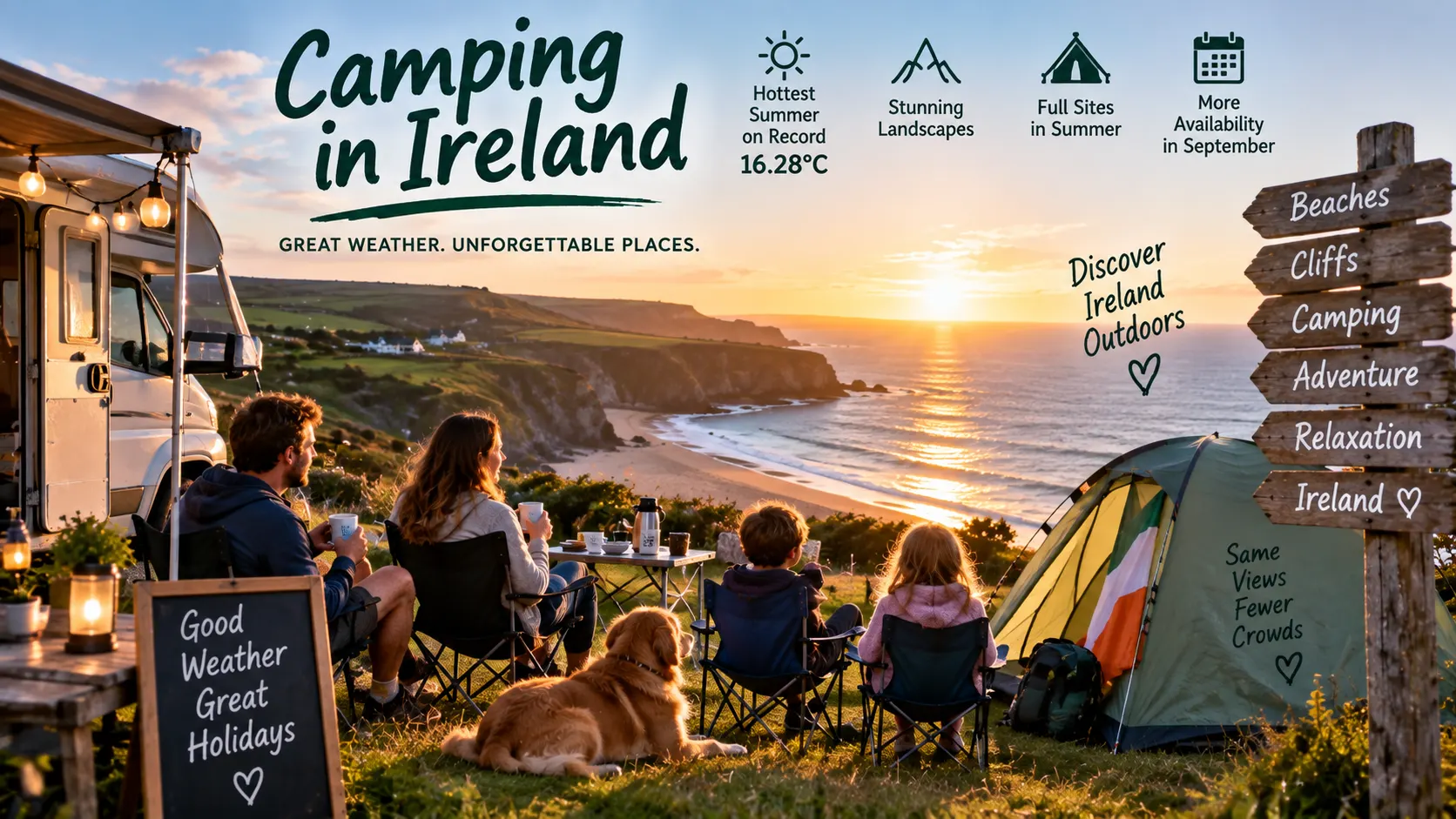
At the height of summer, getting a pitch at some of Ireland’s most popular campsites could be difficult. By early September, the picture had changed almost overnight. Camping Ireland, the industry body representing caravan and camping parks, described an exceptional summer in which many sites were extremely busy and availability became limited, but it is now encouraging travellers to take advantage of the spare capacity that has reappeared as the school holidays end.
The timing is no coincidence. Ireland has just experienced what Met Éireann provisionally classifies as its hottest summer since national records began in 1900. July was extraordinarily dry and sunny, August remained warmer and drier than average for most of the month, and lengthy dry spells created conditions unusually favourable for a form of tourism whose success is closely tied to the weather. For a sector selling nights under canvas, caravan awnings, outdoor cooking, beaches and evenings outside, that matters enormously.
But weather alone does not explain what happened. The summer of 2026 also brought stronger inbound tourism, continued sensitivity to accommodation prices, established demand for domestic breaks, a large population of repeat camping customers and a travel format particularly suited to Ireland’s coasts and countryside. The rapid decline in demand as September arrives reveals the other side of the story: Irish camping remains structurally tied to school holidays, daylight, weather expectations and a business model in which many parks themselves operate for only part of the year.
Ireland’s national mean temperature for June, July and August 2026 was 16.28°C, making it provisionally the hottest summer on record. Seasonal rainfall was only 78% of the 1991–2020 average.
The Weather Did Something Remarkable to the Camping Equation
Irish camping has always involved an unusually large weather risk. A hotel room has approximately the same utility in rain or sunshine; a tent does not. Persistent rainfall can turn a coastal camping holiday into a test of endurance, while prolonged warmth and sunshine can make the same pitch one of the most attractive and affordable places to spend a summer week.
Summer 2026 moved that calculation decisively in favour of the campsite. Met Éireann recorded a national mean summer temperature of 16.28°C, marginally exceeding the record set only a year earlier. Almost all seasonal rainfall totals were below their long-term averages, while all 25 principal weather stations experienced dry spells during the summer. Fourteen stations, including all three Dublin stations and three in Cork, recorded their hottest summer on record.
July was particularly important. It was the second-hottest July recorded nationally since 1900 and the driest July on record. Heatwaves were observed at seven stations, with one lasting 13 days at Moore Park in County Cork. In August, the national mean temperature remained above average and Ireland recorded its ninth-warmest August since 1900.
Those conditions did more than improve holidays that had already been booked. Good weather can stimulate short-notice domestic demand because camping, caravan and motorhome trips can often be organised more spontaneously than a conventional overseas holiday. Once a spell of reliable sunshine becomes visible in the forecast, families who already own equipment and motorhome or caravan users with relatively low additional accommodation costs can decide to travel within days.
That creates a feedback effect during exceptional weather. Local families book short stays, established campers return, day-to-day recommendations spread and coastal destinations become more attractive at precisely the same time. Camping Ireland’s late-August assessment that some parks had experienced limited availability is consistent with what would be expected from such a weather-sensitive market.
Why Summer 2026 Was So Favourable for Outdoor Holidays
| Indicator | Summer 2026 | Why it mattered |
|---|---|---|
| National mean temperature | 16.28°C | Hottest summer on record |
| Seasonal rainfall | 78% of normal | Fewer weather disruptions |
| July temperature | 2nd hottest since 1900 | Peak holiday conditions |
| July rainfall | Driest July on record | Strong outdoor conditions |
| Longest partial drought | 66 days at Oak Park | Exceptional dry spell |
Source: Met Éireann, Climate Statement for Summer 2026 and monthly climate statements.
Camping Offered Something Expensive Accommodation Could Not
Weather made camping attractive, but the relative price of different holidays also matters. Irish consumers have become increasingly conscious of the cost of domestic breaks. Fáilte Ireland’s tourism research has repeatedly identified value for money as an important consideration, while its 2026 Business of Tourism report describes visitors as increasingly selective and price-sensitive.
Official consumer-price data reinforce the point. In July 2026, the CSO’s price index for hotels, motels, inns and similar accommodation services was 3.8% higher than a year earlier. That does not prove that higher hotel prices directly caused families to move into tents or caravans, and the two products appeal to different types of traveller. It does, however, make the relative economics of camping more noticeable, particularly for larger families.
Once somebody already owns a tent, caravan or motorhome, the marginal cost of another night away can be comparatively modest. A campsite pitch generally replaces the accommodation component of a holiday rather than the entire holiday budget. Families still spend money on fuel, food, activities, admissions and eating out, but they gain greater control over one of the largest costs of travelling: where they sleep.
This is especially relevant in Ireland, where accommodation demand can become highly concentrated in popular towns and coastal destinations during school holidays, festivals and major events. Camping adds flexible capacity without requiring every visitor to occupy a conventional hotel room, holiday home or bed and breakfast. In that sense, the sector can act as a pressure valve during the busiest weeks of the tourism calendar.
A Strong Camping Summer Does Not Mean All Domestic Tourism Boomed
There is an important statistical distinction. As of early September, complete official data covering all domestic tourism during the peak summer months of 2026 are not yet available. It would therefore be premature to describe the campsite experience as proof of a nationwide staycation boom.
The most recent complete annual CSO figures show that Irish residents made 15.3 million domestic overnight trips during 2025, 8% fewer than in 2024. That was followed by an improvement at the beginning of 2026: domestic overnight trips increased by 6% year-on-year in the first quarter, while nights spent on those trips rose by 9%.
Camping may consequently have outperformed parts of the wider domestic market during the fine summer without the entire staycation economy expanding at the same rate. A hot, dry summer can change the distribution of holidays as much as their total number. Households that would not normally camp may experiment with it, existing campers may take additional trips, and people already intending to holiday in Ireland may spend more nights outdoors rather than in another accommodation category.
There is also evidence that repeat business is particularly important. In Fáilte Ireland’s Tourism Businesses’ Sentiment Survey conducted in spring 2026, 63% of responding caravan parks identified repeat visitors as a reason for optimism. The caravan and campsite sample contained only 30 businesses, so it should be treated as an indication of operator sentiment rather than a measurement of the entire industry. Nevertheless, it highlights an important feature of the market: once households have invested in equipment and found sites they enjoy, the cost and effort of returning can be relatively low.
Foreign Visitors Added Another Layer of Summer Demand
The 2026 summer was not solely a domestic story. Ireland’s inbound tourism strengthened significantly during the first seven months of the year. The CSO recorded 676,300 foreign visitors completing trips to Ireland in July, 5% more than in July 2025. Across January to July, an estimated 3.9 million overseas visitors completed overnight trips, 13% more than during the same period of 2025 and broadly level with the corresponding period of 2024.
Not all of those visitors camped, of course. Hotels remained the principal accommodation type for 44% of July’s overseas visitors, while one-third stayed with family, friends or in property they owned. The available national inbound statistics do not isolate the 2026 campsite boom sufficiently to calculate what proportion came from foreign campers.
But the structure of Irish camping has long had an international component. Travellers arriving from Britain and continental Europe can combine ferry journeys with cars, caravans, campervans and motorhomes, while rental vehicles allow visitors arriving by air to undertake road trips. Ireland’s relatively small geographical scale then becomes an advantage: several regions can be combined within one holiday without changing accommodation every night in the conventional sense.
The Wild Atlantic Way is particularly compatible with that form of travel. So are parts of Kerry, Cork, Clare, Galway, Mayo, Donegal, Waterford and Wexford, where beaches, hiking, cycling, surfing and scenery provide the activity around which the overnight stop is organised. Camping is not simply cheaper accommodation in those locations. For many travellers, living close to the landscape is part of the product.
Motorhomes Changed What a Camping Holiday Can Be
The word camping now describes several different markets. There is the traditional family tent, the touring caravan, the motorhome, the converted campervan, glamping accommodation and sites combining several of these formats. They behave differently economically and respond differently to weather.
Motorhomes and campervans are especially significant because they reduce one of traditional camping’s greatest disadvantages: exposure to bad conditions. Rain can still spoil the reason for visiting a destination, but it does not necessarily make the accommodation unusable. Heating, kitchens, electricity, onboard water and permanent beds allow travellers to extend their season beyond the weeks when tent camping is most comfortable.
They also make touring easier. A traveller can move from West Cork to Kerry, Clare and Galway without repeatedly packing and unpacking a conventional holiday base. That suits the geography of Ireland’s tourism proposition, which often encourages visitors to explore multiple towns, beaches, trails and coastal viewpoints rather than remain inside a single resort.
It would nevertheless be unsafe to attribute the 2026 campsite performance to a precisely measured surge in campervan ownership without current evidence establishing such a link. What can be said is that Camping Ireland’s present network contains extensive provision for motorhomes and campervans and that this form of travel gives the sector a more flexible customer base than tent camping alone.
Then September Arrives — and the Market Changes in Days
The same industry that struggled with availability during parts of the summer is now advertising spare capacity. That may look like a collapse in demand, but it is more accurately understood as the return of a powerful seasonal pattern.
School calendars are the most obvious dividing line. A family with school-age children that can travel for a week in July may have virtually no ability to do so once September begins. The fall in family demand happens across a narrow period rather than gradually. Universities and workplaces return to normal routines at much the same time, reinforcing the effect.
The weather psychology also changes before the weather itself necessarily becomes unsuitable. September can deliver mild, dry conditions, but the risk of rain, wind and colder nights increases as autumn advances. Daylight hours shorten. People are less willing to commit to a tent holiday when a poor forecast could transform the experience, while families are less likely to make a long journey for a short break when children must return to school on Monday morning.
The sector has historically been exceptionally concentrated in summer. Camping Ireland’s older industry statistics, based on 2009 data, estimated that 78% of camping visitors travelled between June and August. Those figures are far too old to describe today’s market precisely, but they demonstrate that extreme seasonality existed long before the pandemic, recent hotel-price increases or the summer of 2026.
The supply side reinforces the pattern. Camping Ireland’s 2026 opening calendar shows many parks opening in March or April and closing during September or October. Only a relatively small group advertises full year-round operation, with several others available during the off-season only by arrangement. Once customers expect campsites to close and operators expect customers not to arrive, extending the season becomes a coordination problem rather than simply a marketing exercise.
Why demand falls after the summer peak
- School holidays end almost simultaneously across the country.
- Families lose the flexibility required for week-long domestic trips.
- Shorter days reduce the usable outdoor part of a holiday.
- Weather risk becomes more important for tents and outdoor activities.
- Many campsites reduce operations or close during autumn and winter.
- Some attractions, cafés and seasonal tourism services also shorten their opening periods.
- Visitors may assume destinations are effectively closed even when accommodation remains available.
Seasonality Is Not Just a Campsite Problem
Camping’s September slowdown is an extreme version of a challenge affecting Irish tourism more broadly. Fáilte Ireland’s 2026 Business of Tourism report says 42% of overseas arrivals occur between June and September. Hotels, attractions, restaurants and activity providers all face some degree of uneven demand, although the effect is much more pronounced for weather-dependent businesses.
Seasonality has significant economic consequences. A business may have to earn enough in ten or twelve extremely busy weeks to cover maintenance, insurance, financing and capital costs across the whole year. Staff are needed intensively during summer but may not have enough work to remain employed through winter. Owners can be reluctant to invest in facilities that will generate revenue for only part of the calendar.
This helps explain why simply telling campsites to remain open longer is unlikely to work. Opening a reception, heating shower blocks, cleaning facilities and maintaining services for a handful of customers can cost more than those customers generate. The question is therefore how to create sufficient off-season demand to make extending operations commercially rational.
Ireland’s New Tourism Strategy Is Explicitly Trying to Solve This
The direction of government tourism policy is already moving towards a less seasonal model. Fáilte Ireland’s Corporate Strategy 2026–2029 identifies regional and seasonal balance as central objectives. It aims to increase domestic tourism revenue by 7% annually, achieve annual visitor growth of 7% in less developed regions and improve shoulder-season growth relative to the high season.
The strategy also introduces an Outdoor Ireland programme focused on walking, cycling and water-based activities. That is particularly relevant to caravan and camping businesses because these activities provide reasons to travel outside the traditional beach-holiday window. A campervan visitor travelling for a walking festival in October requires different conditions from a family pitching a tent beside the sea in July.
Existing rural investment can support that transition. The Government’s Outdoor Recreation Infrastructure Scheme for 2026–2027 has €20 million available for new and improved outdoor recreational infrastructure, with funding covering trails, amenities, repair and project development. Such schemes are not campsite subsidies, but better trails, cycle infrastructure, waterfront facilities and recreation amenities can create demand that nearby accommodation providers are then able to capture.
Fáilte Ireland is also investing in destination plans designed to spread tourism beyond peak periods. Wexford’s strategy includes a year-round coastal and outdoor focus, North Mayo is developing trails and visitor hubs around its coastal landscape, and other destination plans explicitly seek longer stays and better visitor dispersal. For camping businesses, the important point is that accommodation demand rarely exists in isolation. People need a reason to travel first.
What Could Extend Ireland’s Camping Season?
| Change | Potential effect | Main constraint |
|---|---|---|
| More all-weather facilities | Makes autumn trips easier | Capital and heating costs |
| Walking and cycling events | Creates off-season demand | Needs local coordination |
| Motorhome service points | Supports flexible touring | Planning and infrastructure |
| Heated washrooms | Extends usable season | Energy cost |
| Year-round attractions | Gives visitors a reason to stay | Requires sufficient demand |
| Digital live availability | Encourages spontaneous breaks | Technology adoption |
| Festivals and food tourism | Reduces dependence on weather | Needs critical visitor mass |
Analysis based on current tourism strategy, campsite operating patterns and outdoor recreation policy.
The Best Opportunity May Be Spring and Autumn, Not January
A stronger year-round sector does not necessarily mean that every tent pitch should be occupied in December. Ireland’s weather, daylight and tourism geography make that unrealistic for much of the market. A more achievable objective is to lengthen the profitable season at both ends.
April, May, September and October offer a more plausible growth opportunity. Motorhomes and caravans can operate comfortably in cooler conditions, roads and attractions are less congested, accommodation capacity is easier to find and many natural landscapes remain highly attractive. Travellers without school-age children, including retired people and international touring visitors, are not bound to July and August.
The economics could be powerful even without recreating peak-summer occupancy. A campsite that adds several commercially viable weekends in spring and autumn spreads its fixed costs over more paying nights. The local pub, café, grocery shop, bike-hire business and visitor attraction benefit from spending that would otherwise disappear when August ends.
This is also where event-led tourism matters. Walking festivals, cycling weekends, food events, music, dark-sky tourism, angling and autumn outdoor activities can create a reason to travel independent of beach weather. If destinations coordinate those experiences with accommodation that is visibly open and bookable, the perceived season can gradually expand.
For Rural Ireland, Campers Can Be Economically Valuable Beyond the Pitch Fee
The direct campsite charge captures only part of a visitor’s contribution. Campers buy groceries, fuel and meals. They visit pubs, cafés, heritage attractions and activity providers. Motorhome and caravan tourists moving through several regions can distribute that spending among smaller towns that receive fewer conventional hotel visitors.
That dispersal is particularly valuable because tourism is one of the industries capable of bringing outside expenditure directly into rural and coastal communities. Fáilte Ireland estimates that tourism supported 229,400 jobs in 2025, with businesses distributed throughout the State. A campsite does not need to employ hundreds of people itself to influence the surrounding economy.
There is also a geographic advantage. Camping capacity can exist in locations where constructing a large hotel would be commercially unrealistic or environmentally inappropriate. Properly planned parks can accommodate visitors near beaches, trails and rural attractions while retaining a relatively dispersed form of development.
But the economic benefit depends on visitors being connected to local businesses. A motorhome that arrives fully stocked, stays one night and leaves early the next morning creates less local value than a visitor who remains several days, shops locally and books activities. Future tourism policy therefore has an interest not simply in counting vehicles or bednights but in encouraging longer stays and greater local expenditure.
More Camping Also Creates Infrastructure Problems
The success of outdoor tourism has a physical cost if infrastructure does not keep pace. Campervans and motorhomes need legal places to stop, fresh water and appropriate facilities for grey and toilet waste. Campsites require water, wastewater treatment, electricity, refuse collection and road access. Popular coastal areas must also absorb additional traffic at precisely the time when local roads and car parks are already busiest.
Formal campsite capacity can actually be part of the solution because managed parks concentrate visitors where waste, sanitation and parking can be controlled. Problems become more difficult when demand spills into unsuitable roadside areas, beach car parks or environmentally sensitive land without adequate facilities.
Leave No Trace Ireland specifically advises motorhome users to identify locations with suitable waste-disposal facilities. Its wider guidance stresses proper disposal of waste, durable camping surfaces and minimising the effects of fire. Those principles became unusually relevant during the dry summer of 2026.
In June, the National Parks and Wildlife Service reiterated a complete ban on fires and barbecues in National Parks as exceptionally warm conditions produced a very high vegetation-fire risk. Coastal dunes, uplands and other habitats can also suffer from trampling, vehicle access and uncontrolled recreation. Expanding outdoor tourism therefore requires management as well as promotion.
Climate Change Could Lengthen the Season — and Make It Harder to Manage
Two consecutive record-hot Irish summers might suggest an obvious conclusion: warmer conditions will make camping easier. That would be too simple. A changing climate may produce periods in which spring or autumn outdoor tourism becomes more attractive, but it can simultaneously increase exposure to heat, drought, wildfire, intense rainfall and other extremes.
The summer of 2026 illustrates both sides. Warmth and sunshine supported exceptional demand, yet the same dry conditions produced fire danger and long drought periods. Oak Park in County Carlow experienced a 66-day partial drought, the longest there in records extending back to 1941. If increasingly dry summers place pressure on local water supplies or sensitive landscapes, campsites may face new operating constraints rather than simply a longer season.
Future investment therefore needs to be climate-resilient. Water efficiency, appropriate wastewater capacity, shade, drainage, renewable energy, fire management and careful siting will become more important if Ireland wants to expand outdoor accommodation without degrading the landscapes that attract visitors in the first place.
The Sector Also Has to Become Easier to Book
One of camping’s advantages is spontaneity, but that advantage disappears if visitors cannot quickly establish where there is space. Camping Ireland notes that most parks now operate some form of pre-booking policy, yet the sector remains fragmented compared with large hotel and short-term accommodation platforms.
Better real-time availability could make shoulder-season travel easier. A family looking at a promising Friday weather forecast should be able to see which sites are open, which accept tents or motorhomes, what facilities operate during that month and whether late arrival is possible. For an international motorhome traveller, the same system could help construct a multi-stop itinerary rather than forcing separate searches for every destination.
Fáilte Ireland’s new corporate strategy places significant emphasis on digital adoption across tourism businesses. For smaller campsites, that can be as important as physical expansion. Filling existing pitches for more weeks of the year may produce a better return than adding capacity that is needed only during a handful of exceptional July weekends.
The Summer Boom Should Not Become a Race to Build Everywhere
One record-weather summer can create the impression that Ireland simply needs many more pitches. That conclusion deserves caution. The industry faces a severe difference between peak and off-peak demand. Building enough permanent capacity to ensure nobody is disappointed on the busiest weekend of an exceptional summer could leave expensive infrastructure underused for much of the year.
The more durable approach is likely to combine selective new capacity with better utilisation of what already exists. Locations facing repeated shortages may justify additional pitches or motorhome facilities, particularly where tourism demand is well established. Elsewhere, improving the length of season, quality of facilities and connections with local attractions may offer greater economic value.
Planning must also consider residents. Coastal villages and scenic rural areas are communities before they are tourism products. Excessive traffic, informal overnight parking, litter or pressure on public facilities can weaken local acceptance of tourism even when businesses benefit economically. Fáilte Ireland’s current strategy explicitly places community support and environmental sustainability alongside visitor and revenue growth, reflecting the need to balance these interests.
September’s Empty Pitches Are the Real Test
The summer of 2026 demonstrated that demand for camping in Ireland can be extremely strong when several conditions align. The weather was exceptional. Outdoor destinations were at their most attractive. Foreign visitor numbers were rising. Families were on holiday, accommodation costs elsewhere remained a consideration, and caravans and motorhomes gave travellers considerable flexibility.
September removes several of those supports at once. Children return to school, family travel falls, evenings shorten, weather confidence weakens and some tourism businesses begin winding down their own seasons. Campsite availability therefore returns quickly even if Ireland continues to experience pleasant autumn days.
The opportunity is not to eliminate that cycle completely. July will almost certainly remain more important than November. The more realistic objective is to make the curve less extreme: more motorhome touring in spring, more walking and cycling breaks in autumn, better year-round attractions, stronger local events, reliable service infrastructure and campsites able to tell travellers clearly when they are open and what they provide.
If that can be achieved, camping could do something Irish tourism policy has been trying to accomplish for years. It could move visitors away from the busiest accommodation centres, direct spending into rural and coastal communities and lengthen the tourism season without requiring every destination to become a large resort.
The lesson of 2026 is therefore broader than the fact that Ireland had an unusually good summer for sleeping outdoors. The packed pitches showed how much latent demand can appear when weather, value and freedom of travel come together. The empty spaces returning in September show where the harder work begins.
Sources
Camping Ireland — September the Golden Month for Outdoor Living
Camping Ireland — 2026 Caravan and Camping Parks Opening and Closing Dates
Met Éireann — Climate Statement for Summer 2026
Met Éireann — Climate Statement for July 2026
Central Statistics Office — Inbound Tourism July 2026
Central Statistics Office — Household Travel Survey Quarter 1 2026
Central Statistics Office — Consumer Price Index July 2026
Fáilte Ireland — Business of Tourism Report 2026
Fáilte Ireland — Corporate Strategy 2026–2029
Fáilte Ireland — Statutory Requirements for Caravan and Camping Parks
Source & Transparency
This article is published by Ireland Newspaper for editorial and informational purposes.
Published: 5 September 2026 · Updated: 5 September 2026

Newsroom Ireland Newspaper
Ireland Newspaper editorial team prepares daily news coverage for readers in Ireland and abroad.