When Donald Trump arrives in Dublin on Saturday, 12 September, the formal political programme is expected to last only a matter of hours. The issues surrounding it are much larger. The United States is Ireland’s most important individual export market and its dominant source of foreign direct investment, while Washington’s decisions on trade, pharmaceuticals, the Iran conflict and the future of Gaza can have direct consequences for Irish jobs, tax revenues, energy costs and foreign policy.
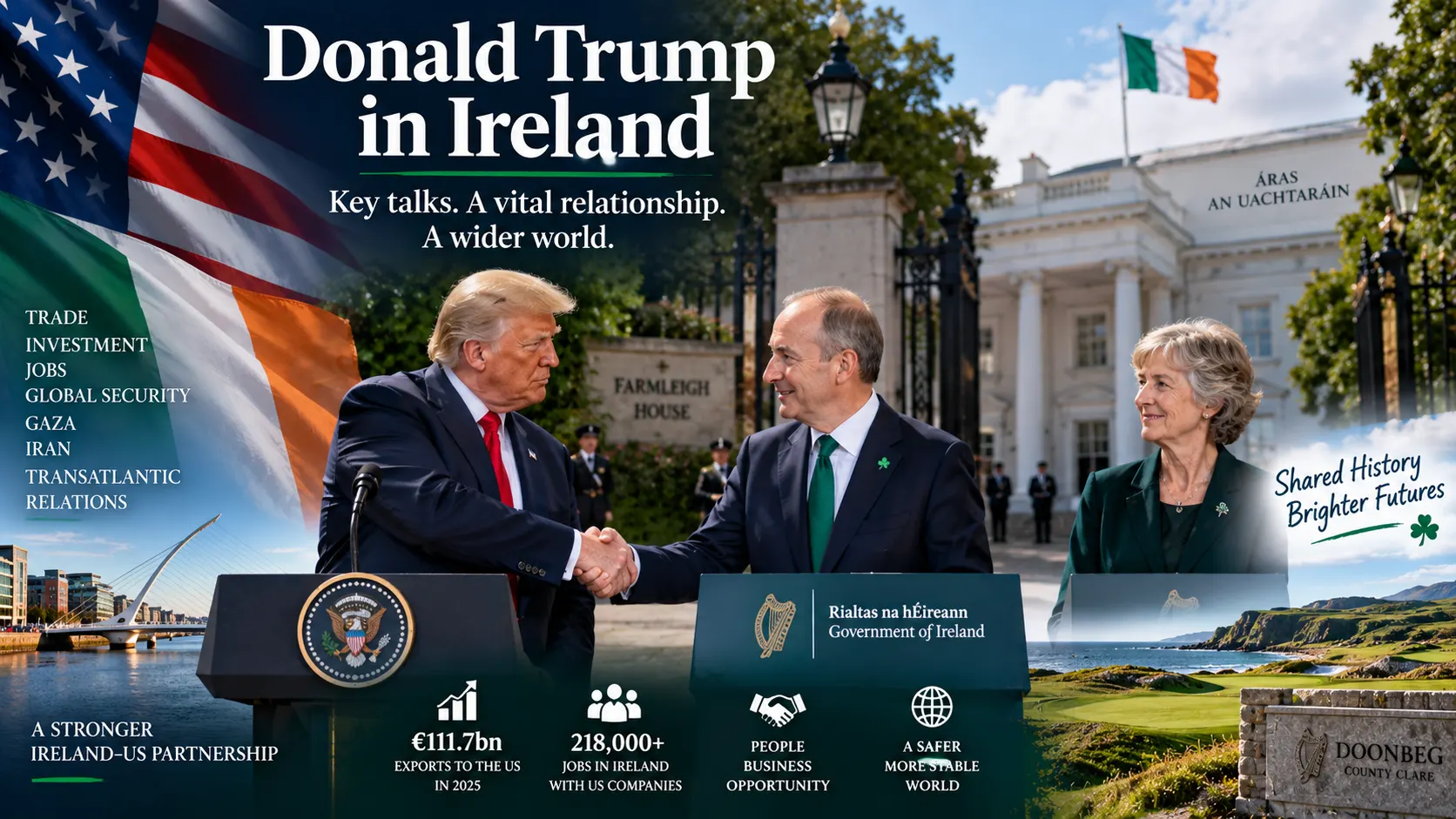
The latest arrangements envisage separate engagements in the Phoenix Park: a bilateral meeting with Taoiseach Micheál Martin at Farmleigh House and a brief courtesy call on President Catherine Connolly at Áras an Uachtaráin. Trump is then expected to travel to County Clare, where his Doonbeg resort is hosting the Irish Open. Officials have cautioned that final logistics can still change, but the political importance of the Dublin meeting is already clear.
Minister for Public Expenditure Jack Chambers said on Sunday that the Martin-Trump talks would examine both the two-way relationship between Ireland and the United States and wider global affairs. Asked specifically about Gaza and the West Bank, he pointed to Martin’s record of setting out the Irish position during his White House visit in March. Martin has separately confirmed that ending the conflict involving the United States and Iran, and restoring stability to global energy markets, will be among the issues he wants to discuss.
The result is an unusual diplomatic encounter. Ireland wants to protect one of the most valuable bilateral relationships it possesses while remaining capable of disagreeing with Washington on matters of international law and foreign policy. The central question is therefore not whether Dublin is “for” or “against” the Trump administration. It is how a small, open economy manages a relationship in which economic interdependence is enormous but policy interests are not always identical.
The Visit Is Short, but the Relationship Behind It Is Enormous
The Dublin programme is not expected to resemble the extensive presidential visits made by Barack Obama in 2011 or Joe Biden in 2023. Trump’s encounter with Connolly is being described as a courtesy call, while the substantive government-to-government discussion will take place with Martin. An event at the US ambassador’s residence in the Phoenix Park is also expected before the president continues to Doonbeg.
That distinction matters. Catherine Connolly is Ireland’s head of state, but the President does not conduct the Government’s foreign or economic policy. The Taoiseach and Government are responsible for those negotiations. The meeting at Áras an Uachtaráin therefore carries diplomatic and symbolic significance, particularly given Connolly’s previously expressed views on war and international affairs, but it should not be treated as a parallel Irish foreign-policy negotiation.
The Farmleigh meeting is different. Martin can raise Ireland’s economic interests directly with Trump, explain Dublin’s position on conflicts in the Middle East and Ukraine, and reinforce the broader political relationship. He cannot, however, negotiate an Irish-only trade settlement with Washington. Ireland is an EU member and commercial policy is largely conducted at European level, a distinction that becomes particularly important when tariffs are discussed.
No Other Bilateral Economic Relationship Looks Quite Like This One
Ireland’s dependence on the US relationship is visible most immediately in trade. The Central Statistics Office recorded €111.7 billion of Irish goods exports to the United States in 2025, representing 42.9% of all goods exported from Ireland under the customs-based trade statistics. That was an extraordinary increase of €38.2 billion from 2024.
Pharmaceuticals were central to the surge. Ireland exported €138.6 billion of medical and pharmaceutical products worldwide in 2025, equivalent to 53.2% of all merchandise exports. A significant share of the industry’s production and corporate ownership is linked to American multinational groups, making US industrial, pharmaceutical and trade policy particularly consequential for Ireland.
The relationship goes far beyond products crossing the Atlantic. IDA Ireland said in June 2026 that American companies had more than 1,000 operations in Ireland employing more than 218,000 people, close to one in ten workers in the country. These businesses include major employers in pharmaceuticals, medical technology, digital services, finance and advanced manufacturing.
The relationship also runs in the opposite direction. During his March visit to Washington, Martin said Irish companies employ approximately 200,000 people in the United States. Irish investment therefore gives Dublin an argument it has used repeatedly with the Trump administration: this is not simply a story of US companies using Ireland as an export platform. Irish capital, employers and businesses also contribute directly to the American economy.
How Deep Is Ireland’s Economic Relationship With the United States?
| Indicator | Latest figure | Why it matters |
|---|---|---|
| Irish goods exports to US | €111.7bn in 2025 | 42.9% of goods exports |
| Pharmaceutical exports worldwide | €138.6bn in 2025 | 53.2% of goods exports |
| US-backed operations in Ireland | More than 1,000 | Major FDI concentration |
| Employment at US companies | More than 218,000 | Nearly 10% of workforce |
| Irish-company jobs in US | About 200,000 | Shows two-way investment |
Sources: Central Statistics Office, IDA Ireland and Department of the Taoiseach, latest available figures.
The Bigger Vulnerability Is Not Simply Trade
Exports attract attention because the numbers are so large, but Ireland’s exposure to multinational companies is even more important when tax and employment are included. Revenue reported underlying net corporation-tax receipts of €32.9 billion in 2025 after excluding exceptional receipts connected with the European Court of Justice ruling. Foreign-owned multinationals accounted for 87% of those net corporation-tax receipts.
The concentration within that figure is striking. The ten largest corporate taxpayers accounted for 56% of net corporation tax in 2025. Revenue does not identify those companies publicly, and it would be incorrect to assume that all are American. The figure nevertheless demonstrates how much of Ireland’s public finances can be influenced by the profitability and investment decisions of a relatively small group of multinational businesses.
This is why a debate about Trump’s industrial policy matters in Ireland even before a factory closes or an investment is cancelled. Corporate decisions about where the next pharmaceutical plant, data centre, research laboratory or technology operation is built can affect Ireland years later. The main economic risk is therefore not necessarily a sudden withdrawal of American business. A gradual diversion of future investment towards the United States could also alter Ireland’s growth model over time.
There are counterweights. IDA employment remains at record levels, Ireland retains access to the EU single market, and US companies have built deep research, manufacturing and management operations in the country over several decades. Moving complex pharmaceutical or technology activity is far more difficult than shifting a line on a spreadsheet. That makes predictions of an imminent departure of American companies difficult to justify.
Foreign-owned multinational companies accounted for 87% of Ireland’s underlying net corporation-tax receipts in 2025. The ten largest corporate taxpayers accounted for 56% of the total. These figures cover foreign multinationals generally and should not be interpreted as figures for US companies alone.
Tariffs Have Moved From Threat to Long-Term Strategic Risk
When Martin visited the White House in March, trade was already one of the most sensitive parts of the relationship. He argued publicly for free and open trade and for as few barriers as possible. Trump’s approach has been very different, using tariffs and domestic-production incentives as tools to encourage investment inside the United States and reduce dependence on foreign manufacturing.
The immediate transatlantic dispute has become more structured since the EU and US reached their trade framework in August 2025. Under that arrangement, the United States committed to a 15% ceiling for a broad range of EU-origin goods, with specific provisions covering important sectors including pharmaceuticals and semiconductors. The EU completed the legislative process for its own tariff commitments in June 2026.
That creates more certainty than the threat of unrestricted tariff escalation, but it does not restore the trading environment that existed before Trump’s return to office. European manufacturers now operate in a world where access to the US market can carry higher tariff costs and where Washington openly encourages companies to manufacture more of their products domestically.
For Ireland, pharmaceuticals are at the centre of that concern. The scale of the sector is exceptional, and recent statistics also demonstrate how volatile its export flows can be. After the extraordinary surge during 2025, Irish medical and pharmaceutical exports in the first half of 2026 were 55% lower than during the exceptionally strong corresponding period a year earlier. Those figures should not be interpreted by themselves as evidence of industrial decline; pharmaceutical trade can move sharply because of inventories, production cycles and corporate supply chains. They do underline how much national export totals can be moved by one industry.
Martin Cannot Negotiate an Irish Tariff — but He Can Influence the Conversation
One of the limits on Saturday’s meeting is institutional. Tariffs between the United States and Ireland are not simply a bilateral matter because Ireland participates in the EU’s common commercial policy. Any fundamental change to the EU-US trade framework has to be handled at European level.
That does not make the meeting economically ceremonial. Martin can make the case that American investment in Ireland also supports the United States, that Irish companies employ large numbers of Americans and that transatlantic supply chains are often integrated rather than purely competitive. He can also seek greater predictability for sectors considering multi-billion-euro investment decisions.
Those arguments have become familiar in Irish diplomacy. The Government’s strategy is not to deny that Ireland benefits heavily from American multinational investment but to present the relationship as reciprocal. Aircraft purchases, Irish investment in US manufacturing and services, and employment created by Irish companies in American states all form part of that case.
At the same time, Ireland has begun trying to reduce its vulnerability. The Government’s market-diversification strategy seeks to broaden export destinations and reduce over-dependence on individual markets. Diversification does not mean replacing the US relationship, something that would be economically unrealistic. It means ensuring that a change in American policy does not have disproportionate consequences for the entire Irish economy.
Iran May Be the Most Immediate Foreign-Policy Question
The most urgent international issue is likely to be the conflict involving the United States and Iran. Martin has already said he wants an end to the hostilities and a restoration of stability and certainty in global energy markets. The conflict, which began with US and Israeli military operations against Iran in late February, has persisted for more than six months and has repeatedly disrupted shipping and energy markets around the Gulf.
Ireland’s position contains two elements that are sometimes lost when the issue is reduced to whether Dublin supports Washington. Martin has condemned Iran’s regime as repressive and has repeatedly stated that Iran must not acquire nuclear weapons. At the same time, he has argued that those objectives should be pursued through diplomacy, negotiation and international law rather than an open-ended military conflict.
The Government made that position explicit at the beginning of the war. Martin urged restraint and a return to negotiation on 28 February. Foreign Affairs Minister Helen McEntee subsequently told the Dáil that the US and Israeli military operations had no United Nations mandate or authorisation. Ireland has also condemned Iranian attacks and threats to international shipping.
That creates a clear subject for the Farmleigh discussion. Ireland wants to understand the path from military pressure to a political settlement: what outcome Washington is seeking, whether negotiations can restart and how the conflict can end without another cycle of escalation. This is not an abstract foreign-policy issue for Irish households. Instability around the Strait of Hormuz has implications for global oil and gas prices, shipping costs and ultimately the price of fuel, transport, food and other goods in Ireland.
The questions likely to matter at Farmleigh
- Can the US-Ireland investment relationship remain predictable despite Washington’s reshoring strategy?
- How stable is the current EU-US tariff framework, particularly for pharmaceuticals?
- What is Washington’s intended political end point in the conflict with Iran?
- Can diplomacy reduce risks to Gulf shipping and global energy markets?
- How can the Gaza peace process move towards Palestinian self-government and a sustainable two-state settlement?
- What role can Ireland play while holding the Presidency of the Council of the European Union?
- How will the United States approach the continuing war in Ukraine?
Gaza Creates Both Common Ground and a Real Policy Difference
Gaza presents a different diplomatic challenge. Ireland welcomed the US-supported Gaza peace process and in January 2026 Foreign Affairs Minister McEntee specifically acknowledged the role played by the United States, Egypt, Türkiye and Qatar in advancing its second phase. Dublin therefore has a direct interest in American engagement succeeding.
But Ireland’s political position on Palestinian statehood is considerably more explicit than Washington’s has traditionally been. Ireland formally recognised the State of Palestine in May 2024 and has repeatedly argued that a viable Palestinian state alongside Israel is the only sustainable settlement. It has also pressed for humanitarian access, adherence to international law and protection of Palestinian civilians while condemning Hamas’s attacks and supporting Israel’s right to exist in peace and security.
This gives Martin room to approach Gaza without treating the meeting as a confrontation. Ireland can acknowledge the importance of US diplomatic leverage while arguing that any durable settlement must protect Palestinian self-determination and lead towards a viable two-state outcome. Those positions are not identical to those of the Trump administration, but neither do they eliminate areas in which both governments can cooperate.
The practical difficulty is that American influence over Israel and the wider region is vastly greater than Ireland’s. Dublin’s leverage is primarily diplomatic: through bilateral engagement, the European Union, the United Nations and humanitarian policy. Raising Gaza directly with Trump therefore gives Ireland access to the one government with the greatest capacity to affect Israeli decision-making.
Why Catherine Connolly’s Meeting Is Politically Sensitive
President Connolly’s encounter with Trump will be watched closely, but its constitutional significance should not be exaggerated. As head of state she represents Ireland and receives foreign heads of state, while the Government determines foreign policy. Reports indicate that the meeting at Áras an Uachtaráin will be a short courtesy call rather than an extended political negotiation.
That does not make it meaningless. Connolly has previously spoken critically about the normalisation of war, and her public record means the symbolism of the encounter will attract attention. Yet the Presidency also carries an obligation to represent the State in its diplomatic relations, including with governments whose policies may be contested within Ireland.
The separation between Connolly’s role and Martin’s is therefore useful rather than contradictory. The President can fulfil the head-of-state function, while the Taoiseach conducts the political exchange on trade, international security and bilateral relations. The arrangement reflects the Irish constitutional structure rather than two competing foreign policies.
Ireland’s EU Presidency Gives the Meeting a Wider European Context
Trump is also arriving at an unusual moment in Ireland’s European role. Ireland holds the rotating Presidency of the Council of the European Union from 1 July to 31 December 2026. Its stated priorities are competitiveness, values and security, with Irish ministers responsible for chairing large parts of the Council’s work and building agreement among member states.
That does not make Martin an EU president, nor does it give him authority to make trade or foreign-policy commitments on behalf of the entire Union. But it increases the diplomatic relevance of discussions in Dublin. Ireland is currently responsible for helping member states find consensus on major European policy questions while simultaneously defending its own unusually deep economic relationship with the United States.
This produces a delicate dual responsibility. Ireland wants stable EU-US relations and open transatlantic commerce, both because they serve European interests and because Ireland is exceptionally exposed to disruption. At the same time, as Council Presidency it is expected to act as an effective broker among member states rather than use the position simply to advance narrow national interests.
Trump’s visit therefore comes at the intersection of Irish, European and American priorities. Trade, competitiveness, Ukraine and Middle East security are all questions on which Washington’s choices can alter the European policy environment Ireland is helping to manage during the second half of 2026.
Ukraine Is Unlikely to Disappear From the Conversation
Ukraine is another subject that may arise even though Iran and the economic relationship currently command greater immediate attention. Ireland continues to support Ukraine politically and financially and has made that support a priority of its EU Presidency. Martin also raised the need for a just and sustainable peace in Ukraine when he met Trump in Washington in March.
The two countries approach international security from different starting points. Ireland is militarily neutral but strongly committed to the European Union, the United Nations system and international law. The United States remains NATO’s dominant military power and the most influential outside actor in several conflicts affecting Europe. Maintaining a channel to the White House is therefore strategically useful to Dublin even where Irish policy differs from Trump’s.
Protests Will Form Part of the Political Picture
The visit will take place against visible domestic opposition. Demonstrations are planned in Dublin and County Clare, with organisers citing Gaza, Iran, Irish neutrality and wider objections to Trump’s policies. The security operation is substantial, and the Phoenix Park is due to be closed to the public for much of the period surrounding the Dublin engagements.
Martin has defended the right to protest while arguing that demonstrations should remain respectful and should not interfere with the rights of others. That position reflects another balancing act surrounding the visit. The Government has an obligation to receive the elected president of a country with which Ireland maintains close diplomatic relations, while Irish citizens are equally free to object publicly to his policies.
Doonbeg presents a very different local context. Trump’s resort is a significant business in the area and is hosting the Irish Open, giving the visit an economic and sporting dimension alongside the politics. The contrast between protests elsewhere and the importance of the resort and tournament to the local economy illustrates why reactions to the president’s visit are unlikely to be uniform across Ireland.
What Could the Meeting Actually Achieve?
No major bilateral treaty is expected from a short meeting at Farmleigh. Nor is Martin in a position to settle the EU-US tariff relationship, end the Iran conflict or determine the future of Gaza. Judging the meeting by whether it produces an immediate agreement would therefore set the wrong test.
The more realistic objectives are narrower. Ireland wants the White House to understand how much US industrial and trade policy matters to the Irish economy. It wants American policymakers to view Irish investment as benefiting the United States rather than simply contributing to a trade imbalance. It wants predictability for companies deciding where to place future investment. And it wants to retain enough political access to raise disagreements on international affairs directly rather than through public statements alone.
On Iran, progress could mean a clearer understanding of Washington’s route towards negotiations and de-escalation. On Gaza, it could mean reinforcing Irish support for a peace process while pressing for Palestinian self-government and a durable political settlement. On Ukraine, it means keeping Irish and European concerns present in American calculations. None of these outcomes can be measured immediately after a press conference.
For Trump, there are advantages in the relationship too. Ireland is a major source of investment in the United States, hosts a large concentration of American businesses serving the European market and currently occupies an influential procedural role inside the EU. The cultural and political relationship also reaches far beyond the governments of the day through the Irish-American community and longstanding congressional connections.
Ireland’s Economic Success Has Made Diplomacy More Important, Not Less
The deeper lesson from Trump’s visit is that economic success can create exposure as well as strength. Ireland’s ability to attract American pharmaceuticals, technology, financial services and other high-value investment transformed employment, exports and public finances. The same concentration means that shifts in Washington’s trade and industrial policies matter more to Ireland than they do to many larger European economies.
That does not make Ireland powerless. Its EU membership gives it access to the world’s largest single market and collective negotiating weight that it could never possess alone. Its long relationship with Washington gives Irish governments unusually regular access to senior American politicians. Irish companies themselves have become substantial investors abroad. The Government is also consciously trying to diversify markets and strengthen European competitiveness.
But diversification will take years, and the figures show why the United States cannot simply be treated as one trading partner among many. More than €111 billion of Irish goods went to the American market last year. More than 218,000 people work for US companies in Ireland. Foreign multinationals provide the overwhelming majority of corporation-tax receipts. Decisions made in Washington can consequently feed directly into Ireland’s employment, exports and budgetary position.
That is the backdrop against which Martin will meet Trump. The diplomatic task is not to conceal areas of disagreement, nor to turn each disagreement into a rupture. It is to defend Irish economic interests, state Irish foreign-policy positions clearly and preserve a relationship that remains unusually valuable to both countries.
The most revealing outcome of 12 September may therefore not be a new announcement. It will be whether Dublin and Washington demonstrate that an increasingly complicated relationship can still accommodate economic interdependence, political disagreement and direct conversation at the same time.
Sources
RTÉ News — Taoiseach to address global issues with Donald Trump in Dublin
RTÉ News — Trump to meet President at Áras an Uachtaráin during Ireland visit
Irish Examiner — Taoiseach on Iran conflict ahead of Trump visit
Central Statistics Office — Goods Exports and Imports December 2025
IDA Ireland — Ireland-US investment relationship and US employment in Ireland
Revenue — Corporation Tax: 2025 Payments and 2024 Returns
Council of the European Union — EU-US tariff commitments
European Commission — EU-US Framework Agreement on Reciprocal, Fair and Balanced Trade
Department of the Taoiseach — Micheál Martin’s White House remarks, March 2026
Department of the Taoiseach — Statement on Iran and the wider region
Department of Foreign Affairs and Trade — Statement on the Gaza Peace Plan
Government of Ireland — Recognition of the State of Palestine
President of Ireland — Constitutional Role of the President
Department of Foreign Affairs and Trade — Ireland’s 2026 EU Presidency priorities
Source & Transparency
This article is published by Ireland Newspaper for editorial and informational purposes.
Published: 6 September 2026 · Updated: 6 September 2026

Newsroom Ireland Newspaper
Ireland Newspaper editorial team prepares daily news coverage for readers in Ireland and abroad.




Market data, financial news and economy content on Ireland Newspaper are provided for editorial and informational purposes only. They do not constitute financial advice, investment advice, trading advice or a recommendation to buy, sell or hold any financial product. Always verify live prices and consult a qualified professional before making financial decisions.