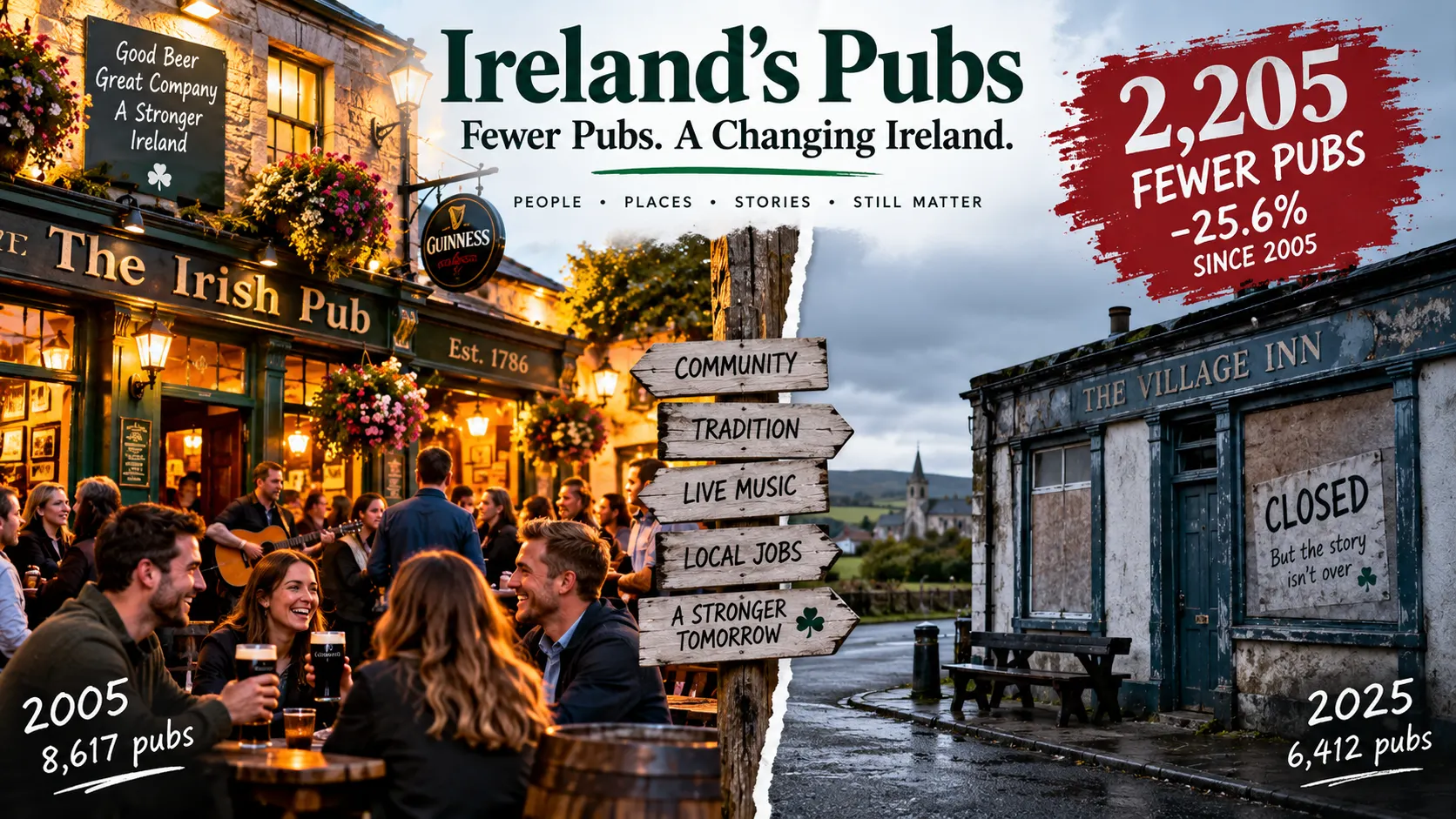
Ireland’s population is larger, employment is higher and the economy is vastly bigger than it was twenty years ago. Yet one of the country’s most recognisable institutions has been moving in the opposite direction. The number of active public-house licences fell from 8,617 in 2005 to 6,412 in 2025, a net decline of 2,205 pubs, or 25.6%. Behind that national figure lies an even more striking divide: Dublin has lost barely one pub in every hundred, while several counties have lost roughly one in three.
The figures come from an analysis commissioned by the Drinks Industry Group of Ireland and based on Revenue licensing data. Because DIGI represents drinks and hospitality interests and is campaigning for a reduction in alcohol excise, its policy conclusions should be read in that context. The underlying licensing trend, however, is unmistakable. Ireland has been losing pubs through economic booms, recession, pandemic disruption and the subsequent recovery, which makes a single-cause explanation difficult to sustain.
Taxation matters. So do wages, electricity, insurance, regulation and the price customers are prepared to pay. But the deeper story is about the transformation of Irish social life itself: where people live, how they travel, how often younger adults drink, whether a village has enough customers to support several licensed premises, and whether the next generation wants to inherit a business that demands long and often unsocial hours.
Ireland’s number of active public-house licences fell from 8,617 in 2005 to 6,412 in 2025, a decline of 25.6% over twenty years.
A Twenty-Year Decline That Has Survived Every Economic Cycle
The most important feature of the pub decline is its persistence. It cannot simply be described as a legacy of the financial crisis, because closures continued after the economy recovered. Nor can it be explained solely by Covid-19, because the contraction was already well established before 2020. The pandemic intensified the pressure on hospitality and disrupted established social routines, but it landed on a sector whose number of premises had already been falling for fifteen years.
The latest analysis recorded 86 fewer pubs in 2025 than in 2024. That was more than the 65 decline recorded in 2024, although below the 117 recorded in 2023. Over the full twenty-year period, the net decline works out at about 110 pubs per year. These are changes in the number of active licences rather than a simple count of individual doors permanently closing: new establishments can open while others cease trading, meaning the figures describe the net transformation of the market.
Ireland’s Shrinking Pub Network
| Year | Active pub licences | Change from 2005 |
|---|---|---|
| 2005 | 8,617 | Baseline |
| 2024 | 6,498 | -24.6% |
| 2025 | 6,412 | -25.6% |
Source: Drinks Industry Group of Ireland analysis of Revenue licensing data, 2025 and 2026 reports.
The result is not that Ireland no longer has a strong pub culture. Thousands of pubs remain, many successful, and the pub continues to occupy an unusually prominent place in tourism, sport, music and community life. What has changed is the density of the network. In places that once supported several family-run pubs, the available trade is increasingly concentrated among fewer businesses.
The Geography of the Closures Reveals the Deeper Problem
If tax were the only explanation, the geographical pattern would be difficult to understand. Excise applies nationally. VAT applies nationally. Minimum-wage rules apply nationally. Yet the decline has been dramatically different from one county to another.
Between 2005 and 2025, the latest DIGI analysis put the decline in Limerick at 37.2%, Offaly at 34.1%, Cork at 32.7%, Roscommon at 32.3%, Tipperary at 32.0%, Laois at 30.6%, Longford at 30.1% and Westmeath at 30.0%. Dublin’s decline was just 1.1%, followed by Wicklow at 9.5% and Meath at 11.4%.
Where Pub Numbers Have Fallen Fastest
| County | Change, 2005–2025 | Broad pattern |
|---|---|---|
| Limerick | -37.2% | Among steepest declines |
| Offaly | -34.1% | Among steepest declines |
| Cork | -32.7% | Large rural component |
| Roscommon | -32.3% | Strong rural exposure |
| Tipperary | -32.0% | Strong rural exposure |
| Westmeath | -30.0% | Large decline |
| Meath | -11.4% | Relatively resilient |
| Wicklow | -9.5% | Relatively resilient |
| Dublin | -1.1% | Smallest decline |
Source: Drinks Industry Group of Ireland, 2026.
The rural-urban distinction is therefore central. A pub in a densely populated neighbourhood can draw customers from thousands of households within walking distance or a short public-transport journey. A rural pub may depend on a small village, surrounding farms and customers travelling several kilometres by car. The operating costs of keeping the lights on, staffing the bar and maintaining the premises do not necessarily fall in proportion to the number of customers available.
This creates a problem of scale. When customer numbers decline slightly in a large urban market, a viable customer base may remain. When the same percentage of trade disappears from a small village pub, the difference can determine whether opening on a Monday or Tuesday evening is worthwhile at all. Reduced opening hours can then make the pub less convenient, which can reduce visits further. Closure is often the end of a long process of contraction rather than a sudden event.
Why Dublin Has Been So Much More Resilient
Dublin’s experience illustrates the opposite dynamic. The capital’s usually resident population reached an estimated 1.598 million in April 2026, or 28.9% of the State’s population. Its share of Ireland’s population has increased from 27.6% in 2011. In the year to April 2026 alone, Dublin’s population increased by an estimated 29,700 people.
Density matters as much as headline population. Census 2022 recorded 3,659 people per square kilometre in Dublin city and suburbs, compared with a State average of only 73 people per square kilometre. That concentration creates a much larger walk-in market for pubs, restaurants and entertainment venues. It also allows businesses to benefit from offices, universities, concerts, sporting events, hotels and other generators of footfall that are concentrated in the capital.
Transport further strengthens this advantage. A customer in Dublin may have access to buses, rail, Luas, DART, taxis or walking routes. The practical decision to have a drink therefore does not necessarily depend on driving home. Many rural customers face a very different calculation, particularly late at night.
Tourism adds another layer. Dublin functions as Ireland’s principal international gateway and has a year-round visitor economy. Fáilte Ireland is pursuing a five-year tourism strategy designed to strengthen the city’s visitor economy further and spread activity beyond traditional tourist districts. A central Dublin pub can therefore serve a mixture of local residents, workers, domestic visitors and international tourists in a way that is much harder to reproduce in a small rural settlement.
Dublin is not immune to hospitality pressures. High rents, wages and commercial property costs create their own difficulties. But higher customer density and more diversified demand can make those costs easier to absorb. The national tax system may be the same, but the economic environment in which a pub pays those taxes is not.
The Economics of Selling a Pint Have Become More Demanding
For a small pub, the retail price of a drink is not the same as the amount available to pay the owner. Alcohol is subject to excise duty and to the standard VAT rate, currently 23%. Revenue’s current excise rate for beer above 2.8% alcohol is €22.55 per hectolitre for each percentage point of alcohol. On that basis, a standard 568ml pint at 4.3% alcohol contains roughly €0.55 in alcohol excise before VAT and before the brewer, distributor, staff, electricity, insurance, rent or other business costs are paid.
Excise is therefore a significant component of the cost structure, particularly because it is a fixed tax related to the alcohol itself rather than to the profitability of the pub selling it. DIGI argues that Ireland’s alcohol excise burden is unusually high by European standards and is seeking a 10% reduction in Budget 2027. That is an industry policy proposal, not an adopted government measure, and public-health policy provides an important counterargument: alcohol taxation is also used to influence consumption and address the social and health costs associated with harmful drinking.
The distinction matters because the debate is not simply about whether alcohol should be taxed. It is about whether the present combination of taxation and business costs leaves enough margin for small pubs to remain viable, particularly in locations with limited customer volumes.
There is also an important difference between food-serving businesses and traditional drink-led pubs. From 1 July 2026, restaurant and catering services moved from 13.5% VAT to the 9% second reduced rate. Alcohol did not. It remains subject to the standard rate. A gastropub selling substantial quantities of food can therefore benefit from the hospitality VAT reduction on that part of its business, whereas a small traditional pub that sells little or no food receives much less direct benefit.
Wages Are Rising Fastest in One of the Most Labour-Intensive Parts of the Economy
Hospitality depends heavily on people. Someone must open the premises, serve customers, collect glasses, clean, manage stock, comply with licensing requirements and close the business, often late at night and at weekends. Labour cannot be automated away as easily as some back-office work in other sectors.
Ireland’s national minimum wage increased to €14.15 an hour for workers aged 20 and over from January 2026. Higher wages improve incomes for employees and can help an industry recruit and retain staff, but they also raise the minimum cost of opening a quiet bar for several hours when customer numbers are uncertain.
The latest CSO earnings data underline the pace of change. Average weekly earnings in accommodation and food services rose by 7.7% in the year to the second quarter of 2026, the fastest percentage increase among the major sectors measured. Average hourly total labour costs in accommodation and food services were €20.27 in that quarter, about 15% higher than three years earlier.
For a busy city venue, additional labour costs can be spread over hundreds of transactions. For a rural pub with a thin midweek trade, they can turn marginal opening hours into loss-making ones. This helps explain why the visible change is not only closure. Some surviving pubs open fewer days or shorter hours than they once did.
Energy Prices Fell From Their Peak — But Not Back to the Old World
The European energy shock added another layer of pressure after the pandemic. Pubs consume electricity through refrigeration, lighting, heating, cooking equipment, glass washers, ventilation and entertainment systems. Even when the doors are quiet, many of those costs continue.
SEAI data show that the weighted average electricity price paid by Irish businesses was 24.27 cent per kilowatt-hour in the first half of 2025, compared with 14.27 cent in the first half of 2021. Prices had eased substantially from the peaks reached during the energy crisis, but the comparison illustrates why many hospitality businesses describe today’s cost base as structurally different from the one they knew before 2022.
Insurance is another recurring concern for hospitality businesses, particularly public and employers’ liability cover. Ireland has implemented insurance reforms and the Central Bank’s National Claims Information Database now provides substantially greater transparency around premiums and claims. Yet there is no simple national statistic demonstrating that insurance alone is responsible for a defined number of pub closures. It is better understood as one element in a cumulative cost base rather than a stand-alone explanation.
What is squeezing the traditional pub?
- Alcohol remains liable to 23% VAT.
- Beer, wine, cider and spirits also carry separate alcohol excise duties.
- The adult minimum wage rose to €14.15 an hour in January 2026.
- Accommodation and food-service weekly earnings rose 7.7% year-on-year in Q2 2026.
- Business electricity prices remain well above their pre-energy-crisis levels.
- Small rural pubs have fewer customers across whom to spread these fixed and semi-fixed costs.
Ireland Is Still Drinking — But Not in the Same Way
Economics explains only part of the decline. Demand has changed too. The latest Irish Health Survey found that 38.9% of people reported drinking alcohol at least once a week in 2025. The age pattern is revealing: 50.1% of people aged 55 to 64 drank at least weekly, compared with just 24.1% of those aged 15 to 24.
That does not prove that young adults have abandoned pubs. Pubs increasingly sell food, alcohol-free beer, cocktails, coffee, live entertainment and experiences as well as conventional beer and spirits. A person may also visit a pub without drinking every week. Nevertheless, lower drinking frequency among the youngest adults is commercially important for a sector whose historical business model depended heavily on repeated alcohol purchases.
Home drinking and the off-trade have also changed the competitive landscape. Supermarkets and off-licences sell alcohol without the same staffing, entertainment and premises costs attached to serving each drink in a pub. Minimum unit pricing, introduced nationally in January 2022 at 10 cent per gram of alcohol, established a statutory floor beneath which alcohol cannot be sold. Its purpose is public health, particularly reducing access to very cheap high-strength alcohol. It narrows some extreme price differences in the off-trade but does not eliminate the fundamental cost advantage of drinking at home.
The pandemic reinforced that shift for some consumers. Pubs were subject to long periods of closure and restrictions, while people developed new routines around home entertainment and home consumption. When restrictions disappeared, not every routine returned to its previous form. Yet it would be misleading to describe Covid as the origin of the pub decline: the licensing data show that the contraction had already been running for many years.
Drink-Driving Law Changed the Geography of a Night Out
Road-safety policy has also altered the relationship between pubs and their customers. Ireland’s current general blood-alcohol limit is 50 milligrams of alcohol per 100 millilitres of blood, with a lower 20mg limit applying to specified drivers such as learner, novice and professional drivers. These rules exist for a clear public-safety reason: alcohol impairs driving, and reducing drink-driving is an important road-safety objective.
The economic effect is nevertheless geographically uneven. In a city, stricter limits can coexist with extensive public transport, taxis and the ability to walk. In a dispersed rural community, where customers may live several kilometres from the pub, there may be no comparable late-night alternative. The same road-safety law can therefore have different consequences for the decision to visit a pub depending on where someone lives.
This does not mean the solution is weaker drink-driving law. The more direct policy issue is transport. The expansion of TFI Local Link shows that government policy increasingly recognises rural mobility as a social and economic issue. Funding for Local Link increased from €12.2 million in 2016 to €76 million in 2025, helping support more than 185 new or enhanced regular rural services as well as evening and night-time services. Local Link recorded 6.9 million passenger journeys in 2025, up from 5.8 million the previous year.
There are now evening services on numerous rural routes and a late-night pilot in Sligo, Longford and Buncrana during 2026 specifically designed in part to support safer access to night-time activity. That direction of travel matters. If people can socialise without driving, road safety and the rural night-time economy do not have to be treated as opposing objectives.
Demography Determines Whether a Local Pub Has a Local Market
Ireland as a whole is not losing population. The estimated population reached 5.526 million in April 2026, up 66,900 in twelve months. But national growth can conceal profound local differences. Dublin alone now accounts for nearly 29% of the country’s usually resident population, and the CSO’s Census 2022 migration data showed Dublin city and suburbs attracting a disproportionately large share of people who had moved home.
This matters to pubs because hospitality is unusually dependent on physical proximity. Online businesses can sell nationally from a rural location. A village pub cannot digitally import Saturday-night customers from another county. Its potential market depends overwhelmingly on the people who live, work, holiday or travel nearby.
Population ageing creates another tension. Ireland had 891,100 people aged 65 or over in April 2026, 165,000 more than in 2020. Older adults are actually more likely than younger adults to report drinking weekly, but ageing can still weaken a rural hospitality market if younger generations move away, households become more dispersed or potential customers become less willing to travel at night.
There is also the succession problem. Many traditional pubs are family businesses in which the premises and the operator’s life are closely intertwined. A business may be profitable enough to provide a living for an owner who already owns the building, yet not attractive enough for a younger successor facing the choice between taking over a seven-day hospitality operation and pursuing another career. Where no successor wants the business, retirement can become closure even when the pub itself has not experienced a dramatic financial collapse.
The Pub Is a Business — but in Some Villages It Is Also Infrastructure
The economic loss from a closure extends beyond the value of the drinks no longer sold. A pub purchases beverages, food, maintenance, energy, entertainment, cleaning and professional services. It employs people directly and may attract visitors who spend elsewhere in the town. In tourism areas it forms part of the experience Ireland markets internationally.
The social consequences are harder to measure but potentially more important. Research involving rural Irish communities has found that pubs can function as meeting places in areas with relatively few other opportunities for social interaction. They may host music, fundraising events, sporting celebrations, club meetings, wakes and informal everyday contact. That function becomes more significant when other village services such as shops, bank branches and post offices have also declined.
It is important not to romanticise the institution. Alcohol causes substantial health and social harm, and public policy is entitled to reduce harmful consumption. Not every pub is an essential community facility, and not every closure represents market failure. In some areas Ireland historically had a very high number of licensed premises relative to the population, making a degree of consolidation unsurprising as lifestyles changed.
But the effect of losing the fourth pub in a town is different from losing the last pub in a village. Once the final social venue disappears, residents do not automatically transfer their interaction to another business. In sparsely populated places, the next alternative may be kilometres away. The economic question therefore overlaps with a wider rural-policy question: what forms of commercially sustainable social infrastructure can small communities realistically support?
Not Every Surviving Pub Will Look Like the Pub of 2005
The pubs that remain are also changing. Many successful operators have moved away from relying predominantly on draught beer and spirits. Food, speciality drinks, alcohol-free products, live music, sport, accommodation, events and tourism can broaden revenue and give customers reasons to visit that cannot easily be replicated at home.
That strategy is easier in some locations than others. A pub on a busy tourist route can turn itself into a destination. A city venue can focus on music, sport or food and draw from a large catchment area. A small pub serving a few hundred local residents has fewer opportunities to diversify without significant investment.
Technology can help at the margins through online booking, event promotion, digital marketing and more efficient stock management. It cannot solve the basic arithmetic of a business whose local customer base is too small to support its opening hours and fixed costs. The future of the sector is therefore likely to involve both innovation and further consolidation.
Could Ireland Really Lose Another 1,000 Pubs?
The latest DIGI-backed analysis suggests a further 600 to 1,000 pub closures over the coming decade under different scenarios. That range should not be treated as an official government forecast or an inevitable outcome. It is an economic projection produced for an industry group and depends on assumptions about future costs, taxation, demand and policy.
Several developments could alter the trajectory. Continued population growth could support demand, particularly in expanding towns. Tourism growth would benefit pubs in visitor destinations. More evening and late-night rural transport could widen the accessible customer base. Operators may also continue adapting towards food, events and alcohol-free products.
Against that are powerful structural pressures. Labour is unlikely to return to the wage levels of the past. Maintaining commercial premises will remain expensive. Younger adults currently drink less frequently than older groups. Rural populations remain more dispersed than urban ones. And the economics of a venue serving twenty customers on a quiet evening will always differ fundamentally from those of a city pub serving several hundred.
Tax policy could change those economics at the margin. A reduction in excise would increase the amount retained somewhere within the supply and retail chain, although how much eventually reached individual pubs or consumers would depend on commercial pricing decisions. Keeping excise unchanged would preserve current public revenues and public-health price signals. Neither choice by itself resolves the structural divide between a densely populated capital and a remote rural village.
The Real Question Is How Many Communities Can Still Support a Pub
Twenty years of closures have produced a paradox. Ireland has grown richer and more populous while its pub network has contracted by more than a quarter. That makes the decline less a story of national economic failure than of changing economics beneath the national headline.
The traditional Irish pub was built around a particular social geography: local populations, repeated custom, limited home entertainment, comparatively strong alcohol consumption, family ownership and communities in which travelling to the pub was an ordinary part of social life. Every one of those conditions has changed to some degree.
High excise, VAT, wages, energy and insurance can determine whether a marginal business survives another year. Drink-driving laws and limited late-night transport can reduce the accessible market in rural areas. Demographic concentration strengthens Dublin while leaving some smaller communities with thinner customer bases. Changing drinking habits reduce the volume on which the traditional model was built. Retirement and succession then turn economic pressure into permanent closure.
This is why no single policy can restore the Ireland of 8,617 pubs. Some closures reflect a market adjusting to a different society. Others remove businesses that still perform an economic and social function but cannot generate enough commercial return under present conditions. The difficult policy question is not whether every pub should be preserved. It is whether Ireland is comfortable with the point at which ordinary commercial consolidation becomes the loss of one of the last shared spaces in a community.
For customers searching for the best pub nearby, the immediate choice in most Irish towns remains substantial. The longer-term question is how far “nearby” will mean travelling in another ten or twenty years.
Sources
Drinks Ireland — One quarter of Irish pubs have closed since 2005
Revenue — Alcohol Products Tax
Revenue — Alcohol Products Tax excise duty rates
Revenue — VAT treatment of food and drink
Workplace Relations Commission — National Minimum Wage
Central Statistics Office — Earnings and Labour Costs Q2 2026
Sustainable Energy Authority of Ireland — Business energy prices
Central Statistics Office — Irish Health Survey 2025: Alcohol Consumption
Central Statistics Office — Population and Migration Estimates, April 2026
Irish Statute Book — Road Traffic Act 2010, Section 4
Department of Transport — Public Transport and TFI Local Link
Source & Transparency
This article is published by Ireland Newspaper for editorial and informational purposes.
Published: 5 September 2026 · Updated: 5 September 2026

Newsroom Ireland Newspaper
Ireland Newspaper editorial team prepares daily news coverage for readers in Ireland and abroad.