
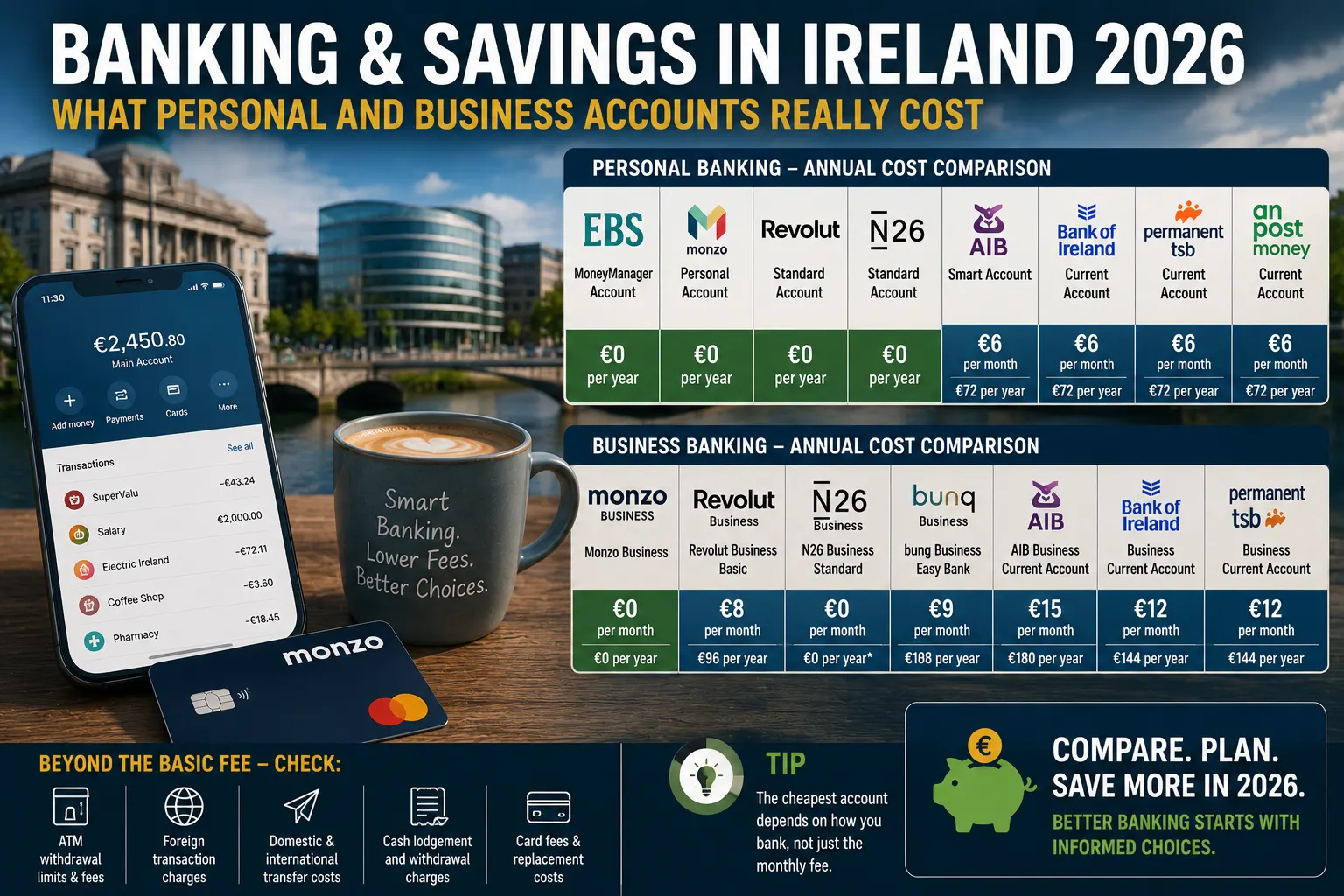
For years, comparing bank accounts in Ireland largely meant looking at AIB, Bank of Ireland and Permanent TSB. That is no longer sufficient. A consumer looking for an everyday current account can now choose among traditional branch-based banks, EBS and several fully digital banks. Monzo has entered Ireland with an Irish banking licence and Irish IBANs, joining Revolut, N26 and bunq in expanding the digital alternatives available to residents. Businesses have gained additional choices as well. Monzo now offers Irish business accounts, Revolut has developed a multi-tier business platform, bunq provides business banking and N26 offers specialist accounts for freelancers. This increased competition makes headline fees easier to avoid — but it also makes comparisons more complicated. A zero-monthly-fee account can become expensive for somebody making frequent cash withdrawals. A traditional bank charging €72 a year may be cheaper for a customer who needs branches and regularly handles cash. For businesses, transaction charges can matter much more than the basic maintenance fee. The following comparison therefore separates private customers from businesses
and distinguishes fixed account costs from charges generated by actual usage. Fees were checked against providers’ published information available on 12 August 2026 . The comparison covers the main general-purpose current-account providers available to Irish customers rather than every credit institution legally authorised to operate in Ireland. Some banks specialise in mortgages, deposits, corporate banking or other financial services and do not compete for ordinary day-to-day current accounts. An Post Money is included in the personal comparison because it directly competes for current-account customers, although An Post itself is not a bank.
Personal Banking: The 2026 Fee Comparison
The first table ranks standard personal accounts according to their basic annual maintenance or subscription charge . That ranking should not be mistaken for a recommendation. Transaction limits, cash access, foreign-exchange charges and banking requirements can make a nominally free account more or less suitable for an individual customer.
Personal Current Accounts — Standard Fixed Costs
| Provider | Standard account | Monthly/basic fee | Standard annual cost |
|---|---|---|---|
| EBS | MoneyManager | €0 | €0 |
| Monzo | Personal Current Account | €0 | €0 |
| Revolut | Standard | €0 | €0 |
| N26 | Standard | €0 | €0 |
| bunq | bunq Free | €0 | €0 |
| AIB | Personal Current Account | €6 in active months | up to €72 |
| Bank of Ireland | Personal Current Account | €6 | €72 |
| An Post Money* | Current Account | €6 | €72 |
| PTSB | Explore Account | €8 | €96 |
*An Post Money is a payment-account provider rather than a bank and is included because its current account competes directly with bank accounts.
Five providers now start at €0 a year
The most striking finding is how much the entry price for current-account banking has changed. EBS, Monzo, Revolut, N26 and bunq all have accounts with no standard monthly maintenance charge. But they are not equivalent products. EBS MoneyManager comes closest to the traditional account model in this zero-fee group. Its current fee information lists account maintenance, euro ATM withdrawals, euro card purchases, direct debits, standing orders and staff-assisted EBS cash transactions at €0. For a customer who wants ordinary euro banking without paying a monthly account fee, that makes EBS particularly notable. Digital banks offer a different proposition. Monzo’s newly launched Irish personal account has no maintenance fee, includes an Irish IBAN and allows up to €300 of ATM withdrawals every 30 days before Monzo’s 2.5% excess-withdrawal charge applies. Card spending in foreign currencies carries no additional Monzo foreign-transaction fee. Revolut Standard is also free but uses a smaller ATM allowance: five withdrawals or €200 in a rolling month, whichever limit is reached first. Above that threshold, the charge is 2% with a minimum of €1. Foreign exchange on Standard is free within its normal weekday allowance of €1,000 a month before a 1% fair-usage charge applies. N26 Standard charges no monthly fee but provides only two free euro ATM withdrawals each month. Its virtual card is included while a physical Mastercard costs €10 to issue. On the positive side for travellers, N26 does not add a foreign transaction fee to card purchases; Standard and Smart customers do, however, pay a 1.7% charge on foreign-currency ATM withdrawals. bunq Free likewise removes the monthly subscription fee, although it is designed as a relatively simple entry product. Customers requiring physical cards and broader banking features may find themselves moving to Core at €3.99 per month or one of the higher plans. This leads to the first important conclusion: “Free bank account” increasingly means no subscription fee — not necessarily unlimited use of every banking service.
AIB’s July 2026 change has simplified its pricing
AIB made one of the year’s most important traditional-bank pricing changes on 1 July 2026 . The bank replaced its previous combination of quarterly maintenance and transaction charges for standard personal current accounts with a €6 monthly fee. The new charge covers unlimited ordinary euro transactions, including debit-card use, automated payments, cash withdrawals and lodgements. There is an unusual feature in AIB’s model: if there is no customer activity during a particular month, the €6 fee is not charged for that month . For an actively used main account, however, the straightforward comparison is €72 per year. Several customers can avoid the charge entirely. AIB exemptions include qualifying student and graduate accounts, customers aged 66 and over through the relevant account arrangement, certain basic and care accounts and qualifying customers paying an AIB mortgage on their principal Irish home through the account. That means two customers apparently holding their everyday banking with AIB can have very different annual costs.
Bank of Ireland is also €72 — with most euro transactions included
Bank of Ireland’s standard Personal Current Account also costs €6 a month , or €72 over a full year. The fee incorporates ordinary euro card purchases, euro ATM withdrawals and euro account transfers up to €20,000 per day. International services and transactions outside euro can produce additional charges. The standard €72 comparison does not apply to everyone. Bank of Ireland states that it does not impose the monthly fee on its Third Level, Graduate and Golden Years current accounts. Its Basic Bank Account also has separate maintenance-fee arrangements. For an ordinary working-age customer who does not qualify for an exemption, however, AIB and Bank of Ireland now have virtually identical headline annual personal-account costs. The meaningful comparison shifts to features, cash access, lending relationships, international use and service preference.
PTSB is the most expensive standard account on maintenance fee alone
PTSB’s Explore Account costs €8 a month , producing a basic annual fee of €96. That is €24 a year more than the standard AIB or Bank of Ireland account and €96 more than the zero-maintenance alternatives. But Explore has no additional ordinary day-to-day transaction charges and incorporates cashback features. Customers can receive 5 cent back on qualifying card payments, up to €5 a month, while qualifying mortgage customers can also receive 2% monthly cashback on their mortgage repayments under the applicable offer. Those benefits make the headline €96 figure less useful for some households. A customer earning €5 a month in card cashback, for example, can offset €60 of the annual maintenance fee. A qualifying mortgage customer can potentially obtain considerably more value. The relevant question is therefore not whether PTSB has the highest standard maintenance charge. It does. The better question is how much of that charge an individual customer actually recovers through benefits they would have earned anyway
.
An Post sits between branch and digital banking
An Post Money is not a bank, but excluding it from a consumer comparison would omit a major current-account alternative. Its standard current account costs €6 a month for customers aged 23 and over. Eurozone electronic payments are included, as is one cash withdrawal per week at a post office. ATM withdrawals cost €0.60 each. Its strongest distinction is physical reach. For people in locations where bank branches have disappeared, access to the post-office network can matter more than saving several euro a month in banking fees. Younger customers also receive significantly different pricing: An Post lists a €2 monthly fee for the 16–22 age group, equivalent to €24 per year.
Business Banking: The headline fee tells only half the story
Business-account pricing is fundamentally different from personal banking. Traditional banks continue to charge businesses according to how they actually use their accounts . A company processing hundreds of electronic payments, lodging cash every day or writing cheques can therefore spend far more than the account-maintenance figure suggests. Digital business accounts often reverse that model: they charge a monthly subscription but bundle a number of transactions, currencies or business-management tools into the plan. The following table compares the principal business accounts available to Irish businesses.
Business Bank Account Fee Comparison — Ireland 2026
Business Accounts — Entry-Level Fixed Costs
| Provider | Entry business account | Fixed annual cost | Key limitation / pricing note |
|---|---|---|---|
| Monzo | Business Lite | €0 | Available to eligible Irish sole traders and limited companies. Irish/Eurozone bank transfers are fee-free. No cash lodgements currently available. Pro costs €7/month and Team from €20/month. |
| N26 | Business Standard | €0 | Only for self-employed people and freelancers operating under their own name — not an incorporated company’s account. Two free euro ATM withdrawals monthly; physical card €10. |
| bunq | Free Business | €0 | Free plan is specifically for sole proprietors. Companies needing wider business functionality can use Core at €7.99/month. |
| AIB | Business Current Account | €18 | €4.50 quarterly maintenance; automated/card transactions €0.20, ATM/self-service €0.35, staff-assisted/paper transactions generally €0.39. Contactless €0.20 charge currently waived. |
| PTSB | Business Current Account | €32 | €8 quarterly maintenance; most automated transactions €0.23; PTSB ATM €0.15; non-PTSB ATM €0.40; standard non-automated transaction €0.80. |
| Bank of Ireland | Business Current Account | €60 | €15 quarterly maintenance; automated transactions €0.10; contactless €0.01; ATM/LATM €0.25; staff-assisted/paper transactions generally €0.60. Cash handling charged separately. |
| bunq | Core Business | €95.88 | €7.99/month. Broader business functionality than the sole-trader-only Free plan; Pro €13.99 and Elite €23.99 monthly. |
| Revolut | Business Basic | from €120 | From €10/month, including 10 no-fee local transfers and €1,000 of exchange at the plan’s interbank-rate allowance. Grow from €30/month and Scale from €90/month. |
*N26 Business Standard and bunq Free Business receive a €0 ranking for self-employed customers but are not equivalent to a conventional limited-company account. N26 requires the account to be held in the individual’s own name; bunq Free Business is specifically designated for sole proprietors.
Monzo has changed the company-account comparison
For an eligible Irish limited company that does not require cash lodgements, Monzo Business Lite currently has the lowest fixed company-account fee in the comparison: €0 . The account is available to eligible sole traders and limited companies and provides free Irish instant bank transfers. Monzo currently does not accept business cash lodgements. That last limitation is critical. A software company, consultant or online business might barely notice the absence of cash facilities. A restaurant, pub, shop or other business taking substantial amounts of physical cash may consider it decisive. This illustrates why a free business account cannot be declared universally “best”. The business model matters.
AIB has the lowest normal fixed fee among the three traditional retail banks
Among AIB, PTSB and Bank of Ireland, AIB has the lowest basic annual business-account charge . Its €4.50 quarterly maintenance fee amounts to only €18 a year. However, AIB then charges €0.20 for many automated transactions and debit-card transactions, €0.35 for self-service transactions such as ATM withdrawals and lodgement-machine activity, and €0.39 for many staff-assisted transactions. AIB’s 2026 personal-account simplification did not extend to business customers. The bank explicitly says business accounts retain the quarterly charging structure, although several service charges were removed from 1 July. For a small business making relatively few transactions, the €18 annual maintenance fee is attractive. For a company processing thousands of transactions, the fixed charge becomes almost irrelevant.
PTSB costs €32 before transactions
PTSB’s Business Current Account has an €8 quarterly charge, or €32 a year . Automated transactions generally cost €0.23 each, PTSB ATM withdrawals €0.15, non-PTSB ATM withdrawals €0.40 and normal non-automated transactions €0.80. Cheque debits and cheques lodged are separately priced at €0.40. Its maintenance fee therefore sits between AIB and Bank of Ireland, while its individual transaction prices follow their own pattern. For a business choosing between these banks, transaction volume should be modelled over a full year rather than comparing €18, €32 and €60 in isolation.
Bank of Ireland costs more to maintain but less for many automated transactions
Bank of Ireland’s standard Business Current Account costs €15 per quarter , equivalent to €60 annually. Its ordinary automated transaction charge is €0.10, half AIB’s €0.20 rate and below PTSB’s €0.23 standard automated charge. Contactless transactions cost €0.01, while ATM or lodgement-ATM transactions are €0.25. Staff-assisted and many paper transactions cost €0.60. This creates an important business-banking paradox. Bank of Ireland has the highest fixed maintenance fee of Ireland’s three traditional large retail banks, but a business making a high number of automated transactions can recover part — or potentially all — of that disadvantage through lower transaction prices. The profile of the company matters more than the headline. Bank of Ireland also offers a significant concession to qualifying new businesses: its Business Start-Up Account waives maintenance and transaction fees for the first 24 months
, together with the Business On Line subscription during the qualifying period. For an eligible start-up, that can completely change the first two years of the comparison.
Revolut and bunq charge more upfront but bundle digital services
Revolut Business takes a different approach. Its Basic plan begins at €10 a month , or €120 annually, but includes ten no-fee local transfers and an allowance to exchange €1,000 at the interbank rate. Grow begins at €30 a month and Scale at €90, with progressively larger transfer and foreign-exchange allowances. For a business operating in multiple currencies, paying international suppliers or giving employees spending cards, the subscription cannot fairly be compared with a traditional account maintenance fee alone. The product is selling business-management infrastructure as well as an account. bunq operates a similar plan model. Free Business is restricted to sole proprietors, while Core Business costs €7.99 a month, Pro €13.99 and Elite €23.99. N26’s free business account is even more specialised. It is designed for freelancers and self-employed individuals operating under their own name. The account cannot simply be opened in the name of an Irish limited company. That distinction is especially important when websites describe an account as a “free business account”. Free for a freelancer does not automatically mean available to a limited company.
Cash is where the cheapest business account can become the wrong account
The greatest divide in modern Irish business banking may no longer be between expensive and inexpensive banks. It is between cash businesses and digital businesses . Monzo explicitly says it cannot currently accept cash lodgements into its Irish business accounts. Traditional banks continue to price cash handling as a service. Bank of Ireland, for example, charges 0.60% for notes lodged or withdrawn and higher rates for certain coin handling, in addition to relevant transaction charges. AIB similarly has separate cash-handling charges in its business tariff. For a consultancy receiving every invoice through SEPA transfer, those charges may be irrelevant. For a convenience store depositing thousands of euro in notes and coins every week, they can become one of the most important elements of the banking bill. A company should therefore analyse at least four things before switching: how many electronic transactions it makes, how much cash it handles, how many international payments it makes and how many people need access to the account.
The cheapest provider can change after any one of those variables changes.
Savings: account fees are only half of the banking equation
A current account is principally designed for spending and receiving money. Savings should normally be compared separately. The key number is no longer the monthly account fee but the AER — Annual Equivalent Rate — together with access restrictions and maximum qualifying balances . Several current offers illustrate just how different the structures are. AIB’s Online Saver currently pays 3.00% AER
on qualifying regular savings within a monthly threshold that increases by €1,000 each month up to €12,000 during a twelve-month cycle. Money above the applicable threshold receives the lower standard saver rate, currently 0.25%. Bank of Ireland’s SuperSaver pays 3.00% AER fixed for the first 12 months , after which it moves to the prevailing Standard Regular Saver rate, currently 2.00%. Amounts above €30,000 receive a lower rate. EBS offers 3.00% AER during the first year
of its Family Savings Account, provided the account’s monthly-saving conditions are met. The currently published rate after year one is 1.25%. PTSB’s Online Regular Saver currently pays 2.00% variable AER on balances up to €75,000 , while its one-year fixed-term deposit also offers 2.00% AER and requires at least €5,000. Monzo’s new Irish Instant Access Savings account currently pays 1.8% AER variable , with no minimum deposit and immediate access to the money. Revolut advertises variable Instant Access Savings rates ranging from 2.0% to 2.5% AER depending on the customer’s plan and balance conditions
, with interest paid daily. bunq’s current structure can reach 3.01% variable , but its model is unusual: new savers can initially receive 3.01%, after which a 1.51% base rate applies up to the customer’s threshold and 3.01% to qualifying savings above it. And the savings market now contains another important competitor that does not feature in the current-account tables: Bankinter Ireland . Its current fixed-term offer pays 2.72% AER for six months on deposits from €2,000 to €2 million and 2.30% AER for twelve months. The six-month promotional rate is currently stated to run until 31 August 2026. These products cannot sensibly be ranked simply from highest to lowest interest rate. A regular saver requiring monthly deposits is different from a €50,000 lump-sum account. A six-month fixed deposit is different from an instant-access savings account. And a rate available only under a paid banking plan has to be considered together with the subscription cost.
The bank with the cheapest current account may not be the best place for savings
There is no requirement for somebody’s salary account, emergency savings and long-term deposits to sit with the same bank. That has become increasingly important as SEPA makes euro payments interoperable across participating European providers. The Central Bank notes that payment users can make euro-denominated payments across SEPA using accounts held with banks and other payment-service providers throughout the participating area. A household could therefore maintain a free current account with one provider and place savings with another provider offering a better rate or different access terms. Businesses can take the same approach, subject to their own liquidity, accounting and treasury requirements. The traditional reason for keeping everything under one banking roof — convenience — remains valid. But economically, it is no longer automatically the cheapest strategy.
Digital banks are changing what Irish consumers should compare
The arrival and growth of digital banks has changed the benchmark. A few years ago, choosing an Irish current account often involved asking which traditional bank charged the least. By August 2026, the starting question can instead be: “Why am I paying a monthly maintenance fee at all?” That does not mean the answer is always to move. Physical branch access has value. Cash lodgement facilities have value. Being able to discuss borrowing with a bank that already knows a household or business can have practical value. Some customers value telephone or face-to-face service more than a low app subscription. But a €72 or €96 annual current-account charge now has to compete with several accounts whose starting maintenance cost is zero. That is a meaningful structural change in the Irish banking market.
The best personal account depends on how the customer actually banks
For a consumer who deals almost entirely electronically and rarely withdraws cash, EBS MoneyManager, Monzo, Revolut, N26 and bunq Free all begin with a €0 annual maintenance cost . Within that group, the practical differences are substantial. Someone who wants EBS cash facilities may favour MoneyManager. A frequent traveller may value Monzo’s foreign-card spending model or the multi-currency features of Revolut or bunq. Someone taking cash from an ATM several times a week should pay particular attention to the withdrawal allowances of Monzo, Revolut and N26. A customer who needs a conventional branch relationship may still prefer AIB, Bank of Ireland or PTSB even though the headline annual cost is higher. And special-account eligibility can change everything. A student, older customer, basic-bank-account holder or qualifying mortgage customer may pay far less than the standard fees shown in a general comparison.
For businesses, counting transactions is essential
A company should go further. Before choosing a provider, it can take the previous twelve months of bank activity and count:
- electronic payments;
- direct debits and standing orders;
- debit-card transactions;
- cash lodgements;
- cash withdrawals;
- cheques;
- international transfers;
- foreign-currency conversions;
- and the number of staff members requiring banking access.
Only then can the real annual banking cost be estimated. AIB’s €18 annual maintenance charge looks much cheaper than Bank of Ireland’s €60. But Bank of Ireland’s standard automated transaction charge is €0.10 compared with AIB’s €0.20. For a highly active company, transaction pricing can therefore erode or reverse the apparent advantage created by the lower account-maintenance fee. Conversely, a business making only a small number of payments could find AIB’s low fixed fee attractive. A newly established company should separately examine Bank of Ireland’s 24-month Start-Up waiver and Monzo’s €0 Lite account rather than assuming the standard tariffs apply from its first day of trading.
Ireland’s banking comparison is no longer simply AIB versus Bank of Ireland
That may be the most important conclusion from the 2026 figures. For personal customers, zero-maintenance banking is now widely available . For incorporated businesses, Monzo has introduced a €0 entry-level account, while traditional banks continue to compete through branches, cash services, credit relationships and transaction pricing. For sole traders and freelancers, the range is even wider because free N26 and bunq options join Monzo and other business products. And for savers, the bank holding the current account may not offer the most attractive place for surplus cash. The modern comparison therefore has three separate questions: What does it cost to keep the account open?
What does it cost to use the account the way I actually bank? What return do I receive on money I am not spending? A customer who answers only the first question can easily choose the wrong account. In Ireland’s increasingly competitive banking market, the cheapest provider is no longer necessarily the institution with the lowest number printed beside “monthly fee”. It is the provider whose complete pricing structure best matches the way a household or business actually moves, stores and uses its money.
Source & Transparency
This article is published by Ireland Newspaper for editorial and informational purposes.
Published: 12 August 2026 · Updated: 14 August 2026

Newsroom Ireland Newspaper
Ireland Newspaper editorial team prepares daily news coverage for readers in Ireland and abroad.