Every summer, tens of thousands of young people leave Irish secondary schools and encounter a question that is far larger than choosing a university course or first job: Do I want to build my adult life in Ireland? In 2026, the answer is more complicated than either pessimists or optimists sometimes suggest. There is no authoritative national survey asking every member of the 2026 Leaving Certificate class whether they intend to emigrate. Claims that “most school leavers are leaving Ireland” would therefore go beyond the available evidence. But there are powerful warning signs. The latest detailed youth polling found that
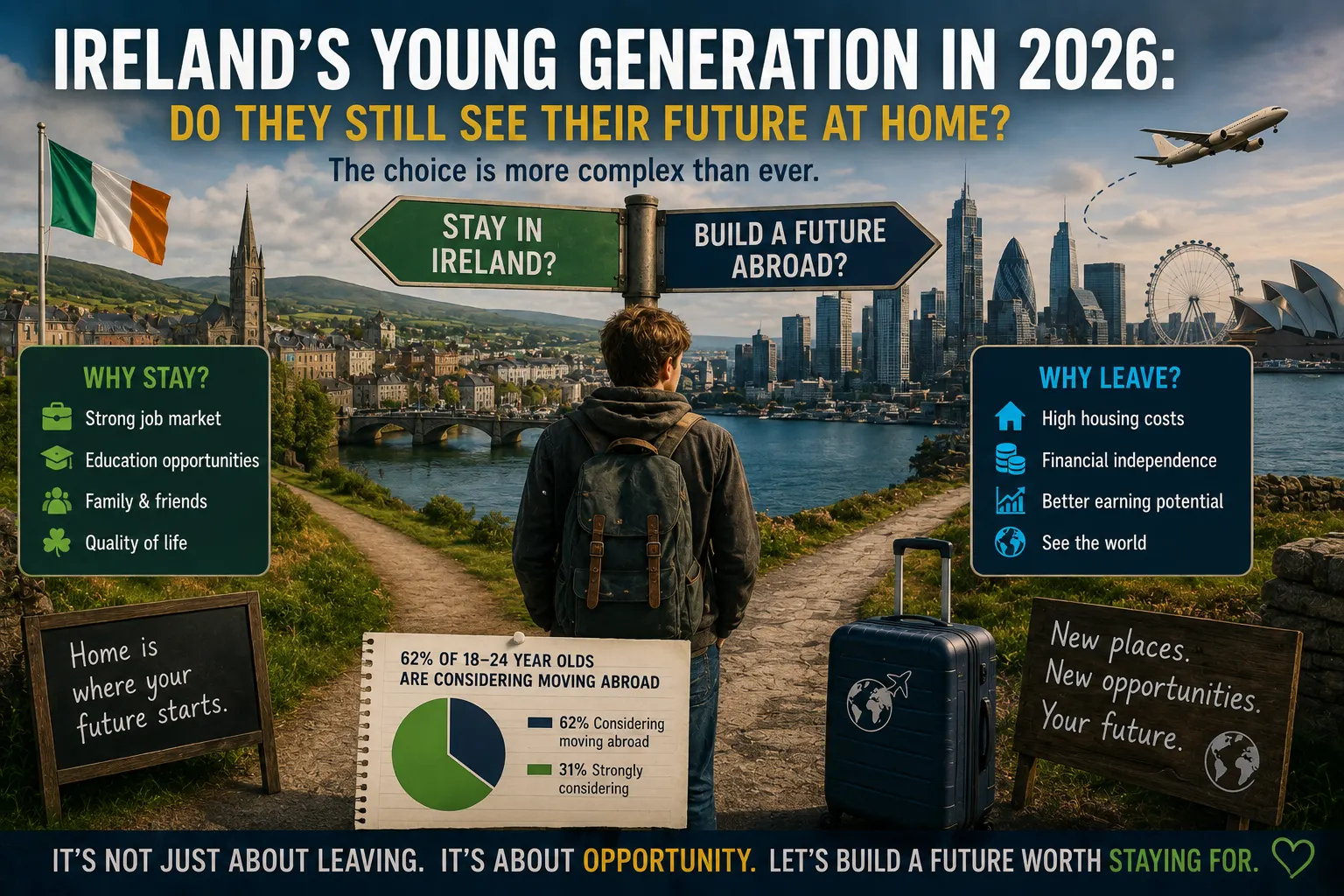
62% of 18- to 24-year-olds were considering moving abroad in search of a better quality of life , while 31% said they were strongly considering doing so. Two-thirds of that age group believed their quality of life could be better outside Ireland. At the same time, 88,817 applications had been submitted to the Central Applications Office by the main February deadline for entry to Irish higher education in 2026. That figure cannot be interpreted as 88,817 school leavers choosing permanently to remain in Ireland — CAO applicants include different categories of students and preferences can change — but it demonstrates substantial continuing demand for education within the State. These two facts can exist together. Young people can want to attend college in Cork, Galway, Dublin, Limerick or elsewhere in Ireland today while simultaneously imagining themselves working in London, Amsterdam, Sydney, Melbourne, New York or another international city several years from now. That is perhaps the real story of Ireland’s younger generation in 2026.
The question is increasingly not whether young Irish people like Ireland. It is whether they believe Ireland will allow them to become financially and residentially independent adults.
Ireland is not witnessing a simple repeat of the post-crash exodus
Historical memory matters in Ireland. Emigration is woven deeply into the country’s social history, and the years following the 2008 financial crisis created another generation for whom leaving was frequently driven by unemployment and a lack of opportunity at home. The situation in 2026 is different. Ireland is not currently characterised by mass unemployment. The national unemployment rate was
5.1% in July 2026 , although unemployment among people aged 15–24 was considerably higher at 12.3% . Employment across the economy remains high. In the first quarter of 2026, an estimated 2.79 million people were employed , while average weekly earnings across the economy reached €1,075.58, 4.4% higher than a year earlier. That makes the present debate unusual. Young people are contemplating emigration at a time when Ireland can offer jobs. In other words, the decision is no longer simply:
“Can I find work in Ireland?” For many, it has become: “If I work in Ireland, can I afford the life that employment is supposed to make possible?” That is a very different economic problem.
The strongest argument for leaving: housing
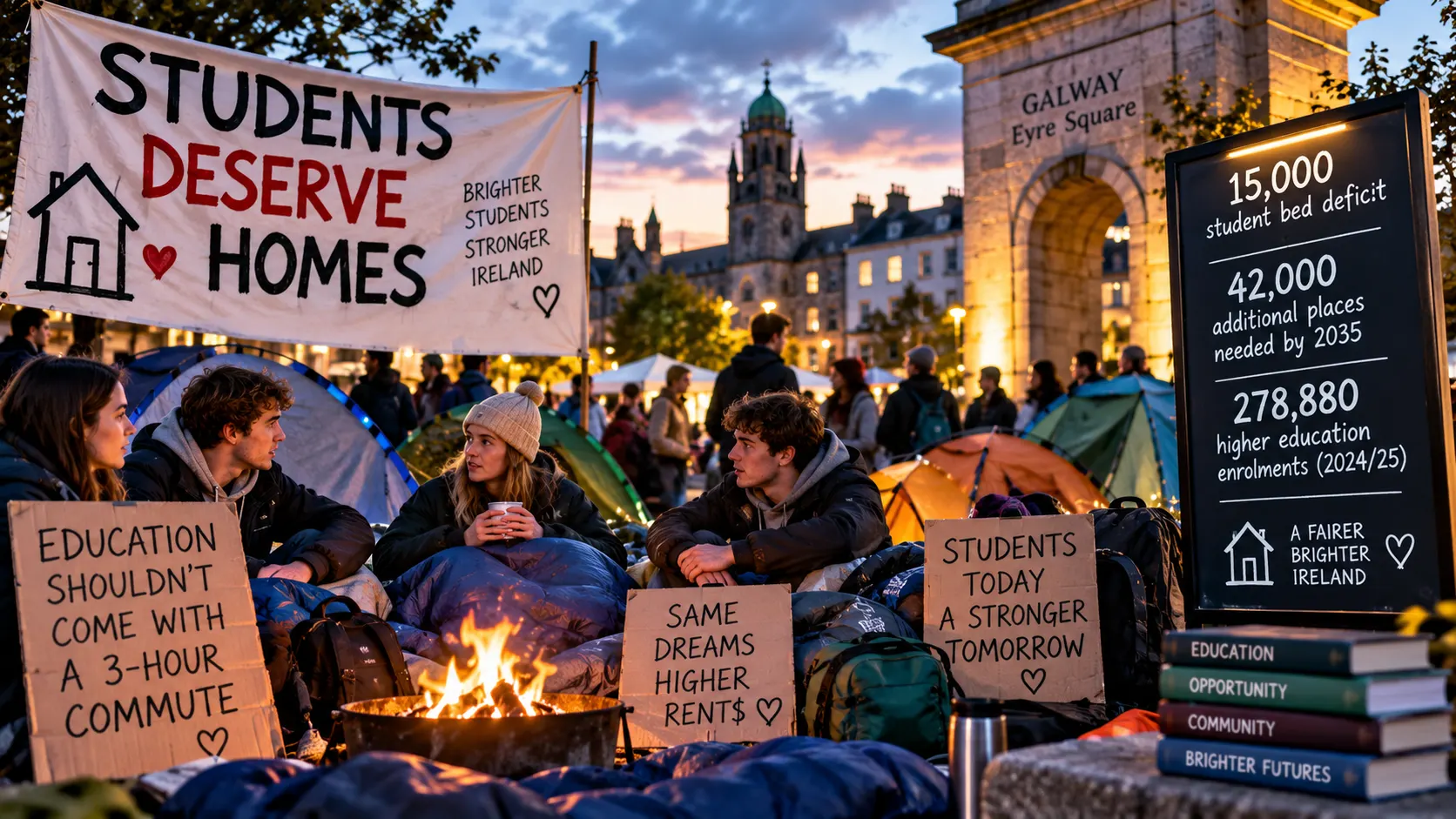
Housing sits at the centre of the debate because it affects several stages of young adulthood simultaneously. It influences whether a student can attend university away from home. It affects whether a graduate can accept a job in Dublin, Cork or Galway. It determines when someone can leave the family home. And eventually it determines whether a young couple believes buying a home and starting a family are realistic. The CSO’s Growing Up in Ireland study offers an unusually revealing picture. When members of its Cohort ’98 were surveyed at age 25,
69.9% were still living in the parental home . Among those living with their parents, 62.4% said they were doing so mainly for financial reasons . Only 3.8% of the full cohort owned their own home. The concern was even broader than those numbers suggest: 85.8% of the 25-year-olds surveyed were very concerned about access to housing in Ireland . Those figures describe people several years older than today’s school leavers. That is precisely why they matter. A 17- or 18-year-old deciding what happens after school is not only looking at the cost of next September. They can also see what is happening to siblings, cousins and young colleagues in their twenties. A teenager watching a 26-year-old with a professional job remain unable to afford independent accommodation receives a powerful message about what adulthood may look like.
The rental market turns that anxiety into arithmetic
The latest RTB/ESRI figures available in early 2026 put the standardised average rent for a new tenancy nationally at €1,776 per month , up 5.4% over the year. In Dublin, the corresponding county-level average was €2,307. Those are whole-property averages rather than the price every individual young renter pays, and students frequently share accommodation. Nevertheless, they show the scale of the market into which young adults are trying to enter. A young person can therefore have a job and still find independence difficult. That distinction matters. Employment provides income. Housing determines how much of that income remains available after one of the most basic costs of life has been paid.
The cost of living is broader than rent
The pressure does not stop at the front door. In youth polling conducted for the National Youth Council of Ireland, 82% of 18- to 24-year-olds said rising costs were negatively affecting them . Housing dominated the concerns: 84% agreed that Ireland’s housing crisis disproportionately affected young people, while among full-time students 94% identified rent and accommodation as a major financial burden. Education costs were identified as a major pressure by 60% of younger respondents, groceries and daily necessities by 47%, and healthcare by 26%. There has been movement in the other direction. For the 2026/27 academic year, the standard third-level Student Contribution has been permanently reduced from €3,000 to
€2,500 , alongside wider changes to student-grant supports. That is a meaningful saving. But reducing an annual college contribution by €500 cannot by itself compensate for accommodation that can cost many thousands of euro during the academic year. This is one reason the youth debate can appear contradictory. Government supports may genuinely improve one part of the financial equation while another part — particularly housing — remains far more difficult.
Leaving Ireland can also be about opportunity, not rejection
It would be a mistake to portray every young Irish person buying a one-way ticket as someone fleeing a country they no longer want. The CSO’s research into 25-year-olds who had emigrated provides an important correction to that narrative. Among emigrants from the Growing Up in Ireland Cohort ’98 who completed the separate emigration survey, 43.3% said employment opportunities were the main reason they had left Ireland . Another 21.1% cited education or training, while 17.3% gave holidays or travel as the main reason. That is a much broader story than housing alone. For somebody in their late teens or twenties, moving abroad can represent ambition rather than desperation. A graduate may want experience with an international employer. A student may want a degree unavailable at home. Someone finishing an apprenticeship may want to work on large overseas projects. Others simply want to see the world before settling down. For many generations of Irish people, travel has been part of early adulthood. What matters is whether young people leave because they
want to experience somewhere else or because they conclude that remaining in Ireland prevents them from becoming independent. Those are very different forms of emigration.
Australia has again become particularly important
The evidence suggests that Australia has regained some of its traditional attraction. In the year to April 2025, 13,500 people emigrated from Ireland to Australia , 27% more than the previous year and the highest number since 2013. Among the emigrant respondents in the CSO’s age-25 Growing Up in Ireland study, 24.6% were living in Australia or New Zealand, while the United Kingdom was the largest individual destination at 35.6%. These destinations offer something particularly attractive at the beginning of adulthood: distance combined with familiarity. English is widely spoken, significant Irish communities already exist, and employment and travel can be combined. For some young people, leaving Ireland for Australia therefore has little resemblance to historical emigration in which departure could effectively mean permanent separation from family. Flights, digital communication and modern mobility have transformed the experience. A young Irish person can spend two or three years abroad while remaining closely connected with home.
Actual emigration is substantial — but it is not evidence that Ireland is emptying
The latest complete CSO annual migration estimates currently available cover the year to April 2025. Ireland recorded 65,600 emigrants , down from 69,900 a year earlier. Of those leaving, 35,000 were Irish citizens. At the same time, 31,500 Irish citizens returned to Ireland, meaning net migration among Irish citizens was outward by approximately 3,500 people. Ireland as a whole continued to experience strong net inward migration: 125,300 people immigrated and overall net migration was positive by 59,700. Age is important. People aged
15–24 represented 33% of all emigrants in the year to April 2025, compared with 16% of immigrants. Another 48% of emigrants were aged 25–44. That clearly demonstrates that emigration is disproportionately a young-adult phenomenon. It does not , however, mean that one-third of Irish 15- to 24-year-olds emigrated. The statistic means that one-third of the people who emigrated belonged to that age bracket. Nor does the figure isolate Irish school leavers. It includes people of different nationalities and circumstances. The distinction is essential in any serious discussion of the issue.
Considering emigration is not the same as emigrating
The figure that attracts most attention is understandably the 62% of under-25s considering moving abroad . It is striking. But an intention survey is not a departure register. Young people can seriously contemplate emigration and ultimately stay. Some may travel for a summer. Some may study abroad and return. Others may spend several years overseas before coming home. The CSO study of actual emigrants demonstrates this fluidity. Among the 25-year-old emigrants surveyed,
48.6% said they intended eventually to return to Ireland . Another 30.2% had not yet decided. Only 21.2% said they did not intend to return. That is arguably one of the most important figures in the entire debate. Ireland can simultaneously have a significant youth-emigration problem and a large number of emigrants who continue to imagine their long-term future at home. The challenge is whether circumstances will allow that intention to become reality.
Why many young people will stay
The reasons for remaining in Ireland are sometimes discussed less dramatically, but they are substantial.
1. Family and community remain powerful anchors
Ireland remains a relatively small country in which family and local connections can have enormous practical importance. Living close to parents and grandparents can provide emotional support, childcare later in life, financial assistance and an established social network. The Growing Up in Ireland study found that among 25-year-olds who had moved out of the parental home, 71.7% were still living in the same broad region in which they had lived at age nine . That suggests considerable geographical attachment even among young adults who have established independent households. Leaving home is therefore not automatically the objective. Many people want independence
in Ireland . Their dissatisfaction may concern the difficulty of achieving that independence rather than a desire to abandon the country.
2. Ireland still offers substantial employment opportunities
The Irish labour market remains an important counterweight to emigration. Overall employment remains high and earnings continued to rise into 2026. Information and communications, professional and scientific services, pharmaceuticals and industry, finance, construction, healthcare, education and public services all provide professional career routes within Ireland. The CSO recorded average earnings growth across 11 of 13 major economic sectors in the year to the first quarter of 2026. Young people do face a higher unemployment rate than older adults, but Ireland is not asking its 2026 school-leaver generation to enter an economy devoid of work. For students who spend several years in higher education before joining the full-time labour market, conditions could also be quite different by the time they graduate. That matters when evaluating a decision made at age 18.
3. Irish higher education remains attractive
The scale of CAO demand gives another indication that many young people still see Ireland as part of their immediate future. By the principal February deadline, the CAO had received 88,817 applications for 2026 entry . Ireland now offers universities, technological universities, further education and a growing range of apprenticeship routes. For many school leavers, leaving Ireland immediately after the Leaving Certificate would therefore mean abandoning educational opportunities available relatively close to home. The permanent reduction in the Student Contribution to €2,500 from 2026/27 and expanded SUSI supports also modestly improve the domestic education proposition. Again, accommodation remains the larger obstacle for many students who cannot commute from home.
4. Young adults are not uniformly pessimistic
Perhaps the most revealing contradiction comes from the Growing Up in Ireland study itself. At age 25, 56.4% of respondents said they were optimistic about the future . More than 80% were employed, and 80.5% of those who did not already own a home expected eventually to become homeowners. Those are hardly the characteristics of a generation that has entirely given up on Ireland. Yet the same cohort displayed intense concern about housing and widespread continued dependence on the parental home. The picture is therefore not optimism versus pessimism. It is optimism constrained by affordability.
Why some school leavers may leave immediately
For somebody finishing secondary school in 2026, the decision to leave can take several forms. One student may choose a university in another EU country. Another may take a year out in Australia. Another may move to Britain for work or education. Someone else may remain in Ireland for university but already expect to emigrate after graduation. Those choices can be driven by different combinations of factors:
Housing and independence. Remaining at home may be financially sensible but can feel restrictive when young people want adult independence. Cost of living. Food, transport, education and accommodation place pressure on earnings and family finances.
Career opportunities. Some industries, specialisms or professional pathways offer particularly attractive opportunities overseas. Higher education. A specific university or course may only be available — or may be considered more attractive — abroad.
Travel and experience. For some, spending part of their twenties overseas is an objective in itself. Friends leaving. Migration can become self-reinforcing socially. Once a group of friends establishes itself overseas, moving becomes easier for those who follow.
The perception of a better future. This is harder to measure economically but potentially more important than any individual bill. When 66% of 18- to 24-year-olds tell researchers they believe their quality of life could be better outside Ireland, policymakers should pay attention even if most do not ultimately emigrate.
Why others will deliberately remain
The reasons for staying are equally personal. A young person may have secured a college course they genuinely want. They may be entering an apprenticeship with a clear earning path. They may have employment lined up. They may value living near family. They may participate heavily in local sport, GAA clubs, music, community organisations or other networks that cannot simply be reproduced by moving overseas. A family home can also operate as a financial advantage as well as evidence of the housing problem. Staying with parents while studying or beginning a career may allow somebody to accumulate savings more quickly than paying market rent elsewhere. Some young adults will therefore make a deliberate calculation:
stay at home for several years, build qualifications and savings, and attempt to buy later. The fact that 80.5% of non-homeowners in the age-25 Growing Up in Ireland cohort still expected eventually to own a home indicates that aspirations for conventional adult life in Ireland remain strong. The question is whether those expectations will prove achievable.
Ireland should not treat temporary emigration as failure
There is another danger in the debate: assuming that every person who leaves represents a national loss. Ireland has benefited enormously from people who spent part of their careers overseas and later returned with experience, savings, qualifications, professional connections or ideas for businesses. Almost half of the emigrant 25-year-olds surveyed by the CSO intended to return. An open economy should not aim to prevent young people from travelling. Nor would it be realistic. Irish citizens have unusually extensive opportunities for international mobility, particularly across the European Union and between Ireland and the United Kingdom. A young engineer spending three years abroad can ultimately be an asset to Ireland. A nurse gaining experience overseas can return. An entrepreneur may build international contacts before establishing a business at home. The policy problem begins when
temporary exploration becomes involuntary permanent departure because returning no longer appears financially possible .
The greater danger is not emigration — it is loss of choice
That distinction should sit at the centre of Ireland’s discussion about young people. There is nothing inherently alarming about an 18-year-old wanting to see Australia. There is nothing wrong with a graduate choosing London because a particular career opportunity exists there. And there is no reason every Irish citizen should be expected to live permanently in Ireland. The problem is different. If a young person who
wants to remain in Cork leaves because they cannot find somewhere affordable to live, that is not simply lifestyle mobility. If a teacher, engineer, nurse or technician wants to return home but concludes that housing will consume too much of their income, Ireland has lost someone it might otherwise have retained. And if an entire generation starts treating emigration as the normal route to financial independence, that eventually affects employers, public services, communities and the demographic balance of the country. The objective therefore should not be to persuade young people never to leave. It should be to ensure
staying is a realistic choice .
What could change the decision over the next few years?
For today’s Leaving Certificate generation, the most important developments may occur between now and 2030 rather than during the next few months. Many students entering university in autumn 2026 will not seek full-time graduate employment until 2029 or 2030. Housing construction completed during those years could therefore matter greatly. So could the supply of purpose-built student accommodation, expansion of cost-rental housing, public transport investment and the availability of affordable rental accommodation in major employment centres. The labour market will matter as well. If Ireland continues generating high-quality employment and real earnings grow faster than essential living costs, remaining or returning becomes more attractive. If employment weakens while housing remains expensive, outward migration could rise. The relationship is therefore dynamic. The same 18-year-old who talks about Australia today might choose Galway University next month, Dublin for a graduate job four years later and Australia at 24 — before returning to Ireland at 29. Migration statistics capture movements. They do not always capture the changing intentions behind them.
So, do young people want to leave Ireland in 2026?
The most accurate answer is: a remarkably large number are thinking about it, but that does not mean an entire generation has decided to go. The warning signs are nevertheless too strong to dismiss. Around three in five people aged 18–24 in the latest youth polling said they were considering moving abroad for a better quality of life. One-third of all emigrants in the latest annual CSO migration estimates were aged 15–24. Among a longitudinal group of Irish-raised 25-year-olds, more than one in eight of those approached for the survey were already living outside Ireland, and employment opportunities were the most common reason given by emigrant respondents for leaving. But the counter-evidence is equally important. Demand for Irish higher education remains strong. Employment remains high. Earnings are increasing. A majority of the 25-year-olds followed by the CSO described themselves as optimistic about the future, and almost half of the emigrants surveyed planned eventually to return. This is not a generation that has rejected Ireland. It is a generation weighing Ireland against alternatives.
The real question facing Ireland
For previous generations, emigration was often discussed primarily in terms of jobs. Ireland in 2026 faces a subtler test. The country can offer a young person education. It can frequently offer employment. It can offer rising wages, family, community and a dynamic economy. What it has greater difficulty offering many young adults is the next step:
an affordable route from childhood dependence to adult independence . That is why housing matters so much to the emigration debate. A country does not retain young people merely by creating jobs. It retains them when those jobs allow people to build lives. The 2026 school-leaver generation should be free to study in Paris, work in London, travel through Australia or build careers anywhere in the world. International experience should remain an opportunity rather than something Ireland fears. But there is an important difference between leaving because the world is attractive and leaving because home feels impossible. Ireland’s challenge over the next several years is therefore not to stop its young people travelling. It is to build a country to which they want — and can afford — to return. And for those who would rather never leave at all, the test is even simpler:
can Ireland make staying a genuine choice rather than a financial compromise?
Source & Transparency
This article is published by Ireland Newspaper for editorial and informational purposes.
Published: 12 August 2026 · Updated: 14 August 2026

Newsroom Ireland Newspaper
Ireland Newspaper editorial team prepares daily news coverage for readers in Ireland and abroad.