The economics of an Irish pint are easily misunderstood. A customer pays €6 or €7 across the bar, sees beer flowing from a keg and may reasonably assume that the difference between the wholesale cost of the liquid and the retail price represents profit for the pub. It does not. A pub is selling considerably more than the beer inside the glass. It provides a heated and insured building, refrigeration, glassware, cleaning, toilets, staff, card-payment facilities, licensing, waste collection and a place where the customer can occupy a table or bar stool for considerably longer than it takes to pour the drink.
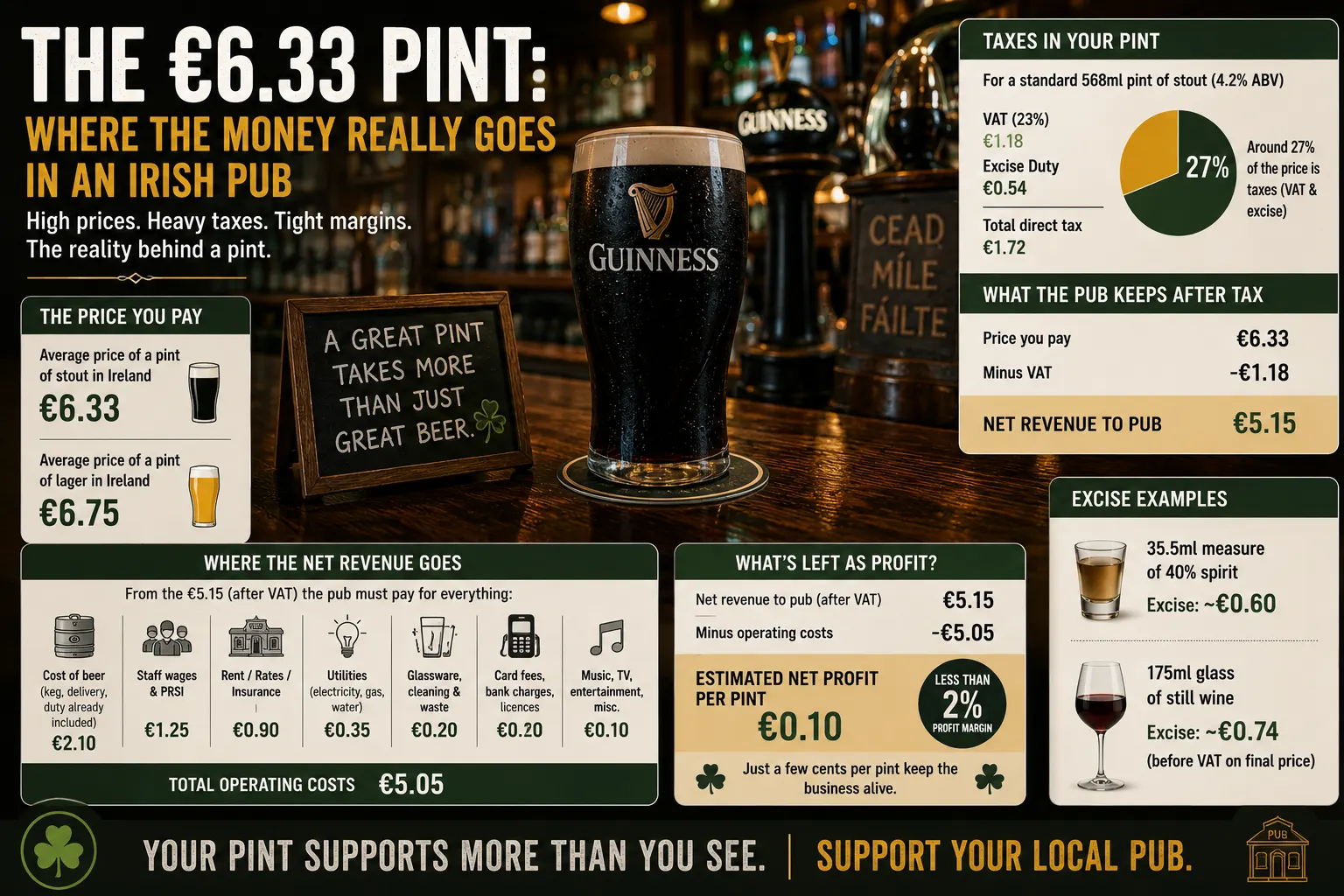
In many premises there are additional costs for live music, sports subscriptions, security, kitchens, maintenance and late-night staffing. The result is a business in which the gross margin on a drink can look substantial while the final net profit remains surprisingly small. That distinction is particularly important in 2026. The national average price of a pint of stout in a licensed premises reached approximately €6.33 in June 2026, while the corresponding average for lager was around €6.75.
Irish pub prices therefore remain high at a time when households are already dealing with elevated living costs. But where exactly does the €6.33 paid for a pint go?
Start With VAT: €6.33 Is Not €6.33 of Pub Revenue
Alcohol sold in an Irish pub is subject to the standard 23% VAT rate. That means a €6.33 pint contains approximately: €1.18 in VAT. Once VAT is removed, the pub is left with approximately: €5.15 in net sales revenue. The first important lesson is therefore simple: The publican does not have €6.33 available to pay for the beer and operate the business.
The commercially relevant figure is closer to €5.15. And VAT is only one form of taxation contained within the retail price.
Excise Duty Is Already Built Into the Pint
Ireland also imposes Alcohol Products Tax on alcoholic beverages. For beer above 2.8% alcohol by volume, excise is calculated according to both the volume of beer and its alcoholic strength. Take a standard 568ml pint of stout at approximately 4.2% alcohol. The excise duty attributable to that pint is roughly: €0.54.
The publican does not normally hand 54 cent to Revenue every time a pint is poured. The duty has already been charged earlier in the supply chain and is incorporated into the wholesale price paid for the product. Nevertheless, it ultimately forms part of what the customer pays. For an average €6.33 pint of 4.2% stout, the broad direct tax burden therefore looks approximately like this:
| Tax Component | Approximate Amount |
|---|---|
| VAT | €1.18 |
| Alcohol excise duty | €0.54 |
| Total direct tax | €1.72 |
Around 27% of the customer’s €6.33 therefore represents direct VAT and alcohol excise before considering other taxes and charges affecting the pub business itself. Those additional business costs can include commercial rates, employer taxes and tax on any eventual profit.
Different Drinks Carry Different Excise Costs
Not all alcoholic drinks are taxed in precisely the same way. Excise depends on the type of beverage, alcoholic strength and quantity. A standard 35.5ml pub measure of a 40% spirit contains approximately 60 cent of excise duty. A 175ml glass of ordinary still wine can contain roughly 74 cent of excise before VAT on the final retail price is considered.
If such a glass of wine were sold for €8.50, approximately €1.59 of the retail price would represent VAT. Combined VAT and excise would therefore amount to roughly: €2.33. The exact amount changes according to the product and selling price, but the principle remains the same: a significant proportion of the customer’s payment never becomes operating income for the pub.
What Does the Beer Itself Cost the Publican?
This is where the calculation becomes less uniform. Pubs do not necessarily pay exactly the same effective wholesale price. The final cost can depend on:
- brewery arrangements;
- distributor terms;
- purchasing volumes;
- rebates;
- discounts;
- contractual arrangements;
- and the particular brand being sold.
Published industry price increases nevertheless allow a reasonable illustration. A 50-litre keg of a major stout brand had a published list-price level of approximately €181 before subsequent increases. Further wholesale increases during 2025 and 2026 added more than €11 per keg. That produces an indicative 2026 list-cost level in the region of: €193 for a 50-litre keg.
This should be understood as an industry illustration rather than a claim that every pub receives exactly the same invoice. Commercial terms differ.
One Keg Does Not Produce 88 Perfectly Saleable Pints
A 50-litre keg theoretically contains almost 88 imperial pints. But a publican rarely sells every theoretical millilitre. Losses can occur through:
- line cleaning;
- beer remaining inside dispensing lines;
- foam;
- over-pouring;
- spillage;
- test pours;
- occasional quality problems.
If the effective yield is closer to 85 saleable pints, a €193 keg works out at approximately: €2.27 for each pint actually sold. That figure gives us a useful starting point for reconstructing the economics of the €6.33 pint.
The €6.33 Pint — Step by Step
Consider an average pint of stout selling for €6.33. The simplified calculation looks like this:
| Component | Approximate Amount |
|---|---|
| Customer pays | €6.33 |
| VAT | €1.18 |
| Revenue excluding VAT | €5.15 |
| Effective beer cost including normal wastage | around €2.27 |
| Gross contribution left for the pub | around €2.88 |
At first glance, €2.88 sounds like an excellent profit. It is not. It is the amount remaining before the pub itself has been paid for. That €2.88 must contribute towards virtually every other cost of operating the business.
Gross Profit Is Not Net Profit
This distinction is fundamental. A customer may see a product that appears to cost the publican approximately €2.27 and is sold for €6.33. It can therefore appear that the pub earns more than €4. But that comparison ignores VAT.
Once VAT is removed, the pub’s actual sales revenue is closer to €5.15. Once the beer itself is paid for, around €2.88 remains. The publican has still not paid:
- the bartender;
- employer costs;
- electricity;
- heating;
- refrigeration;
- insurance;
- rent;
- mortgage or finance costs;
- commercial rates;
- cleaning;
- waste collection;
- glass replacement;
- repairs;
- accountancy;
- banking fees;
- card-processing charges;
- licences;
- entertainment;
- television subscriptions;
- security;
- or general maintenance.
Only after all those costs are covered can the business calculate genuine net profit.
Labour Is One of the Largest Costs
For many pubs, wages are one of the biggest expenses after drink purchases. Ireland’s National Minimum Wage increased to €14.15 per hour in 2026. But the actual cost of employing someone is higher than the hourly wage alone. An employer can also incur costs associated with:
- employer PRSI;
- holiday pay;
- sick-leave obligations;
- pension-related requirements;
- Sunday or late-hour arrangements;
- training;
- uniforms;
- payroll administration.
One bartender serving 50 or 60 drinks during a very busy hour has a relatively low labour cost per drink. The same employee serving only five or ten customers during a quiet afternoon creates a completely different calculation. That is why customer volume matters so much. A pub has to pay its employees for the hours they work, not merely for the number of pints sold.
Electricity, Heating and Refrigeration
Beer needs refrigeration. Glasses need washing. Lights remain on. Toilets require heating, water and cleaning.
Older pub buildings can be expensive to heat. Where food is served, costs rise further because kitchens require:
- ovens;
- extraction systems;
- fridges;
- freezers;
- dishwashers;
- additional staff.
These expenses cannot easily be allocated to one specific pint. But every pint sold has to contribute towards them.
Rent, Rates and Property Costs
Property costs vary enormously around Ireland. A major Dublin city-centre pub can face a level of rent, commercial rates and property expenditure that would be unimaginable for a small rural premises. At the same time, the Dublin pub may sell vastly more drinks. A rural publican may own the building outright and have relatively modest property costs but far fewer customers.
Neither situation automatically guarantees greater profitability. The important factor is how fixed costs are distributed across total sales.
Insurance Is Another Fixed Cost
Public houses require substantial commercial insurance. Policies can include:
- public liability;
- employer liability;
- buildings cover;
- contents;
- business interruption;
- other specialist commercial protection.
The cost continues whether the pub is full or empty. Insurance therefore becomes cheaper per customer when a premises has high turnover. For a low-volume pub, the same annual premium has to be recovered from far fewer transactions.
Entertainment Can Be Expensive
Music and sport are central to the attraction of many Irish pubs. They are not free. Live music can require payment to musicians. Sports pubs may pay significant commercial television subscription charges.
Late-night venues can require additional door staff and security. The services help attract customers, but they also increase the minimum amount the pub must earn before it becomes profitable.
Card Payments Also Cost Money
A growing proportion of pub spending now takes place through debit cards, credit cards and smartphones. The pub may therefore pay merchant-processing charges on each transaction. The amount is individually small. Across thousands of payments every week, it becomes a real business cost.
Even after VAT and the direct beer cost have been removed, the remaining money continues to be divided among multiple suppliers and service providers.
Cleaning, Glassware and Everyday Losses
Pubs consume large quantities of small items. Glasses break. Cleaning products are used constantly. Toilets need servicing.
Napkins, towels, paper products and other consumables have to be replaced. Beer lines need cleaning. Furniture wears out. Equipment fails.
None of these costs looks dramatic by itself. Together they contribute materially to the cost of operating the premises.
So How Much Does the Publican Actually Make From One Pint?
There is no official Irish statistic providing a universal average net profit per pint. Nor could there realistically be one that applied to every pub. The economics of a family-operated rural premises can differ enormously from those of a high-volume city-centre venue. An owner-operated pub differs from a professionally managed operation.
A food-led pub differs from a wet-led pub. An owner-occupied building differs from an expensive leased property. Any claim that every Irish publican earns precisely 15 cent, 30 cent or €1 from each pint would therefore be misleading. Industry estimates nevertheless provide a useful indication.
Previous calculations published by representatives of the pub sector suggested that after taxation, supplier costs, wages and overheads, a typical pint could generate only around 17 cent of final net profit. That specific figure came from an industry organisation and should not be treated as an independently audited national average. But wider hospitality data point in the same broad direction: many hospitality businesses operate on low single-digit net profit margins. That is the central economic point.
A pub can have a healthy gross margin on alcohol while still ending the year with only a modest percentage of its total sales remaining as profit.
What Does a 3% Profit Margin Mean?
Take the current average stout price of €6.33. If a pub ultimately makes a net profit equivalent to 3% of sales, the profit represented by that transaction would be approximately: €0.19. At a 5% margin: €0.32. At 8%: €0.51.
This produces a useful illustration:
| Final Net Margin | Approximate Profit on €6.33 Sale |
|---|---|
| 2% | €0.13 |
| 3% | €0.19 |
| 5% | €0.32 |
| 8% | €0.51 |
| 10% | €0.63 |
These are not claims about the performance of every pub. They simply demonstrate how apparently large gross margins can turn into small final profits once the whole business is considered.
Why One Pub Can Earn Much More Than Another
Consider two pubs buying broadly the same beer. One sells a pint for: €5.80. Another sells it for: €7.20. At €5.80, revenue after 23% VAT is approximately: €4.72.
After an illustrative €2.27 effective beer cost: €2.45 remains as gross contribution. At €7.20, revenue after VAT is approximately: €5.85. Subtract the same €2.27 drink cost: €3.58 remains. The higher-priced pub therefore has more than €1 of additional gross contribution from every pint.
But that does not automatically mean the owner is pocketing an extra euro. The expensive venue may also have:
- higher rent;
- higher commercial rates;
- more staff;
- security costs;
- longer opening hours;
- entertainment expenses;
- greater insurance costs.
The relevant question is what remains after all of those expenses have been paid.
Why a Seven-Cent Wholesale Increase Can Become a 20-Cent Pub Increase
This frequently frustrates customers. A brewery announces an increase equivalent to perhaps seven cent per pint. Soon afterward, some pubs increase the menu price by 20 cent. It can appear that the publican has simply turned seven cent into 20 cent of additional profit.
The economics are more complicated. If the publican wishes to preserve the same percentage gross margin, adding only the seven-cent supplier increase does not necessarily maintain that margin. VAT also applies to the higher selling price. At the same time, the pub may be facing unrelated increases in:
- wages;
- insurance;
- energy;
- rent;
- rates;
- card-processing costs;
- cleaning;
- food;
- entertainment.
A price increase can therefore be used to recover several accumulated cost increases rather than a single brewery increase. That does not mean every retail increase is automatically necessary. Publicans decide their own prices. Competition and customer willingness to pay remain crucial.
Small Cost Increases Matter When Final Profit Is Small
Suppose an average sale produces 20 cent of eventual net profit. A seven-cent increase in the direct product cost represents more than one-third of that final profit. If the pub absorbs it completely, the 20-cent profit might fall to roughly 13 cent. Another increase could reduce it further.
This is why changes that appear trivial when expressed as “six cent per pint” can matter significantly to a business operating on a low net margin. The consumer can regard another price increase as expensive. The supplier can describe a wholesale increase as modest. The publican can still regard the same increase as commercially significant.
All three perspectives can be simultaneously valid.
A Busy Saturday Night Can Be Misleading
One of the easiest mistakes is to judge the economics of a pub by visiting it when it is full. A pub packed during a major football match may appear to be printing money. But profitability has to be measured across the entire week and year. Rent is still due on Monday morning.
Insurance still costs money when the doors are closed. Refrigeration continues overnight. Finance payments continue every month. Equipment still needs maintaining.
Many pubs experience a growing concentration of trade between Thursday and Saturday. That can make quieter parts of the week increasingly difficult to operate economically.
Volume Changes Everything
Imagine that a pub has €1,000 of fixed costs to recover during a particular trading period. If it sells 1,000 drinks, those fixed costs represent: €1 per drink. If it sells 2,000 drinks: 50 cent per drink. If it sells only 500 drinks: €2 per drink.
This is why volume can be as important as price. A high-volume pub can survive substantial rent and staffing costs because those expenses are spread across large numbers of transactions. A small rural pub may have lower fixed costs but too little volume to spread them efficiently.
The Owner’s Wage Is Not Necessarily Profit
Small family pubs have another economic complication. The publican may personally work behind the bar for 40, 50 or 60 hours per week. Suppose the business ultimately provides €45,000 to the owner over the year. Calling the entire amount “profit” can be misleading.
Part of that money effectively compensates the owner for labour that would otherwise have required a paid employee. If another bartender had to be employed for those hours, the business’s true investment return could be considerably smaller. This matters when comparing small family pubs with larger operations where managers and employees appear explicitly in payroll costs.
Food Can Increase Revenue — But Also Costs
Many Irish pubs have increasingly moved into food. Food can increase customer spending and attract people earlier in the day. But it turns part of the premises into a restaurant business. Additional costs can include:
- chefs;
- kitchen porters;
- food purchases;
- food waste;
- freezers and refrigeration;
- cooking energy;
- extractors;
- food-safety systems;
- extra cleaning.
Qualifying food and catering services benefit from a lower hospitality VAT rate, while alcohol continues to attract the standard 23% rate. A pub serving a meal and drinks is therefore often operating with different VAT treatment across the same customer’s bill. Food can strengthen the business enormously. It can also introduce another complete layer of operating costs.
Rural Pubs Face a Very Different Equation
The rural Irish pub occupies a distinctive place in the market. Property costs can be lower than in major cities. But customer numbers can also be much lower. Several structural factors matter:
- smaller local populations;
- declining weeknight trade;
- increased home consumption;
- the necessity of driving in rural areas;
- changing social habits;
- younger populations moving towards major towns and cities.
The rural publican therefore faces a difficult equation: lower prices combined with lower volume do not necessarily compensate for lower property costs. A major urban pub can face the opposite situation: high costs can still produce a strong business if very high volume and higher selling prices compensate for them.
The Irish Pint Has Become Considerably More Expensive
The rise in pub prices is real. A pint of stout costing less than €5 nationally before the pandemic now averages more than €6. Repeated increases have occurred across:
- wholesale drink prices;
- labour;
- energy;
- insurance;
- hospitality inputs;
- property-related costs.
Not every increase in the retail price can be attributed directly to breweries. The increase paid by the customer has generally been larger than the cumulative wholesale increases in the beer itself. The difference reflects the broader cost of running pubs and, in high-demand locations, the ability of businesses to charge prices the local market will accept. Cost therefore explains part of the price.
Demand explains another part.
The Customer’s Problem Is Still Real
Explaining publican margins does not make alcohol cheap for the consumer. At €6.75 for the average pint of lager: Four pints cost: €27.00. For a couple buying four drinks each: €54.00. Add food, a taxi or other transport and a relatively ordinary night in a pub can become a substantial household expense.
Consumers are therefore entirely justified in noticing that drinking in pubs has become more expensive. The important distinction is that an expensive retail price does not automatically imply an equally large profit margin for the business selling it.
The €6.75 Lager
The same tax mathematics can be applied to lager. At a retail price of €6.75: VAT is approximately: €1.26. For an illustrative 4.3% lager, excise is around: €0.55. Combined direct VAT and excise are therefore approximately: €1.81.
Again, the exact wholesale cost varies considerably by brand and pub agreement. But around one-quarter or more of the customer’s retail payment can be attributed directly to VAT and alcohol duty.
The Anatomy of a €6.33 Irish Pint
A reasonable 2026 illustration looks like this:
| Component of €6.33 Pint | Approximate Amount |
|---|---|
| Customer payment | €6.33 |
| VAT | €1.18 |
| Excise embedded in wholesale beer cost | around €0.54 |
| Product, brewer and distribution component excluding excise | around €1.70 |
| Amount remaining for pub operations after VAT and direct drink cost | around €2.90 |
| Wages, property, rates, energy, insurance, licences, banking, cleaning, maintenance and other operating costs | Most of remaining amount |
| Illustrative final profit at 3% net margin | around €0.19 |
Excise is shown separately so that the tax burden is visible, although in practice it is already embedded in the pub’s wholesale purchase price.
Gross Margin and Real Profit Are Completely Different Numbers
This is ultimately the most useful way to understand pub economics.
Retail price
The customer sees: €6.33.
Revenue after VAT
The pub effectively has: approximately €5.15.
Gross contribution after purchasing the drink
Approximately: €2.90.
Final net profit
After operating the entire pub: potentially only a few tens of cents per pint in a low-margin business. A very successful high-volume pub can make considerably more. A struggling venue can make nothing. Some can operate at a loss.
The answer to the question “How much does the publican make from a pint?” therefore depends on what type of profit is being discussed. If the question means gross contribution before overhead, the answer can approach €3. If the question means real final business profit after everything is paid, the answer may be closer to 20 or 30 cent in a low-single-digit-margin operation.
Why Irish Pub Prices Will Remain a Difficult Debate
The price of alcohol in Ireland sits at the intersection of several interests. For consumers, it is part of the cost of socialising. For pubs, it is the principal revenue stream of an expensive physical business. For breweries and distributors, it funds production and distribution.
For the State, alcohol produces substantial VAT and excise revenue. Those interests do not move together automatically. A reduction in excise could increase pub margins, reduce retail prices or produce a combination of both. A brewery holding wholesale prices steady would remove one source of pressure, but wages and insurance could still increase.
A publican raising prices protects margin but risks reducing customer numbers. Customers can decide that another evening at home provides better value. This constant balancing process ultimately determines the price seen above the bar.
The Real Economics Behind the Irish Pint
A customer paying €6.33 sees a single number. Behind that number sits an entire chain of costs. Approximately €1.18 is VAT. Roughly 54 cent represents excise on a typical 4.2% stout.
The brewery, distributor and product itself account for another significant portion. The pub can initially appear to have almost €3 remaining. But that €3 still has to keep the building open. It has to pay the staff.
It has to heat and light the premises. It has to insure it. It has to clean it. It has to replace glasses, maintain equipment, process card payments, pay commercial rates and absorb quiet trading periods.
Only what remains after all of that is genuine profit. That is why the economics of an Irish pub contain an apparent contradiction. The pint can feel expensive to the customer while still producing only a modest final profit for the publican. A €6.33 retail price and a 20- or 30-cent eventual profit are not mutually exclusive.
They are two different ends of the same transaction. And understanding the difference between them explains much of the pressure facing both Irish pub customers and the people serving them in 2026.
Source & Transparency
This article is published by Ireland Newspaper for editorial and informational purposes.
Published: 13 August 2026 · Updated: 14 August 2026

Newsroom Ireland Newspaper
Ireland Newspaper editorial team prepares daily news coverage for readers in Ireland and abroad.