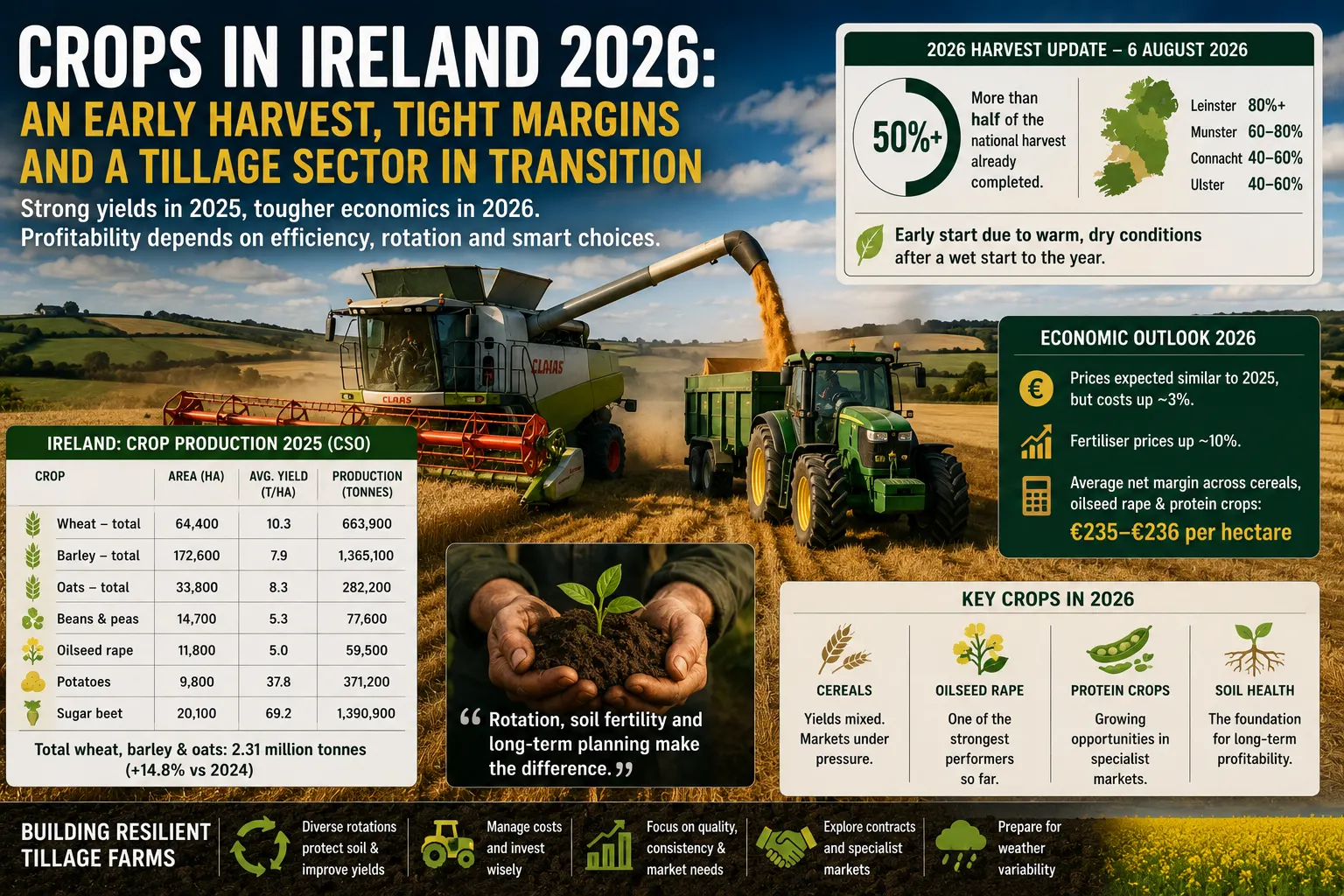
Irish agriculture is usually associated internationally with grass. That reputation is justified. Grass-based dairy, beef and sheep production dominate much of the country’s agricultural landscape. But across Leinster, the south-east, east Munster and parts of the Midlands lies another highly specialised agricultural economy: fields of barley, wheat, oats, oilseed rape, beans, potatoes, maize, beet and increasingly more experimental crops such as rye and alternative protein crops. In 2026, those farms are at an important point in their development. The previous harvest produced some of the strongest cereal yields Ireland had seen in years. Production of wheat, barley and oats reached
2.31 million tonnes in 2025, almost 15% more than in 2024 . Winter wheat alone produced almost 629,000 tonnes, 75% more than a year earlier. Yet the economic outcome was considerably less impressive than the physical harvest. Strong yields coincided with relatively weak grain prices. Teagasc entered 2026 forecasting that cereal prices would remain broadly similar to 2025 while direct production costs would rise by around 3%, largely because fertiliser prices were expected to increase by approximately 10%. The projected average net margin across cereals, oilseed rape and protein crops was only about
€235–€236 per hectare . Now, with the 2026 combines already well into the harvest, another lesson is becoming clear: producing a large crop and producing a profitable crop are not necessarily the same thing.
The 2026 harvest started early
The weather pattern of 2026 has been unusual. Wet conditions slowed work during the opening months of the year. By March, Teagasc reported that winter crops had generally established well but field operations had been delayed by rainfall. Later in the season, warm and dry conditions accelerated crop development and ultimately brought harvest forward. By
6 August 2026 , Teagasc estimated that more than half of the national harvest had already been completed, with some regions above 80%. The speed of harvest is significant, but the early results are highly variable. Teagasc advisers described many cereal yields as disappointing while identifying oilseed rape as one of the strongest-performing crops of the 2026 harvest so far . Individual farms demonstrate how widely results can vary. On one Signpost tillage farm in County Cork, winter barley harvested from 3 July averaged around
10 tonnes per hectare , winter oats around 9 tonnes per hectare , and winter rye was also reported to be performing well. The farmer attributed much of the performance to crop rotation and long-term soil fertility, particularly the use of organic manure. Those figures are an individual farm example rather than a national yield estimate, but they illustrate the difference that soil, rotation and farm management can make during a difficult season. Final national 2026 crop areas, yields and production figures are not yet available. Any assessment in August therefore has to distinguish carefully between
current harvest observations and the official national statistics that will follow after the season.
The starting point: what Ireland grew in 2025
The latest complete CSO crop-production figures provide the best baseline for understanding the sector entering 2026.
Ireland’s Main Crop Production in 2025
| Crop | 2025 area | 2025 average yield | 2025 production |
|---|---|---|---|
| Wheat – total | 64,400 ha | 10.3 t/ha | 663,900 t |
| Winter wheat | 59,700 ha | 10.5 t/ha | 628,900 t |
| Spring wheat | 4,700 ha | 7.4 t/ha | 35,000 t |
| Barley – total | 172,600 ha | 7.9 t/ha | 1,365,100 t |
| Winter barley | 57,300 ha | 9.2 t/ha | 525,300 t |
| Spring barley | 115,300 ha | 7.3 t/ha | 839,800 t |
| Oats – total | 33,800 ha | 8.3 t/ha | 282,200 t |
| Winter oats | 18,000 ha | 9.1 t/ha | 163,200 t |
| Spring oats | 15,900 ha | 7.5 t/ha | 119,000 t |
| Beans and peas | 14,700 ha | 5.3 t/ha | 77,600 t |
| Oilseed rape | 11,800 ha | 5.0 t/ha | 59,500 t |
| Potatoes | 8,900 ha | 43.1 t/ha | 384,900 t |
The table shows just how dominant cereals remain. Approximately 270,800 hectares were devoted to wheat, barley and oats in 2025 . Barley alone accounted for almost 173,000 hectares. Teagasc’s longer-term tillage strategy similarly describes cereals as occupying more than 85% of Irish tillage land, with barley by far the largest cereal crop. But beneath those totals, the composition of Irish cropping changed sharply between 2024 and 2025.
The return of winter crops
One of the most striking recent developments has been the movement between winter and spring cereals. Winter wheat area rose from 40,600 hectares in 2024 to 59,700 hectares in 2025 , an increase of almost 47%. Winter barley increased from 43,300 to 57,300 hectares. Winter oats rose even more dramatically, from 7,500 to 18,000 hectares. At the same time, spring cropping contracted. Spring barley fell by almost
23,000 hectares , from 138,200 hectares in 2024 to 115,300 hectares in 2025. Spring oats dropped by more than 6,000 hectares. The distinction matters economically. Winter cereals normally have a higher yield potential because they have a longer growing season. In 2025, winter wheat averaged 10.5t/ha compared with 7.4t/ha for spring wheat. Winter barley produced 9.2t/ha compared with 7.3t/ha from spring barley, while winter oats averaged 9.1t/ha against 7.5t/ha from the spring crop. Higher yield, however, comes with additional cost and risk. Winter crops occupy the land for longer, require autumn establishment and can need substantial disease, weed and growth-regulator programmes. A wet autumn can prevent planting altogether. A mild autumn can increase aphid and virus pressure. A wet spring can drive disease. And a crop with exceptional yield potential may require expensive fungicide protection to preserve it. This is why the financially strongest crop is not always the crop with the highest theoretical yield.
Barley remains Ireland’s dominant grain crop
If there is one crop at the centre of Irish tillage farming, it is barley. Irish farmers produced approximately 1.37 million tonnes of barley in 2025 , almost 60% of all production from the three main cereals. Most barley area remains spring-sown, although winter barley has become increasingly important. The crop has several markets. A large share ultimately enters animal feed. A specialist part of the spring barley crop is grown for
malting , serving Ireland’s brewing and distilling industries. There are important differences between the two.
Feed barley
Feed barley is primarily valued according to grain yield, quality and the prevailing feed-grain market. The farmer’s economic objective is relatively straightforward: produce enough tonnes at a low enough cost to create a margin above the feed-barley price. When global grain supplies are plentiful, this becomes difficult because Irish prices are influenced heavily by international wheat, barley and maize markets. Ireland may produce excellent yields, but an Irish grower cannot independently determine the price of grain. That is the central economic vulnerability of tillage farming.
Malting barley
Malting barley offers the possibility of a premium but introduces stricter specifications. Protein content, germination, grain size, moisture, varietal purity and other quality criteria matter. A field can therefore produce a good physical yield and still fail to achieve the desired malting premium if grain falls outside specification. For growers, this changes the objective from simply maximising tonnes to producing the correct quality of tonne . Malting contracts can provide additional price certainty or market access, making them valuable in years when feed grain margins are weak. But they also demand careful nitrogen management and variety selection.
Winter barley: early harvest has strategic value
Winter barley offers advantages that are easy to overlook when comparing only grain prices. It is normally among the first major cereal crops harvested. That helps spread combine and labour requirements across the summer and can create an early opportunity to establish cover crops, oilseed rape or other following crops. In 2026, the early harvest has made this particularly visible. Winter barley was already being harvested in early July on some farms, several weeks before much of the spring cereal acreage. Its economic value therefore includes not just grain yield but also: earlier cash generation, straw value, better distribution of machinery workload, and greater flexibility for the next crop. Those benefits can be especially important on large tillage farms where the cost of combines, tractors and cultivation equipment has to be spread over sufficient hectares.
Wheat: Ireland can produce exceptionally high yields
Ireland’s climate can make wheat production challenging. It can also make it remarkably productive. The country’s combination of long summer daylight, moderate temperatures and adequate moisture gives winter wheat very high yield potential when disease is controlled. The national average winter wheat yield reached 10.5t/ha in 2025 , compared with 8.9t/ha in the poorer 2024 season. Long-term productivity gains have been considerable. Teagasc data show average wheat yields increasing from roughly 4.2t/ha in the early 1970s to around 10t/ha in recent decades. That improvement reflects genetics, agronomy, fertilisation, fungicides, mechanisation and much more precise crop management. But wheat is also one of the sector’s expensive crops to grow. Teagasc’s 2026 economic analysis forecast a fall of roughly
€105 per hectare in winter-wheat gross margin compared with its 2025 estimate as production costs rise and yield assumptions revert towards more normal levels. That means wheat’s exceptional output does not guarantee an exceptional return.
Disease resistance is becoming an economic trait
The 2026 wheat season has provided another warning. Teagasc reported in March that changes in the yellow-rust population meant all winter wheat crops had to be considered vulnerable to the disease in 2026 . A large proportion of the varieties planted also had susceptibility to yellow rust, increasing the importance of monitoring and early intervention. Septoria remains another central disease risk in Ireland’s wheat climate. For growers, this changes the economic value of variety selection. A variety yielding a little less in official trials but possessing stronger disease resistance may sometimes generate a better commercial margin by reducing fungicide requirement or protecting yield during periods when spraying is delayed. Modern crop selection therefore increasingly asks not simply:
Which variety can produce the most tonnes? but: Which variety can reliably produce profitable tonnes under Irish disease pressure?
Oats: a smaller crop with a strong Irish identity
Oats occupy a much smaller area than barley but remain an important part of Irish cropping. The total oat area reached 33,800 hectares in 2025 , producing approximately 282,000 tonnes. Ireland’s moist, temperate climate can be particularly suitable for producing high-quality oats. The crop feeds into human-food markets as well as animal feed, with specialist contracts providing opportunities for farmers able to meet milling specifications. Winter oat production expanded dramatically in 2025, with the planted area more than doubling from the previous year. Production increased from approximately 65,000 tonnes in 2024 to more than
163,000 tonnes in 2025 . The 2026 harvest has again demonstrated the potential of well-managed oat crops, although national yields cannot yet be established. On the Cork Signpost example, winter oats yielded around 9t/ha this July. As with malting barley, food-grade oat production is attractive partly because it can move grain away from the pure commodity feed market. That distinction is likely to matter more if global feed-grain prices remain under pressure.
Oilseed rape: the 2026 crop attracting attention
Oilseed rape is one of the most interesting crops in Ireland this year. Its national area had fallen sharply before the current harvest. Ireland grew approximately 21,600 hectares of oilseed rape in 2023 , 16,100 hectares in 2024 and only 11,800 hectares in 2025. Yet yields strengthened considerably. Average yield increased from 4.1t/ha in 2024 to
5.0t/ha in 2025 , meaning production fell much less sharply than the planted area. And early evidence from harvest 2026 is particularly encouraging. Teagasc advisers described oilseed rape as the “star” of the harvest so far, with strong results generating renewed interest among growers considering their 2027 rotations. The crop offers more than the value of its seed.
Oilseed rape as a break crop
Continuous cereal production creates agronomic problems. Disease cycles become harder to break. Grass weeds can become more difficult to control. Take-all can reduce wheat performance. Oilseed rape provides a rotational break. Teagasc notes that its value can be seen in the performance of the crop that follows, particularly first wheat, rather than merely in the oilseed rape gross margin itself. The crop can also spread harvest and cultivation workloads because it is harvested earlier than many cereals. That creates an important concept for farm economics:
the profitability of a crop should sometimes be measured across the rotation rather than within one year. A break crop generating €100 less margin this year may still be financially valuable if it adds several hundred euro to the following wheat crop or reduces weed-control costs.
Beans and peas: the protein opportunity
Protein crops remain relatively small in Irish agriculture, but their strategic role is larger than their acreage suggests. Beans and peas covered 14,700 hectares in 2025 , down from 18,900 hectares in 2024. Production fell to around 77,600 tonnes. Their attraction comes from three sources. First, they provide a break from cereals. Second, legumes fix atmospheric nitrogen through their association with rhizobia, reducing the need for nitrogen fertiliser within the crop. Third, they can reduce Ireland’s dependence on imported protein ingredients for livestock feed. Financial support through the
Protein Aid Scheme also changes the crop’s economics. The 2025 rate reached €600/ha for qualifying beans, peas, lupins and soya, although annual rates depend on the eligible area and available budget rather than being permanently fixed at that amount. Early in 2026, Teagasc highlighted spring beans as economically attractive where suitable land was available, pointing to forward grain prices around €230/t together with the value of the protein payment and rotational benefits. New work also points towards higher-value human-food markets. Teagasc research published in 2026 showed that certain pea and wheat crops may have potential for food processing rather than simply feed, although this remains an emerging rather than mass market. That may become increasingly important to the future of the Irish tillage sector. Ireland cannot easily compete with enormous cereal-producing regions on scale. It can potentially compete better through
quality, traceability, specialist contracts and higher-value end uses .
Potatoes: small acreage, enormous output per hectare
Potatoes occupy a relatively small proportion of Irish agricultural land but remain economically and culturally important. The potato area fell slightly to 8,900 hectares in 2025 , yet production increased to almost 385,000 tonnes because average yield rose to 43.1t/ha. That illustrates how different potato economics are from cereal production. A cereal farmer may sell 7–10 tonnes from a hectare. A potato grower can harvest more than 40 tonnes. But potatoes also involve much greater establishment, fertiliser, crop protection, irrigation risk, harvesting, grading and storage costs. The crop is generally divided into early potatoes, maincrop, seed and salad sectors, each with different production and marketing requirements. The high gross output can therefore be misleading if viewed without the corresponding production and storage costs. Potatoes are also particularly exposed to diseases such as late blight and to weather during planting, tuber bulking and harvest. A wet autumn can make lifting difficult. A severe dry period can restrict yield without irrigation. The commercial potato grower therefore operates a much more capital-intensive system than a straightforward spring cereal producer.
Beet and maize remain important outside the grain statistics
Not every crop grown on Irish tillage land is harvested as grain for sale. Fodder beet and maize are particularly important to livestock agriculture. Both can produce very high quantities of feed per hectare and are commonly grown for dairy and beef farms. Their economics are often based on direct contracts or local relationships rather than a globally quoted commodity grain market. That can be a considerable advantage. A grower selling maize or beet directly to a nearby livestock farmer can potentially know the buyer and market before the crop is planted. But high yield and specialised harvesting machinery make logistics crucial. Transporting a bulky crop over long distances quickly becomes expensive. These crops therefore tend to work best where a strong livestock market exists relatively close to the tillage farm.
Rye is beginning to attract more attention
Rye remains a niche crop in Ireland, but it is one of the alternatives receiving more research attention. Teagasc launched a dedicated Rye Growers’ Guide in 2026 , reflecting increasing interest in the crop for feed, food processing and the drinks industry. Rye has several characteristics of interest to growers. It generally requires less nitrogen than high-output winter wheat and can carry lower disease-control costs. It produces substantial straw. It can fit into certain cereal rotations differently from wheat. And specialist food or distilling markets could potentially create value beyond commodity feed. Teagasc’s recent economic analysis found rye production costs comparable with barley while its combination of grain and straw output could generate margins comparable with winter wheat under suitable conditions. The crucial condition is market access. A crop is not diversified simply because it is agronomically different. Someone still has to buy it. Farmers moving into rye, specialist wheat, food peas or other niche crops therefore need secure market relationships before expanding acreage significantly.
Where Ireland grows its crops
Irish tillage production is highly regional. In 2025, the Dublin and Mid-East region had approximately 93,500 hectares of cereals , the largest regional concentration in the country. The South-East followed with around 79,700 hectares . The Dublin and Mid-East grouping includes Dublin, Kildare, Louth, Meath and Wicklow and has traditionally been one of the strongest crop-producing regions in the State. In 2024 it produced roughly one-third of Irish cereals and 58% of potatoes. The South-East — Carlow, Kilkenny, Waterford and Wexford — is another major centre and was the country’s second-largest crop-producing region in the latest regional accounts. Cork and parts of east Munster also contain significant cereal, malting, beet and forage-crop production. Several factors explain this geography. Soils tend to be more suitable for repeated cultivations. Field sizes can be larger. Harvest conditions are generally more dependable than in high-rainfall western regions. And there is an established infrastructure of grain merchants, maltsters, contractors and specialised machinery. This does not mean crops cannot be produced successfully in western Ireland. It means large-scale commercial tillage tends to concentrate where
soil, climate, field structure and market infrastructure align .
The biggest economic problem in 2026: high yield, modest grain value
Ireland’s tillage sector faces a structural challenge that distinguishes it from cattle or dairy farming. The farmer commits much of the production cost before knowing the final selling price. Seed is purchased. Fertiliser is applied. Herbicides and fungicides are used. Machinery travels across the field. Land rent may have to be paid. Only months later does the farmer discover the yield and final market price. In its 2026 outlook, Teagasc expected harvest grain prices to remain broadly unchanged from 2025 because large international stocks were likely to limit upward price pressure. Meanwhile, fertiliser costs were forecast to increase by around 10%, crop-protection expenditure by approximately 1%, and overall direct cropping costs by about 3%. This is an uncomfortable combination. If price does not increase and costs rise, yield has to improve merely to maintain the same margin. But yield cannot rise indefinitely. That is why the future of the sector increasingly depends on controlling the
cost of producing each tonne , not simply chasing maximum yield.
What a €20 change in grain price means
A cereal price movement that appears modest can have a large effect on a farm. Consider a winter wheat crop yielding 10 tonnes per hectare. A €20/t movement in grain price changes gross output by: €200 per hectare. Across 100 hectares: €20,000.
For a spring barley crop yielding 7.5t/ha, the same €20/t change represents €150/ha. The farm has little ability to change most costs after the crop is already established. This makes cereal margins inherently sensitive to international markets. It also explains the appeal of forward selling, malting contracts, food-grade contracts and other arrangements that provide at least partial price visibility before harvest.
Machinery is becoming a critical cost
The combine is one of the most visible symbols of tillage farming. It is also part of one of the sector’s largest cost categories. Teagasc estimates that machinery commonly accounts for approximately 25–30% of total crop-growing costs , making it the second-largest cost area on many tillage farms. That has major implications for scale. A €400,000 machine does not become cheaper because grain prices fall. Its cost has to be spread over hectares. This helps explain why machinery sharing, contracting and larger operational scale can provide substantial economic advantages. But ownership can still make sense where machines cover enough land, improve harvest timing or protect crop quality. The correct calculation is not:
“Do I need a combine?” It is: “What does this combine cost per hectare and per tonne of grain harvested?” A high-yield farm using machinery efficiently can remain internationally competitive even with comparatively high Irish labour and machinery costs. A smaller farm with excessive machinery investment can struggle despite equally good crops.
Land rental can turn a profitable crop into an unprofitable field
Tillage farms frequently operate a mixture of owned and rented land. That creates another important distinction between crop margin and farm profit . A crop may generate a positive gross margin before land rent. But if rented land is expensive, the residual return can disappear. The same applies where additional travelling time, awkward field shapes, poor soil fertility or drainage increase machinery and input costs. The profitability of rented land should therefore be calculated field by field. High cereal prices can encourage farmers to bid aggressively for additional acreage. When grain markets subsequently fall, the land rent remains. This is one reason Teagasc recommends growers use their own historic yields and costs rather than relying exclusively on national crop-budget averages. A field that consistently produces 8t/ha of wheat should not be budgeted as if it routinely produces 11t/ha simply because another farm does.
Government support has become more important
The difficult economics of 2023, 2024 and the weaker price environment after the 2025 harvest prompted additional support for the tillage sector. A new National Tillage Sustainability Support Scheme opened in February 2026 with a €30 million budget. It applied to qualifying cereal and oilseed rape acreage declared in the previous year’s BISS application. Payment rates were degressive:
National Tillage Sustainability Support Scheme: 2026 Rates
| Eligible area band | 2026 payment rate |
|---|---|
| Over 1ha to 100ha | €110/ha |
| Over 100ha to 125ha | €90/ha |
| Over 125ha to 150ha | €70/ha |
| Above 150ha | €50/ha |
Eligible crops included barley, wheat, oats, rye, triticale and oilseed rape. For an eligible 80-hectare cereal farm, €110/ha represents €8,800. When the expected market-based net margin may only be a few hundred euro per hectare, such support is economically significant. But it is important to distinguish a temporary support scheme from the underlying profitability of growing grain. A viable crop sector ultimately needs commercially sustainable returns as well as public support.
Straw is no longer simply a by-product
Straw can represent a significant part of cereal revenue. It can be baled and sold to livestock farms for bedding or feed. It can remain on the farm. Or under the Straw Incorporation Measure , qualifying straw can be chopped and returned to the soil. For 2026, the measure provides
€250/ha for eligible cereal straw and €150/ha for oilseed rape , subject to scheme rules and area limits. The economic decision is therefore not automatically to bale every field. Where straw prices are strong and livestock demand is nearby, sale can generate useful revenue. Where soil organic matter is a concern, incorporation may provide longer-term benefits as well as scheme income. On some farms, straw management is becoming part of soil-capital management rather than simply post-harvest cleaning.
Crop rotation may be the most undervalued financial tool
The simplest rotation is often the most tempting: grow the crop with the strongest immediate price. But repeated cereals can create hidden costs. Take-all can reduce wheat yield. Grass weeds become harder to control. Certain diseases become more persistent. Herbicide resistance develops. Soil structure can deteriorate. The solution is not necessarily to abandon cereals. It is to view the farm as a
multi-year production system . A rotation might include: winter oilseed rape, winter wheat, winter barley, spring beans, spring barley, rather than repeating wheat and barley indefinitely. The break crops may individually generate lower returns in certain years. But they can provide: better cereal yields afterward, different herbicide chemistry, reduced disease pressure, different drilling dates, different harvest dates, and improved workload distribution. The 2026 harvest is reinforcing that lesson. Teagasc’s current observations suggest rotation and soil fertility are among the reasons some crops have held up better than others under this year’s conditions.
Herbicide resistance is becoming a bigger threat
Crop protection is changing. Teagasc warned during the 2026 season that resistance to one or more herbicides is now present on many tillage farms. This matters financially because the old solution — repeatedly applying the same chemistry — becomes less effective. Integrated weed management is therefore becoming essential. That includes: rotating crops, changing sowing dates, using stale seedbeds, cultivating strategically, rotating herbicide modes of action, preventing weeds from setting seed, and cleaning machinery where serious grass weeds are present. The challenge is particularly important for weeds such as wild oats, brome and blackgrass. Blackgrass remains relatively limited compared with the severe resistance problems seen in Britain, giving Ireland an opportunity to prevent a much larger future problem. The cheapest weed is the weed that never produces seed.
Cover crops are becoming part of mainstream tillage management
Earlier harvesting in 2026 has created additional opportunities for cover crops. Once winter barley or oilseed rape is harvested in July, substantial growing time remains before winter. Cover crops can capture residual nitrogen, protect soil from erosion, maintain living roots, improve soil biology and provide forage in some systems. Their value is not always immediately visible on a single year’s profit-and-loss account. This is another reason tillage economics is gradually shifting from
annual crop margin towards long-term soil productivity . A farmer mining soil fertility or organic matter can produce an apparently inexpensive crop for several years. Eventually the cost returns through lower yields, poorer soil structure or greater fertiliser requirement.
Organic manures could connect livestock and tillage farming more closely
Ireland has an unusual agricultural opportunity because intensive livestock and tillage regions overlap in parts of the country. Pig slurry, cattle slurry and other organic manures contain nitrogen, phosphorus, potassium and organic material that have considerable fertiliser value. Moving suitable organic nutrients from livestock farms to tillage farms can potentially benefit both sectors. The livestock farmer has another outlet for nutrients. The tillage farmer reduces chemical fertiliser requirement and adds organic matter. The Cork Signpost example from the 2026 harvest illustrates the potential: the farmer linked high winter-barley and oat yields partly to long-term soil fertility built through organic manure and rotation. Transport, nutrient regulations, timing and application technology remain constraints. But with chemical fertiliser prices again increasing, better integration between livestock and crop farms becomes economically more attractive.
Environmental performance could become a market advantage
Tillage farming has another characteristic that may become increasingly valuable. Compared with many livestock systems, crop production can have relatively low greenhouse-gas emissions per unit of food or feed output. The AgNav Tillage platform now allows Irish growers to estimate crop carbon footprints using an Ireland-specific life-cycle model based on fertiliser, cultivations, fuel, yield, manure use, straw management and other factors. The commercial question is what happens next. If feed manufacturers, maltsters, distillers or food companies increasingly need to reduce the carbon footprint of their supply chains, low-carbon Irish grain could potentially acquire additional value. That outcome is not guaranteed. A carbon score only becomes an economic asset if a buyer is prepared to reward it through market access, contract preference or price. But the infrastructure for demonstrating that environmental performance is now beginning to exist.
The tillage sector is small — but strategically important
Tillage occupies only a minority of Irish agricultural land. Yet its significance extends beyond the farms producing grain. Irish cereals feed cattle, pigs and poultry. Barley supplies breweries and distilleries. Oats enter human-food markets. Straw supplies livestock farms. Protein crops can replace some imported protein. Maize and beet support livestock production. Potatoes and vegetables feed the domestic consumer market. The tillage sector therefore sits inside the wider agricultural supply chain rather than alongside it. This makes declining crop acreage a strategic concern even if Ireland could technically import additional grain. Domestic crop production provides a degree of food and feed security and reduces exposure to international supply disruptions. The experience of the grain and fertiliser markets after Russia’s invasion of Ukraine demonstrated how quickly global agricultural inputs and commodities can become volatile.
What is actually profitable in 2026?
There is no universal ranking because farm yield, market contract, rotation and cost structure differ. But the broad commercial characteristics can be summarised.
Broad Commercial Position of Major Irish Crops in 2026
| Crop | Main strength | Main weakness | 2026 position |
|---|---|---|---|
| Winter wheat | Very high yield potential | High input and disease costs | Margin under pressure; disease management crucial |
| Spring wheat | Spring option on suitable land | Smaller market/acreage, lower yield | Niche role |
| Winter barley | High yield, early harvest | Disease/lodging risk | Valuable for spreading harvest workload |
| Spring feed barley | Flexible, established feed market | Commodity price exposure | Margins remain tight |
| Malting barley | Potential premium | Strict quality specifications | Attractive where contract and quality align |
| Winter oats | Strong yield and food-market potential | Smaller market | Increasing importance |
| Spring oats | Useful spring cereal and food crop | Lower yield than winter oats | Contract market important |
| Oilseed rape | Valuable break crop and 2026 performance | Establishment and pest risk | One of the strongest 2026 performers so far |
| Beans/peas | Protein aid, nitrogen fixation, rotation | Later harvest and variable yield | Economically attractive on suitable land |
| Potatoes | Very high output per hectare | Very high cost and weather/storage risk | Specialist high-value sector |
| Rye | Lower inputs, strong straw, rotation potential | Limited market | Emerging opportunity |
| Maize/beet | High forage output | Specialist harvest/logistics | Strong where livestock market is nearby |
The most profitable rotation is unlikely to consist simply of whichever crop occupies first place in a one-year table. The better question is: Which combination produces the strongest five-year return while preserving the productive capacity of the soil?
Why 2026 margins remain fragile
The economic environment entering the year was already challenging. Teagasc forecast an average net cereal-enterprise margin of around €236/ha , slightly below 2025 and close to 2024 levels. Approximately 70% of specialist tillage farms were expected to record a positive market-based net margin, meaning a significant minority could still lose money from production before support payments. The average income of specialist cereal, oilseed and protein-crop farms was forecast at roughly €43,500 for 2026 , around 6% lower than the previous year’s estimate. Those numbers are forecasts rather than completed 2026 accounts, and the unexpectedly variable harvest will alter the eventual outcome. For farms achieving high yields, the year may remain reasonably successful. For farms suffering disappointing cereal yields while carrying high rents, machinery repayments and fertiliser bills, the same grain price can produce a much weaker result. That is one of the defining characteristics of tillage farming:
small differences in yield become large differences in profit because so much cost is incurred before the combine enters the field.
The best farms increasingly know their cost per tonne
Traditionally, crop farmers often compared performance through yield per acre or hectare. That remains important. But another figure may be more useful:
Imagine two wheat farms. Farm A spends €2,000/ha and harvests 10t/ha. Its cost is: €200/t. Farm B spends €1,800/ha but harvests only 8t/ha. Its cost is:
€225/t. Farm B appears cheaper per hectare. It is actually more expensive per tonne of grain produced. The opposite can also occur. An expensive fungicide or fertiliser programme does not automatically make economic sense merely because it increases yield. If an additional €100 of inputs produces grain worth only €70, output has increased while profit has fallen. The strongest farms therefore increasingly measure the
marginal return from each input rather than simply maximising crop appearance.
Weather is becoming a larger business risk
Irish crop farmers have always lived with weather risk. But recent seasons have demonstrated how different those risks can be. One year can bring an autumn too wet to sow winter cereals. Another can produce waterlogged spring fields. Another can bring drought during grain filling. Another can deliver excellent crops followed by rain at harvest that reduces grain quality. The 2026 season itself moved through several contrasting phases: wet conditions constrained early field work, followed later by prolonged warm and dry weather and an unusually early harvest. Climate adaptation therefore cannot mean preparing for one specific type of weather. Resilience increasingly involves: soil structure capable of draining excess rainfall, organic matter that improves water retention, diverse rotations, varieties with appropriate disease resistance, sufficient machinery capacity to exploit short harvest windows, and financial reserves capable of absorbing a poor season.
The next crop is already being decided
While combines continue through 2026 fields, farmers are already making decisions for harvest 2027. Oilseed rape must be considered quickly because establishment begins soon after harvest. Winter barley, wheat, oats and rye follow during the autumn. Those decisions will be influenced not only by this year’s yields but by expected grain markets, seed availability, disease pressure, field rotation and cash flow. The strong performance of oilseed rape in 2026 is likely to increase interest in planting the crop again, although one good harvest does not guarantee the same result next year. Rye may gain additional attention. Protein crops remain attractive where the agronomy and scheme support align. Food-grade cereals could become increasingly important where growers can secure contracts. And some farms may reduce the area devoted to expensive cereals in poor rotational positions where yield potential does not justify the production cost.
Ireland’s opportunity is not necessarily more commodity grain
The long-term question for the Irish crop sector is sometimes framed simply as whether the country should grow more tillage crops. A more useful question may be: What kind of crops should Ireland grow? Competing purely on bulk commodity grain is difficult. Ireland’s farms are relatively small compared with operations covering thousands of hectares in parts of North America, Ukraine, Australia or eastern Europe. Land and machinery are expensive. Weather risk is considerable. But Ireland also has advantages. It can produce very high yields. It has major livestock, brewing, distilling and food-processing industries nearby. It has established traceability systems. And it may increasingly be capable of demonstrating comparatively low-carbon cereal production. That creates opportunities in: malting barley, distilling grain, food oats, specialist wheats, high-quality seed, protein crops, rye, organic grain, and crops linked directly with domestic food and feed processors. The future may therefore depend as much on
increasing the value of each tonne as on increasing the number of tonnes.
What farmers can learn from harvest 2026
Although the final national figures are still to come, several conclusions are already emerging. The first is that high 2025 yields did not solve the sector’s profitability challenge because grain prices remained weak. The second is that 2026 crop performance has been highly variable. The third is that oilseed rape has again demonstrated the potential economic value of break crops. The fourth is that soil fertility and crop rotation can materially affect performance during difficult seasons. And the fifth is that direct government support has become significant relative to the market margin available from many cereal crops. None of those points means cereals have become uneconomic. Irish growers continue to achieve yields that compare strongly internationally. The challenge is converting that biological performance into dependable commercial returns.
Ireland’s crop sector is becoming more sophisticated because it has to
The modern Irish tillage farmer is no longer simply planting barley and waiting for harvest. The business increasingly requires decisions about global grain markets, forward selling, disease resistance, herbicide resistance, fertiliser efficiency, carbon footprint, machinery utilisation, soil structure, environmental schemes, rotation and specialist contracts. That complexity reflects pressure. But it also creates opportunity. A farmer who knows the true cost of every field can identify which land is genuinely profitable. A farmer using beans or oilseed rape intelligently can improve the economics of the following cereal. A grower with access to organic manure can reduce reliance on expensive chemical nutrients. A malting, food-oat or rye contract can move production partly away from commodity feed pricing. And environmental measurement may eventually give Irish grain another basis on which to compete. As of mid-August 2026, Ireland still does not know the final size of this year’s harvest. What is already clear is that it will not be remembered simply for the number of tonnes produced. It is becoming another year in which farmers have been reminded that
yield, price, cost and rotation must all work together . Ireland is capable of growing exceptional crops. The 2025 national results proved that, and individual farms are proving it again in 2026. The greater challenge for the years ahead is economic rather than agronomic: can Ireland build a tillage system in which producing an excellent crop also reliably produces an excellent business result?
Source & Transparency
This article is published by Ireland Newspaper for editorial and informational purposes.
Published: 13 August 2026 · Updated: 14 August 2026

Newsroom Ireland Newspaper
Ireland Newspaper editorial team prepares daily news coverage for readers in Ireland and abroad.