
ARTICLE HTML
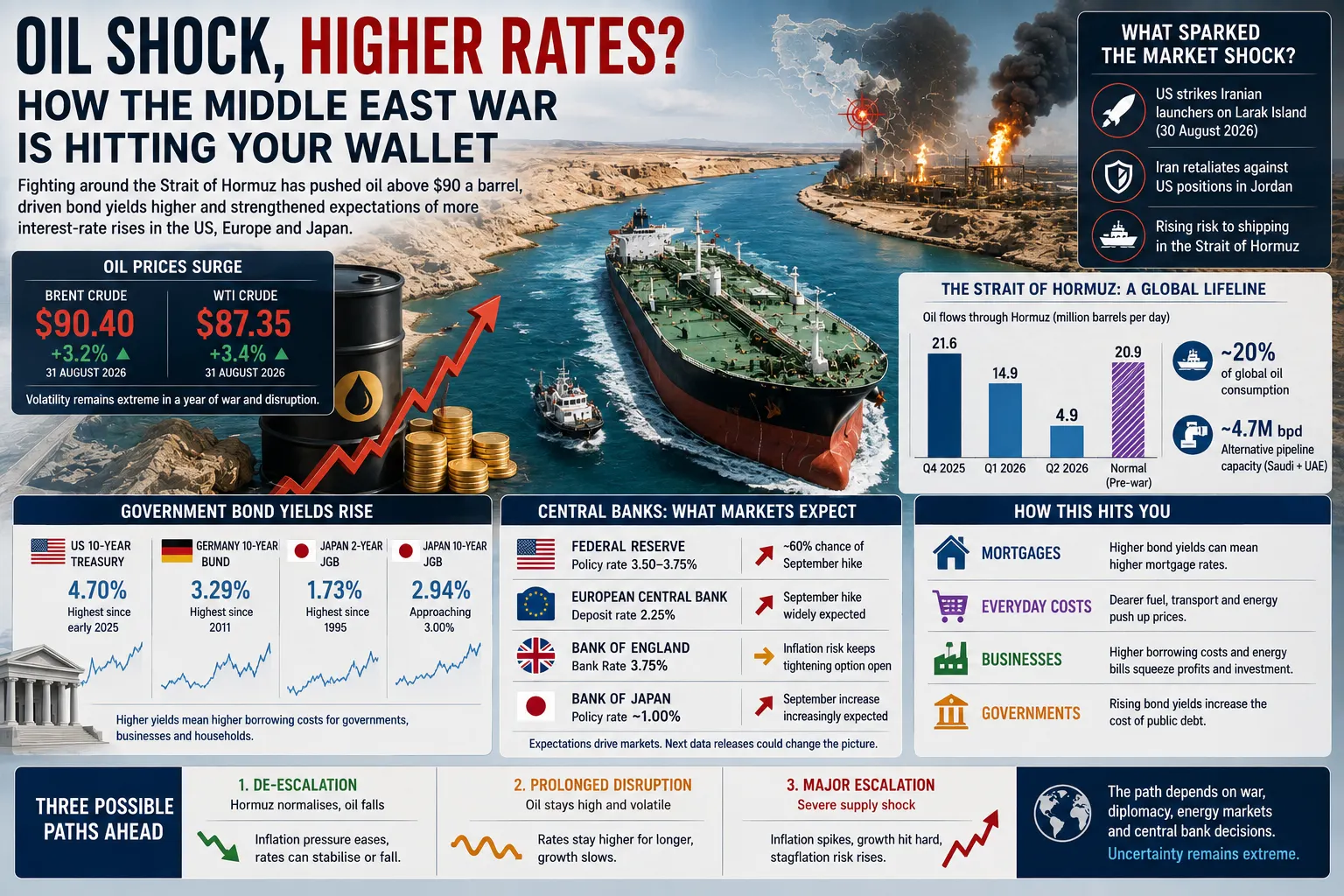
Brent crude moved above $90 a barrel on 31 August after renewed fighting between the United States and Iran around the Strait of Hormuz, and the response in financial markets was immediate. Government bond yields rose across several of the world’s largest economies, expectations of further interest-rate increases strengthened and equity markets came under pressure. The reaction reflects a concern extending far beyond the latest military exchange: an energy shock that was already complicating the global inflation outlook may persist long enough to force central banks to keep borrowing costs higher than households, businesses and governments had expected.
The shift is clearest in the bond market. The yield on the US 10-year Treasury was trading around 4.7 per cent and briefly approached its highest level since early 2025, while Germany’s benchmark 10-year government bond yield climbed to about 3.29 per cent, its highest since 2011. Japan’s two-year government bond yield reached 1.73 per cent, a level not seen since 1995, and its 10-year yield approached 3 per cent. These moves cannot be attributed to the Middle East alone: central-bank guidance, government borrowing, fiscal policy and domestic inflation also matter. But the renewed increase in oil prices has strengthened the part of the market’s argument that says inflation may require tighter monetary policy for longer.
The distinction is important because higher energy prices present central banks with one of their most difficult policy problems. Raising interest rates cannot produce another barrel of oil or reopen a shipping route. Yet if higher petrol, transport and electricity costs spread into wages, services and the prices companies charge their customers, an initially external supply shock can become broader inflation. Central banks then face pressure to act even though higher rates also weaken investment, housing and economic growth.
The Latest Market Shock Began in the Strait of Hormuz
US forces struck Iranian launchers on Larak Island in the Strait of Hormuz on 30 August, the first known American attack on Iranian territory since late July. Iran subsequently said it had retaliated against US positions in Jordan. The exchange ended a period of relative military restraint and reminded energy traders that the conflict, which began in February 2026, remains capable of directly affecting one of the most important routes in the global energy system.
Oil prices climbed by more than 3 per cent during Monday trading, with Brent moving above $90 and at one stage just above $92 a barrel. The scale of the move was notable but not unprecedented in a year of extraordinary volatility. The International Energy Agency reported that benchmark crude prices traded through a range of almost $40 a barrel during July alone as expectations about negotiations and Gulf supply repeatedly changed.
The underlying vulnerability is the Strait of Hormuz itself. Before the current war, approximately 20.9 million barrels a day of crude oil and petroleum products passed through the waterway during the first half of 2025, according to the US Energy Information Administration. That was equivalent to roughly one fifth of global petroleum consumption and about one quarter of internationally traded maritime oil. Saudi Arabia and the United Arab Emirates have pipelines capable of bypassing Hormuz, but their combined alternative capacity is far below normal flows through the strait.
The disruption in 2026 has therefore been exceptional. EIA estimates show average oil flows through Hormuz falling from 21.6 million barrels a day in the fourth quarter of 2025 to 14.9 million in the first quarter of 2026 and only 4.9 million in the second quarter. By August, some traffic had recovered, but the passage remained far from normal and the renewed fighting has again increased uncertainty over how quickly shipping can be restored.
Why the Strait of Hormuz Matters to the Global Economy
| Measure | Scale | Reference Period |
|---|---|---|
| Normal Hormuz oil flow | 20.9m barrels/day | First half 2025 |
| Share of global petroleum consumption | About 20% | Pre-war benchmark |
| Hormuz flow | 14.9m barrels/day | Q1 2026 |
| Hormuz flow | 4.9m barrels/day | Q2 2026 |
| Saudi/UAE bypass capacity | About 4.7m barrels/day | Available pipeline capacity |
Sources: US Energy Information Administration, February and August 2026 energy-security assessments.
The Energy Shock Is Larger Than the Oil Price Alone Suggests
Oil traders are no longer assuming that Gulf exports will collapse completely, but they are also not pricing a rapid return to normal. An August Reuters survey of 31 economists and analysts projected Brent crude to average $85.08 a barrel during 2026 and US West Texas Intermediate crude to average $80.20. Those forecasts remain subject to large geopolitical uncertainty, but they illustrate how much the baseline has changed from an environment in which the Middle East risk premium could be treated as temporary.
The International Energy Agency’s August assessment was more revealing about physical supply. It estimated that global oil supply in July remained 6.3 million barrels a day below its level a year earlier, with 8.3 million barrels a day of Gulf output still shut in. Regional oil exports fell to about 15 million barrels a day in July and were significantly below pre-war levels. Global observed oil inventories had fallen by approximately 410 million barrels between the end of February and the end of July.
At the same time, high prices are destroying some demand. The IEA expects world oil consumption to decline by 1.6 million barrels a day in 2026, with weaker economic activity and expensive fuel reducing usage. China’s oil demand is particularly important: Chinese crude imports fell sharply during the summer, providing a counterweight to the supply shortage. This is one reason oil has not simply continued rising regardless of the deterioration in Gulf supply.
OPEC+ is also adding some production. Seven members agreed in August to increase output by 188,000 barrels a day from September as part of the rollback of earlier voluntary cuts. Under normal market conditions that would contribute to downward pressure on prices. In the current environment, however, the volume is small relative to the production and shipping disruption caused by the war.
Why Oil Pushes Bond Yields Higher
The connection between a tanker route in the Gulf and the yield on a German, American or Japanese government bond is indirect but powerful. A bond promises fixed future payments. If investors believe inflation will be higher, those fixed payments become less valuable in real purchasing-power terms. Investors therefore demand a higher yield to hold the bond, which means the market price of the existing bond falls.
Expectations about central-bank interest rates reinforce that process. If investors believe the Federal Reserve will raise its policy rate, newly issued short-term debt and bank deposits are likely to offer higher returns. Existing bonds must become cheaper, and therefore yield more, to remain competitive. The effect is strongest initially in shorter maturities, which are closely connected to expected policy rates, but longer maturities can also rise as markets reassess future inflation, government debt issuance and the compensation demanded for locking money away for years.
This explains why the latest bond-market sell-off cannot be described simply as investors reacting to military risk. In many geopolitical crises, investors buy US Treasuries and other government bonds as safe assets, pushing their yields lower. The opposite pressure becomes important when the crisis itself is inflationary. Investors may still want safety, but they also have to consider what expensive energy means for future interest rates and the real value of fixed payments.
The current episode contains both forces. Some capital is moving into traditional defensive assets such as gold, which was heading for its strongest monthly gain since January. But sovereign bonds are simultaneously being repriced because investors believe central banks may have to fight another inflation impulse.
The Federal Reserve Has Moved Back to the Centre of the Debate
The most consequential shift has occurred in US interest-rate expectations. The Federal Reserve has kept the federal funds target range at 3.50 to 3.75 per cent since the beginning of 2026. At its July meeting, nine policymakers voted to hold rates unchanged while three preferred an immediate quarter-point increase, already indicating unusually visible disagreement within the Federal Open Market Committee.
Inflation has subsequently remained uncomfortable. Federal Reserve Chair Kevin Warsh said at the Jackson Hole symposium on 28 August that the Fed’s preferred measure of inflation was running at 3.7 per cent over twelve months and 4.1 per cent over six months. He also argued that financial conditions were not broadly restrictive and that the labour market remained consistent with full employment. In that combination, inflation rather than unemployment becomes the dominant immediate policy concern.
Warsh stopped short of promising a September increase. His message was nevertheless clear enough for markets to change their pricing. Interest-rate futures placed the probability of a quarter-point rate increase at the Fed’s 15-16 September meeting at around 60 per cent on 31 August, compared with roughly 35 per cent before his Jackson Hole speech. Barclays, which had previously expected no further increases this year, revised its forecast to quarter-point hikes in September and December.
Those are market expectations and private forecasts, not Federal Reserve commitments. The next US employment report and August inflation data arrive before the September meeting and could materially alter the calculation. A sharp deterioration in employment would strengthen the case for holding rates even if inflation remains too high, demonstrating the difficult trade-off created by a supply shock.
Interest Rates and Market Expectations at the End of August 2026
| Economy | Current Policy Setting | Near-Term Market Direction |
|---|---|---|
| United States | Fed funds 3.50–3.75% | September hike probability around 60% |
| Euro area | ECB deposit rate 2.25% | September hike widely expected |
| United Kingdom | Bank Rate 3.75% | Inflation risk keeps tightening option open |
| Japan | Policy rate around 1.00% | September increase increasingly expected |
Sources: Federal Reserve, European Central Bank, Bank of England, Bank of Japan and market pricing reported by Reuters through 31 August 2026. Expectations are not policy commitments.
Europe Faces an Even More Direct Energy Problem
The European Central Bank entered 2026 with its deposit rate at 2 per cent after the earlier post-pandemic tightening cycle had been partially reversed. The Middle East shock changed that trajectory. In June, the ECB raised its three key rates by 25 basis points, taking the deposit facility rate to 2.25 per cent, specifically citing inflationary pressure generated by the war.
The Governing Council paused in July but did not declare the tightening cycle finished. Minutes published in August showed that policymakers considered a further increase likely if the energy shock persisted. By 31 August, financial markets widely expected the ECB to raise rates again at its 9-10 September meeting.
Fresh German inflation data reinforced the concern while also showing why the ECB’s decision is not straightforward. Germany’s EU-harmonised inflation rate rose from 2.8 per cent in July to 2.9 per cent in August. Energy inflation accelerated sharply to 10.5 per cent, but core inflation excluding food and energy remained at 2.4 per cent. That means the original external shock is visible, while evidence that it has spread deeply through the entire price system remains more limited.
Euro-area inflation data for August are due on 1 September and were expected by economists surveyed by Reuters to show headline inflation rising to about 3.3 per cent from 2.9 per cent in July. That figure is a forecast until the official release is published. If confirmed, it would leave inflation substantially above the ECB’s 2 per cent medium-term target and strengthen the case for another increase.
Yet Europe is also more vulnerable to the growth effect of expensive energy than a simple inflation comparison suggests. Manufacturers use energy directly, households have less disposable income after paying for fuel and electricity, and European companies compete globally with producers facing different energy costs. The ECB therefore risks intensifying an economic slowdown if it raises rates aggressively in response to prices that originated largely outside the euro area.
The ECB Is Watching for the Second Round
The phrase increasingly important to European monetary policy is second-round effects. A one-off rise in oil prices pushes headline inflation upward directly. Central banks cannot undo that initial increase. Their concern begins when employees demand higher wages to compensate for lost purchasing power, businesses raise prices to recover wage and transport costs and inflation expectations become embedded in contracts and behaviour.
So far, the evidence is mixed rather than conclusive. German core inflation remained stable in August despite the rise in energy prices. ECB policymakers noted in July that wage developments remained broadly compatible with the inflation target and that longer-term inflation expectations were still anchored around 2 per cent. Those factors explain why the Governing Council paused rather than increasing rates at every meeting.
The risk grows with time. Energy costing more for several weeks has a very different economic effect from energy costing more for a year. Airlines eventually adjust fares, freight companies renegotiate contracts, farmers face higher fuel and fertiliser costs and manufacturers incorporate more expensive transport and raw materials into their prices. The longer the disruption lasts, the less plausible it becomes to describe the resulting inflation as a purely temporary energy event.
This is why the duration of the Middle East conflict now matters almost as much to the ECB as the daily oil price. A durable reopening of Hormuz could reduce inflation pressure before broad second-round effects become entrenched. Repeated military escalations could do the opposite.
Japan Is Leaving the Era of Near-Zero Rates Behind
Japan is experiencing a different but related transformation. For decades, the Bank of Japan struggled with inflation that was too low and maintained extraordinarily loose monetary policy. That environment has changed. The policy rate is now around 1 per cent, and the Bank of Japan says it expects to continue increasing rates if economic activity and prices develop broadly in line with its outlook.
The bond market is already reflecting that shift. Japan’s two-year government bond yield reached 1.73 per cent on 31 August, its highest since April 1995, while the 10-year yield was around 2.94 per cent. Longer maturities have also been under pressure as investors consider inflation, fiscal policy and the reduced role of the Bank of Japan as an overwhelming buyer of government debt.
The yen adds another dimension. It has again weakened to around 160 against the US dollar. A weaker currency raises the yen cost of imported oil and other commodities, meaning Japan can experience an energy shock through both the global dollar price of crude and the exchange rate. That increases the argument for higher Japanese interest rates even if domestic demand itself is not overheating.
A Reuters survey published in late August found economists increasingly expecting the Bank of Japan to raise its policy rate to 1.25 per cent in September. Again, that is an expectation rather than a decided policy. The Bank’s next scheduled meeting is on 17-18 September, after both the ECB and Federal Reserve have made their decisions.
Asia Does Not Experience High Oil Prices in the Same Way
The effect across Asia varies sharply because economies differ in their dependence on imported energy, exchange rates and domestic growth conditions. Japan and India import large quantities of crude, making a sustained price increase potentially damaging to trade balances and consumer inflation. Exporting countries and economies with significant domestic energy production may face a different mix of benefits and costs.
India illustrates the tension. Its economy expanded by a stronger-than-expected 7.8 per cent in the April-to-June quarter, providing a healthy domestic growth backdrop, yet high oil prices remain a significant inflation and currency risk. Indian government bond yields have risen, and investors are watching whether robust economic growth and imported energy inflation will eventually push the Reserve Bank of India towards a less accommodative stance.
China presents almost the opposite problem. Domestic economic activity remains uneven, with the official manufacturing purchasing managers’ index at 49.8 in August, still below the level normally associated with expansion. Chinese oil imports have also been weak, helping suppress global demand. Beijing therefore faces less obvious pressure to tighten monetary policy simply because crude is expensive, particularly while property and domestic demand remain concerns.
This divergence matters globally. A common energy shock does not produce a common central-bank response. The Federal Reserve is looking at strong domestic demand and inflation above target; the ECB is trying to prevent imported energy inflation from spreading; Japan is normalising policy while defending purchasing power against a weak currency; China is still concerned about insufficient demand. Global interest rates can therefore rise broadly without every central bank following exactly the same path.
Higher Bond Yields Reach Households Even When Central Banks Do Nothing
The repricing of government bonds matters because central-bank policy rates are only one component of borrowing costs. Mortgage rates, corporate bonds, car finance, infrastructure projects and many other loans are priced partly from government bond yields of comparable maturity. When those yields rise, financing can become more expensive before a central bank has formally changed its policy rate.
A business planning a factory does not borrow overnight from the Federal Reserve or ECB. It may finance construction over ten or twenty years. If long-term government yields rise by half a percentage point and corporate risk premiums remain unchanged, the required return on the project rises as well. Marginal investments can therefore be delayed or cancelled.
Housing is equally sensitive. Fixed-rate mortgage markets respond heavily to medium- and long-term bond yields. Higher financing costs reduce how much households can borrow for the same monthly repayment, which can weaken property demand even if employment remains strong. Developers simultaneously face higher construction finance and potentially weaker demand from buyers.
Variable-rate borrowers are affected more directly by central-bank policy. A further cycle of rate increases would therefore place pressure on both new fixed-rate borrowers through the bond market and existing floating-rate borrowers through policy rates. The precise transmission differs between countries because mortgage structures vary widely.
Governments Are Becoming Part of the Interest-Rate Story
Higher yields also raise the cost of servicing public debt. This effect is gradual because governments do not refinance their entire debt stock on one day, but it compounds as old low-rate bonds mature and are replaced with more expensive borrowing. Countries running large deficits are therefore particularly exposed to a sustained increase in yields.
The United States has an additional complication because concerns over the scale of federal borrowing are already affecting the Treasury market independently of the Middle East. US government debt has exceeded $40 trillion, and investors have debated whether heavy issuance requires a larger yield premium. Treasury Secretary Scott Bessent has argued that the market remains fundamentally resilient, while the Treasury has taken steps including debt buybacks to improve market functioning.
Europe faces a related but more fragmented problem. Governments are increasing expenditure on defence, infrastructure and energy resilience at the same time that borrowing costs are rising. The euro area’s common monetary policy therefore interacts with very different national debt positions. A higher ECB rate can affect heavily indebted countries differently from governments with smaller refinancing needs.
Japan represents perhaps the clearest long-term sensitivity because public debt is exceptionally large and the country is emerging from decades of ultra-low interest rates. Rising Japanese government bond yields increase future fiscal costs while the Bank of Japan is simultaneously reducing the degree of monetary accommodation that helped suppress those costs for years.
The result is a feedback loop central banks cannot ignore. Higher inflation can require higher rates; higher rates increase government borrowing costs; larger interest bills can worsen deficits; larger deficits can require more bond issuance; and greater bond supply can itself push long-term yields higher if investor demand does not keep pace.
Consumers Experience the Shock Twice
For households, the combination of energy inflation and higher borrowing costs is particularly difficult because the two pressures arrive through different channels. Petrol, heating, electricity, airline tickets and transported goods become more expensive as energy costs rise. Mortgage payments, credit costs or future borrowing can then increase as central banks respond to the same inflation.
This produces a different effect from an inflationary boom driven by strong household demand. Consumers did not choose to bid up the price of oil through excessive local spending. Yet monetary policy works primarily by reducing demand elsewhere in the economy because central banks cannot increase Gulf oil production themselves.
Lower-income households can be disproportionately exposed because energy and transport account for a larger share of their budgets. They may also have fewer savings to absorb higher monthly costs. Governments can attempt to soften the effect through targeted support, but broad energy subsidies can weaken incentives to reduce consumption and increase already significant fiscal pressures.
For workers, wages become critical. If pay fails to keep pace with the energy-driven rise in prices, real household income falls. If wages rise rapidly enough to compensate fully and companies pass those labour costs into prices, central banks may worry about a more persistent inflation cycle. The same wage adjustment that protects individual purchasing power can therefore complicate monetary policy when replicated across an economy.
Companies Face a Three-Way Squeeze
Businesses can be hit by energy costs, financing costs and weaker demand simultaneously. Airlines and logistics companies face direct fuel exposure. Chemicals, fertiliser, metals, glass and other energy-intensive industries can experience higher production costs. Retailers and service businesses may encounter weaker consumer spending as households redirect income towards necessities.
At the same time, issuing corporate debt becomes more expensive when government bond yields rise. Companies with large amounts of debt maturing during 2026 and 2027 can therefore face higher refinancing costs even when their underlying businesses remain profitable. Highly leveraged companies are particularly sensitive.
Energy producers are an obvious exception. European and US energy shares rose as crude prices climbed on 31 August, illustrating how a shock can redistribute profits rather than simply reduce them everywhere. Companies producing oil and gas may benefit from higher prices while companies consuming large quantities of energy lose purchasing power.
Equity markets consequently react by sector as well as at index level. The European STOXX 600 fell on 31 August and US equities also moved lower, but energy shares outperformed. The broad concern is that if high oil prices persist, the combination of lower growth and higher interest rates will eventually outweigh the benefits enjoyed by individual commodity producers.
The Present Shock Is Not the 1970s — but the Comparison Explains the Fear
The obvious historical comparison is with the oil shocks of the 1970s, when energy prices rose dramatically and became part of a prolonged period of high inflation and weak growth. The global economy today is structurally different. Energy intensity has fallen in many advanced economies, central banks operate explicit inflation targets and labour markets are generally less dominated by automatic wage indexation.
That reduces the probability that an oil shock automatically produces a decade of stagflation. It does not make the comparison irrelevant. The central lesson of the 1970s was that an external energy shock can become persistent when households, companies and policymakers begin making decisions on the assumption that high inflation will continue.
Central banks are therefore particularly sensitive to inflation expectations. If households expect prices to rise rapidly, workers may demand higher wages. If businesses expect suppliers and competitors to raise prices, they may increase their own prices earlier. If bond investors expect inflation to remain elevated, they demand higher yields. Expectations can therefore help turn a temporary disturbance into a more persistent one.
So far, longer-term inflation expectations in the euro area remain relatively well anchored, and there is no clear evidence of an uncontrollable wage-price spiral. That is an important difference from a full stagflation scenario. The longer energy remains expensive, however, the more central banks will test whether those expectations remain stable.
The Main Transmission Channels From War to Interest Rates
| Shock | Economic Effect | Possible Market Response |
|---|---|---|
| Hormuz disruption | Less oil and gas reaches world markets | Energy prices rise |
| Higher fuel prices | Headline inflation increases | Rate expectations rise |
| Persistent energy costs | Wages and business prices may adjust | Central banks may tighten |
| Higher policy expectations | Future money becomes more expensive | Bond prices fall and yields rise |
| Higher bond yields | Mortgage, corporate and public borrowing costs rise | Investment and demand weaken |
Ireland Newspaper analysis based on central-bank monetary-policy transmission mechanisms and current energy-market conditions.
The Central Banks’ Problem Is That Inflation and Growth Are Moving in Opposite Directions
A normal demand-driven inflation problem can be treated with tighter monetary policy because the same action that reduces excess demand also reduces inflation. An oil supply shock is more awkward. Expensive energy raises inflation while simultaneously reducing real income and economic activity. Central banks can therefore face inflation moving upward while growth moves downward.
The ECB described precisely this trade-off earlier in the year, noting upside risks to inflation and downside risks to growth from the Middle East conflict. The Bank of England has adopted similarly cautious language, arguing that monetary policy cannot affect the underlying energy price but must prevent the shock from becoming persistent. The Federal Reserve is in a somewhat different position because US domestic demand and investment remain comparatively strong, giving it greater reason to focus immediately on inflation.
The first response does not necessarily have to be a large sequence of rate increases. Central banks can raise once and then wait, use strong communication to constrain inflation expectations or keep rates unchanged for longer than previously expected. Financial conditions can tighten substantially through bond and currency markets before official rates move again.
This distinction matters when interpreting the phrase higher for longer. It can mean that central banks actively raise rates several times, but it can also mean that previously anticipated cuts disappear from forecasts. For borrowers, both outcomes can keep financing costs elevated even if the policy rate changes little.
Three Broad Paths Now Confront the Global Economy
The first and least damaging scenario is renewed de-escalation in the Middle East combined with a durable improvement in shipping through Hormuz. Oil prices could retreat as the geopolitical risk premium falls and more Gulf production returns to world markets. Under that scenario, headline inflation would eventually ease and central banks could stop tightening after relatively limited additional action. Long-term bond yields could also fall if investors regain confidence that the energy shock is temporary.
The second scenario is prolonged but contained disruption. Oil remains broadly in the $80-to-$100 range, shipping operates below normal capacity and military incidents continue without destroying major Gulf energy infrastructure. This resembles the environment implicitly assumed by many current market forecasts. Inflation remains uncomfortable, central banks keep rates elevated or add modest further increases, and economic growth weakens without collapsing.
The third scenario is a renewed major supply shock. A severe interruption at Hormuz, attacks on major export terminals or widespread damage to Gulf production could push oil substantially above recent levels. The effect would depend on duration and the availability of emergency stocks, alternative pipelines and production elsewhere. Such a scenario would create the strongest stagflation risk because central banks would confront sharply higher inflation alongside weaker demand.
These are scenarios rather than forecasts. Energy markets have repeatedly moved from expectations of escalation to expectations of diplomatic progress within days during 2026. The uncertainty is itself economically important because businesses are less likely to invest when they cannot estimate future energy or financing costs.
Possible Paths From Here
| Scenario | Energy Market | Likely Monetary Consequence |
|---|---|---|
| De-escalation | Hormuz normalises and oil falls | Rate-hike pressure diminishes |
| Prolonged disruption | Oil remains elevated and volatile | Rates stay high or rise moderately |
| Major escalation | Severe Gulf supply losses | Inflation rises but growth weakens sharply |
Scenario analysis, not a forecast. Outcomes depend on military developments, shipping access, energy supply, demand and central-bank responses.
There Are Still Powerful Forces Preventing an Unlimited Oil Rise
The bullish case for oil is easy to understand, but several forces work in the opposite direction. High prices themselves reduce demand. The IEA expects oil consumption to contract in 2026, while China’s weaker imports remove some of the demand that would normally intensify a global shortage.
Producers outside the most disrupted Gulf states can increase supply over time. OPEC+ is restoring some output, while producers in the Americas contribute additional barrels. Emergency inventories have also been used to cushion the shock, although the IEA’s estimate of a 410-million-barrel decline in observed stocks since the war began demonstrates that this buffer is not unlimited.
Economic weakness is another natural brake. If expensive energy and high interest rates slow the global economy sufficiently, industrial activity, road transport and aviation demand decline. That can eventually push oil prices lower even if physical supply remains constrained. Such a correction would be economically painful because it would come through reduced demand rather than restored supply.
These mechanisms explain why oil forecasting during a geopolitical crisis is exceptionally difficult. A high price can contain the seeds of its own decline, while a diplomatic breakthrough can rapidly remove a risk premium that took weeks to build.
The September Central-Bank Meetings Have Become Critical
The next several weeks will provide a concentrated test of the global monetary-policy outlook. The ECB meets on 9-10 September, the Federal Reserve on 15-16 September and the Bank of Japan on 17-18 September. Markets currently see a meaningful prospect that all three could move towards tighter policy, although the probability and economic justification differ in each jurisdiction.
The ECB will first have the official August euro-area inflation data and additional information about wages and activity. A quarter-point increase is widely expected, but policymakers have signalled little appetite for committing in advance to a long series of further moves. Whether core inflation and wages begin responding more strongly to energy will matter more than one headline number.
The Federal Reserve will receive both payroll and consumer-price data before its meeting. Market pricing currently favours an increase, but a significantly weaker labour report could change that. Warsh’s Jackson Hole speech makes a hold more difficult to interpret as complacency, meaning the Fed would need to explain clearly why waiting remained consistent with its commitment to 2 per cent inflation.
The Bank of Japan faces a different combination of above-target inflation, a weak yen and rising bond yields. An increase could support the currency and reinforce policy normalisation but would also place further pressure on a government bond market already adjusting to yields not seen in decades.
What Investors Will Watch Beyond the Central Banks
The first indicator is no longer simply the daily Brent price. Physical tanker traffic through Hormuz matters more because it reveals whether supply is genuinely normalising. A temporary fall in crude based on diplomatic optimism would be less durable if export volumes remained severely restricted.
Inventory data are equally important. Emergency reserves and commercial stocks can absorb a temporary disruption, but repeated withdrawals reduce the world’s ability to manage another one. The IEA’s estimate that observed global inventories had fallen below 7.9 billion barrels by the end of July gives future supply interruptions greater significance.
The third indicator is core inflation. If headline inflation rises because of energy while core measures remain stable, central banks have more room to look through the shock. If core services, wages and broader goods prices accelerate, the case for further tightening becomes considerably stronger.
The fourth is economic growth. Weak employment, manufacturing or consumer spending would make additional rate increases more costly. Central banks could then face an increasingly uncomfortable choice between accepting inflation above target for longer and deliberately weakening economies already under pressure from expensive energy.
Finally, fiscal policy matters. Governments may respond to expensive fuel with subsidies, tax reductions or direct household support. Targeted measures can protect vulnerable households, but large untargeted programmes can sustain demand and increase government borrowing at the same time central banks are attempting to suppress inflation. The interaction between fiscal and monetary policy could therefore become a larger part of the bond-market debate.
The Risk Is Not Simply Higher Rates, but a Longer Period of Expensive Money
The financial-market shift at the end of August is significant because expectations had previously contained the possibility that inflation would continue easing and interest rates could gradually normalise. The Middle East shock has challenged that assumption. Investors are now being forced to consider a world in which energy remains expensive, inflation settles above target more slowly and central banks have less freedom to support growth.
This does not mean another global inflation crisis is inevitable. Core inflation has not accelerated everywhere, oil demand is weakening and a political agreement capable of restoring Gulf shipping could change the outlook quickly. Central banks also retain credibility that was absent during some earlier inflationary episodes.
But monetary policy works partly through expectations, and those expectations have already changed. The probability of a September Federal Reserve increase has risen sharply. The ECB is widely expected to tighten again. Japan is confronting yields and policy rates not seen for decades. Global bond markets are consequently adjusting before many central-bank decisions have actually been made.
For households and companies, the practical implication is that the Middle East conflict no longer belongs only in the geopolitical section of the news. It is affecting the price of fuel, the cost of government borrowing, mortgage markets, corporate finance, currencies and expectations for the world’s major central banks. The transmission from Larak Island to a mortgage or business loan is not immediate, but it is increasingly visible.
The decisive question for the remainder of 2026 is therefore not whether oil rises on every new military headline. It is whether disruption lasts long enough to move from energy markets into the wider inflation process. If it does not, central banks may be able to stop after limited additional tightening. If it does, the global economy could enter 2027 with interest rates higher, growth weaker and the cost of the Middle East conflict embedded far beyond the price of a barrel of crude.
Sources
Reuters — Global bond markets, oil prices and central-bank expectations, 31 August 2026
Reuters — Oil-price outlook and Middle East supply risks, 31 August 2026
Reuters — Federal Reserve rate expectations following Jackson Hole, 31 August 2026
Reuters — German inflation and ECB expectations, 31 August 2026
Reuters — ECB July meeting account and expectations for further tightening
Reuters — Bank of Japan policy expectations, August 2026
Federal Reserve — Chair Kevin Warsh’s Jackson Hole remarks, 28 August 2026
Federal Reserve — FOMC monetary policy decision, 29 July 2026
Federal Reserve — Minutes of the 28-29 July 2026 FOMC meeting
European Central Bank — Monetary policy decision, 23 July 2026
European Central Bank — June 2026 rate increase and inflation projections
European Central Bank — Account of the July 2026 monetary policy meeting
Bank of England — Monetary Policy Report, July 2026
Bank of Japan — July 2026 Outlook for Economic Activity and Prices
Bank of Japan — Current policy-rate and market-operation information
International Energy Agency — Oil Market Report, August 2026
International Energy Agency — Middle East Maritime Chokepoints Shipping Monitor
US Energy Information Administration — World Oil Transit Chokepoints
US Energy Information Administration — August 2026 energy-security assessment
Source & Transparency
This article is published by Ireland Newspaper for editorial and informational purposes.
Published: 31 August 2026 · Updated: 31 August 2026

Newsroom Ireland Newspaper
Ireland Newspaper editorial team prepares daily news coverage for readers in Ireland and abroad.