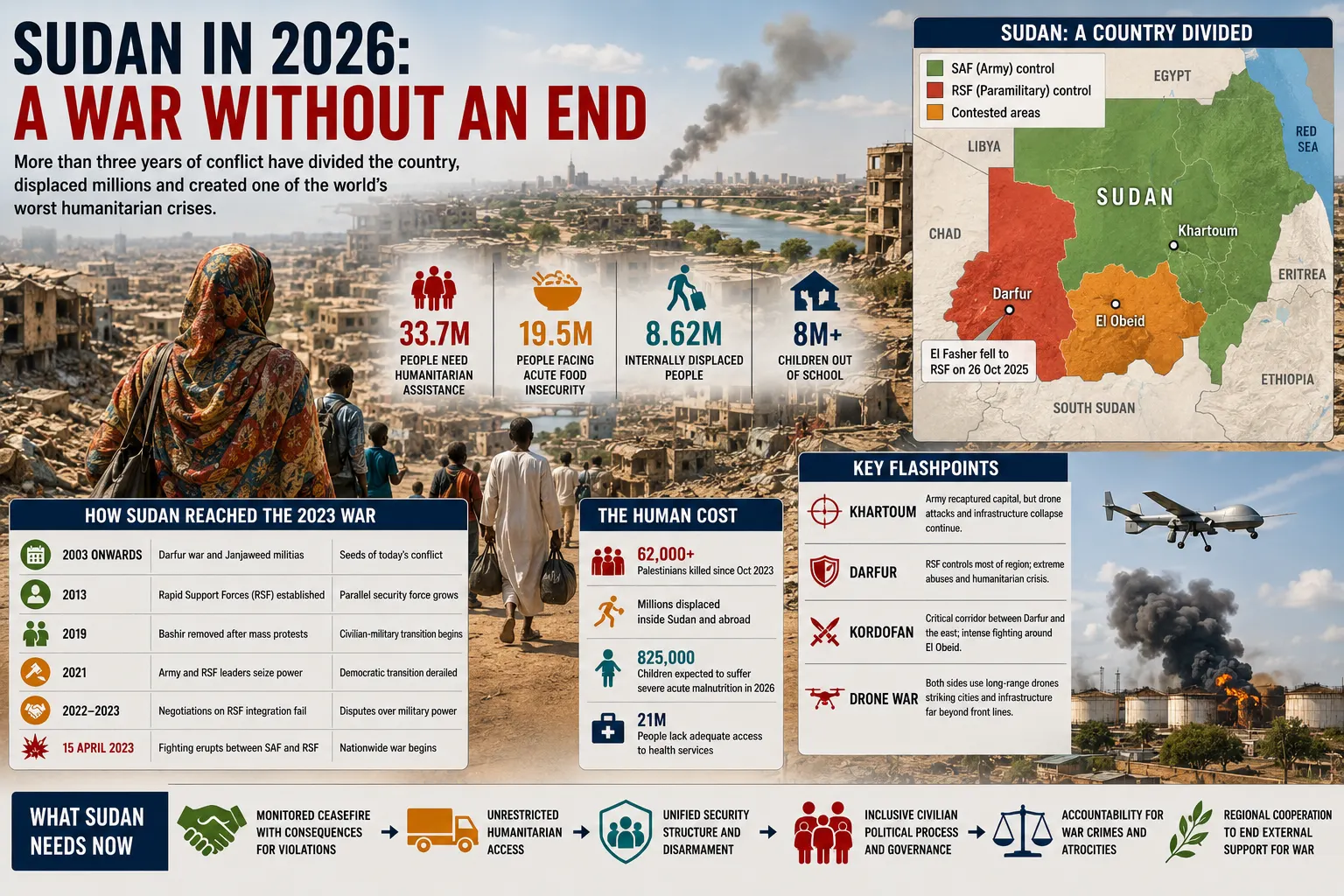
More than three years after war erupted in Sudan, the military map has changed dramatically but the underlying crisis has not moved closer to resolution. The Sudanese Armed Forces have recovered Khartoum and much of the north, east and centre of the country, while the paramilitary Rapid Support Forces dominate most of Darfur after capturing El Fasher in October 2025. Between those two zones, Kordofan has become one of the war’s most important and dangerous fronts, while increasingly long-range drone attacks allow both sides to threaten cities and infrastructure far beyond conventional battle lines.
For civilians, territorial changes have brought only uneven relief. Some families have returned to Khartoum and other army-held areas, yet they are returning to neighbourhoods with damaged homes, unreliable electricity, disrupted water networks and weakened public services. In Darfur and Kordofan, fighting, displacement and restrictions on humanitarian access continue to create exceptionally severe conditions. The United Nations estimates that 33.7 million people require humanitarian assistance in 2026, while the latest nationwide food-security assessment found almost 19.5 million people facing acute food insecurity.
The central contradiction of Sudan’s war is therefore becoming clearer. Neither the army nor the RSF has been able to reunify the country by force, but both retain enough military power and external connections to continue fighting. Battlefield gains have repeatedly changed negotiating positions without producing an agreement on how Sudan should ultimately be governed, who should control its armed forces or how a credible civilian political system could emerge after years of coups and war.
The War Began With the Collapse of an Unfinished Political Transition
The immediate conflict began on 15 April 2023, but the structures that produced it developed over decades. Sudan had been ruled since 1989 by Omar al-Bashir, whose government combined military power, Islamist political structures, security agencies and regional armed groups. During the Darfur war that began in 2003, government forces fought alongside Arab militias widely known as the Janjaweed against rebel organisations. Those campaigns became associated with mass displacement, ethnic violence and international allegations of war crimes and crimes against humanity.
The Rapid Support Forces emerged from that security environment. The RSF was formally created in 2013 and placed under the leadership of Mohamed Hamdan Dagalo, commonly known as Hemedti. Its roots lay substantially in the Darfur militias that had fought alongside the government, although it later expanded geographically, accumulated heavy weapons and developed economic interests including connections to Sudan’s gold industry. By the end of the Bashir era, Sudan effectively possessed two large armed structures: the conventional Sudanese Armed Forces and an increasingly powerful paramilitary organisation with its own command, finances and political influence.
Popular protests beginning in late 2018 eventually led the military to remove Bashir in April 2019. A power-sharing arrangement between civilian representatives and military leaders was subsequently intended to guide Sudan towards democratic elections. General Abdel Fattah al-Burhan became the most senior military figure in the transitional structure, while Hemedti became his deputy. For a time, the two commanders who would later lead opposing sides in the civil war were partners within the same political order.
That transition never resolved the fundamental question of military power. Civilian authorities could not fully control the security sector, while the army and RSF retained separate command systems and extensive economic interests. In October 2021, Burhan and Hemedti jointly displaced the civilian-led government in a military takeover that derailed the transition. Subsequent attempts to restore civilian government required agreement on security-sector reform, including the politically explosive question of how and when the RSF would be integrated into the regular army.
By early 2023, that issue had become inseparable from the struggle over who would command Sudan’s future military establishment. Negotiations addressed the timetable for integration, command structures and a renewed transfer of authority to civilian government. Tensions escalated as forces deployed around strategic locations in Khartoum and elsewhere. Fighting then began on 15 April. Competing accounts have continued over responsibility for the first shots, but the structural cause was broader than one incident: two heavily armed institutions were competing for authority inside a state whose civilian transition had already collapsed.
How Sudan Reached the 2023 War
| Period | Development | Why It Mattered |
|---|---|---|
| 2003 onwards | Darfur war and mobilisation of Janjaweed militias | Creates armed networks later connected to the RSF |
| 2013 | Rapid Support Forces formally established | Parallel security structure gains institutional status |
| 2019 | Omar al-Bashir removed after mass protests | Civilian-military transition begins |
| 2021 | Army and RSF leaders remove civilian government | Democratic transition is derailed |
| 2022–2023 | New transition negotiations begin | RSF integration and military command become central disputes |
| 15 April 2023 | Fighting erupts between SAF and RSF | Power struggle becomes nationwide war |
Sources: Reuters, United Nations reporting and United States government background material on Sudan’s security institutions.
The First Phase Was a Battle for Khartoum
The initial war was unusual because much of its heaviest combat took place inside the national capital rather than along a distant frontier. RSF units established positions across Khartoum, Omdurman and Bahri, while the army relied heavily on air power, artillery and fortified military installations. Residential districts became battlefields, government buildings were occupied or destroyed and millions of people fled the metropolitan area.
The conflict subsequently expanded into central Sudan, Darfur and Kordofan. The RSF’s seizure of much of Gezira state in late 2023 was particularly damaging because the region is an important agricultural centre and because the advance displaced large numbers of people who had already escaped Khartoum. Reports of looting, killings and disruption to farming illustrated how territorial conquest could rapidly become an economic and humanitarian problem far beyond the battlefield itself.
The balance changed during 2024 and early 2025 as the army rebuilt its ground forces, mobilised allied armed groups and increasingly used drones. It gradually regained territory in central Sudan and entered previously RSF-held districts of the capital. In March 2025, army forces recaptured the presidential palace and subsequently consolidated control over most of greater Khartoum.
That was a major military and symbolic victory for the SAF, but it did not end the war. Instead, the geographical centre of the conflict moved westwards. The army increasingly controlled the Nile Valley, eastern Sudan and much of the central belt, while the RSF concentrated its power in Darfur and contested areas farther east.
The Fall of El Fasher Reshaped the War Again
For much of the conflict, El Fasher in North Darfur was the most important city preventing the RSF from consolidating control over the entire Darfur region. The city contained army forces, allied former rebel movements and hundreds of thousands of civilians and displaced people. It was subjected to a prolonged siege that restricted food, medicine and movement and produced increasingly severe humanitarian conditions.
The RSF captured El Fasher on 26 October 2025 after roughly 18 months of siege and fighting. The city’s fall was strategically important because it removed the principal remaining army stronghold in Darfur and strengthened the RSF’s ability to administer a large contiguous territory in western Sudan. It also produced some of the most serious allegations of atrocities in the entire war.
Witnesses interviewed by Reuters described civilians being shot, abducted and attacked while attempting to flee. The United Nations Human Rights Council subsequently ordered an urgent investigation into reported ethnically motivated killings, summary executions, torture, rape, abductions and other abuses. The RSF has said abuses are investigated and that individuals responsible can be punished, while disputing or rejecting some accounts of systematic violations.
The fall of El Fasher also deepened the danger of political partition. An RSF-led coalition had already announced a parallel governing structure in July 2025 from Nyala in South Darfur. Hemedti was named head of its presidential council, with Sudan People’s Liberation Movement-North leader Abdel Aziz al-Hilu as deputy. The army-led authorities rejected the parallel administration and maintained that Sudan must remain under a single national government.
Kordofan Is Now the Hinge Between Two Sudans
By August 2026, Kordofan had become the most important connecting battlefield between RSF-held Darfur and the territories controlled by the army farther east. North Kordofan’s capital, El Obeid, is particularly significant because roads through the city connect central Sudan with western regions and provide important commercial and humanitarian routes. Control of those corridors affects not only military movement but also food, fuel and aid deliveries.
Fighting intensified around El Obeid during the summer. On 12 August, witnesses reported eight drones over the city as air defences engaged incoming attacks. Drone activity was also reported around Khartoum, Omdurman, Bahri and Atbara, demonstrating that the RSF retained the ability to threaten distant army-held areas despite losing the capital the previous year.
Late-August violence underlined the danger to civilians. Rights monitors reported that drone strikes in North Kordofan killed civilians near Sowdari, while separate violence in South Kordofan caused further deaths and displacement. Responsibility for individual drone attacks can be difficult to establish immediately, particularly where neither side claims them, and casualty reports from isolated areas often cannot be independently verified in real time.
Kordofan matters strategically because neither belligerent can comfortably accept permanent enemy control of the region. For the RSF, it is the route between Darfur and the country’s political and economic centre. For the army, holding the corridor helps isolate Darfur from the Nile Valley and protects approaches towards Khartoum. This geography makes the region both militarily valuable and particularly vulnerable to a prolonged war of attrition.
Where the Conflict Stands in August 2026
| Region | Broad Military Position | Humanitarian Significance |
|---|---|---|
| Khartoum and central Sudan | Predominantly army-held | Large-scale returns amid severe infrastructure damage |
| Eastern and northern Sudan | Predominantly army-held | Administrative and logistical centre of SAF-controlled Sudan |
| Darfur | RSF dominates most of region | Extreme protection, hunger and displacement risks |
| North Kordofan | Heavily contested | El Obeid is a strategic supply and displacement hub |
| South Kordofan | Multiple forces and contested areas | Several communities face severe access and famine risks |
| Blue Nile | Army dominant with contested pockets | Additional front involving RSF-aligned SPLM-N forces |
Sources: Reuters, IOM, UK government security assessments and publicly available conflict-control reporting. Territorial control can change rapidly.
Sudan’s War Has Become a Drone War
One of the clearest changes since 2023 is the growing importance of unmanned aircraft. In the opening stages, the Sudanese army possessed the stronger conventional air force, while the RSF relied heavily on mobile ground forces. Over time, both sides acquired or developed increasingly capable drones, making it possible to attack targets hundreds of kilometres from active front lines.
The consequences are military and civilian. Drones can attack air bases, troop concentrations and logistics depots, but they can also disrupt power stations, fuel infrastructure, markets and urban areas. UNICEF reported that drone attacks accounted for 78 per cent of reported child casualties during the first three months of 2026. By the end of June, at least 330 children had been reported killed or injured during the first half of the year, with Darfur and Kordofan suffering the highest numbers.
Long-range attacks also complicate the idea that territories behind a front line are genuinely safe. Khartoum is again under army control, but drones have returned to its skies. Atbara and other cities in the Nile Valley have also faced threats. The development resembles patterns seen in several contemporary conflicts: territory may be recaptured while infrastructure remains within range of relatively inexpensive unmanned weapons.
The civilian electricity system illustrates the resulting vulnerability. By late August, large parts of army-controlled Sudan were experiencing extensive blackouts. Government officials have blamed a combination of attacks, looting and insufficient resources for repairs, while the RSF has denied accusations that it deliberately targets the electricity network. Sudan’s Merowe dam, an important source of electricity, has also been affected during the conflict.
For households and businesses, the distinction between direct war damage and wider system failure can become almost irrelevant. Workshops cannot operate reliably without electricity, refrigerators cannot preserve food or medicine and water pumping can become difficult. High fuel prices make private generators unaffordable for many families, while reconstruction becomes slower because functioning power is itself required to repair damaged infrastructure.
The Scale of Humanitarian Need Is Extraordinary
The latest UN planning figure estimates that 33.7 million people will require humanitarian assistance in Sudan during 2026. UNICEF’s mid-year reporting put the number of children needing assistance at 17.3 million. These figures reflect not only people living beside active battlefields but also communities affected by displacement, hunger, disease, destroyed public services and lost livelihoods.
Displacement figures require careful interpretation because different agencies measure different populations and time periods. IOM’s July 2026 assessment recorded about 8.62 million internally displaced people across Sudan and approximately 4.93 million returnees. More than half of the internally displaced population were children. UNHCR separately recorded millions of new refugees and asylum seekers who had crossed into neighbouring countries since the war began.
The decline from the peak number of internally displaced people does not mean that the crisis has simply reversed. Millions have returned to Khartoum, Gezira, Sennar and other locations where security improved, but return is not synonymous with recovery. Families may come back because displacement itself is unsustainable even when their homes, schools, clinics and local economies remain damaged.
Sudan’s neighbours are carrying part of the burden. Chad has received hundreds of thousands of Sudanese refugees, particularly from Darfur, while Egypt, South Sudan, Libya, Ethiopia, Uganda and the Central African Republic have also received people fleeing the conflict. Host countries face their own economic and humanitarian pressures, and several international refugee operations are struggling with funding shortages.
Sudan’s Humanitarian Crisis in 2026
| Measure | Latest Figure | Reference |
|---|---|---|
| People needing humanitarian assistance | 33.7 million | 2026 UN planning figure |
| People facing acute food insecurity | Nearly 19.5 million | February–May 2026 nationwide IPC |
| People in Catastrophe food insecurity | Nearly 135,000 | IPC Phase 5 |
| Children projected with severe acute malnutrition | 825,000 | 2026 |
| Internally displaced people | About 8.62 million | IOM, July 2026 |
| Children out of school | At least 8 million | UNICEF, 2026 |
Sources: IPC, WFP, FAO, UNICEF and IOM. Different displacement datasets use different definitions and reference periods.
The Famine Picture Requires Careful Interpretation
Sudan has experienced confirmed famine conditions during the war, but describing the current situation requires precision. In September 2025, the IPC classified El Fasher in North Darfur and Kadugli in South Kordofan as experiencing Famine conditions, with similar concerns surrounding Dilling. Those assessments covered a period of severe siege, displacement and restricted access.
The newer nationwide IPC assessment covering February to May 2026 did not classify any area as currently experiencing Famine. That does not mean the hunger emergency ended. Almost 19.5 million people remained in Crisis conditions or worse, including more than five million in Emergency and nearly 135,000 people in Catastrophe.
The assessment also identified 14 areas across North Darfur, South Darfur and South Kordofan at risk of Famine under a reasonable worst-case scenario involving intensified conflict, further restrictions on humanitarian access and deteriorating access to markets and basic services. Conditions were expected to worsen during the June-to-September lean season.
There is another important statistical limitation. The February-to-May analysis covered the entire country, but projections for the June-to-September lean season covered only 56 localities and displacement sites representing about 8.3 million people. The IPC therefore explicitly warns against treating figures from the two periods as directly comparable nationwide totals.
The distinction between Catastrophe and Famine is also frequently misunderstood. A person can be classified in IPC Phase 5 Catastrophe without the entire area satisfying all thresholds required for a formal Famine classification. The presence of 135,000 people in Catastrophe therefore represents extreme individual deprivation even where an area has not crossed the technical threshold for Famine.
Malnutrition Turns Food Shortages Into a Health Emergency
Food insecurity becomes particularly dangerous when it intersects with disease and collapsed healthcare. An estimated 825,000 children under five are expected to suffer severe acute malnutrition during 2026, an increase from the previous year. Severe acute malnutrition greatly increases vulnerability to infections that might otherwise be survivable.
Sudan’s health system had significant weaknesses before the war, but conflict has damaged hospitals, displaced medical workers and disrupted medicine and vaccination supplies. WHO estimated in April that roughly 21 million people lacked adequate access to health services. Cholera, malaria, dengue and measles have circulated in a population frequently living without reliable clean water or sanitation.
The problem is particularly acute for people displaced repeatedly. A family may first flee shelling, then lose income and food supplies, then move into an overcrowded settlement with weak sanitation, and finally be unable to reach functioning medical care. None of those stages alone explains the humanitarian catastrophe. Together, they create a system in which war increases the likelihood of death from causes far removed from the weapon that forced the family to flee.
This is also why determining the total death toll of Sudan’s war is exceptionally difficult. Battlefield and violence databases count documented killings, but indirect deaths from hunger, untreated illness and the collapse of medical services are far harder to measure. A World Bank economic report published in 2025 cited research estimating more than 61,000 deaths in Khartoum state alone between April 2023 and June 2024, illustrating how incomplete narrower nationwide counts can be.
An Education Crisis Is Becoming a Generational Crisis
The consequences will persist long after the fighting stops. UNICEF said in May that at least eight million Sudanese children remained out of school and that nearly half of school buildings were no longer functioning as educational facilities. Some have been damaged, others are being used as shelters and teachers have fled or gone unpaid.
Darfur and Kordofan have been especially badly affected. Interruptions lasting several years cannot easily be recovered through a normal return to school. Children lose literacy and numeracy progress, adolescents enter work early, families arrange marriages during economic distress and armed organisations can recruit young people who have few other opportunities.
There are signs that services can resume where security improves. UNICEF and partner organisations launched programmes in 2026 intended to restore learning for hundreds of thousands of conflict-affected children. But repairing a school building is only one part of the task. Teachers require salaries, families need sufficient income to allow children to attend, roads must be safe and communities need confidence that schools will not again become military positions or displacement shelters.
The Economy Was Weak Before the War and Has Been Reshaped by It
Sudan entered 2023 with high debt, inflation, weak public finances and unresolved structural problems. The civil war then destroyed productive assets and interrupted trade on a much larger scale. World Bank estimates indicate real GDP contracted by 29.4 per cent in 2023 and another 14 per cent in 2024. In cumulative terms, economic output fell by close to 40 per cent between 2022 and 2024.
The damage has been uneven. Khartoum had concentrated a large share of Sudan’s services, manufacturing, administration and finance, making the battle for the capital economically devastating. Agriculture proved more resilient in some regions but was subsequently disrupted as fighting spread into major producing areas such as Gezira and Sennar.
Some high-frequency indicators have shown tentative recovery in safer urban areas as displaced people return and government institutions reopen. That recovery is fragile. Electricity shortages, damaged transport links, destroyed businesses, limited banking services and insecurity continue to constrain normal commerce. A family returning to Khartoum may therefore regain access to its property while still lacking reliable work, electricity or public services.
War economies have developed alongside the collapse of formal activity. Gold, fuel, transport routes, cross-border trade and taxation at checkpoints can finance armed actors and create constituencies that benefit materially from continued control of territory. This does not mean economic interests alone caused the war, but they can make armed structures more capable of sustaining themselves once political conflict has turned into prolonged warfare.
Both Main Sides Face Serious Allegations of International Crimes
An independent UN fact-finding mission reported in September 2025 that both the Sudanese Armed Forces and the Rapid Support Forces had committed large-scale violations against civilians, including acts amounting to war crimes. Its findings included attacks in populated areas, arbitrary detention, torture and destruction of infrastructure essential for civilian survival.
The mission found particularly extensive crimes associated with the RSF and allied forces in Darfur, including killings, rape, sexual slavery, forced displacement and persecution on ethnic grounds. It also said starvation had been used during the siege of El Fasher and that some patterns could amount to crimes against humanity.
The United States made a separate legal and policy determination in January 2025 that members of the RSF and allied militias had committed genocide in Sudan. Washington sanctioned Hemedti and associated businesses. The RSF has rejected accusations that it systematically targets civilians and says individual violations should be investigated and punished.
Allegations against the army are substantial as well. UN investigators have examined indiscriminate bombardment, killings, detention, torture and attacks affecting civilian areas. The SAF says it is defending the Sudanese state from an armed rebellion and disputes allegations that it deliberately targets civilians.
International accountability mechanisms remain active. In July 2026, the International Criminal Court’s deputy prosecutor said investigators had made an important breakthrough in developing evidence linking senior figures to atrocities in Darfur, particularly concerning El Geneina and El Fasher. Sudan is not generally a state party to the Rome Statute, but the ICC has jurisdiction over Darfur through a 2005 referral by the UN Security Council.
Foreign Weapons Have Made a Domestic War Harder to End
Sudan’s conflict is fundamentally a struggle between Sudanese forces, but it has become increasingly internationalised. Both sides have sought weapons, financing, political support and logistical connections outside the country. The growing use of sophisticated drones is one visible sign that the war cannot be understood solely through Sudan’s domestic military resources.
Egypt has consistently supported Sudan’s army politically and regards the stability and territorial unity of its southern neighbour as an important national-security interest. Reuters reported in February 2026 that Turkish-made combat drones had been deployed to an Egyptian airstrip near the Sudanese border, a development interpreted by regional officials and analysts as evidence of deeper Egyptian involvement. Cairo has emphasised support for Sudanese state institutions.
The United Arab Emirates has repeatedly been accused by Sudan’s army, US lawmakers and other observers of supporting the RSF. Abu Dhabi has consistently denied providing military support to the paramilitary force. The issue has become one of the most contentious diplomatic elements of the conflict.
United Nations experts have nevertheless documented international supply networks supporting the RSF. A draft Panel of Experts report described by Reuters in July 2026 found that Boeing 727 aircraft had transported fighters, foreign mercenaries, drones and other military equipment for the RSF. UN investigators also reported the involvement of Colombian mercenaries. Such findings demonstrate how international networks can sustain fighting even when formal arms restrictions exist.
The army has also developed outside military relationships, including renewed cooperation with Iran and access to foreign drone technology during earlier stages of the war. The result is an arms competition in which battlefield setbacks can be partly offset by new equipment and external supply routes.
Foreign involvement is an amplifying factor rather than the original cause of the war. Sudan’s conflict emerged from the collapse of its domestic political transition and competition between rival armed institutions. External weapons, financing and diplomatic support have subsequently increased the ability of those forces to continue fighting.
Humanitarian Funding Is Falling Far Behind the Scale of Need
Even when aid organisations gain physical access, financing can determine whether assistance reaches civilians. Sudan’s 2026 humanitarian response plan seeks approximately $2.9 billion to assist more than 20 million of the 33.7 million people estimated to need humanitarian support.
By early August, the United Nations said only about $1.2 billion had been received, equivalent to roughly 41 per cent of the requirement. The gap has practical consequences. Health centres close, nutrition programmes restrict admissions and food assistance is reduced precisely when displacement and hunger remain severe.
The reduction in international humanitarian budgets is particularly important because Sudan’s own state capacity has been weakened by war. Local emergency-response groups, community kitchens, medical networks and Sudanese aid workers have therefore carried an unusually large share of the response. They can often reach places international organisations cannot, but local initiatives cannot substitute indefinitely for national health systems or large-scale international food and nutrition programmes.
Access is another limitation. Fighting, checkpoints, damaged roads, administrative restrictions, insecurity and attacks on humanitarian personnel can make delivery impossible even where supplies and funding exist. The approaching rainy season compounds the problem in areas where roads become difficult to use and flooding increases disease risks.
Why Peace Efforts Have Repeatedly Failed
There has been no shortage of diplomatic initiatives. Saudi Arabia and the United States began hosting negotiations in Jeddah in 2023, producing commitments intended to protect civilians and facilitate humanitarian access. Subsequent mediation involved the African Union, IGAD, the United Nations, Switzerland and other international partners. Temporary ceasefires were announced at different stages but repeatedly collapsed.
The underlying difficulty is that ceasefire diplomacy is trying to solve both a military war and an unresolved constitutional struggle. The SAF considers itself the core national institution and demands that the RSF leave occupied cities and ultimately cease functioning as an independent military force. The RSF argues that Sudan’s old military and political structures cannot simply be restored and presents itself as part of a project to create a different political order.
The diplomatic process became more structured in September 2025 when the United States, Saudi Arabia, the United Arab Emirates and Egypt proposed a roadmap calling for a three-month humanitarian truce, followed by a permanent ceasefire and a nine-month process towards civilian-led government. The four countries said there was no viable military solution to the conflict.
A US-backed proposal remained under negotiation during 2026. It again centred on a 90-day humanitarian truce followed by permanent ceasefire negotiations and civilian transition. But documents reported by Reuters in July showed that the army insisted the plan must require the RSF to withdraw completely from cities it had occupied since the war began rather than from only selected areas.
That disagreement is not technical. Withdrawal determines who controls territory, weapons, government facilities, trade routes and civilian populations during negotiations. The army fears that a ceasefire allowing the RSF to retain major territorial control could institutionalise the country’s division. The RSF has little incentive to surrender territory before receiving guarantees concerning its own political and military future.
International Pressure Is Shifting Back Towards Arms and Sanctions
With negotiations stalled, international attention has increasingly focused on reducing the military resources available to the belligerents. The existing UN arms embargo was originally created around the earlier Darfur conflict and does not constitute a simple comprehensive prohibition on weapons transfers to every actor throughout Sudan.
In August 2026, the United States pressed for stronger UN sanctions and a wider arms embargo covering Sudan as a whole, including drones and related technologies. G7 governments and the European Union had made a similar call in July while urging external actors to stop supplying military and financial support to the combatants.
Burhan rejected the threat of additional sanctions and has continued to insist that the army will fight until the RSF threat is removed. The army has simultaneously promoted a Sudanese national-dialogue process, but Burhan has ruled out restoring Hemedti and the RSF leadership to the political position they held before the war.
Sanctions may increase the costs of acquiring weapons, but they cannot by themselves create agreement over Sudan’s political order. Effective enforcement is also difficult when equipment can move through long land borders, informal trade networks and neighbouring countries. A broader embargo would therefore depend heavily on cooperation from regional states.
The Risk of De Facto Partition Is Growing
Sudan has not formally divided again, but the structures of separate rule are becoming more visible. The army dominates Khartoum, the north, east and important central areas and operates the internationally recognised state apparatus. The RSF and its allies exercise power across most of Darfur and have announced their own parallel political structure.
Kordofan consequently resembles more than a battlefield. It is the contested bridge between two emerging zones of authority. If neither side can achieve a decisive victory, temporary military boundaries could harden into administrative, economic and political divisions even without formal international recognition.
Such an outcome would carry serious consequences. Sudan’s internal markets and transport networks were designed around an integrated national territory. Darfur depends on routes eastward as well as cross-border commerce; central and eastern Sudan depend on agricultural and livestock production from western regions. Partition would also complicate citizenship, property, monetary policy, oil and mineral revenues and the return of millions of displaced people.
The experience of South Sudan’s independence in 2011 also makes territorial fragmentation particularly sensitive. The secession removed much of the former unified Sudan’s oil production and contributed to economic shocks in the north. Today’s conflict is different, and there is no recognised process towards a new state in Darfur, but Sudanese political actors are acutely aware of the consequences of another permanent division.
A Military Victory Would Not Automatically Rebuild the State
Even if one side eventually gained a decisive battlefield advantage, Sudan’s problems would not end at that moment. The country would still require a functioning national army, courts, police, local government, banking system and agreement over the role of armed movements that have fought alongside both main belligerents.
The question that preceded the war would therefore return in an even more difficult form: who controls Sudan’s weapons? The RSF is not the country’s only non-SAF armed organisation. Former Darfur rebel groups, the SPLM-N, locally mobilised forces and other militias now form part of the security landscape. Years of war have increased rather than reduced the number of armed actors.
A sustainable post-war settlement would consequently require security-sector reform broader than simply merging the SAF and RSF. It would need agreed chains of command, demobilisation and reintegration programmes, policing arrangements and credible guarantees for communities that fear domination or retaliation by rival groups.
The political system presents the same problem. Restoring the pre-war order would not answer the demands for civilian rule that drove the 2018-19 uprising. But constructing an entirely new government while large armed organisations retain independent power would reproduce one of the fundamental weaknesses of the failed transition.
What a Credible Settlement Would Need to Achieve
The first requirement is a ceasefire that can be monitored rather than merely announced. Repeated temporary agreements have failed partly because violations produced no effective mechanism capable of imposing consequences or quickly resolving disputes. Monitoring would have to cover drones and air strikes as well as conventional ground movements.
The second is reliable humanitarian access independent of the political negotiations. Food and medical supplies cannot reasonably be treated as bargaining instruments while millions face emergency conditions. Major routes into Darfur, Kordofan and other vulnerable regions would need sustained protection rather than short periods of exceptional access.
Third, negotiations would need to determine the future of armed forces rather than postpone the issue that helped produce the war. That would include the RSF, the army, allied former rebel movements and other armed formations. A timetable that is too rapid may be impossible to implement; one that leaves parallel armies intact indefinitely risks recreating the same crisis.
Fourth, civilian political participation would have to become more than a ceremonial final stage of a military agreement. Sudan’s 2019 revolution was fundamentally a demand for political transformation, and many civilians reject a settlement negotiated solely between the commanders who dominated the period after Bashir’s removal.
Finally, any political process would need to address accountability. Communities in Darfur, Khartoum, Gezira, Kordofan and elsewhere have experienced killings, displacement, sexual violence and destruction by multiple armed actors. A settlement that ignores those grievances could stop organised combat while leaving local conflicts capable of reigniting.
Ending Sudan’s war requires more than agreement between Burhan and Hemedti. A durable settlement would need a monitored ceasefire, humanitarian access, a unified security structure, credible civilian government, regional cooperation and a mechanism for addressing grave crimes committed during the conflict.
The Next Phase Will Be Determined in Kordofan, in the Air and at the Negotiating Table
The most important immediate military question is whether the army can continue pushing westwards from the territory it regained in 2025 and 2026, or whether the RSF can stabilise its position around Kordofan and reconnect its Darfur stronghold with areas farther east. El Obeid will remain central to that contest because of its geography and transport links.
The second indicator is the drone campaign. If both sides continue acquiring longer-range and more sophisticated systems, cities nominally far from front lines will remain vulnerable. Repeated attacks on electricity, fuel, transport and other infrastructure could also undermine the limited economic recovery underway in Khartoum and other returning urban areas.
The third is humanitarian access during and after the lean season. The latest IPC analysis deliberately avoids claiming that famine currently exists across entire regions where evidence is insufficient, but it identifies conditions capable of deteriorating rapidly. If fighting intensifies in the 14 areas considered at risk and aid access contracts, the technical threshold between Catastrophe and Famine can become a matter of life and death rather than terminology.
The fourth is external support. The conflict has demonstrated that Sudan’s battlefield is connected to wider networks running through North Africa, the Sahel, the Gulf and the Red Sea. Restricting weapons and financing could reduce the ability of either side to pursue total victory, but doing so requires states with competing interests to cooperate.
Sudan Is Not Simply Experiencing One Humanitarian Emergency
The scale of Sudan’s crisis can obscure its structure. Darfur faces acute protection risks, mass displacement and continuing hunger. Kordofan combines active warfare with severe food insecurity and restricted access. Khartoum is experiencing return and reconstruction alongside electricity shortages and the possibility of renewed drone attacks. Neighbouring states are absorbing refugees while confronting humanitarian and economic problems of their own.
This is why improvements in one indicator can coexist with deterioration elsewhere. Internal displacement can fall because millions return home while new families flee fighting in Kordofan. Nationwide food insecurity can improve after a harvest while particular communities remain in Catastrophe. The army can restore government offices in Khartoum while the country as a whole moves closer to political fragmentation.
The war that began in April 2023 was initially described as a confrontation between two generals and two armed forces. That description is now too narrow. More than three years of fighting have altered Sudan’s economy, population distribution, regional alliances, security institutions and political geography. Armed groups that were once peripheral have become national actors, millions of people have crossed internal and international borders and entire cities require reconstruction.
As of 31 August 2026, the danger is therefore not only that the war continues. It is that prolonged conflict turns emergency conditions into permanent structures: separate administrations, fragmented armed forces, disrupted education, chronic hunger and communities increasingly disconnected from a functioning national economy. Sudan’s army has recovered substantial territory and the RSF retains a powerful western stronghold, but neither development provides a political answer to the question that has remained unresolved since the fall of Omar al-Bashir: how military power can be placed under a legitimate, unified and ultimately civilian Sudanese state.
Sources
Reuters — Fighting around El Obeid and renewed drone attacks, 12 August 2026
Reuters — Power shortages and infrastructure damage in Sudan, 28 August 2026
Reuters — US-backed peace proposal and Sudanese army response, July 2026
Reuters — International Criminal Court investigation into Darfur atrocities, July 2026
Reuters — RSF-led coalition announces parallel government, July 2025
Reuters — Witness accounts following the fall of El Fasher, November 2025
WFP, FAO and UNICEF — Sudan acute food insecurity and malnutrition assessment, May 2026
UNICEF — Sudan Humanitarian Mid-Year Situation Report 2026
International Organization for Migration — Sudan Displacement Tracking Matrix
UNHCR — Sudan regional displacement situation
World Health Organization — Sudan health crisis assessment, April 2026
World Bank — Sudan economic and humanitarian overview
United Nations — Sudan humanitarian response funding and access, July 2026
Source & Transparency
This article is published by Ireland Newspaper for editorial and informational purposes.
Published: 31 August 2026 · Updated: 31 August 2026

Newsroom Ireland Newspaper
Ireland Newspaper editorial team prepares daily news coverage for readers in Ireland and abroad.