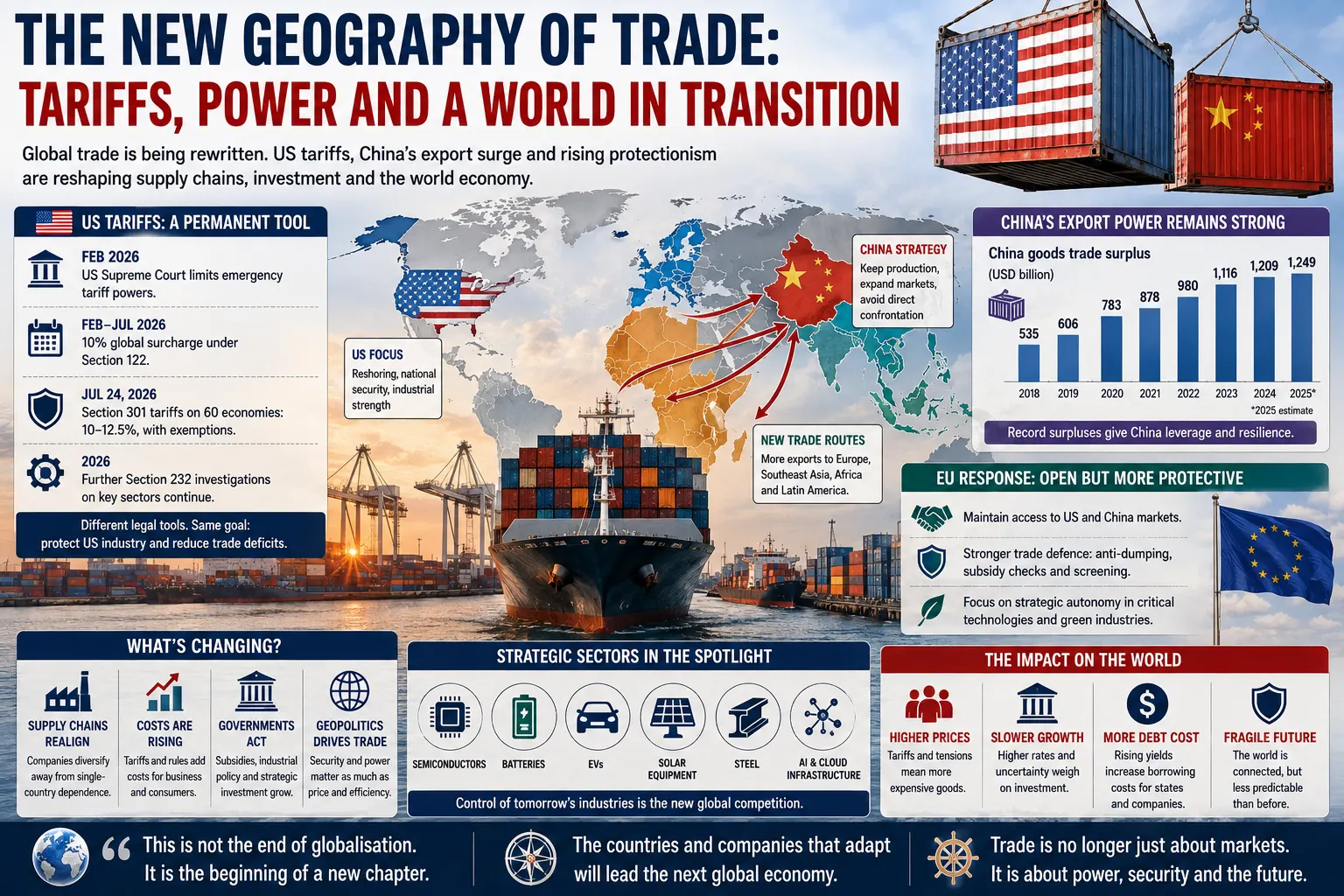
A decade ago, the central assumption behind global trade was that companies would manufacture wherever costs were lowest and sell wherever demand was strongest. By September 2026, that principle has not disappeared, but it is increasingly competing with a different set of priorities: national security, industrial capacity, technological leadership, labour standards, energy resilience and political control over critical supply chains. Tariffs that were once treated largely as exceptional responses to individual trade disputes have become part of a much broader restructuring of the world economy.
The United States is at the centre of that shift. President Donald Trump’s second administration has continued using tariffs on a scale rarely seen in recent decades, even after the US Supreme Court curtailed the legal foundation of some of the broad duties imposed during 2025. Washington has responded not by abandoning tariffs but by moving them onto different statutory foundations, including Sections 301, 232 and 122 of US trade law. China, meanwhile, has maintained an enormous export surplus while redirecting more goods towards Europe, Southeast Asia, Africa and other markets. The European Union is trying to preserve access to both the American and Chinese economies while simultaneously constructing stronger trade-defence mechanisms of its own.
The emerging system is not straightforward deglobalisation. Global goods continue to move in enormous volumes, technology trade is expanding rapidly and companies remain deeply dependent on international suppliers. Instead, trade is being reorganised. Production is shifting between countries, goods are being rerouted through alternative markets, governments are subsidising strategic industries and businesses are increasingly willing to accept somewhat higher costs in exchange for lower geopolitical risk.
The result is a world economy that remains connected but is becoming less neutral. Decisions about where to manufacture semiconductors, electric vehicles, batteries, pharmaceuticals, solar equipment, steel or artificial-intelligence infrastructure are increasingly influenced by governments as well as markets. That transformation is likely to shape global investment and prices long after individual tariff disputes have been settled.
The United States Has Made Tariffs a Permanent Economic Policy Tool
Trump returned to office in January 2025 promising to reduce America’s trade deficits, encourage domestic manufacturing and make foreign producers pay more for access to the world’s largest consumer market. The administration initially attempted to build a broad tariff system using emergency presidential powers. Those measures affected trading partners across the world and produced unusually high levels of uncertainty for importers, retailers and manufacturers.
The legal architecture changed in February 2026 when the US Supreme Court rejected the administration’s use of the International Emergency Economic Powers Act for broad tariff measures. The ruling limited one route through which the White House had attempted to impose wide-ranging duties without the more traditional trade-law procedures associated with investigations and specific statutory findings.
The administration responded immediately. A temporary 10 per cent global import surcharge was imposed under Section 122 of the Trade Act while the government developed tariffs using other powers. That temporary measure expired in July, but it was replaced by a new structure rather than a return to the pre-2025 trading system.
On 24 July, new Section 301 tariffs took effect on imports from 60 economies following US investigations into whether trading partners had adequately prohibited imports produced using forced labour. Tariffs were generally set at 10 or 12.5 per cent, subject to product exemptions and special arrangements for certain economies. China was among the countries affected. Oil, gas, food, selected raw materials and products considered difficult to replace domestically received exemptions.
The significance extends beyond the individual rates. Washington demonstrated that even when courts limit one tariff mechanism, the administration can attempt to reproduce much of the policy through established trade statutes. Tariff policy has therefore become more legally complex but not necessarily less important.
How US Tariff Policy Changed During 2026
| Stage | Measure | Significance |
|---|---|---|
| February 2026 | Supreme Court restricts use of emergency powers for broad tariffs | Administration must rely more heavily on traditional trade statutes |
| February–July | Temporary 10% global surcharge under Section 122 | Maintains broad tariff pressure during transition |
| July 2026 | Section 301 tariffs imposed on 60 economies | 10–12.5% duties apply to many imports, with exemptions |
| 2026 | Sector-specific investigations and Section 232 measures continue | Security and industrial policy increasingly shape trade |
| Under consideration | Additional semiconductor and overcapacity tariffs | Potential further expansion into strategic technology |
Sources: White House, Office of the US Trade Representative and Reuters reporting through 1 September 2026.
The New Tariffs Are More Targeted Than the 2025 System — but They Reach Deep Into Global Supply Chains
The July measures illustrate how the current US trade strategy differs from a conventional tariff on one product from one country. Washington investigated 60 economies simultaneously and linked the resulting duties to labour standards in international supply chains. Canada, Mexico, India, Indonesia, Malaysia and the United Kingdom were among economies facing a 10 per cent rate under the new action, while many others were assigned 12.5 per cent.
The European Union and several important Asian partners received specially structured treatment. For many EU goods, the additional Section 301 duty was designed so that the combination of the normal most-favoured-nation tariff and the new tariff would reach 10 per cent rather than simply adding another 10 percentage points on top. Similar arrangements at different levels were established for Japan, South Korea, Switzerland and Taiwan.
The policy also contains numerous exclusions because the United States remains dependent on imported materials and products that cannot easily be substituted. Raw materials with inadequate domestic supply, goods that could cause economy-wide disruption and certain items unavailable at reasonable prices from alternative sources can be exempted. Those exceptions reveal an important constraint on protectionism: an economy as large as the United States can redirect trade, but it cannot instantaneously reproduce every part of the global production system inside its own borders.
Tariffs are also being combined with negotiations. Governments can reduce their exposure by changing policies, purchasing more US products, increasing investment in the United States or reaching sector-specific arrangements. This increasingly turns tariffs into instruments for negotiating market access and investment rather than simply mechanisms for collecting customs revenue.
The US-EU Relationship Shows How Managed Trade Is Replacing Simple Free Trade
The transatlantic relationship illustrates the new system particularly clearly. The United States and European Union remain among each other’s most important economic partners, and neither side has an economic interest in a comprehensive trade war. Yet the relationship is now governed increasingly through negotiated tariff ceilings, sectoral exemptions and political commitments.
An agreement reached in 2025 established a framework under which much of the EU’s exports to the United States would face a US tariff ceiling of around 15 per cent, while the EU committed to reducing duties on a broad range of American industrial goods. The European Parliament approved important implementing measures in June 2026, and the Commission subsequently introduced tariff changes from July.
The European Commission also extended indefinitely the suspension of retaliatory measures it had prepared against US exports. Brussels said the decision reflected its intention to provide greater certainty and implement the 2025 transatlantic agreement, while reserving the ability to reconsider measures if Washington failed to fulfil its commitments.
This is neither conventional free trade nor a full trade war. The United States is using tariffs to establish minimum conditions for access to its market, while Europe accepts some US protection in exchange for predictability and attempts to negotiate exemptions for important industries. The economic relationship remains enormous, but more of its terms are being explicitly managed by governments.
That creates winners and losers within Europe. Companies with highly specialised products and limited US competition may absorb a moderate tariff or pass part of it to customers. Exporters competing in price-sensitive markets can face a much greater disadvantage. Industries that can move production to the United States may eventually avoid some tariffs but must bear the cost of constructing new factories and reorganising supply chains.
China Has Responded to American Pressure by Selling More to the Rest of the World
The most consequential structural development may be China’s ability to maintain enormous exports despite losing some access to the US market. Chinese exports to the United States fell sharply during 2025 as tariffs and restrictions increased, yet China’s overall merchandise trade surplus reached a record of almost $1.2 trillion for the year. Producers compensated partly by expanding sales to Southeast Asia, Europe, Africa and Latin America.
That pattern continued into 2026. Chinese exports rose 23.9 per cent from a year earlier in July, supported by exceptionally strong demand for technology products and by companies accelerating shipments ahead of further tariff changes. Semiconductor exports nearly doubled from the previous year, while broader high-technology exports increased by more than 40 per cent.
China’s export strength is particularly significant because domestic demand remains comparatively weak. Economic growth slowed to 4.3 per cent in the second quarter of 2026, the weakest pace in several years, while retail sales growth and investment remained subdued. The property-sector downturn continues to weigh on household confidence and construction.
Exports therefore perform a larger stabilising role in China’s economy than they would if domestic consumption were expanding strongly. Factories with substantial productive capacity can continue operating by selling abroad even when Chinese households and businesses are cautious. From Beijing’s perspective this supports employment, industrial development and technological upgrading. From the perspective of trading partners, it can create a surge of competitively priced imports at a time when their own manufacturers are struggling.
China’s Record Surplus Is Becoming a Global Political Issue
US Treasury Secretary Scott Bessent used the approach to the G20 meetings at the end of August to argue that other major economies should consider stronger measures against Chinese trade imbalances. He said China’s approximately $1.2 trillion goods surplus was unsustainable and argued that Beijing needed to rely more on domestic consumption rather than external demand.
This represents an important change in Washington’s strategy. Earlier rounds of the US-China trade conflict could be interpreted mainly as an attempt to reduce America’s bilateral deficit with China. The current argument is broader: if US tariffs simply cause Chinese exporters to redirect goods into Europe, Latin America and Southeast Asia, then America’s bilateral deficit may shrink without correcting the global imbalance.
That trade diversion is already visible. China’s exporters have spent years diversifying away from the United States, building stronger distribution networks and production relationships across ASEAN, Africa and other emerging markets. Some Chinese companies have also invested directly in factories abroad, allowing them to produce closer to final customers and sometimes obtain different tariff treatment.
The consequence is that US protection can transfer competitive pressure rather than eliminate it. A Chinese product that no longer enters California may instead be sold in Germany, Brazil, Indonesia or Mexico. Governments in those markets can then face pressure from domestic industries to introduce their own trade defences.
The central global trade problem is increasingly trade diversion rather than simple trade destruction. US tariffs can reduce direct imports from China while Chinese producers redirect exports elsewhere. That can spread protectionist pressure from a bilateral US-China dispute into a much wider international system.
Europe Is Becoming More Defensive Towards China
The European Union is particularly exposed to this redirection because it combines a large consumer market with extensive manufacturing industries of its own. In the second quarter of 2026, China supplied €153.6 billion of goods to the EU, making it the bloc’s largest external source of imports. EU exports to China totalled only €50.3 billion during the same quarter.
The imbalance does not mean every Chinese import represents damage to European industry. European consumers and manufacturers benefit from inexpensive electronics, machinery, components and intermediate goods. Many European companies also rely on Chinese suppliers to remain globally competitive. But the scale and concentration of imports have intensified political concern about particular industries.
Electric vehicles have become one of the most prominent examples. The EU’s countervailing measures on battery-electric cars manufactured in China remain in force and are scheduled to run until 2029 unless changed following reviews. Brussels argues that Chinese state support gave some producers an unfair advantage. China disputes the EU’s analysis and has challenged European trade measures while conducting investigations affecting European products in return.
Trade defence is spreading into other categories. In July 2026 the European Commission imposed definitive anti-dumping duties ranging from 4.3 to 45.3 per cent on Chinese passenger-car and light-commercial-vehicle tyres following an investigation that concluded Chinese products were being sold at unfairly low prices and harming European producers. Other investigations cover batteries, chemicals and industrial products.
Europe is also using tools that are not conventional tariffs. The Foreign Subsidies Regulation allows the Commission to investigate whether companies receiving support from non-EU governments gain unfair advantages when acquiring European businesses or bidding for large public contracts. Investment screening, procurement rules, cybersecurity requirements and forthcoming forced-labour legislation are becoming part of the same economic-security framework.
Protectionism Is No Longer Just About Protecting Old Industries
Classical protectionism often focused on shielding declining domestic sectors from cheaper imports. The modern version is different. Some of the most aggressive intervention concerns industries expected to dominate future economic and military power: semiconductors, artificial intelligence, batteries, drones, renewable energy, advanced manufacturing and critical minerals.
The United States has already imposed or considered restrictions on imported semiconductors, semiconductor manufacturing equipment and products incorporating advanced chips. Further measures reportedly under consideration could extend tariffs beyond chips themselves to laptops, servers and other devices containing semiconductors. The administration has also tied potential tariff relief to foreign companies investing in manufacturing facilities inside the United States.
Drone imports provide another example. Washington announced new duties in August on foreign drones and components, with the highest rates reaching 100 per cent for certain sensitive systems. The policy was justified primarily through national-security arguments rather than concerns about an ordinary commercial trade deficit.
China operates its own system of industrial policy, subsidies, procurement preferences and export controls. Beijing has used restrictions involving strategically important materials and technologies while promoting domestic production in sectors where it previously depended heavily on foreign suppliers. The objective is similar in structural terms even where policies differ: reduce vulnerability to another government’s decisions.
Europe is following the same broad direction through legislation supporting semiconductor production, batteries, clean technology, defence manufacturing and critical raw materials. Governments may disagree sharply over whether particular subsidies or tariffs are justified, but all three major economic centres increasingly accept that strategic industries cannot be left entirely to short-term market forces.
The Semiconductor Industry Shows Why Complete Economic Separation Is So Difficult
Few industries demonstrate the contradictions of the new trade system better than semiconductors. The United States dominates important areas of chip design and semiconductor-production technology. Taiwan manufactures a large share of the world’s most advanced logic chips. South Korea is exceptionally important in memory. Japan and Europe supply specialised equipment, chemicals and components. China is one of the world’s largest electronics manufacturing centres and a rapidly growing semiconductor producer.
No major economy currently controls the entire chain. Building a leading-edge chip requires machinery, intellectual property, chemicals and manufacturing expertise distributed across several countries. Attempting to replicate the complete ecosystem inside one nation would be extremely expensive and would take years even with enormous government support.
This is why policymakers increasingly speak of de-risking rather than complete decoupling. The objective is to ensure that essential technologies remain available during geopolitical disruption without eliminating ordinary commercial relations altogether. Companies may build a second factory outside Taiwan, establish alternative suppliers for specific chemicals or hold larger inventories of critical components rather than abandon existing Asian manufacturing networks.
The AI investment boom has made these networks even more economically important. Demand for processors, memory chips, servers and data-centre equipment has become one of the strongest forces supporting global trade during 2025 and 2026. Restricting this trade too aggressively would therefore threaten one of the few areas currently generating exceptionally rapid industrial growth.
World Trade Is Slowing, but It Is Not Collapsing
The World Trade Organization’s latest full forecast provides an important corrective to claims that globalisation has ended. The WTO expects world merchandise trade volume growth to slow from 4.6 per cent in 2025 to 1.9 per cent in 2026 before improving to 2.6 per cent in 2027. Commercial services trade is expected to grow faster, at 4.8 per cent in 2026.
The slowdown reflects several forces operating simultaneously. Companies imported goods early during 2025 to avoid anticipated tariff increases, creating unusually strong trade that could not simply repeat the following year. Tariffs are weighing on some conventional goods flows. The Middle East conflict has also raised fuel and shipping costs.
At the same time, trade in products connected to artificial intelligence is expanding extremely rapidly. WTO data showed the dollar value of trade in AI-enabling goods rising by more than 40 per cent from a year earlier in the first quarter of 2026. Semiconductors, electronic components and data-transmission equipment have offset weakness elsewhere.
Actual merchandise trade volumes increased 3.2 per cent year on year during the first quarter, stronger than the WTO’s full-year forecast would imply. The organisation cautioned in July that later quarters could weaken, particularly because the full consequences of the Middle East war had not yet appeared in the data.
The WTO’s broader institutional statistics are equally revealing. Around 72 per cent of world trade was still conducted under most-favoured-nation tariff conditions at the end of February 2026. In other words, despite unprecedented tariff disputes, most global commerce still operates through the multilateral trading framework rather than through exceptional punitive tariffs.
Global Trade Is Slowing Rather Than Disappearing
| Measure | 2025 | 2026 Forecast |
|---|---|---|
| World merchandise trade volume | +4.6% | +1.9% |
| Commercial services trade | +5.3% | +4.8% |
| Goods and services trade combined | +4.7% | +2.7% |
| World GDP | +2.9% | +2.8% |
| Trade under MFN conditions | — | About 72% |
Source: World Trade Organization, Global Trade Outlook and Statistics, March and July 2026 updates.
The IMF Sees Trade Rerouting Rather Than a Simple Retreat From Globalisation
The International Monetary Fund reaches a similar conclusion from a different perspective. Its July 2026 World Economic Outlook update projected global growth of 3.0 per cent this year and 3.4 per cent in 2027. World trade volumes are projected to expand by 3.5 per cent in 2026 after 5.0 per cent growth in 2025 and then accelerate to 4.3 per cent in 2027.
Those figures include both goods and services and therefore differ from the WTO’s merchandise-only forecast. Both institutions nevertheless identify the same underlying pattern: tariffs are reducing some trade, while companies are adapting through rerouting, alternative suppliers and new production locations.
This distinction is economically important. If a US company stops importing an item from China and begins buying an equivalent product from Vietnam, global trade may continue even though US-China trade falls. If a Chinese manufacturer builds a factory in Hungary or Mexico, production becomes geographically more complex rather than disappearing from the international economy.
The IMF warns that deeper fragmentation would still carry substantial costs. Trade barriers targeting upstream industries or critical intermediate inputs can create bottlenecks whose economic effects are far greater than the direct value of the goods affected. Retaliation magnifies the problem because one country’s protective tariff becomes another country’s justification for introducing a new barrier.
There is therefore a difference between resilient diversification and fragmentation. A company maintaining two suppliers instead of one can reduce risk. A world divided into political blocs in which each side refuses to purchase important technologies from the other can duplicate factories, reduce economies of scale and increase prices.
Tariffs Can Protect Producers — but Consumers and Importers Often Pay Part of the Cost
Political debates about tariffs frequently focus on who formally pays the customs duty. In practical economic terms, the burden can be divided between foreign producers, importing businesses and consumers depending on market power, exchange rates and the availability of alternatives.
A foreign manufacturer may reduce its export price to preserve access to the US market, absorbing part of the tariff through lower profit margins. An importer may accept a lower margin temporarily. Retailers may increase prices. Consumers may switch to another product. The final distribution is rarely identical across industries.
Domestic manufacturers can benefit when imported competitors become more expensive. A US steel producer, for example, may gain pricing power if foreign steel is subject to additional duties. Yet companies that use steel to manufacture machinery, vehicles or construction products can face higher input costs. Protection for one sector can therefore become a cost for another.
Small businesses can be particularly vulnerable because they lack the purchasing power and global sourcing departments of multinational companies. A large retailer can negotiate with dozens of suppliers, redesign products or move production between countries. A small importer dependent on one specialised manufacturer may have far fewer options.
The same trade-off appears in agriculture. Retaliatory tariffs can reduce access to foreign markets for farmers even when the original tariff was intended to protect an unrelated industry. Governments often respond with financial support, shifting part of the cost from consumers and producers to taxpayers.
Canada Shows That Protectionism Can Spread Even Among Close Allies
The current trade conflict is not confined to Washington and Beijing. Relations between the United States and Canada deteriorated sharply during August after negotiations failed and Washington imposed new tariffs of up to 50 per cent on selected Canadian products. Canada announced retaliatory duties on around $20 billion of annual US imports, with rates between 15 and 50 per cent scheduled to begin on 8 September.
The automotive industry demonstrates how disruptive tariffs can become when production is already deeply integrated. Vehicles assembled in Canada frequently contain components that crossed the US border several times during manufacturing. Toyota and Honda together account for a large share of Canadian vehicle production, meaning a US tariff aimed politically at Canada can also damage Japanese companies and US dealers.
Washington has threatened 50 per cent tariffs on Canadian-made vehicles and parts from January 2027 if no agreement is reached. Automotive companies have warned that such duties could make some production lines uneconomic. A factory cannot relocate within weeks simply because a customs rate changes.
This is one reason tariff uncertainty can matter even before tariffs take effect. Companies postpone investment when they cannot calculate the future cost of moving components across borders. Governments may eventually reach an agreement and remove the threatened duty, but investment delayed during months of uncertainty is not automatically recovered.
The World Is Moving From Just-in-Time Towards Just-in-Case Supply Chains
For three decades, companies sought to minimise inventories and concentrate production where it was most efficient. The pandemic exposed the vulnerability of that model when factories closed and shipping networks became congested. Russia’s invasion of Ukraine added an energy-security dimension. US-China tensions then made technology and geopolitical alignment part of routine supply-chain planning.
Businesses increasingly describe their strategy in terms of resilience rather than minimum cost. A manufacturer may source an important component from suppliers in China and Southeast Asia rather than from China alone. A pharmaceutical company may maintain production on two continents. Governments are building strategic reserves of minerals, energy and medical supplies.
Redundancy increases resilience but also has a price. Two smaller factories can be more expensive than one enormous facility operating at maximum efficiency. Larger inventories require warehouses and capital. Alternative suppliers may charge more. Transport routes can become longer.
The economic consequence is subtle but significant. Globalisation produced decades of disinflationary pressure partly because companies relentlessly moved production towards the lowest-cost location. A trading system organised partly around resilience and national security may sacrifice some of that efficiency. That does not necessarily produce continuously high inflation, but it can raise the underlying cost level for certain manufactured goods.
Southeast Asia Is Both a Winner and a New Target
Countries such as Vietnam, Malaysia, Thailand and Indonesia have benefited from companies seeking alternatives to direct production in China. Foreign investment has flowed into electronics, machinery, batteries and other manufacturing industries. Chinese companies themselves are among the investors, creating overseas production bases that can serve foreign markets more easily.
This pattern can benefit host economies through employment, infrastructure and technology transfer. It can also create political suspicion in importing countries if factories are viewed primarily as mechanisms for routing Chinese goods through a third country.
The United States has therefore broadened its investigations beyond China. Several Southeast Asian economies are included in the new Section 301 tariff regime, although rates and exemptions differ. Rules of origin and enforcement against transshipment are becoming increasingly important parts of trade policy.
That creates an important limitation to the concept of friendshoring. A country may initially benefit because companies relocate production away from China, but it can later become subject to tariffs itself if exports grow rapidly enough to attract political attention. Diversification therefore does not guarantee permanent tariff-free access.
Mexico Faces the Same Opportunity and Risk
Mexico’s proximity to the United States, lower manufacturing costs and existing North American supply chains make it an obvious destination for nearshoring. Automotive, electronics and industrial companies have invested heavily in Mexican capacity as businesses attempt to serve American customers without shipping products across the Pacific.
But deeper integration has also generated disputes over rules of origin, Chinese investment and whether products made in Mexico contain sufficient regional value. Washington increasingly scrutinises not only where the final assembly takes place but also where components originate and who owns the company producing them.
This marks a shift from geographic trade policy towards ownership and supply-chain trade policy. A factory located inside a partner country may no longer be politically treated as fully local if its technology, financing or components come primarily from a strategic competitor.
For multinational companies, this means that choosing a factory location is becoming only the first stage of compliance. Businesses must increasingly understand the origin of minerals, labour practices, ownership structures, software, semiconductors and financing throughout the supply chain.
Trade Policy Is Merging With National Security
The most profound transformation may be conceptual rather than statistical. Governments increasingly classify economic dependence itself as a security vulnerability. A country dependent on one foreign source for military drones, electricity-grid equipment, advanced semiconductors or pharmaceutical ingredients may discover during a crisis that commercial supply can be interrupted for political reasons.
The United States illustrated this approach again in August by restricting certain foreign equipment used in the electricity grid, citing cybersecurity and national-security concerns. Similar concerns have appeared around solar inverters, telecommunications systems, cranes, batteries and software.
Europe has moved in the same direction. Procurement rules increasingly consider whether critical infrastructure can become dependent on foreign technology. Investment screening examines acquisitions of strategically important companies. China’s involvement in ports, energy systems and telecommunications receives far more scrutiny than an ordinary commercial acquisition would have received two decades ago.
China also regards technological dependency as a national-security issue. Beijing has spent years developing domestic alternatives in semiconductors, aircraft, industrial software and advanced machinery, particularly after US export restrictions demonstrated how access to critical technology could be constrained.
This creates a self-reinforcing cycle. The United States restricts technology because it fears dependence on China. China invests in replacing US technology because it fears American restrictions. Washington then interprets China’s state-supported technological expansion as another strategic threat requiring additional controls.
The WTO System Is Under Pressure but Remains Far From Irrelevant
The World Trade Organization was designed around a principle fundamentally different from the increasingly bilateral trade system emerging today. Members generally promise not to discriminate arbitrarily between trading partners and bind tariffs at negotiated levels. Disputes are intended to be managed through common rules rather than economic retaliation.
That framework has weakened. The WTO’s dispute-settlement system has been impaired for years, while governments increasingly rely on national-security arguments, subsidies and unilateral trade investigations. Large economies can impose measures first and negotiate later because smaller trading partners often have limited practical ability to retaliate.
Yet the WTO’s estimate that roughly 72 per cent of global trade still operates under most-favoured-nation conditions demonstrates how much of the traditional system remains intact. Everyday trade in thousands of ordinary products continues with little political attention. The exceptional tariffs dominating headlines represent a smaller share of global commerce than the political debate sometimes suggests.
The danger lies in cumulative erosion. If every large economy responds to another country’s industrial policy with new tariffs and subsidies, the exception can gradually become the norm. Smaller economies would be particularly vulnerable because they lack the fiscal capacity to match enormous subsidy programmes in the United States, China or European Union.
The EU Is Trying to Protect Industry Without Closing Its Market
Europe’s strategic challenge differs from both America’s and China’s. The EU remains highly dependent on exports and international supply chains, making a broad retreat from open trade particularly costly. Germany, Ireland, the Netherlands, Belgium and many smaller economies benefit enormously from access to global markets.
At the same time, European governments face political pressure when domestic companies compete against foreign producers supported by cheaper energy, state subsidies or much larger home markets. The answer increasingly favoured in Brussels is selective protection rather than across-the-board tariffs.
Trade-defence investigations target particular industries where evidence of dumping or subsidies is established. Foreign subsidies can be examined during acquisitions and public procurement. Critical sectors receive European investment support. At the same time, the EU continues negotiating trade agreements with countries across Asia, Latin America and other regions.
This creates an economic strategy that might be described as open but conditional. Europe still wants international trade, but it increasingly insists that access to its market comes with requirements involving subsidies, labour, climate standards, cybersecurity and strategic dependency.
The Climate Transition Is Becoming Part of Trade Policy
Environmental policy is also transforming international commerce. Europe’s Carbon Border Adjustment Mechanism applies carbon-related costs to selected imports in order to reduce the risk that European production simply relocates to countries with weaker carbon pricing. The policy is designed as a climate instrument but functions at the border and therefore has significant trade consequences.
Governments elsewhere argue that such environmental measures can become disguised protectionism if standards are designed primarily around the regulatory systems of wealthy economies. European policymakers respond that domestic producers cannot reasonably be required to pay for carbon emissions while imported competitors face no comparable cost.
Similar debates surround subsidies for electric vehicles, batteries, hydrogen and renewable-energy equipment. The United States, Europe and China all support parts of their clean-technology industries through different combinations of subsidies, procurement policy and regulation. Each government can therefore accuse the others of distorting competition while defending its own programmes as necessary industrial policy.
The distinction between climate policy, industrial policy and trade policy is consequently becoming increasingly difficult to maintain. The same battery factory can simultaneously be described as a climate investment, an employment programme, an energy-security asset and a strategic response to China.
Companies Are Responding by Manufacturing in Several Economic Blocs
Multinational companies have little ability to resolve geopolitical disputes, so they are adapting to them. One increasingly common strategy is localisation: instead of producing everything in one country and exporting globally, companies manufacture inside or close to several major markets.
Chinese electric-vehicle and battery manufacturers are expanding production in Europe and other regions. Taiwanese semiconductor companies are investing heavily in the United States, Japan and Europe while maintaining their most important operations in Taiwan. European manufacturers are expanding US production to reduce tariff exposure. American companies continue building supply chains across Asia despite government incentives to increase domestic capacity.
This form of globalisation looks very different from the model that dominated the early 2000s. International companies remain international, but production becomes more regional. A company may effectively maintain an American supply chain, a European supply chain and an Asian supply chain using different factories and suppliers.
The model can preserve access to markets even during political tension, but duplication raises costs. Companies must operate multiple factories, maintain separate regulatory approvals and sometimes use different technologies because export controls prevent transferring the same equipment between regions.
Artificial Intelligence Is Preventing the Trade Slowdown From Becoming Much Worse
The global AI investment cycle has become an unexpected stabilising force. Data centres require enormous quantities of semiconductors, memory, networking equipment, servers, power electronics and cooling infrastructure. The supply chains producing those systems run through the United States, Taiwan, South Korea, China, Japan, Malaysia and numerous other economies.
The WTO estimates that AI-related goods accounted for an unusually large share of global trade growth during 2025 despite representing a much smaller proportion of total trade. Many important technology goods have also been exempted from recent tariffs because governments recognise that imposing broad duties could slow investment in strategically important infrastructure.
Asian manufacturing data released on 1 September showed the continuing strength of this cycle. Factory activity expanded across several major technology exporters, while South Korean exports increased exceptionally rapidly in August. These figures demonstrate how sectoral booms can offset trade barriers elsewhere.
The strength of AI trade also creates another political paradox. Governments are attempting to make semiconductor supply chains more national while the AI boom depends on some of the most international production networks ever created. Excessive fragmentation could therefore slow the same technological investment policymakers regard as strategically essential.
Forces Reshaping the Global Trading System
| Force | Policy Response | Likely Structural Effect |
|---|---|---|
| US trade deficits | Tariffs and negotiated market-access agreements | More managed bilateral trade |
| Chinese industrial capacity | US and EU trade defences | Chinese exports redirected to more markets |
| Technology rivalry | Export controls, subsidies and investment screening | Partial separation of strategic supply chains |
| Supply-chain disruption | Nearshoring and multiple suppliers | Greater resilience but higher costs |
| Security concerns | Domestic-production incentives | Regional manufacturing blocs |
| AI investment boom | Technology exemptions and industrial support | Strong cross-border trade in advanced electronics |
Ireland Newspaper analysis based on WTO, IMF, US, EU and international trade-policy developments through 1 September 2026.
A More Protectionist World Does Not Necessarily Mean Manufacturing Returns Home
One of the strongest political arguments for tariffs is that they can encourage factories to return. In some sectors that is already happening. Semiconductor manufacturers have announced enormous investments in the United States, while battery and clean-technology plants are being constructed across North America and Europe.
But reshoring is not always the outcome. Companies can move production from China to Vietnam, Mexico or Malaysia instead of to the United States. Labour-intensive industries in particular may remain uneconomic in high-wage economies regardless of tariffs unless automation substantially reduces labour requirements.
Modern manufacturing also depends on supplier ecosystems that take decades to develop. A final-assembly plant may require hundreds of specialist companies making components, tools and materials nearby. Governments can subsidise the main factory, but reproducing the complete ecosystem is considerably harder.
The more realistic long-term outcome is therefore a combination of reshoring, nearshoring and diversification. Particularly sensitive products may return home. Moderately strategic industries may move to allies. Ordinary consumer manufacturing may continue wherever costs remain lowest, subject to new tariff constraints.
The Cost of Protectionism Depends on What It Protects
Not every tariff has the same economic effect. A temporary duty protecting a strategically important industry during the construction of domestic capacity can have a different long-term consequence from a permanent tariff insulating an inefficient producer from competition. Economic analysis therefore depends on what governments are attempting to achieve and whether domestic investment actually follows.
A semiconductor tariff combined with billions of dollars of factory construction may eventually create alternative production capacity. A tariff on a product for which no domestic producer intends to invest could primarily raise prices. The difference becomes visible only over several years.
This places greater responsibility on governments. Once protection becomes politically popular, industries have strong incentives to lobby for continuing support even after the original justification has weakened. Consumers paying slightly higher prices across thousands of products are usually less politically organised than the workers and companies directly benefiting from one protected industry.
A world of strategic trade policy therefore requires governments to distinguish genuine vulnerabilities from ordinary commercial competition. If every unsuccessful domestic industry is declared strategically essential, protectionism can become economically expensive without creating meaningful resilience.
The Next US-China Summit Could Reduce Some Tariffs Without Ending the Rivalry
US and Chinese officials are preparing for a planned meeting between Trump and Chinese President Xi Jinping in September. Negotiators have discussed possible tariff reductions on some non-strategic products while continuing disagreements over industrial capacity, technology, investment and national security.
A limited agreement would be economically meaningful. Removing tariffs from ordinary consumer goods could reduce costs for American households and provide Chinese exporters with more predictable market access. Agricultural purchasing commitments could support US farmers. Clearer technology rules could reduce uncertainty for companies operating across both economies.
Such an agreement would not restore the pre-2018 relationship. Semiconductors, artificial intelligence, defence-related technology, critical minerals and advanced manufacturing are now embedded in a much broader strategic competition. Restrictions in those sectors are likely to remain even if tariffs on clothing, household goods or other non-sensitive products fall.
The distinction between strategic and non-strategic trade may therefore become one of the defining features of the next phase. Governments could gradually reopen ordinary commerce while maintaining much tougher controls around technologies considered important to military or economic security.
China’s Biggest Long-Term Trade Adjustment May Need to Happen at Home
Foreign governments frequently describe China’s industrial overcapacity as an export problem, but its deeper roots are partly domestic. Chinese households consume a relatively modest share of national output compared with households in many advanced economies. The property downturn has weakened household wealth and confidence, while precautionary saving remains high.
When domestic demand is weak but factories continue producing, foreign markets absorb a larger share of output. This can generate trade surpluses even without a deliberate policy to maximise exports. Subsidies, industrial investment and currency conditions can reinforce the pattern, but demand inside China remains an important structural factor.
A durable reduction in trade imbalances may therefore require China to increase household purchasing power and domestic consumption rather than simply agree to numerical export limits. Stronger social protection, reforms to household registration, improved pensions and a stabilised property sector are among policies economists have proposed as ways of reducing the need for precautionary saving.
That transformation would also benefit China by making growth less dependent on exports at a time when foreign markets are becoming more defensive. But rebalancing an economy of China’s size is a multi-year process, not something achievable during one trade negotiation.
Three Broad Futures Are Emerging for Global Trade
The first scenario is managed competition. The United States, China and Europe retain tariffs and security restrictions around strategic industries but negotiate agreements preventing disputes from spreading into ordinary goods. Companies diversify supply chains without attempting complete economic separation. Global trade continues growing, although more slowly and with greater regionalisation.
The second scenario is deeper fragmentation. More countries respond to Chinese trade surpluses and American tariffs with barriers of their own. Retaliatory tariffs multiply, export controls expand and supply chains increasingly divide into American-, Chinese- and European-centred systems. Economic duplication increases and productivity suffers as companies lose access to the cheapest global suppliers.
The third scenario is renewed liberalisation after the present restructuring. Governments could eventually conclude that the cost of widespread barriers is excessive and negotiate new rules covering subsidies, industrial policy, state-owned enterprises, environmental standards and digital trade. This would not return the world to the 1990s but could create a more regulated form of globalisation capable of accommodating security concerns.
None of these paths is predetermined. The IMF explicitly identifies stronger international cooperation and durable trade agreements as an upside risk to global growth, while warning that accelerating fragmentation would reduce output and increase prices. Decisions being made during 2026 will determine which direction becomes more likely.
Possible Paths for Global Trade
| Scenario | Main Characteristics | Likely Economic Effect |
|---|---|---|
| Managed competition | Strategic tariffs remain, ordinary trade stays relatively open | Slower but resilient globalisation |
| Deep fragmentation | More retaliation, export controls and rival blocs | Higher costs and weaker productivity |
| New cooperation | Rules negotiated for subsidies and strategic industries | Stronger investment and trade growth |
Scenario analysis based on current policies and IMF and WTO assessments. These are possible outcomes, not forecasts.
What Businesses Will Need to Watch During the Rest of 2026
The first question is whether September’s US-China negotiations produce actual tariff reductions or merely a temporary political understanding. A deal covering non-strategic goods would indicate that Washington and Beijing are attempting to construct boundaries around their economic rivalry rather than allowing it to expand indefinitely.
The second is whether other G20 economies follow Washington’s call for stronger measures against Chinese industrial overcapacity. A coordinated response from Europe, Japan and major emerging economies would be considerably more significant for China than additional American tariffs alone because it would reduce the number of alternative markets available to exporters.
The third is the evolution of European trade policy. Brussels is simultaneously trying to stabilise trade with the United States and defend industries against Chinese competition. New anti-dumping, anti-subsidy and foreign-subsidy investigations will show how aggressively the EU intends to use its expanding trade-defence toolkit.
The fourth is the US legal system. The administration’s new tariffs rely more heavily on statutes with established procedural requirements, but legal challenges are continuing. Small businesses have already challenged the new forced-labour tariffs in the Court of International Trade. Future judgments could again change the exact mechanisms available to the White House without eliminating political support for protectionism itself.
Finally, companies will watch whether global trade remains strong enough to absorb simultaneous geopolitical shocks. The AI boom is currently providing exceptional demand for technology goods, but the Middle East conflict is raising energy and transportation costs. The WTO’s next comprehensive trade forecast is due in October and will provide a clearer picture of which force is dominating.
The New Trade Order Will Affect Households Even When the Products Are Invisible
Many of the goods at the centre of trade disputes are not items households buy directly. Semiconductors, industrial machinery, battery materials and electrical components sit several stages behind the final product. A consumer may therefore never see the tariff that ultimately influences the price of a car, computer or household appliance.
The effects can also move in opposite directions. Protection may create employment in a domestic factory while increasing prices for consumers. Supply-chain diversification may cost more initially but reduce the probability of severe shortages during a geopolitical crisis. A tariff that damages one export industry may strengthen another domestic producer.
For workers, geography matters. A new semiconductor plant can generate highly paid employment in one region while higher input costs threaten jobs in another. Farmers can gain from foreign purchasing commitments yet lose suddenly when agricultural exports become targets for retaliation.
The overall economic result therefore cannot be judged simply by counting tariffs. The important questions are whether productive investment follows the protection, how much consumers pay, whether new supply chains become genuinely more secure and how foreign governments respond.
Globalisation Is Becoming More Political Rather Than Disappearing
The trading system that emerged after the Cold War was never entirely free of politics, but economics was often allowed to dominate decisions about production. That balance has shifted. Governments increasingly want to know not only whether a product is inexpensive but who makes it, where its components come from and whether supply would remain available during a crisis.
China’s rise as a manufacturing power is central to that transformation, but it is not the only cause. The pandemic exposed vulnerabilities in highly concentrated supply chains. Russia’s invasion of Ukraine demonstrated the geopolitical risk of energy dependence. The global semiconductor shortage showed how disruption in a small number of factories could affect entire industries. The rapid development of artificial intelligence has elevated computing infrastructure into an issue of strategic power.
US tariffs have accelerated this transition by forcing almost every major economy and multinational company to reconsider assumptions that had governed trade for decades. China’s ability to redirect exports demonstrates that bilateral tariffs alone cannot reorganise the global economy. Europe’s increasingly defensive response shows how protectionist pressure can propagate from one market to another.
The probable outcome is not a world in which nations stop trading. The scale of modern production makes that extremely unlikely without enormous economic damage. Instead, trade will increasingly occur inside a framework of political conditions, security assessments and negotiated access.
That is the real meaning of the emerging world trade order. The question is no longer simply where a product can be manufactured most cheaply. Companies must increasingly ask whether a supplier is politically acceptable, whether a government might impose tariffs next year, whether critical technology can cross a border and whether an alternative factory exists if relations deteriorate.
If governments manage that transition carefully, the world could retain most of the benefits of international commerce while reducing dangerous dependencies. If protectionism becomes self-reinforcing, each new barrier could justify another and gradually divide the global economy into less efficient rival systems. As of 1 September 2026, both possibilities remain open — and the decisions being taken in Washington, Beijing, Brussels and corporate boardrooms are already determining which one will emerge.
Sources
World Trade Organization — Global Trade Outlook and Statistics, March 2026
International Monetary Fund — July 2026 World Economic Outlook update
White House — Section 301 tariff actions involving 60 economies, July 2026
Reuters — US tariff strategy following Supreme Court ruling, February 2026
Reuters — New US tariffs on 60 trading partners, July 2026
Reuters — US push for wider G20 response to Chinese trade imbalances, August 2026
Reuters — China’s July 2026 trade data and export growth
Reuters — China’s record 2025 trade surplus and export diversification
Eurostat — EU trade with the United States, China and other major partners in Q2 2026
Eurostat — EU goods trade balance in the second quarter of 2026
European Commission — Anti-dumping duties on Chinese passenger-car and light-lorry tyres, July 2026
European Commission — Suspension of EU rebalancing measures against the United States, July 2026
Reuters — European Parliament implementation of the EU-US trade framework, June 2026
Reuters — Canadian retaliatory tariffs following US trade measures, August 2026
Reuters — Effects of US-Canada tariffs on integrated automotive production
Reuters — Possible new US semiconductor tariff measures, August 2026
Source & Transparency
This article is published by Ireland Newspaper for editorial and informational purposes.
Published: 1 September 2026 · Updated: 1 September 2026

Newsroom Ireland Newspaper
Ireland Newspaper editorial team prepares daily news coverage for readers in Ireland and abroad.



Market data, financial news and economy content on Ireland Newspaper are provided for editorial and informational purposes only. They do not constitute financial advice, investment advice, trading advice or a recommendation to buy, sell or hold any financial product. Always verify live prices and consult a qualified professional before making financial decisions.