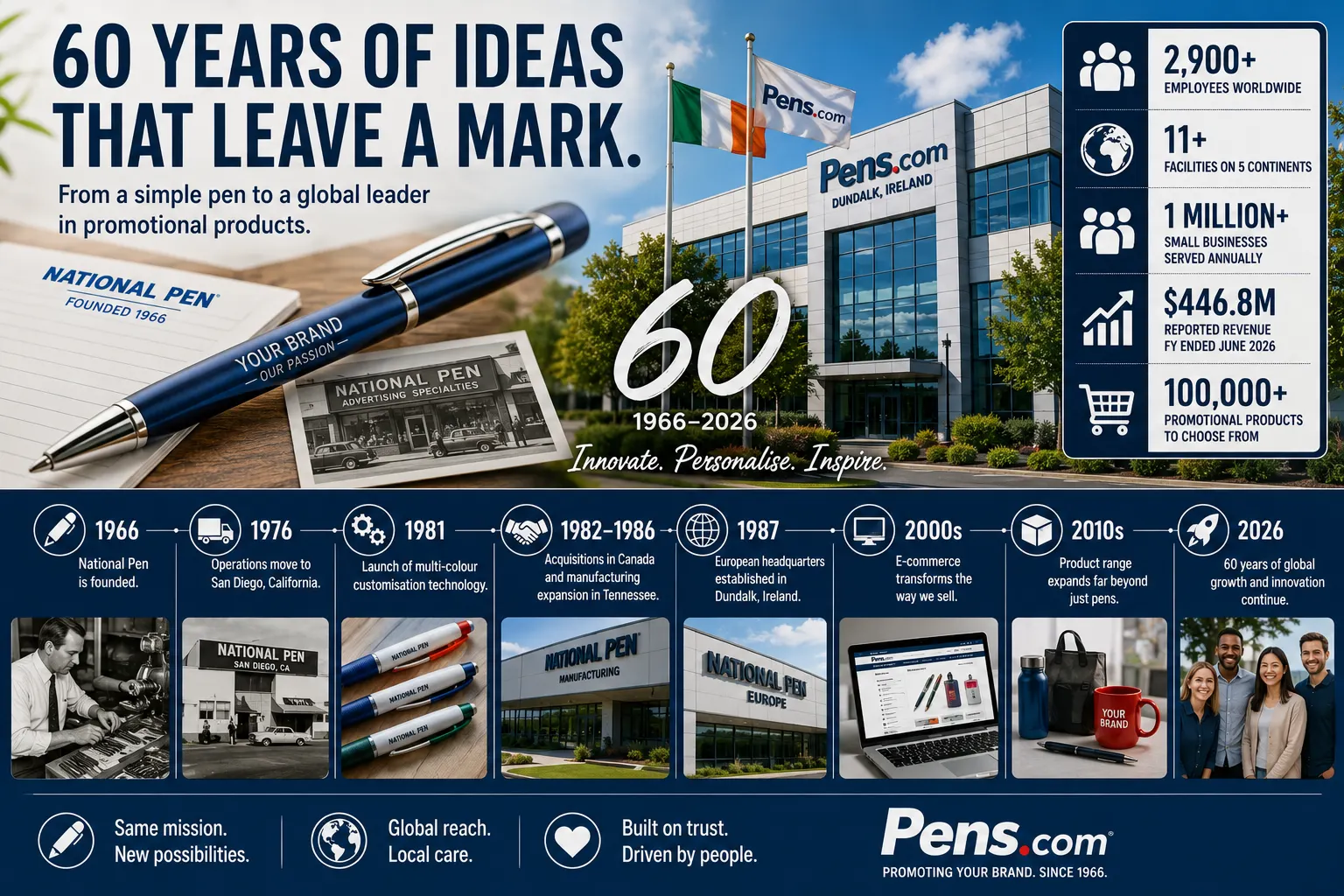
Sixty years after National Pen was founded in 1966, the business behind Pens.com has become considerably more than a company selling promotional pens. It now serves more than one million small businesses annually, operates through more than 11 facilities across five continents, employs close to 3,000 people globally and generated reported segment revenue of $446.8 million in the financial year ended June 2026. Its development is also an Irish business story: Dundalk has been the company’s European headquarters since 1987 and remains an important operational and digital-transformation centre almost four decades later.
The scale of the modern company would have been difficult to predict from its origins. Pens.com traces its history to Al Liguori, who worked with some of the early American ballpoint pens before founding National Pen in 1966. The commercial idea was straightforward but powerful: take an inexpensive everyday object, personalise it with a company’s name and telephone number, and turn it into a practical advertising medium that could remain in a customer’s pocket or on a desk long after a conventional advertisement had disappeared.
That principle still sits at the centre of the promotional-products industry today, but almost everything around it has changed. Ordering moved from catalogues and direct mail towards e-commerce. Personalisation became increasingly automated. Product ranges expanded from pens into drinkware, bags, clothing, stationery and gifts. Manufacturing and customer service became international, while software and data increasingly determined how millions of individually customised products could be sold economically in relatively small quantities.
Pens.com’s success is therefore not simply the story of one popular product. It is the story of a company repeatedly adapting the same basic commercial proposition — affordable personalised marketing for businesses — to new technologies, sales channels and geographical markets.
The Ballpoint Pen Created a New Kind of Advertising Product
The modern ballpoint pen was still a comparatively young product when National Pen emerged. Pens.com’s official company history says Liguori had been involved in producing some of the first ballpoint pens made in the United States before founding National Pen in 1966. The new company was among the early businesses offering customised pens as affordable promotional products.
The attraction to a small company was fundamentally economic. Newspaper, radio or later television advertising required a business to buy exposure repeatedly. A branded pen could be purchased once, handed to a customer and remain useful for months. Its value was not simply as stationery but as a small physical advertisement.
That placed National Pen in a market particularly suited to small and medium-sized enterprises. A local mechanic, restaurant, insurance agent or construction company did not require hundreds of thousands of promotional items. It needed modest quantities at a price low enough to make personalised merchandise practical.
Producing customised products in relatively small batches is operationally more difficult than mass-producing millions of identical items. Each order may contain another logo, name, colour or message. Much of National Pen’s later development therefore centred on making that complexity efficient enough to serve smaller customers at scale.
San Diego Became the First Centre of Expansion
National Pen consolidated operations from Florida and New York in San Diego in 1976. According to the company’s history, bringing operations together created a central hub for product development and faster fulfilment.
Technical innovation followed. In 1981 the company established its own ink supply and developed the ability to offer multi-colour customisation on both the cap and barrel of writing instruments. While such capabilities may appear ordinary in today’s digital-print environment, differentiation through printing and personalisation technology was an important competitive advantage in a market built around making standard products individual.
Between 1982 and 1986 National Pen acquired two Canadian mail-order businesses and shifted manufacturing to Tennessee. The company was no longer simply developing a product range; it was building the operational and direct-marketing infrastructure required to reach customers across North America.
The mail-order model was particularly well suited to the period. Instead of depending on retail stores, National Pen could communicate directly with businesses, send samples and catalogues, accept relatively small orders and use its own production capabilities to personalise them. This direct relationship with small businesses would remain one of the defining features of the company even as the channel later migrated online.
Six Decades of National Pen and Pens.com
| Period | Development | Significance |
|---|---|---|
| 1966 | National Pen founded | Custom pens become core business |
| 1976 | Operations centralised in San Diego | Greater operational scale |
| 1982–1986 | Canadian acquisitions and Tennessee manufacturing | North American expansion |
| 1987 | Dundalk operation opens | European expansion begins |
| 1993 | Product range broadens | Move beyond writing instruments |
| 1996 | One million active customers reached | International scale established |
| 2016 | Acquired by Cimpress | Access to mass-customisation technology |
| 2023 | Pens.com becomes flagship consumer-facing identity | Digital brand transformation |
| 2026 | 60th anniversary | Global promotional-products business |
Source: Pens.com company history and Cimpress corporate filings.
Dundalk Became the Gateway to Europe
The decision to open in Dundalk, County Louth, in 1987 became one of the most important turning points in National Pen’s international development. Ireland was not simply another sales territory. Dundalk became the European headquarters from which the company could build operations across multiple national markets.
The company now says its brands serve 22 countries worldwide. Its 2025 Irish gender-pay-gap report, published as the company approached its 60th anniversary, described a network of more than 11 facilities across North America, Europe, Africa, Australia and Asia.
Dundalk remains significant 39 years after the original operation opened. National Pen reported approximately 154 employees in Ireland in its latest Irish workforce report. Those roles are now very different from the large manufacturing and support operation historically associated with Dundalk. The Irish organisation is increasingly connected with technology, digital transformation, business support and international operations.
The contrast illustrates how the company itself has changed. When National Pen celebrated 30 years in Dundalk in 2017, the Department of Enterprise described an operation that had employed large numbers of full-time and seasonal workers and included manufacturing and support functions. The current Irish operation is smaller in direct headcount but remains strategically important within an increasingly digital global organisation.
Ireland’s importance extends beyond National Pen. Cimpress plc, National Pen’s parent group, is an Irish-incorporated company and lists its principal executive offices in Dundalk in its latest US regulatory filing. The town therefore has an unusual connection to a multinational customisation group whose businesses generated more than $3.7 billion in consolidated revenue during fiscal 2026.
International Expansion Turned a Pen Company Into a Marketing Business
By 1993 National Pen described itself as the world’s largest mail-order manufacturer of personalised writing instruments. That year also marked an important change in the product strategy. Key tags, mugs, calendars and other promotional merchandise were added alongside pens.
The logic was straightforward. A business already buying branded pens was a natural potential customer for mugs, notebooks, bags or other promotional material. Expanding the catalogue allowed National Pen to increase the value of each customer relationship without having to find an entirely new customer for every additional sale.
By 1996 the company said it had passed one million active customers worldwide. The achievement demonstrated that the direct-marketing model could be replicated across national borders rather than remaining a predominantly American operation.
Private-equity investment during the period from 2004 to 2012 provided further capital for products, technology, marketing and operations. The ownership changed, but the underlying strategy remained focused on scale: reach more small businesses, offer a wider selection and make personalisation sufficiently efficient to handle high numbers of relatively small orders.
The $218 Million Cimpress Acquisition Changed the Company’s Trajectory
The next major turning point came in December 2016, when Cimpress agreed to acquire National Pen. The transaction closed on 30 December for approximately $218 million in cash, subject to the normal adjustments for cash, debt and working capital.
At the time, Cimpress estimated National Pen would generate approximately $275 million of revenue during calendar 2016, representing growth of around 10 per cent from the previous year. The buyer described National Pen as a leading manufacturer and marketer of custom writing instruments for small and medium-sized businesses.
The acquisition was strategically logical because Cimpress had developed its own expertise in mass customisation through businesses such as Vistaprint. Mass customisation attempts to combine two economic models that traditionally conflict: individualised products and industrial-scale production efficiency.
National Pen brought deep experience in promotional merchandise, direct marketing and customised writing instruments. Cimpress brought a larger technology, procurement and production ecosystem. The combination created opportunities to use National Pen’s products within other Cimpress businesses while applying more digital technology to National Pen’s own customer acquisition and fulfilment.
Importantly, Cimpress operates through a decentralised structure. National Pen did not simply disappear inside a single global operating company. It remained a distinct reportable segment and operating business, which is why its financial development can still be followed separately in Cimpress’s published accounts.
The Financial Scale Has Increased Substantially Since the Acquisition
The latest audited Cimpress filing provides a clear picture of National Pen’s current financial scale. The National Pen segment reported revenue of $446.8 million in the financial year ended 30 June 2026, compared with $407.2 million in fiscal 2025 and $389.5 million in fiscal 2024.
Reported revenue therefore increased by approximately 10 per cent in the latest financial year. Currency movements contributed around four percentage points, leaving constant-currency growth of approximately 6 per cent. Cimpress said external revenue growth came particularly from e-commerce and telesales, while additional revenue was generated through fulfilment work for other Cimpress businesses.
Segment EBITDA increased more rapidly, from $31.9 million in fiscal 2025 to $40.6 million in fiscal 2026, a rise of 27 per cent. The EBITDA margin increased from roughly 8 to 9 per cent. The improvement was not produced entirely by underlying sales growth: Cimpress reported benefits including $3.1 million of US tariff refunds, positive currency movements and lower variable long-term incentive compensation expenses.
That distinction is important in assessing a company success story objectively. Revenue growth reflects stronger commercial scale, while profitability in an individual year can also be affected by currency, tariffs, compensation accruals and other items that may not recur.
National Pen Segment Financial Performance
| Financial Year | Revenue | Segment EBITDA |
|---|---|---|
| 2024 | $389.5m | $30.2m |
| 2025 | $407.2m | $31.9m |
| 2026 | $446.8m | $40.6m |
Source: Cimpress Form 10-K for the year ended 30 June 2026. Segment revenue includes inter-segment activity under Cimpress’s reporting methodology.
From Roughly $275 Million to Almost $447 Million
The numbers also provide perspective on the decade since the Cimpress acquisition. National Pen was expected to produce approximately $275 million of revenue in calendar 2016. The reportable segment recorded $446.8 million in fiscal 2026.
The figures are not perfectly like-for-like: one was an acquisition-period calendar-year estimate and the other is current segment revenue calculated under Cimpress’s financial reporting methodology, including some inter-company fulfilment. They nevertheless illustrate the broad scale of expansion. The latest reported figure is roughly 62 per cent above the revenue estimate used when the acquisition was announced.
The transformation becomes more significant when viewed against changes in the underlying sales model. The company that Cimpress acquired still relied heavily on direct mail. By fiscal 2026, growth was being generated particularly through e-commerce and telesales.
This has allowed National Pen to retain one of the strengths of the original business — direct relationships with small companies — without depending exclusively on physical catalogues and mail campaigns. The customer can now discover a product online, upload artwork digitally, approve personalisation electronically and place the order without entering a conventional promotional-products sales process.
Pens.com Is Now Much More Than Pens
The 2023 rebranding from National Pen towards Pens.com as the flagship direct-to-business brand was symbolically important. The name Pens.com retained the company’s most recognisable product while positioning the brand naturally for online commerce.
The product range today includes customised writing instruments but also stationery, drinkware, bags, gifts, clothing and trade-show accessories. In practical terms, Pens.com has become a supplier of branded merchandise rather than simply a pen seller.
A small business can use the platform for promotional pens, mugs for customers, branded clothing for employees, notebooks for an event or bags for a trade show. The underlying manufacturing and sourcing requirements differ across those products, but the customer’s objective is essentially the same: apply one brand identity to physical objects in relatively small quantities.
Cimpress’s latest annual report describes National Pen as focusing on customised writing instruments, promotional products, apparel and gifts for small and medium-sized businesses. Pens.com is the flagship direct-to-business brand, while National Pen also operates several smaller brands.
The Business Model Is Built Around Small Orders at Very Large Scale
The economics of Pens.com differ from those of a traditional large corporate promotional-products contract. Cimpress reported an average National Pen order value of approximately $380 during fiscal 2026, while average annual spending per customer was approximately $470.
Those figures reveal a business built around a very large number of comparatively modest transactions rather than dependence on a small group of major corporate accounts. National Pen serves more than one million small businesses annually across regions including North America, Europe and Australia.
The model creates both an advantage and a cost. A diversified base of small customers reduces dependence on one large buyer, but acquiring and servicing so many customers requires substantial marketing expenditure. Cimpress said National Pen’s advertising expenditure was approximately 20 per cent of external revenue in fiscal 2026.
Gross margin was approximately 51 per cent. That comparatively high gross margin has to support marketing, customer service, technology, administration and the operational complexity associated with personalising and delivering a very high number of individual orders.
The business is also strongly seasonal. Cimpress notes that National Pen’s profitability is heavily concentrated in the December quarter, reflecting the importance of Christmas, year-end corporate gifts and seasonal promotional spending.
How the National Pen Business Operates Today
| Metric | Current Figure | Context |
|---|---|---|
| Small businesses served annually | More than 1 million | North America, Europe, Australia and other markets |
| Average order value | About $380 | FY2026 |
| Annual spend per customer | About $470 | FY2026 |
| Gross margin | About 51% | FY2026 |
| Advertising share | About 20% | Of external revenue |
| Reported segment revenue | $446.8m | FY2026 |
Source: Cimpress Form 10-K, fiscal year 2026.
The Global Workforce Is Close to 3,000
National Pen’s latest Irish corporate report says the company employs close to 3,000 team members globally. That is the most useful current company-provided workforce figure, although Cimpress does not publish a separate audited National Pen employee count in its annual financial statements.
The employees are distributed through a network spanning North America, Europe, Africa, Australia and Asia. The company says it operates more than 11 facilities and serves 22 countries.
Publicly documented National Pen locations over its international development have included San Diego in California, Shelbyville in Tennessee, Tijuana in Mexico, Dundalk in Ireland and Montego Bay in Jamaica. Manufacturing, customer care, marketing, technology and support functions have been distributed differently across the network as the company has evolved.
The latest company documentation does not provide a complete public facility-by-facility list with employee numbers for every country. It is therefore more accurate to describe the confirmed global network than to create an apparently precise worldwide location table from historical sources that may no longer reflect the current organisational structure.
Ireland’s approximately 154 employees consequently represent only a modest share of the global workforce, but Dundalk’s importance is larger than the headcount alone suggests because of its role as the European headquarters and its connection with the company’s digital transformation.
What Is Pens.com’s Current Market Share?
This is one of the areas where a precise number would create a false impression of certainty. Neither Pens.com nor Cimpress publishes a current percentage share of the global personalised-writing-instrument market, and independent industry organisations do not publish a directly comparable market-share figure for the company.
National Pen describes itself in its current corporate material as the largest global provider of customised writing instruments. That is a meaningful statement about its position in its specialist category, but it should not be converted into an invented percentage.
The wider promotional-products market is also much broader than pens. The Promotional Products Association International estimated that US distributor sales alone reached a record $27.1 billion in 2025. That market includes clothing, drinkware, bags, technology products, awards, signage and many other categories as well as writing instruments.
National Pen’s $446.8 million segment revenue cannot simply be divided by the $27.1 billion figure to produce a legitimate market share. National Pen operates internationally, some of its revenue comes from internal fulfilment for other Cimpress businesses and PPAI’s figure measures US distributor sales using a different market definition. Such a calculation would compare different geographies and different forms of revenue.
The most defensible conclusion is therefore that Pens.com occupies a leading global position in personalised writing instruments and is a substantial participant in the broader promotional-products sector, while no reliable current public percentage for its worldwide market share is available.
Market position: National Pen describes itself as the world’s largest global provider of customised writing instruments. A current audited percentage market share is not publicly disclosed, so assigning a precise figure would be misleading.
A Fragmented Industry Makes Scale Particularly Valuable
The broader promotional-products market remains highly fragmented. PPAI estimated US distributor sales of $27.1 billion in 2025, yet small distributors generating less than $2.5 million annually still accounted for approximately 46 per cent of industry sales.
This fragmentation helps explain the value of National Pen’s model. A small local supplier can offer personal service, but it cannot easily reproduce the purchasing scale, software, automated customisation, international sourcing and marketing systems available to a business processing orders from more than one million customers a year.
At the same time, fragmentation means scale alone does not eliminate competition. Customers can buy branded merchandise from local distributors, specialist online platforms, large international groups or non-traditional suppliers. Switching costs are often low.
Pens.com therefore has to compete simultaneously on price, convenience, delivery, product selection and personalisation quality. Its large advertising expenditure reflects the reality that maintaining customer attention in a fragmented digital marketplace is expensive.
The Decline of Mail Order Could Have Threatened the Original Model
One reason the 60-year history is notable is that National Pen’s traditional sales engine could easily have become a structural weakness. Direct mail was central to the company’s expansion for decades, but customer behaviour increasingly moved online.
Cimpress reported during fiscal 2025 that e-commerce was growing while mail-order revenue declined as National Pen deliberately reduced and optimised direct-mail advertising expenditure. By fiscal 2026, e-commerce and telesales were among the principal sources of external revenue growth.
The transition demonstrates an important feature of successful long-established companies: preservation of the customer need without preserving every historical operating method. Small businesses still want inexpensive branded products. They no longer necessarily want to order them using the same process employed in the 1980s or 1990s.
Digital commerce also changes the economics of the catalogue. A printed mailer is limited by physical space and must be distributed before the customer responds. An online platform can expose customers to thousands of products, update pricing rapidly and use data to recommend related products.
That makes the 2023 Pens.com rebranding more than a cosmetic exercise. It reflects a company whose future depends increasingly on the digital relationship between customer and production system.
Telesales Remains Important in an Increasingly Digital Company
The move online has not eliminated human sales. Cimpress specifically identified telesales alongside e-commerce as an important contributor to National Pen’s fiscal 2026 growth.
This combination makes sense for the customer base. A business owner may be comfortable designing a straightforward pen order online but want assistance with a larger order, artwork, deadlines or a combination of products. A sales adviser can also develop repeat relationships with customers whose spending becomes more valuable over time.
The resulting model is genuinely omnichannel rather than exclusively digital. National Pen’s corporate material describes customer acquisition and service through e-commerce, mail order and telesales.
The relative importance of those channels will probably continue to change. Digital ordering offers efficiency, while direct human interaction can increase confidence and customer value for more complicated purchases. The company’s challenge is to use each channel where its economics are strongest rather than attempting to force every customer through one process.
Cimpress Gives Pens.com Access to a Much Larger Industrial Network
National Pen’s $446.8 million revenue makes it a significant company in its own right, but it operates within a substantially larger group. Cimpress generated consolidated revenue of $3.737 billion during fiscal 2026, up about 10 per cent from $3.403 billion a year earlier.
The portfolio includes VistaPrint and multiple European printing and customisation businesses. Although the brands operate with considerable autonomy, the group can coordinate procurement for equipment, shipping and major raw-material categories.
This creates economies of scale that would be difficult for National Pen to reproduce independently. A group buying large quantities of printing materials or international shipping can negotiate differently from a smaller standalone business. Technology and production capabilities can also be shared across companies where economically useful.
That cross-group relationship is visible in National Pen’s latest results. Part of its revenue growth came from fulfilment performed for other Cimpress businesses. National Pen is therefore not only selling through Pens.com; its production and supply-chain capabilities increasingly support other brands within the group.
The Acquisition Price Looks Different Ten Years Later
Cimpress paid approximately $218 million for National Pen in 2016. That number should not be directly compared with current annual revenue as though revenue represented investment return; company value depends on cash flow, profitability, debt, capital requirements and many other factors.
The development nevertheless provides useful perspective. Cimpress acquired a business expected to generate about $275 million in annual revenue. A decade later, National Pen has become a reportable segment approaching $447 million of revenue and more than $40 million of segment EBITDA.
The transaction also produced capabilities that can now be used elsewhere within Cimpress. The strategic value therefore extends beyond the revenue generated directly through National Pen’s own brands.
At the same time, the journey was not a straight line of effortless growth. Promotional merchandise is sensitive to economic confidence, freight costs, raw materials, currencies and marketing expenditure. The business has also had to migrate away from an established mail-order model without losing the customer base that model originally created.
Tariffs Are a New Challenge for a Global Physical-Goods Business
Unlike a purely digital company, Pens.com ultimately has to manufacture, source and move physical products. That exposes it directly to trade policy and international logistics.
The US tariff environment became an important factor across the promotional-products sector during 2025 and 2026. PPAI reported that tariffs, freight costs and tighter customer budgets were among the main pressures on industry margins. US promotional-product distributor sales still reached a record $27.1 billion in 2025, but growth was only 1.3 per cent.
National Pen performed significantly better at the revenue level during fiscal 2026, with reported growth of 10 per cent and constant-currency growth of 6 per cent. Its results were nevertheless affected by trade policy: Cimpress disclosed $3.1 million of US tariff refunds that benefited National Pen’s segment EBITDA during the year.
This demonstrates the increasingly complicated environment in which global promotional-products companies operate. A personalised pen may be a simple item to the customer, but behind it can sit raw-material sourcing, manufacturing, printing, customs, currency conversion, international shipping and final-mile delivery.
Online Sales Are Becoming Central to the Entire Promotional-Products Industry
Pens.com’s digital transition is occurring alongside a wider industry shift. PPAI estimates that online sales reached $7.1 billion in the US promotional-products market in 2025, representing 26.3 per cent of total distributor sales.
That figure suggests considerable room remains for further digitalisation because nearly three quarters of industry sales were still generated through other channels. For companies already built around online customisation, continuing migration towards digital purchasing can create opportunity.
The competitive barrier is also falling. Smaller distributors can deploy e-commerce software, online design tools and automated marketing much more easily than they could twenty years ago. Artificial intelligence is reducing the cost of producing artwork, marketing copy and customer-support responses.
Pens.com’s advantage therefore cannot rest simply on owning a memorable internet address. Its deeper advantage is the combination of customer history, production capability, sourcing, international infrastructure, design technology and the ability to process large numbers of customised orders.
Artificial Intelligence Could Change the Customer Experience Again
The next technological change is likely to affect the design process itself. A small business that previously required a designer to clean a logo, choose colours or adapt artwork for a promotional product can increasingly receive automated assistance.
AI can potentially recommend products based on the customer’s industry, generate design alternatives, adapt artwork to different printing surfaces and help customer-service teams resolve routine issues more quickly. These capabilities could reduce friction in one of the most difficult parts of mass customisation: turning an idea into production-ready artwork.
They may also increase competition because similar technology will be available to rival businesses. The economic advantage will depend on connecting AI effectively with actual production and fulfilment rather than merely adding a conversational interface to a website.
National Pen’s Irish workforce report explicitly places digital transformation among the company’s current strategic priorities. Dundalk’s long-term importance may therefore increasingly depend on technology and service capabilities rather than the manufacturing model with which the location was originally associated.
Sustainability Is Changing What Customers Expect From Promotional Merchandise
The promotional-products industry also faces a structural question about waste. A useful branded bottle or durable pen can remain in use for years, but low-value merchandise that is quickly discarded creates an obvious environmental problem.
PPAI estimated sustainable promotional-product sales at approximately $3.8 billion in the US market during 2025, representing around 14 per cent of industry sales. The organisation describes sustainability as increasingly moving from a niche trend towards a standard part of the product offering.
This creates both a challenge and an opportunity for companies such as Pens.com. Customers increasingly want information about materials, sourcing, durability and environmental characteristics. At the same time, the fundamental economics of promotional merchandise remain sensitive to price.
The likely direction is not the disappearance of physical promotional products but greater differentiation between disposable low-value merchandise and products that recipients actually retain. Industry research increasingly suggests buyers are placing more emphasis on quality and recognised product brands rather than simply buying the largest possible quantity at the lowest unit cost.
The Market Is Large, but Mature
The promotional-products industry remains economically substantial. US distributor sales reached $27.1 billion in 2025, while Canada added the equivalent of roughly $1.46 billion in distributor sales. Europe represents another large but more fragmented market.
Yet the mature US market grew only modestly in 2025. PPAI’s 2026 industry monitoring has continued to show positive but restrained growth, with distributors increasing revenue by 2.3 per cent and suppliers by 2.1 per cent during May and June compared with the same period a year earlier.
For Pens.com, this means future expansion cannot depend entirely on the wider market growing rapidly. It has to win customers, increase the number of categories purchased by existing customers, improve repeat ordering or gain efficiencies from technology and shared Cimpress capabilities.
The company’s latest figures indicate that this process is working: National Pen’s constant-currency revenue growth of 6 per cent during fiscal 2026 exceeded the modest growth rates being reported for the broader US promotional-products industry. The comparison is directional rather than exact because the geographic and revenue definitions differ.
Why the One-Million-Customer Base Matters
A company serving more than one million small businesses annually has a valuable asset beyond factories and inventory: customer relationships accumulated over decades. The average customer does not spend a huge amount — approximately $470 annually according to Cimpress — but the total becomes substantial when repeated across a very large population.
The opportunity is to increase the value of those relationships. A customer originally acquired through a promotional pen can later purchase mugs, bags, apparel or event materials. Even a relatively small increase in average annual spending can become meaningful when multiplied across hundreds of thousands of businesses.
There is also a defensive benefit to diversity. Losing one customer has almost no material impact on a company serving more than a million. This contrasts with industrial suppliers whose annual revenue can depend heavily on contracts with a handful of major buyers.
The disadvantage is that maintaining such a broad customer base requires constant marketing. Many businesses purchase promotional products only occasionally, and a customer may not automatically return to the same supplier years later. This helps explain National Pen’s unusually high advertising expenditure relative to revenue.
Ireland Has Played a Disproportionately Large Role in the Story
For an international business founded in the United States, the longevity of the Dundalk operation is striking. National Pen arrived in County Louth in 1987, at a time when Ireland was still years away from the high-growth multinational economy that would emerge during the 1990s.
The original investment provided access to European markets and an English-speaking workforce within the European Community. Over subsequent decades, Dundalk developed into the company’s European headquarters and a major employment centre.
The nature of that employment has changed as manufacturing, customer service and technology have been reorganised internationally. Today, approximately 154 National Pen employees are reported in Ireland, while the company describes the location as an important operational site supporting its digital transformation.
The history mirrors a wider Irish economic development. International companies originally came for manufacturing and access to Europe; many later added service, technology, management and digital functions. Dundalk’s role inside National Pen has followed aspects of that transition.
A Success Story Does Not Mean the Company Faces No Risks
National Pen enters its seventh decade from a strong position, but its operating model contains several identifiable risks. Physical merchandise remains exposed to tariffs, freight and supply chains. A large marketing budget means customer-acquisition efficiency matters greatly. Economic downturns can lead businesses to postpone promotional expenditure.
Currency movements are also important because the company buys and sells across multiple markets. Four percentage points of fiscal 2026 reported revenue growth came from favourable exchange-rate movements rather than underlying constant-currency expansion.
The business must simultaneously manage a legacy direct-mail operation and invest in digital growth. Moving too slowly risks losing customers to online competitors; moving too aggressively away from traditional channels risks abandoning customers for whom direct mail and telesales remain effective.
Competition will continue from both large international platforms and thousands of smaller promotional-products specialists. Technology that gives Pens.com greater automation also becomes available to competitors.
The strength of the business therefore lies less in possessing one permanent competitive advantage than in having repeatedly changed how it delivers essentially the same customer proposition.
The Next Phase Is Likely to Be More Digital and More Diversified
Cimpress does not publish long-term revenue forecasts specifically for National Pen, so any precise prediction of Pens.com’s sales in 2030 or 2035 would be speculative. Current results nevertheless show several identifiable directions.
E-commerce and telesales are growing. Direct mail is being managed more selectively. National Pen is undertaking more fulfilment for other Cimpress businesses. The product range extends increasingly beyond writing instruments, while digital transformation is an explicit organisational priority.
A plausible future therefore involves Pens.com becoming even less dependent on pens as a percentage of sales while retaining the category as the identity around which the brand was built. Drinkware, apparel, gifts and event products offer opportunities to increase spending from customers who already trust the company for writing instruments.
Automation can also continue reducing the cost of handling individual custom orders. The commercial objective is similar to the one National Pen pursued decades ago: make personalisation inexpensive enough that even a very small business can buy it. The technology used to achieve that objective is what continues to change.
Pens.com at 60
| Measure | Latest Public Information | Source Basis |
|---|---|---|
| Founded | 1966 | Pens.com |
| Countries served | 22 | National Pen Ireland report |
| Global facilities | More than 11 | National Pen Ireland report |
| Global workforce | Close to 3,000 | National Pen Ireland report |
| Ireland workforce | About 154 | National Pen Ireland report |
| Annual small-business customers | More than 1 million | Cimpress FY2026 filing |
| FY2026 segment revenue | $446.8m | Cimpress FY2026 filing |
| FY2026 segment EBITDA | $40.6m | Cimpress FY2026 filing |
Current publicly disclosed company information as available in August 2026.
The Numbers Explain Why the Anniversary Matters
Corporate anniversaries can easily become marketing exercises, but National Pen’s 60-year milestone has a measurable economic story behind it. The business survived the decline of the traditional mail-order economy, expanded from one product category into a broad promotional-merchandise range, built operations across several continents and passed through multiple ownership structures before becoming part of Cimpress.
Its latest financial year was also one of growth rather than simply longevity. Revenue increased by 10 per cent on a reported basis, constant-currency revenue grew 6 per cent and segment EBITDA reached $40.6 million. That performance came while the wider promotional-products industry was dealing with tariff uncertainty, freight costs and relatively slow market growth.
The figures do not mean every aspect of the company has expanded continuously. Operations have been reorganised, the nature of employment in locations such as Dundalk has changed and older sales channels have declined. Success over six decades has involved replacing parts of the original business model rather than preserving them unchanged.
What Started as a Pen Has Become an Infrastructure for Personalisation
The most useful way to understand Pens.com today is not as an unusually large stationery retailer. Its real business is the repeated customisation of physical products for customers whose individual orders are too small for traditional industrial production economics.
A pen is an ideal example because the base product can be manufactured at scale while the final imprint makes every batch different. The same system can then be extended to mugs, bottles, clothing, notebooks, bags and numerous other products.
Technology determines whether that process remains economical. The customer interface must capture artwork correctly, the production system must know which design belongs on which product, procurement must provide sufficient inventory and logistics must deliver thousands of unrelated orders to different destinations.
Cimpress describes this broader discipline as mass customisation. National Pen had been practising an earlier version of the concept long before digital platforms made the terminology commonplace.
From Dundalk to More Than a Million Businesses
There is a particular Irish dimension to that transformation. Dundalk joined the National Pen story when the company was 21 years old. It is now approaching four decades as the European headquarters, making Ireland part of the business for nearly two thirds of its entire history.
The operation has lived through the rise of the fax machine, personal computer, commercial internet, smartphones, cloud computing and now artificial intelligence. During the same period, National Pen’s customer relationship moved from mail-order forms towards a business in which e-commerce is one of the principal growth channels.
For County Louth, this provides a different example of foreign direct investment from the pharmaceutical plants and large technology campuses more commonly associated with Ireland’s multinational economy. National Pen is a consumer-facing and small-business-focused company whose Irish operation became part of a global network long before Ireland’s modern technology boom.
The Market-Share Question Shows Why Scale Should Be Measured Carefully
It is tempting to turn every large company’s position into a percentage. In Pens.com’s case, that would be poor analysis. The company competes simultaneously in personalised pens, promotional merchandise, apparel, gifts and online customisation, while individual industry studies define those markets differently.
What can be stated reliably is substantial. National Pen says it is the largest global provider of customised writing instruments. Cimpress reports more than one million small-business customers annually. The business generated almost $447 million of segment revenue in fiscal 2026 and operates globally through more than 11 facilities.
What cannot be stated reliably from public evidence is that Pens.com controls a particular percentage of the global promotional-products market. A figure such as 5, 10 or 20 per cent would require a consistent definition of the market and independently comparable sales figures for competitors that are not publicly available.
For an independent assessment, acknowledging that limitation provides a more accurate picture than presenting a market-share estimate with unjustified precision.
Sixty Years of Adaptation May Be the Company’s Strongest Asset
The product that started National Pen remains recognisable. A business still places its name on a pen and gives it to a customer for the same fundamental reason it did in 1966: the object is useful, inexpensive and keeps the company’s identity visible.
Everything required to deliver that pen has been transformed. Manufacturing became international. Marketing moved from direct mail towards digital acquisition. Personalisation became increasingly automated. A catalogue of writing instruments became a catalogue of branded merchandise, while an independent American company became part of an Irish-incorporated global mass-customisation group.
The next decade will bring another set of changes. Artificial intelligence can alter design and customer service, sustainability will influence product choices, tariffs can reshape supply chains and e-commerce will continue changing the way smaller businesses purchase branded merchandise. None offers guaranteed growth.
But the history of Pens.com suggests that continuity and change are not opposites. The company has preserved a remarkably consistent customer proposition while repeatedly changing the machinery behind it. In 1966 that proposition was an affordable personalised pen. In 2026 it is a global platform through which more than a million businesses a year can place their identity on a growing range of physical products.
That combination — a simple idea, international scale and repeated reinvention — is what makes the company’s 60-year history more than an anniversary. It is the central reason National Pen survived long enough to become Pens.com, and why a business built around one of the simplest promotional products now generates hundreds of millions of dollars in annual revenue.
Sources
Pens.com — Company History and 60th Anniversary
National Pen Ireland — Gender Pay Gap Report 2025 and Corporate Profile
Cimpress plc — Form 10-K for the Financial Year Ended 30 June 2026
Cimpress — National Pen Acquisition Announcement, December 2016
US Securities and Exchange Commission — Completion of National Pen Acquisition
Department of Enterprise — National Pen Celebrates 30 Years in Dundalk
Promotional Products Association International — 2025 US Distributor Sales Volume Estimate
Promotional Products Association International — Branded Merchandise Industry Update, July 2026
Promotional Products Association International — Promotional Products Trends for 2026
Source & Transparency
This article is published by Ireland Newspaper for editorial and informational purposes.
Published: 1 September 2026 · Updated: 1 September 2026

Newsroom Ireland Newspaper
Ireland Newspaper editorial team prepares daily news coverage for readers in Ireland and abroad.




Market data, financial news and economy content on Ireland Newspaper are provided for editorial and informational purposes only. They do not constitute financial advice, investment advice, trading advice or a recommendation to buy, sell or hold any financial product. Always verify live prices and consult a qualified professional before making financial decisions.