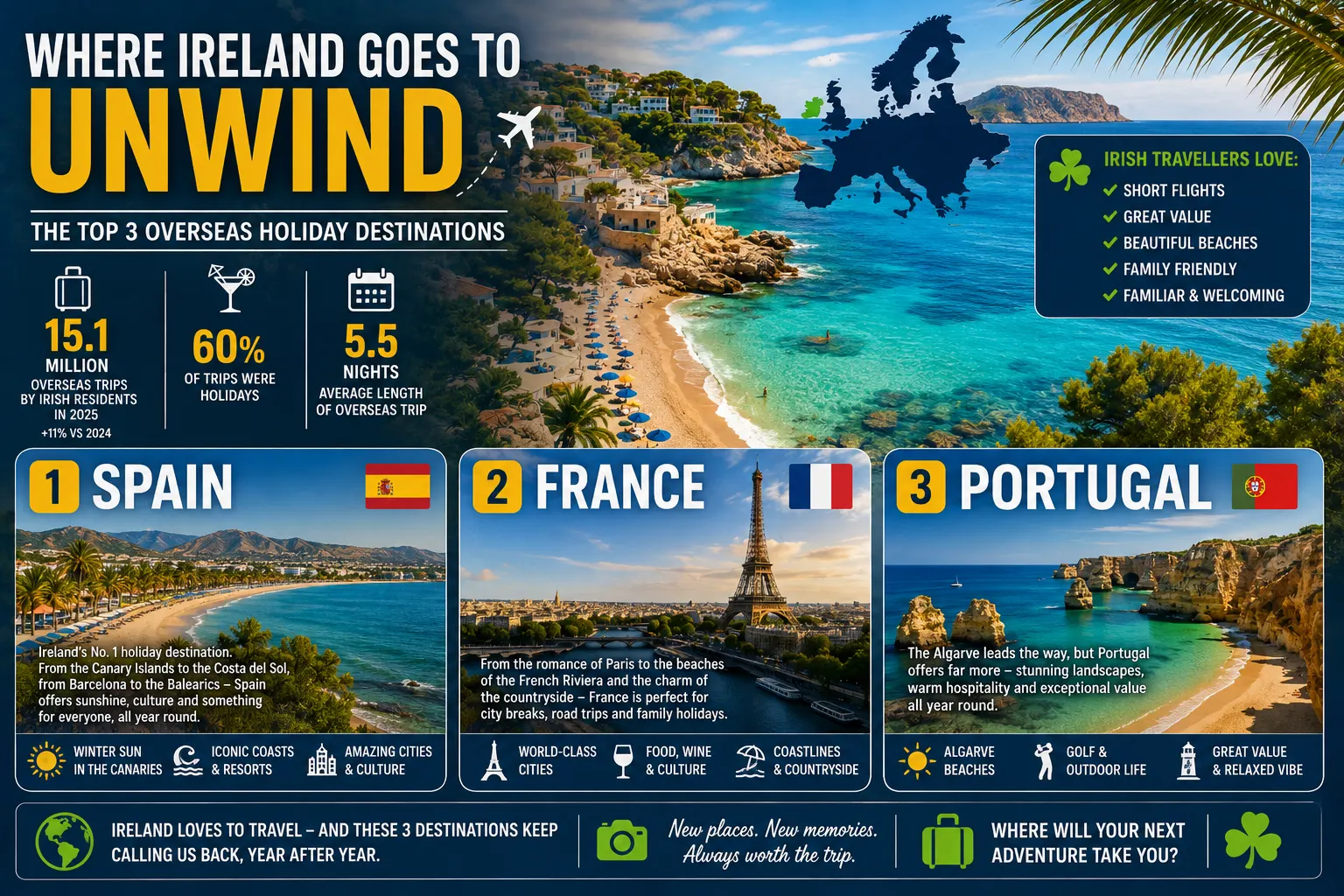
Irish residents made 15.1 million overnight trips outside the country in 2025, 11 per cent more than a year earlier. Around 60 per cent were holidays, making leisure travel by far the largest reason for going abroad. Behind that extraordinary volume is a remarkably persistent pattern: Spain remains Ireland’s dominant holiday country, while France and Portugal form the next tier of major leisure destinations. Their appeal is not based on one attraction alone, but on a combination of short flights, dense airline capacity, established resorts, family familiarity and the ability to offer everything from winter sunshine to city weekends.
Identifying a precise top-three ranking requires some care. The Central Statistics Office’s latest Household Travel Survey measures how many trips Irish residents make overseas and why they travel, but its current published release does not provide a country-by-country league table specifically for holiday journeys. Airport passenger statistics are not a substitute because they include business travel, people visiting relatives and inbound passengers as well as holidaymakers.
The clearest broad leisure-market ranking available from the Irish travel industry, reported by RTÉ, places Spain first, France second and Portugal third, ahead of Italy and Greece. More recent 2026 booking evidence reinforces Spain’s commanding position but shows that Portugal can overtake France when the comparison is narrowed specifically to sun holidays. Click&Go’s 2026 booking data puts Lanzarote first among sun destinations, the Algarve second and Tenerife third, followed by the Costa del Sol and Gran Canaria.
The safest conclusion is therefore not that every Irish traveller follows one immutable ranking. It is that Spain, France and Portugal constitute the strongest three-country leisure group, with Spain clearly ahead and the relative position of France and Portugal depending on whether the traveller is booking a beach holiday, city break, family trip, touring holiday or winter escape.
Ireland Is Travelling Abroad on an Enormous Scale
The scale of Irish outbound travel has grown alongside population, employment and disposable income. The CSO recorded 15.1 million overseas overnight trips by Irish residents in 2025, producing 82.9 million nights abroad. The number of trips increased by 11 per cent in a single year, while the average overseas journey lasted approximately 5.5 nights.
Holiday travel accounted for 60 per cent of those trips. Visiting friends and relatives represented another 24 per cent and business travel 9 per cent. This distinction matters because countries with large Irish diaspora connections can generate enormous passenger volumes without necessarily ranking equally highly as pure holiday destinations.
The United Kingdom is the clearest example. Aviation statistics show exceptionally heavy traffic between Ireland and Britain, and London routes consistently dominate Dublin Airport’s busiest-destination tables. Yet a substantial proportion of that traffic reflects family connections, work and short visits. It would therefore be misleading to declare Britain Ireland’s favourite holiday destination merely by counting airline passengers.
The opposite is true of Spain. Its enormous traffic is accompanied by direct evidence of leisure demand. Spain’s National Statistics Institute recorded 1,462,379 tourists resident in Ireland arriving during the first six months of 2026, 3.5 per cent more than during the same period in 2025. In June alone, 324,760 Irish-resident tourists visited Spain.
Ireland’s Three Core Overseas Holiday Markets
| Country | Current Evidence | Main Appeal |
|---|---|---|
| Spain | Clear No. 1 leisure market | Sun, islands, resorts, route choice |
| France | No. 2 in broad leisure ranking | Paris, family trips, coast, touring |
| Portugal | Top-three overall; especially strong for sun holidays | Algarve, climate, golf, value |
Sources: CSO, RTÉ travel-industry analysis, Spanish INE tourism statistics and 2026 Irish travel-industry booking data. France and Portugal can change position depending on the type of holiday measured.
Spain Is in a Category of Its Own
No other country combines the same scale of Irish leisure demand with such a diverse year-round product. Spain offers the Canary Islands for winter sunshine, the Balearics for Mediterranean summer holidays, the Costa del Sol and Costa Blanca for established resort travel, Barcelona and Madrid for city breaks and a large network of smaller coastal and cultural destinations.
Spanish tourism authorities reported that 2,441,713 travellers from Ireland visited Spain during the first nine months of 2025 alone, 10.8 per cent more than a year earlier. Irish tourist spending in Spain increased by 13.9 per cent over the same period. By the first half of 2026, Spain was still recording growth from the Irish market despite extraordinarily high volumes.
Separate Irish consumer-spending evidence points in the same direction. An analysis of 79 million AIB card transactions in June 2026 found that customers spent €51 million in Spain, more than in any other foreign country in the dataset. France accounted for €18 million and Portugal €15 million. Card data are not a measure of holiday trips alone and cover only AIB customers, but they illustrate how deeply Spain is embedded in Irish overseas spending.
Connectivity is one of the strongest reasons. Travel-industry executives repeatedly emphasise that destinations with extensive airline and ferry capacity tend to dominate because frequency creates competition, flexibility and a greater choice of departure dates. Malaga was Dublin Airport’s fourth-busiest outbound destination in May, June and July 2026, even though the top positions included large business and connecting hubs such as Heathrow and Amsterdam.
Why Irish Travellers Keep Going Back to Spain
Climate is the obvious starting point, but it does not explain everything. Ireland’s relatively cool and changeable weather creates strong demand for predictable sunshine, particularly outside the summer months. Lanzarote, Tenerife and Gran Canaria provide a climate that makes a January or February beach holiday practical without travelling long-haul.
Familiarity is almost as important. Generations of Irish travellers know resorts such as Puerto del Carmen, Playa de las Américas, Benalmádena and Salou. Repeat visitors understand the airports, resort layouts, accommodation choices and approximate costs before they book. That lowers the perceived risk associated with an expensive family holiday.
Spain also works across very different budgets. Travellers can choose self-catering apartments, family resorts, all-inclusive properties, boutique hotels or five-star accommodation. Large hotel inventories and frequent flights make it easier to adjust the holiday to the household’s budget rather than changing country completely.
For families, established tourism infrastructure matters. Beaches, pools, restaurants, transfer services, attractions and accommodation designed for children reduce logistical uncertainty. For couples and independent travellers, the same country offers gastronomy, hiking, architecture, nightlife and historic cities. Spain is therefore not dependent on one demographic.
A Mallorca Hotel Example From Early-Booker.com
Travellers wanting the Spanish experience without choosing the Canary Islands or Costa del Sol can look towards Mallorca. One current accommodation example listed on early-booker.com is the Hesperia Mallorca in Palma de Mallorca. The four-star property has an 8.0 out of 10 rating based on 3,629 verified guest reviews and includes an outdoor pool, restaurant, family rooms, fitness facilities and parking.
The portal currently displays a stored starting price of €165 per stay, last updated on 10 June 2026. That figure is not a quotation for a specific holiday and should not be interpreted as the price of a week in Mallorca. Travellers have to enter their dates, number of guests and room requirements to obtain current availability, taxes, cancellation conditions and the final price from the relevant travel partner.
The example nevertheless illustrates one of Spain’s competitive strengths. Irish holidaymakers are not choosing between Spain and the rest of the world as a single product. They can choose between markedly different Spanish destinations while retaining the advantages of a mature tourism market and extensive air connections.
France Wins Irish Travellers for Different Reasons
France’s strength is less dependent on conventional sun holidays. In the broad Irish leisure-market ranking reported by RTÉ, France occupies second position, but the reasons people travel there are considerably more varied than those driving demand for the Canary Islands or Algarve.
Paris provides one of Europe’s strongest city-break products, combining museums, architecture, food, shopping and major international attractions. Disneyland Paris adds an entirely different family market. Elsewhere, Irish visitors travel to campsites and holiday parks, Atlantic beaches, Mediterranean resorts, wine regions and the Alps.
France also benefits from geography. It can be reached by direct flight but also by ferry and car, which matters particularly to families bringing substantial luggage, touring motorists and holidaymakers planning longer stays. Airline capacity is therefore only part of the accessibility story.
The country’s scale makes it possible to return repeatedly without taking the same holiday. Paris bears little resemblance to Provence; Brittany offers a different experience from the Côte d’Azur; an Alpine skiing holiday has almost nothing in common with a summer campsite on the Atlantic coast. This diversity supports repeat travel in much the same way Spain’s islands and coastal regions do.
June 2026 AIB card data recorded €18 million of spending by customers in France, placing it behind Spain but ahead of Portugal and Italy within that particular dataset. Again, the figure includes more than tourism and is not a national holiday survey, but it is consistent with France’s position as one of Ireland’s largest continental travel markets.
Paris Remains the Obvious Short-Break Gateway
For travellers using France primarily as a city-break destination, early-booker.com currently lists the Ibis Styles Paris Batignolles at 119 Avenue de Clichy. The three-star property has an 8.3 out of 10 rating from 3,785 verified reviews and sits around a one-minute walk from Brochant Métro station, making the location practical for visitors who intend to spend much of their stay exploring the city rather than remaining in the hotel.
The stored starting price shown by the portal is €134.15 per stay, updated on 14 July 2026. Family rooms, air conditioning, Wi-Fi, a bar and concierge services are among the listed facilities. As with every stored starting price, live dates must be entered before the actual cost and availability of a particular stay can be established.
The Paris example also helps explain why France competes differently from Portugal. Many Irish travellers considering Portugal are primarily looking for sunshine and a resort stay. France can attract the same household for a completely different trip several months later — perhaps a weekend in Paris, a family visit to Disneyland or a driving holiday from a ferry port.
Portugal Has Become One of Ireland’s Most Dependable Sun Markets
If the ranking were limited to beach and sun holidays in 2026, Portugal would have a strong case for second place behind Spain. Click&Go’s current booking information places the Algarve second only to Lanzarote among sun destinations, ahead of Tenerife and the Costa del Sol. For family holidays, the Algarve is also among the company’s leading choices.
Irish Travel Trade News reported in March that Ireland is now among Portugal’s six most important source markets for visitor expenditure, with Irish spending increasing by 2.8 per cent compared with 2024. The Algarve remains by far the most visited Portuguese region among Irish travellers.
The appeal is easy to understand. The Algarve combines long beaches, distinctive limestone cliffs, golf, family resorts and a climate suitable for travel well beyond July and August. A relatively short flight from Ireland makes it accessible for one-week holidays and shorter breaks, while the concentration of accommodation gives travellers considerable choice.
Portugal has also developed beyond the traditional Algarve proposition. Lisbon and Porto compete strongly for city-break travellers, Madeira provides a mild year-round climate and walking holidays, while other regions attract visitors interested in food, wine and cultural tourism. This broadening gives Portugal more protection from the seasonality traditionally associated with beach tourism.
Value remains part of the appeal, although Portugal should no longer automatically be described as a cheap destination. Strong tourism demand has raised accommodation costs in many popular areas. For Irish households comparing a range of Mediterranean and Atlantic destinations, however, the combination of climate, flight time and accommodation choice continues to make Portugal highly competitive.
Portugal Beyond the Algarve: A Porto Hotel Example
Travellers wanting to combine Portugal with a city experience rather than a conventional resort stay can find the Eurostars Aliados in Porto on early-booker.com. The five-star hotel on Avenida dos Aliados has an 8.9 out of 10 rating from 5,536 verified guest reviews, with its central location, service and breakfast among the most positively rated aspects.
The hotel currently has a stored starting price of €159.59 per stay, updated on 9 July 2026. Facilities listed by the portal include an indoor pool, restaurant, sauna and fitness centre. Final pricing depends on the chosen dates, occupancy, room, applicable taxes and partner conditions.
Choosing Porto rather than an Algarve hotel in this comparison is deliberate. The Algarve explains much of Portugal’s exceptional popularity with Irish sun-seekers, but Porto demonstrates why the country’s future growth is not necessarily limited to beach holidays. Portugal increasingly offers Irish travellers multiple reasons to return at different times of year.
Three Current Hotel Examples on Early-Booker.com
| Destination | Hotel | Stored Starting Price |
|---|---|---|
| Spain | Hesperia Mallorca | From €165.00 per stay |
| France | Ibis Styles Paris Batignolles | From €134.15 per stay |
| Portugal | Eurostars Aliados | From €159.59 per stay |
Source: early-booker.com hotel listings checked 1 September 2026. Displayed figures are stored starting prices per stay rather than quotations for specified dates.
About the hotel prices: The examples above are selected current listings rather than package-holiday prices or guaranteed offers. Early-booker.com states that availability and live pricing are supplied by selected travel partners. Travellers should enter dates and occupancy and check the final price, taxes, payment terms, cancellation conditions and refund rules before completing a booking.
Why These Three Countries Beat Many More Exotic Alternatives
The popularity of Spain, France and Portugal demonstrates that holiday demand is not determined by novelty alone. Convenience has enormous economic value. A destination served by frequent direct flights allows a family to choose among more departure dates, reduce the need for connecting journeys and often compare several airlines.
Distance also influences the real cost of a holiday. Long-haul destinations can offer attractive accommodation once the traveller arrives, but higher airfares and longer journeys make them less suitable for the annual mass market. Spain, France and Portugal can all be reached from Ireland within a few hours.
Familiar tourism infrastructure reduces another form of cost: uncertainty. Irish travellers know that major Spanish and Portuguese resorts contain supermarkets, restaurants, airport transfers, car-hire companies and accommodation across multiple price levels. France has decades of experience serving Irish families through ferry tourism, camping, self-catering and city travel.
Repeat travel should therefore not be interpreted as a lack of curiosity. For many households, a holiday is one of the largest discretionary purchases of the year. A destination that has worked well previously offers a degree of predictability that can outweigh the attraction of experimenting with somewhere completely unfamiliar.
The Canary Islands Give Spain an Exceptional Winter Advantage
Spain possesses another competitive advantage that France and mainland Portugal cannot fully reproduce: a major European holiday region offering reliable warmth during the Irish winter. Lanzarote currently leads Click&Go’s 2026 sun-holiday bookings, while Tenerife ranks third and Gran Canaria fifth.
This extends Spain’s effective tourism season across virtually the entire year. An Irish household may visit mainland Spain or Mallorca during summer and then consider Lanzarote or Tenerife for winter sunshine. The trips compete with different destinations at different times of the year.
Year-round airline demand encourages carriers to maintain routes, and route availability in turn encourages travellers to book the destination. This creates a reinforcing cycle: popular destinations receive more capacity, and additional capacity makes them easier and often more competitively priced to visit.
Portugal’s Algarve Has Built a Similar Relationship With Ireland
The Algarve benefits from many of the same network effects. Irish travellers have been visiting the region for decades, creating an established market for accommodation, golf, family holidays and property ownership. Airlines and tour operators know demand exists, while travellers know that flights and accommodation will normally be widely available.
The region also works beyond the school summer holidays. Spring and autumn temperatures can suit golfers, older travellers and households able to travel outside peak periods. This reduces dependence on a short July-August season and makes the destination relevant to several demographic groups.
For families restricted to school holidays, Spain and Portugal face the same disadvantage as other high-demand destinations: peak dates are expensive. The popularity of the countries does not automatically make them inexpensive. Flexibility with dates, airports and exact resort location remains one of the most effective ways of widening the available choice.
France Benefits From Ferries as Well as Flights
France has an advantage that is easy to miss when holiday popularity is judged entirely through airport statistics. Direct ferry services allow Irish residents to take their own cars, bicycles and considerably more luggage than would normally be practical on a flight.
For a family taking a two-week camping or self-catering holiday, the transport economics can therefore differ substantially from those of a conventional flight-and-hotel break. Travellers can continue from French ports into Brittany, Normandy, the Loire Valley or much further south.
This gives France access to a type of Irish traveller who may not appear strongly in rankings dominated by airline package holidays. It also broadens the country’s appeal to touring, cycling and outdoor tourism alongside Paris, Disneyland and the Mediterranean.
What 2026 Booking Patterns Tell Us About Irish Travellers
Current booking data suggest that sunshine continues to dominate leisure demand. Lanzarote, the Algarve, Tenerife, Costa del Sol and Gran Canaria occupy Click&Go’s five leading sun positions for 2026. Four of those five are Spanish, with Portugal taking the remaining place.
Family preferences are more diverse. Lanzarote, Disneyland Paris, the Algarve, Salou and Orlando are the leading family choices in the same dataset. Three different holiday models appear in a single top-five list: traditional sun resorts, theme-park tourism and long-haul Florida.
City breaks differ again, with Rome, London, Amsterdam, Prague and Budapest leading Click&Go’s 2026 city bookings. This is another reason country rankings should be interpreted carefully. France can be one of Ireland’s largest leisure countries even when Paris does not lead the city-break table in a particular year.
The broader pattern is one of diversification within continued geographical concentration. Irish travellers are taking more trips and experimenting with cruises, city breaks and long-haul destinations, but Spain, Portugal and France retain structural advantages that are difficult for newer destinations to replicate quickly.
Hotel Choice Is Becoming More Digital
The way Irish travellers select accommodation is also changing. A holidaymaker who previously relied predominantly on a printed brochure can now compare hotel location, photographs, room categories, verified reviews and live partner prices before making a decision.
This makes the hotel itself more separable from the destination. A traveller can first decide on Spain and then compare Palma, Malaga, Lanzarote or Tenerife before looking at individual properties. Alternatively, an unusually attractive hotel price can influence the destination choice itself.
Platforms such as early-booker.com operate within this increasingly fragmented booking process by presenting searchable hotel inventory and then obtaining live availability from travel partners. For consumers, the important distinction is between a displayed indicative starting price and the actual total for the dates they intend to travel.
A €134 hotel starting price cannot meaningfully be compared with a €165 starting price without first specifying nights, guests, room type, season, meals and cancellation terms. The examples in this article are therefore accommodation illustrations rather than a claim that France, Portugal or Spain is currently the cheapest country.
Booking Early Can Increase Choice — but It Does Not Guarantee the Lowest Price
The phrase “early booking” is often associated with saving money, but timing and price are not connected by a universal rule. Hotels and travel companies use dynamic pricing. An early customer can benefit from greater room choice or promotional inventory, while a late customer may occasionally find distressed capacity discounted shortly before departure.
Families tied to school holidays have a stronger reason to book earlier because their dates are inflexible and popular family-room categories can sell out. Travellers able to depart midweek or outside peak periods can afford to be more flexible.
Airline capacity also matters. A low hotel rate has limited value if flights on the required dates are unusually expensive. The economically relevant calculation is the total trip — transport, accommodation, transfers, luggage, meals and other major charges — rather than the hotel headline in isolation.
Climate Is Beginning to Influence When People Travel
The traditional assumption that hotter weather automatically makes a Mediterranean destination more attractive is also beginning to change. Irish travel businesses have reported increasing interest in avoiding the hottest part of the southern European summer, particularly among travellers who are not constrained by school calendars.
Wildfires affected localised areas of Spain, Portugal and France during summer 2026. In August, the Irish Travel Agents Association advised travellers to monitor local authorities and official travel advice, while emphasising that the vast majority of airports, resorts and tourist areas continued operating normally.
This does not indicate that Irish travellers are abandoning southern Europe. Current bookings show the opposite. It may, however, gradually change seasonality, with April, May, September and October becoming more attractive for travellers seeking warm conditions without the most intense summer heat.
Such a shift could actually strengthen destinations with large tourism industries because airlines and hotels can extend their operating season. The Algarve, Canary Islands, Mallorca and southern mainland Spain already have much of the infrastructure required for travel outside the traditional summer peak.
The Top Three Are Unlikely to Remain Completely Static
Travel preferences can change surprisingly quickly when airline capacity changes. New routes can transform a destination that previously required an inconvenient connection into a realistic short-break option. The reverse can happen when airlines withdraw capacity.
Prices matter as well. A sustained increase in Spanish or Portuguese accommodation costs could push more Irish households towards Greece, Turkey, Croatia or other Mediterranean markets. Currency movements can strengthen or weaken long-haul destinations, while geopolitical events can alter demand within weeks.
Demographics also matter. Younger travellers may place greater emphasis on city breaks, festivals and long-haul experiences, while families prioritise flight convenience and child-friendly accommodation. Older travellers with greater flexibility can travel for longer and outside peak months.
For that reason, the current dominance of Spain, France and Portugal should be understood as the result of structural advantages rather than an entitlement to future demand. They retain their position because airlines, accommodation providers and tourism regions continue offering products that fit Irish travel behaviour.
Spain’s Lead Looks Particularly Difficult to Challenge
Among the three countries, Spain’s position is the most firmly supported by current data. More than 1.46 million Ireland-resident tourists entered Spain during the first six months of 2026. Spanish destinations dominate current sun-holiday booking rankings, Malaga remains one of Dublin Airport’s busiest routes and consumer-card spending continues to put Spain far ahead of other continental destinations.
There is also no single competitor that reproduces the complete Spanish offering. Greece and Turkey have strong summer products but less Irish winter-sun capacity. Portugal competes extremely well in the Algarve but has a smaller tourism geography. France offers greater variety but not the same concentration of winter and summer beach resorts.
Spain has effectively become several major holiday markets within one country. Lanzarote competes in winter sun, Mallorca in Mediterranean summer travel, Costa del Sol in resort and golf tourism, Salou in the family market and Barcelona in city breaks. Losing demand in one segment does not necessarily mean losing the Irish customer altogether.
Portugal May Be the Strongest Challenger for Pure Leisure Travel
Portugal’s position is particularly interesting because current sun-holiday evidence is stronger than a simple third-place label suggests. The Algarve is running second only to Lanzarote in Click&Go’s 2026 sun bookings and won the Best Summer Destination category at the 2026 Irish Travel Industry Awards.
The country also benefits from strong repeat demand. Once travellers become familiar with Albufeira, Vilamoura, Lagos or other Algarve resorts, they encounter many of the same advantages that support Spain: regular flights, established accommodation and a tourism sector accustomed to Irish visitors.
Expansion of Lisbon, Porto and Madeira gives Portugal additional routes to future growth. A country once strongly associated in Ireland with one southern coastal region is becoming a broader year-round destination.
France’s Strength Is Its Ability to Be Several Holidays at Once
France does not need to defeat the Algarve in the beach-holiday market to remain one of Ireland’s major leisure destinations. Its strength comes from occupying several categories simultaneously.
A family can visit Disneyland Paris, a couple can spend a weekend in Paris, motorists can tour Brittany or Normandy, campers can spend two weeks on the Atlantic coast and skiers can travel to the Alps. Ferry links give France an additional transport channel that Spain and Portugal cannot offer Irish motorists to the same extent.
That makes France less visible in some sun-package rankings but highly resilient across the overall leisure market. It is also why broad country-level data and narrow resort-booking rankings can appear to contradict one another while both remain correct.
Three Countries, Three Different Reasons to Return
Spain’s extraordinary success with Irish holidaymakers comes from scale, familiarity and an almost unmatched variety of sun destinations. Portugal has turned the Algarve into one of Ireland’s favourite beach regions while expanding its city and shoulder-season markets. France combines proximity with a much broader mixture of city, family, coastal, touring and winter holidays.
The common denominator is accessibility. All three can be reached quickly from Ireland, have mature tourism industries and offer enough accommodation and transport capacity to support very large numbers of visitors. Those structural advantages translate into familiarity, and familiarity encourages repeat business.
For travellers, the increasingly competitive digital accommodation market adds another dimension. The Hesperia Mallorca, Ibis Styles Paris Batignolles and Eurostars Aliados illustrate three very different ways of experiencing these markets: Mediterranean island travel, a Paris city break and a central Porto stay.
The prices shown today will change, as hotel prices always do, and a country’s ranking can change as well. What is less likely to disappear quickly is the underlying relationship Irish travellers have built with these three destinations. Spain, France and Portugal are not simply fashionable holiday countries in 2026. Decades of airline capacity, tourism investment and repeat travel have made them part of Ireland’s established holiday geography.
Sources
Central Statistics Office — Household Travel Survey Quarter 4 and Year 2025
RTÉ — Irish Travel Trends and Leading Leisure Destinations
RTÉ — Irish Travel Agents Association Industry Barometer 2026
Instituto Nacional de Estadística — Tourist Movements at Spanish Borders, June 2026
Turespaña — Irish Tourism Market and Spain, 2025
Irish Travel Trade News — Click&Go 2026 Destination Booking Trends
Irish Travel Trade News — Portugal and the Irish Holiday Market, March 2026
Dublin Airport — July 2026 Passenger and Route Statistics
TravelExtra — AIB Overseas Consumer Spending Analysis, June 2026
Irish Travel Agents Association — European Wildfire Travel Advice, August 2026
Early-Booker.com — Hesperia Mallorca
Source & Transparency
This article is published by Ireland Newspaper for editorial and informational purposes.
Published: 1 September 2026 · Updated: 1 September 2026

Newsroom Ireland Newspaper
Ireland Newspaper editorial team prepares daily news coverage for readers in Ireland and abroad.