From School Gyms to Packed Arenas: Why Basketball Is Growing Across Ireland
Basketball in Ireland is no longer a niche sport confined to a handful of traditional strongholds. Membership has expanded rapidly, almost half of registered participants are female, schools are introducing tens of thousands of young players to the game, new clubs are entering national competition and 3×3 basketball has opened another route towards the Olympic stage. The challenge now is turning extraordinary participation growth into stronger clubs, better facilities and sustained international progress.
Basketball occupies an unusual position in Irish sport.
It does not command the national attention of Gaelic games, football or rugby. It does not have enormous professional stadiums or a domestic league filled with highly paid full-time athletes.
Yet beneath that layer of Ireland’s sporting culture, something significant has been happening.
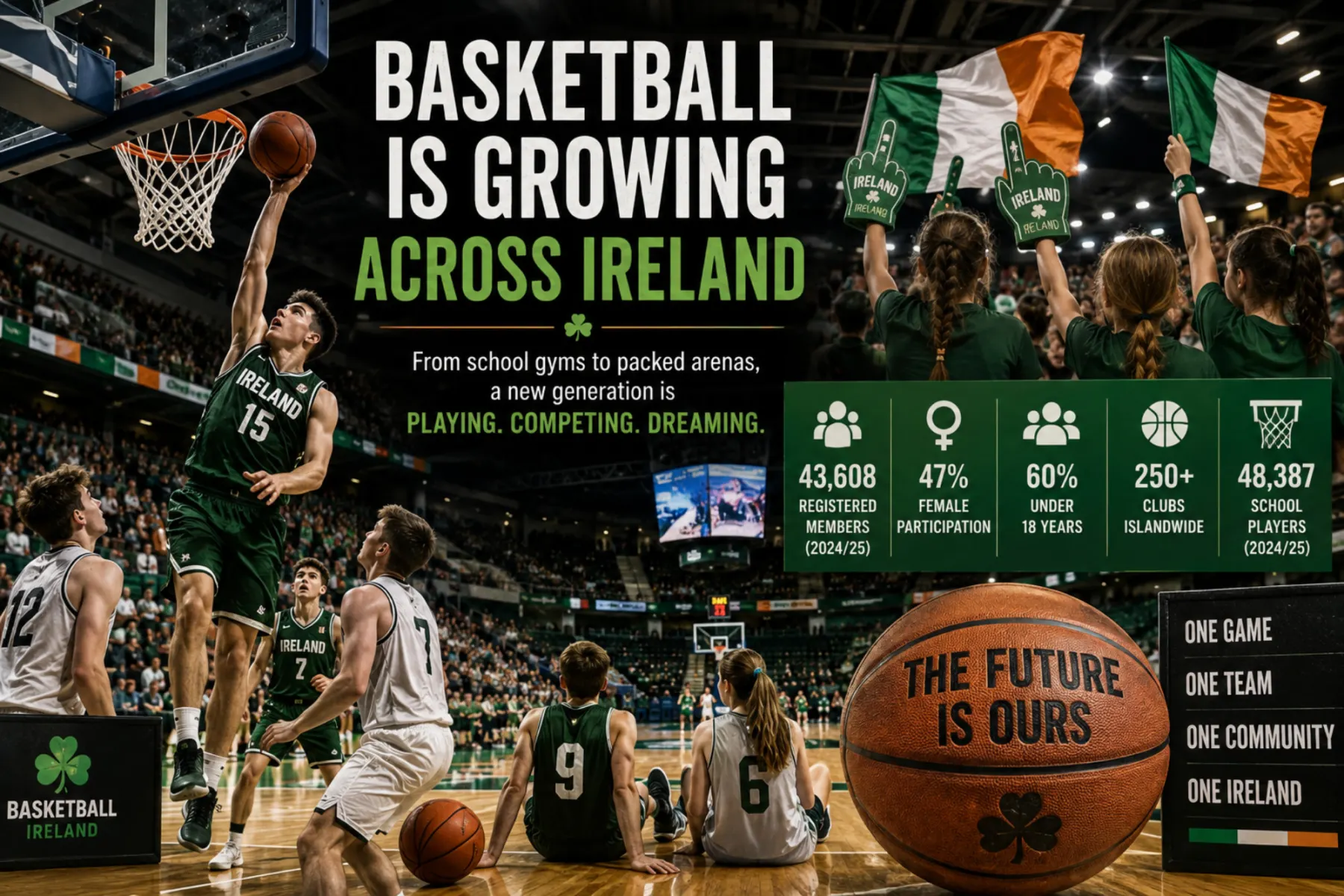
Basketball Ireland’s latest detailed annual figures recorded 43,608 registered members in the 2024/25 season, compared with 28,242 in 2019/20. The governing body reported membership growth of approximately 54 per cent over four years, with almost 47 per cent of members female and more than six in ten under the age of 18. Basketball Ireland currently lists more than 250 clubs across the island.
Then there is school basketball.
During 2024/25, 48,387 players participated in post-primary school competitions, up from 47,131 a year earlier. Basketball Ireland’s annual report also recorded participation across hundreds of schools, with boys and girls represented in almost equal numbers.
Those numbers reveal the central story.
Irish basketball is growing from the bottom upwards.
Children are finding the sport in schools. Clubs are expanding. New national-league teams are appearing in areas that previously had limited representation. Women’s basketball is developing alongside the men’s game. Recreational versions are creating routes for adults who do not want elite competition. And a rapidly expanding 3×3 programme is connecting Ireland with one of the fastest-growing forms of basketball internationally.
The greatest opportunity now is to connect those pieces.
Ireland Has a Much Longer Basketball History Than Many Realise
Basketball in Ireland is not a recent import.
Ireland sent a men’s basketball team to the 1948 Olympic Games in London, an extraordinary early appearance on the sport’s largest international stage.
Over subsequent decades, the sport developed around schools, universities, community halls and increasingly ambitious clubs.
The 1970s and particularly the 1980s produced a vibrant domestic basketball culture. Clubs such as Neptune, Blue Demons, Killester, St Vincent’s, Ballina and others built powerful local followings, while American players brought an additional level of athleticism and spectacle to the National League.
Cork emerged as one of the sport’s major centres.
Players such as Tom Wilkinson became household names within Irish basketball. Wilkinson accumulated eight National League titles and more than 100 Irish international appearances during a career closely associated with Neptune and Blue Demons.
The women’s game developed its own strong traditions.
Ireland’s first senior women’s international team was established in the 1970s, with the side competing internationally by 1974. Generations of players and coaches subsequently built strong women’s basketball programmes in Dublin, Cork, Limerick, Kerry and elsewhere.
The opening of the National Basketball Arena in Tallaght in 1993 provided the sport with a permanent national home.
Domestic league and cup finals, school competitions and international games could now take place in a venue identified directly with basketball.
That infrastructure helped establish a more recognisable national basketball calendar.
The Modern Growth Story Is Happening in Clubs
The most important institution in Irish basketball is not the national team.
It is the local club.
A basketball club has to do far more than put five players on the court.
It needs coaches.
Referees.
Table officials.
Administrators.
Volunteers.
Child-protection structures.
Access to sports halls.
Equipment.
Competition organisation.
Fundraising.
And increasingly sophisticated governance.
For that reason, the rapid rise in registered participation is significant.
Basketball Ireland’s membership figures show substantial expansion since the beginning of the decade, while the organisation’s current network extends to more than 250 clubs across the island.
This is not growth concentrated entirely in Dublin.
Cork and Kerry remain major basketball regions.
Limerick has a substantial presence.
Galway and the West have developed strongly.
Belfast and other parts of Northern Ireland possess important club structures.
Cavan, Sligo, Mayo, Meath, Wicklow, Kildare and other counties are increasingly represented within development and national competition.
The 2026/27 National League structure demonstrates that geographical spread particularly well.
A New Men’s Division Two Shows How the Club Pyramid Is Expanding
One of the clearest signs of development is the creation of a new eight-team Men’s Division Two for the 2026/27 season.
The inaugural competition will include:
Athlone BC
Ballina Braves
Cavan Eagles
Dublin Raiders
Fr. Mathews
Ongar Chasers
Team Northwest
Trinity BC
The league winner will earn promotion to Men’s Division One.
The list tells an interesting story.
Ballina brings National League basketball back to Mayo.
Athlone is returning to senior national competition after decades of development at underage level.
Cavan Eagles will field a men’s National League side for the first time, having already developed their women’s programme from Division One into the Women’s Super League.
Ongar Chasers, founded only in 2012, are moving into national competition.
Dublin Raiders will have national-level men’s and women’s programmes.
Trinity enters during the club’s 80th anniversary year.
Fr. Mathews returns to men’s National League competition.
These are not merely eight additional teams.
They represent eight additional local pathways.
A teenager joining one of those clubs can now see a route from junior basketball into senior national competition without necessarily having to move elsewhere.
That matters enormously for player retention.
The Women’s National League Is Expanding Too
The same expansion is occurring in women’s basketball.
Tralee Warriors and Ongar Chasers are entering Women’s Division One for the first time in 2026/27.
Tralee’s entry is particularly interesting because Kerry already possesses a strong basketball tradition through schools and clubs.
A stronger women’s National League presence gives young female players another reason to remain within their local basketball system as they move from junior to senior age groups.
Ongar represents a different model.
The Dublin club was founded in 2012 and has progressed rapidly through local competition. Its women’s team won Dublin Division One and the Top Four before stepping onto the national stage.
That kind of progression is precisely what a healthy sporting pyramid should allow.
Local success should create the possibility of regional competition.
Regional success should open a pathway towards national competition.
And national competition should connect the best players with international opportunities.
Ballincollig and Trinity Meteors Show the Strength of the Top Level
At the top of the domestic structure, Irish basketball has a competitive men’s and women’s Super League.
The 2025/26 season produced memorable champions.
Ballincollig won the Men’s Super League and National Cup double, strengthening Cork’s long association with elite Irish basketball.
In the women’s competition, Trinity Meteors won their first league title since 1992/93, defeating UCC Glanmire 87-81 in the Super League playoff final.
The next season begins in October 2026 with clubs from several regions again competing at the highest domestic level.
The geographic diversity matters.
Irish basketball does not function successfully if elite competition becomes exclusively a Dublin product.
The presence of major clubs in Cork, Kerry, Limerick, Galway, Sligo, Cavan and other regions helps national basketball remain connected with local communities.
Commercial Partners Are Beginning to Notice
Growing participation is increasingly being accompanied by commercial interest.
At the end of July 2026, Domino’s agreed a new three-year title sponsorship of the Men’s and Women’s Super League and Division One competitions, extending a relationship that began during the 2024/25 season.
Basketball Ireland said participation and attendances had continued to grow year-on-year.
That is important for a sport attempting to professionalise.
Sponsorship does more than put a company name beside a league.
Commercial income can support marketing, events, broadcasting, league administration and greater visibility.
Basketball Ireland has also built relationships with brands including Nike and AIG, while its own online television platform provides another route for domestic games to reach audiences beyond the physical capacity of individual sports halls.
For clubs, greater visibility can create a positive cycle.
More spectators make sponsorship more attractive.
Better sponsorship can improve presentation.
Better presentation can attract additional spectators.
And increased visibility gives young players local athletes to follow rather than relying entirely on the NBA for basketball role models.
Schools May Be Irish Basketball’s Greatest Asset
Professional basketball dominates the global image of the sport.
In Ireland, the school gym may ultimately be more important.
The 48,387 participants recorded in post-primary competition during 2024/25 represent an enormous development pool.
Girls accounted for approximately 24,000 of those participants and boys for another 24,000, making school basketball unusually balanced by gender.
This provides basketball with an advantage few sports possess.
The equipment requirement is relatively simple.
A school with a suitable hall, baskets and balls can introduce substantial numbers of children to the game.
Teams are comparatively small.
Training can take place indoors throughout the winter.
Girls and boys can follow almost identical versions of the sport.
And the basic skills — passing, shooting, movement, defending and teamwork — can be introduced quickly.
For some pupils, school basketball will remain purely recreational.
For others, it becomes the introduction to club basketball.
That conversion from school player to club player is one of the most important development opportunities facing the sport.
Basketball Ireland’s own school data shows that only part of the enormous school-playing population also participates in club basketball.
Closing even a portion of that gap could produce another significant increase in club membership.
The Academy System Is Trying to Build the Bridge to Elite Basketball
For talented young players, Basketball Ireland has expanded its regional and provincial Academy structure.
The aim is not simply to identify a tiny national squad at an early age.
It is to expose a larger number of promising players to higher-level coaching and international-standard concepts while allowing them to remain connected with their clubs.
During the 2024/25 season, Basketball Ireland piloted a new U13 programme for boys and girls.
More than 1,400 players participated across three sessions, alongside 132 club coaches who were invited to attend and develop their own knowledge.
That second figure is particularly significant.
An academy system becomes far more useful when the knowledge gained does not stay inside the academy.
If club coaches learn alongside elite coaches and then return to work with dozens of other young players, the impact spreads through the system.
Ireland’s relatively small population makes that kind of knowledge transfer especially important.
The objective should not be identifying talent while weakening clubs.
It should be raising the standard of the clubs that produce the talent.
Ireland’s Young Players Are Beginning to Produce International Results
There are encouraging signs that the youth pathway is becoming more competitive.
In July 2026, Ireland’s U20 men’s team finished fifth at FIBA Youth EuroBasket, described by Basketball Ireland as the best-ever finishing position for an Irish men’s team at that level.
The U20 women’s team finished eighth during its 2026 competition, while the U18 women’s side subsequently finished 13th with an impressive 5-2 record, losing only twice during the tournament.
These results should be interpreted carefully.
Youth success does not guarantee future senior success.
Players develop at different rates.
Some stop competing.
Others move abroad.
A dominant teenage player may not become an elite senior athlete.
But consistently producing competitive underage teams creates a deeper pool from which future senior internationals can emerge.
That is something Irish basketball has historically needed.
The Senior Men’s Team Is Becoming More Competitive — But Europe Remains Difficult
Ireland’s senior men’s programme illustrates both the progress and the scale of the challenge.
During the latest FIBA EuroBasket 2029 pre-qualifying campaign, Ireland defeated Luxembourg 91-85 in Dublin and later produced a 76-70 victory over Azerbaijan in Baku.
Other results were more difficult, including defeats to North Macedonia and Luxembourg, and the campaign ultimately did not produce progression to the next stage.
That should not obscure the underlying development.
Ireland is competing internationally against countries where professional basketball structures are considerably larger and where many national-team players compete full-time in strong European leagues.
The realistic next step is therefore not assuming Ireland should suddenly become a major European basketball nation.
It is closing the gap.
Producing more professional players abroad.
Increasing the depth available to national-team coaches.
Giving young Irish players more high-quality competitive minutes.
And gradually converting close international games into victories.
The expansion of domestic pathways makes that objective more realistic than it was when the player pool was substantially smaller.
The Women’s Team Has Also Shown It Can Win Internationally
The senior women’s team has faced similarly demanding European competition.
During its recent qualification programme, Ireland defeated Bosnia and Herzegovina 94-67 in Dublin and later won 81-78 in Zenica.
The next cycle is already taking shape.
Ireland is scheduled to begin the Women’s EuroBasket 2029 pre-qualifiers against Iceland at the National Basketball Arena in November 2026, followed by matches against Azerbaijan and Switzerland, with further games scheduled for February 2027.
The challenge for the women’s programme mirrors the broader sport.
Ireland now has impressive participation numbers.
The task is turning participation into sufficient elite depth to compete consistently against countries with well-established professional leagues.
That is a long-term process.
But having a large base of girls already playing basketball gives Ireland an important starting advantage.
Female Participation Is One of Basketball’s Greatest Strengths
Basketball Ireland’s membership data shows an almost even gender distribution, with approximately 47 per cent of registered members female.
That is a significant strength.
Many sports struggle to retain girls during adolescence.
Basketball already possesses competitive school and club structures for girls and women, alongside development programmes specifically designed to keep people involved with the sport.
One of the most interesting is SOCIA-Ball.
Rather than requiring women to join conventional competitive leagues, the programme creates a recreational and social version of basketball.
By 2025, SOCIA-Ball had expanded to 84 clubs in 27 counties with more than 1,000 registered participants.
The principle is important.
Not everyone who enjoys basketball wants to train several times a week and compete in a league.
If organised sport offers only an elite or competitive pathway, many adults eventually leave.
Creating social basketball allows the sport to retain people whose motivation is exercise, friendship and enjoyment rather than trophies.
Men’s Social Basketball Is Following the Same Model
Basketball Ireland has subsequently introduced a social membership pathway for adult men as well.
The model allows recreational players who are not participating in conventional competitive club basketball to register and play through organised social sessions.
Clubs currently advertise such opportunities in areas including Belfast, Cork, Donegal, Galway, Kildare, Louth, Mayo, Sligo and Wicklow.
This may appear separate from elite basketball.
In reality, it is part of the same healthy sporting ecosystem.
A successful national sport should have space for:
the seven-year-old learning to dribble,
the teenager dreaming of playing internationally,
the Super League athlete,
the recreational adult,
the former player returning at 40,
the coach,
the referee,
and the volunteer helping run the local club.
Basketball becomes stronger when participation does not have to end simply because a person no longer wants competitive sport.
Basketball’s Multicultural Appeal Could Become Increasingly Important
Ireland’s demographic change also creates opportunities.
Basketball is one of the world’s most widely understood sports.
A child arriving in Ireland from Lithuania, Poland, the United States, Spain, Nigeria, the Philippines, Ukraine or dozens of other countries may already know the rules before entering an Irish school.
Basketball Ireland describes its membership as multicultural, and the relatively low linguistic barrier of the game can make a basketball court a particularly effective place for people from different backgrounds to interact.
That gives the sport a social role beyond competition.
A club can become a point of integration.
Children meet through teams.
Parents meet through volunteering.
Players who may speak different first languages communicate through a sport they already understand.
As Ireland becomes more internationally diverse, basketball’s global familiarity could become one of its greatest advantages.
3×3 Basketball Is Creating an Entirely New Opportunity
Traditional basketball is five against five.
One of the most exciting developments in Ireland is happening with three.
3×3 basketball is played on half a court with three players per side, a 12-second shot clock and games lasting a maximum of ten minutes unless a team reaches 21 points first.
The game is faster and requires fewer players and less space than traditional basketball.
That makes it particularly suitable for outdoor events, schools, festivals and temporary courts.
Ireland has expanded rapidly in the discipline.
Basketball Ireland’s 2024/25 annual report recorded 3,351 players across 115 3×3 events, with activity spread across 16 host counties and participation from U11 through senior level.
And the international side is now developing too.
Ireland’s Men Are Going to the 3×3 European Championships
In June 2026, Ireland’s men’s 3×3 team qualified for the FIBA 3×3 Europe Cup Finals in Antwerp for the second consecutive year.
The European finals will take place in September, with Ireland drawn to face Latvia and Lithuania in the group stage.
That achievement has significance beyond one tournament.
International 3×3 competitions generate ranking points relevant to qualification pathways for major events, including the World Cup and ultimately the Olympic Games.
Basketball Ireland has explicitly identified Los Angeles 2028 as part of its long-term 3×3 ambition.
Ireland’s women’s programme is also developing internationally, including participation in the FIBA 3×3 Women’s Series for a third successive year in 2026.
This gives Ireland something it has not historically possessed in basketball:
a realistic additional route towards the highest global stage.
€200,000 in 3×3 Funding Shows the Opportunity Is Being Taken Seriously
Sport Ireland allocated €200,000 in Performance Development Programme funding to Basketball Ireland’s international 3×3 programme in 2026.
Basketball Ireland said the investment would support participation in international competitions and help the country build ranking points towards future World Cup and Olympic qualification opportunities.
This is a sensible area for Ireland to explore.
Competing with Europe’s strongest nations in traditional five-player basketball requires enormous player depth and professional infrastructure.
3×3 requires a smaller elite playing pool.
That does not make international success easy.
The leading 3×3 countries are highly specialised and increasingly professional.
But for a smaller sporting nation, concentrated investment can potentially produce international results more quickly than attempting to replicate the entire professional basketball ecosystem of countries with populations many times Ireland’s size.
State Support for Basketball Has Increased Substantially
The growth of Irish basketball has also been accompanied by increased public investment.
Sport Ireland’s core grant to Basketball Ireland has risen from €598,000 in 2018 to €980,000 in 2026.
That places Basketball Ireland among the larger recipients of core funding among Ireland’s national governing bodies.
Sport Ireland also included Basketball Ireland among organisations receiving targeted strategic investment in 2026 because of their growth potential.
Women’s basketball has received additional support.
Basketball Ireland was allocated €80,000 through Sport Ireland’s 2026 Women in Sport programme, alongside the separate funding streams supporting participation and development.
These numbers should not be interpreted as proof that every facility problem has been solved.
They have not.
But they demonstrate that basketball’s development is increasingly being recognised within national sports policy.
The Biggest Problem May Be Finding Somewhere to Play
Growth brings its own difficulties.
Basketball cannot be played competitively without a suitable court.
That sounds obvious, but indoor facility availability may become one of the most important constraints on further expansion.
A football club can sometimes create additional training capacity by using another outdoor pitch.
A basketball club requires an appropriately sized indoor hall with suitable flooring, baskets, changing facilities and scheduling availability.
Schools need their halls.
Other indoor sports need them.
Community centres have multiple users.
And winter evenings create enormous pressure on available hours.
Basketball Ireland’s own strategic plan identifies improved access to gyms and better infrastructure standards as key development objectives.
This may be where participation growth eventually collides with physical capacity.
A club can find another 30 children who want to play.
Finding another three hours of court time can be much harder.
The National Basketball Arena Illustrates the Infrastructure Challenge
The existing National Basketball Arena in Tallaght has served Irish basketball since 1993.
But Basketball Ireland has argued that the sport now needs something substantially larger.
Planning permission has been granted for a proposed €38 million redevelopment that would increase the venue’s capacity to approximately 3,272 spectators and create four basketball courts alongside a gym, café and other facilities.
However, the project did not receive funding in the 2024 Large Scale Sport Infrastructure Fund allocation.
Basketball Ireland subsequently said it remained committed to the redevelopment but acknowledged that the timetable would have to change while alternative funding routes were explored.
This is an important reality check within an otherwise positive growth story.
Irish basketball has demonstrated that it can attract players.
The next question is whether infrastructure can expand at the same pace.
Better Coaching Is as Important as Better Buildings
A new sports hall does not automatically create better basketball.
Players require coaches.
And rapid participation growth creates a danger if the number and quality of coaches do not increase alongside player numbers.
Basketball Ireland has been attempting to address this through its Academy system, coach-education programmes and the Helpside online learning platform.
Updated minimum coaching standards are due to apply from the 2026/27 season, while coaching clinics and continuing professional development are increasingly part of the national structure.
This is particularly important at younger ages.
Children do not simply need coaches who understand offensive systems or defensive schemes.
They need adults who understand skill development, age-appropriate training, safeguarding, confidence and how to make sport enjoyable enough that children want to return the following week.
The long-term success of basketball will therefore be determined partly by people whose names never appear on a scoreboard.
Referees and Officials Need to Grow With the Game
The same is true of referees.
Every additional league creates additional games.
Every additional game requires officials.
If player participation grows much faster than the referee population, competitions become increasingly difficult to operate.
Basketball Ireland now maintains structured development pathways for referees, commissioners and table officials and provides education through its online learning systems.
This is one of the less glamorous parts of sporting growth.
A club can celebrate registering another 100 players.
It is equally important to produce the next ten referees.
Sustainable growth requires both.
Wheelchair and Inclusive Basketball Are Part of the Same Development
Basketball in Ireland is also broadening the definition of who the sport is for.
The 2025 Basketball Ireland annual report highlighted Rebel Wheelers becoming the first Irish club to compete in IWBF EuroCup qualifying, while also recording its sixth consecutive Irish Wheelchair Association National Cup title.
Basketball Ireland has also developed diversity, inclusion and recreational programmes designed to reach people who may not enter conventional competitive basketball.
The significance is structural.
A growing sport has an opportunity to design inclusion into its expansion rather than attempting to add it later.
Accessible facilities, inclusive coaching and different forms of competition can make that possible.
Basketball Fits Modern Ireland Particularly Well
There are several reasons basketball may continue growing.
It is global.
It is indoor.
It requires relatively small teams.
Girls and boys can play the same sport under essentially the same rules.
It works in schools.
It works in universities.
It can be competitive or recreational.
It can be played five-a-side or 3×3.
It is familiar to many of Ireland’s newer communities.
And international basketball culture is increasingly visible to young people through the NBA, WNBA, European competitions, video games and social media.
None of these factors guarantees continued growth.
But together they create unusually favourable conditions.
A teenager does not have to be introduced to the idea that basketball is exciting.
Often the challenge is simply providing somewhere for that teenager to play it.
What Irish Basketball Could Look Like by 2030
The most plausible positive scenario is not that Ireland suddenly becomes a European basketball superpower.
A more realistic transformation would happen closer to home.
Membership continues expanding.
More school players transfer into clubs.
Existing clubs establish additional teams.
New clubs appear in towns without established basketball structures.
Men’s Division Two creates a sustainable pathway into higher national competition.
Women’s National League basketball expands geographically.
3×3 develops a genuine Olympic pathway.
More Irish players earn opportunities in European professional leagues and US college basketball.
Domestic games attract larger audiences.
Coaching and refereeing numbers rise.
And regional centres provide more high-quality court time.
If those developments occur simultaneously, the senior national teams would eventually benefit from a much deeper pool of players.
That would be systemic progress rather than dependence on one unusually talented generation.
The 3×3 Olympic Dream Could Accelerate Interest
Los Angeles 2028 could become particularly important.
Ireland has never developed the same Olympic basketball tradition that exists in some larger European nations.
3×3 provides a new possibility.
The men’s qualification for the 2026 Europe Cup and increased investment in both men’s and women’s programmes demonstrate that this is no longer purely theoretical.
Olympic qualification would be extremely difficult and should not be presented as inevitable.
But even competing seriously for that opportunity could have a powerful effect domestically.
Children understand the Olympics.
Sponsors understand the Olympics.
Media understand the Olympics.
An Irish basketball team entering an Olympic qualification race would therefore give the sport a narrative extending well beyond its existing audience.
Clubs Will Decide Whether the Growth Lasts
The national governing body can create programmes.
Government can provide funding.
Commercial partners can sponsor competitions.
International coaches can develop elite players.
But the future of Irish basketball will still be determined largely on ordinary evenings in local sports halls.
A volunteer opening the gym.
A parent driving children to training.
A coach teaching a ten-year-old how to use both hands.
A referee taking charge of an U14 game.
A committee raising money for new equipment.
A senior player staying after training to help the juniors.
Those activities are difficult to measure in national statistics.
Yet they are the mechanism through which those statistics grow.
Basketball Ireland’s membership expansion would not exist without them.
A Sport Becoming More Confident in Its Place
Basketball is unlikely to replace Ireland’s traditional major sports.
It does not need to.
Its opportunity is different.
Ireland has enough sporting appetite for basketball to establish a much larger place of its own.
The evidence is increasingly visible.
More than 250 clubs.
Tens of thousands of registered members.
Almost 50,000 post-primary school players.
An unusually balanced male-female participation profile.
New national leagues.
New women’s teams.
Expanding social basketball.
A growing Academy structure.
Increasing state investment.
Commercial partners committing for multiple seasons.
Youth teams achieving some of Ireland’s strongest international results.
Senior teams recording competitive European victories.
And a 3×3 programme preparing to represent Ireland at another European Championship while looking towards the Olympic pathway.
The limitations are equally clear.
Ireland needs more suitable indoor courts.
Clubs need more coaches and officials.
The National Basketball Arena redevelopment remains unresolved.
Domestic players need stronger pathways towards professional basketball.
And international success will require years of sustained development.
But those are increasingly the problems of a sport dealing with growth rather than decline.
That distinction matters.
For much of its history, Irish basketball had passionate pockets of support and periods of remarkable domestic enthusiasm but struggled to turn them into consistently expanding national structures.
The current period looks different.
The player base is larger.
The school system is stronger.
The women’s game is deeply embedded.
Club pathways are broadening.
3×3 has created a new international opportunity.
And children joining basketball today can see clearer routes from a school gym to a local club, from a local club to an Academy, from an Academy to the National League and, for the most talented, from Ireland to international basketball.
That may ultimately be the most positive measure of the sport’s development.
Basketball in Ireland is no longer asking whether there are enough people interested in playing.
Increasingly, the question is whether Irish basketball can build enough courts, clubs, coaches and competitive opportunities to keep up with all the people who already want to play.
Source & Transparency
This article is published by Ireland Newspaper for editorial and informational purposes.
Published: 11 August 2026 · Updated: 11 August 2026

Newsroom Ireland Newspaper
Ireland Newspaper editorial team prepares daily news coverage for readers in Ireland and abroad.