Ireland’s Fishing Fleet in 2026: What It Costs to Go to Sea — and Which Vessel Sizes Have the Strongest Outlook
Irish fisheries entered 2026 after a year in which lower catch volumes were offset by stronger prices. But the economics are tightening again: quota availability has fallen sharply, fuel remains a major vulnerability, new monitoring rules increase the administrative burden and profitability varies enormously between vessels of similar length. From an owner-operated eight-metre potter to a 40-metre-plus pelagic trawler, the decisive question is no longer simply how large the boat is — but what it catches, how efficiently it catches it, what quota it can access and how much capital is tied up in keeping the vessel at sea.
There is a revealing contradiction at the centre of Irish commercial fishing.
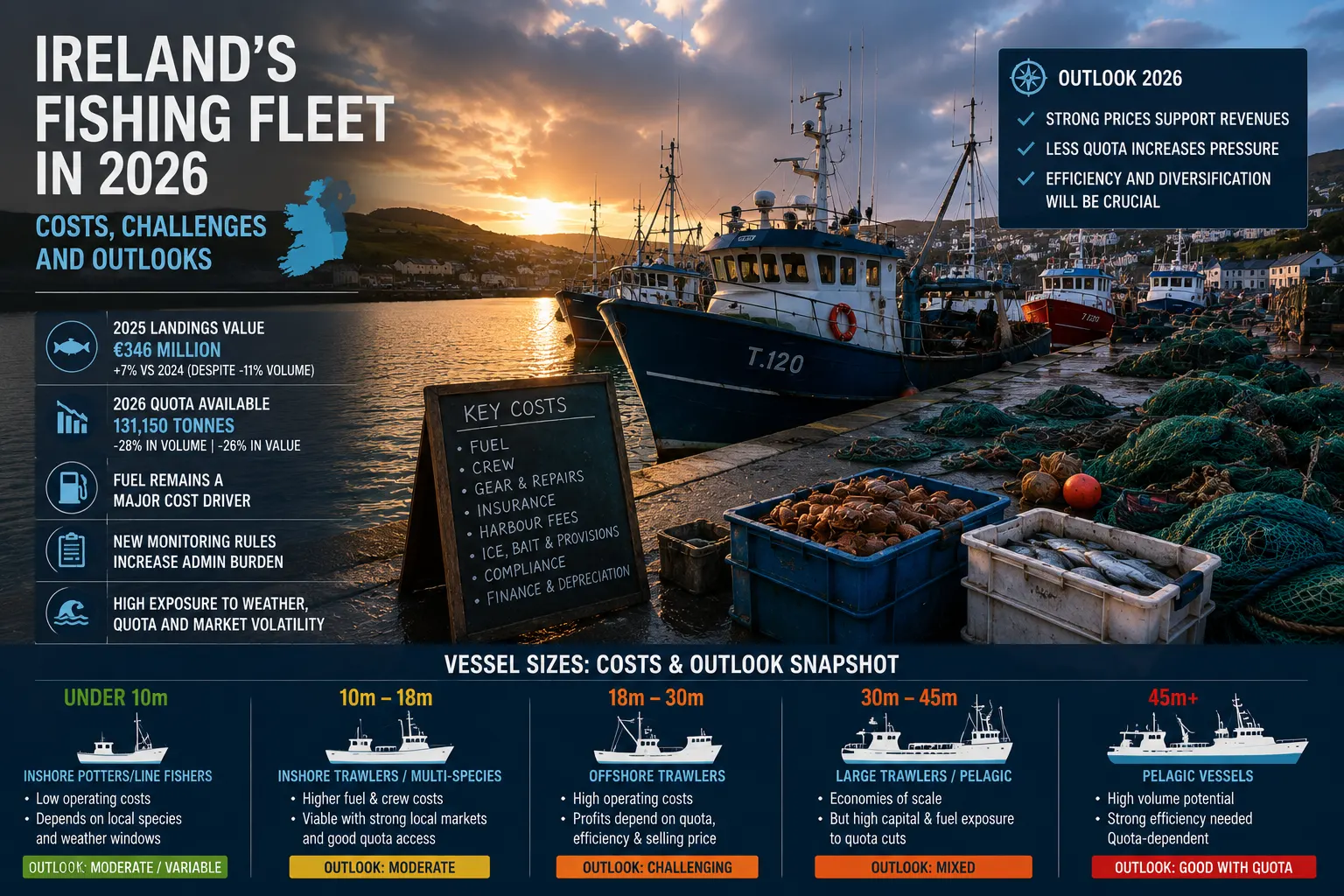
In 2025, Irish fishing vessels landed 11 per cent less fish by volume than a year earlier — yet the value of those landings increased by 7 per cent to €346 million. Mackerel alone was worth €91 million at first sale, Dublin Bay prawn €71 million and crab €25 million. Higher prices helped compensate for reduced physical supply.
For many vessel owners, that was encouraging.
But it was not necessarily comfortable.
A fishing vessel does not generate profit because fish prices rise. It generates profit only if the value of what is landed exceeds the combined cost of fuel, crew, gear, repairs, insurance, harbour charges, ice, bait, provisions, compliance, finance, depreciation and the considerable amount of time when the vessel may be unable to fish at all.
And 2026 has introduced another major constraint.
Bord Iascaigh Mhara describes this year’s quota allocations as the most severe reductions faced by the Irish fleet since quotas were introduced in 1982. Its Business of Seafood 2025 report calculates available Irish quota at 131,150 tonnes, down 28 per cent, with an estimated value of €220 million, down 26 per cent. Pelagic quota volume is 33 per cent lower and its value 37 per cent lower.
A separate BIM calculation excluding Hague Preferences puts the 2026 fishing opportunity somewhat lower, at around €205 million. The difference reflects the allocation basis used rather than a fundamentally different assessment of the direction of the industry: 2026 offers considerably less fishing opportunity than 2025.
For somebody already operating a fishing business — or considering buying a boat — that makes one question particularly important:
Which vessel sizes can still operate economically in Ireland?
The answer is more complicated than it first appears.
The First Rule of Fishing Economics: Length Alone Tells You Very Little
It is tempting to imagine a simple progression.
A small boat has low costs and low earnings.
A larger boat has higher costs but higher profits.
A very large vessel has the greatest earning potential.
Irish fleet data show why that assumption can be badly misleading.
A 25-metre scallop dredger and a 25-metre beam trawler may be almost identical in length but operate entirely different businesses.
One may catch a relatively high-value species with favourable economics.
The other may consume very large quantities of fuel for every tonne landed.
A 10-metre potter targeting lobster and crab can have a completely different cost base from a 10-metre trawler.
A 45-metre refrigerated seawater pelagic vessel can land enormous tonnages extremely efficiently but may be heavily dependent on only a handful of quota-controlled species.
So the economics of a fishing boat are determined by at least seven variables:
vessel size, fishing method, target species, quota or entitlement, fuel intensity, number of viable fishing days and capital cost.
Location matters too.
A vessel operating from Killybegs has different fisheries and markets from one working from Kilmore Quay, Castletownbere, Howth, Ros an Mhíl or a small west-coast harbour.
Ireland’s Fishing Industry Still Matters Economically
The catching sector directly supported about 2,220 jobs in 2025, while the wider Irish seafood economy — including fishing, aquaculture, processing and associated activity — was estimated by BIM to contribute €1.31 billion to GDP.
The geography of that activity is highly concentrated in coastal Ireland.
Killybegs alone recorded €111 million of Irish vessel landings in 2025. Castletownbere recorded €26 million, Howth €15 million, Kilmore Quay and Greencastle €14 million each, Dunmore East and Ros an Mhíl €12 million each, Union Hall €11 million and Clogherhead €9 million. Foreign vessels also add substantial activity to some ports, particularly Castletownbere.
This means vessel economics extend beyond the boat owner.
A viable fishing vessel creates demand for engineering, fuel, chandlery, ice, refrigeration, transport, processing, harbour services and crew.
A vessel tied permanently to the quay affects all of them.
What Does It Actually Cost to Operate an Irish Fishing Vessel?
The latest detailed BIM fleet accounts provide an unusually useful breakdown.
There is, however, an important limitation.
Because fishing businesses file accounts after the end of their financial year and BIM must subsequently collect and harmonise the information, the latest fully detailed vessel-segment financial data in the National Seafood Survey 2025 relate to the 2023 operating year.
They should therefore be treated as a benchmark for understanding the cost structure, not as a claim that a boat in August 2026 has precisely the same income or expenses.
BIM explicitly explains this reporting lag and states that the survey collected 2023 economic data during late 2024 and early 2025.
Across the Irish fleet in that benchmark year, total operating costs amounted to approximately €307.8 million.
Of that:
€92.3 million went to personnel,
€52.4 million to energy,
€40.6 million to repairs and maintenance,
€53.2 million to other variable costs,
and €32.9 million to other non-variable expenditure.
The “other variable” category is easy to underestimate. BIM identifies expenditure such as provisions, cleaning and hygiene materials, lubricants and filters, ice, bait, memberships and harbour dues among these costs.
Then come the capital costs.
The engine eventually needs replacing.
Electronics become obsolete.
Gear wears out.
Steel corrodes.
Survey work and safety equipment cost money.
The vessel itself loses economic value with age.
And if the vessel was financed, loan repayments and interest have to be serviced from cash flow.
That is why gross profit and net profit tell different stories in fishing.
A vessel may cover its day-to-day operating expenses and appear commercially healthy while failing to generate enough return to replace the vessel or remunerate the capital invested in it.
Fuel Can Decide Whether a Trip Is Worth Making
Few expenses can change the economics of fishing as quickly as diesel.
The Irish fleet consumed approximately 63.1 million litres of fuel in 2023 at an average reported price of €0.83 per litre. Energy expenditure represented about 17 per cent of total operating costs that year.
BIM modelled what would happen if average fuel prices rose while other conditions remained unchanged.
At the aggregate fleet level, modelled net profit reaches break-even at approximately €1.16 per litre. Gross profit does not reach break-even until around €1.61 per litre.
That does not mean every vessel becomes unprofitable at exactly €1.16.
An efficient pelagic vessel and a fuel-intensive beam trawler behave completely differently.
But it demonstrates how narrow the capital return of the sector can become when fuel rises.
The pressure was sufficiently important in 2026 for the State to introduce a temporary vessel fuel-support scheme. Eligible vessels of six metres or more could receive support of up to €0.40 per qualifying litre for the relevant fuel-purchase period, while vessels below six metres qualified for a €350 flat-rate payment. The scheme was temporary rather than a permanent reduction in the industry’s fuel cost.
Crew Costs Rise Rapidly With Vessel Size
The smallest Irish boats are frequently owner-operated.
Family labour and unpaid work remain important in parts of the inshore sector.
Move into larger boats and the economic model changes.
A vessel fishing 150 or 200 days a year cannot normally depend on one person.
There are deckhands, engineers, skippers and sometimes specialist roles.
Many Irish fishing crews are paid through share arrangements linked to catch value rather than simple fixed salaries. BIM notes that crew remuneration therefore rises and falls with landings and vessel performance.
In the detailed 2023 fleet data, average crew cost per full-time equivalent varied dramatically between segments: from relatively modest figures on small inshore vessels to more than €170,000 in the large RSW pelagic segment.
This helps explain why a large boat can generate millions of euros in turnover without its owner necessarily becoming proportionately more profitable.
Revenue has scaled.
But so have the expenses.
Under 10 Metres: Small Capital Base, but Not Automatically a Small Business
Ireland’s under-12-metre fleet is numerically dominant.
In the detailed 2023 benchmark, 1,164 active vessels were under 12 metres, representing 84 per cent of the active fleet.
Many of the smallest vessels use pots, traps, nets, hooks or dredges and operate relatively close to their home ports.
This can create important advantages.
Fuel consumption in absolute terms can be much lower.
Crew requirements are limited.
The boat can often be operated by its owner.
Maintenance is cheaper in absolute euros than on a large steel trawler.
Trips are shorter.
And some vessels target high-value shellfish such as lobster and crab.
But small size brings its own restrictions.
Weather limits the number of safe fishing days.
Range is shorter.
Hold capacity is lower.
The owner may have little ability to compensate for a poor season by moving hundreds of miles to another fishery.
And income can become highly seasonal.
The under-10-metre potter
This is one of the most important small-boat models in Ireland.
BIM’s 2023 segment contained 807 potters below 10 metres. Combined revenue was about €33 million, gross profit €10.7 million and net profit approximately €9 million.
Dividing those segment totals by the number of vessels gives a rough arithmetic average of approximately:
€41,000 revenue per vessel,
about €28,000 of operating-cost equivalent before capital costs,
and roughly €11,000 net profit per vessel.
These are not BIM forecasts for an individual vessel. They are simple averages derived from a large and extremely varied segment.
A highly active lobster or crab boat with productive grounds may perform far better.
A part-time vessel may earn dramatically less.
The owner may also contribute labour that is not captured in the same way as a conventional employee salary.
Nevertheless, the figures demonstrate something important: a small vessel can be economically viable without producing hundreds of thousands of euros in turnover if its capital and operating costs remain low.
Small dredgers
The under-10-metre dredger segment showed average revenue of roughly €52,000 per vessel in the same benchmark, with an approximate net result of €6,500 each when aggregate figures are divided by vessel numbers.
But fuel intensity was much greater than for potters: BIM recorded around 910 litres of energy use per tonne landed for the segment, versus about 358 litres per tonne for under-10-metre potters.
The lesson is clear.
Two boats of the same length can face radically different exposure to diesel prices.
Outlook for Boats Below 10 Metres: Selectively Positive
For a low-debt owner-operator with access to productive lobster, crab, net or other high-value inshore fisheries, the sub-10-metre category can remain one of the more defensible economic models.
Its strength is not huge turnover.
It is low fixed cost and operational flexibility.
The strongest businesses are likely to be those that can maximise value per kilogram rather than volume alone — through freshness, quality, good landing arrangements and, where regulations and logistics allow it, closer links with local buyers or direct markets.
Public policy currently gives this category additional support.
Under BIM’s Small-Scale Coastal Fisheries Scheme, owners of eligible vessels under 12 metres that do not use towed gear have been eligible for an 80 per cent support rate, with the latest call capped at €30,000 grant aid per vessel for qualifying investment such as energy efficiency, safety, traceability and quality improvements.
The biggest risks remain weather, ageing vessels, restricted fishing opportunities, species dependence and the fact that an owner often has little organisational redundancy: if the skipper is ill or the engine fails, the business may stop completely.
10 to 12 Metres: The Surprisingly Difficult Middle Ground
A 10- to 12-metre vessel looks, at first glance, like an attractive step up.
There is more deck space.
More storage.
Greater range.
Better ability to work in difficult conditions.
Potential revenue increases substantially.
Unfortunately, costs can rise even faster.
The 2023 BIM data illustrate the problem.
The 90 potters between 10 and 12 metres generated nearly €12.9 million of revenue — about €143,000 per vessel on a simple average.
Yet the segment recorded negative gross profit of €932,000 and net losses of €3.34 million. That equates arithmetically to roughly €37,000 of net loss per vessel.
The 10- to 12-metre dredger segment also produced a small aggregate operating loss and an average derived net loss of about €6,700 per vessel.
Yet 10- to 12-metre fixed and drift netters performed differently: 15 vessels generated €1.67 million in revenue and positive net profit of €136,502 — roughly €9,100 per vessel on a simple average.
The conclusion is not that 11-metre boats are bad investments.
It is that the fishery matters more than the metre mark.
Why 12 Metres Is Now an Important Regulatory Boundary
Crossing 12 metres increasingly changes more than the physical capability of the vessel.
From 10 January 2026, all fishing vessels of 12 metres length overall and above must carry a fully functioning Vessel Monitoring System. A previous exemption for some boats between 12 and 15 metres was removed.
Those vessels must also submit an electronic prior notification at least four hours before entering port and record fishing activity haul by haul in the electronic logbook. From July 2027, VMS position reporting is due to increase from at least every two hours to at least every 30 minutes.
None of these requirements alone will determine whether a fishing business succeeds.
But they create an important economic reality.
A vessel just above 12 metres may face:
more electronic equipment,
greater reporting obligations,
additional administrative time,
more sophisticated maintenance,
higher compliance exposure,
and often a more professionalised operating structure.
That makes the 10-to-12-metre category interesting for suitable non-towed fisheries because it can offer increased capability while remaining within the EU small-scale coastal definition used by certain support schemes.
12 to 18 Metres: Where Fishing Becomes a Full Commercial Enterprise
At 12 to 18 metres, the economics change substantially.
A vessel can work farther offshore.
Trips become longer.
Crew costs rise.
The boat carries more expensive electronics and safety systems.
Fuel consumption becomes a much larger absolute expense.
Repairs can involve specialist yards and machinery.
And quota availability becomes increasingly central to whether the vessel has enough profitable days at sea.
The 2023 BIM results were difficult for several segments in this size range.
Twenty-one demersal trawlers and seiners between 12 and 18 metres generated approximately €5.48 million in revenue, or around €261,000 per vessel.
Yet gross profit for the segment was negative by just over €1 million and net losses exceeded €3.1 million — around €149,000 per vessel on a simple average.
Thirty-three potters between 12 and 18 metres did better operationally. They produced about €15 million in revenue and positive gross profit of €1.3 million. But after capital costs the segment still recorded a net loss of approximately €1.27 million.
This distinction is critical.
The boats were earning enough to cover normal operating activity collectively.
They were not generating enough to produce an adequate return after the cost of their capital base was recognised.
That is exactly the sort of business that can look healthy from the harbour — busy boat, active crew, substantial landings — while remaining financially fragile underneath.
The 2026 Outlook for 12–18 Metre Vessels Is Challenging
For vessels targeting Dublin Bay prawn, whitefish and mixed demersal fisheries, 2026 quota changes matter directly.
Area VII Norway lobster quota excluding FU16 is down 16 per cent, while the FU16 allocation is down 38 per cent. Several important whitefish allocations have also fallen substantially, although individual species differ and some quotas have increased.
That means a vessel owner can face a painful combination:
a mechanically capable boat,
a crew that needs enough work to remain,
high fixed expenditure,
and fewer tonnes legally available to catch.
The 12–18-metre segment therefore looks selective rather than broadly attractive in 2026.
A modern, efficient vessel with favourable entitlements, diversified fisheries and limited debt can still work.
A heavily financed vessel dependent on one constrained fishery is much more exposed.
18 to 24 Metres: High Turnover Does Not Guarantee High Return
Once a vessel approaches 20 metres, annual turnover can begin to resemble that of a substantial land-based company.
The selected Irish demersal trawler and seiner segment between 18 and 24 metres contained 51 vessels in BIM’s 2023 data.
Together they generated €47.6 million in revenue.
That is approximately €933,000 per vessel on a simple average.
At first glance, this sounds highly profitable.
It was not.
The segment recorded only €1.34 million of gross profit and a net loss of €3.26 million after capital costs — roughly €64,000 negative per vessel on an arithmetic average.
Fuel intensity was also substantial: approximately 1,337 litres per landed tonne in the BIM segment data.
This is one of the clearest examples of why turnover is a poor guide to the economic health of a fishing operation.
A boat can sell almost €1 million of fish a year and still fail to produce an adequate return on the capital invested.
What Makes an 18–24 Metre Vessel Work?
At this scale, utilisation becomes crucial.
The vessel needs enough profitable days at sea.
It needs sufficient quota.
It needs to minimise unplanned mechanical downtime.
The crew must be retained.
Catch quality must remain high.
Trips need to be planned around fuel, weather and likely catch rates.
And the owner has to think much more carefully about capital replacement.
A major engine problem on an eight-metre boat can be financially painful.
On a 22-metre trawler it can become a six-figure business event.
The prospective buyer therefore needs to examine more than the purchase price.
A relatively inexpensive older boat can become the expensive choice if it requires continual steelwork, engine overhaul, hydraulic repairs, refrigeration upgrades or electronic replacement.
18–24 Metres May Still Suit the Right Professional Operator
This category nevertheless has advantages.
It offers meaningful range without the extreme capital requirements of a large offshore trawler.
It can support diversified fisheries.
It can land enough volume to justify professional buyer relationships and sophisticated onboard handling.
And capacity adjustment has already changed parts of the sector.
BIM reports that 39 large-scale vessels were decommissioned during 2023 through the Brexit voluntary permanent cessation scheme, and notes that key demersal segments subsequently showed improved economic performance as capacity adjusted.
Fewer boats chasing the same available fishing opportunity can improve utilisation for those remaining.
But 2026 quota reductions offset some of that potential gain.
The segment should therefore be regarded as a professional operating business rather than a lifestyle fishing investment.
24 to 40 Metres: One Length Category, Three Completely Different Businesses
Nowhere is the danger of judging by vessel length clearer than in the 24-to-40-metre range.
Consider three BIM segments from 2023.
Demersal trawlers and seiners
There were 43 vessels.
Revenue was approximately €52.6 million, or about €1.22 million per vessel on a simple average.
Gross profit was positive at nearly €2 million.
Net profit, however, was negative €4.3 million, equivalent to approximately €100,000 loss per vessel on a straight average.
Beam trawlers
The 13-vessel beam-trawl segment generated approximately €8.1 million in revenue.
Gross profit was already negative at €1.54 million and net losses reached €2.22 million.
The most striking figure is fuel intensity.
BIM recorded around 1,765 litres per landed tonne — the highest among the major segments shown in its 2023 table.
At that level of energy dependence, fuel price becomes central to commercial survival.
Dredgers
Then consider the seven dredgers in exactly the same broad 24-to-40-metre length category.
They generated €13.75 million in revenue, €6.62 million in gross profit and €5.85 million in net profit.
On a simple per-vessel division, that is almost €2 million in revenue and more than €835,000 of net profit per vessel.
It was an exceptionally strong result.
But it involved only seven vessels and one specific fishery.
It would be irresponsible to suggest that buying any 30-metre dredger will reproduce it.
The figures instead demonstrate the central rule of fisheries economics:
the fishing opportunity is the asset; the hull is the platform used to exploit it.
Pelagic Vessels Between 24 and 40 Metres: High Turnover, High Quota Exposure
The 15 pelagic/polyvalent vessels between 24 and 40 metres generated almost €26 million of revenue in 2023, around €1.73 million per vessel on a simple average.
Their fuel intensity was comparatively low at around 148 litres per tonne because pelagic fishing can move large volumes efficiently.
Yet the segment recorded a net loss of €4.34 million in that year despite positive gross profit.
And 2026 introduces a new problem.
Pelagic quota has been hit harder than any other major category.
BIM’s current published table shows:
mackerel: 18,705 tonnes, down 53 per cent;
blue whiting: 30,188 tonnes, down 41 per cent;
boarfish: 20,537 tonnes, down 22 per cent.
High fish prices may partially compensate.
But a vessel cannot sell fish it does not have the entitlement to catch.
Over 40 Metres: The Most Efficient Tonnes — and the Greatest Concentration Risk
Ireland’s large refrigerated seawater pelagic vessels sit at the opposite end of the fleet from the inshore potter.
Only 20 vessels appeared in BIM’s 2023 segment.
Together they generated almost €89 million in revenue.
Gross profit reached €24.9 million and net profit approximately €2.55 million.
A simple per-vessel division gives extraordinary scale:
about €4.45 million of revenue per boat.
Their energy efficiency per tonne was also by far among the strongest in the fleet, at around 100 litres per tonne landed.
That does not mean the fuel bill is small.
These vessels catch enormous quantities, so absolute fuel consumption remains substantial.
But they demonstrate the efficiencies created by scale.
A large pelagic vessel can catch and transport a tonne of fish using much less fuel than many demersal operations.
The weakness: quota concentration
The economic danger is that the business is concentrated in relatively few species.
Mackerel was worth €91 million to the Irish fleet in 2025, making it Ireland’s most valuable landed species.
When mackerel availability is cut dramatically, a vessel designed to catch huge pelagic volumes cannot simply become a lobster potter.
The equipment, refrigeration, crew, port infrastructure and capital structure have been built around a specific high-volume fishing model.
For the very largest vessels, therefore, operational efficiency is excellent but biological and political quota risk is concentrated.
That makes 2026 substantially more difficult than the strong 2023 results might suggest.
A Practical Comparison of Selected Vessel Segments
The latest detailed actual BIM segment data give the following broad picture. The per-vessel figures below are arithmetic averages calculated from the 2023 segment totals and are intended only to illustrate scale — they are not forecasts, valuations or expected profits for an individual boat.
| Vessel/fishery segment | Approx. revenue per vessel | Approx. net result per vessel | 2026 interpretation |
|---|---|---|---|
| Potter under 10m | €41,000 | +€11,000 | Low-cost model can remain attractive with good grounds and low debt |
| Dredger under 10m | €52,000 | +€6,500 | Viable in suitable fishery, but more fuel-intensive |
| Potter 10–12m | €143,000 | -€37,000 | Higher revenue did not translate into profit in benchmark year |
| Fixed/drift netter 10–12m | €111,000 | +€9,000 | Shows gear choice can matter more than length |
| Demersal trawler 12–18m | €261,000 | -€149,000 | High-risk if quota, fuel or finance is unfavourable |
| Potter 12–18m | €455,000 | -€39,000 | Positive operating margin but weak after capital costs |
| Demersal trawler 18–24m | €933,000 | -€64,000 | High turnover, narrow capital return |
| Demersal trawler 24–40m | €1.22m | -€100,000 | Requires scale, quota, efficiency and disciplined capital cost |
| Beam trawler 24–40m | €623,000 | -€171,000 | Particularly exposed to fuel intensity |
| Dredger 24–40m | €1.96m | +€836,000 | Strong benchmark result, but tiny specialised segment |
| Pelagic 24–40m | €1.73m | -€289,000 | Efficient per tonne but quota-sensitive |
| Pelagic/RSW 40m+ | €4.45m | +€127,000 | Scale efficient, but 2026 pelagic quota cuts are a major risk |
The table makes one point unmistakable.
There is no economically “best” fishing-boat length.
Buying a Fishing Boat: Why the Advertisement Price Is Only the Beginning
Anyone considering entering commercial fishing needs to separate the cost of a vessel from the cost of acquiring a viable fishing business.
A fishing boat without the required licence, capacity, entitlement, suitable gear, markets and realistic fishing opportunity is simply an expensive marine asset.
The Irish Young Fisher Scheme illustrates the scale of the issue.
Its eligibility rules allow qualifying applicants under 40 to receive support equal to 40 per cent of eligible vessel-acquisition costs, capped at €250,000. Eligible expenditure includes not only the vessel itself but qualifying licence and capacity costs. The vessel must be below 24 metres and satisfy other age, registration and ownership conditions.
The existence of a €250,000 grant ceiling does not establish a market price.
It does illustrate that buying a commercial fishing operation can involve capital well beyond the cost of the hull and engine.
A proper acquisition assessment should therefore examine:
the vessel survey,
engine hours and overhaul history,
gear condition,
licence and capacity,
access to relevant fisheries,
historic landings,
days at sea,
fuel consumption,
crew structure,
insurance,
harbour arrangements,
electronics,
safety compliance,
anticipated repairs,
and realistic resale value.
An apparently cheap vessel with a worn engine and weak fishing opportunity can be far more expensive than a higher-priced boat with strong commercial capability.
New Entrants Face a Capital Problem
Fishing has an unusual barrier to entry.
A young farmer can theoretically buy or lease additional land over time.
A haulage company can add a truck if demand increases.
A fisherman cannot simply buy a bigger vessel and begin catching unlimited quantities of fish.
Fleet capacity and fisheries are regulated.
Quota-controlled species remain limited by Total Allowable Catches and allocation arrangements.
The boat must also meet national and EU requirements.
This makes the value of a fishing business partly intangible.
Historic fishing opportunities, access, licence capacity and the ability to participate in particular fisheries can matter as much as steel and machinery.
That is why a new entrant should never value a boat solely by comparing asking prices for similar-length vessels.
Grants Can Change the Investment Calculation
Ireland and the EU currently provide substantial capital support for eligible fleet investment under the European Maritime, Fisheries and Aquaculture Fund.
For qualifying small-scale coastal vessels — under 12 metres and not using towed gear — the latest Small-Scale Coastal Fisheries Scheme offered an 80 per cent support rate up to €30,000 per vessel.
For eligible vessels outside that small-scale definition, the Sustainable Fisheries Scheme has offered 50 per cent support, with the most recent call capped at €125,000 per vessel and a €250,000 lifetime ceiling under the scheme. Eligible investments include quality improvements, catch handling, traceability, health and safety and energy efficiency.
These calls have closing dates and are not permanently open, so an owner cannot assume funding will be available whenever an investment is made. BIM’s current funding page should be checked before committing expenditure.
But strategically, grant support can alter the economics considerably.
A €40,000 energy-efficiency investment is one proposition if entirely owner-financed.
It is another if a qualifying scheme absorbs a significant part of the cost.
The Cheapest Fuel Is the Fuel the Vessel Never Burns
Technical efficiency is therefore becoming one of the most important areas of investment.
Hull condition, propeller efficiency, engine maintenance, towing resistance, gear design, vessel speed and route planning all affect fuel consumption.
BIM continues to run applied trials on lower-drag trawl doors, lighter Nephrops gear, alternative codends and other technologies intended to reduce fuel consumption while maintaining commercially acceptable catches. Its 2026 fisheries research programme includes further work specifically on reduced-drag Pluto trawl doors and energy-efficient fishing gear.
The economic logic is powerful.
Increasing catch by 10 per cent is useful.
Reducing fuel consumption by 10 per cent while catching the same value of fish can be just as important — and may be more predictable.
Efficiency investment is especially valuable for boats in the 12-to-40-metre trawl segments where fuel represents a large share of trip expenditure.
2026 Is Not Simply a Story of Falling Quotas
The industry also has a positive market signal.
Ireland landed less fish in 2025 but received more money for it.
Mackerel value increased.
Crab value increased 22 per cent.
Razor clam value rose strongly.
Several other shellfish categories improved.
That means value per tonne is becoming increasingly important.
This may be one of the most important strategic changes available to a country whose quota volume is constrained.
Ireland cannot create additional quota by marketing fish better.
But it can potentially extract more economic value from each tonne legally caught.
That can mean:
better onboard handling,
faster chilling,
improved grading,
traceability,
premium branding,
direct supply relationships,
processing,
and avoiding damage that converts premium fish into lower-value product.
The future of parts of the Irish fleet may therefore depend less on catching more fish and more on earning more from each fish caught.
Quota Is the Dominant 2026 Risk
The overall headline remains difficult.
According to BIM’s main 2026 assessment, total quota volume is down 28 per cent.
Pelagic opportunities are hardest hit.
Area VI demersal quota is down 13 per cent.
Area VII demersal quota is down 8 per cent.
Some individual stocks have much larger reductions, including substantial cuts in cod, haddock, saithe, plaice and Nephrops allocations, although other stocks such as some whiting and pollack allocations have increased.
That produces different consequences by vessel.
A crab potter may barely notice the mackerel reduction.
An RSW pelagic vessel may build its entire annual business plan around it.
A Nephrops trawler may be more concerned with functional-unit allocation.
A mixed whitefish vessel may care less about the headline national tonnage than whether one low-quota bycatch species restricts its ability to continue fishing.
National quota figures therefore describe the sector.
They do not describe every boat.
Brexit Still Sits in the Background
The current position cannot be understood solely through 2026 biological advice.
Ireland’s fishing industry has also been adjusting to the quota transfers associated with the EU–UK Trade and Cooperation Agreement.
BIM’s annual report identifies post-Brexit quota changes as one of the continuing structural forces affecting fleet economics and notes that capacity reduction through the voluntary cessation programme improved the position of some demersal segments.
This is another example of interacting causes.
Fleet profitability is not determined by one government decision.
It reflects stock abundance, scientific advice, EU negotiations, Brexit allocation changes, fish prices, fuel, vessel efficiency, crew costs, capital structure and international seafood demand simultaneously.
Which Vessel Size Has the Best Prospects?
The data allow a more useful answer than simply naming one length.
Below 10 metres: potentially the best risk-adjusted model for a new small operator
A low-debt, owner-operated vessel targeting lobster, crab, pots or another high-value local fishery can have modest turnover but limited fixed costs.
The strongest prospects are likely where fishing grounds are productive, markets are established and the owner does not burden a small vessel with excessive acquisition debt.
The weakness is limited weather capability and scale.
Outlook: cautiously positive for the right fishery.
10 to 12 metres: capable, but watch the cost jump
This size offers more seaworthiness and capacity while some non-towed vessels remain within the small-scale funding framework.
But BIM’s benchmark data show that higher turnover can be swallowed by higher expenses.
The business needs a clearly identified fishery rather than simply a bigger hull.
Outlook: mixed and highly gear-dependent.
12 to 18 metres: the difficult transition zone
These vessels incur a fully commercial regulatory and operating burden without necessarily possessing the scale of the largest vessels.
Current quota pressure in Nephrops and several demersal species adds risk.
A modern vessel with good access and little debt may succeed; a heavily financed older trawler can be difficult.
Outlook: challenging.
18 to 24 metres: substantial business, substantial exposure
Turnover can approach or exceed €1 million, but fuel, crew and capital costs are correspondingly large.
The segment can work where utilisation and quota are strong.
It is much less forgiving of poor planning or mechanical downtime.
Outlook: viable for well-capitalised professional operators, but not low-risk.
24 to 40 metres: the fishery decides everything
BIM’s data show both some of the strongest and some of the weakest profitability in this size range.
Dredgers performed extremely strongly in the benchmark year.
Beam trawlers did not.
Demersal and pelagic segments generated significant turnover but weak net returns.
Outlook: impossible to judge by size alone; evaluate the precise fishery.
More than 40 metres: scale efficiency with concentrated quota risk
The largest pelagic vessels demonstrate extraordinary productivity per tonne and large revenues.
But their specialisation means quota reductions can remove a substantial part of the business opportunity before the vessel leaves the quay.
The severe 2026 mackerel and blue-whiting cuts therefore matter greatly.
Outlook: structurally efficient, but unusually exposed in 2026.
The Most Dangerous Boat May Be the One With Too Much Debt
There is a broader conclusion running through all the size categories.
Fishing revenue is inherently variable.
Fish move.
Weather changes.
Quota changes.
Prices change.
Engines fail.
A business with modest debt can absorb some bad months.
A highly leveraged vessel may need almost every season to go well.
That is why purchase price and financing structure deserve as much attention as forecast catch.
A €300,000 vessel producing €150,000 of annual revenue may be an excellent business if debt is low and operating expenses are controlled.
The same vessel can become financially dangerous if the owner must service a large loan while also funding an engine rebuild.
Likewise, a multimillion-euro pelagic boat may be an excellent asset when quota and prices are favourable but difficult to carry through a year in which fishing opportunity is heavily reduced.
Cash Profit Is Not Enough to Fund the Next Boat
This distinction matters particularly in an ageing fleet.
An owner may say:
“The boat paid its bills and left money in the bank.”
That is encouraging.
But if a vessel worth several hundred thousand euros has an engine approaching replacement and the business has not generated sufficient return to finance the next generation of equipment, the apparent profit can be misleading.
BIM’s own data illustrate this through the gap between gross and net profit.
Several fleet segments produced positive gross profit but negative net profit after capital costs were recognised.
For long-term viability, the business must ultimately pay for more than this year’s diesel and wages.
It has to pay for tomorrow’s vessel too.
Regulation Will Continue Becoming More Digital
The regulatory trend is also clear.
Electronic logbooks, VMS, traceability and electronic notification are becoming more comprehensive.
From July 2027, vessels subject to VMS will transmit positions at least every 30 minutes rather than every two hours under the new control framework.
For the most technologically advanced fleet segments this may be a relatively modest adjustment.
For smaller owner-managed vessels around the regulatory threshold, electronic systems and administration represent a more visible burden.
The likely future is therefore not less monitoring.
It is more automated monitoring.
Operators who integrate compliance into normal vessel management rather than treating it as an additional task are likely to adapt more easily.
Offshore Development Will Add Another Spatial Question
Fishing vessels also operate in an increasingly crowded marine environment.
Offshore renewable-energy development, marine conservation objectives, shipping, aquaculture, cables and other uses all require sea space.
BIM’s 2026 fisheries research programme specifically includes work on interactions between offshore wind farms and fisheries and improved mapping of under-12-metre vessel activity for marine spatial planning.
For inshore boats, access to small productive grounds can be disproportionately important because they have less ability than offshore vessels to relocate.
For larger vessels, steaming farther can restore access — but at a fuel cost.
Future fisheries economics will therefore increasingly include another scarce resource besides quota:
space.
The Best Investment May Be in an Existing Vessel
There is a temptation to view modernisation as buying a larger boat.
That is not always the economically rational step.
For many operators, the better return may come from:
improving fuel efficiency,
installing modern catch monitoring,
upgrading refrigeration,
reducing gear drag,
improving working conditions,
making handling more efficient,
reducing downtime,
or investing in higher-quality output.
Current BIM schemes explicitly support many of these types of investment.
A vessel that consumes 15 per cent less fuel, loses fewer fishing days to mechanical problems and receives a better average price may outperform a larger replacement boat carrying substantially more debt.
What Should a Prospective Fisher Calculate Before Buying?
A serious business plan should begin with the fishery, not the boat.
The first question is not:
“How much does a 15-metre fishing boat cost?”
It is:
“What legal and commercially realistic fishing opportunity will this vessel have?”
Only then should the buyer calculate the boat.
A practical model should estimate annual revenue conservatively and then deduct:
crew,
fuel,
ice and bait,
gear replacement,
harbour and landing costs,
insurance,
routine maintenance,
major-engine reserve,
electronic systems,
survey and safety expenditure,
accountancy and administration,
loan interest,
depreciation,
and a contingency for lost fishing days.
The model should then be stressed.
What happens if fuel rises 25 per cent?
What happens if a key quota falls 20 per cent?
What happens if fish prices fall 15 per cent?
What happens if the vessel loses six weeks to an engine repair?
What happens if the first season is poor?
If the investment only works when every assumption is favourable, it is not a resilient fishing business.
The Next Three Years: What Could Improve the Outlook?
It would be misleading to predict today’s 2026 quota reductions straight through to 2027, 2028 and 2029.
Fish stocks change.
Scientific advice changes.
International negotiations change.
Quota-sharing arrangements change.
Prices change.
But several trends are reasonably clear.
Value will matter more than volume
When quota is constrained, quality, handling and market positioning become increasingly valuable.
Ireland’s 2025 experience already demonstrated that falling volume can coexist with rising landed value.
Energy efficiency will become a competitive advantage
Fuel is too large and volatile a cost to treat as fixed.
The vessel that can land the same catch using less diesel gains protection from both market shocks and future environmental regulation.
Capital discipline will become more important
The data contain repeated examples of high-revenue fleet segments producing poor net returns.
Owners able to modernise without excessive leverage will have a stronger position.
Small-scale fishing retains a defensible niche
Inshore boats cannot compete with pelagic trawlers on volume.
They do not need to.
Their future lies in high-value species, local knowledge, low capital intensity, selective fishing and extracting more value from smaller quantities.
Large vessels will remain essential but more volatile
Ireland’s large pelagic fleet can be extremely efficient.
Its problem is not necessarily technical efficiency.
It is the concentration of earnings in quota-controlled species whose availability can change dramatically from one negotiation to the next.
A Smaller Catch Can Still Support a Stronger Business
The most encouraging lesson from 2025 is that volume alone does not determine the industry’s value.
Irish vessels landed less fish and generated more first-sale revenue.
That provides a possible direction for a country unlikely to solve its fishing challenges simply by obtaining unlimited additional tonnage.
Better quality.
Better efficiency.
Lower fuel consumption.
Stronger market positioning.
Reduced downtime.
More selective gear.
Higher value per kilogram.
Those improvements do not eliminate the impact of a 50 per cent quota reduction.
But they can determine which businesses remain profitable within the fishing opportunity available.
The Future Will Belong to Efficient Boats, Not Necessarily Big Boats
Ireland’s fleet statistics ultimately dismantle one of the simplest assumptions about commercial fishing.
Bigger is not automatically better.
An eight-metre owner-operated potter can produce a respectable return with relatively low turnover.
An 11-metre vessel can generate three times as much revenue and lose money.
A 22-metre trawler can sell almost €1 million worth of fish and still produce a negative net result.
A 30-metre dredger can be highly profitable while a similarly sized beam trawler struggles.
A 40-metre-plus pelagic vessel can be extraordinarily efficient per tonne while remaining dangerously exposed to a single quota decision.
The economic future of Irish fisheries therefore cannot be reduced to a preferred boat length.
It will be determined by the combination of access, efficiency, capital, species, markets and management.
For a small inshore operator, that may mean staying small, keeping debt low and earning more from high-value local catch.
For a medium-sized trawler, it may mean reducing fuel consumption and making every fishing day count.
For a large offshore operator, it may mean managing quota concentration and ensuring that enormous capital investment is matched by long-term fishing opportunity.
And for somebody considering buying their first commercial fishing vessel, perhaps the most important lesson is the simplest:
do not buy the boat first and then search for a business model.
Find the fishery.
Understand the quota and licence position.
Calculate the real operating cost.
Stress-test the numbers.
Then decide how much boat that business can afford.
Ireland’s fishing industry remains economically important, technically sophisticated and deeply rooted in its coastal communities. But 2026 is also demonstrating how quickly favourable prices can be overtaken by quota cuts and operating pressure. The strongest vessels of the next decade are therefore unlikely to be defined simply by length or engine power.
They will be the boats capable of turning a limited fishing opportunity into the highest sustainable value at the lowest realistic cost.
Source & Transparency
This article is published by Ireland Newspaper for editorial and informational purposes.
Published: 12 August 2026 · Updated: 12 August 2026

Newsroom Ireland Newspaper
Ireland Newspaper editorial team prepares daily news coverage for readers in Ireland and abroad.