
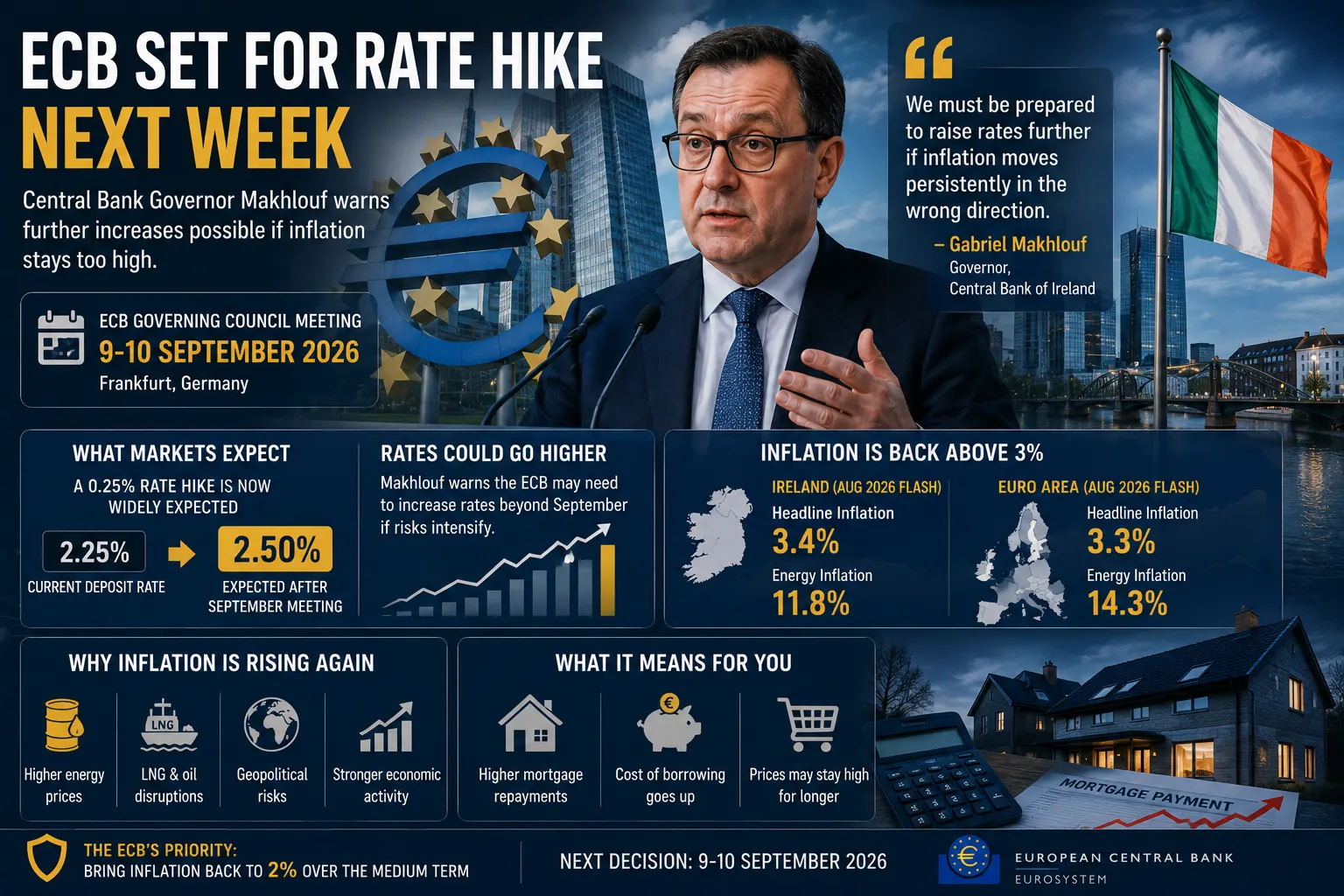
A European Central Bank interest-rate increase next week is now widely expected rather than merely possible. Ireland’s Central Bank Governor Gabriel Makhlouf, who sits on the ECB’s Governing Council, has signalled that the 10 September decision is unlikely to surprise financial markets as euro-area inflation has accelerated to 3.3 per cent and Irish inflation to 3.4 per cent. More significant for Irish households is what could follow: Makhlouf says the ECB must be prepared to raise rates further if inflation begins moving persistently in the wrong direction.
The warning comes at an uncomfortable moment for borrowers. The ECB already increased its deposit rate from 2.00 to 2.25 per cent in June, its first rate rise after a long period in which monetary policy had been moving in the opposite direction. Financial markets now broadly expect another quarter-point increase to 2.50 per cent at the Governing Council meeting in Berlin on 9 and 10 September.
Makhlouf’s message should nevertheless be interpreted carefully. He is not forecasting an extended sequence of increases comparable with the aggressive tightening cycle of 2022 and 2023. He has said inflation expectations remain well anchored and that there is not yet evidence of a significant wage-driven second round of inflation. His concern is that the combination of headline inflation above 3 per cent, continuing energy disruption and economic activity that has proved somewhat stronger than expected could require the ECB to do more if those risks intensify.
That distinction matters for Irish mortgage holders, prospective homebuyers and businesses. A September increase appears increasingly likely. Rates above that level are possible rather than predetermined. The economic question has shifted from whether the ECB has finished tightening to how far it may ultimately have to go before it considers the inflation risk contained.
Inflation Has Moved Back Above 3 Per Cent Across the Euro Area
Eurostat’s flash estimate for August put euro-area annual inflation at 3.3 per cent, up sharply from 2.9 per cent in July. The increase was overwhelmingly associated with energy, where prices were estimated to be 14.3 per cent higher than a year earlier, compared with a 10.3 per cent increase in July.
The underlying numbers are less alarming. Inflation excluding energy was estimated at 2.2 per cent. The widely followed measure excluding energy, food, alcohol and tobacco stood at 2.4 per cent, slightly lower than in July. Services inflation eased from 3.3 to 3.0 per cent.
This creates the dilemma confronting the ECB. Headline inflation is substantially above its 2 per cent medium-term target, but much of the latest increase reflects an external energy shock rather than an overheating consumer economy. Raising interest rates cannot produce more oil, repair damaged energy infrastructure or reopen disrupted shipping routes. Monetary policy instead attempts to stop those initial price increases spreading into wages, services and inflation expectations.
For Ireland, the latest figures are slightly worse than the euro-area average. The CSO estimates that Irish HICP inflation reached 3.4 per cent in August, up from 3.1 per cent in July. Energy prices rose by an estimated 11.8 per cent over twelve months and by 4.3 per cent in August alone.
When energy is removed, Irish inflation falls to 2.5 per cent. Excluding energy and unprocessed food, the rate was 2.6 per cent. Services remained more persistent at 3.7 per cent, while food excluding alcohol and tobacco was only 0.1 per cent more expensive than a year earlier.
The Inflation Picture Before the September ECB Meeting
| Indicator | August 2026 | July 2026 |
|---|---|---|
| Ireland HICP | 3.4% | 3.1% |
| Ireland energy | 11.8% | Lower than August |
| Ireland HICP excluding energy | 2.5% | — |
| Euro-area HICP | 3.3% | 2.9% |
| Euro-area energy | 14.3% | 10.3% |
| Euro-area core HICP | 2.4% | 2.5% |
Sources: Central Statistics Office and Eurostat. August figures are flash estimates and remain subject to revision.
Makhlouf’s Warning Goes Beyond the Expected September Increase
Makhlouf’s latest comments are important because they address not simply next week’s decision but the level at which monetary policy would become genuinely restrictive. In an interview published by the Financial Times on 2 September, the Irish central-bank governor indicated that an ECB deposit rate of 2.50 per cent would still not, in his assessment, materially restrain economic activity.
He suggested that restrictive territory begins, roughly speaking, only once the deposit rate moves above 2.75 per cent. That is an individual policymaker’s assessment rather than an official ECB threshold. The neutral interest rate cannot be observed directly and estimates differ according to economic conditions and methodology.
Makhlouf’s argument is therefore conditional. If inflation risks shift significantly upwards, the ECB should be prepared to move rates into restrictive territory. If energy prices stabilise, underlying inflation remains contained and wage growth does not transmit the shock more broadly, the need for additional tightening would be considerably weaker.
His concern is strengthened by the fact that the euro-area economy has held up better than feared. Manufacturing surveys in August pointed to the strongest expansion in more than four years, while Germany has shown signs of recovery. Makhlouf expects the ECB’s new projections next week to revise its 2026 growth estimate slightly higher than the 0.8 per cent forecast made in June.
Stronger growth is normally positive. In a monetary-policy context, however, economic resilience can give a central bank greater confidence that it can increase rates without causing a recession. Weak growth would provide a stronger argument for tolerating temporary energy inflation; stronger demand reduces that constraint.
The ECB Has Already Reversed Direction Once This Year
The policy change during 2026 has been unusually rapid. After the inflation shock of 2022 and 2023, the ECB had gradually reduced rates as price pressure subsided. The deposit facility rate eventually reached 2.00 per cent and remained there for about a year.
The renewed Middle East energy shock changed that outlook. On 11 June the Governing Council unanimously raised all three policy rates by 25 basis points. The deposit facility moved to 2.25 per cent, the main refinancing operations rate to 2.40 per cent and the marginal lending facility to 2.65 per cent.
The Governing Council paused in July, leaving the rates unchanged. Its communication made clear that this was not necessarily the end of tightening. The ECB said the full inflationary impact of the energy shock had yet to play out and that it would monitor direct, indirect and second-round effects.
Minutes of the July meeting subsequently showed that policymakers considered another increase likely if the inflation outlook did not improve sufficiently. Financial markets entered September already expecting the deposit rate to rise to 2.50 per cent.
ECB Interest Rates Entering September
| ECB Rate | Current | If Raised 25bp |
|---|---|---|
| Deposit facility | 2.25% | 2.50% |
| Main refinancing rate | 2.40% | 2.65% |
| Marginal lending facility | 2.65% | 2.90% |
Current rates: European Central Bank. The right-hand column illustrates a uniform 25-basis-point increase and is not an announced ECB decision.
Why an Energy Shock Can Still Lead to Higher Interest Rates
The apparent contradiction is straightforward: if expensive energy causes inflation, why make mortgages and business loans more expensive as well? The answer lies in the difference between the first-round shock and what happens afterwards.
The first effect is direct. Oil, gas and electricity become more expensive. Households pay more for transport and heating, while businesses face higher fuel, freight and production expenses.
The second effect occurs when companies attempt to recover those costs by increasing the prices of other goods and services. A restaurant may pay more for electricity and deliveries; a construction company may face higher transport and material costs; a manufacturer can see both energy and logistics become more expensive.
The third stage is potentially more persistent. Employees facing a higher cost of living seek compensation through wages, while companies facing higher payroll costs increase prices again. At that point an external energy shock can evolve into domestic inflation that continues even after oil prices eventually decline.
The ECB cannot prevent the initial energy increase, but it can make it harder for the later stages to become entrenched. Higher borrowing costs reduce demand, encourage saving and signal that the central bank will continue defending its inflation target.
This Time Is Not Yet a Repeat of 2022
The comparison with Europe’s previous energy crisis is unavoidable, but important differences remain. When inflation surged after the pandemic and Russia’s invasion of Ukraine, the economy was simultaneously dealing with supply-chain disruption, exceptional fiscal support, accumulated household savings and unusually strong demand.
The current shock is more concentrated in energy supply. ECB research published this week described the 2026 increase as much more clearly driven by adverse energy-supply developments than the broader combination of forces seen in 2021 and 2022.
Core inflation offers some reassurance. Euro-area inflation excluding food and energy was 2.4 per cent in August rather than moving upwards with headline inflation. Wage developments have also not produced the widespread second-round effect feared by policymakers.
Makhlouf has explicitly acknowledged this. Inflation expectations remain in what he considers a good position and he sees no clear evidence that wages have begun producing a second inflation cycle.
That is why the current debate concerns quarter-point adjustments rather than the much more aggressive moves made during the previous tightening cycle. But the absence of second-round effects today does not guarantee they will not emerge if high energy prices persist through winter and into 2027.
Ireland Is Particularly Sensitive to Global Energy Prices
Energy dependence makes the debate unusually relevant for Ireland. In a June speech, Makhlouf noted that Ireland imports roughly four-fifths of its energy, considerably more than the EU average. The country imports all of its oil requirements and most of its natural gas.
This means a geopolitical disruption can affect Irish inflation even when domestic demand has not changed. Households do not need to buy more fuel for the price of fuel to increase; the international price itself can change the domestic cost of maintaining the same standard of living.
The Central Bank of Ireland has already revised its 2026 inflation forecast upwards to 3.5 per cent, compared with 2.1 per cent recorded in 2025. Its current baseline expects inflation of 2.9 per cent in 2027 before returning towards 2 per cent in 2028.
Energy is the primary reason for the revision. The Bank’s June forecast assumes energy-price inflation of 9.6 per cent during 2026, while services inflation is projected at 3.7 per cent. Gas and oil price assumptions have been revised sharply higher since the end of 2025.
The August flash figure of 3.4 per cent does not mean the annual 3.5 per cent forecast has already been achieved because the latter refers to the average rate across the entire year. It does, however, demonstrate that the renewed inflation pressure assumed in the forecast is already visible in consumer prices.
Irish Mortgage Borrowers Will Not All Be Affected in the Same Way
An ECB increase does not automatically add exactly 0.25 percentage points to every Irish mortgage. The transmission depends on the type of loan.
Tracker mortgages are the clearest case. Their interest rates are contractually linked to an ECB reference rate, generally the main refinancing operations rate. When that ECB rate rises, the tracker rate normally rises by the same amount plus the unchanged contractual margin. AIB, for example, passed the June 25-basis-point ECB increase directly to tracker customers.
Variable-rate mortgages work differently. Banks decide their own variable rates using funding costs, competition, credit risk and other commercial factors. An ECB increase can influence those rates without requiring an immediate one-for-one change.
Fixed-rate borrowers are protected during the agreed fixed period. Their monthly repayment does not rise simply because the ECB changes policy next week. The risk emerges when the fixed period expires and the borrower must choose among whatever rates are available at that time.
New borrowers face a similar issue. Mortgage pricing reflects expectations about future ECB rates, wholesale funding costs and competition between lenders. Markets can therefore move before the official central-bank decision occurs.
The structure of recent Irish lending provides some protection from immediate shocks. In June, 93 per cent of new mortgage agreements by volume were fixed-rate loans. The average rate on new fixed mortgages was 3.46 per cent, compared with 3.96 per cent for new variable agreements.
The Average New Irish Mortgage Rate Was 3.49 Per Cent in June
The Central Bank’s latest retail-interest-rate release put the weighted average rate on new Irish mortgage agreements at 3.49 per cent at the end of June. That was almost identical to the euro-area average of 3.51 per cent and 11 basis points below the Irish rate a year earlier.
That apparently favourable position should not be interpreted as evidence that the June ECB increase had no effect. Mortgage lenders price fixed loans using expected financing costs over future years, not only the policy rate on one particular day. The impact of a changing monetary outlook can therefore appear gradually.
The strong increase in mortgage switching provides evidence that households are already reacting. In the second quarter of 2026, remortgage and switching volumes increased by 13.6 per cent year on year and their value rose by 24.8 per cent. June mortgage approvals for switching were even stronger, with value up 65.8 per cent from a year earlier.
For borrowers whose fixed terms expire in the coming months, the question is therefore increasingly whether rates can still be locked before another period of monetary tightening becomes reflected in lender pricing.
What Another Quarter Point Could Mean for a Mortgage
A model calculation shows why apparently small interest-rate movements matter over long periods. Consider a €300,000 repayment mortgage with 25 years remaining. At an annual interest rate of 3.49 per cent, the calculated monthly capital-and-interest payment is approximately €1,500.
If the mortgage rate increased by exactly 0.25 percentage points to 3.74 per cent, the model payment would rise to approximately €1,541 — around €41 more a month or almost €490 a year.
If the rate increased by a cumulative half percentage point to 3.99 per cent, the monthly payment would be approximately €1,582, around €82 above the original model and almost €980 more over twelve months.
These figures are illustrations rather than predictions of Irish bank pricing. A fixed-rate customer would experience no such increase during the fixed term, and lender rates do not necessarily move one-for-one with the ECB deposit rate.
Illustrative €300,000 Mortgage With 25 Years Remaining
| Mortgage Rate | Monthly Payment | Difference |
|---|---|---|
| 3.49% | About €1,500 | Reference |
| 3.74% | About €1,541 | +€41/month |
| 3.99% | About €1,582 | +€82/month |
Ireland Newspaper model calculation. Assumes a standard capital-and-interest mortgage with unchanged balance and term. Rates above 3.49% are illustrative and are not forecasts or lender quotations.
Tracker Borrowers Feel ECB Changes More Directly
A second model illustrates the different exposure of a tracker borrower. Assume a €200,000 mortgage with 20 years remaining and a contractual tracker margin of one percentage point above the ECB main refinancing rate.
With the ECB refinancing rate currently at 2.40 per cent, the model mortgage rate would be 3.40 per cent and the monthly repayment approximately €1,150. A 25-basis-point ECB increase would raise the model tracker to 3.65 per cent and the repayment to approximately €1,175.
A second identical increase would take the model mortgage rate to 3.90 per cent and the monthly repayment to roughly €1,201. The difference from the initial position would then be about €52 a month or more than €620 a year.
The actual effect for every tracker customer depends on outstanding balance, remaining term and contractual margin. The key distinction is that these borrowers have much less protection from ECB movements than somebody several years into a fixed-rate mortgage.
The September question is no longer whether ECB rates can rise again.
Markets broadly expect the deposit rate to reach 2.50 per cent. The more important question is whether inflation subsequently forces policy towards 2.75 per cent or into the higher territory Makhlouf considers restrictive.
First-Time Buyers Could Face a Different Problem
Higher mortgage rates do more than increase monthly payments for existing borrowers. They can also reduce how much a prospective buyer is able to borrow under a lender’s affordability assessment.
Irish mortgage rules already limit most first-time buyers to borrowing no more than four times gross income and normally require at least a 10 per cent deposit. Those macroprudential limits do not replace a lender’s own assessment of whether repayments are affordable.
Under consumer-protection rules, lenders must conduct a robust stress test for many mortgage borrowers using an interest rate at least two percentage points above the offered rate, although mortgages fixed for five years or more are exempt from that particular test. Higher offered rates can therefore change the affordability calculation even when the Central Bank’s four-times-income ceiling remains unchanged.
In a property market where purchase prices remain historically high, this creates a difficult interaction. A buyer can face a more expensive house and a more expensive loan at the same time. Higher rates may eventually cool property demand, but that effect can take considerable time when housing supply remains constrained.
Businesses Are Already Paying Much More Than Mortgage Borrowers
For companies, the cost of credit is already significantly higher. The weighted average interest rate on new lending to Irish non-financial corporations reached 5.22 per cent in June, according to Central Bank data. That was 25 basis points higher than in May and 33 basis points above the rate a year earlier.
The equivalent euro-area average was 3.72 per cent, leaving new Irish corporate borrowing substantially more expensive in that particular month. Loans worth more than €1 million carried an average rate of 5.15 per cent.
For Irish small and medium-sized enterprises, the latest quarterly data put the weighted average rate on new bank lending at 4.98 per cent in the first quarter. Outstanding SME loans carried a broadly similar average rate of 4.99 per cent.
An additional ECB increase would not necessarily translate mechanically into every company’s loan rate, but tighter monetary policy increases the probability that refinancing, working capital and new investment remain expensive.
This matters because the energy shock is already raising operating costs. A company can therefore face higher electricity, transport and material costs while simultaneously encountering more expensive finance. Capital-intensive businesses, property developers and smaller companies with variable-rate borrowing are particularly sensitive to that combination.
Higher Rates Could Slow Housing Construction as Well as Housing Demand
The relationship between rates and housing is more complex than the effect on mortgage customers alone. Higher borrowing costs can reduce what households are able to pay, which may eventually moderate house-price growth. But construction itself also requires financing.
Developers borrow to acquire land, fund construction and bridge the period before completed homes are sold. Higher interest rates increase the financing component of every project. Where margins are already narrow, that can delay or prevent development.
For Ireland, this creates a policy problem because insufficient supply remains one of the main structural causes of high housing costs. Monetary policy designed for the entire euro area can cool Irish demand while simultaneously making the expansion of housing supply more expensive.
The ECB cannot calibrate rates specifically for Ireland’s housing shortage. It sets one monetary policy for the twenty-one-country euro area. National housing, planning, infrastructure and fiscal policies therefore have to deal with the domestic consequences.
The Irish Economy Is Strong Enough to Complicate the ECB Debate
Ireland enters this period from a stronger position than many countries experiencing an inflation shock. Employment remains high and domestic economic activity is continuing to grow, although the labour market has cooled from its exceptionally tight earlier position.
The Central Bank’s June forecast expects modified domestic demand — its preferred measure of the underlying Irish economy — to expand by 3.3 per cent in 2026 and 2.8 per cent in 2027. Employment is forecast to grow by 1.2 per cent this year.
The unemployment rate is expected to average about 5.1 per cent in 2026 and 5.2 per cent in 2027. Those figures represent some easing in the labour market rather than a severe employment downturn.
Higher energy prices are nevertheless expected to weaken household consumption because they reduce real disposable income. The economy is being supported partly by large multinational investment, particularly capital expenditure connected with artificial intelligence and data centres.
This creates a mixed picture. Irish households can feel poorer even while aggregate investment and domestic-demand measures continue expanding. Monetary policy responds to the broader inflation and euro-area outlook rather than any individual household’s experience.
Stronger Euro-Area Growth Gives the ECB More Room to Tighten
At the beginning of the Middle East energy shock, one argument for caution was that Europe’s economy was already weak. Higher oil and gas prices could therefore suppress demand sufficiently without the ECB having to add much monetary restraint.
That calculation has changed somewhat. Germany expanded by 0.3 per cent in the second quarter, while euro-area manufacturing activity accelerated during August. The manufacturing purchasing managers’ index rose to 52.7, its strongest reading in more than four years, with new orders improving markedly.
Economic resilience is one of the reasons Makhlouf describes the September decision as relatively clear. An economy growing more strongly than previously forecast is better able to absorb another modest rate increase.
There is still substantial weakness in parts of Europe, and rate increases affect highly indebted households and businesses much more strongly than debt-free ones. The Governing Council must therefore balance an aggregate economic improvement against very uneven financial exposure.
Bond Markets Are Already Tightening Financial Conditions
Central-bank rates are only one part of the cost of money. Long-term government-bond yields have risen sharply around the world as investors respond to inflation, energy prices and concern about high public borrowing.
On 2 September, global bond markets extended a substantial sell-off. German and French bond futures fell sharply, while US Treasury and Japanese government yields reached levels not seen for years or decades. Brent crude was trading close to $96 a barrel.
Government yields matter because they form reference points for financing throughout the economy. Banks, corporations and governments ultimately compete for capital in interconnected markets. A higher long-term risk-free rate can therefore influence mortgage pricing and corporate finance even without another immediate ECB decision.
Financial conditions can consequently tighten before the ECB formally increases rates. Markets attempt to anticipate future policy rather than waiting for central bankers to announce it.
The ECB’s June Forecast Is Already Being Tested by Reality
The Eurosystem’s June baseline projected euro-area inflation averaging 3.0 per cent during 2026, falling to 2.3 per cent in 2027 and 2.0 per cent in 2028. Growth was projected at only 0.8 per cent this year.
Those forecasts were accompanied by alternative energy scenarios because the uncertainty around the Middle East conflict was exceptionally high. Under the adverse scenario, inflation would average 3.3 per cent in 2026 and 3.0 per cent in 2027. Under the severe scenario, it could reach 4.0 per cent this year and 5.3 per cent in 2027.
The August 3.3 per cent inflation reading does not mean the adverse scenario has already become reality; annual projections represent averages across the year and incorporate many other variables. But the latest energy increase underlines why the ECB attached substantial importance to those alternatives.
The Governing Council will receive new economic projections at the September meeting. Makhlouf has indicated that the growth forecast is likely to be revised slightly upwards. The inflation projections will be watched even more closely because they help determine whether a September hike is sufficient or merely another stage in the tightening process.
ECB June 2026 Inflation Scenarios
| Scenario | 2026 | 2027 |
|---|---|---|
| Baseline | 3.0% | 2.3% |
| Milder energy scenario | 2.9% | 1.8% |
| Adverse scenario | 3.3% | 3.0% |
| Severe scenario | 4.0% | 5.3% |
Source: Eurosystem staff macroeconomic projections, June 2026. Alternative scenarios are analytical exercises rather than forecasts.
Ireland’s Own Severe Scenario Shows Why Policymakers Are Cautious
The Central Bank of Ireland has conducted a similar exercise for the domestic economy. Its central forecast is for Irish HICP inflation of 3.5 per cent this year and 2.9 per cent in 2027.
Under a much more severe and persistent energy shock, Irish inflation could rise to approximately 4.4 per cent in 2026 and around 4.8 per cent in 2027. Modified domestic demand growth would weaken substantially.
Again, this is not the Bank’s expectation. The purpose of such scenarios is to show how sensitive Ireland is to international energy conditions.
The results explain why Makhlouf has repeatedly emphasised the need to watch indirect and second-round inflation rather than relying on the assumption that energy prices will automatically return to previous levels. Damage to production infrastructure and uncertainty around shipping routes can make an apparently temporary shock last longer than expected.
Government Policy Can Either Help or Complicate the ECB’s Task
Interest rates are not the only tool influencing inflation. Fiscal policy can either reinforce or partially offset monetary tightening.
The Government has responded to the energy shock with tax reductions and targeted support for households, farmers, transport operators and other exposed groups. Such measures can cushion sudden losses in purchasing power.
Makhlouf has cautioned against relying excessively on broad universal support. If government transfers raise demand across the entire economy while the ECB is attempting to restrain inflation, fiscal and monetary policy can begin working against one another.
There is an important distinction between compensating vulnerable households that cannot absorb a large energy bill and replacing the increased energy expenditure of every household regardless of income. The first can protect living standards with a relatively contained impact on aggregate demand; the second is substantially more expensive and potentially more inflationary.
Ireland’s unusually strong public finances give the State capacity to respond, but that does not remove the need for targeting. The cost of energy support ultimately appears elsewhere in the public finances through additional spending or lower tax revenue.
Higher Interest Rates Also Have Winners
The discussion around monetary tightening focuses understandably on borrowers, but higher rates redistribute income rather than creating only costs. Savers can receive better returns on deposits and fixed-income investments.
Irish households hold very large amounts of cash in bank deposits. For years, deposit rates in Ireland lagged considerably behind increases in ECB rates, meaning savers received relatively little of the monetary-policy benefit while borrowers faced higher costs.
Competition for deposits is now increasing, including from foreign digital banks, State savings products and other investment alternatives. If the ECB moves higher again, Irish banks may face greater pressure to improve savings rates.
The distributional effect therefore depends on household balance sheets. A young household with a large mortgage is likely to lose from higher rates. An older household with no debt and substantial cash savings may gain.
The September Increase May Not Be the Most Important Decision
The extraordinary aspect of the current situation is that next week’s decision is becoming almost secondary. Financial markets have largely incorporated a 25-basis-point rise to 2.50 per cent into expectations.
Attention is shifting towards October, December and 2027. If the September projections suggest inflation will return towards 2 per cent despite the energy shock, the ECB could pause and wait for more evidence.
If inflation continues increasing while services and wages remain contained, policymakers would face a more difficult judgment. They would have to decide how much temporary energy inflation should be tolerated without unnecessarily weakening economic growth.
If underlying inflation begins to rise as well, the decision becomes clearer. Persistent services inflation, accelerating wage growth or deteriorating inflation expectations would indicate that the energy shock was no longer confined to energy.
That is the situation in which Makhlouf’s comments about rates above 2.75 per cent become especially important.
Three Realistic Paths Now Face Irish Borrowers
The first scenario is a relatively benign one. The ECB raises the deposit rate to 2.50 per cent on 10 September, energy prices stabilise and core inflation remains close to current levels. The Governing Council then pauses for an extended period while waiting for headline inflation to decline.
The second scenario involves another moderate tightening step. Energy remains expensive, the economy continues performing better than expected and underlying inflation refuses to fall convincingly. The ECB ultimately moves the deposit rate towards 2.75 per cent.
The third is the risk Makhlouf is explicitly warning about rather than predicting. Inflation risks shift materially upwards, energy disruption persists and second-round pressures begin appearing in services, wages or expectations. Rates could then move above 2.75 per cent into territory he regards as broadly restrictive.
The distinction between these scenarios is crucial. A September increase is close to the market consensus. A move well into restrictive territory would represent a significantly larger change in the financing environment for Ireland.
Possible ECB Paths After September
| Path | Deposit Rate | Likely Trigger |
|---|---|---|
| September hike then pause | 2.50% | Energy stabilises; core inflation contained |
| Further moderate tightening | Around 2.75% | Inflation remains persistent |
| Restrictive scenario | Above roughly 2.75% | Clear upward shift in inflation risks |
The first path reflects current market expectations for September. Later paths are scenarios based on current ECB communication and Makhlouf’s comments, not official rate forecasts.
Fixed-Rate Borrowers Have Time, but Not Permanent Protection
Ireland’s heavy use of fixed mortgages slows the transmission of monetary policy into household budgets. That can make rate increases less immediately painful than in countries where most mortgages reprice every few months.
But fixing delays the effect rather than necessarily eliminating it. Thousands of households reach the end of fixed-rate periods each year. The rate available when they refinance can differ substantially from the one they previously paid.
The risk therefore arrives in waves. A borrower fixed until 2029 may be largely indifferent to a September 2026 decision. A borrower whose fixed rate ends in November can be highly exposed to the same change.
This staggered transmission is one reason ECB policy works with long and variable delays. Monetary tightening announced today can continue affecting household spending years later as loans reprice.
Mortgage Arrears Are Falling, but That Does Not Remove the Risk
Ireland’s mortgage market enters the new period in a comparatively stronger position than during the financial crisis. At the end of the first quarter of 2026, 21,302 principal-dwelling mortgage accounts were more than 90 days in arrears. That was 17.7 per cent fewer than a year earlier.
Long-term arrears also declined substantially. This is important evidence that higher interest rates have not so far produced a broad mortgage-distress crisis.
However, more than 698,000 principal-dwelling mortgage accounts remain outstanding. A renewed period of energy inflation and higher borrowing costs can test households even when unemployment remains relatively low.
The pressure is most acute where several expenses coincide: a mortgage reprices upward, electricity and heating become more expensive and household income fails to increase at the same rate. Financial stress is normally produced by combinations of shocks rather than a single statistic.
High Mortgage Demand Shows Ireland Has Not Yet Been Frozen by Rates
Despite higher financing costs, demand for mortgages remains strong. Almost 21,232 mortgages worth approximately €6.8 billion were drawn down during the first half of 2026, according to Banking & Payments Federation Ireland.
First-time buyers accounted for the largest segment. Their mortgage drawdown value reached €4.1 billion during the first six months, the highest first-half amount in the organisation’s data series dating to 2003.
Annualised mortgage approvals reached €17.6 billion in the twelve months to June, another record in that particular series. That resilience helps explain why higher rates have not produced a dramatic contraction in Irish housing demand.
Part of the increase reflects higher property values as well as more borrowing activity. A larger euro value of mortgage lending does not necessarily mean households are buying substantially more homes.
The figures nevertheless reinforce Makhlouf’s wider point: economic and credit activity have not weakened sufficiently to make modest monetary tightening obviously inappropriate.
The Real Test Will Come During the Winter
The inflationary consequences of an energy shock are highly seasonal. Household demand for heating rises during autumn and winter, while European gas storage becomes more important. A further geopolitical disruption during this period could cause wholesale energy prices to move rapidly.
If energy markets calm, the current inflation increase could begin reversing relatively quickly. Annual inflation calculations are also affected by what happened twelve months previously, meaning base effects can amplify both increases and subsequent declines.
If energy remains expensive through winter, companies have more time to pass costs through to customers and employees have more reason to seek compensation in wage negotiations. That is when the distinction between direct energy inflation and second-round inflation becomes increasingly important.
The ECB will therefore receive several months of additional inflation, wage and economic data before its December meeting. September may establish the immediate policy level, but winter data could determine whether tightening stops there.
For Irish Households, Inflation and Interest Rates Now Reinforce Each Other
The economic difficulty is that the two pressures affect the same household from different directions. Higher energy prices raise the cost of living directly. Higher interest rates can then raise the cost of financing the home, car or other borrowing.
A household with a fixed mortgage may experience only the first pressure initially. A tracker borrower can experience both almost simultaneously. A renter avoids mortgage repricing but remains exposed to energy costs and to the wider housing market.
Higher rates can eventually reduce inflation and restore purchasing power, which is why central banks accept their short-term economic cost. But the adjustment period can be uncomfortable, particularly when the inflation originates from goods households cannot easily stop consuming.
Makhlouf’s Warning Is Really About Preventing the Next Stage of Inflation
Ireland’s Central Bank governor is not arguing that every increase in petrol or gas prices requires an automatic interest-rate response. His concern is about persistence and transmission.
The current data contain both reasons for concern and reasons for restraint. Headline inflation has moved above 3 per cent. Energy inflation is in double digits. Growth has proved more resilient than previously expected. These developments favour tighter policy.
Against that, core euro-area inflation has eased to 2.4 per cent, inflation expectations remain anchored and there is not yet evidence of a broad wage-price cycle. Those factors argue against assuming that rates must rise repeatedly.
This leaves the ECB in a position where a September increase can be relatively clear while every subsequent decision remains highly uncertain.
Ireland Should Prepare for 2.50 Per Cent — but Not Assume That Is the Peak
For Irish households and businesses, the practical conclusion is narrower than the more dramatic market headlines suggest. A 25-basis-point ECB increase next week is now the central expectation. It has not yet been formally decided and the Governing Council remains committed to a meeting-by-meeting approach.
At 2.50 per cent, the ECB deposit rate would still sit far below the 4 per cent level reached during the previous inflation crisis. It would also remain below the level Makhlouf currently regards as broadly restrictive.
That makes the next stage particularly important. If inflation retreats as the energy shock fades, a relatively short tightening episode remains plausible. If headline inflation stays elevated but underlying pressure remains limited, the ECB may choose to wait rather than continuously increase rates.
If energy disruption persists and begins generating broader price and wage pressure, however, the situation changes. Makhlouf has now made clear that the ECB should not hesitate to move further simply because borrowing costs have already risen.
For a country where mortgages dominate household debt and where businesses are already paying close to 5 per cent or more for much new credit, such a move would have tangible consequences. Ireland’s immediate challenge is therefore no longer simply renewed inflation. It is the possibility that the energy shock lasts long enough to turn an external price increase into a new cycle of higher financing costs.
Sources
Financial Times — ECB Must Be Prepared to Lift Interest Rates Further, 2 September 2026
Central Statistics Office — Flash Estimate for the Harmonised Index of Consumer Prices, August 2026
Eurostat — Euro Area Annual Inflation, August 2026 Flash Estimate
European Central Bank — Monetary Policy Decision, 11 June 2026
European Central Bank — Monetary Policy Decision, 23 July 2026
European Central Bank — Official Key Interest Rates
European Central Bank — Governing Council Meeting Calendar
European Central Bank — Eurosystem Staff Macroeconomic Projections, June 2026
Central Bank of Ireland — Quarterly Bulletin Q2 2026
Central Bank of Ireland — Retail Interest Rates, June 2026
Central Bank of Ireland — Bank Lending to Irish SMEs, Q1 2026
Central Bank of Ireland — Mortgage Arrears Statistics, Q1 2026
Banking & Payments Federation Ireland — Mortgage Drawdowns Q2 2026
AIB — June 2026 ECB Rate Change and Tracker Mortgages
Reuters — Euro-Area Inflation and ECB Rate Expectations, 1 September 2026
Reuters — ECB September Rate Outlook, 25 August 2026
Reuters — ECB July Meeting Account and Future Rate Outlook, 27 August 2026
Reuters — Global Bond Sell-Off and Energy Inflation, 2 September 2026
Source & Transparency
This article is published by Ireland Newspaper for editorial and informational purposes.
Published: 2 September 2026 · Updated: 2 September 2026

Newsroom Ireland Newspaper
Ireland Newspaper editorial team prepares daily news coverage for readers in Ireland and abroad.




Market data, financial news and economy content on Ireland Newspaper are provided for editorial and informational purposes only. They do not constitute financial advice, investment advice, trading advice or a recommendation to buy, sell or hold any financial product. Always verify live prices and consult a qualified professional before making financial decisions.