
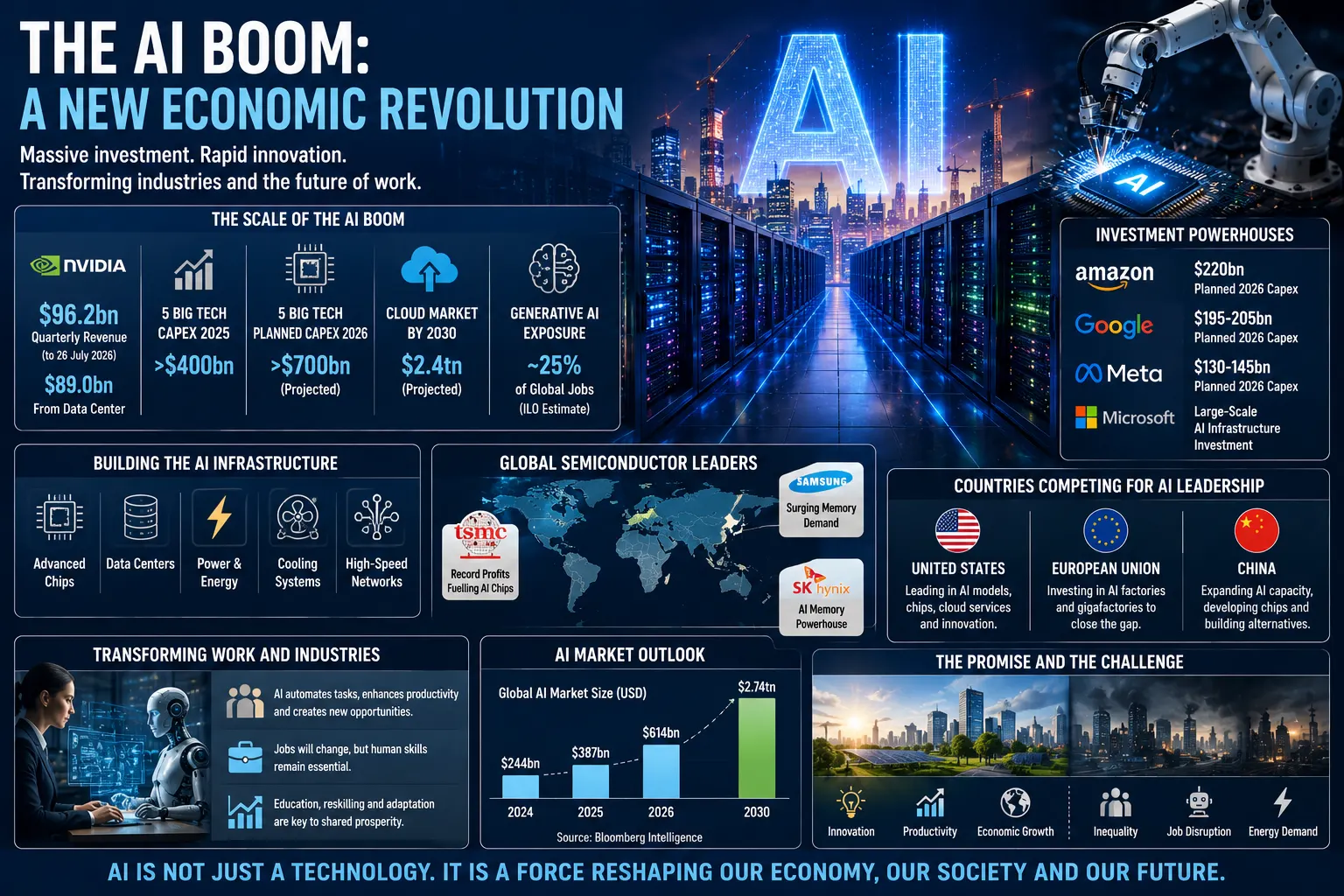
Nvidia generated $96.2 billion of revenue in just three months to 26 July 2026, more than twice the level of a year earlier. Of that total, $89 billion came from data-centre products. The figures illustrate how quickly artificial intelligence has changed from a promising software technology into one of the largest investment cycles in the global economy, directing capital towards semiconductors, electricity grids, cloud computing, construction and companies capable of turning enormous quantities of computing power into useful services.
The scale is no longer confined to Silicon Valley. Taiwan’s TSMC is reporting record profits as it manufactures advanced processors for the AI industry. South Korea’s semiconductor exports are surging as Samsung Electronics and SK Hynix benefit from demand for advanced memory. China is expanding domestic computing capacity and investing heavily in alternatives to restricted Western technology. The European Union is building publicly supported AI factories and preparing much larger gigafactories as it attempts to narrow the computing gap with the United States and China.
At the same time, businesses are beginning to change how work is organised. Generative AI can write software, analyse documents, translate languages, process customer enquiries, create images and automate administrative tasks. The International Labour Organization estimates that roughly one quarter of global employment is in occupations with some exposure to generative AI, but it also concludes that transformation of jobs is currently more likely than complete replacement. That distinction is central to understanding what the AI boom may mean economically.
There are consequently two revolutions taking place at once. The first is an infrastructure revolution involving chips, data centres, power stations, networks and enormous amounts of capital. The second is an organisational revolution in which companies experiment with transferring individual tasks from people to machines. The economic outcome will depend on whether the productivity generated by the second revolution ultimately justifies the extraordinary cost of the first.
The AI Boom Has Become a Physical Investment Boom
The popular image of artificial intelligence is a chatbot running almost invisibly on a smartphone or computer. Behind that interface lies an increasingly industrial system. Advanced models require specialised processors, high-bandwidth memory, networking equipment, storage systems, cooling infrastructure and large quantities of electricity. Training the largest models requires enormous computing clusters, while serving millions of users creates a continuing requirement for inference — the computational process through which trained models generate answers, images, code or decisions.
This physical layer explains why capital expenditure by the world’s largest technology companies has accelerated so dramatically. The International Energy Agency reported in April that capital spending by five large technology companies exceeded $400 billion during 2025 and was expected to increase by a further 75 per cent in 2026. That implies an investment programme measured at more than $700 billion across those companies alone, although not every dollar is exclusively attributable to artificial intelligence.
Individual corporate plans demonstrate the scale. Amazon increased its 2026 capital-expenditure forecast to approximately $220 billion in July after AWS recorded its strongest cloud growth in more than four years. Alphabet raised its expected annual capital expenditure to between $195 billion and $205 billion. Meta expects between $130 billion and $145 billion. Microsoft is also continuing an enormous data-centre build-out as demand for Azure and AI computing expands.
These figures represent more than computer purchases. A hyperscale data centre needs land, substations, transformers, backup systems, cooling plants, fibre connections, security and increasingly dedicated sources of electricity. The investment consequently flows into construction companies, utilities, electrical-equipment manufacturers and industrial suppliers that once had relatively little direct connection to the technology sector.
The Scale of the AI Infrastructure Boom
| Indicator | Latest Figure | Reference |
|---|---|---|
| Nvidia quarterly revenue | $96.2bn | Quarter ended 26 July 2026 |
| Nvidia Data Center revenue | $89.0bn | Same quarter |
| Amazon planned 2026 capex | About $220bn | Updated July 2026 |
| Alphabet planned 2026 capex | $195–205bn | Updated July 2026 |
| Meta planned 2026 capex | $130–145bn | Updated July 2026 |
| AI share of global VC | 61% | 2025 |
Sources: Nvidia, Meta, OECD and Reuters reporting on Amazon and Alphabet.
Nvidia Has Become One of the Main Toll Collectors of the AI Economy
The extraordinary rise of Nvidia illustrates how technological transitions can redistribute economic power before the eventual applications of the technology are fully known. The company spent decades developing graphics processors and the CUDA software ecosystem used to program them. Those processors proved exceptionally well suited to the parallel calculations required by modern neural networks.
As companies began training increasingly large models, demand for Nvidia accelerators moved from a specialist market into the centre of the technology economy. Second-quarter fiscal 2027 Data Center revenue reached $89 billion, an increase of 117 per cent from the equivalent quarter a year earlier. Nvidia expects approximately $108 billion of total revenue in the current quarter and has forecast another substantial expansion in its next fiscal year.
The scale has transformed capital markets as well. Nvidia’s market value exceeded $5 trillion during 2026, placing it among the most valuable companies ever created. Movements in its share price can now influence major stock-market indices in much the same way that changes in the largest banks, oil companies or industrial conglomerates once shaped entire markets.
That concentration also creates risk. A company trading at a valuation of several trillion dollars reflects expectations extending many years into the future. If data-centre investment slows, competing chips become substantially more capable or AI services fail to generate sufficient economic returns, semiconductor valuations can change quickly even when current earnings remain strong.
Nvidia’s position is therefore powerful but not guaranteed. Google designs Tensor Processing Units, Amazon has developed Trainium chips, Microsoft has its own accelerator programmes and AI developers are increasingly exploring custom silicon. AMD is expanding its accelerator business, while Chinese companies are developing alternatives because US export controls have reduced access to the most advanced American processors.
Taiwan Sits at the Most Critical Point in the Supply Chain
Nvidia designs many of the chips driving the AI boom, but it does not manufacture the most advanced silicon itself. That role is dominated by Taiwan Semiconductor Manufacturing Company. TSMC manufactures processors for Nvidia, Apple and many of the world’s most important technology businesses, placing Taiwan at a particularly sensitive point in the global economy.
TSMC reported $40.2 billion in revenue for the second quarter of 2026, an increase of 33.7 per cent from a year earlier. Net income rose 77.4 per cent to NT$706.6 billion. Technologies at seven nanometres and below accounted for 77 per cent of wafer revenue, and the company’s new two-nanometre process had already begun contributing to sales.
Demand associated with AI has become so strong that TSMC raised its expectation for full-year 2026 revenue growth to slightly above 40 per cent in US-dollar terms. Capacity is simultaneously expanding outside Taiwan. Reuters reported on 1 September that TSMC’s planned investment in US semiconductor facilities had increased to approximately $265 billion, while the company is also participating in semiconductor expansion in Europe and Japan.
The diversification has commercial and geopolitical motivations. Customers want additional production capacity, while governments increasingly view advanced semiconductor manufacturing as critical infrastructure. Yet replicating Taiwan’s semiconductor ecosystem is difficult. Leading-edge manufacturing depends on engineers, suppliers, chemicals, packaging expertise and decades of accumulated operational knowledge, meaning geographical diversification will take years even with enormous investment.
Taiwan’s strategic importance consequently remains unusually high. A serious disruption to the island’s semiconductor industry would affect AI companies, consumer electronics, vehicles, industrial equipment and defence production simultaneously. AI therefore adds another layer to the wider geopolitical significance of stability across the Taiwan Strait.
South Korea Is Benefiting From the Memory Bottleneck
Artificial-intelligence systems need more than processing chips. They require enormous quantities of memory capable of moving data rapidly between processors. High-bandwidth memory, commonly known as HBM, has consequently become one of the most strategically important products in the semiconductor industry.
South Korea’s SK Hynix emerged as a major supplier of advanced HBM used with Nvidia accelerators, while Samsung Electronics has invested heavily to compete in the same market. SK Hynix reported a more than sixfold increase in second-quarter operating profit during 2026 as AI-related memory demand and higher semiconductor prices drove earnings to record levels.
Samsung also reported record quarterly results during the same period. Its semiconductor division benefited heavily from the memory upcycle as AI infrastructure absorbed increasing quantities of DRAM and other components. Competition for memory has become sufficiently strong to influence prices for ordinary computers and electronic devices as manufacturers compete with data centres for available supply.
The wider South Korean economy is now experiencing the effect. Official trade data released on 1 September showed exports increasing 68.7 per cent from a year earlier in August, extending a powerful technology-led expansion. Semiconductor demand has helped the manufacturing sector offset weakness in other parts of the global economy.
That dependence also illustrates the cyclical danger. Semiconductor booms have historically been followed by periods of oversupply. If manufacturers expand capacity on the assumption that present growth continues indefinitely, a future slowdown in AI investment could eventually produce falling prices and excess factories. The current shortage therefore creates both exceptional profits and incentives capable of generating the next supply cycle.
AI Is Supporting Manufacturing Across Asia
The effects extend well beyond the largest chipmakers. Manufacturing surveys released on 1 September showed expansion across several Asian technology economies during August. Taiwan’s purchasing managers’ index remained firmly in expansionary territory, South Korean manufacturing expanded for a ninth consecutive month and Japan recorded its strongest new-business growth in years.
Demand for semiconductors, servers, networking equipment and electronic components has helped counter pressures from high energy prices and geopolitical uncertainty. Malaysia and other Southeast Asian manufacturing centres also participate in semiconductor assembly, testing and electronics supply chains, giving them indirect exposure to the AI investment cycle.
This is important because artificial intelligence is sometimes described mainly as a threat to employment. At the infrastructure stage, however, it is simultaneously creating demand for manufacturing workers, engineers, construction contractors, power equipment and logistics. The distribution of those opportunities differs greatly from the occupations exposed to software automation.
A clerical worker in London may encounter AI as software capable of performing part of an office job. A semiconductor engineer in Taiwan may experience the same technology as extraordinary demand for manufacturing capacity. An electrician in Texas may encounter it through the construction of a data centre. A South Korean memory-chip worker may see it through export orders and higher industry profits. The labour-market effect therefore depends heavily on where a worker sits inside the economic system.
China Is Building a Parallel AI Infrastructure System
China represents the largest strategic challenge to American dominance because it combines a vast domestic market, extensive manufacturing capacity, large technology companies and government willingness to support long-term industrial development. US restrictions on advanced chips and semiconductor-manufacturing equipment have made domestic technological independence an increasingly explicit objective.
China’s Ministry of Industry and Information Technology reported that national intelligent-computing capacity had reached approximately 2,185 EFLOPS by the end of June 2026, with computing facilities operating at an overall utilisation rate of 71.4 per cent. Beijing’s 15th Five-Year Plan calls for an integrated national computing network, larger intelligent-computing clusters and broader implementation of the country’s “AI Plus” programme across industry and public services.
The geographical structure is deliberate. Much of China’s AI development and commercial demand is concentrated in eastern cities, while several major computing hubs are being established in western regions with more abundant land and renewable electricity. The objective is to move computational workloads towards areas where energy is cheaper while connecting users through high-speed national networks.
China is also investing aggressively in semiconductor independence. Huawei spent 121.38 billion yuan on research and development during the first half of 2026, an increase of more than 25 per cent from a year earlier. Its investment covers AI, semiconductors, devices and automotive technologies as the company attempts to reduce reliance on foreign systems restricted by US sanctions.
Chinese memory manufacturer CXMT has reportedly begun small-scale production of advanced high-bandwidth memory, a development that would be strategically important if it can be expanded commercially. Alibaba, Huawei and other Chinese groups are also developing AI accelerators, while domestic model developers are increasingly designing systems capable of running efficiently on Chinese hardware.
The immediate performance gap with the most advanced US-led ecosystem remains significant in important areas, particularly access to leading semiconductor-manufacturing equipment. But export restrictions have also increased the economic incentive to overcome that gap. Technology denied today can become the target of enormous domestic investment tomorrow.
The US-China AI Contest Is About More Than Which Country Builds the Best Model
The competition increasingly covers an entire technology stack: semiconductor design, manufacturing equipment, memory, cloud infrastructure, electricity, models, software tools and international standards. The United States retains powerful positions across several layers. Nvidia dominates advanced AI accelerators, American cloud platforms operate globally and US companies remain prominent among leading model developers.
Washington’s strategy combines promotion and restriction. America’s AI Action Plan calls for faster domestic infrastructure construction and international exports of US-origin AI technology while strengthening enforcement of controls intended to prevent strategic adversaries from obtaining the most advanced computing equipment.
China is pursuing almost the mirror image: expanding domestic computing resources, promoting Chinese models internationally, supporting indigenous semiconductor development and reducing dependence on American technology. The country’s 2026 AI cooperation plan calls for broader access to data and computing power, international model ecosystems and coordination on AI standards and governance.
This does not amount to complete technological separation. Chinese developers continue seeking access to Western cloud platforms, American companies remain interested in the Chinese market and semiconductor supply chains cross national boundaries repeatedly. But the direction is increasingly towards two partially overlapping technology systems whose most strategically advanced components may become less interchangeable.
The consequences extend to third countries. Governments deciding whether to build national AI infrastructure may increasingly face choices involving American or Chinese chips, cloud platforms, models and cybersecurity standards. Economic influence can therefore spread through the technical architecture countries adopt, much as telecommunications standards became geopolitical instruments during earlier technology cycles.
Europe Is Trying to Create a Third Centre of AI Power
The European Union starts from a different position. Europe has world-class universities, industrial companies and semiconductor-equipment manufacturers, particularly ASML, but it has fewer hyperscale cloud companies and frontier-model developers than the United States and less concentrated computing capacity than either the US or China.
Brussels has consequently made access to computing infrastructure a strategic objective. Nineteen AI Factories are being developed around Europe’s supercomputing network, with additional satellite facilities providing regional access. The programme is intended particularly for start-ups, small and medium-sized businesses, researchers and industrial companies that cannot independently finance enormous AI clusters.
In July 2026 the EU launched a tender for up to seven larger AI Gigafactories. The programme is backed by as much as €10 billion in EU and national public funding and is expected to attract at least €20 billion in additional private investment. Each gigafactory is intended to use more than 100,000 advanced AI processors and provide infrastructure capable of training and deploying much larger models.
A separate €387.8 million contract announced at the end of August will provide the LUMI-AI supercomputer in Finland. The project forms part of a wider EuroHPC programme through which Europe is attempting to expand computing capacity without requiring every company to depend entirely on non-European commercial cloud providers.
The approach reflects a broader European strategy: compete through infrastructure and industrial adoption while regulating how AI is used. Whether this produces globally competitive companies will depend not merely on government expenditure but on how quickly European businesses incorporate AI into productivity-enhancing applications.
Europe’s AI Adoption Is Growing but Remains Uneven
The latest comprehensive Eurostat data show that 20 per cent of EU businesses with at least ten employees used some form of artificial intelligence during 2025, up from 13.5 per cent in 2024. Adoption was much higher among large companies, at approximately 55 per cent, than among small and medium-sized businesses, where the share was about 19 per cent.
Differences between countries are substantial. Denmark reported adoption among approximately 42 per cent of qualifying businesses, Finland around 38 per cent and Sweden approximately 35 per cent. Romania was near 5 per cent, while Poland and Bulgaria remained below 10 per cent.
These differences matter economically because the gains from AI are likely to depend partly on how rapidly ordinary firms use it rather than on whether a country produces a frontier model. A logistics company reducing empty journeys, a manufacturer detecting equipment failures earlier or an accountancy practice automating routine document processing can generate economic value without developing new AI technology itself.
The danger for slower-adopting economies is therefore not simply technological dependence. It is a productivity gap between companies that redesign workflows around AI and those that continue operating largely as before. The same divide can emerge between large corporations capable of hiring specialist teams and smaller businesses that lack technical skills, data or capital.
Different Centres of the Global AI Economy
| Region | Core Strength | Strategic Challenge |
|---|---|---|
| United States | Models, cloud platforms and AI-chip design | Power, infrastructure costs and market concentration |
| China | Scale, manufacturing and domestic AI ecosystem | Restricted access to leading-edge chip technology |
| Taiwan | Advanced semiconductor manufacturing | Geographic concentration and geopolitical risk |
| South Korea | Advanced memory and semiconductor production | Exposure to chip cycles |
| European Union | Industrial base, research and semiconductor equipment | Smaller hyperscale computing ecosystem |
Ireland Newspaper analysis based on corporate, government, OECD, Eurostat and international technology data.
The Electricity System Is Becoming Part of the AI Supply Chain
A shortage of processors was the defining physical constraint during the first phase of the AI boom. Electricity and grid connections are increasingly becoming the next one. Data centres can be constructed more quickly than major transmission lines or power stations, creating a mismatch between the speed of digital investment and the speed of the energy system.
The IEA estimates that data centres consumed approximately 485 terawatt-hours of electricity worldwide during 2025. Its updated 2026 analysis projects consumption roughly doubling to around 950 TWh by 2030. AI-focused data-centre electricity consumption is expected to grow significantly faster, approximately tripling during the same period.
Globally, data centres would still account for only around 3 per cent of electricity demand in 2030 under the IEA’s central projection. The local effect can be far larger. Data centres are geographically concentrated, meaning a cluster of facilities can place enormous pressure on one regional grid even when the global share appears modest.
The United States is the most visible example. The IEA expects data centres to account for almost half of US electricity-demand growth through 2030. Utilities are already reporting shortages and longer delivery times for transformers, circuit breakers and other electrical equipment. Reuters reported in July that delivery times for some high-voltage transformers had stretched towards three years.
Power availability is consequently influencing where data centres are constructed. Technology companies are signing long-term electricity agreements, exploring dedicated gas generation, investing in renewables and negotiating nuclear-energy arrangements. Locations that can provide large quantities of reliable power may acquire a new competitive advantage even if they were previously peripheral to the technology industry.
This links AI policy directly to energy policy. A government can subsidise semiconductor factories and encourage model developers, but expansion eventually slows if the electricity grid cannot connect new computing facilities. AI infrastructure therefore depends on planning laws, transmission networks, power equipment and generation capacity as much as on software engineers.
The Growing Electricity Requirement
| Measure | 2025 | 2030 Projection |
|---|---|---|
| Global data-centre electricity use | About 485 TWh | About 950 TWh |
| Share of global electricity demand | About 1.5% | About 3% |
| AI-focused data-centre demand | Base year | Roughly triples |
Source: International Energy Agency, Key Questions on Energy and AI, April 2026. Projections are scenario-based rather than guaranteed outcomes.
The AI Boom Is Also Reshaping Energy Companies
Industrial companies far removed from conventional software are repositioning themselves around data-centre demand. On 31 August, oilfield-services company SLB announced a $4.1 billion agreement to acquire cooling-equipment manufacturer Kelvion as part of its expansion into data-centre infrastructure. The transaction illustrates how AI investment is drawing capital from established industrial sectors into power and cooling technologies.
Utilities, turbine manufacturers and electrical-equipment companies have experienced similar demand. Data centres require exceptionally reliable electricity, making backup generation and grid stability commercially valuable. Renewable power can provide large amounts of energy economically, but variable production often requires batteries, grids or dispatchable generation to provide continuous supply.
Nuclear power has consequently returned to technology-sector discussions. Large companies have explored electricity contracts with existing nuclear plants as well as future small modular reactors. Natural gas is also likely to contribute substantially because new gas-fired generation can provide controllable power where grids cannot expand quickly enough.
The environmental consequences are not simple. More efficient chips reduce the electricity needed for each individual computation, but lower computational cost can encourage companies to perform far more computation. This rebound effect means technological efficiency can coexist with rising total electricity demand.
AI may simultaneously improve the energy system itself. Grid operators can use machine learning to forecast electricity demand, predict renewable production and identify equipment failures. Industrial operators can optimise processes and reduce energy consumption. The net environmental effect therefore depends on whether efficiency gains generated by AI eventually outweigh the additional resources consumed by the computing infrastructure.
The Capital Market Is Funding an Investment Cycle of Historic Scale
Early AI infrastructure expansion could largely be financed from the enormous cash flows of technology companies. That is changing as project sizes continue to grow. Data-centre developers increasingly rely on debt, leases, private credit and long-term commitments from technology companies to finance construction.
A Reuters analysis in August found that Microsoft, Meta, Oracle, Amazon and Alphabet had disclosed approximately $1.09 trillion in future lease commitments for facilities that had not yet commenced. These commitments do not appear in exactly the same way as ordinary debt until relevant accounting conditions are met, but they represent substantial future financial obligations.
AI-related companies are also issuing unprecedented quantities of bonds and equity. This creates a bridge between technological expectations and the broader financial system. Banks, pension funds, private-credit firms and bond investors increasingly hold exposure to the assumption that future demand for computing will remain strong enough to support today’s construction.
The scale does not automatically imply a bubble. Cloud revenue is expanding rapidly: Amazon’s AWS revenue increased 37 per cent from a year earlier in the second quarter, while Microsoft reported 43 per cent Azure growth. Nvidia’s revenue is already demonstrating extraordinary demand for infrastructure.
The financial question is whether this growth ultimately produces returns across the entire investment chain. A chip manufacturer can earn exceptional profits while a data-centre developer earns much less. A cloud company can experience strong demand while a model developer spends most of its revenue on computing. The profitability of the AI ecosystem therefore cannot be measured solely through the success of its strongest companies.
Private Capital Is Becoming Increasingly Concentrated Around AI
The concentration is even more striking in venture capital. OECD analysis published in February found that AI companies received $258.7 billion of venture investment during 2025, representing 61 per cent of total global venture-capital funding. AI’s share had roughly doubled from 30 per cent in 2022.
Infrastructure and hosting businesses received especially large flows. That reflects a fundamental change from earlier software booms, when a small company could build a global internet product with relatively modest physical investment. Frontier AI requires access to computing infrastructure that can cost billions of dollars.
US investors remain dominant. The OECD calculated that American investors accounted for approximately 56 per cent of global outgoing AI venture investment in 2025, compared with 9 per cent for the United Kingdom, 8 per cent for China and 7 per cent for investors in the EU27.
World Bank analysis shows an even broader concentration. High-income economies account for the overwhelming majority of prominent AI models, start-ups and venture finance even though they contain a much smaller share of the world’s population. This creates the possibility that productivity benefits spread globally while ownership of the underlying companies remains highly concentrated.
The economic distinction matters. A business in Africa or Latin America can become more productive by using an American or Chinese AI service without owning any part of the technology. Consumers may benefit, but much of the profit can still flow to the countries hosting the models, data centres and intellectual property.
61% of global venture-capital investment in 2025 went to AI companies.
OECD analysis recorded $258.7 billion of AI venture investment out of $427.1 billion globally.
Stock Markets Are Becoming More Dependent on the AI Story
AI investment has also changed the structure of public markets. Reuters calculated in June that technology companies accounted for more than 39 per cent of the S&P 500’s total market capitalisation, higher than during the peak of the dot-com boom. Much of that concentration reflects companies directly or indirectly benefiting from artificial intelligence.
Concentration is not in itself evidence of irrational valuation. Today’s largest technology businesses generally produce enormous revenue and cash flow, unlike many speculative internet companies of the late 1990s. Nvidia’s latest quarterly net income alone approached $60 billion under US accounting standards.
But index concentration changes risk. Millions of retirement accounts and passive investment funds automatically hold larger positions in companies whose market values increase. A correction in a handful of technology shares can consequently affect investors who never consciously decided to make a concentrated bet on artificial intelligence.
Expectations are also exceptionally demanding. A company can report record profits and still suffer a sharp share-price fall if growth is slightly below what investors expected. SK Hynix demonstrated this in July when its operating profit increased more than sixfold but the shares fell because the result did not fully meet highly optimistic market forecasts.
The AI boom therefore produces a paradox familiar from previous technological revolutions: the technology can genuinely transform the economy while investors simultaneously pay too much for some companies participating in it. The long-term importance of railways, telecommunications and the internet did not prevent periods of financial speculation around each technology.
The Question of Jobs Is More Complicated Than a Simple Automation Percentage
The most extensive global assessment from the ILO estimates that approximately one in four workers is employed in an occupation with some degree of exposure to generative AI. Only about 3.3 per cent of global employment falls into its highest exposure category. Exposure is considerably greater in wealthy economies because more workers perform office-based tasks that can be digitised.
In high-income countries, around 34 per cent of employment has some generative-AI exposure, compared with approximately 11 per cent in low-income countries. Clerical occupations remain the most exposed, including data-entry work, administrative support and bookkeeping. Exposure is also increasing in highly digitised professional occupations such as software development, financial analysis and media production.
These figures measure technical exposure rather than predicted unemployment. An occupation can contain many tasks, only some of which can be automated. An accountant may use AI to classify transactions or draft reports while remaining responsible for judgement, client communication, compliance and legal accountability.
This is why the ILO says job transformation is currently more likely than complete replacement. The critical unit of analysis is frequently the task rather than the job. AI can eliminate enough tasks to reduce the number of people required in one department without eliminating the occupation altogether.
That distinction also explains why technological adoption may initially appear as slower hiring rather than mass redundancies. A company can maintain an existing workforce while using AI to handle growth that would previously have required additional employees. Employment effects can therefore accumulate gradually even without dramatic announcements of workers being replaced by machines.
Generative AI Exposure to Employment
| Measure | Share | Interpretation |
|---|---|---|
| Global jobs with some exposure | About 25% | At least some tasks potentially affected |
| Highest exposure category | 3.3% | Large share of tasks potentially automatable |
| Exposure in high-income economies | 34% | More digital and clerical work |
| Exposure in low-income economies | 11% | More physical and informal occupations |
Source: International Labour Organization and NASK, Generative AI and Jobs, 2025. Exposure represents technological potential, not a forecast of job losses.
Women and Office Workers May Face Greater Exposure in Rich Economies
The distribution of employment matters as much as the global average. The ILO found that women are more heavily represented than men in the most exposed occupations, particularly in high-income countries. Around 9.6 per cent of female employment in wealthy economies fell into the highest exposure category, compared with 3.5 per cent of male employment.
This largely reflects occupational composition rather than any difference in the technology itself. Women are more heavily represented in administrative and clerical roles in many economies, while men remain more heavily concentrated in construction, transport and other physical occupations that current generative AI cannot directly perform.
The gap may change as robotics develops. Generative AI primarily affects information work because language, images and computer code can be processed digitally. Combining AI with increasingly capable robots could eventually bring more physical occupations into the automation debate, but progress remains uneven and substantially more difficult than generating text on a computer screen.
Healthcare, education, construction, care work, agriculture and many skilled trades also contain physical, interpersonal and responsibility-heavy tasks that are difficult to automate completely. AI may change how workers perform those jobs without removing the underlying demand for people.
Evidence of Productivity Gains Is Beginning to Accumulate
Automation risk is only half of the employment equation. AI can make a worker more productive, allowing the same person to produce more output in a given period. If productivity gains increase company revenue or reduce prices sufficiently, they can create additional demand and potentially generate new employment elsewhere.
A European Commission survey conducted in early 2026 found that roughly one quarter of Europeans were using AI in their jobs. Among workplace users, 91 per cent said AI helped them complete tasks more quickly. Employed users estimated average time savings of approximately 7.4 hours per month, equivalent to around 4.6 per cent of a standard 160-hour working month.
These are self-reported perceptions rather than measured economy-wide productivity statistics. Controlled studies cited in IMF research have nevertheless found significant gains in particular tasks. Customer-service experiments have reported improvements of around 15 per cent, with larger gains among less experienced workers, while experiments involving writing and knowledge tasks have found larger time reductions in some settings.
Such findings cannot simply be extrapolated to an entire economy. A faster employee does not automatically produce proportionately higher national output. Demand may be limited, errors may need human correction and time saved on one task can be absorbed by meetings or other work. Organisational redesign often determines whether technical efficiency actually becomes economic productivity.
This implementation problem may ultimately distinguish successful companies from unsuccessful adopters. Simply purchasing an AI subscription changes little. Redesigning workflows so that machines perform repetitive work while people concentrate on judgement, customer relationships and complex decisions can create much larger gains.
Meta’s Experience Shows Why Replacing Workers Is Harder Than a Demonstration Suggests
A highly publicised experiment inside Meta provides a useful warning against assuming that technical capability automatically translates into organisational replacement. Reuters reported in August that the company had developed an internal programme intended to reorganise teams around AI agents and dramatically reduce the number of employees needed for some functions.
Meta ultimately scaled back the plan after internal productivity problems, security concerns and employee resistance. The company proceeded with a workforce reduction of around 10 per cent during May but cancelled plans for a further broad round of cuts later in the year, according to Reuters.
The episode does not prove that AI cannot reduce employment. Meta continues investing heavily in automation and AI infrastructure. It demonstrates instead that replacing individual tasks is much easier than replacing the organisational knowledge, coordination and accountability provided by entire teams.
AI systems can generate software code, but someone must decide what should be built, integrate systems, investigate unexpected failures and accept responsibility when something goes wrong. The more complex the organisation, the more difficult it can be to convert theoretical automation potential directly into headcount reduction.
For workers, that may mean the immediate transition is less dramatic but more continuous. Job descriptions change, teams become smaller, productivity expectations rise and entry-level positions may become harder to obtain because some of the routine work traditionally performed by junior employees can now be automated.
The Entry-Level Problem Could Become One of AI’s Most Important Labour Effects
Many professional careers have traditionally worked like ladders. Junior accountants reconcile straightforward records before handling complex clients. New software developers fix simple bugs before designing systems. Young lawyers review documents before managing cases. Entry-level work is often repetitive precisely because it serves as training.
Those are also the tasks modern AI systems can perform increasingly well. Companies therefore face an economic incentive to automate work that previously allowed inexperienced employees to develop expertise. In the short term this can increase productivity; in the longer term it may create problems in developing the next generation of senior workers.
Businesses may need to redesign training deliberately rather than expecting skills to emerge through years of routine work. Apprenticeship-style structures, supervised AI use and greater emphasis on judgement could become more important. Universities and vocational schools may similarly need to move away from assignments that primarily test tasks machines can already perform cheaply.
The risk is not simply fewer jobs. It is a change in the route through which people become qualified for the jobs that remain. Labour-market statistics focused only on total employment may initially miss this structural change.
AI Will Also Create Occupations That Are Difficult to Predict Today
Previous technologies repeatedly produced jobs that were difficult to imagine at the beginning of the transition. The commercial internet created search-engine optimisation, social-media management, cloud architecture and app development. Electrification transformed engineering and manufacturing while creating entirely new industries.
AI is already increasing demand for machine-learning engineers, chip designers, data-centre technicians, electrical engineers, cybersecurity specialists and people capable of integrating AI into specific industries. Human oversight, model evaluation, data governance and AI security are becoming professional functions in their own right.
The World Economic Forum’s Future of Jobs survey projects substantial job creation through 2030, although its figures cover artificial intelligence alongside demographic change, the green transition and other macroeconomic trends rather than AI alone. Employers surveyed expect fast growth in AI, data and technology occupations while continuing to anticipate large increases in care, education, construction and frontline roles.
This combination matters. The future economy is unlikely to consist only of people designing algorithms. Ageing populations continue to increase demand for healthcare and care workers, infrastructure requires construction labour and physical services remain difficult to digitise. AI can therefore transform the composition of employment without making human work economically unnecessary.
AI exposure is not the same as job elimination. Current evidence points towards a combination of task automation, higher productivity, smaller teams in some occupations and new demand elsewhere. The distribution of gains and losses is likely to matter more politically than the global net employment number.
Developing Economies Face a Different AI Risk
At first glance, lower-income countries appear relatively protected because fewer workers perform occupations highly exposed to generative AI. The ILO-World Bank analysis published in March 2026 shows why that conclusion is incomplete. Developing economies may experience disruption without receiving the same productivity benefits if workers and businesses lack reliable electricity, broadband, computing access or digital skills.
Some service-export economies face particular exposure. Business-process outsourcing, transcription, basic software work and remote administrative services became important development paths because companies in richer countries could send digital tasks abroad. AI can automate some of those same tasks directly.
At the same time, the technology creates opportunities. The World Bank reported that more than 40 per cent of ChatGPT traffic during mid-2025 originated in middle-income countries, led by countries including Brazil, India, Indonesia and Vietnam. One in five advertised jobs requiring generative-AI skills was already located in middle-income economies.
The critical factor is therefore whether countries become users and producers rather than merely markets. Access to inexpensive models can allow small businesses to obtain translation, programming, marketing and analytical capabilities previously available mainly to larger companies. AI may lower some barriers to participating in international markets even while increasing dependence on foreign infrastructure.
Countries with weak digital infrastructure could fall farther behind. If productivity rises rapidly in AI-intensive economies but slowly elsewhere, differences in income between countries can widen even without factories physically relocating.
AI Could Change the Geography of Economic Development
Traditional industrial development often depended on inexpensive labour. Countries became manufacturing centres by offering workers at lower cost and gradually moving towards more technologically sophisticated production. Artificial intelligence and robotics could reduce the labour-cost advantage that supported this development model.
If automated factories require fewer workers, companies may place greater emphasis on electricity prices, political stability, access to chips, engineering skills and proximity to customers. Manufacturing could become more geographically concentrated in countries capable of providing the complete technological infrastructure.
But lower labour costs will not become irrelevant overnight. Robotics remains expensive and imperfect, particularly for tasks requiring flexible physical manipulation. Many products continue to require large workforces, while services such as tourism, care and construction remain fundamentally local.
The more immediate geographical shift may occur in digital services. A small firm in an emerging economy can use AI to compete internationally without employing a large professional staff. A programmer can manage more complex projects, and a local company can translate marketing materials into many languages almost instantly. The same technology threatening some outsourced work can therefore create opportunities for entirely new exporters.
Regulation Is Beginning to Divide the World’s AI Markets
Governments broadly agree that artificial intelligence is economically important, but they differ substantially over how it should be regulated. The European Union has created the world’s most extensive horizontal AI regulatory regime. The United States currently emphasises faster development and lighter federal restrictions, while China combines industrial promotion with extensive state governance over models, data and online services.
The majority of immediately applicable EU AI Act provisions entered into force or became enforceable on 2 August 2026. Transparency requirements now apply to certain AI systems, including obligations concerning interactions with AI and synthetic content. General-purpose AI obligations and bans on selected practices are also subject to enforcement.
The full system has not yet arrived. Rules covering many stand-alone high-risk applications are scheduled to become applicable in December 2027, while high-risk AI embedded inside regulated products follows in August 2028 under the amended timetable.
Europe’s model attempts to distinguish between levels of risk rather than regulate every AI application identically. Supporters argue that common standards can increase trust and provide legal certainty across the single market. Critics warn that compliance costs can become particularly difficult for smaller companies competing against large American and Chinese firms.
The United States has adopted a different philosophy under the Trump administration, emphasising infrastructure expansion, private-sector innovation and exports of American AI systems while using national-security controls around advanced chips and sensitive technology. The administration is also pressing internationally for a lighter regulatory approach to AI.
These different regimes can affect where companies develop products. A global business may ultimately need different versions of an AI system for European, American and Chinese markets, increasing compliance costs and further encouraging regional technology ecosystems.
AI Is Becoming an Instrument of National Power
The economic competition has acquired a national-security dimension because advanced AI can be used in intelligence analysis, cyber operations, autonomous systems, logistics and military planning. Governments therefore treat control of advanced computing as more than an ordinary commercial issue.
The United States restricts exports of some advanced semiconductor technology to China while simultaneously encouraging allies to adopt American technology stacks. Washington’s 2025 AI Action Plan explicitly describes advanced computing as relevant to both economic dynamism and military capability.
China’s response is to accelerate domestic alternatives. Huawei, Alibaba and semiconductor companies are investing heavily in processors and software capable of replacing restricted foreign products. Even if those alternatives initially perform less efficiently, a sufficiently large protected domestic market can support further development.
Europe’s concept of technological sovereignty has similar origins, although its policies are less focused on direct military rivalry. Brussels does not want European companies, governments and researchers to depend entirely on computing infrastructure controlled elsewhere.
The result is that computing capacity itself is becoming comparable with other strategic resources. Countries once measured industrial power through steel production, energy reserves and manufacturing capacity. Access to advanced processors, data centres and AI talent increasingly joins that list.
The Most Powerful Companies May Control Several Layers at Once
One reason the AI transition raises competition concerns is vertical integration. Amazon operates AWS, designs AI chips and provides models and applications. Google operates cloud infrastructure, designs TPUs, develops Gemini models and controls products through which billions of people encounter AI. Microsoft combines Azure infrastructure with productivity software and major AI investments.
Nvidia is expanding beyond processors into networking, software, cloud partnerships and financing relationships throughout the AI ecosystem. Its investment in Taiwan’s MediaTek, announced on 31 August, represents another connection between the leading accelerator supplier and companies building customised processors and AI-enabled devices.
These relationships can accelerate innovation because technologies are designed to work together. They can also increase switching costs. A company building its software around one cloud provider’s chips, APIs and models may find migration expensive even if a competitor later offers a cheaper service.
Competition policy will therefore increasingly focus not only on conventional acquisitions but on partnerships, investments, cloud agreements and access to computing infrastructure. Economic power can be exercised by controlling the platform on which competitors themselves depend.
The Cost of Training Models May Not Remain the Main Barrier Forever
The first generation of the generative-AI race placed enormous emphasis on training increasingly large models. The next stage is shifting towards inference and agents that perform continuing tasks for users. This changes the economics because a model may be trained occasionally but used billions of times.
Inference therefore creates recurring demand for processors and electricity. If AI agents become embedded in office software, customer-service systems, industrial control and personal devices, total computation can increase dramatically even if individual models become more efficient.
At the same time, competition is reducing the cost of intelligence. Open-source models, smaller specialised systems and improvements in semiconductor efficiency allow more applications to run using less expensive hardware. Chinese developers have placed particular emphasis on efficiency because advanced US chips are harder to obtain.
This creates another potential economic reversal. If the cost of using capable AI falls rapidly enough, value may gradually move away from model developers towards companies applying AI to specific industries. The infrastructure layer could remain enormous while the model itself increasingly resembles a commodity.
Under that outcome, the strongest long-term businesses may not necessarily be the companies currently attracting the greatest attention. Healthcare, manufacturing, finance, logistics and scientific companies that use AI to improve real-world operations could capture a substantial share of the eventual productivity dividend.
The AI Boom Could Lift Productivity — but the Timing Is Uncertain
The optimistic macroeconomic case rests on productivity. Advanced economies have experienced comparatively modest productivity growth for much of the period since the global financial crisis. If AI allows workers and businesses to produce substantially more output without proportional increases in labour and capital, long-term economic growth could accelerate.
IMF officials have argued that artificial intelligence could materially increase global productivity if adoption becomes widespread. The potential is especially important for ageing economies where slower labour-force growth otherwise places downward pressure on economic expansion.
Evidence at company and task level is encouraging but not yet sufficient to establish the eventual macroeconomic effect. Technologies often require complementary investment before they appear clearly in national productivity statistics. Electricity existed for decades before factories were redesigned around electric motors. Computers spread through offices before their full productivity contribution became obvious.
AI may follow a similar pattern. Companies first purchase tools, then experiment, reorganise processes and eventually build new products impossible under the previous system. The transition can therefore involve years of spending before economy-wide productivity data conclusively justify the investment.
This lag is particularly important for financial markets. Investors are funding infrastructure today based on earnings expected many years into the future. The technology can succeed eventually while some current investments still earn poor returns because too much capacity was built too early or in the wrong locations.
The Biggest Financial Risk Is a Gap Between Investment and Revenue
The central financial question is increasingly straightforward: who will ultimately pay enough for AI services to support trillions of dollars of infrastructure? Current revenue growth is substantial, but future investment commitments are larger still.
Anthropic provides one striking example of the scale being contemplated. Reuters reported on 31 August that the company had reached a $35 billion cloud-computing agreement with Nvidia-backed Lambda for capacity associated with a planned 350-megawatt Texas data centre. Days earlier, Reuters reported a separate $45 billion computing agreement involving Nscale in West Virginia. The companies involved have not publicly confirmed every detail reported by the news agency, so these commitments should be treated as reported commercial arrangements rather than independently audited expenditure.
Such deals demonstrate why AI developers need enormous future revenue. Renting advanced processors at this scale creates financial obligations long before the end markets for every AI application are established.
If companies successfully automate valuable work, the economic market can be enormous. Businesses spend trillions of dollars on wages for information processing, administration, coding, analysis and customer service. Capturing even a modest fraction of that expenditure through AI software could justify very large revenues.
The alternative is that competitive pricing pushes the cost of AI services downward faster than usage expands. Model developers could then generate extraordinary volumes of computation without earning sufficient margins to pay for the infrastructure supporting it. The eventual winners would be chipmakers, power providers or consumers rather than the companies operating the models.
A Correction Would Not Mean the Technology Had Failed
Financial history repeatedly separates technological adoption from investment returns. Railway companies transformed nineteenth-century economies even though many investors lost money. Fibre-optic networks built during the dot-com boom remained useful after telecommunications companies collapsed. Internet usage continued expanding after technology shares crashed in 2000.
The same distinction may eventually apply to AI. A period of overinvestment could produce excess data-centre capacity and falling computing prices. That would damage investors in poorly financed projects but could make AI significantly cheaper for ordinary businesses, accelerating adoption.
Infrastructure left behind after an investment correction does not disappear. Servers have finite technological lives, but substations, fibre networks, data-centre buildings and power connections remain valuable. A financial correction could therefore redistribute economic value rather than reverse technological progress.
This is one reason current comparisons with the dot-com era need nuance. AI companies already generate substantial revenue and the underlying applications are real. The relevant question is not whether artificial intelligence exists, but whether current valuations correctly anticipate who will capture its future profits.
The Labour Transition Could Widen Inequality Before Productivity Benefits Spread
Technology rarely affects every worker simultaneously. Employees able to use AI effectively may become more productive and command higher wages, while people performing easily automated tasks can face reduced demand. Companies that own valuable AI infrastructure can benefit more rapidly than households that encounter the technology mainly through employment disruption.
That can widen income inequality even if total national output rises. Productivity growth and unequal distribution are not mutually exclusive. A country can become wealthier while particular occupations, regions or age groups experience significant losses.
Education and retraining therefore influence the political sustainability of the transition. Teaching every worker to become an AI engineer would be unrealistic and unnecessary. More important may be helping people use AI inside existing professions and developing complementary skills machines perform poorly: judgement, responsibility, negotiation, physical dexterity and interpersonal trust.
Social protection also matters because reskilling takes time. A worker displaced at 55 cannot necessarily begin a new technology career simply because the economy eventually creates more jobs overall. Transition policies must therefore consider individual timing as well as aggregate employment.
The distributional question may become especially important if capital captures a larger proportion of economic output. AI systems represent accumulated intellectual property and physical capital capable of performing tasks previously supplied by labour. Without broad ownership or mechanisms through which productivity gains reach wages and prices, the technology could increase the share of income flowing towards owners of capital.
AI Could Also Strengthen Small Businesses
The same technology capable of increasing corporate concentration can reduce the minimum scale required to operate a business. A small company can use AI for translation, software development, customer support, market research, accounting preparation and advertising without hiring specialised employees for every function.
This can be particularly powerful for entrepreneurs. One person can perform work that previously required a small team, allowing new businesses to test ideas with less capital. A manufacturer can analyse technical documents, an exporter can communicate with customers in several languages and a local retailer can create marketing material almost instantly.
Lower entry costs could consequently increase business formation and competition even as the underlying AI infrastructure becomes concentrated among a few large providers. Whether the decentralising or concentrating force dominates will depend partly on pricing and interoperability.
If advanced AI remains inexpensive and companies can switch easily between providers, small businesses may gain disproportionately. If access becomes expensive or tied to proprietary platforms, the largest corporations can reinforce their existing advantages.
By 2030, Electricity and Skills May Be Bigger Constraints Than Algorithms
The next stage of the AI race may therefore be defined less by whether models become more capable and more by whether economies can deploy them. Chips, electricity, data-centre connections and trained workers all require physical or organisational investment that cannot scale as quickly as software.
The IEA’s projection of roughly 950 TWh of global data-centre electricity consumption by 2030 already assumes infrastructure bottlenecks constrain some potential growth. Its analysis warns that even larger demand is possible if power equipment and semiconductor supply expand more rapidly than expected.
Companies also report shortages of specialised workers. Semiconductor fabrication requires highly trained engineers. Data centres need electricians, network specialists and cooling expertise. Power grids need construction crews, while AI adoption inside companies requires managers who understand both technology and the business process being changed.
The infrastructure boom may consequently increase demand for traditional engineering and skilled trades even as software automates sections of white-collar work. This reversal challenges the assumption that technological disruption necessarily falls most heavily on manual occupations.
By 2035, AI Could Follow Several Very Different Economic Paths
The first plausible scenario is broad productivity diffusion. Computing becomes cheaper, reliable AI agents are integrated across business processes and productivity gains spread from technology companies into manufacturing, healthcare, finance, science and public administration. Infrastructure investment remains high but becomes supported by clear economic returns. Employment changes substantially, yet new occupations and higher demand elsewhere prevent permanent mass unemployment.
A second scenario is concentrated AI capitalism. The technology produces real gains, but advanced chips, cloud infrastructure and the strongest models remain controlled by a small number of companies and countries. Businesses become dependent on these platforms and a growing share of global profits flows towards the owners of computing infrastructure. Productivity rises while inequality and geopolitical dependence increase.
A third scenario is an investment correction. Data-centre capacity expands faster than profitable demand, model prices fall and highly leveraged projects experience financial stress. Technology shares and private valuations decline, construction slows and some companies fail. AI continues spreading because the resulting excess computing capacity makes it cheaper to use.
A fourth scenario involves deeper geopolitical fragmentation. American and Chinese technology systems increasingly separate, Europe develops a more independent regulated ecosystem and countries elsewhere choose between partially incompatible chips, cloud platforms and standards. Duplicate infrastructure improves resilience but raises costs and reduces the economies of scale associated with one global market.
These scenarios are not mutually exclusive. A financial correction can occur inside a long-term productivity boom. Geopolitical fragmentation can coexist with continued technological progress. AI can create more economic output overall while simultaneously concentrating profits.
Four Possible AI-Economy Paths to 2035
| Scenario | Main Development | Likely Consequence |
|---|---|---|
| Productivity diffusion | AI becomes widely useful across industries | Higher output and broad workplace transformation |
| Concentrated power | Compute and models remain controlled by few companies | Higher productivity but greater inequality and dependence |
| Investment correction | Infrastructure temporarily exceeds profitable demand | Market losses but cheaper future computing |
| Geopolitical fragmentation | US, China and Europe develop more separate systems | Greater resilience but higher duplication costs |
Scenario analysis based on current investment, labour-market, regulatory and geopolitical trends. These are plausible outcomes rather than forecasts.
What Is Already Decided and What Remains Speculative
Several developments are already committed. Technology companies are spending hundreds of billions of dollars on infrastructure during 2026. TSMC is expanding advanced semiconductor capacity internationally. Europe has launched its AI Gigafactories tender. China is implementing national computing and AI-development programmes. The EU AI Act has entered its enforcement phase, with additional high-risk requirements scheduled for 2027 and 2028.
Other developments are projections. The IEA’s 2030 electricity-demand estimates depend on assumptions about hardware efficiency, AI adoption and the speed at which grids and data centres can be constructed. Labour-exposure studies estimate which tasks technology could perform rather than how many employers will actually automate them.
The most dramatic claims remain speculative. There is no reliable basis today for asserting that AI will eliminate most employment, create universal abundance or inevitably produce human-level machine intelligence within a particular year. Model capabilities are progressing rapidly, but technological capability, commercial reliability, regulation and economic adoption do not move at the same speed.
The most useful indicators are therefore increasingly practical: corporate revenue generated from AI services, computing utilisation, electricity connections, prices for inference, adoption by ordinary businesses and actual changes in employment rather than announcements about what systems may eventually be able to do.
The Next Test Is Whether AI Moves Beyond the Technology Sector
The first phase of the boom has been extraordinarily profitable for companies selling infrastructure. Nvidia, TSMC, SK Hynix and other semiconductor suppliers demonstrate that there is genuine demand for computing. Cloud companies are also reporting strong growth. Those facts answer the question of whether businesses are willing to spend money building AI infrastructure.
They do not completely answer the next question: whether companies throughout the rest of the economy can earn enough from AI to support the investment indefinitely. A bank needs lower costs or better products. A manufacturer needs higher output or fewer defects. A hospital needs improved outcomes or administrative efficiency. A retailer needs more sales or lower operating costs.
The transition becomes economically transformative only when those gains appear across thousands of ordinary businesses rather than remaining concentrated among technology suppliers. Europe’s adoption statistics, US business surveys and workplace experiments suggest that diffusion is underway, but it remains far from universal.
In the United States, Census Bureau surveys conducted between December 2025 and May 2026 found that roughly 17 to 20 per cent of businesses reported using AI in some business function. Adoption was considerably higher among larger firms. This resembles the European pattern and reinforces the possibility that the immediate productivity gap may be between large organisations and smaller companies rather than simply between countries.
The Global AI Race Is Becoming an Industrial Policy Race
Governments increasingly reject the idea that the market alone should determine where the AI economy is located. The United States supports semiconductor manufacturing, accelerates data-centre development and controls exports of strategic technology. China coordinates computing infrastructure and promotes domestic hardware. Europe is using public money to reduce the cost of frontier computing. South Korea’s proposed 2027 budget directs further resources towards AI, semiconductors and future technologies.
South Korea’s position demonstrates how quickly the AI boom can feed back into government finances. Record semiconductor profits have increased expected corporate-tax revenue, giving Seoul greater fiscal capacity to reinvest in the technologies driving those profits. The government proposed a record 2027 budget on 1 September, although the spending plan still requires parliamentary approval.
This creates the possibility of a reinforcing cycle. Countries with successful AI companies earn more tax revenue, attract more capital and can finance more research and infrastructure. Countries starting farther behind may have fewer resources with which to close the gap.
International access therefore becomes an important policy question. The ability of smaller countries to rent advanced computing, train people and use open models may determine whether the AI economy becomes geographically concentrated or produces wider global productivity gains.
The Technology Could Change Economic Power Without Replacing Traditional Industries
AI does not make energy, manufacturing or raw materials obsolete. The opposite is increasingly visible. Advanced computing requires power stations, copper, semiconductor factories, transformers, cooling systems and construction. Digital economic power is becoming more dependent on physical industry rather than less.
Taiwan matters because it manufactures chips. South Korea matters because it manufactures memory. The Netherlands matters because ASML produces critical lithography equipment. Countries with abundant and reliable electricity can attract data centres. Regions with skilled engineers and fast planning processes can build infrastructure sooner.
The AI economy therefore resembles earlier industrial revolutions more than the weightless internet economy sometimes imagined during the 1990s. Software remains crucial, but whoever controls the factories and energy systems behind the software can acquire substantial strategic influence.
This also creates opportunities outside the traditional technology centres. Data centres do not need to be located in Silicon Valley. Regions with available land, electricity and fibre connections can attract investment worth billions. New clusters may develop around energy rather than established technology labour markets.
The Most Important Question for Workers Is Which Tasks Become More Valuable
Debate often asks which jobs will disappear. An equally useful question is which human tasks become more valuable when machines perform more routine cognitive work. If AI can produce a first draft almost instantly, the ability to determine whether the draft is correct becomes more important. If software can generate code, architecture and security judgement matter more. If an AI system can analyse thousands of medical records, clinical responsibility remains with people.
Skills based on verification, contextual understanding and accountability may therefore increase in value. Communication and trust also remain economically important because customers, patients and citizens may still prefer dealing with people in high-stakes situations.
AI literacy will nevertheless become increasingly fundamental. A worker who knows how to use AI effectively may compete not only against a machine but against another worker whose productivity is multiplied by one. This dynamic could spread rapidly through professional labour markets.
The transition places pressure on education systems to teach both technology and the ability to question technology. Memorising information that can be retrieved instantly becomes less valuable, while reasoning about whether information is reliable becomes more important.
The AI Boom Has Not Yet Settled the Question of Who Ultimately Benefits
As of 1 September 2026, the infrastructure phase of the artificial-intelligence revolution is unmistakable. Nvidia is generating almost $100 billion of quarterly revenue. TSMC and South Korean memory manufacturers are reporting extraordinary semiconductor demand. Big technology companies are directing hundreds of billions into data centres, while power utilities and industrial manufacturers are reorganising investment around the electricity requirements of computing.
The labour-market transformation is less settled. AI is already automating tasks and influencing corporate restructuring, particularly in clerical, software, media and administrative work. Yet studies from the ILO and workplace evidence suggest that complete replacement remains much less common than partial automation and augmentation. Even companies aggressively attempting to become AI-native have discovered that organisational change is more difficult than technical demonstrations imply.
The geographical distribution is equally uncertain. The United States currently controls much of the most valuable AI software and chip design. Taiwan remains indispensable to advanced manufacturing. South Korea controls crucial memory technology. China is building a large increasingly independent ecosystem. Europe is investing heavily to avoid permanent dependence on infrastructure developed elsewhere.
By the end of this decade, the decisive economic measure may not be which country produces the most impressive chatbot. It may be which economies use artificial intelligence broadly enough to increase productivity, build sufficient electricity and semiconductor capacity to support it and manage the labour transition without excluding large parts of the population from the benefits.
The investment boom has already demonstrated that artificial intelligence can redistribute capital. The next phase will determine whether it can redistribute productivity as widely. If it does, AI could become a general-purpose technology comparable in economic significance with electrification or computing. If returns remain concentrated among infrastructure providers and a handful of platforms, the technology may still transform the world while simultaneously creating a much more concentrated structure of economic power.
Sources
Nvidia — Second Quarter Fiscal 2027 Results, 26 August 2026
TSMC — Second Quarter 2026 Results
Samsung Electronics — Second Quarter 2026 Results
International Energy Agency — Key Questions on Energy and AI, April 2026
International Energy Agency — Data-centre electricity and investment update, April 2026
OECD — AI Firms Capture 61% of Global Venture Capital in 2025
International Labour Organization and World Bank — Disruption Without Dividend?, March 2026
European Commission — AI Adoption, Productivity and Workers, May 2026
Eurostat — 20% of EU Enterprises Use AI Technologies
US Census Bureau — AI Use by US Businesses, May 2026
European Commission — AI Gigafactories Investment Programme, July 2026
European Commission — European AI Factories Network
European Commission — AI Act Enforcement and Transparency Rules, August 2026
European Commission AI Act Service Desk — Implementation Timeline
State Council Information Office of China — Intelligent Computing Capacity, July 2026
Government of China — AI Cooperation and Development Action Plan, July 2026
White House — America’s AI Action Plan
Reuters — Nvidia Forecasts Continued AI Spending Growth, 26 August 2026
Reuters — Big Tech’s Future Data-Centre Lease Commitments, August 2026
Reuters — Meta’s AI Workforce Transformation Experiment, August 2026
Reuters — US Technology Stock-Market Concentration, June 2026
Reuters — Global AI Boom Fuels Asian Manufacturing Expansion, 1 September 2026
Reuters — Nvidia Investment in Taiwan’s MediaTek, 31 August 2026
Reuters — Taiwan Semiconductor Industry and TSMC’s International Expansion, 1 September 2026
Reuters — South Korean Exports and Technology Demand, 1 September 2026
Reuters — China’s CXMT and High-Bandwidth Memory Development, 31 August 2026
Reuters — Huawei Research and Development Spending, 31 August 2026
Reuters — Anthropic and AI Computing Infrastructure, 31 August 2026
Source & Transparency
This article is published by Ireland Newspaper for editorial and informational purposes.
Published: 1 September 2026 · Updated: 1 September 2026

Newsroom Ireland Newspaper
Ireland Newspaper editorial team prepares daily news coverage for readers in Ireland and abroad.