
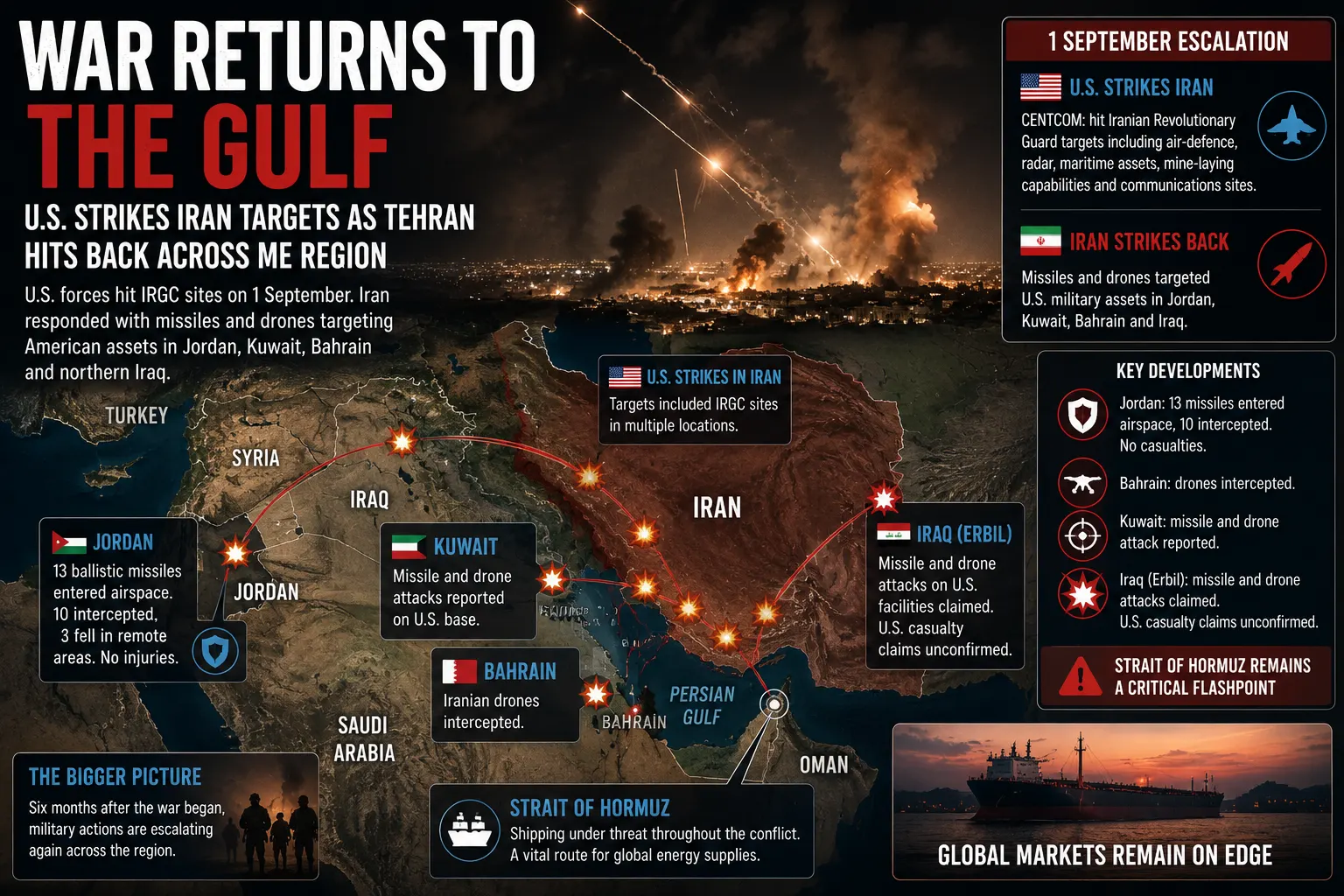
After weeks in which the United States and Iran largely avoided major direct attacks, the war has abruptly returned to the military bases, coastlines and shipping routes of the Gulf. U.S. forces struck a range of Iranian Revolutionary Guard targets on 1 September, and Iran responded with missiles and drones aimed at what it described as American military assets in Jordan, Kuwait, Bahrain and northern Iraq. It is the most substantial direct exchange between Washington and Tehran since July.
The immediate military picture remains fluid. U.S. Central Command says its latest strikes hit Iranian air-defence sites, radar systems, maritime assets and facilities, mine-laying capabilities and communications sites. Iran says its retaliation reached several countries hosting American forces, but some of Tehran’s claims of U.S. casualties have not been independently confirmed. Jordan reported no deaths or injuries after intercepting most of the ballistic missiles that entered its airspace, while U.S. officials said their initial assessment showed no casualties there.
The significance of the escalation extends far beyond the number of targets struck overnight. Six months into a conflict that began with large-scale U.S. and Israeli attacks on Iran on 28 February, Washington and Tehran have already discovered that neither air power, missile retaliation, sanctions nor a temporary political agreement has produced a durable settlement. The latest exchange therefore raises a more consequential question: whether the conflict is returning to sustained warfare after a period in which economic pressure and control of the Strait of Hormuz had become the principal battleground.
1 September: U.S. Central Command says it completed a new wave of strikes against Iranian Revolutionary Guard targets.
13 ballistic missiles: Jordan says that number entered its airspace; ten were intercepted and three fell in remote areas.
Four countries: Iran says it targeted American assets in Jordan, Kuwait, Bahrain and Iraq.
At least 12 deaths: Iranian reports attributed this number to the latest U.S. strikes; the claims had not all been independently verified.
What the United States Says It Struck
U.S. Central Command describes the new operation as a response to recent attempted attacks by the Islamic Revolutionary Guard Corps against commercial shipping in the Strait of Hormuz and against American military personnel in the region. The targets identified by CENTCOM are notable because they connect two of the central fronts of the war: Iran’s ability to defend its territory from aircraft and missiles, and its ability to threaten maritime traffic through the Gulf.
Air-defence sites and radar systems affect Iran’s ability to detect and engage incoming attacks. Maritime facilities and mine-laying capabilities are directly connected to the struggle over the Strait of Hormuz, where shipping has been severely disrupted throughout the conflict. Communications infrastructure, meanwhile, can support military command and coordination. CENTCOM did not provide a complete public target list or comprehensive damage assessment.
Iranian media reported attacks at several locations, particularly in the south and around the approaches to Hormuz. Reports included explosions around Bandar Abbas, Qeshm Island, Chabahar and other areas, as well as an attack near the southeastern city of Jiroft. As in previous phases of the conflict, not every reported explosion can immediately be matched with a confirmed U.S. target.
The Latest Exchange Across the Region
| Location | Reported action | Current status |
|---|---|---|
| Iran | U.S. strikes on IRGC military systems | Confirmed by CENTCOM |
| Jordan | 13 Iranian ballistic missiles entered airspace | Jordan says 10 intercepted; no casualties |
| Kuwait | Missile and drone attacks reported | Iran says U.S. base targeted; drone damage also reported |
| Bahrain | Iranian drone attack | Bahrain says drones were intercepted |
| Erbil, Iraq | Missile and drone attacks on U.S. facilities claimed | Iranian claims of U.S. deaths unconfirmed |
Source: U.S. Central Command, Jordan Armed Forces and reporting from Reuters, 2 September 2026.
Iran’s Response Spread the Risk Across Several U.S. Partners
Iran’s retaliation illustrates one of the defining characteristics of the conflict: American military power in the Middle East is distributed across a network of bases and facilities located in countries that are not themselves seeking a direct war with Tehran. That makes any Iranian strategy of striking U.S. forces inherently regional. An attack aimed at American military infrastructure can simultaneously place the sovereignty, civilian population and economic infrastructure of the host country at risk.
Jordan’s military said 13 ballistic missiles originating from Iranian territory entered the kingdom’s airspace. Ten were intercepted and destroyed, while three fell in remote areas. Jordan reported no deaths or injuries. Iran’s Revolutionary Guard claimed that its attack had inflicted substantial American casualties, but U.S. officials told Reuters that their initial information indicated there had been none.
In Kuwait, Iran said it attacked Ali Al Salem Air Base with missiles and drones and targeted accommodation associated with an American commander. Separately, Kuwait’s emergency services reported that a drone struck a residential complex and caused a fire and property damage without casualties. Bahrain, where the U.S. Navy’s Fifth Fleet is headquartered, said Iranian drones had been intercepted and destroyed.
The Revolutionary Guard also claimed combined missile and drone attacks against U.S. facilities in Erbil in northern Iraq. It said military infrastructure and fuel facilities were damaged and that several Americans were killed. Neither U.S. nor Iraqi authorities had confirmed those casualty claims at the time the latest reports were published.
No confirmed U.S. casualties in Jordan had been reported in initial American and Jordanian assessments despite Iranian claims of significant losses.
Civilian Casualties in Iran Are Becoming Part of the Escalation
Iran says the American attacks also caused civilian deaths. Iranian authorities reported at least 12 people killed during the latest strikes, including five people at a wedding near Sirik on the coast of the Strait of Hormuz. The Iranian Red Crescent reported dozens wounded, while Iranian media said a four-year-old child was among those killed.
The United States had not publicly provided an assessment of that incident when the reports emerged, and Reuters said it could not independently verify the circumstances of the strike. That distinction is important. The existence of Iranian casualty reports can be reported as fact, but responsibility for a particular explosion and the intended target require further evidence.
Civilian casualties have repeatedly complicated the war since February. They increase domestic pressure within Iran for retaliation and make diplomatic compromise politically more difficult, while attacks on civilian or residential areas in Gulf states create similar pressures on governments that have generally tried to avoid becoming direct participants in the confrontation.
The War Began With a Much Larger Shock in February
The latest exchange is best understood as another phase of a conflict that began on 28 February 2026, when the United States and Israel launched extensive attacks on Iran. The opening operation targeted Iranian military, command, missile and nuclear-related infrastructure. Supreme Leader Ali Khamenei was killed, along with senior Iranian military figures, fundamentally altering the country’s leadership structure within the first days of the war.
Washington said its objectives included eliminating what it described as imminent threats, preventing Iran from developing a nuclear weapon and reducing Tehran’s capacity to attack neighbouring states. Iran characterised the attacks as illegal aggression and responded with large missile and drone barrages against Israel and countries hosting American military forces.
The scale was extraordinary. U.S. military officials later said more than 1,000 Iranian targets were struck during the first 24 hours of Operation Epic Fury, while American missile-defence systems engaged Iranian ballistic missiles and drones across the region. What followed was not a conventional ground war but an extended contest involving air power, missiles, drones, maritime interdiction, sanctions and attacks on energy and logistics infrastructure.
A June Agreement Failed to Resolve the Core Disputes
By June, the military and economic costs had created an incentive for negotiation. Washington and Tehran reached an interim memorandum intended to stop military operations and begin a 60-day process towards a broader agreement. The arrangement addressed not only hostilities but also sanctions, Iranian oil exports, frozen assets, reconstruction and the Strait of Hormuz.
Under the framework made public by the White House, Iran reaffirmed that it would not develop nuclear weapons, while the two sides were to negotiate the future of Iran’s enriched uranium and enrichment programme. Washington was to move towards sanctions relief and enable Iranian petroleum exports, while Tehran was expected to facilitate safe commercial passage through Hormuz.
The apparent breadth of the agreement was also its weakness. It postponed some of the hardest questions rather than settling them. Iran’s nuclear programme, the sequencing of sanctions relief, military deployments and the future administration of the Strait remained deeply contested. By July, intense fighting had resumed and the ceasefire had effectively broken down.
How the Conflict Reached the Latest Escalation
| Period | Development | Significance |
|---|---|---|
| 28 February | U.S. and Israeli attacks begin | War expands across Iran and Gulf |
| June | U.S.-Iran interim agreement | Temporary path towards ceasefire |
| July | Heavy direct fighting resumes | Agreement begins to collapse |
| August | Hormuz dispute intensifies | Shipping and oil become central |
| 1–2 September | Large U.S. and Iranian strikes | Heaviest exchange since July |
Source: Reuters, U.S. Central Command and the June U.S.-Iran interim memorandum.
Hormuz Has Become the Strategic Centre of the War
The Strait of Hormuz explains why even geographically limited attacks can have global economic consequences. The narrow waterway between Iran and Oman connects the Persian Gulf with the Arabian Sea and historically carries a large share of the world’s oil and liquefied natural gas exports. Before the current conflict, around one-fifth of global petroleum consumption passed through it.
The war has transformed those flows. U.S. Energy Information Administration data estimate that oil and petroleum-liquid traffic through Hormuz averaged only 4.9 million barrels a day during the second quarter of 2026, compared with 21.6 million barrels a day in the final quarter of 2025. Some oil has been diverted through pipelines and alternative ports, but the available bypass capacity is far smaller than normal Hormuz traffic.
Recent flows have improved. U.S. Energy Secretary Chris Wright said 17 million barrels passed through the strait on Monday, the largest daily quantity since the war disrupted shipping. Yet the renewed military exchange shows why a recovery remains fragile. Mine threats, attacks on tankers and competing attempts to control passage can reverse improvements quickly.
Iran views the waterway as both strategic leverage and an economic asset. Washington, Gulf producers and major importing economies view freedom of navigation through it as essential to global energy security. The dispute therefore combines military control, maritime law, sanctions and commercial access in a single geographical chokepoint.
Oil Markets React Faster Than Diplomacy
The economic response to the latest strikes was immediate. Brent crude rose by more than $4 on Tuesday to settle at $94.65 a barrel, its highest closing level since late July, while West Texas Intermediate climbed to $90.22. Prices remained close to those levels on Wednesday as traders assessed the possibility of further disruption.
The effect extends beyond crude oil. Refinery disruption, shipping risk and restricted Gulf exports have contributed to higher diesel and liquefied natural gas prices. When energy becomes more expensive, the consequences eventually feed through to transport, manufacturing, food distribution and household energy bills, although the timing and scale vary between economies.
Financial markets also responded to the renewed fighting. Asian and European equities came under pressure while higher energy prices added to concerns about persistent inflation and interest rates. The economic consequence of the conflict therefore operates through two channels at once: physical restrictions on energy supply and the risk premium traders attach to the possibility of future disruption.
Why the Escalation Matters to Ireland
Ireland is geographically distant from the battlefield but unusually exposed to international energy movements. Sustainable Energy Authority of Ireland data show that the country imported 78.2% of its overall energy requirement in 2025 and imported its entire oil supply. Oil accounted for 47.3% of Ireland’s energy requirement, largely because transport and parts of the heating system remain dependent on petroleum products.
That does not mean every rise in Brent crude is immediately reproduced at Irish petrol stations or in heating-oil prices. Retail prices are also determined by refining margins, transport costs, inventories, exchange rates, taxes and competition. But a sustained increase in international crude and refined-product prices creates upward pressure throughout an economy that remains heavily dependent on imported fuels.
The same applies more broadly to inflation. Ireland is a small open economy integrated into European and global supply chains. Higher diesel, aviation and shipping costs can ultimately influence the price of goods and services even when Ireland does not buy the underlying crude directly from the Gulf.
Irish foreign policy has consistently called for de-escalation. Foreign Affairs Minister Helen McEntee criticised both the decision by the United States and Israel to launch the February conflict and Iran’s subsequent attacks, while supporting negotiations over Iran’s nuclear programme. When the June agreement was announced, the Government welcomed the prospect of a ceasefire and the reopening of the Strait of Hormuz.
Neither Side Has Yet Achieved Its Original Objectives
The durability of the conflict partly reflects the difficulty both countries face in translating military power into a political settlement. The United States has demonstrated that it can repeatedly penetrate Iranian defences and destroy military infrastructure. Iran’s conventional forces and economy have suffered severe damage. Yet Tehran retains missiles, drones, maritime capabilities and the geographical ability to threaten American facilities and commercial shipping throughout the Gulf.
Iran, conversely, has shown that it can impose regional and economic costs on Washington and its partners, but it has not removed U.S. forces from the region or secured a final agreement delivering the sanctions relief and financial access it seeks. Its own economy has also been damaged by the war and the disruption of normal trade.
The military balance therefore does not automatically produce a clear political endpoint. Continued U.S. attacks can further degrade Iranian capabilities without necessarily compelling Tehran to accept Washington’s terms. Continued Iranian retaliation can raise American and regional costs without necessarily forcing a U.S. withdrawal. That dynamic creates the conditions for repeated cycles of escalation followed by temporary pauses.
Military Resources Are Becoming Part of the Calculation
There is also a less visible constraint: ammunition. Modern air and missile warfare consumes sophisticated weapons rapidly. Reuters reported that the United States has used a substantial part of its stocks of certain air-defence interceptors and precision long-range missiles during the conflict, creating questions about readiness for other potential crises.
Iran faces its own resource constraints. Months of strikes have degraded conventional military infrastructure, command systems, air defences and parts of its naval and missile capabilities. Replacing complex equipment under wartime conditions and sanctions is difficult even for a state with a large domestic defence industry.
This creates an unusual strategic balance. Both sides retain the ability to inflict serious damage, but sustained high-intensity warfare becomes progressively more expensive. The result can favour intermittent bursts of intense military action separated by periods of economic pressure, sanctions, negotiations and rebuilding rather than continuous bombing at the highest possible tempo.
The Nuclear Question Remains Unresolved Beneath the Fighting
The nuclear dispute that preceded the current war has not disappeared. Before attacks on Iranian nuclear facilities disrupted international monitoring, the International Atomic Energy Agency had documented a large Iranian stockpile of uranium enriched to 60%, well above normal civilian reactor requirements but below weapons-grade levels. Iran has repeatedly said its nuclear programme is peaceful, while the United States and Israel have argued that its enrichment capacity created an unacceptable weapons risk.
Bombing nuclear infrastructure can destroy buildings and equipment, but it cannot by itself settle the political question of whether Iran will retain enrichment capabilities in the future. Nor does physical damage automatically account for all nuclear material or scientific knowledge. A durable settlement would therefore still require verification arrangements and renewed access for international inspectors.
The June memorandum recognised precisely that problem by postponing the final disposition of enriched material and enrichment itself to negotiations under IAEA supervision. Those negotiations have not produced the comprehensive agreement envisaged at the time.
Three Paths Now Look Plausible
The first possibility is renewed escalation. If Iran continues striking American forces and Washington carries out the more severe attacks threatened by President Donald Trump, the conflict could return to the intensity seen earlier in the year. Wider attacks on energy infrastructure or sustained disruption of Hormuz would substantially increase the economic consequences for countries far beyond the Middle East.
A second scenario is another limited military cycle followed by restraint. Both sides have already demonstrated that they can attack, retaliate and then reduce the tempo without formally resolving the war. Military resource constraints and economic pressure provide incentives for such pauses, even when political hostility remains unchanged.
The third possibility is a return to mediation. The June agreement demonstrated that Washington and Tehran can reach a detailed framework when the cost of continued conflict becomes sufficiently high. It also demonstrated how easily such a framework can fail when the parties disagree over implementation. Any new diplomatic effort would therefore have to address the issues that the previous arrangement deferred, particularly Hormuz, sanctions and the nuclear programme.
None of those outcomes is predetermined. The immediate danger lies in the speed with which military action can outpace political calculation. Missiles aimed at American bases pass through the sovereign territory of other states; drones can fall outside their intended targets; attacks on military facilities can produce civilian casualties; and an incident involving shipping can rapidly influence global energy prices.
The Latest Strikes Are More Than Another Round of Retaliation
The renewed attacks demonstrate that the relative calm of recent weeks was not equivalent to peace. The fundamental dispute remained intact while Washington and Tehran temporarily relied more heavily on economic and maritime pressure. Once direct attacks resumed around Hormuz, the escalation mechanism rebuilt itself rapidly: an American strike produced Iranian retaliation across several countries, which in turn generated new threats from Washington.
For the Gulf states caught geographically between the two powers, the strategic problem is especially difficult. They host American forces and depend on U.S. security relationships, but many also have strong incentives to avoid becoming battlefields in a prolonged U.S.-Iran war. Every Iranian missile or drone directed towards an American facility tests that balance.
The central question in the coming days is therefore not simply whether another strike occurs. It is whether either side decides that the latest exchange has satisfied its immediate need to retaliate, or whether each attack becomes the justification for a larger one. After six months of war, a failed interim agreement and repeated disruption of one of the world’s most important energy routes, the difference between those two outcomes matters far beyond Washington and Tehran.
Sources
Reuters — US Pounds Iran, Tehran Strikes Back at Bases in Biggest Exchange Since July
Reuters — US Launches New Strikes on Iran and Tehran Hits Back
U.S. Central Command — CENTCOM Completes Strikes on IRGC Targets in Iran
Jordan Armed Forces via Petra — 13 Ballistic Missiles Enter Jordanian Airspace
Reuters — US and Israel Launch February 2026 Attacks on Iran
Reuters — The 14-Point US-Iran Interim Agreement
Reuters — Oil Prices Rise After Renewed US-Iran Fighting
U.S. Energy Information Administration — Strait of Hormuz and Global Energy Security
Sustainable Energy Authority of Ireland — Ireland’s Energy Supply and Security of Supply 2025
Government of Ireland — Statement on the Outbreak of Conflict with Iran
Source & Transparency
This article is published by Ireland Newspaper for editorial and informational purposes.
Published: 2 September 2026 · Updated: 2 September 2026

Newsroom Ireland Newspaper
Ireland Newspaper editorial team prepares daily news coverage for readers in Ireland and abroad.