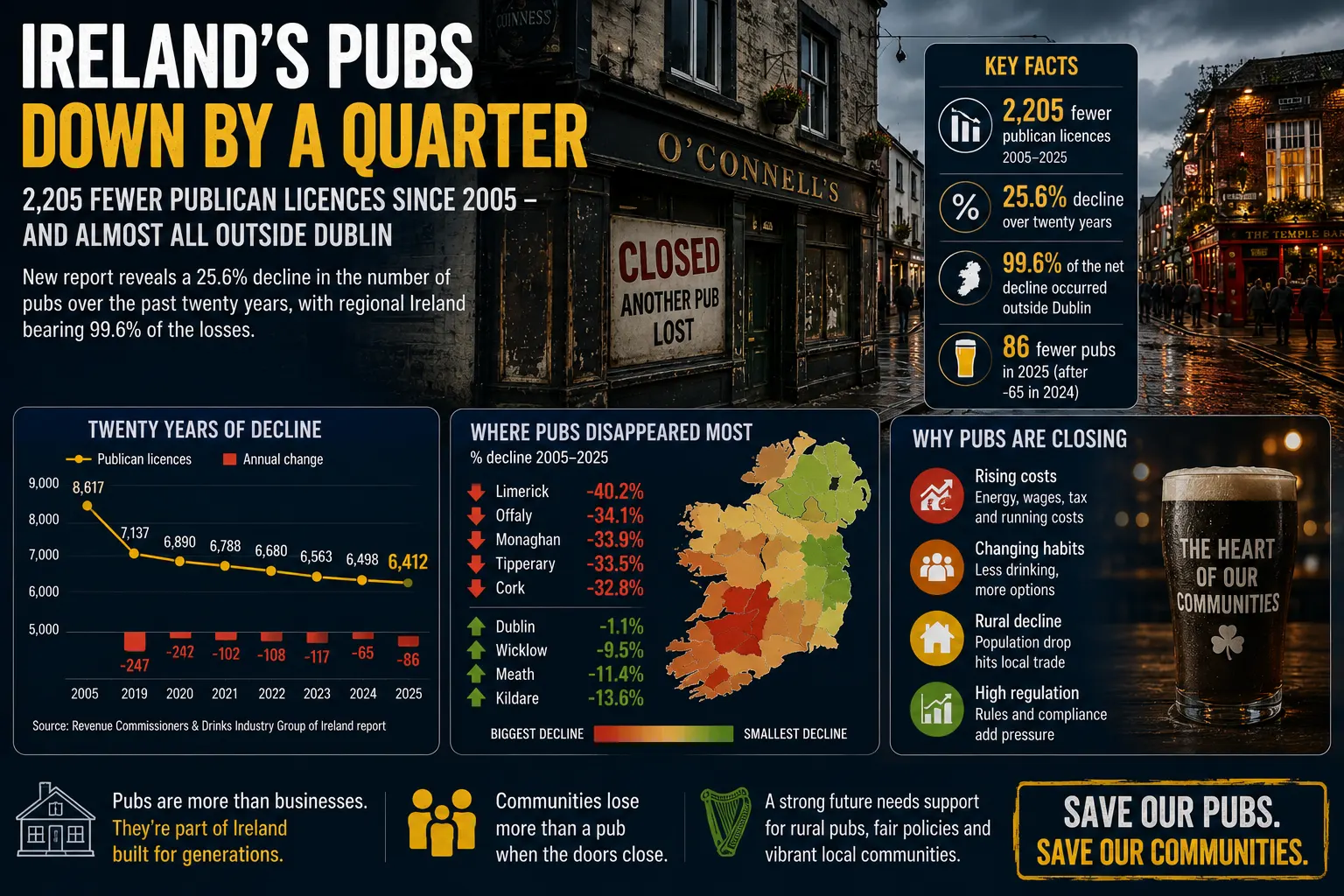
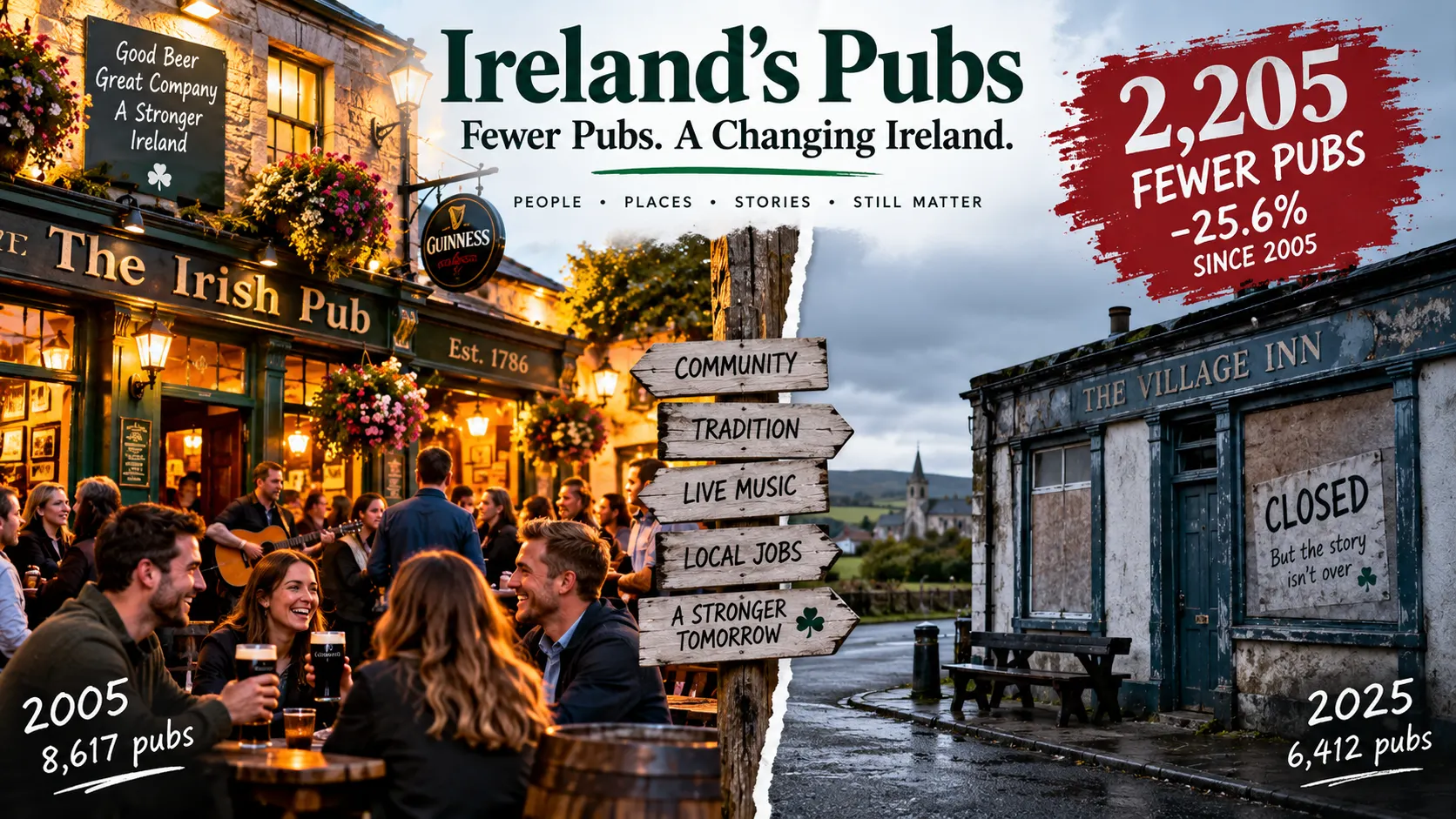
Ireland had 8,617 publican licences in 2005. By 2025, that number had fallen to 6,412, a net reduction of 2,205 or 25.6%. Yet the most revealing part of the new figures is not the national total: 2,196 of those lost licences were outside Dublin, meaning regional Ireland accounted for 99.6% of the twenty-year decline.
The figures come from a new report commissioned by the Drinks Industry Group of Ireland and prepared by economist Anthony Foley, using the Revenue Commissioners’ register of alcohol licences as its underlying data source. That distinction matters. The headline number represents the net reduction in publican licences rather than a survey documenting the individual circumstances behind each closure, so it cannot by itself establish why each business disappeared. What it does establish is a sustained structural contraction in an industry that remains far more resilient in Dublin than across much of the rest of the State.
The decline has also survived several very different economic periods. It began before the financial crisis, slowed markedly during the later recovery, accelerated dramatically during the pandemic and has continued after reopening. At the same time, Ireland’s population and employment have increased substantially. The result is not a simple story of a shrinking country supporting fewer businesses, but of changing demand, higher operating costs and a transformation in the role of alcohol and the traditional pub in Irish social life.
2,205 fewer publican licences: Ireland fell from 8,617 in 2005 to 6,412 in 2025.
25.6% decline: roughly one publican licence in four disappeared over the twenty-year period.
99.6% of the net decline: 2,196 of the 2,205 lost licences were outside Dublin.
86 fewer pubs in 2025: the national total fell again after a reduction of 65 in 2024.
The Pub Decline Began Long Before Covid
The long-term sequence helps separate structural change from individual shocks. According to the report, the number of pubs declined by an average of about 200 a year between 2005 and 2010, a period that included the collapse of Ireland’s property-driven boom and the financial crisis. Between 2010 and 2015, the annual average decline slowed to 87. From 2015 to 2019, the market came close to stabilising, with an average annual reduction of only 11.
Covid then produced a different kind of disruption. The number of publican licences fell from 7,137 in 2019 to 6,890 in 2020, a reduction of 247 in one year. The decline continued after the most severe restrictions ended: the total fell by 102 in 2021, 108 in 2022 and 117 in 2023. The reduction slowed to 65 in 2024 before increasing again to 86 in 2025.
That pattern makes two conclusions possible at the same time. The pandemic was an exceptional shock to pubs and clearly coincided with a major acceleration in the decline. But Covid did not create the underlying trend: by 2019, Ireland had already lost approximately 1,480 pubs compared with 2005. Nor did reopening restore the old structure of the market.
How Ireland’s Pub Numbers Changed
| Year | Publican licences | Annual change |
|---|---|---|
| 2005 | 8,617 | Baseline |
| 2019 | 7,137 | — |
| 2020 | 6,890 | -247 |
| 2021 | 6,788 | -102 |
| 2022 | 6,680 | -108 |
| 2023 | 6,563 | -117 |
| 2024 | 6,498 | -65 |
| 2025 | 6,412 | -86 |
Source: The Decline in the Number of Public Houses 2005 to 2025, based on Revenue licence data.
The Geography of the Decline Is the Most Striking Part
Every county recorded fewer pubs in 2025 than in 2005, but the scale of the losses varies dramatically. The detailed county table in the new report records a 40.2% decline in Limerick, followed by Offaly at 34.1%, Monaghan at 33.9%, Tipperary at 33.5% and Cork at 32.8%. Roscommon, Laois, Longford and Clare also lost more than 30% of their pubs.
Dublin is the conspicuous exception. Its total fell from 786 publican licences in 2005 to 777 in 2025, a reduction of only 1.1%. Wicklow recorded the next-smallest decline at 9.5%, followed by Meath at 11.4% and Kildare at 13.6%. The contrast suggests that proximity to population growth, tourism, employment centres and larger pools of potential customers has mattered, although licence figures alone cannot isolate how much each factor contributed.
Some of the largest absolute reductions occurred in counties with historically large numbers of pubs. Cork lost 400 licences, falling from 1,221 to 821. Tipperary lost 176, Galway 148, Mayo 139 and Donegal 129. A percentage decline and an absolute loss therefore tell different stories: smaller counties can experience a severe proportional contraction while larger counties lose a greater number of establishments.
Where Pub Numbers Fell Most, 2005–2025
| County | Decline | Change |
|---|---|---|
| Limerick | 40.2% | -158 |
| Offaly | 34.1% | -56 |
| Monaghan | 33.9% | -41 |
| Tipperary | 33.5% | -176 |
| Cork | 32.8% | -400 |
| Roscommon | 32.7% | -83 |
| Dublin | 1.1% | -9 |
Source: Drinks Industry Group of Ireland report, 2026.
The county pattern is one reason the issue has become part of a wider discussion about Rural Ireland rather than simply the economics of alcohol retailing. Losing one pub among dozens in a busy urban district has a different social effect from losing the only remaining licensed premises in a small village. A closure in a sparsely populated area can remove not only a commercial business but also a meeting place, music venue, informal event space and part of the visitor economy.
That does not mean every pub is indispensable or that the disappearance of a licensed premises automatically causes social isolation. Communities have sports clubs, parish halls, cafés, community centres and other gathering spaces, and the significance of a particular pub varies enormously. The structural concern is greatest where alternatives are already limited. In those places, the closure of one more business can narrow the range of reasons for residents and visitors to spend time in the village itself.
2,196 of the 2,205 net losses in publican licences between 2005 and 2025 occurred outside Dublin.
Ireland Became Larger While the Pub Network Became Smaller
The demographic background makes the contraction unusual. Ireland’s population was 4.24 million at the 2006 Census. By April 2026, the Central Statistics Office estimated it at 5.526 million. The country therefore added well over one million residents during roughly the same period in which the number of publican licences fell by more than 2,200.
Population growth does not automatically generate equivalent pub demand. Much of Ireland’s economic and demographic expansion has been concentrated in cities, larger towns and commuter areas, while individual rural communities have experienced very different trajectories. Household composition, commuting, tourism, age structure and disposable income also affect how much of a growing national population translates into customers for a traditional pub in a particular place.
The Dublin figures illustrate this. The capital’s pub stock has been broadly stable over two decades despite major economic shocks. That does not prove urban pubs are immune from commercial pressure, but it indicates that a dense population, large workforce, tourism market and evening economy can sustain a different business model from a premises depending on a much smaller local catchment.
The Irish Relationship With Alcohol Has Also Changed
One of the most important demand-side changes is that Irish adults are drinking less than they once did. The Department of Health’s latest long-term indicators show that per-capita alcohol consumption among people aged 15 and over declined by 12.2% between 2015 and 2024. The 2025 Healthy Ireland Survey found that 71% of people aged 15 or older had consumed alcohol during the previous twelve months, down from 73% in 2024, while 35% reported drinking at least weekly.
That is a positive development from a public-health perspective, particularly because harmful alcohol consumption remains a significant health concern. But it also represents a structural demand change for businesses whose primary product is alcohol. Fewer drinking occasions, moderation among some consumers and growing interest in alcohol-free products can all reduce the volume available to be divided among licensed premises.
The change is not necessarily the same as the disappearance of pub culture. Consumers can visit less frequently while spending more on food, entertainment or premium products when they do go out. Pubs themselves have adapted by expanding food, live entertainment, tourism experiences and alcohol-free ranges. The businesses most exposed to structural change are often those with fewer possibilities for diversification.
Recent data also show why the term “pub crisis” requires some precision. The CSO’s Retail Sales Index recorded the volume of sales in bars in July 2026 at 4.1% above July 2025. A year-on-year increase in one month does not reverse a twenty-year decline in the number of licensed premises, but it demonstrates that falling outlet numbers and improving trade among surviving businesses can occur simultaneously.
Costs Have Risen Even as the Number of Customers Has Become Harder to Predict
The pressure on pubs is not solely about demand. Hospitality businesses are labour-intensive, often operate for long hours and have substantial fixed costs before the first drink is sold. The national minimum wage increased from €13.50 to €14.15 an hour at the start of 2026, a rise of 4.8%. Pension auto-enrolment also began in 2026, adding another element to employment costs for affected businesses.
Official labour-market data show the wider movement. Average weekly earnings in accommodation and food service activities were 7.7% higher in the second quarter of 2026 than a year earlier. Average total hourly labour costs in the sector were €20.27, up from €19.50 in the second quarter of 2025. Higher pay is income for employees and cannot simply be categorised as an economic loss, but for a small business with limited scope to increase prices or sales volumes it is nevertheless an additional operating cost.
Energy, insurance, supplies, compliance and property costs add to the equation. Their effect differs greatly between businesses: an owner-operated rural pub with no kitchen has a different cost structure from a large food-led urban premises. That difference is important when evaluating tax interventions designed for “hospitality” as a whole.
The 9% Hospitality VAT Rate Does Not Apply to the Pint
Budget 2026 restored the 9% VAT rate for food and catering services from 1 July 2026. That provides a direct benefit to pubs with meaningful food sales, alongside restaurants, cafés and other catering businesses. Alcohol is excluded: Revenue confirms that alcoholic products remain subject to the standard VAT rate, which is currently 23%.
This creates an important dividing line within the pub sector. A food-led premises can benefit significantly from the reduced catering rate, whereas a traditional drinks-led rural pub receives much less direct assistance from it. That is one reason the drinks industry has shifted its Budget 2027 campaign towards excise duty.
Alcohol carries a separate Alcohol Products Tax in addition to VAT. Revenue’s current rates include €22.55 per hectolitre for each percentage point of alcohol on beer above 2.8% strength, €42.57 per litre of pure alcohol in spirits, and €424.84 per hectolitre on most still wine between 5.5% and 15% alcohol. The structure means taxation is a material component of the final retail price before the pub’s other costs are considered.
The Industry Wants a 10% Excise Cut — but Tax Has Another Purpose
DIGI is calling for a 10% reduction in alcohol excise in Budget 2027. The organisation argues that high taxation, combined with rising operating costs and weaker consumption volumes, reduces the viability of small pubs and disproportionately affects areas where businesses have lower footfall. Separate industry-commissioned research places Ireland among the highest-taxing European countries for alcohol excise.
The proposal is not yet Government policy, and there is an important counterargument. Alcohol taxation is not designed solely as a source of State revenue or as a business cost. It is also a public-health instrument. The Public Health Alcohol Act framework aims to reduce population alcohol consumption and alcohol-related harm, while the World Health Organization identifies excise taxation and pricing policies as among the most effective measures available to governments for reducing harmful alcohol use.
Ireland’s alcohol policy consequently contains an unavoidable tension. Lower excise could improve margins or allow some businesses to restrain price increases, potentially helping pubs at the commercial margin. But lower alcohol taxation could also reduce the price signal that public-health policy deliberately uses to discourage excessive consumption. The final effect would depend on how much of any tax reduction was retained by producers and retailers, how much reached consumers, and how drinking behaviour responded.
Nor can a 10% excise reduction logically explain away the entire twenty-year decline. Pub numbers fell during periods of economic boom and recession, before and after Covid, and while consumer behaviour was changing. Tax is one relevant variable in a much larger system rather than a single explanation for 2,205 missing licences.
Why the Rural Pub Matters Beyond Its Turnover
The strongest case for treating rural pubs differently from ordinary retail outlets lies in what economists sometimes describe as external value: benefits or costs that do not appear fully in the business’s own accounts. A pub may provide a venue for local music, fundraising, sports-club activity, celebrations and informal contact between people who would otherwise have fewer places to meet. Those activities can matter even when they do not produce large profits for the operator.
The same principle applies to tourism. Ireland’s pub tradition is part of the country’s international visitor image, but tourists generally experience that tradition locally rather than nationally. A strong pub and hospitality offering in Dublin cannot substitute for an absent evening economy in a village hundreds of kilometres away. For rural tourism, the distribution of amenities can therefore matter as much as the total number available across the State.
There is also a cumulative effect. A village may be able to absorb the loss of one business while retaining a shop, post office, restaurant and another pub. When several services disappear over time, each remaining enterprise operates in a weaker commercial ecosystem because there are fewer reasons for people to stop, meet or spend locally. Pub closures can be part of that process without necessarily being its original cause.
The Next Decade Is Not Predetermined
The DIGI-commissioned report presents scenarios in which another 600 to 1,000 pubs could disappear over the decade from 2024 if present trends and pressures continue. Those figures should be treated as modelling scenarios rather than an official forecast. They depend on assumptions about future costs, demand, taxation and the continuation of historical closure patterns, all of which can change.
There are already signs that the path will not be uniform. Five counties recorded an increase in pub numbers during 2025, according to the report, while four were unchanged. Dublin’s long-term total has been almost stable, and recent CSO sales figures show positive year-on-year bar volumes. The future may therefore involve continued contraction in some localities alongside commercially successful pubs in places with stronger population, tourism or entertainment demand.
Tax policy will be one of the immediate variables. Budget 2027 will determine whether the Government accepts the industry’s case for excise relief, rejects it on fiscal or public-health grounds, or chooses a more targeted form of support. Other possible approaches could focus more narrowly on rural business viability, community services, tourism development or the cost base rather than reducing the tax on alcohol itself.
Business adaptation will matter as well. Food, live music, community events, tourism, accommodation partnerships and non-alcoholic products can broaden the reason for customers to visit a pub, but such diversification is not equally practical everywhere. A small family-run premises may lack the capital, kitchen space, staffing or customer base available to a large urban operator.
The Central Question Is No Longer Whether the Pub Is Changing
Twenty years of licence data make one conclusion difficult to dispute: Ireland’s pub network has already changed fundamentally. There are fewer pubs despite a much larger national population, and the contraction has fallen overwhelmingly on counties outside Dublin. The pandemic intensified that movement but did not begin it, while recent improvements in bar sales have not yet translated into a reversal of the long-term reduction in licences.
For Budget 2027, the policy argument will inevitably focus on tax. The more difficult question is what problem policymakers are trying to solve. If the objective is simply to maximise the number of licensed premises, lower business costs may help. If the objective is to preserve social infrastructure in small towns and villages while continuing to reduce alcohol-related harm, a broader and more targeted set of policies may be required.
The future of the Irish pub is therefore unlikely to be decided by nostalgia or one tax measure. It will depend on whether enough customers still want the service, whether operators can make the economics work and whether policymakers judge some rural pubs to provide community value that the market alone may not fully reward. After a net loss of 2,205 licences, that debate is no longer about preventing change. It is about deciding how much further contraction Ireland is prepared to see, and what — if anything — should be done to influence where it happens.
Sources
Drinks Industry Group of Ireland — The Decline in the Number of Public Houses 2005 to 2025
Drinks Ireland — One Quarter of Irish Pubs Have Closed Since 2005
Revenue — Alcohol Products Tax Rates
Revenue — VAT Treatment of Food and Alcoholic Drinks
Central Statistics Office — Population and Migration Estimates, April 2026
Central Statistics Office — Earnings and Labour Costs Q2 2026
Central Statistics Office — Retail Sales Index July 2026
Department of Health — Healthy Ireland Survey 2025
Department of Health — Health in Ireland: Key Trends 2025
Department of Health — Healthy Ireland Alcohol Policy
World Health Organization — Alcohol Pricing and Excise Policies
Source & Transparency
This article is published by Ireland Newspaper for editorial and informational purposes.
Published: 2 September 2026 · Updated: 2 September 2026

Newsroom Ireland Newspaper
Ireland Newspaper editorial team prepares daily news coverage for readers in Ireland and abroad.


Market data, financial news and economy content on Ireland Newspaper are provided for editorial and informational purposes only. They do not constitute financial advice, investment advice, trading advice or a recommendation to buy, sell or hold any financial product. Always verify live prices and consult a qualified professional before making financial decisions.