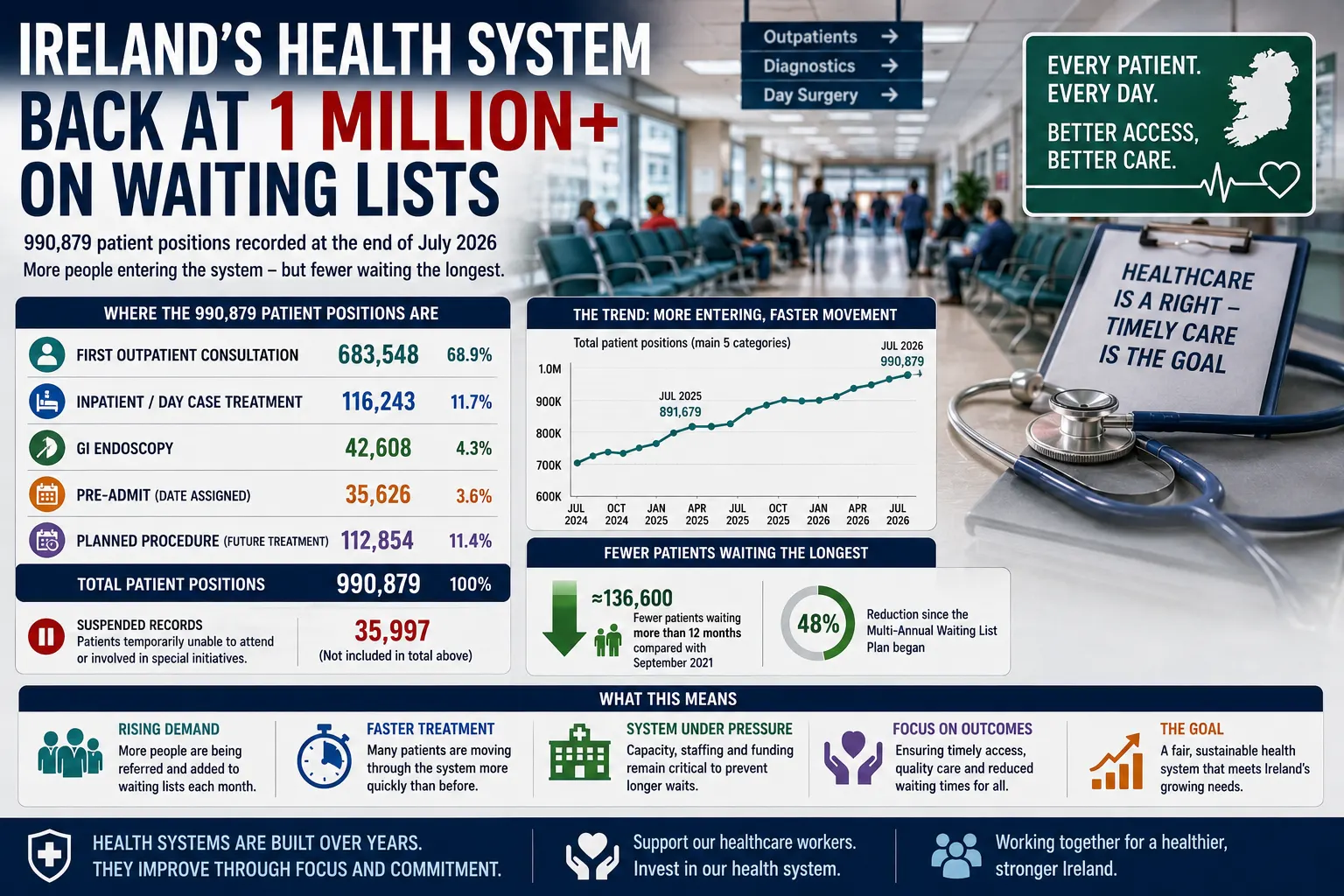
Ireland ended July 2026 with 990,879 patient positions recorded across the main public-hospital waiting-list categories used to describe people awaiting care, a figure that has brought the system back to the threshold of one million. The largest component was not surgery but the first step into specialist hospital care: 683,548 patients were waiting for an initial outpatient consultation. Another 116,243 were waiting for inpatient or day-case treatment and 42,608 for a gastrointestinal endoscopy, while tens of thousands more had already been given procedure dates or were awaiting clinically planned future treatment.
The headline number is striking, but it requires interpretation. Ireland does not have one queue containing almost one million people waiting for the same type of treatment, and the NTPF figures are aggregated across several stages of care rather than constituting a simple measure of distinct individuals requiring immediate procedures. Planned-procedure patients, for example, have generally already received treatment and require another intervention or surveillance at an appropriate future point. Pre-admit patients have been assigned dates. Separately, almost 36,000 records were classified as suspended at the end of July because patients were temporarily unable or unfit to attend or were involved in certain insourcing or outsourcing initiatives.
Even after those distinctions are made, the direction of the numbers is difficult to ignore. The total commonly reported as being on some form of waiting list rose by more than 9,500 between June and July alone. Compared with July 2025, the equivalent total increased by approximately 99,200. The three active lists for a first outpatient appointment, inpatient or day-case treatment and GI endoscopy contained 842,399 patient positions in July 2026, compared with 747,328 a year earlier.
At the same time, a second and apparently contradictory trend has been developing. Ireland has substantially reduced the number of patients experiencing the very longest waits. The Department of Health reported in August that around 136,600 fewer patients were waiting more than 12 months than when the multi-annual waiting-list programme began in September 2021, a reduction of approximately 48 per cent. The weighted average length of time spent waiting across the major lists has improved by about 43 per cent over the same period. Ireland therefore has a health system in which more people are entering the queues even while many of those already in them are moving through faster.
What the Almost One Million Figure Actually Contains
The National Treatment Purchase Fund publishes several different categories because a patient journey through hospital care has several stages. The active outpatient list records people referred for a first consultant-led hospital appointment. The inpatient and day-case list records patients who require treatment after the relevant clinical decision has been made. The GI endoscopy list covers gastrointestinal scopes.
Beyond those active lists are two categories with a different meaning. The Pre-Admit list contained 35,626 patients at the end of July; these people had already been given a date for an inpatient, day-case or endoscopy procedure. The Planned Procedure list contained 112,854 patients, many of whom require repeat treatment or surveillance in the future. The NTPF said 79,223 of these planned-procedure patients already had an indicative future date or appointment.
Adding the three active categories, Pre-Admit and Planned Procedure gives 990,879. This is the figure reported in August as the number waiting for some form of treatment or appointment. It excludes the separate Suspension category of 35,997. Adding suspended records would take the combined published categories beyond 1.02 million, but doing so without qualification would exaggerate the size of the conventional waiting queue because suspension has a different administrative meaning.
The distinction also explains why simply dividing 990,879 by Ireland’s population would be misleading. A patient can move through different stages of care and may require care from more than one specialty. The most useful measures are therefore the individual list volumes, how long patients wait, how rapidly new patients enter the system and whether hospitals can provide enough activity to prevent demand accumulating faster than treatment.
Ireland’s Public Hospital Waiting Lists at the End of July 2026
| Category | Patients / Positions | What It Represents |
|---|---|---|
| First outpatient consultation | 683,548 | Waiting to see a hospital specialist for the first time |
| Inpatient / day case | 116,243 | Waiting for scheduled hospital treatment |
| GI endoscopy | 42,608 | Waiting for gastrointestinal scope |
| Pre-Admit | 35,626 | Procedure date already assigned |
| Planned Procedure | 112,854 | Future treatment or surveillance following earlier care |
| Total excluding Suspension | 990,879 | Main total commonly reported |
| Suspension | 35,997 | Temporarily unavailable, unfit or in specified initiatives |
Source: National Treatment Purchase Fund, July 2026.
The Real Bottleneck Begins Before the Operating Theatre
The most important number in the July data is 683,548. More than two-thirds of the headline waiting-list total relates to people waiting for their first outpatient hospital consultation. That matters because an outpatient appointment is frequently the gateway through which a patient reaches diagnosis, further testing or scheduled treatment.
A patient with persistent knee pain may first be referred by a GP to orthopaedics. A person with hearing problems may wait for an ENT consultation. Someone with a suspicious skin lesion may require dermatology assessment, while another patient may need ophthalmology, cardiology, neurology or another specialist service. Only after assessment might some of those patients move onto an inpatient or day-case list.
This creates a pipeline rather than a single queue. Increasing outpatient activity can reduce one backlog while simultaneously generating more demand farther along the pathway. The Department of Health has explicitly acknowledged this effect: seeing more new patients naturally results in some being referred onwards for procedures, meaning inpatient and day-case lists can grow even as access to specialist consultation improves.
The outpatient bottleneck also determines how long uncertainty continues before patients know what treatment they require. Waiting for a planned hip replacement after diagnosis is different from spending months waiting to discover whether persistent symptoms need surgery, medication, further diagnostics or no hospital treatment at all. For families and GPs, that uncertainty can itself impose a burden even where the eventual condition proves relatively minor.
Ireland Has Been Struggling With Waiting Lists for Far Longer Than the Pandemic
Long waiting times were already a structural problem before Covid-19. Ireland’s health system combined strong emergency and specialist clinical services with persistent difficulties providing timely access to planned care. Capacity was distributed unevenly, hospital infrastructure developed over decades rather than as one integrated network, and scheduled treatment frequently operated alongside emergency activity in the same hospitals, theatres and beds.
That matters because emergency care takes priority when capacity is scarce. A hospital bed intended for an elective surgical patient may instead be required for someone arriving critically ill through an emergency department. Winter respiratory illness can increase emergency admissions, while delayed discharge of medically fit patients can reduce available beds further. Scheduled surgery is therefore vulnerable to pressures originating elsewhere in the health and social-care system.
The cross-party Sláintecare report in 2017 attempted to address the problem as part of a much broader redesign of Irish healthcare. Rather than accepting long hospital queues as inevitable, it proposed maximum waiting times of ten weeks for an outpatient appointment and twelve weeks for inpatient or day-case treatment. Subsequent implementation plans also applied a twelve-week objective to GI endoscopy.
Those targets remain the benchmark in 2026. They are considerably shorter than the waits still experienced by many patients, which is why government policy increasingly distinguishes between the absolute number of people on lists and the duration of those waits. A system containing many patients waiting several weeks can be performing very differently from one containing fewer people but leaving a large proportion waiting for years.
Covid-19 Turned a Structural Problem Into a Much Larger Backlog
The pandemic did not create Ireland’s waiting-list problem, but it intensified it. Hospital activity was disrupted as services were reorganised around Covid-19, infection-control requirements reduced throughput and staff were redirected towards emergency pandemic care. Scheduled procedures and outpatient appointments were postponed while demand continued accumulating.
The 2021 cyberattack on the HSE added another major disruption. Hospitals lost access to critical digital systems, appointments were cancelled and administrative work became considerably more difficult. The Government introduced a waiting-list action plan later that year partly to deal with the combined consequences of the pandemic and cyberattack.
Beginning in September 2021, the approach evolved into a multi-annual programme involving the Department of Health, the HSE and the NTPF. The policy combined additional activity with waiting-list validation, outsourcing to private hospitals, insourcing within public facilities outside ordinary operating hours, pathway reform and attempts to improve productivity.
The results demonstrate why the present situation cannot be described simply as continuous deterioration. Weighted average waiting times had increased between 2016 and 2021 but began falling after the multi-annual programme started. By December 2025, the weighted average outpatient wait had fallen from 12.8 months in September 2021 to 6.8 months. The inpatient and day-case average fell from 9.1 to 6.4 months, while GI scopes fell from 6.9 to 3.5 months.
Those are substantial improvements. They also remain far above the ultimate Sláintecare targets when measured against ten or twelve weeks. The policy challenge has therefore shifted from reducing the extreme waits created during the earlier crisis towards creating enough sustainable capacity to handle the much larger number of referrals entering the system every year.
Why the Lists Began Growing Again
The improvement in waiting times was accompanied by renewed growth in volumes during 2025 and 2026. At the end of December 2025, 753,763 patients were on the three active hospital waiting lists, an increase of approximately 11.8 per cent over the end of 2024. By July 2026, the active total had risen further to 842,399.
The arithmetic of 2025 illustrates the underlying problem. Almost 1.93 million patients were added to hospital waiting lists during the year, while around 1.85 million were removed. The health service therefore delivered an enormous amount of activity but still finished the year with more people waiting because inflow exceeded outflow.
This is an important distinction. A waiting list can grow even while hospitals perform more operations and consultations than ever before. If referrals rise still faster, the queue increases. The Department of Health says scheduled-care demand has grown beyond both pre-pandemic levels and earlier demographic expectations.
Several influences are operating simultaneously. Ireland’s population is growing rapidly. People are living longer, increasing demand for specialties associated with ageing. Chronic disease creates repeat and complex healthcare needs. Improved awareness and new services can generate additional referrals because conditions that previously went untreated are now recognised. Residual post-pandemic demand remains part of the system as well.
The result is not primarily a story of hospitals doing less. It is a story of capacity struggling to expand as quickly as the number and complexity of people requiring care.
Ireland’s Population Has Passed 5.5 Million
The demographic pressure is substantial. The Central Statistics Office estimated Ireland’s usually resident population at 5,525,600 in April 2026, an increase of 66,900 in only twelve months. Net migration added 48,100 people during that period.
Population growth creates demand across almost every part of the health system: general practice, maternity services, emergency departments, diagnostics, outpatient clinics and elective procedures. Immigration is only one component. Ireland also has a growing older population whose healthcare requirements differ significantly from those of a younger population.
There were approximately 891,100 people aged 65 or older in April 2026, according to the CSO. That was 165,000 more than in 2020, an increase of 22.7 per cent in six years. Older populations generally require more orthopaedic treatment, ophthalmology, cardiology, cancer care and management of multiple chronic conditions.
Ageing does not automatically translate into identical increases in hospital activity because healthier ageing and community care can reduce some demand. But the speed of demographic change means that standing still on capacity effectively means losing ground. Hospitals must expand simply to maintain the same level of access per person before any existing backlog is reduced.
Demand Pressures Behind the Waiting Lists
| Factor | Latest Evidence | Why It Matters |
|---|---|---|
| Population growth | 5.526m residents in April 2026 | More people require healthcare |
| Ageing | 891,100 aged 65+ | Higher demand for many specialist services |
| New referrals | 1.93m additions in 2025 | Inflow exceeded removals |
| Chronic disease | Increasing service demand | Creates repeated and complex care pathways |
| Emergency pressures | Seasonal surges continue | Can displace scheduled hospital activity |
Sources: Central Statistics Office and Department of Health.
Hospital Capacity Has Increased — but So Has the Workload
Ireland has added hospital capacity over the past decade, a fact sometimes lost in the political debate. Department of Health statistics show that the number of public acute beds increased from 10,473 in 2015 to 12,016 in 2024, a rise of almost 15 per cent. Inpatient discharges also increased from approximately 631,000 to almost 697,000 over the same period.
The Government reported in 2024 that 1,218 net additional acute hospital beds had been delivered since 2020. Its Acute Inpatient Hospital Bed Capacity Expansion Plan envisages 4,367 additional or replacement beds being delivered by 2031 when projects already under way and later planned capacity are combined.
Those additions matter, but an acute bed is not a complete unit of healthcare capacity by itself. It requires nurses, doctors, healthcare assistants, diagnostics, pharmacy, catering, cleaning, operating theatres and discharge pathways. Opening physical space without sufficient staff does not create the same treatment capacity as a fully functioning staffed ward.
Nor do more inpatient beds alone solve an outpatient backlog approaching 684,000. Many outpatient appointments need consulting rooms, diagnostics, specialist staff and administrative systems rather than overnight beds. The composition of new capacity therefore matters as much as the total number.
Workforce Growth Must Match Infrastructure
The HSE’s 2026 National Service Plan contains an allocated budget of approximately €29 billion across health and social-care services and provides for a year-end workforce limit of 136,606 whole-time equivalent positions. The organisation says recruitment and development of the required skills remain central to expanding access.
Healthcare staffing cannot be increased as quickly as some forms of physical investment. A new operating theatre can be built in several years, but producing an additional consultant, specialist nurse or radiographer requires education, clinical training and professional registration. Ireland can recruit internationally, but it competes with health systems in Britain, Australia, Canada, the Gulf and elsewhere for many of the same professionals.
Staffing problems also vary between specialties and locations. A national workforce total does not reveal whether one hospital has sufficient anaesthetists, another lacks radiographers or a regional service struggles to recruit a particular consultant specialty. This contributes to substantial geographical differences in waiting lists.
Regional variation is one reason the Government created six HSE Health Regions and 20 Integrated Health Areas. The reform is intended to align hospital and community services more closely with local populations and allow resources to be managed around regional need rather than through the older hospital-group structure.
Emergency Care and Planned Care Compete for the Same System
One of the most persistent structural problems is that conventional acute hospitals must simultaneously treat unpredictable emergencies and predictable elective patients. When emergency departments are crowded and wards are full, elective procedures are vulnerable to cancellation because the hospital cannot safely guarantee a bed after surgery.
This is economically inefficient as well as frustrating for patients. An operating theatre, surgeon and patient may all be prepared for a procedure only for the admission to be postponed because another part of the hospital has run out of capacity. The problem can then repeat during subsequent winter surges.
This is why Ireland is increasingly separating scheduled care from emergency hospitals. Surgical hubs are designed primarily for high-volume, lower-complexity planned activity. Because they are not running a major emergency department, their theatres and outpatient rooms should be less vulnerable to sudden displacement by emergency admissions.
Mount Carmel in Dublin became the first of the new generation of hubs, carrying out more than 3,700 procedures during its first year of operation. Additional hubs in North Dublin, Cork, Galway, Limerick and Waterford are expected to operate during 2026, with further facilities planned for Sligo and Letterkenny.
When fully operational, each hub is expected to provide thousands of day-case and minor procedures and as many as 18,500 outpatient appointments annually. The precise output will vary by facility and specialty, but the structural principle is important: building capacity specifically for scheduled care can protect elective treatment from emergency-hospital volatility.
Larger Elective Hospitals Are Intended to Change the System More Fundamentally
Surgical hubs are the medium-term element of a broader elective-care strategy. Larger Elective Treatment Centres are planned for Cork, Galway and Dublin. These facilities are intended to provide much greater volumes of scheduled operations, procedures and specialist activity outside the conventional emergency-hospital model.
Design work has progressed in Cork and Galway, with planning applications expected during 2026. Dublin remains at an earlier demand-modelling stage. These projects are inherently slower than outsourcing additional appointments because major hospitals require years of planning, approval, construction, equipment and workforce preparation.
This creates a timing problem. Ireland needs to reduce current waiting lists while simultaneously building capacity intended to prevent the next backlog. Short-term initiatives can buy activity but cannot substitute indefinitely for permanent infrastructure. Permanent infrastructure cannot help a patient who needs treatment this year if the facility does not open for several more years.
The policy response therefore combines both. The NTPF purchases or arranges additional treatment now, while the HSE attempts to expand the permanent public system for later years.
The NTPF Has Become a Major Source of Additional Capacity
The National Treatment Purchase Fund does more than publish waiting-list statistics. It commissions consultations and procedures for public patients using additional capacity in both private and public hospitals. In 2025 it arranged care for a record 197,420 public patients.
That included 141,413 outpatient consultant appointments, 34,580 inpatient or day-case procedures and 21,427 GI scopes. Approximately 32 per cent of the patients were facilitated in private hospitals, with the remainder largely treated through additional activity in public facilities.
The scale shows how important targeted purchasing has become. Almost 200,000 episodes of care are not marginal relative to the national waiting lists. Without that activity, more patients would either remain on lists or need equivalent additional treatment capacity elsewhere in the HSE.
The NTPF also validates lists by contacting patients to establish whether they still require treatment and remain ready and available. More than 955,000 patients were contacted during 2025, resulting in almost 145,000 removals where care was no longer required. Validation is not treatment, but removing outdated records allows hospitals to direct appointments towards people who still need them.
There are nevertheless policy questions around heavy dependence on additional initiatives. If insourcing or outsourcing becomes essential to baseline capacity rather than genuinely supplementary, removing it abruptly can recreate pressure. An internal HSE assessment in the West and North West region reported in July warned that ending third-party insourcing without replacement capacity could add thousands of patients each month to outpatient lists in that region.
This illustrates the central difficulty: temporary capacity can become structurally important when core demand remains persistently above ordinary service capacity.
Why Waiting Time Can Improve While Waiting-List Numbers Get Worse
The apparently contradictory data become easier to understand through a simplified example. Imagine a hospital starts a year with 1,000 patients waiting, including 300 who have waited more than a year. It treats those longest waiters rapidly but receives 1,200 new referrals during the same period. The number waiting at year-end can increase even though the worst waits have fallen substantially.
Ireland’s national data show a version of this dynamic. Since September 2021, the number waiting more than twelve months has almost halved. Yet 2025 brought nearly 80,000 more additions than removals, and that imbalance continued into 2026. Old backlogs are being reduced while new demand replenishes the queues.
This is why the Department of Health and international health organisations emphasise waiting time alongside total list size. Clinically, a patient waiting six weeks and a patient waiting two years cannot be treated as equivalent merely because each contributes one entry to the total.
Waiting-list volume nevertheless still matters. Persistently rising numbers indicate that demand is exceeding available throughput. Even if long waits are initially controlled, a larger pool of new patients can eventually generate future long waiters unless treatment capacity rises or referrals are managed differently.
Ireland’s waiting-list picture contains two simultaneous trends. Long waits have improved substantially since 2021, but the volume of patients entering planned hospital care has risen so quickly that the total number waiting has climbed again. Both facts are necessary to understand current performance.
The 2026 Plan Has Shifted the Focus From List Size to Patient Flow
The Waiting Time Action Plan 2026 contains 36 actions grouped around reforming planned care, enabling planned care and optimising capacity. The targets focus increasingly on how patients move through the system rather than simply promising that a certain headline number will disappear.
One target is for 50 per cent of outpatient and inpatient or day-case patients to be within the Sláintecare waiting-time limits, with 65 per cent of GI-scope patients within the twelve-week target. Another aims to reduce weighted average waiting times below 5.5 months for outpatient and inpatient or day-case lists and below 3.5 months for GI scopes.
The plan also aims for 90 per cent of patients to wait less than twelve months for first access to outpatient services. Other targets concern the balance between new and return outpatient appointments, chronological scheduling and ensuring that elective procedures take place promptly after admission.
These measures address several less visible causes of delay. A consultant clinic filled mainly with routine follow-up appointments can have little space for new referrals. A waiting list organised inconsistently can leave patients waiting longer simply because another hospital or consultant has unused capacity. A theatre beginning late or experiencing cancellations can deliver fewer operations without any change in the number of surgeons employed.
Productivity therefore matters alongside money. But productivity has limits: a system cannot continuously absorb population growth and increasingly complex demand simply by expecting existing employees and facilities to work harder. The long-term strategy consequently combines operational reform with new capacity.
Selected Waiting Time Action Plan 2026 Targets
| Measure | 2026 Target | Purpose |
|---|---|---|
| Outpatient within 10 weeks | 50% | Move closer to Sláintecare standard |
| IPDC within 12 weeks | 50% | Shorten treatment waits |
| GI scopes within 12 weeks | 65% | Improve diagnostic access |
| OPD weighted average wait | Under 5.5 months | Reduce average waiting duration |
| OPD first access under 12 months | 90% | Reduce very long waits |
| Routine chronological scheduling | 85% | Improve fairness and list management |
Source: Department of Health, Waiting Time Action Plan 2026.
Pooled Waiting Lists Could Reduce the Importance of a Patient’s Postcode
Traditional hospital waiting lists can be highly localised. Two consultants treating similar conditions may have very different queues. Hospitals in different regions can also experience substantially different pressures, creating situations where a patient waits much longer in one location than someone with a comparable clinical need elsewhere.
Centralised referrals and pooled waiting lists are intended to make the system more flexible. Instead of a patient effectively belonging to one consultant’s queue, suitable cases can potentially be directed towards the provider with available capacity. This can improve utilisation without constructing a new theatre or hiring an additional consultant.
The concept sounds simple but requires reliable data, common clinical protocols and patient willingness to travel. A person in Donegal may not find an appointment in Dublin genuinely accessible, particularly if repeated visits are required. Older people, disabled patients and households without private transport can experience practical barriers even when another hospital technically has capacity.
A national or regional waiting-list system therefore needs to consider both efficiency and geography. Moving patients between hospitals can reduce delays, but expanding capacity closer to where people live remains important for equitable access.
Digital Fragmentation Has Made Coordination Harder
Ireland’s health system is still moving away from a landscape in which different hospitals and services use separate electronic systems and substantial amounts of information remain paper-based. Patients can encounter services whose records do not communicate easily with one another, creating administrative work and making integrated planning more difficult.
The 2026 National Service Plan provides for continued expansion of the HSE Health App, Shared Care Record and electronic health records. The waiting-time plan also includes greater use of digital referrals, virtual patient engagement, automated waiting-list management and data analysis to identify unused capacity.
Digitalisation will not create a consultant appointment by itself. Its value lies in reducing avoidable friction around the appointment: duplicate referrals, outdated records, missed communications, poorly coordinated scheduling and patients remaining on lists after their circumstances change.
When applied across hundreds of thousands of cases, modest administrative improvements can release meaningful clinical capacity. But healthcare technology programmes are large organisational projects, and their benefits emerge gradually rather than immediately.
For Patients, the Cost of Waiting Is Not Captured by the Headline Number
Waiting for non-emergency care does not mean the condition is medically unimportant. Elective care simply means treatment can be scheduled rather than requiring immediate emergency intervention. A hip replacement, cataract procedure, endoscopy or specialist consultation can have a profound effect on a person’s mobility, independence or ability to work even when it is safe to postpone for a limited period.
Long delays can change that balance. Pain may become harder to manage. Mobility can deteriorate. A person unable to walk comfortably may become less active and develop additional health problems. Families can take time away from work to provide care. Patients may repeatedly visit their GP or, if symptoms worsen, return through an emergency department.
The economic effects therefore extend beyond the health budget. A working-age patient awaiting orthopaedic treatment can be absent from employment or unable to perform a physical job. A relative providing informal care may reduce working hours. Employers experience sickness absence while households can face expenditure on medicines, physiotherapy or private consultations.
For older people, delayed treatment can threaten independence. A procedure that restores vision or mobility can determine whether someone continues living at home or requires greater family, community or residential support. Measuring only the cost of the hospital intervention can therefore underestimate the economic value of providing it promptly.
The Public-Private Divide Adds Another Layer
Ireland’s mixed healthcare system means waiting-list pressure is experienced differently by households depending on insurance, income, location and the treatment required. Private health insurance can provide faster access to some specialists and procedures, although it does not guarantee immediate treatment and private hospitals do not provide every form of complex care.
The public system itself purchases substantial private capacity through the NTPF. The distinction between public and private treatment is therefore less clear operationally than it appears politically: a public patient can be treated in a private hospital using public funding while remaining entirely within a State-arranged pathway.
This approach can use available national capacity more rapidly than waiting for new public hospitals to be constructed. The counterargument is that long-term reliance on purchased private capacity does not automatically create permanent public-sector infrastructure. Both considerations can be valid simultaneously.
The practical policy question is therefore not whether public or private capacity should be used in isolation, but how short-term purchasing interacts with a credible plan to expand sustainable capacity for a growing population.
Children’s Spinal Surgery Shows That Individual Services Can Improve Even During a National Increase
National waiting-list totals can conceal significant improvement in individual services. Children’s Health Ireland reported that its spinal-surgery waiting list had fallen to 199 patients by July 2026, compared with 231 a year earlier. Its active list contained 104 patients, while additional planned procedures formed part of continuing treatment pathways.
Between January and July, 279 spinal operations were carried out while 229 procedures were added to the surgical waiting list. This is the basic condition required to reduce a queue: treatment must exceed new demand over a sustained period.
Outpatient waiting also improved within the service. CHI reported 431 patients on its spinal outpatient list in July, down from 557 a year earlier, while average outpatient waiting time fell from 7.4 months to 3.9 months.
The service remains under scrutiny following years of concerns over delays, cancellations and waiting-list governance. The improvement therefore does not erase earlier problems, but it demonstrates that targeted management, capacity and increased activity can reverse a backlog even while national lists overall move in the opposite direction.
The Almost One Million Figure Is Both More and Less Serious Than It First Appears
It is less straightforward than the headline suggests because not all 990,879 entries represent patients waiting without a date for overdue treatment. More than 112,000 are in a planned-procedure category and more than 35,000 Pre-Admit patients already have procedure dates. Suspended records are reported separately. Nor should the number automatically be interpreted as 990,879 different Irish residents.
But the underlying pressure is more serious than the headline can capture in another respect. The NTPF figures do not represent every possible health-service queue. Waiting for community services, disability assessments, mental-health services and some diagnostic pathways sits outside the main national hospital-list total. The hospital figures are therefore not a complete measurement of delayed access across Irish healthcare.
They also say little about the lived difference between a short routine wait and an extremely long one. A total number alone cannot show whether a patient’s condition is deteriorating, whether the person can work or whether repeated visits to primary or emergency care are occurring while they wait.
For this reason, both government claims of progress and criticism of the near-million total can be supported by the same dataset. Long waits have improved significantly. Overall demand has simultaneously risen to levels the system has not yet been able to absorb.
The Next Test Is Whether New Capacity Grows Faster Than New Referrals
The immediate outlook depends less on reducing one month’s figure than on changing the relationship between inflow and outflow. If nearly two million people continue entering hospital waiting lists each year, the system must either treat a comparable or larger number, redirect appropriate cases towards community services or reduce unnecessary referrals through better pathways.
The surgical hubs are intended to add protected elective activity during 2026. The HSE’s National Service Plan also provides for 177 additional acute beds and 428 community beds during the year. Community capacity can indirectly help hospitals by allowing patients who no longer require acute treatment to leave hospital sooner, releasing beds for emergencies and scheduled care.
Beyond 2026, the larger acute-bed expansion programme and Elective Treatment Centres become more important. These are longer-term investments rather than immediate waiting-list interventions. Their success will depend on whether staffing, diagnostics, theatres and community services expand alongside the physical buildings.
Population growth will continue working in the opposite direction. Ireland added almost 67,000 residents in the year to April 2026, while the number aged over 65 is increasing rapidly. Even if immigration slows, ageing alone means health demand is unlikely to remain static.
What Would Sustainable Improvement Look Like?
A sustainable improvement would not necessarily mean eliminating waiting lists entirely. Planned healthcare systems use waiting lists to schedule finite resources and prioritise clinical need. The important question is whether patients receive care within a medically and socially reasonable period.
The clearest sign of progress would therefore be several indicators moving together: fewer people waiting beyond Sláintecare targets, shorter average waiting times and eventual stabilisation or reduction of the active list. If long waits improve but list volumes continue increasing indefinitely, the system is postponing future pressure. If volumes fall because referrals are restricted while patients cannot access necessary care, that would not represent genuine success either.
Activity also needs to become less dependent on extraordinary initiatives. Insourcing, outsourcing and NTPF commissioning can be highly useful for clearing backlogs, but a mature system requires enough core capacity to handle normal demand without repeatedly creating another backlog as temporary programmes end.
Regional differences will be another test. A national average can improve while patients in one specialty or hospital continue waiting far longer than elsewhere. Pooled lists, regional management and new facilities need to translate into more consistent access rather than simply better national statistics.
Ireland Is Spending More — the Challenge Is Converting Resources Into Timely Care
Health expenditure has become one of the largest components of public spending. The HSE’s 2026 service plan operates with a budget of approximately €29 billion, while capital investment is expanding across hospitals, digital systems, community facilities and new specialist infrastructure.
The scale of spending means the waiting-list debate can no longer be framed solely as a question of whether healthcare receives money. How resources are converted into appointments, procedures and completed patient pathways has become equally important. Theatre utilisation, discharge processes, staffing rosters, clinic design, digital referrals and regional coordination can determine how much treatment existing spending produces.
Equally, efficiency cannot substitute for capacity indefinitely. Ireland is adding population roughly equivalent to a substantial regional town every year, while the older population is expanding faster still. A system designed around materially fewer people will require continuing physical and workforce expansion even if every existing resource is used more effectively.
The policy challenge is therefore systemic rather than attributable to one decision or one government term. Today’s waiting lists reflect accumulated infrastructure, workforce, demographic and organisational pressures developed over many years, intensified by the pandemic and now interacting with exceptionally strong demand.
The July Figures Are a Warning About Demand, Not Proof That Earlier Reforms Failed
The rise to almost 991,000 can easily be interpreted as evidence that years of waiting-list initiatives have achieved little. The underlying data tell a more complicated story. The number of patients enduring waits longer than a year is substantially below the 2021 level, average waiting times have fallen and targeted services have demonstrated measurable improvement.
What earlier reforms have not yet achieved is sufficient structural capacity to keep overall volumes under control while referrals rise. That distinction is crucial. Ireland has become better at moving some long-waiting patients through the system while simultaneously generating new queues faster than it can eliminate them.
The outpatient list is the clearest manifestation. At 683,548, it is considerably larger than all active surgical and endoscopy waiting lists combined. Reducing it sustainably requires more than operating theatres: primary-care pathways, consultants, diagnostics, clinic capacity, better referral management and alternatives to hospital-based care all matter.
The next several years will determine whether the network of surgical hubs, elective hospitals, acute beds, community services and digital reforms can finally change that relationship. If treatment capacity grows faster than referrals, the headline total should eventually follow the long-wait figures downward. If demand continues increasing faster, Ireland may keep shortening individual waits while carrying an ever-larger number of patients through the system.
Behind the Statistics Is a Question of Time
Waiting lists are ultimately measurements of time rather than simply counts of people. For the health service, time determines whether available capacity can keep pace with demand. For clinicians, it can affect whether a condition remains straightforward or becomes more complex. For patients, it can mean months lived with pain, uncertainty or restricted mobility.
Ireland’s experience since 2021 demonstrates that waiting times can be reduced even under severe pressure. It also demonstrates that clearing a historical backlog is different from fixing the mechanisms that create new backlogs. The population is larger, older and using more healthcare, and that demand will not disappear after one successful waiting-list initiative.
The almost one million figure should therefore be neither minimised nor misunderstood. It contains categories with different clinical meanings and is not a simple count of almost one million people awaiting surgery. But 842,399 positions on the three active hospital lists — including more than 683,000 people awaiting their first specialist outpatient consultation — still represent a major access challenge for a country of 5.5 million residents.
The decisive measure of reform will be whether Ireland can move from repeatedly buying additional activity to building a system in which timely scheduled care becomes normal capacity. The July 2026 figures show that progress on the longest waits is real. They also show that the underlying contest between rising healthcare demand and available capacity remains unresolved.
Sources
National Treatment Purchase Fund — July 2026 National Public Hospital Waiting List Data
National Treatment Purchase Fund — National Public Hospital Waiting List Reports
National Treatment Purchase Fund — Waiting List Protocols and Data Definitions
Department of Health — Waiting Time Action Plan 2026
Department of Health — Waiting Time Action Plan 2026 Targets and Historical Performance
National Treatment Purchase Fund — 197,420 Public Patients Had Care Arranged in 2025
Central Statistics Office — Population and Migration Estimates, April 2026
Department of Health — Health in Ireland: Key Trends, Hospital Care
Health Service Executive — National Service Plan 2026
Department of Health — Acute Hospital Bed Expansion Plan
Department of Health — Surgical Hubs and Elective Treatment Centres
Department of Health — HSE Capital Plans 2026
Department of Health — December 2025 Waiting List Figures
RTÉ News — Nearly One Million on Public Hospital Waiting Lists, 14 August 2026
Children’s Health Ireland — Spinal Surgery Waiting List and Activity Updates
Source & Transparency
This article is published by Ireland Newspaper for editorial and informational purposes.
Published: 1 September 2026 · Updated: 1 September 2026

Newsroom Ireland Newspaper
Ireland Newspaper editorial team prepares daily news coverage for readers in Ireland and abroad.