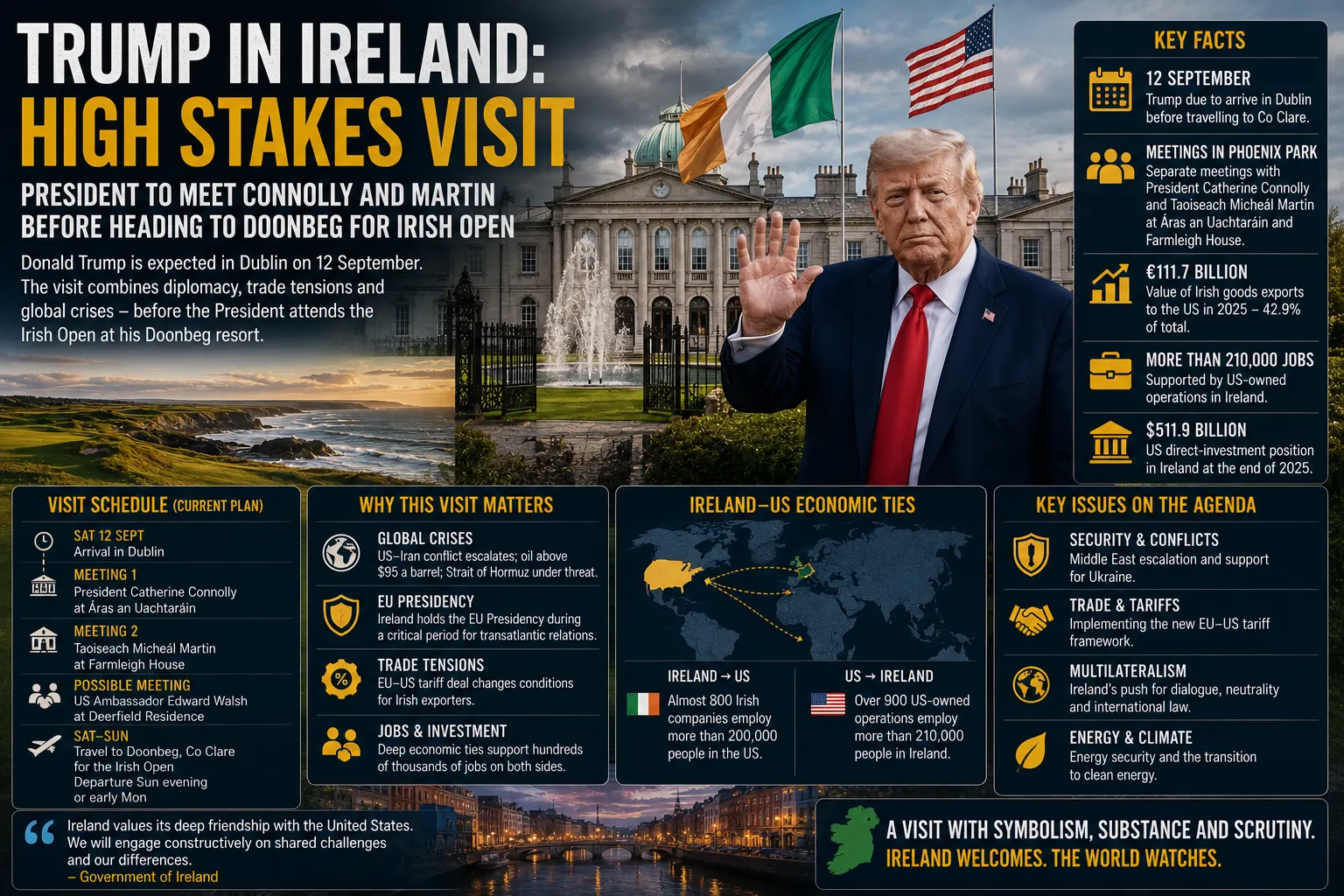
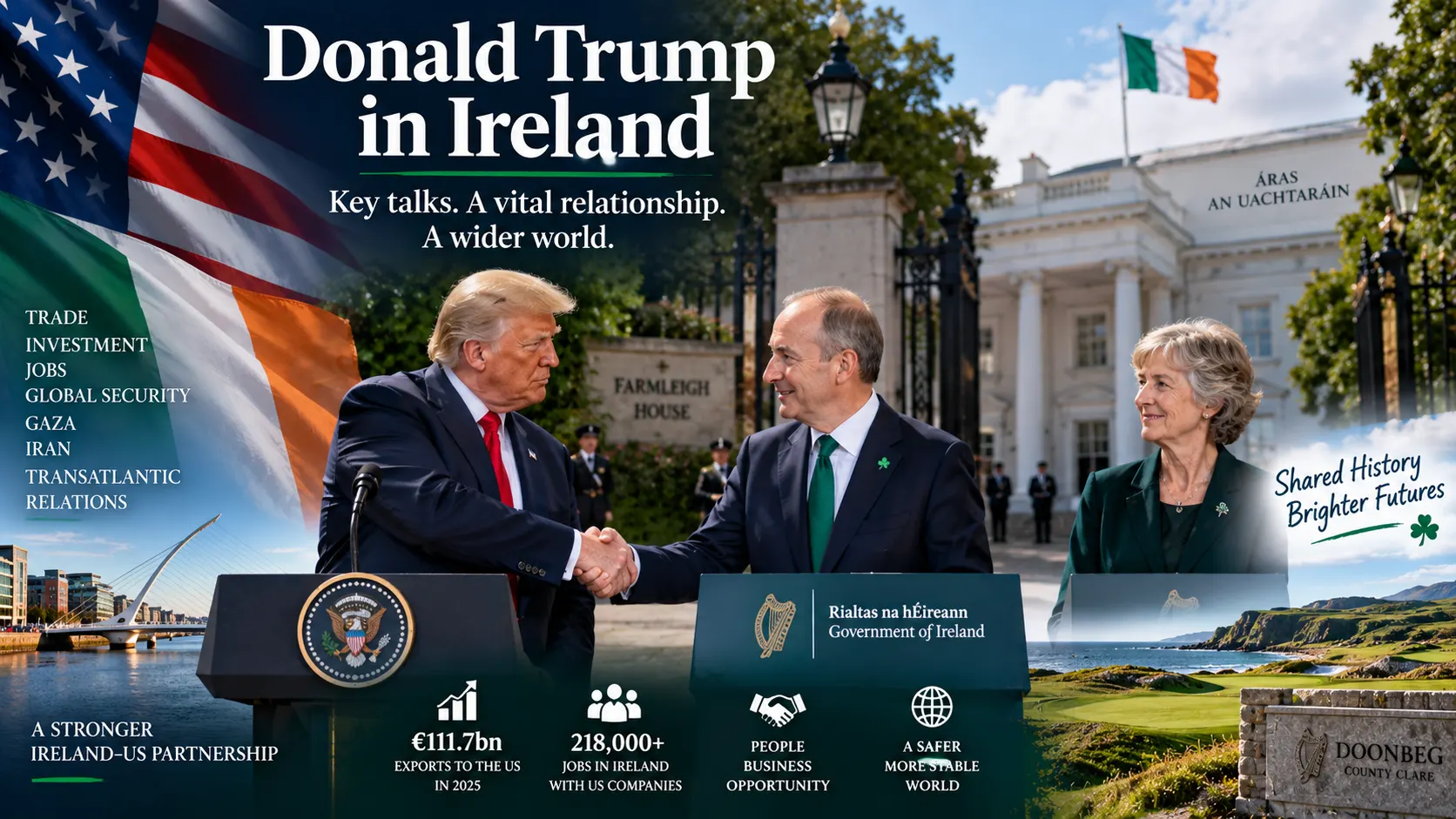
Donald Trump is expected to arrive in Dublin on Saturday, 12 September, for a visit that began as a trip linked to the Irish Open but is rapidly acquiring much greater political significance. The current schedule envisages separate meetings in Phoenix Park with President Catherine Connolly at Áras an Uachtaráin and Taoiseach Micheál Martin at Farmleigh House before the US president travels to his golf resort in Doonbeg, Co Clare. The Irish Government has not yet formally published the complete programme and officials have cautioned that individual elements can still change.
The timing ensures that the visit will be about considerably more than golf. The United States and Iran have just exchanged their heaviest attacks since July, renewed disruption around the Strait of Hormuz has pushed oil back above $95 a barrel, and Ireland is holding the Presidency of the Council of the European Union during a period of unusually difficult transatlantic diplomacy. Trade remains equally sensitive as the EU and Trump administration implement a tariff framework that has fundamentally changed the commercial conditions under which Irish exporters sell into their largest goods market.
For Ireland, the relationship is unusually consequential. The United States absorbed €111.7 billion of Irish goods exports in 2025, equivalent to 42.9% of the national total. More than 900 US-owned operations employ over 210,000 people in Ireland, while official American data put the US direct-investment position in Ireland at $511.9 billion at the end of 2025. The connection also runs strongly in the opposite direction: the Irish Government estimates that almost 800 Irish companies employ more than 200,000 people across the United States.
That economic interdependence explains why successive Irish governments have tried to preserve exceptionally close access to Washington even when serious disagreements arise over trade, international law or military policy. Trump’s visit will test that strategy in unusually public circumstances.
12 September: Trump is currently expected to arrive in Dublin before travelling to Co Clare.
Two presidential encounters: meetings are planned with President Catherine Connolly and Taoiseach Micheál Martin in Phoenix Park.
€111.7 billion: value of Irish goods exported to the United States in 2025.
$511.9 billion: US direct-investment position in Ireland at the end of 2025.
More than 210,000 jobs: employment associated with US-owned operations in Ireland.
A Golf Visit Has Turned Into a Diplomatic Event
The origins of the trip are unusual for a presidential visit. Trump’s Doonbeg property is hosting the 2026 Irish Open, and the president has for months indicated that he wanted to attend the tournament. Current plans have him spending Saturday night at the resort and attending the closing stages of the event before leaving Ireland on Sunday evening or early Monday.
The Dublin component has gradually expanded. A bilateral meeting with Micheál Martin had long been anticipated, but it emerged this week that Trump is also expected to make a courtesy call on President Catherine Connolly at Áras an Uachtaráin. That meeting is politically noteworthy because Connolly has been an outspoken defender of Irish neutrality, international law and multilateral diplomacy and has publicly criticised the resort to war in the Middle East.
The trip is not expected to resemble a traditional State visit. There are no current plans for Trump to address the Oireachtas, which is not due to return from its summer recess until 16 September. Earlier suggestions that he might turn the sod at the site of the new US embassy in Ballsbridge have also become less likely because of security and logistical complications.
Instead, the Dublin programme is expected to be concentrated inside Phoenix Park. Trump may also meet US Ambassador Edward Walsh at the nearby Deerfield Residence. The result is likely to be a tightly controlled diplomatic schedule involving Ireland’s head of state, head of government and the American diplomatic mission before the president moves west to Clare.
The Connolly Meeting Will Carry More Symbolism Than Executive Power
Catherine Connolly became Ireland’s tenth President in November 2025. Under the Constitution, the President is Head of State but does not direct the Government’s foreign, defence or trade policy. Any substantive negotiations with Washington will therefore take place principally through Micheál Martin and Government ministers rather than at Áras an Uachtaráin.
That does not make the presidential meeting insignificant. The President represents Ireland at the highest ceremonial level, and Connolly has articulated a foreign-policy philosophy that differs sharply in tone from the Trump administration’s approach to international affairs. Following the US and Israeli attacks on Iran in February, she warned against the normalisation of war and called for an immediate return to diplomacy and negotiation under international law and the UN Charter.
Her International Women’s Day statement days later went further, arguing that violations of international law could not simply be accepted as normal features of world politics. Those positions reflect a longstanding strand of Irish foreign policy built around the United Nations, peacekeeping, neutrality and negotiated conflict resolution.
The current meeting is nevertheless being described as a brief courtesy call rather than an extended policy session. That distinction provides space for both institutions to perform their constitutional roles. Connolly can receive a visiting foreign head of state without determining Government policy, while the Taoiseach remains responsible for the substantive bilateral relationship.
Micheál Martin Has Already Practised This Balancing Act in Washington
The two leaders last met at the White House on St Patrick’s Day in March. What would normally have been a ceremonial celebration of Irish-American ties took place only weeks after the United States entered the war with Iran. Questions about the conflict dominated much of the public encounter, even as Trump and Martin emphasised the strength of the economic relationship.
Trade was also clearly on the agenda. Trump joked at the beginning of the meeting that Martin would probably want to discuss tariffs. The Taoiseach used his Washington programme to emphasise that economic ties run in both directions and that Irish investment creates a large number of American jobs.
Martin’s approach has been to maintain high-level access without pretending that the two governments agree on every issue. Ireland opposed the decision by the United States and Israel to begin widespread military operations against Iran in February, while also condemning Iranian missile attacks, Tehran’s regional activities and any attempt by Iran to develop nuclear weapons. The Government’s consistent position has been that those concerns should be addressed through negotiation and international law rather than a continuing cycle of military escalation.
That formula will be tested again in Dublin. The renewed attacks of early September have returned the war to the centre of international politics just days before Trump’s expected arrival.
Ireland and America Are Economically More Connected Than the Trade Headlines Suggest
The most visible economic statistic is Ireland’s large goods surplus with the United States. In 2025, Ireland exported €111.7 billion of goods to the American market, up 52% from €73.5 billion a year earlier. The United States consequently accounted for almost 43% of all Irish merchandise exports.
Those figures require careful interpretation. Much of the extraordinary increase occurred during the first half of 2025 as pharmaceutical and other companies moved products ahead of expected US tariffs. Medical and pharmaceutical products accounted for €138.6 billion, or 53.2%, of all Irish goods exports during the year. The export boom therefore reflected both real industrial activity and an exceptional change in the timing of shipments.
The reverse effect became visible in 2026. During the first six months of this year, exports to the United States fell by 65.1% from the exceptionally high 2025 comparison to €26.2 billion. Total Irish goods exports fell 30.5%. Yet by June itself, exports to the United States were €4.3 billion, almost unchanged from June 2025.
The first-half decline should therefore not automatically be interpreted as a collapse in American demand for Irish products. The comparison is distorted by the enormous front-loading that occurred before tariffs were introduced. The more useful question is where trade settles once inventory movements and tariff anticipation cease dominating the statistics.
Ireland’s Economic Exposure to the United States
| Measure | Latest figure | Reference period |
|---|---|---|
| Irish goods exports to US | €111.7bn | 2025 |
| Share of Irish goods exports | 42.9% | 2025 |
| US direct investment in Ireland | $511.9bn | End-2025 |
| US-linked operations in Ireland | 900+ | Latest IDA figure |
| Employment in US-owned operations | 210,000+ | Latest IDA figure |
Source: Central Statistics Office, US Bureau of Economic Analysis and IDA Ireland.
The Relationship Is Not a One-Way Dependence
Ireland is frequently described as economically dependent on American multinationals, and there is substantial truth in that description. Technology, pharmaceuticals, medical devices, financial services and other US-owned industries account for a large share of high-value employment, exports and corporate taxation. But the modern economic relationship is increasingly reciprocal.
The Irish Government says Ireland is now the fifth-largest source of foreign direct investment into the United States, with Irish investment valued at approximately $390 billion. Almost 800 Irish companies employ more than 200,000 people in all 50 states. That employment includes manufacturing, food, construction materials, financial services, technology and life sciences.
Companies such as Kingspan and Kerry Group have built large American operations. Government figures presented in Washington this year said Kerry employs roughly 6,000 people across 19 states, while Kingspan employs around 2,700 people across 17 states. Those numbers matter politically because they allow Dublin to argue that Ireland is not simply a destination for American corporate investment but also an employer and investor inside the United States.
American official statistics underline the scale of the reverse relationship. The US Bureau of Economic Analysis recorded Ireland as the fourth-largest destination for US direct investment worldwide at the end of 2025, behind only the United Kingdom, the Netherlands and Luxembourg. The American investment position in Ireland stood at $511.9 billion.
These numbers include complex corporate structures and should not be confused directly with the value of factories, offices or annual production inside Ireland. But they demonstrate the depth of financial integration between the two economies.
Tariffs Have Changed the Relationship, Even Without Producing a Trade War
Trump’s return to the White House fundamentally altered the trade environment. In July 2025, the United States and European Union reached a political agreement intended to prevent a much larger transatlantic tariff confrontation. The framework was formally detailed in August.
Under the arrangement, the United States applies an all-inclusive tariff ceiling of 15% to most EU products covered by its new tariff regime. Generic pharmaceuticals and certain ingredients receive only the normal Most Favoured Nation tariff, while pharmaceuticals, semiconductors and several other strategically important sectors were brought within negotiated tariff limits. In return, the EU agreed to remove duties on US industrial goods and provide improved market access for selected American agricultural products.
The EU implemented important parts of its side of the arrangement from 1 July 2026. The European Commission has also kept retaliatory measures against American products suspended while monitoring US implementation.
For Ireland, the difference between a 15% tariff and the much higher rates threatened during earlier negotiations is economically important. But a 15% tariff is still a substantial change from the trading environment that existed before Trump’s second presidency, particularly for businesses operating on narrow margins.
The effect is highly uneven. Ireland’s most valuable exports to America include pharmaceuticals, chemicals, medical products and advanced technology. Those industries do not react to tariffs in the same way as food producers or traditional manufacturers because pricing, patents, corporate structures and supply chains differ enormously.
Martin Cannot Negotiate a Separate Irish Tariff Deal
One limit on the Dublin discussions is frequently overlooked. Ireland cannot negotiate its own bilateral customs agreement with Washington. Trade policy is an exclusive competence of the European Union under the EU treaties, meaning the European Commission negotiates external trade arrangements on behalf of the 27 member states.
Micheál Martin can therefore advocate strongly for Irish industries, explain the particular importance of pharmaceuticals and other sectors to both economies, and seek political assurances from Trump. He cannot offer the United States an Irish tariff in exchange for a separate American concession.
This makes Ireland’s current EU role especially interesting. From July until the end of December, Ireland holds the rotating Presidency of the Council of the European Union. Irish ministers chair Council meetings and help organise compromise between member states, although they are expected to act as honest brokers rather than simply use the presidency to promote national interests.
The Trump visit therefore places Ireland in two positions at once. It is one of the European economies most exposed to US trade policy, but it is also chairing much of the Council’s work while Europe manages its broader relationship with Washington.
Pharmaceuticals Are the Most Sensitive Economic Link
No sector illustrates Ireland’s exposure more clearly than pharmaceuticals. Medical and pharmaceutical products represented more than half of all Irish goods exports in 2025. Many of the world’s largest US pharmaceutical companies manufacture products in Ireland for global markets, including the United States.
The Trump administration has made pharmaceutical supply chains a central part of its industrial policy. Washington wants more medicines manufactured domestically and has linked tariff treatment to company commitments on US production, research and drug pricing. A presidential action in April established a general 15% tariff rate for relevant patented pharmaceutical products from the European Union while providing different treatment where lower rates apply or company-specific agreements have been reached.
This creates both risk and complexity for Ireland. A multinational may expand American manufacturing to satisfy US policy without necessarily closing Irish production. Pharmaceutical plants are highly specialised, expensive to replicate and embedded in international regulatory and supply networks. Investment decisions also depend on talent, intellectual property, electricity, tax policy, market access and the type of medicine being produced.
The important question is therefore not whether every pharmaceutical job will migrate across the Atlantic. There is no evidence to support such a claim. The risk is that the marginal decision about where the next factory, production line or research investment is located becomes more competitive when the United States offers stronger incentives for domestic manufacturing.
Ireland’s Public Finances Add Another Layer of Exposure
The importance of multinational companies reaches beyond employment and exports. Ireland collected €32.9 billion in corporation tax during 2025, a 17.2% increase from the previous year. Revenue’s latest analysis shows that the ten largest individual corporate taxpayers contributed approximately €18.6 billion.
That concentration is a recognised fiscal risk. Company identities are protected by taxpayer confidentiality, so it is not possible to attribute the largest payments specifically to American firms from official figures. What is known is that foreign multinationals operating in sectors such as technology, pharmaceuticals and finance account for a very large share of the Irish corporate tax base.
The Irish Fiscal Advisory Council has repeatedly warned that headline budget surpluses conceal dependence on receipts that may not be permanent. The Government has responded by placing some of the revenue into the Future Ireland Fund and Infrastructure, Climate and Nature Fund rather than committing all of it to recurring expenditure.
US industrial or tax policies that changed multinational investment patterns could therefore affect Ireland through several channels simultaneously: fewer future investments, weaker exports, employment effects and lower tax revenue. That does not make such an outcome inevitable, but it explains why trade relations with Washington carry unusual importance for Irish fiscal policy.
€18.6 billion in corporation tax was paid by Ireland’s ten largest corporate taxpayers in 2025, illustrating the exceptional concentration of part of the State’s revenue base.
The Iran War Creates a Much More Difficult Political Conversation
Economics might have dominated the visit under normal circumstances. The renewed US-Iran conflict makes foreign policy impossible to avoid. American forces have carried out new strikes against Iranian air-defence, radar, maritime and military infrastructure, while Iran has responded with missiles and drones against American interests in several Middle Eastern countries.
Trump said this week that he did not expect the latest US bombing campaign to continue for long, although he also said the United States was prepared to strike again. The conflict has already disrupted energy supplies, contributed to higher oil prices and placed additional pressure on countries hosting American military forces.
Ireland’s position differs from Washington’s on the method rather than on every underlying concern. The Government has repeatedly stated that Iran must not acquire nuclear weapons and has condemned Iranian attacks and destabilising actions. It has also criticised the decision by the United States and Israel to launch widespread military action and consistently called for de-escalation, diplomacy and compliance with international law.
When an interim US-Iran agreement was reached in June, Foreign Affairs Minister Helen McEntee welcomed it and emphasised both negotiations over the nuclear programme and the reopening of the Strait of Hormuz. The subsequent collapse of that arrangement and renewed attacks leave Ireland with essentially the same diplomatic position it held earlier in the war: criticism of Iranian conduct combined with opposition to an open-ended military cycle.
A substantive Martin-Trump discussion would therefore involve genuine disagreement. The Taoiseach is unlikely to persuade an American president to reverse a major military strategy during a brief bilateral meeting. The practical value of the encounter lies more in conveying Ireland’s position directly, understanding Washington’s intentions and keeping communication open during an unstable period.
Catherine Connolly Could Make the Contrast More Visible
Connolly’s presence gives the visit an additional dimension that did not exist during Trump’s 2019 trip to Ireland. Her public language on the Iran conflict has been more explicitly framed around the danger of normalising military force and violating the sovereignty of states.
That creates the possibility of an encounter between two presidents with markedly different instincts on international security. Yet the constitutional character of the meeting should prevent that difference from being confused with a bilateral negotiation. Connolly is not empowered to commit Ireland to foreign-policy changes or negotiate with Washington on behalf of the Government.
The meeting nevertheless carries symbolic value precisely because the Irish presidency is designed to stand somewhat apart from everyday party politics. A courteous encounter does not imply endorsement of Trump’s foreign policy, just as disagreement over war does not prevent the Irish head of state receiving the elected president of a country with which Ireland has one of its closest international relationships.
Neutrality and Shannon Will Remain in the Background
The American military relationship has long created domestic debate in Ireland, particularly around the use of Shannon Airport by US military personnel and aircraft. The controversy has intensified during periods of American military action because critics argue that extensive US transit is difficult to reconcile politically with Ireland’s military neutrality.
The Government rejects the claim that Shannon is being used as an operational base for attacks on Iran. During his March visit to the United States, Martin said the airport was not being used by aircraft involved in the bombing campaign and stated that there were established rules governing the use of Irish airspace and facilities.
Those assurances have not ended the political argument. Planned demonstrations around Trump’s visit involve groups concerned about neutrality alongside wider opposition to his policies. Protests are expected in Dublin and Co Clare, contributing to the decision to keep much of the presidential programme within tightly controlled locations.
The distinction between military neutrality and diplomatic relations is important. Ireland maintains extensive political, commercial and cultural ties with the United States without being a NATO member. The Government’s position is that military neutrality does not require political neutrality or diplomatic distance.
The Visit Comes While Ireland Is Chairing European Foreign-Policy Discussions
The timing is especially striking because Irish ministers are currently hosting major EU defence and foreign-affairs meetings under the country’s Council Presidency. European security, Ukraine, transatlantic relations and the Middle East have all been on the agenda this week.
Ireland’s Presidency programme is organised around competitiveness, values and security. That combination mirrors many of the tensions surrounding the Trump visit. Europe wants access to the American market and continued US investment while becoming less dependent on external powers for defence, energy and critical technologies. It also wants to preserve a rules-based international system at a time when military conflict and unilateral trade measures have become more common.
Ireland has traditionally viewed strong EU membership and close American relations as complementary rather than competing identities. That formula worked particularly well when Washington and Brussels broadly agreed on trade liberalisation, multilateral institutions and European security. It becomes harder when the United States itself pursues policies that European governments challenge.
Dublin’s diplomatic task is consequently more complex than simply being a bridge between two sides. A bridge cannot determine where either side wants to go. Ireland can facilitate communication, protect relationships and explain European positions, but major decisions on tariffs, war and strategic competition will be made in Washington, Brussels and other capitals.
Northern Ireland Still Gives the US Relationship a Strategic Dimension
Economic ties may dominate modern Irish-American relations, but the peace process remains a foundational part of the political relationship. Successive American administrations played important roles in supporting negotiations that produced the Good Friday Agreement in 1998. US administrations, members of Congress, Irish-American organisations and American diplomats have continued to take an interest in Northern Ireland since then.
That history matters because it gives the relationship an institutional depth that survives individual presidents. Governments in Dublin work not only with the White House but with Congress, state governments, businesses, universities and the Irish-American community. More than 35 million Americans identify Irish ancestry, creating political connections far beyond the federal executive.
The bilateral relationship should therefore not be reduced to the personalities of Trump, Martin or Connolly. Presidents and Taoisigh change, while trade, migration, investment and the peace process produce networks that last across administrations.
Security Will Shape What the Public Actually Sees
The presidential visit will require a major Garda and Defence Forces operation. Airspace restrictions, protected motorcades, specialist units and extensive coordination with the US Secret Service are expected. The State has been preparing for the visit for several months.
Officials appear to be reducing unnecessary movement in Dublin. A proposed stop in Ballsbridge at the future US embassy site is now considered unlikely, while the principal meetings are concentrated in Phoenix Park. Trump is expected to travel onwards to Doonbeg by air rather than undertake a long road journey across the country.
That security model limits both disruption and exposure to planned protests. Demonstrations are being organised in Dublin and Clare, while the Doonbeg segment of the visit is expected to operate inside a heavily secured environment around the golf resort and tournament.
No reliable final public estimate has yet been given for the cost of the security operation, and it would be premature to assign one. Previous presidential visits have required substantial public resources, but the eventual cost depends on the duration, routes, staffing and level of security required.
What Is Currently Expected on 12–13 September
| Stage | Expected engagement | Status |
|---|---|---|
| Dublin Airport | Arrival and Government welcome | Expected |
| Áras an Uachtaráin | Courtesy meeting with President Connolly | Planned |
| Farmleigh House | Bilateral meeting with Taoiseach Martin | Expected |
| Deerfield Residence | Possible meeting with US Ambassador | Possible |
| Doonbeg | Irish Open and overnight stay | Expected |
Source: Current reporting from RTÉ News and The Irish Times. The Government has not yet formally published the complete itinerary and plans may change.
What Ireland Can Realistically Gain From the Visit
The most valuable outcome for Dublin may not be a dramatic announcement. Ireland cannot conclude its own tariff agreement, a presidential visit will not settle the Iran war and major corporate investment decisions are rarely determined by one political meeting. The practical benefits are more incremental.
Martin can reinforce the argument that American investment in Ireland supports US corporate access to the European Single Market rather than simply moving jobs out of America. He can emphasise the scale of Irish investment and employment in the United States. He can raise specific concerns about the implementation of tariffs, pharmaceutical policy and future industrial measures before they become more serious disputes.
The Government can also seek reassurance about the stability of the broader economic relationship. Multinational investment decisions are highly sensitive to predictability. Even when tax rates or tariffs are not ideal from a company’s perspective, businesses can often adapt if the rules are clear. Abrupt changes and repeated policy reversals create a different kind of risk.
On foreign policy, Ireland can restate its support for diplomacy and international law directly to the president responsible for American military strategy. Whether that changes US policy is uncertain, but diplomacy frequently involves maintaining access precisely when governments disagree.
What Trump May Want From Ireland Is Different
Washington has its own interests in the relationship. The Trump administration has repeatedly argued that large US trade deficits are evidence of an unbalanced economic relationship. Ireland’s large goods surplus makes it a conspicuous example when bilateral statistics are viewed without the wider investment and services relationship.
The administration also wants companies selling pharmaceuticals, semiconductors and strategic products into the American market to build more production inside the United States. Ireland’s success in attracting precisely those industries makes it directly relevant to Trump’s reshoring agenda.
At the same time, American companies benefit substantially from their Irish operations. Ireland provides an English-speaking base inside the European Union, access to the Single Market, a multinational workforce and established clusters in technology, pharmaceuticals and financial services. Removing those operations from Ireland would not automatically mean equivalent production appeared in the United States; companies make global investment decisions involving many competing locations.
Trump therefore approaches Ireland as the president of a country seeking more domestic manufacturing while representing American corporations that have invested hundreds of billions of dollars in the Irish economy. That tension is built into the relationship rather than created by the visit.
Three Longer-Term Outcomes Are Plausible
The most benign scenario is a stabilisation of transatlantic relations. The EU-US tariff framework remains in place, companies adapt to the new duties and both sides avoid another major trade confrontation. In that environment, Ireland could continue attracting American investment while Irish companies expand further in the United States. Growth might be slower in some sectors without fundamentally changing the model.
A second possibility is a gradual rebalancing of investment. US incentives, tariffs and industrial policy could encourage multinational companies to place a greater proportion of new production in America. Ireland might retain existing high-value plants and European headquarters but win a smaller share of future expansion. Such a change would unfold over years rather than through a sudden corporate exit.
The most difficult scenario would combine renewed trade conflict with geopolitical divergence. Higher US tariffs, aggressive reshoring policies and repeated disagreements over international law or European security could weaken the political foundation supporting the economic relationship. Ireland would then face stronger pressure to diversify trade and investment while remaining deeply connected to American companies already operating here.
None of these futures is predetermined. The EU-US relationship has already moved from threats of much higher tariffs to a negotiated framework within the space of a year. The Iran conflict has likewise alternated between major fighting, negotiations and temporary agreements. Policy can change rapidly in both areas.
The Importance of the Visit Lies in the Contradictions
The expected Trump visit brings several Irish realities together in one weekend. Ireland is a militarily neutral country receiving the commander-in-chief of a United States fighting a major Middle Eastern war. It is one of the world’s most Americanised economies while simultaneously holding the Presidency of the Council of the European Union. Its President has publicly warned against the normalisation of war while its Taoiseach must manage one of the State’s most valuable diplomatic and economic relationships.
Those positions are not necessarily incompatible, but they require careful diplomacy. Ireland benefits enormously from American investment and the American market. The United States benefits from Irish investment, corporate operations and a long-standing political relationship with a strategically important EU member. Both countries have reasons to preserve that partnership even when their governments disagree.
For that reason, the success of the September visit should probably not be measured by whether Trump and Martin announce a new deal or whether Connolly and Trump conceal their political differences. The more meaningful test is whether Ireland can protect the economic and political relationship without abandoning its ability to disagree with Washington where national and European positions diverge.
The photographs from Áras an Uachtaráin, Farmleigh and Doonbeg will dominate the immediate coverage. The questions behind them will last much longer: where American companies choose to invest, how the transatlantic tariff system develops, whether the Iran conflict can return to diplomacy and whether Ireland can continue to maintain unusually close relationships with both Washington and Brussels as those two centres of power become more difficult to reconcile.
Sources
RTÉ News — Trump to Visit President at Áras an Uachtaráin During Ireland Trip
The Irish Times — Donald Trump to Meet Catherine Connolly During Phoenix Park Engagements
President of Ireland — Constitutional Role of the President
President of Ireland — Statement by President Connolly Following Strikes on Iran
Department of Foreign Affairs and Trade — Statement on the Outbreak of Conflict With Iran
Department of the Taoiseach — Micheál Martin’s St Patrick’s Day Visit to the United States
Central Statistics Office — Goods Exports and Imports, December 2025
Central Statistics Office — Goods Exports and Imports, June 2026
US Bureau of Economic Analysis — Direct Investment by Country and Industry, 2025
IDA Ireland — Ireland-US Investment and Employment Relationship
European Commission — EU-US Framework on Reciprocal, Fair and Balanced Trade
White House — Adjusting Imports of Pharmaceuticals and Pharmaceutical Ingredients
Revenue — Corporation Tax: 2025 Payments and 2024 Returns
Department of Foreign Affairs and Trade — Ireland’s 2026 EU Presidency Priorities
Source & Transparency
This article is published by Ireland Newspaper for editorial and informational purposes.
Published: 3 September 2026 · Updated: 3 September 2026

Newsroom Ireland Newspaper
Ireland Newspaper editorial team prepares daily news coverage for readers in Ireland and abroad.



Market data, financial news and economy content on Ireland Newspaper are provided for editorial and informational purposes only. They do not constitute financial advice, investment advice, trading advice or a recommendation to buy, sell or hold any financial product. Always verify live prices and consult a qualified professional before making financial decisions.