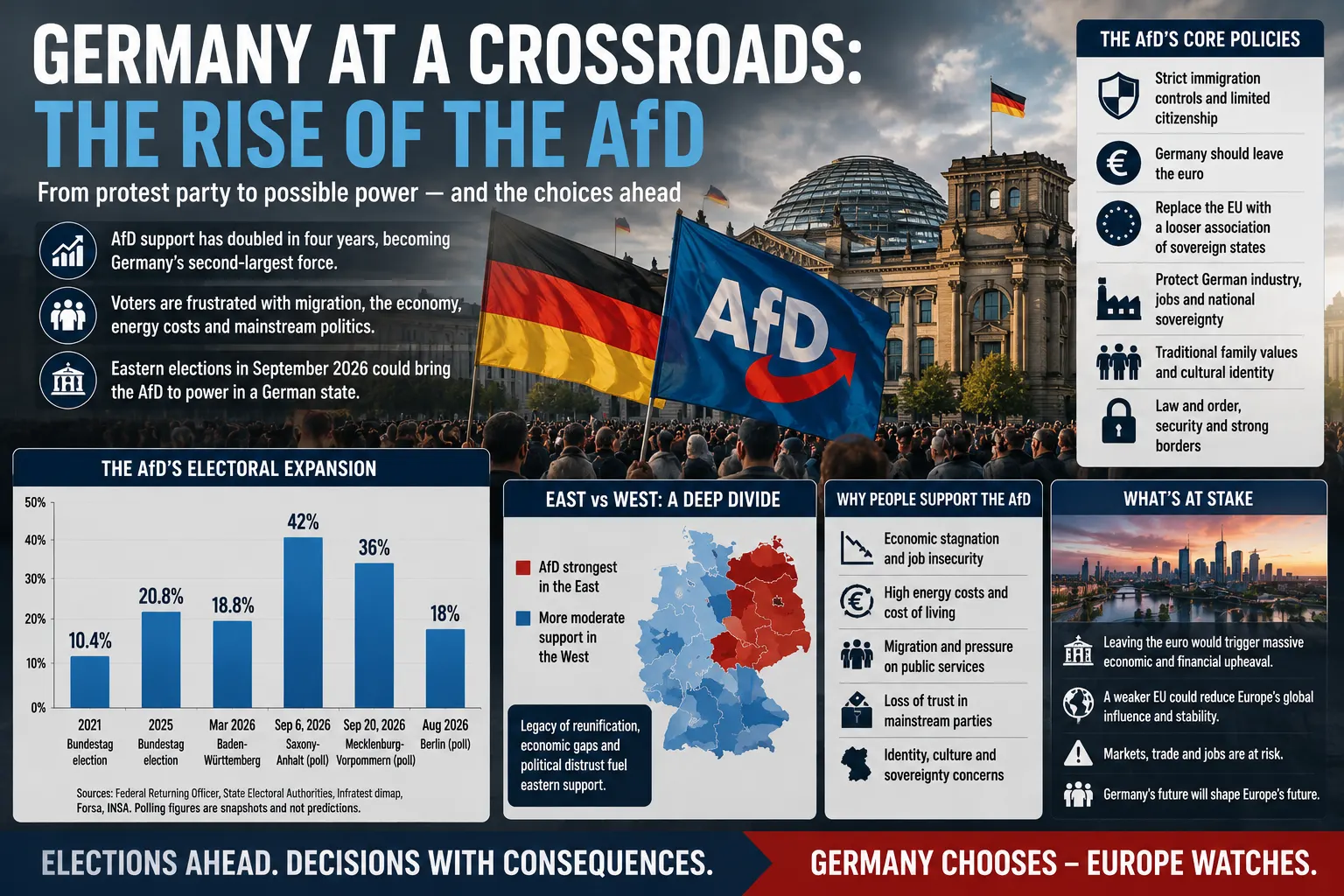
Five days before Saxony-Anhalt votes for a new state parliament, the Alternative for Germany is polling at 42 per cent — twice the share it won there in 2021 and almost twice the support of the governing Christian Democrats. A second eastern election follows in Mecklenburg-Western Pomerania on 20 September, where the AfD has recently polled at 36 per cent. What began in 2013 as a small eurosceptic party opposing the management of the euro crisis has become Germany’s second-largest federal parliamentary force and, in parts of the east, a potential governing party.
The development is part of a wider European shift, but Germany is not simply following the same path as Italy, France, Austria or the Netherlands. Parties to the right of Europe’s traditional centre-right have gained influence for different reasons and with substantially different programmes. Some have moderated important positions after approaching government; others remain outside power despite winning elections. The AfD is distinctive because its current federal programme combines a much stricter immigration and citizenship regime with an explicit German departure from the euro system and a proposal to replace the present European Union with a substantially looser association of sovereign states.
Those proposals address frustrations that cannot simply be dismissed. Germany has experienced weak economic growth, industrial restructuring, high energy costs, pressure on housing and public services, contentious migration debates and growing distrust of established political parties. Eastern regions face additional problems of demographic decline, lower incomes and the long after-effects of reunification. Voters supporting the AfD are not a single ideological group, and voting for the party does not by itself establish that a voter endorses every position or statement associated with its more radical figures.
A critical examination nevertheless has to move beyond the reasons people vote for the AfD and examine what implementation of its programme could mean. Germany is one of the world’s most export-dependent large economies, is deeply integrated into European production chains and increasingly relies on foreign workers as its population ages. Reconstructing its relationship with the EU, abandoning the euro and sharply narrowing parts of the migration system could therefore have consequences considerably larger than the slogans through which those policies are often presented.
The AfD Has Moved From Protest Party to Mass Electoral Force
The AfD’s rise has been rapid by the standards of post-war German politics. Founded during the euro-area debt crisis in 2013, it initially concentrated on monetary policy and opposition to financial transfers within the euro area. The migration crisis of 2015 and 2016 transformed both its electorate and internal politics, with immigration, Islam, national identity and opposition to Angela Merkel’s refugee policy becoming increasingly central.
The party entered the Bundestag in 2017 with 12.6 per cent of the second vote. Its share slipped to 10.4 per cent in 2021 but then doubled to 20.8 per cent in the February 2025 federal election. The Federal Returning Officer recorded more than 10.3 million AfD second votes, making the party the second-strongest force nationally and giving it 152 seats in the 630-member Bundestag.
The growth did not stop after the federal election. The AfD won 18.8 per cent in Baden-Württemberg in March 2026, almost twice its 2021 result there, and around one fifth of the vote in Rhineland-Palatinate later the same month. These western results matter because they weaken the idea that AfD support is exclusively an eastern German phenomenon.
National surveys during the summer have placed the party in the high twenties, in some polls ahead of Chancellor Friedrich Merz’s CDU/CSU. Opinion polls are snapshots rather than election forecasts, but the direction is politically important. The question confronting Germany is increasingly not whether the AfD can remain a major opposition party, but whether its electoral strength will eventually translate into executive power.
The AfD’s Electoral Expansion
| Election / Poll | AfD Support | Significance |
|---|---|---|
| 2021 Bundestag election | 10.4% | National baseline before rapid expansion |
| 2025 Bundestag election | 20.8% | Second-largest federal parliamentary force |
| Baden-Württemberg, March 2026 | 18.8% | Major advance in western Germany |
| Saxony-Anhalt poll, August 2026 | 42% | Clear lead before 6 September election |
| Mecklenburg-Western Pomerania poll | 36% | Lead before 20 September election |
| Berlin poll, August 2026 | 18% | Level with CDU in latest Forsa survey |
Sources: Federal Returning Officer, Baden-Württemberg electoral authorities, Infratest dimap, Forsa and INSA. Polling figures are snapshots and not predictions of election results.
Europe Has Moved Right — but Not in One Direction
The AfD’s development belongs to a broader fragmentation of European politics. In the European Parliament elected in 2024, Patriots for Europe secured 84 seats, the European Conservatives and Reformists 78 and Europe of Sovereign Nations 25 at the constitutive session. Yet treating all 187 members of these three groups as politically identical would be misleading. The ECR includes national-conservative parties that differ substantially from parties in the more radical ESN group to which the AfD’s European representatives belong.
Italy demonstrates one possible path. Giorgia Meloni entered office in 2022 after years of radical-right opposition but has subsequently governed more pragmatically on European fiscal policy, NATO and several questions involving EU institutions than some of her earlier rhetoric suggested. Her Brothers of Italy remains strongly conservative on migration, security and cultural policy, but Rome has not attempted to leave the euro or dismantle the EU single market.
Austria provides a different example. The Freedom Party won the 2024 parliamentary election with about 29 per cent but failed to construct a governing coalition. A combination of the conservative ÖVP, Social Democrats and liberal NEOS subsequently formed a government without it. Winning the largest number of votes therefore did not automatically produce executive power.
The Netherlands shows that electoral momentum can also reverse. Geert Wilders’ Party for Freedom became central to government after its breakthrough, but that arrangement collapsed and a pro-European D66-led minority government took office in February 2026. Hungary moved in the opposite direction again when Viktor Orbán, one of Europe’s most influential nationalist leaders, lost power in April after 16 years to the centre-right Tisza party.
France remains the largest unresolved test. Marine Le Pen was polling at approximately 36 per cent for the first round of the April 2027 presidential election in surveys published in July, and current polling gives her a credible path to the presidency. European politics is consequently experiencing a strong nationalist and populist-right current, but not a uniform or irreversible march in one direction.
Why the AfD Is Different From Many of Europe’s Governing Right-Wing Parties
The central difference is not that the AfD is the only European party demanding tougher borders. Mainstream governments from Denmark to Italy and the Netherlands have already tightened asylum policies, and the EU itself has strengthened external-border and return policies. Nor is scepticism about Brussels unusual. Disagreement over regulatory centralisation, agricultural rules, climate legislation and migration is widespread across the European political spectrum.
The AfD goes materially further on the institutional structure of European integration. Its 2025 federal election programme states explicitly that Germany must leave the euro system and argues for the restoration of a national currency, potentially alongside a parallel euro or a European accounting unit. It separately proposes replacing the current EU with a newly created “Federation of European Nations” — a European economic and interest community in which most competences would return to national governments.
The programme says such an organisation should retain a common market, protect external borders, coordinate strategic security interests and preserve European cultures and identities. The party therefore does not propose ending every form of European economic cooperation. Its objective is a fundamental reconstruction of the institutional system through which that cooperation currently operates.
That makes the economic question more complicated than simply asking whether the AfD supports or opposes Europe. Germany could theoretically participate in extensive cross-border commerce outside the present EU architecture. Britain, Norway and Switzerland demonstrate different models of close European economic relations outside either the EU or euro area. None, however, reproduces all the benefits and obligations of full membership while allowing complete national autonomy over the rules governing the market.
A Common Market Requires Common Rules
The tension inside the AfD proposal becomes clearest in the single market. The party says it wants to preserve a common European market while returning most other political competences to the nation state. Yet the existing single market works partly because common rules determine product standards, competition, state aid, consumer rights, transport, financial services and the mutual recognition of goods and professional qualifications.
Common institutions also determine what happens when governments interpret those rules differently. Removing substantial supranational authority while maintaining nearly frictionless commerce would therefore require an alternative system capable of resolving the same disputes. Otherwise businesses would increasingly face separate national standards, courts and certification requirements.
For a relatively self-contained economy, some additional friction could be manageable. Germany’s industrial system is unusually integrated with its neighbours. Components move between Germany, Czechia, Poland, Austria, France, the Netherlands, Slovakia and other countries before a finished vehicle, machine or chemical product reaches its customer.
Germany was the leading destination for merchandise exports from 16 of the EU’s other 26 member states in 2025. In December alone, Germany exported €75.3 billion of goods to other EU countries out of €133.3 billion in total exports. More than half of German goods exports that month therefore remained inside the Union.
Disrupting this system would not require the reintroduction of visible customs posts to create costs. Diverging regulations, currency risk, certification, border formalities and uncertainty over future legal rules can all increase the price of doing business. A Mittelstand manufacturer deciding where to construct a new factory would have to consider not only German tax and labour costs but whether its products would continue to move into the rest of the European market under exactly the same conditions.
Leaving the Euro Would Be an Economic Experiment Without a Modern German Precedent
The AfD argues that a restored national currency would allow Germany to regain control over interest rates and exchange-rate policy. In its programme, the party acknowledges that changing currency would create transitional costs but argues that these would ultimately be smaller than the costs of remaining within what it regards as an unsustainable transfer system.
There are legitimate economic arguments about the design of the euro. A common interest rate has to serve economies with different debt levels, productivity trends and business cycles. The euro crisis demonstrated that monetary union without complete fiscal union can create severe tensions, and disputes over shared borrowing continue today.
For Germany, however, leaving would create a separate category of risk. Contracts, mortgages, bank deposits, sovereign debt, company accounts and cross-border liabilities currently denominated in euros would need rules determining whether and how they were converted. Financial markets would immediately attempt to estimate the exchange rate of a new German currency.
A new Deutsche Mark could appreciate because of Germany’s trade position and perceived financial strength. That could make imported goods cheaper but German exports more expensive abroad. Companies whose production costs were denominated in a stronger national currency while competitors remained in euros could lose price competitiveness.
Alternatively, uncertainty surrounding the transition could initially generate capital movements, financial-market volatility and higher risk premiums. The exact outcome cannot be calculated in advance because no country of Germany’s size and importance has ever left the euro.
AfD European Policy: Objective and Potential Trade-Off
| AfD Proposal | Stated Objective | Potential Risk |
|---|---|---|
| Leave euro system | Restore national monetary sovereignty | Currency, contract and financial-market disruption |
| Replace present EU architecture | Return powers to sovereign states | Single-market and regulatory uncertainty |
| Reject further EU debt | Limit German financial liability | Reduced joint crisis and investment capacity |
| End current Russia sanctions | Restore trade and cheaper energy links | Conflict with current EU foreign-policy consensus |
| Reopen Nord Stream | Lower energy costs | Renewed strategic dependence on Russian supply |
Source: AfD federal election programme 2025. Potential risks are analytical assessments, not predetermined outcomes.
Economic Estimates of a Full Dexit Are a Warning, Not a Forecast of the AfD Programme
Attempts to calculate the cost of a German departure from European integration produce dramatic figures, but they need to be used carefully. A 2024 study by the Cologne-based German Economic Institute, IW, used Britain’s experience after Brexit to construct a counterfactual scenario for Germany. It estimated that a full German departure from the EU could leave real GDP 5.6 per cent lower after five years, involve cumulative lost output of roughly €690 billion and put approximately 2.5 million jobs at risk.
Those numbers are not a reliable prediction of the precise AfD programme now before voters. The 2025 programme calls for replacing the existing EU with a new economic association that would retain a common market rather than simply severing economic links. The IW study also necessarily depends on assumptions derived from Britain’s very different economic structure and Brexit experience.
It is nevertheless useful as a stress test. The study demonstrates how valuable European integration is to an export-oriented economy if a restructuring causes trade barriers similar to those associated with Brexit. The larger the gap between the current single market and whatever replaced it, the larger the economic risk would become.
The same principle applies to the euro. The economic consequences of a euro exit would come on top of any trade effects and could move in either direction for individual sectors. Exporters could suffer from a stronger currency while importers and consumers could benefit from cheaper foreign goods. Savers, banks and borrowers would be affected according to the conversion rules eventually chosen.
The critical weakness is therefore uncertainty. Businesses can plan around a known tax rate or labour cost. It is much harder to make a 20-year investment when the future currency, EU legal relationship and cross-border regulatory regime are simultaneously subject to fundamental renegotiation.
Germany’s Industrial Weakness Helps the AfD — but Makes Disruption More Dangerous
The AfD’s European policy is gaining support during a period in which Germany’s established economic model is already under pressure. Cheap Russian pipeline gas is no longer available on its previous scale, China has become both a crucial market and formidable industrial competitor, and US tariffs have complicated another major export relationship. Volkswagen and other manufacturers are restructuring operations as they confront excess capacity, weaker Chinese sales and technological change.
These problems provide fertile ground for a party arguing that existing policy has failed. High electricity prices, bureaucracy, climate regulation and fear of industrial job losses are genuine concerns for many companies and employees. The AfD promises lower energy costs, reduced regulation, restored Russian trade and a slower transition away from fossil fuels.
Some of those measures could reduce particular costs in the short term. Removing carbon charges would directly lower energy costs for certain users. Simplifying regulation can reduce administrative expenditure. Greater availability of gas could potentially ease wholesale energy pressure if infrastructure and geopolitical conditions permitted it.
The longer-term trade-offs are less favourable if policy uncertainty discourages investment in industries already moving towards electrification, renewable power and low-carbon production. A manufacturer planning a battery plant, grid-equipment factory or green-steel project needs to know whether Germany will maintain the European regulatory framework under which the investment was designed.
The risk is therefore that a political response to industrial insecurity could create a new form of investment insecurity. That outcome is not inevitable, but it becomes more plausible when several major policy frameworks — currency, EU membership structure, climate regulation and relations with Russia — are proposed for simultaneous revision.
Migration Is Where the Political Argument Is Strongest — and the Economic Contradiction Sharpest
The AfD’s electoral rise cannot be understood without immigration. Germany admitted large numbers of asylum seekers during the 2015–2016 refugee crisis and later received more than a million Ukrainians after Russia’s full-scale invasion. Municipalities have faced pressure on accommodation, schools and administrative services, while high-profile crimes involving foreign suspects have intensified demands for stronger border control and deportation of people without a legal right to remain.
Criticism of failed asylum procedures or weak enforcement is not confined to the AfD. Successive German governments and the EU have tightened migration rules, expanded border checks and attempted to accelerate returns. A functioning asylum system ultimately requires both protection for those legally entitled to it and credible enforcement when applications fail.
The AfD goes considerably further. Its 2025 programme calls for nationally controlled immigration, a comprehensive return campaign, stronger border enforcement, removal of several mechanisms through which tolerated migrants can regularise their status and withdrawal from the UN Global Compact for Migration and Global Compact on Refugees. It seeks more restrictive citizenship rules, including naturalisation generally no earlier than after ten years even with strong integration and the reintroduction of broad restrictions on multiple citizenship.
The programme would abolish the entitlement to citizenship based on long residence and the existing birthright route available to qualifying children of foreign parents. It also proposes reducing social benefits for certain groups and separating humanitarian protection much more clearly from labour migration.
These are major restrictions, but accuracy requires another fact that is frequently lost in political debate: the AfD does not propose ending all foreign labour migration. Its programme explicitly says it welcomes selected qualified workers in areas experiencing shortages, naming skilled trades, healthcare, scientific occupations and information technology. Its argument is that labour migration should be selective and separated from the asylum system.
Germany’s Labour Market Is Already Becoming More Dependent on Foreign Workers
The economic tension arises because Germany’s demographic transition is happening faster than the political debate over immigration. The Federal Employment Agency said in July 2026 that employment growth since 2024 had been driven exclusively by foreign workers. Employment among German and other EU nationals was already declining as larger generations reached retirement and smaller generations entered the labour market.
The agency’s executive board said workers from third countries were particularly important in stabilising companies’ labour demand. This does not mean every foreign resident fills a shortage occupation or that immigration automatically benefits every public budget. Skill levels, employment rates and fiscal outcomes differ substantially between migrant groups.
It does mean that reducing immigration has an arithmetic consequence unless the missing labour can be replaced through higher domestic participation, longer working hours, later retirement, automation or productivity growth. The AfD argues that Germany has substantial unused domestic labour, including trained workers who have left particular professions because of poor conditions. There is evidence for untapped potential, especially among part-time workers and people whose qualifications are underused.
The scale of demographic ageing, however, makes it uncertain whether domestic mobilisation can fully substitute for migration. Hospitals need nurses, care homes need staff, construction companies need skilled tradespeople, manufacturers need technicians and digital businesses need engineers. These shortages are likely to become more difficult as the baby-boom generation retires.
This is particularly relevant in eastern Germany, where the AfD is strongest. Many eastern regions have spent decades losing younger residents and now have older populations and fewer working-age people. The same electorate demanding much tighter migration therefore lives in regions whose economic viability increasingly depends on attracting workers from elsewhere.
The Migration Policy Tension
| Policy Area | AfD Position | Economic Question |
|---|---|---|
| Asylum and returns | Much stricter enforcement and deportation | Can legitimate cases and labour pathways remain efficient? |
| Skilled migration | Selected qualified immigration welcomed | Can Germany attract enough workers under stricter rules? |
| Citizenship | Longer path and fewer dual nationalities | Will skilled migrants choose to settle elsewhere? |
| Domestic workforce | Mobilise unused German labour first | Is the potential large enough to offset ageing? |
| Foreign employment | Not targeted as a single category | Foreign workers already underpin employment growth |
Sources: AfD federal election programme and German Federal Employment Agency.
Citizenship Policy Can Influence Labour Migration Even When Work Visas Remain Open
A country’s attractiveness to skilled migrants depends on more than whether a work permit can be obtained. Salary, housing, schools, language, taxation, professional recognition and the possibility of building a permanent life all influence where mobile workers choose to settle. Germany competes for doctors, engineers, nurses, researchers and IT specialists with countries including Switzerland, the Netherlands, Britain, Canada, Australia and the United States.
A longer route to citizenship and tighter restrictions on dual nationality could therefore have effects extending beyond the people directly affected by asylum policy. A highly qualified worker considering a decade in Germany may attach significant value to whether citizenship is attainable without giving up an existing nationality.
The size of such an effect is uncertain and should not be exaggerated. Employment opportunities and salaries can outweigh citizenship rules, and many migrants never intend to naturalise. But in a demographic competition for globally mobile professionals, policy works partly through perceptions of long-term belonging.
There is also a difference between removing people without legal residence and creating an environment in which lawful migrants question whether they are wanted. The AfD argues that this distinction is fundamental to its policy and says qualified workers who contribute to Germany are welcome. Whether that distinction would be perceived as clearly abroad as it is written in the programme would be economically important.
Mass Return Rhetoric Often Obscures the Legal Limits on Government Power
The term “remigration” has become one of the most controversial words surrounding the AfD. It has been used by different actors to mean different things, ranging from ordinary enforcement of deportation orders to much broader concepts promoted by parts of Europe’s radical right. A factual assessment should not attribute every version of the concept to the AfD’s federal programme.
The national programme calls for a large-scale return initiative focusing on people who are not entitled to remain, abolition of several toleration and regularisation routes, and reassessment of protection where legal grounds cease to exist. Any government implementing these measures would remain bound by Germany’s Basic Law, individual judicial review, EU law while applicable and international obligations that Germany had not lawfully withdrawn from.
The practical limits are considerable. Deportation requires proof of identity, a receiving country willing to accept the person, transport capacity and compliance with rules preventing removal to countries where serious harm is likely. Germany has struggled with these problems under governments already committed to increasing deportations.
Moving from political commitment to substantially larger numbers would therefore require administrative resources, bilateral agreements and lengthy legal procedures. It could also create economic disruption where people with insecure residence status are already employed, trained or integrated into local labour markets.
Supporters of stricter enforcement respond that failing to remove people after final legal rejection undermines confidence in the asylum system and creates incentives for irregular migration. That concern deserves serious consideration. The policy question is whether enforcement can be strengthened without undermining legitimate protection, integration of lawful residents and the skilled migration Germany increasingly needs.
The Constitutional Controversy Around the AfD Requires Precise Language
The AfD’s growth is unusually sensitive in Germany because the country’s post-war constitutional system was explicitly designed to prevent another destruction of democracy from within. Domestic intelligence agencies are permitted to monitor organisations considered threats to the free democratic basic order, but such assessments are themselves subject to judicial review.
Germany’s federal domestic intelligence agency classified the AfD as a confirmed right-wing extremist organisation in May 2025. The party challenged the decision. In February 2026, the Cologne Administrative Court issued an injunction preventing the agency from publicly treating the entire federal party as confirmed extremist while the full legal case remains unresolved.
The court did not declare the AfD free of constitutional concerns. It said there remained strong grounds for suspicion regarding anti-constitutional positions among party officials, while concluding at the interim stage that there was insufficient basis to attribute such positions to the entire federal party in the manner required for the higher classification. The eventual merits case has not yet produced a final judgment.
Several regional AfD branches are in a different position. State intelligence agencies have classified branches including those in Saxony, Thuringia and Saxony-Anhalt as confirmed right-wing extremist organisations under their respective procedures. The AfD rejects these assessments, describes the use of intelligence agencies against it as politically motivated and says it supports Germany’s constitutional democratic order.
This distinction matters ahead of the Saxony-Anhalt election. Voters are not choosing between a legally banned party and conventional parties: the AfD is a lawful party competing in democratic elections. At the same time, the state branch leading the polls is subject to an official extremist classification, making the prospect of it controlling a state government institutionally unprecedented in modern Germany.
The Firewall Has Kept the AfD Out of Government — but It Is Becoming Harder to Maintain
Every other major German party has so far rejected coalition government with the AfD, a policy commonly described as the Brandmauer, or firewall. This has allowed the AfD to become the largest opposition party in some parliaments without gaining executive authority.
The arithmetic becomes increasingly difficult as AfD support rises above 30 or 40 per cent. If several smaller parties fail to clear the five-per-cent parliamentary threshold in Saxony-Anhalt, the AfD could come close to a majority of seats even without receiving a majority of votes. If it falls short, almost every remaining parliamentary party may need to cooperate in some form to create an alternative government.
That produces costs of its own. Broad coalitions of parties with sharply different programmes can struggle to govern coherently. They can also reinforce the AfD’s argument that established parties form a political cartel whose primary objective is keeping it out of power.
Breaking the firewall carries another set of risks for the centre-right CDU. Cooperation could normalise AfD policies and give the party access to ministries, appointments and administrative power while alienating moderate CDU voters. Refusing cooperation may leave increasingly complex coalition arrangements. Neither option provides a simple answer to the electoral transformation.
The durable response therefore depends on more than coalition tactics. Established parties need to address the underlying problems driving support — economic insecurity, irregular migration, weak infrastructure, housing shortages and distrust — while drawing clear boundaries around constitutional and institutional questions.
Saxony-Anhalt Is the Immediate Test
The first decisive election comes on 6 September. Infratest dimap’s survey conducted on 24 and 25 August put the AfD at 42 per cent, CDU at 22 per cent, the Left at 11 per cent, SPD at 8 per cent and Greens at 6 per cent. BSW and FDP were below the five-per-cent threshold in that poll.
AfD lead candidate Ulrich Siegmund wants to become the state’s minister-president and has presented the election as a demonstration that the party can move from opposition into government. He has adopted a more polished public style than some of the AfD’s best-known eastern leaders while continuing to campaign on migration, opposition to green-energy policy, criticism of support for Ukraine and a stronger emphasis on German national identity.
An AfD victory would have symbolic significance well beyond the state. Germany has not had an AfD-led state government. State governments also participate in federal politics through the Bundesrat and control important areas including education, policing, cultural funding and significant parts of public administration.
But an AfD government in Magdeburg could not independently take Germany out of the euro, change national asylum law or end EU sanctions on Russia. Those policies require federal authority and, in several cases, negotiation with European partners. A state victory would instead provide the party with administrative experience, appointments and a platform from which to argue that it is ready for federal government.
Mecklenburg-Western Pomerania Could Confirm That the Shift Is Regional Rather Than Exceptional
Two weeks after Saxony-Anhalt, voters in Mecklenburg-Western Pomerania go to the polls. An INSA survey in August put the AfD at 36 per cent, ahead of the governing SPD at 29 per cent. The party received only 16.7 per cent in the state election of 2021.
The north-eastern state contains many of the structural pressures found elsewhere in eastern Germany: an older population, rural depopulation, labour shortages, weaker incomes and strong scepticism towards federal institutions. Opposition to sanctions on Russia and sympathy for restoring economic relations with Moscow are also more common than in many western regions.
This makes the economic implications of AfD policy particularly complicated. Eastern states need investment and additional workers but are providing the party with its strongest support for policies that economists fear could weaken EU integration and make international recruitment more difficult. The contradiction does not make voter concerns irrational; it means the policy proposed to answer those concerns could generate secondary effects working against the desired economic outcome.
The region also provides evidence that development strategies can work. Universities, advanced manufacturing, renewable-energy projects and internationally recruited workers have revitalised individual locations. A political environment that attracts domestic voters while discouraging some international talent or investors could therefore produce competing effects.
Berlin Shows That the AfD Is Growing Even Where It Is Not Close to Government
Berlin votes on the same day as Mecklenburg-Western Pomerania. A Forsa poll published on 22 August put the Left first on 22 per cent, with the AfD and CDU both at 18 per cent, the Greens at 16 per cent and SPD at 12 per cent.
The result illustrates another dimension of Germany’s fragmentation. The AfD may roughly double its 2023 Berlin vote without becoming the leading party, while the governing CDU and SPD have both lost support and the Left has expanded sharply. Political discontent is therefore flowing in more than one ideological direction.
Berlin’s demographic structure also differs radically from rural eastern Germany. It is young, international, highly urbanised and dependent on foreign workers in technology, hospitality, healthcare, universities and creative industries. The same national AfD platform therefore encounters very different social and economic conditions from those in Saxony-Anhalt.
This regional variation cautions against treating the AfD’s rise as a single national revolt caused by one issue. Immigration is central, but housing, energy, public services, economic opportunity, distrust of institutions and dissatisfaction with governing parties combine differently from one state to another.
Germany’s September 2026 Electoral Tests
| Date | Election | Recent AfD Poll |
|---|---|---|
| 6 September | Saxony-Anhalt Landtag | 42% |
| 20 September | Mecklenburg-Western Pomerania Landtag | 36% |
| 20 September | Berlin House of Representatives | 18% |
| Spring 2029 | Next scheduled Bundestag election | Not an election forecast |
Sources: German Bundestag election calendar, Infratest dimap, INSA and Forsa. Polls contain sampling uncertainty and reflect opinion only at the time of fieldwork.
AfD Support Cannot Be Explained Simply by Xenophobia
A serious analysis of the party’s rise has to distinguish the political organisation from the motives of its millions of voters. Immigration restriction is one of the strongest AfD issues, but research and electoral patterns show that support is also associated with distrust of institutions, dissatisfaction with economic conditions and a sense that established parties no longer respond to ordinary voters.
The eastern German experience is particularly important. Reunification brought enormous investment and rising living standards, but it also brought mass industrial closures, migration towards the west and a prolonged demographic shock. Many eastern communities lost younger residents, local institutions and employers during the 1990s and 2000s. Average wealth remains lower than in western Germany.
Younger voters did not personally experience the East German state or the initial reunification crisis, yet the regional consequences remain visible. Reuters reporting from Saxony-Anhalt in August found AfD support increasingly strong among younger adults as well as older protest voters. The party has successfully connected present-day concerns to a broader narrative of eastern Germans being ignored or lectured by institutions centred elsewhere.
Migration adds another paradox. Some communities with relatively small foreign populations express particularly strong anxiety about immigration, while cities with far larger immigrant populations can vote very differently. Personal experience, media exposure, perceptions of disorder and expectations about future change all influence attitudes.
Security concerns also cannot be dismissed as imaginary. Germany has experienced serious Islamist attacks, violent crimes involving asylum seekers and failures in deportation enforcement. Treating every concern about immigration as extremist can strengthen parties that claim established institutions refuse to discuss obvious problems. The democratic distinction lies between acknowledging those problems and accepting every proposed solution.
A Critical Assessment Must Also Ask Where AfD Policies Could Work
Criticism is more credible when it recognises areas in which AfD proposals respond to real weaknesses. Faster removal of people whose claims have been finally rejected can improve confidence in an asylum system if due process is preserved. More selective labour migration can make sense when selection is based on genuine skills needs. Reducing unnecessary bureaucracy is a legitimate competitiveness objective.
Germany also has untapped domestic labour. Better childcare can increase working hours, improved conditions could return some trained nurses and carers to their professions, and tax incentives can influence whether part-time workers expand their hours. Automation can compensate for parts of the demographic decline. None of these options should be ignored simply because the AfD emphasises them.
Similarly, concerns over European centralisation are not inherently anti-democratic. Decisions made at EU level can feel remote, regulations can impose costs and joint debt raises legitimate questions about fiscal responsibility between member states. European institutions require political scrutiny like national governments do.
The critical issue is proportionality. Correcting an inefficient asylum process does not necessarily require weakening Germany’s ability to attract long-term skilled migrants. Reforming EU rules does not necessarily require leaving the euro or rebuilding the institutional architecture of the Union. Reducing energy costs does not necessarily require recreating dependence on Russian pipeline gas.
The potential damage arises when legitimate problems are answered with changes whose secondary economic or strategic consequences exceed the original problem.
Russia Policy Could Put Berlin on a Collision Course With Its European Partners
AfD co-leader Alice Weidel has made restoration of German-Russian economic relations a central part of her longer-term governing ambition. In an interview with Reuters in June, she argued that sanctions and the loss of inexpensive Russian energy had damaged German industry and said the party wanted to repair economic ties.
The federal programme calls for an immediate end to economic sanctions on Russia and repair of the Nord Stream pipelines. It also envisages Ukraine as a neutral state outside both NATO and the EU. These positions are substantially different from the policy of Germany’s current government and most major EU members.
There is a straightforward economic argument behind part of the proposal. Energy-intensive German industry benefited for years from substantial supplies of Russian pipeline gas, and the loss of those supplies contributed to the energy shock after 2022. Restoring lower-cost supply could benefit certain manufacturers if commercially viable volumes became available.
The strategic risk is dependence. Germany’s earlier reliance on Russian gas left it vulnerable when geopolitical relations collapsed. Rebuilding that relationship without a durable security settlement could recreate the same exposure. It would also put Berlin in conflict with countries such as Poland and the Baltic states, which regard Russian energy dependency as a national-security threat.
Because Germany is the EU’s largest economy, a German government seeking to lift sanctions would have consequences extending far beyond domestic energy policy. It could weaken the common European position towards Moscow and increase divisions over Ukraine at a time when Europe’s security arrangements are already under pressure.
A Weaker EU Could Also Mean a Weaker Germany Abroad
The AfD views the return of sovereignty to nation states as a way of strengthening democratic control. There is another possible interpretation: Germany acting alone may possess less effective sovereignty in a world dominated by the United States and China than Germany acting through a bloc of more than 400 million people.
This is particularly relevant in trade negotiations, technology regulation, sanctions and competition policy. Germany is a major economy but cannot individually match the market size of the United States or China. The EU’s leverage comes partly from providing access to one of the world’s largest single markets.
Returning trade, industrial and regulatory powers to national governments could allow Germany to pursue policies more closely aligned with domestic preferences. It could simultaneously reduce collective bargaining power if European states pursued competing rules and agreements.
The trade-off is therefore not simply Brussels versus Berlin. It is national autonomy versus the leverage created by pooling sovereignty. Different voters can reasonably value those objectives differently, but describing the second only as lost sovereignty ignores the power that shared institutions can provide.
Immigration Restrictions Could Reduce Pressure in Some Areas While Intensifying It Elsewhere
Reducing asylum arrivals would relieve some direct pressure on municipal accommodation and asylum administration. Fewer new arrivals requiring publicly funded housing could also reduce competition at the lowest end of particularly tight rental markets, although Germany’s housing shortage is driven by many factors including construction costs, planning restrictions, interest rates and years of under-building.
The effects on schools would likewise vary. Municipalities experiencing rapid refugee inflows can face acute shortages of teachers and classrooms. Slower inflows can give services more time to integrate existing residents. These are plausible benefits of more controlled migration.
But labour shortages can intensify in hospitals, care homes, hospitality, construction and industry if a restrictive policy also reduces legal migration or causes existing foreign workers to leave. The programme attempts to avoid that outcome by admitting selected skilled workers, but successful migration policy depends on more than the legal text.
Potential migrants compare countries. If Germany presents itself internationally primarily through debates about deportation, citizenship restrictions and national identity, some workers who would legally qualify may nevertheless choose Vienna, Zurich, Amsterdam, Dublin, Toronto or Sydney instead.
This reputational effect is difficult to quantify and should not be assumed. It is nevertheless relevant for eastern German states attempting simultaneously to reduce immigration politically and attract foreign engineers, doctors, researchers and factory workers economically.
The Investment Question Is More Complex Than Political Warnings Suggest
Chancellor Merz warned on 30 August that an AfD victory in Saxony-Anhalt could deter international investors. That is a political forecast, not an established economic fact. Companies invest according to taxes, labour costs, infrastructure, subsidies, energy, market access, regulation and expected returns; the party identity of a regional government is only one potential consideration.
An AfD administration could theoretically attract some investors through lower bureaucracy, cheaper land or policies favourable to conventional energy and industry. Regional governments also have limited authority over many federal tax and regulatory rules.
The countervailing risk involves workforce recruitment and policy stability. A semiconductor plant, battery factory or research centre employing international staff may place greater weight on social climate and skilled migration than a highly automated logistics facility. An investor whose business model depends on European climate regulation may view radical regulatory change differently from a company opposing it.
The question is therefore sector-specific rather than ideological. A state government becomes economically damaging if its policies materially reduce the expected return on investment, not simply because opponents describe it as radical. September’s elections could eventually provide real evidence on that question if the AfD obtains executive power.
Germany’s History Makes Institutional Policy More Sensitive Than Elsewhere
Modern Germany built unusually strong constitutional safeguards after the collapse of the Weimar Republic and the crimes of National Socialism. Federalism distributes power, the Constitutional Court can invalidate legislation, public broadcasters were deliberately separated from direct central government control and the security services operate under parliamentary and judicial oversight.
That institutional history helps explain why proposals concerning public broadcasting, domestic intelligence, education and cultural policy generate such intense debate when they come from the AfD. The party says existing institutions have become politicised against conservative and dissenting opinion and argues that reform would restore democratic neutrality.
Critics fear that governments could instead use such reforms to weaken institutions that scrutinise them. Both possibilities have to be examined at the level of specific legislation rather than assumed from campaign rhetoric. Germany’s constitutional courts and federal distribution of powers would constrain any state or federal government attempting changes outside the Basic Law.
The AfD’s regional classifications by domestic intelligence services make the institutional issue particularly sensitive. A future AfD government could gain political authority over parts of the same state apparatus whose security agencies have scrutinised the party. Rules governing appointments, oversight and administrative neutrality would therefore receive exceptional public attention.
The most consequential AfD policies are not necessarily those producing the loudest campaign debate. Deportation policy can be changed incrementally. Replacing Germany’s currency, reconstructing its EU relationship or changing its strategic orientation towards Russia would alter economic and foreign-policy structures built over several decades.
The September Elections Will Not Decide Germany’s Federal Future
Even a dramatic AfD victory in Saxony-Anhalt would not place Alice Weidel in the Chancellery or immediately implement the federal programme. Germany’s next scheduled Bundestag election is not due until spring 2029. The current federal government therefore has time to recover politically, and voter preferences can change substantially over three years.
Austria, the Netherlands and Hungary provide recent reminders that political trajectories can reverse. Parties can lose momentum after entering government, rivals can reorganise and new issues can displace those dominating today’s debate. Opinion polling should not be mistaken for historical inevitability.
A regional breakthrough would nevertheless change expectations. Governing a state would allow the AfD to demonstrate either administrative competence or the limits of its programme. It could produce a cadre of ministers with executive experience and weaken the argument that the party is incapable of governing.
Failure could have the opposite effect. Internal conflicts, administrative problems or unpopular decisions could make voters more cautious about transferring federal power. Government frequently forces parties to choose between ideological purity and practical compromise.
This is one reason the Saxony-Anhalt election matters beyond its approximately 1.7 million eligible voters. It could turn abstract debate about the AfD into the first large-scale test of how the party actually uses executive authority.
Three Broad Paths Lead Towards 2029
The first scenario is continued growth without federal participation in government. The AfD could win or lead eastern state elections, remain in opposition nationally and enter 2029 as the strongest or second-strongest federal party while every major competitor continues refusing coalition talks. Germany would then face increasingly difficult parliamentary arithmetic and potentially very broad governments formed primarily to exclude the AfD.
The second scenario is gradual normalisation. Successful regional government, more moderate rhetoric or political pressure inside the CDU could weaken the firewall. Cooperation might begin locally or through individual parliamentary votes before developing into a formal coalition somewhere. This is possible but remains speculative; the CDU leadership currently rules it out.
The third is stagnation or reversal. Economic recovery, tighter migration management by existing governments, AfD internal conflict or dissatisfaction with its performance in office could reduce support before 2029. Recent European politics offers multiple examples of apparently unstoppable movements losing momentum.
A fourth possibility overlaps all three: the AfD may retain high support but adapt parts of its programme as government becomes more plausible. Meloni’s experience in Italy demonstrates that radical-right parties can modify economic or European positions after taking responsibility. Whether the AfD would make comparable compromises on the euro, EU architecture or Russia cannot be known from its current programme.
Possible Paths to Germany’s 2029 Federal Election
| Scenario | Political Development | Likely Consequence |
|---|---|---|
| Continued isolation | AfD grows but firewall remains | More complex anti-AfD coalitions |
| Normalisation | Cooperation with other parties begins | First route towards federal executive power |
| Electoral reversal | Support falls after recovery or governing difficulties | AfD remains important but loses momentum |
| Programmatic moderation | AfD adjusts policies to become coalition-compatible | Lower institutional conflict but internal party tensions |
Scenario analysis. These are plausible political paths, not forecasts.
Europe Would Feel a German Political Realignment More Than Similar Changes Elsewhere
Germany’s size makes the AfD question a European issue. Governments in Austria or the Netherlands can influence EU policy, but Berlin’s economic and political weight is larger. Germany is the Union’s most populous member and largest national economy and plays a central role in EU budgets, industrial policy, sanctions and negotiations between northern, eastern and southern member states.
A German government seeking to leave the euro would pose an existential question for the monetary union. A government attempting to replace the EU’s current institutions with a looser association would inevitably require treaty negotiations involving every other member. A unilateral attempt would face legal, political and financial resistance.
German opposition to common EU migration policy would also change European negotiations because Germany sits at the centre of the Schengen area and is a major destination for asylum seekers. Permanent national border controls would have implications for neighbouring Poland, Czechia, Austria, France, Luxembourg, Belgium, the Netherlands and Denmark.
Ending sanctions on Russia would create another fracture. EU sanctions generally require continuing political agreement among member states. A German government fundamentally opposed to them would have the ability to reshape or obstruct future packages even without persuading other countries to adopt its broader Russia policy.
The AfD’s potential accession to federal power would therefore not simply add another right-wing government to Europe. It could change the balance of the Union itself.
The Rightward Shift Has Already Changed Mainstream Politics
The influence of a party is not measured only by whether it holds ministries. AfD growth has already pushed migration, border security, energy costs and national identity towards the centre of German political debate. The CDU and SPD now advocate migration controls that would have been politically harder to imagine during the height of Merkel-era refugee policy.
The same pattern exists across Europe. Governments that reject far-right parties often adopt parts of their policy agenda in an attempt to respond to voter concerns. Denmark’s centre-left introduced notably strict immigration policies. The Netherlands’ new government continues to promise tougher asylum rules even after Wilders left power. EU institutions have strengthened border and return policy.
This can be interpreted in two ways. One is democratic responsiveness: voters raise an issue and mainstream parties adjust. The other is agenda capture, in which increasingly restrictive policies normalise the framing of more radical competitors without necessarily reducing their support.
Evidence across Europe suggests there is no universal answer. Tougher migration policy can reduce one source of dissatisfaction, but parties built around a broader anti-establishment identity can move to new issues. Voters may also prefer the original party to competitors adopting diluted versions of its programme.
The AfD’s Strongest Argument Is That Existing Policy Has Not Worked Well Enough
The party’s appeal benefits whenever established institutions appear incapable of solving visible problems. Failed deportations, housing shortages, bureaucratic delays, expensive electricity and industrial job losses make radical change easier to sell. Simply warning voters about the AfD without improving those conditions risks reinforcing its message.
This is particularly true in eastern Germany, where abstract claims about strong national economic performance have often sat uneasily beside local experiences of depopulation and institutional decline. A town losing a hospital department, school, factory or bank branch can experience national prosperity as something happening somewhere else.
Criticism of the AfD therefore becomes more persuasive when it addresses policy outcomes rather than moralising about voters. The economic argument against weakening European integration is strongest when accompanied by credible measures to make integration deliver investment and employment locally. The argument for skilled migration is stronger when governments also demonstrate control over irregular migration and enforce final asylum decisions.
The political challenge for Germany’s established parties is consequently twofold: defend institutions they believe are valuable while reforming those that are visibly failing. Attempting only the first leaves the AfD’s diagnosis of stagnation largely unanswered.
The AfD’s Weakest Point Is the Gap Between National Control and Economic Interdependence
The party’s programme is built around restoring national political control. That principle runs consistently through its positions on the euro, migration, climate policy, foreign affairs and international organisations. It offers voters a clear proposition: more decisions should again be made in Germany.
The difficulty is that Germany’s prosperity is built on unusually deep interdependence. Factories rely on European suppliers and foreign workers. Banks operate through a common currency and European financial system. Exporters need access to neighbouring markets. Energy and security depend on cross-border infrastructure and alliances.
National control can therefore increase formal sovereignty while reducing practical capacity if cooperation becomes harder. Conversely, common European rules can constrain German autonomy while increasing German influence over much larger markets. The balance between those two effects is the core economic and political question obscured by much of the campaign rhetoric.
This is why the AfD’s European programme deserves greater scrutiny than a conventional debate over left or right taxation. Replacing a tax can be reversed by the next government. Reconstructing a currency system and treaty architecture can create effects that last for decades.
September Could Be the Beginning of a New Phase, Not the End of the Argument
The AfD enters September 2026 stronger than at any point in its history. It doubled its federal vote between 2021 and 2025, has expanded significantly in western states and is approaching the possibility of governing an eastern state. In Saxony-Anhalt, the final Infratest dimap poll places it twenty percentage points ahead of the CDU.
That support cannot be explained away as a temporary protest. It reflects a durable change in German politics and dissatisfaction that established parties have failed to reverse. Any democratic response has to begin by accepting the legitimacy of election results and understanding why millions of voters believe existing policy no longer serves them.
Acceptance of that political reality does not require suspending critical scrutiny of the programme. An explicit euro exit would expose Europe’s largest economy to monetary uncertainty. Replacing the present EU architecture could introduce new barriers into production networks on which German employment depends. A much more restrictive migration and citizenship system would have to coexist with a labour market that the Federal Employment Agency says increasingly depends on workers from abroad. A return towards Russian energy and an end to sanctions could divide Germany from key European security partners.
None of those negative consequences is guaranteed. The AfD could modify policies in government, negotiate arrangements that preserve economic integration or successfully mobilise more domestic labour. Some of its measures, particularly more effective enforcement of immigration law and reduction of unnecessary bureaucracy, could address problems other parties have struggled to solve.
The central issue is therefore not whether Germany should move left or right. It is whether the remedies offered are proportionate to the problems they seek to solve. A country can tighten asylum enforcement without making itself less attractive to skilled workers. It can demand EU reform without destabilising the single market. It can reduce energy costs without recreating strategic dependence on Moscow.
Germany’s voters will begin answering a much larger question in Saxony-Anhalt on 6 September: whether the AfD should remain the force pressuring the political system from outside, or be entrusted with operating part of that system itself. If the party crosses that threshold, the debate over its programme will move from theoretical promises towards measurable consequences — and the outcome will matter not only for Germany, but for the future direction of Europe.
Sources
Federal Returning Officer — Final Result of the 2025 Bundestag Election
German Bundestag — Election Dates in Germany
Infratest dimap — Saxony-Anhalt Trend, August 2026
Mecklenburg-Western Pomerania Landtag / dpa — August 2026 State Poll
t-online / Forsa — Berlin State Election Poll, August 2026
Baden-Württemberg — Final 2026 State Election Result
Alternative für Deutschland — Federal Election Programme 2025
Reuters — Ulrich Siegmund and the AfD’s Saxony-Anhalt Campaign, 26 August 2026
Reuters — Saxony-Anhalt Election and Investment Debate, 30 August 2026
Reuters — AfD Support, Demography and Economic Pressures in Eastern Germany, 10 August 2026
Reuters — Court Suspends Federal AfD Extremist Classification Pending Full Case, 26 February 2026
Saxon State Office for the Protection of the Constitution — AfD Saxony Classification and Assessment
Federal Employment Agency — Employment Growth Is Driven by Foreign Workers, 14 July 2026
Federal Statistical Office — German Foreign Trade in 2025
Federal Statistical Office — Germany as an EU Trading Partner, 2025
German Economic Institute — Modelled Economic Effects of a Dexit Scenario
European Parliament — 2024 European Election Results and Political Groups
Reuters — Giorgia Meloni and Italy’s Right-Wing Government, 31 August 2026
Reuters — Austrian Coalition Formed Without Election-Winning FPÖ, March 2025
Reuters — Netherlands Forms D66-Led Government After Wilders Era, February 2026
Reuters — Viktor Orbán Loses Hungary’s 2026 Election
Reuters — Marine Le Pen and France’s 2027 Presidential Polling, July 2026
Reuters — Alice Weidel on Russia Policy and the 2029 Chancellery, 30 June 2026
Source & Transparency
This article is published by Ireland Newspaper for editorial and informational purposes.
Published: 1 September 2026 · Updated: 1 September 2026

Newsroom Ireland Newspaper
Ireland Newspaper editorial team prepares daily news coverage for readers in Ireland and abroad.