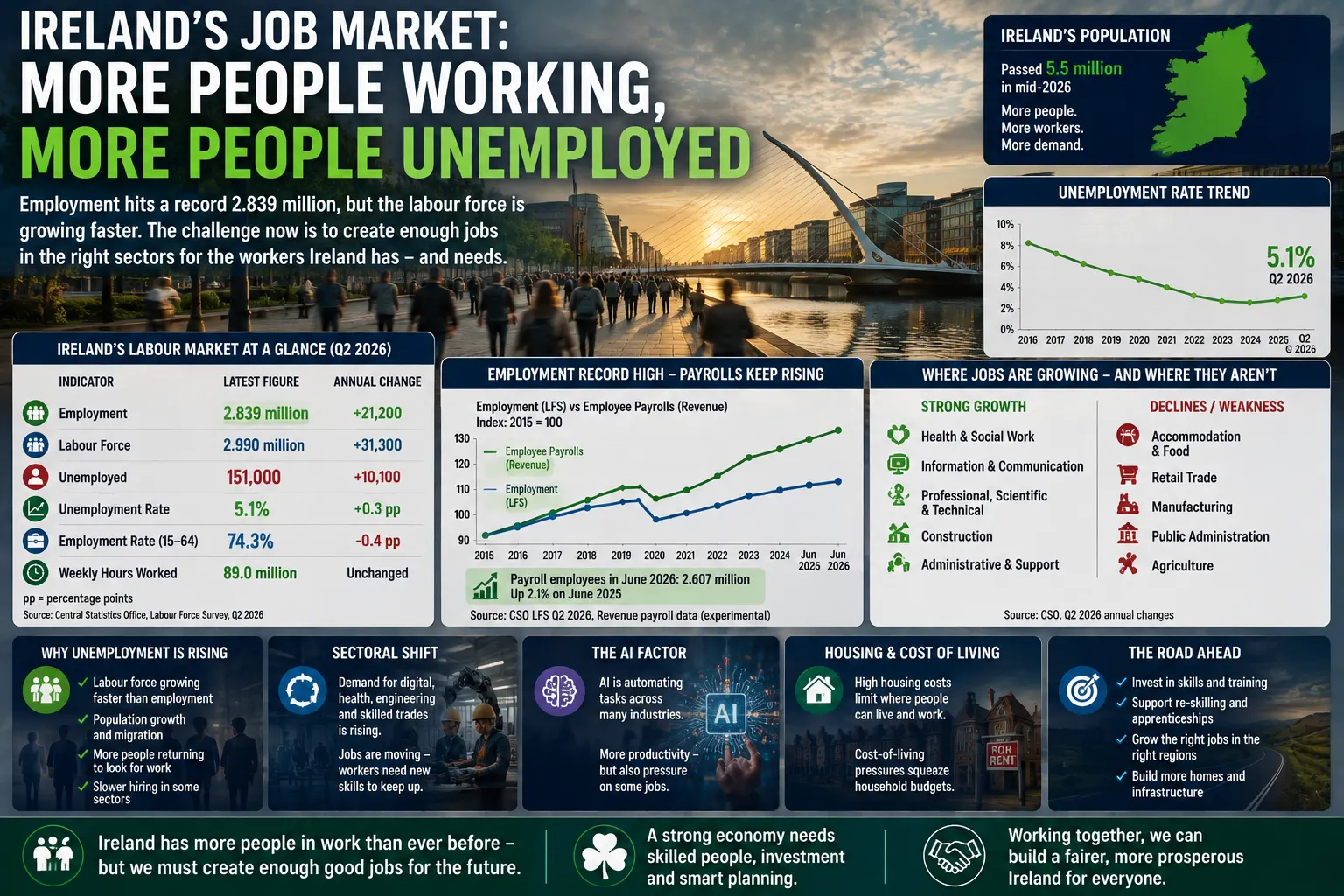
Ireland entered the second half of 2026 with more people in work than ever before and, at the same time, a rising number unable to find jobs. Employment reached an estimated 2.839 million in the second quarter, 21,200 higher than a year earlier. Yet unemployment increased by 10,100 to 151,000 and the unemployment rate rose from 4.8 to 5.1 per cent. The figures are not contradictory. They show a labour market in which the supply of workers is expanding faster than employment — while the economy itself is beginning to move from an exceptionally tight post-pandemic jobs market towards a more complicated period of slower hiring, sectoral change and technological disruption.
The labour force grew by 31,300 people in the year to the second quarter, substantially more than the increase in employment. This simple arithmetic explains much of the rise in unemployment: Ireland created jobs, but not enough to absorb everyone entering or returning to the labour market. Population growth, migration and younger people looking for work are adding to labour supply at the same time as employers become more cautious about recruitment.
There is no clear evidence of a broad employment collapse. Administrative payroll records point to stronger conditions than the Labour Force Survey, with the number of employees registered through Revenue reaching 2.607 million in June, 2.1 per cent higher than a year earlier. Job vacancies remain above their long-term average, wages are still rising and shortages persist in healthcare, construction, engineering and other occupations. The emerging picture is instead one of normalisation after several years in which employers frequently struggled to find almost any available worker.
That transition matters because Ireland’s labour market sits at the centre of several larger economic changes. The population has passed 5.5 million, housing remains scarce, multinational industries are becoming more exposed to trade and technological shocks, employers face higher wage and pension costs, and artificial intelligence is beginning to alter high-skilled occupations once considered among the safest parts of the economy. Ireland may therefore continue creating jobs while simultaneously experiencing more unemployment, more skills shortages and greater insecurity within particular professions.
The Labour Market Has Not Suddenly Become Weak
The scale of employment remains historically high. The Central Statistics Office estimated 2,839,300 people were working in the second quarter of 2026, up 0.8 per cent from 2,818,100 a year earlier. The employment rate among people aged 15 to 64 was 74.3 per cent, only modestly below the 74.7 per cent recorded a year earlier.
Employment also recovered within the quarter. On a seasonally adjusted basis, the number working rose by 19,500 between the first and second quarters after falling by the same amount during the opening three months of 2026. That movement reinforces the danger of interpreting one quarter as the beginning of a recessionary cycle.
Revenue payroll data point towards stronger growth still. The CSO’s experimental administrative series counted approximately 2.607 million employees in June 2026, compared with 2.553 million in June 2025. The employee index was 2.1 per cent higher over the year and had not recorded an annual decline since the pandemic period of 2021.
The two statistics are not directly interchangeable. The Labour Force Survey is a household survey covering employees and self-employed people under internationally standardised definitions, while payroll data come from employer tax records and cover employees. The Central Bank has highlighted a widening divergence between the two measures since mid-2025 and cautions against treating either series in isolation.
What they have in common is more important: neither indicates mass job destruction. Ireland’s labour market is cooling from an unusually strong position rather than falling from high employment directly into a conventional employment crisis.
Ireland’s Labour Market in Mid-2026
| Indicator | Latest Figure | Annual Change |
|---|---|---|
| Employment | 2.839m | +21,200 |
| Labour force | 2.990m | +31,300 |
| Unemployed | 151,000 | +10,100 |
| Unemployment rate | 5.1% | +0.3 percentage points |
| Employment rate, age 15–64 | 74.3% | -0.4 percentage points |
| Weekly hours worked | 89.0m | Unchanged |
Source: Central Statistics Office, Labour Force Survey Q2 2026.
Why Unemployment Can Rise While Employment Is Still Growing
Unemployment is determined by more than the number of jobs disappearing. It also depends on how many people are trying to find work. If 20,000 additional jobs are created while 30,000 additional people enter the labour force, both employment and unemployment can increase at the same time.
That is broadly what Ireland’s latest data show. The labour force expanded by 1.1 per cent in the year to the second quarter while employment increased by 0.8 per cent. The difference flowed mainly into unemployment. The unemployment rate consequently moved above the exceptionally low levels recorded earlier in the decade without indicating that the absolute number of people working had fallen year on year.
The distinction is important politically and economically. A rise in unemployment caused predominantly by large-scale redundancies would signal weakening demand for workers. An increase caused partly by population and labour-force expansion can occur in an economy that is continuing to create jobs but cannot absorb new workers at the previous pace.
Ireland is currently experiencing elements of both. Labour supply is growing, while indicators of employer demand have also weakened. The Central Bank reported that online job postings were 8.9 per cent lower year on year in May and had fallen below their pre-pandemic level. The number of officially measured vacancies stood at 30,000 at the end of the second quarter, compared with 31,500 a year earlier.
The result is a labour market in which finding a new job is becoming less automatic. Employers still need workers, but workers have somewhat less bargaining power than during the extreme labour shortages of 2022 and 2023.
July Confirmed That Unemployment Is No Longer Below 5 Per Cent
The latest available monthly unemployment estimate puts the seasonally adjusted rate at 5.1 per cent in July, up from 5.0 per cent in June and also slightly above the July 2025 rate. The CSO estimated approximately 149,900 people were unemployed on a seasonally adjusted basis.
The July number is partly modelled because quarterly Labour Force Survey benchmarks are not yet available for every month, meaning it is subject to later revision. The independently measured quarterly survey nevertheless also produced a 5.1 per cent unemployment rate for the second quarter, giving greater confidence that the labour market has moved away from the 4 to 4.5 per cent rates seen during its tightest phase.
A rate close to 5 per cent remains low by Ireland’s historical standards. During the financial crisis unemployment exceeded 15 per cent on the revised statistical series, while the economy subsequently spent years rebuilding employment. Today’s conditions bear little resemblance to that period.
The significance lies instead in direction. Unemployment averaged 4.3 per cent in 2024 and 4.7 per cent in 2025. The Central Bank now expects approximately 5.1 per cent for 2026 and 5.2 per cent by 2028. That would still represent a relatively healthy labour market but one with more competition between jobseekers and greater exposure for workers in sectors experiencing structural change.
Young Workers Are Feeling the Cooling More Clearly
The national average conceals substantially weaker conditions for younger people. The unemployment rate for those aged 15 to 24 stood at 13.2 per cent in the second quarter. Their employment rate fell from 46.7 per cent a year earlier to 45.2 per cent.
Monthly estimates for July put youth unemployment at 12.3 per cent, although that number is subject to revision. The overall pattern has nevertheless concerned policymakers because younger workers are particularly sensitive to slower recruitment. They are more likely to be looking for their first job, changing jobs frequently or working in hospitality, retail and other sectors where hiring adjusts quickly when businesses become cautious.
The Central Bank has previously identified a decline in the rate at which younger people move from inactivity into employment. This does not necessarily mean young workers are losing existing jobs in large numbers. A slowdown in new hiring can produce the same result by making it more difficult for students and new graduates to enter employment.
That distinction will become increasingly important if artificial intelligence reduces demand for some entry-level office tasks. Graduate roles traditionally provided junior workers with repetitive analytical, administrative or coding work through which they gained experience. AI can perform a growing share of exactly those tasks, potentially changing the route through which young professionals enter higher-skilled careers.
Long-Term Unemployment Is Also Moving in the Wrong Direction
The number of people unemployed for at least twelve months increased to 38,900 in the second quarter, 7,200 more than a year earlier. The long-term unemployment rate rose from 1.1 to 1.3 per cent.
The numbers remain small compared with earlier Irish downturns, but duration matters. A short period between jobs often represents ordinary labour-market movement. Extended unemployment can weaken skills, reduce household income and make re-entry into work progressively more difficult.
Long-term unemployment can also reveal a mismatch between the jobs available and the people looking for them. A worker whose previous occupation has contracted may not possess the qualifications required in healthcare, engineering or construction even when thousands of vacancies exist in those sectors.
This is why rising unemployment does not automatically solve labour shortages. Ireland can simultaneously have unemployed workers and employers unable to recruit because geography, qualifications, wages, working conditions and experience do not match.
Ireland is experiencing more labour-market slack without an overall shortage of jobs becoming an overall shortage of work. The emerging problem is increasingly one of matching people, skills and locations to the jobs that continue to grow.
Part-Time Work Reveals Another Layer of Spare Capacity
Approximately 589,600 people were working part-time in the second quarter of 2026, representing 20.8 per cent of total employment. Of those, 153,800 — more than one quarter — were classified as underemployed because they wanted additional paid hours.
This matters because the headline unemployment rate counts only people who meet the International Labour Organization definition of unemployment. A worker doing ten hours a week who wants a full-time job is counted as employed rather than unemployed.
Underemployment therefore provides a broader measure of spare labour capacity. It is particularly relevant in retail, hospitality, care and other sectors where variable schedules and part-time contracts are common.
A labour market can consequently look tight using unemployment alone while still containing a substantial group of people willing to work more. Better use of that existing workforce can reduce employer dependence on additional recruitment, although childcare, transport, caring responsibilities and the design of individual jobs often determine whether workers can realistically increase their hours.
The Employment Boom Has Become Less Evenly Distributed Between Sectors
The period immediately following the pandemic was characterised by broad job creation as services reopened, technology expanded and public services increased staffing. The 2026 labour market is more differentiated. Some sectors are expanding strongly while others have slowed or contracted.
The Labour Force Survey recorded its largest annual employment increase in education, where employment rose by 14,200 or 5.9 per cent. The largest decline occurred in professional, scientific and technical activities, which lost an estimated 17,100 workers, a fall of 8.2 per cent.
A separate CSO survey based on employers shows particularly strong employment growth in construction. Employment in enterprises covered by that survey increased from approximately 144,400 in the second quarter of 2025 to 159,300 a year later. Industry also expanded, while employment in wholesale and retail trade was lower.
These datasets use different methodologies and should not be mechanically combined, but they point towards a common structural development: Ireland is no longer experiencing one uniform labour market. Construction, public services and parts of hospitality remain labour-hungry, while sections of the professional and internationally traded economy are undergoing more cautious recruitment and reorganisation.
Selected Enterprise Employment Changes
| Sector | Q2 2025 | Q2 2026 |
|---|---|---|
| Industry | 280,300 | 286,300 |
| Construction | 144,400 | 159,300 |
| Wholesale and retail | 316,500 | 309,800 |
| Accommodation and food | 186,600 | 195,100 |
| Information and communication | 112,400 | 113,600 |
| Finance and real estate | 120,900 | 126,900 |
Source: CSO Earnings, Hours and Employment Costs Survey. Preliminary Q2 2026 enterprise estimates; coverage and methodology differ from the Labour Force Survey.
Construction Shows Why Higher Unemployment Does Not End Skills Shortages
Ireland needs considerably more workers in construction if housing, infrastructure, energy and retrofit ambitions are to be delivered simultaneously. Government-commissioned analysis has identified a substantial future workforce requirement and recommends expanded apprenticeships, modern construction methods, higher productivity and continued skilled inward migration.
The contradiction is visible in policy. While national unemployment has risen, the Government changed employment-permit rules in May specifically because employers continued reporting shortages in construction. Construction planners and geospatial surveyors were added to the Critical Skills system, while occupations including steel fixers, curtain wallers and concrete-pump operators became eligible for general employment permits.
This is not evidence that unemployed Irish workers are being overlooked automatically. Many construction roles require experience, trade qualifications or specialist knowledge that cannot be created immediately. Training an electrician, engineer or surveyor takes years rather than weeks.
At the same time, reliance on immigration cannot substitute indefinitely for domestic training. Government policy explicitly states that employment permits are intended to address shortages rather than replace investment in Ireland’s own workforce. The construction challenge consequently requires both: faster expansion of apprenticeship and training capacity, and targeted migration where shortages cannot be filled domestically.
Housing adds a further circular problem. Ireland needs additional construction workers to build homes, while the shortage and high cost of homes can make it more difficult to attract and retain the workers required to build them.
Housing Has Become Labour-Market Infrastructure
Housing is usually discussed as a social problem or property-market problem. It is increasingly also an employment constraint. A company deciding whether to expand in Dublin, Cork or Galway must consider whether its employees can find accommodation at a price compatible with the salary being offered.
This issue becomes especially important for internationally recruited workers. A nurse, engineer or software specialist can compare employment opportunities across many countries. A high nominal salary loses part of its attraction if a very large share of income is required for rent.
Domestic mobility is affected as well. A worker living in a lower-cost part of Ireland may decline employment in Dublin if the pay increase is absorbed by rent and commuting. Employers can respond through higher wages, remote work or locating jobs elsewhere, but each response carries trade-offs.
The ESRI expects approximately 38,500 new dwellings to be completed in 2026 and just under 40,500 in 2027, but it continues to judge supply insufficient relative to underlying demand. The housing deficit therefore risks becoming a constraint on labour availability even as construction employment itself expands.
This creates one of Ireland’s most difficult structural loops: labour is needed to expand housing supply, but adequate housing supply is increasingly needed to expand the labour force.
Population Growth Is Still Transforming the Scale of the Workforce
Ireland’s population reached an estimated 5.526 million in April 2026, an increase of 66,900 in twelve months. Net inward migration accounted for 48,100 of that increase after 110,600 people moved into the State and 62,500 left.
Migration has supported economic growth by increasing the supply of workers at a time when employers have faced persistent shortages. Non-Irish citizens now number approximately 931,000, equivalent to 16.8 per cent of the usually resident population. Migrant workers are prominent across healthcare, technology, hospitality, construction, agriculture and other sectors.
The pace of net migration has begun to moderate. Net inward migration fell from 59,700 in the previous twelve-month period to 48,100. Ireland also continues to experience significant outward movement by its own citizens: 35,400 Irish citizens emigrated in the year to April while 30,200 returned.
That two-way movement matters. Ireland can simultaneously attract large numbers of international workers while losing young Irish adults, some of whom leave because of career opportunities, housing costs or personal preference. Labour supply therefore cannot be understood through immigration totals alone.
Population growth also expands demand. Every additional worker is also a potential consumer of housing, transport, healthcare, childcare and public services. Migration can relieve a labour shortage while increasing the number of workers required in other sectors to support the larger population.
Ageing Will Eventually Push in the Opposite Direction
Despite rapid population growth, Ireland is ageing. There were approximately 891,100 people aged 65 or over in April 2026, 165,000 more than in 2020. That represents an increase of 22.7 per cent in only six years.
At the other end of the demographic structure, the number of children aged under 15 has fallen below one million for the first time since 2014. Birth numbers have also declined significantly over the longer term. These trends will gradually alter the relationship between people entering and leaving the labour force.
The Expert Group on Future Skills Needs expects Ireland’s population to increase by roughly another one million people over the coming two to three decades while ageing becomes more pronounced. The implication is unusual: the economy may have more residents while still facing shortages of working-age people in particular occupations.
Healthcare and care services are the clearest example. More older residents increase demand for nurses, doctors, healthcare assistants and home-support workers at exactly the time when parts of the existing workforce are themselves approaching retirement.
This is one reason immigration will remain economically important even if overall unemployment moves somewhat higher. An unemployment rate of 5 per cent does not provide Ireland with thousands of trained nurses, engineers or electricians on demand.
Ireland Is Still Importing Workers Because Shortages Remain Real
The employment-permit system provides a direct indication of where domestic and European labour supply is insufficient. The Government’s 2026 review broadened access to permits across construction, healthcare, transport, hospitality and agri-food occupations after more than 400 submissions were examined during the review process.
Critical Skills permits continue to cover professions including medicine, nursing, information technology, engineering, science and specialist financial roles. Other permit channels allow employers to recruit non-European Economic Area workers where a labour-market needs test demonstrates that suitable candidates cannot be found locally.
The Central Bank reported that cumulative employment permits to May 2026 were 15.3 per cent higher than during the equivalent period of 2025. Individual quotas are also being used up: the 1,000-permit quota for meat-processing operatives was close to exhaustion by late August.
This continued demand for overseas recruitment is one of the clearest signs that the rise in unemployment should not be interpreted as a general surplus of workers. Labour shortages and unemployment can coexist when the unemployed population does not match the occupation, skills or location of the vacancy.
Wages Are Still Growing — but Workers Are Barely Moving Ahead of Prices
Average weekly earnings reached €1,046.88 in the second quarter, 3.9 per cent higher than a year earlier. Average hourly earnings increased 3.8 per cent to €31.96. At first sight, these remain strong wage increases.
Consumer prices increased by approximately 3.6 per cent over the equivalent period, meaning average earnings were only slightly ahead of inflation. The improvement in real purchasing power was therefore considerably smaller than the nominal wage figures imply.
The distribution is also highly uneven. Average hourly earnings in information and communication were €46.88 compared with €18.08 in accommodation and food services. Finance, education and professional services similarly sit well above many consumer-facing industries.
This produces very different labour-market experiences. A highly paid employee in a technology or financial company may be concerned primarily about restructuring and job security. A hospitality worker may have stronger nominal wage growth but remain under pressure from rent, food, transport and energy costs.
Average weekly earnings in accommodation and food services rose 7.7 per cent year on year, the largest percentage increase among the main sectors. The rise partly reflects the intense competition for staff and policy changes affecting low-paid workers, but it also increases the cost base of businesses operating with comparatively narrow margins.
Pay and Labour Costs in Q2 2026
| Measure | Q2 2026 | Annual Change |
|---|---|---|
| Average weekly earnings | €1,046.88 | +3.9% |
| Average hourly earnings | €31.96 | +3.8% |
| Hourly total labour cost | €37.73 | +4.1% |
| Other hourly labour costs | €5.77 | +5.7% |
| Job vacancies | 30,000 | -1,500 |
| Vacancy rate | 1.3% | Unchanged |
Source: Central Statistics Office, Earnings and Labour Costs Q2 2026.
Employer Costs Are Rising Faster Than Basic Pay in Some Areas
The total cost of employing a worker extends beyond wages. Employers also pay social insurance, pension contributions and other non-wage costs. Average hourly total labour costs increased by 4.1 per cent in the year to the second quarter and have risen 14.5 per cent over three years.
Two major policy changes added to the 2026 cost environment. The national minimum wage increased to €14.15 an hour on 1 January, 65 cent higher than in 2025. MyFutureFund, Ireland’s new automatic-enrolment pension scheme, began collecting contributions at the same time.
Eligible employees initially contribute 1.5 per cent of gross pay to MyFutureFund and employers match that amount, with an additional State contribution. The employer rate is designed to rise gradually over the coming decade.
These reforms improve employee income and retirement security, but they are not costless for businesses. The effect is proportionally more important in labour-intensive sectors employing large numbers of lower-paid staff, including hospitality, retail and some personal services.
Employers can absorb the additional cost through lower margins, higher productivity, slower recruitment, price increases or some combination of these responses. It would be too strong to attribute current unemployment changes directly to the minimum wage or auto-enrolment because many other factors are operating simultaneously. They nevertheless form part of the changing economics of employing people in Ireland.
The Multinational Economy Creates Extraordinary Jobs — and Concentrated Risks
Ireland’s labour market has been transformed by foreign multinational companies operating in technology, pharmaceuticals, medical devices, finance and internationally traded services. These sectors typically produce much higher output and wages than many domestically oriented industries and contribute disproportionately to income-tax and corporation-tax receipts.
The benefits are substantial. High-paying employment has supported household income, created specialised supplier industries and attracted highly educated workers from Ireland and abroad. The presence of major technology and pharmaceutical businesses also gives Ireland access to investment and knowledge networks that would be difficult for a small economy to reproduce independently.
The same concentration creates vulnerability. Decisions affecting thousands of Irish workers can be made at headquarters in California, New York, Switzerland or elsewhere based on global strategies rather than domestic demand. A company may restructure a European division even when its Irish operation is profitable.
The Central Bank has highlighted particular exposure in information technology because functions can be expanded, automated or relocated comparatively easily. Global technology businesses have repeatedly reorganised staffing since the extraordinary expansion of the pandemic years.
Pharmaceutical employment is more anchored in physical plants and specialised manufacturing infrastructure, but it carries different geopolitical risk. Ireland’s concentration of US-owned pharmaceutical businesses creates exposure to American tax policy, trade fragmentation and possible tariff changes. These risks do not imply large future job losses are inevitable, but they mean headline national employment can be influenced disproportionately by developments outside Ireland.
Artificial Intelligence Could Disrupt the Part of the Workforce Once Considered Safest
Past waves of automation were frequently associated with factory and routine manual work. Generative artificial intelligence is unusual because its greatest technical exposure often occurs in professional occupations involving language, software, analysis, administration and digital information.
That matters particularly for Ireland because the economy contains an unusually large number of well-educated workers in multinational technology, finance and business-service companies. Many of those occupations are precisely where AI tools can perform a growing share of existing tasks.
An ESRI and Department of Finance study published in April modelled several possible effects of AI adoption on Irish households. In its central scenario, around 7 per cent of existing jobs could be displaced in the short to medium term. The researchers emphasised that this was a modelling scenario rather than a prediction and that their exercise could not capture all new occupations or business opportunities that AI may generate.
The distribution of risk was also unusual. Higher-income and highly educated workers were more exposed to potential displacement than in many previous technological transitions. Workers who retained their jobs could experience productivity-related wage gains, while owners of capital could benefit from higher returns.
That means AI could increase inequality even without producing mass unemployment. A relatively small number of displaced high earners can experience substantial income losses while workers whose productivity improves benefit. The final outcome will depend on how quickly companies adopt AI, which tasks remain complementary to human labour and whether new activities expand sufficiently to replace employment lost elsewhere.
AI Could Create Jobs in Ireland at the Same Time
Ireland is not only exposed to AI automation; it is also a location where companies are investing in the technology. The Central Bank has identified a surge in imports of AI-related data-centre hardware and investment associated with expanding computing infrastructure.
This creates demand for engineers, electrical specialists, data-centre technicians, construction workers, cybersecurity staff and advanced computing professionals. Government skills analysis has also projected strong long-term demand for ICT expertise under scenarios in which Ireland remains a significant technology centre.
The emerging labour-market effect is therefore likely to be redistribution rather than a simple disappearance of technology employment. Routine coding, support and administrative roles may face increasing automation while demand grows for AI engineering, infrastructure, data governance, cybersecurity and people capable of applying the technology inside other industries.
The transition could be difficult for individual workers because new jobs do not automatically go to the people whose existing jobs disappear. A software professional specialising in a declining function may need retraining even if the broader technology sector is expanding.
Reskilling consequently becomes economically important not as an abstract educational goal but as a mechanism for preventing structural unemployment.
The Professional Services Decline Deserves Attention
The largest sectoral employment decline reported in the latest Labour Force Survey occurred in professional, scientific and technical activities, where employment fell by an estimated 17,100 people or 8.2 per cent over the year.
The category is broad and includes legal, accounting, engineering, scientific, consultancy and other professional activities, so the movement should not be interpreted as evidence that one profession alone is contracting. Survey estimates can also move considerably from quarter to quarter.
It is nevertheless notable because these occupations sit close to several of the structural forces now reshaping work. International corporate restructuring affects professional services. AI can automate document processing, research and analytical tasks. High interest rates and business uncertainty can reduce demand for consultancy and investment-related services.
At the same time, the employer vacancy survey showed professional, scientific and technical activities with one of the highest vacancy rates in the economy at 2.6 per cent. Employment decline and active vacancies can therefore exist within the same broad sector as some specialisms contract while others face shortages.
This is another reason national unemployment statistics alone cannot describe the labour market adequately.
Healthcare Faces Almost the Opposite Problem
Healthcare demand is structurally rising because Ireland’s population is growing and ageing. The number of people aged over 65 has increased by almost a quarter since 2020, while hospital waiting lists and community-care demand remain high.
The sector therefore needs more doctors, nurses, allied health professionals, healthcare assistants and home-support workers even during periods when employment growth elsewhere slows. Public-sector employment figures show health employment continuing to rise, reaching approximately 173,600 in the CSO’s enterprise-based public-sector series in the second quarter.
Recruitment from abroad remains an important part of meeting this need. Medicine, nursing and several allied health professions remain within the Critical Skills employment-permit framework, while the Government expanded permit eligibility for additional healthcare roles during 2026.
Ageing makes this demand comparatively resistant to the ordinary business cycle. A technology company can postpone expansion when confidence falls; an older population still requires healthcare. The difficulty is financing and staffing the system sustainably rather than generating underlying demand.
For workers deciding on future careers, this distinction matters. Employment security may increasingly differ between internationally mobile digital occupations and domestically anchored services whose demand is created by demographics.
Education Is One of the Strongest Areas of Recent Job Growth
Education recorded the largest annual employment increase in the Labour Force Survey, adding approximately 14,200 people. This expansion reflects a mixture of school, further-education and higher-education activity rather than one single government programme.
Education has a dual role in the structural transition. It is itself a substantial employer, but it is also responsible for producing the workers required in sectors experiencing shortages. If engineering, construction and healthcare expand more rapidly than the education system can train people, employers become increasingly dependent on international recruitment.
The challenge is forecasting demand several years before workers qualify. Training capacity created in response to today’s shortage may produce graduates only after the shortage has changed. This is especially difficult in fast-moving technological occupations.
Lifelong education consequently becomes more important alongside traditional schooling. A labour market undergoing AI adoption, decarbonisation and demographic change will require existing workers to acquire new skills rather than relying only on younger entrants.
Regional Labour Markets Are Becoming More Distinct
Ireland’s employment growth is not confined to Dublin. Government analysis of the latest Labour Force Survey says employment outside the capital increased by approximately 12,000 in the year to the second quarter. That is important because earlier phases of the technology-led expansion were heavily concentrated around Dublin.
The economic structure nevertheless differs substantially by region. Dublin has the country’s largest concentration of technology, financial services, professional employment and public administration. Cork combines internationally traded pharmaceuticals and technology with a large domestic economy. Galway has significant medical-device and technology activity, while the Midlands, border and south-east contain larger relative shares of manufacturing, construction, agriculture and locally traded services.
This means structural shocks affect places differently. A global software restructuring can disproportionately affect Dublin and other technology centres. Agricultural weakness has greater consequences in rural regions. Construction investment can create employment more widely, while tourism has particular importance in western and coastal counties.
Remote and hybrid work initially appeared capable of weakening the geographical concentration of professional employment. Almost 991,000 workers still reported working from home to some extent in the second quarter, but the number was 22,500 lower than a year earlier. The number who never worked from home increased by 43,800.
A continued return towards workplace attendance could once again make housing and transport around major employment centres more important determinants of where people can work.
The Minimum Wage Is Moving Ireland Towards a Higher-Cost Labour Model
Ireland’s national minimum wage increased to €14.15 an hour at the beginning of 2026. For a full-time worker, the cumulative effect of successive increases since the pandemic has been substantial.
Higher statutory wages directly benefit lower-paid employees and can reduce in-work poverty where employment hours are sufficient. They can also make work more attractive relative to inactivity and strengthen household consumption because lower-income workers typically spend a larger proportion of additional income.
Employers in low-margin sectors experience the other side of the measure. Restaurants, hotels, retailers and care providers cannot always generate productivity gains as quickly as wages increase. MyFutureFund added a further employer pension contribution for eligible workers from January.
The response need not be job cuts. Businesses can increase prices, reduce opening hours, change staffing structures, automate tasks or accept lower profits. Some firms can absorb the increases easily while others cannot.
The structural direction is nevertheless clear. Ireland is becoming a higher-wage and higher-cost economy. Remaining competitive increasingly requires higher productivity rather than relying on inexpensive labour.
This Is Particularly Difficult for Small Businesses
Large multinational employers often have sufficient productivity and profit margins to pay high wages. A technology company producing hundreds of thousands of euros of value added per employee operates under very different economics from a small restaurant, shop or local service business.
Smaller businesses face simultaneous pressure from wages, pensions, energy, insurance, commercial rents and borrowing costs. ESRI research published alongside its summer economic outlook also identified high borrowing costs and limited banking competition as constraints on the ability of Irish small and medium-sized companies to scale.
This can create a divergence inside the labour market. Workers may move towards larger employers capable of paying more, while smaller businesses struggle to recruit. A national shortage of staff can therefore coexist with firms that cannot economically afford the wage required to attract them.
Business closures or consolidation can eventually raise productivity by moving workers towards more productive firms, but that process has local consequences. Independent shops, restaurants and service providers contribute to regional employment and community economies that cannot simply be replaced by multinational companies.
Ireland Is Still Growing Despite an Unusually Distorted GDP Picture
Labour-market analysis is complicated by Ireland’s multinational economy because conventional gross domestic product frequently moves for reasons that have little relationship with employment or household living standards. GDP fell sharply in the first quarter of 2026, largely because of multinational and intellectual-property effects, while domestic economic activity continued growing.
The Central Bank therefore places greater emphasis on modified domestic demand and modified national income when assessing underlying conditions. Modified domestic demand increased 4.3 per cent year on year in the first quarter and is forecast to grow by approximately 3.3 per cent during 2026 as a whole.
Part of that expansion comes from unusually strong investment, including data centres and AI-related equipment. Household consumption is growing more slowly because higher energy prices have reduced purchasing power.
This mixed environment explains why employment can remain resilient even while individual sectors are cautious. Construction and investment continue generating activity, public services expand with the population and multinational capital projects remain substantial. At the same time, consumer-facing businesses and internationally mobile professional occupations face more uncertainty.
The Middle East Energy Shock Adds Another Risk to Hiring
Ireland’s labour market is also exposed to the renewed rise in global energy costs caused by the 2026 Middle East conflict. The Central Bank expects inflation to average approximately 3.5 per cent during 2026, higher than previously anticipated.
Higher energy costs affect employment indirectly. Households have less discretionary income to spend in shops, restaurants and entertainment. Businesses face higher operating and transport costs. Energy-intensive manufacturing becomes more expensive.
A temporary price shock may have little lasting employment effect if energy markets normalise. A prolonged period of expensive oil and gas would be more problematic because firms would face both weaker consumer demand and higher input costs.
Wage negotiations can amplify the process. Employees seek compensation when inflation erodes real income, while firms may raise prices to cover higher wages. If this cycle persists, interest rates can remain higher for longer, increasing borrowing costs for investment and housing.
The labour-market effect is therefore several steps removed from the original geopolitical shock, but it can ultimately influence how many workers businesses decide to hire.
Ireland’s Export Model Faces Greater Geopolitical Risk Than It Did a Decade Ago
Ireland built much of its modern employment model during an era of expanding global trade, relatively open investment flows and deep economic integration between the United States and Europe. Those conditions have become less predictable.
US trade policy, strategic competition with China, international tax changes and pressure on pharmaceutical supply chains all create risks for multinational investment. Ireland’s attractiveness remains supported by EU membership, an English-speaking workforce, established corporate clusters and a strong record of foreign investment, but those advantages do not remove external risk.
The labour-market impact of trade disputes would not necessarily begin with mass factory closures. Companies may first postpone recruitment, move new projects elsewhere or automate functions they previously expected to expand with additional employees.
This is why vacancy and hiring data can weaken before headline employment falls. A company that keeps 1,000 existing workers but abandons plans to recruit another 100 contributes to slower employment growth without producing a redundancy announcement.
The current cooling in recruitment therefore deserves attention even while the overall employment level remains high.
The Next Few Years Are Expected to Bring Slower Employment Growth, Not Mass Unemployment
The Central Bank’s current central forecast remains relatively benign. It expects employment to average approximately 2.852 million during 2026, rising to 2.908 million in 2027 and 2.959 million in 2028.
The labour force is projected to expand faster, from approximately 3.004 million in 2026 to more than 3.12 million by 2028. Unemployment consequently rises modestly even while employment continues setting new records.
The forecast unemployment rate is 5.1 per cent for 2026 and 5.2 per cent in both 2027 and 2028. These numbers would represent cooling rather than recession.
Forecasts are conditional rather than guaranteed. A severe international trade shock, persistent energy disruption, major multinational restructuring or faster-than-expected AI displacement could produce a weaker outcome. Conversely, stronger domestic investment, faster housebuilding or additional foreign investment could generate more employment.
Central Bank Labour Market Outlook
| Indicator | 2026 Forecast | 2028 Forecast |
|---|---|---|
| Employment | 2.852m | 2.959m |
| Employment growth | 1.2% | 1.8% |
| Labour force | 3.004m | 3.121m |
| Unemployed | 152,000 | 162,000 |
| Unemployment rate | 5.1% | 5.2% |
| Modified domestic demand growth | 3.3% | 3.3% |
Source: Central Bank of Ireland Quarterly Bulletin Q2 2026. Forecasts are subject to uncertainty and are not guaranteed outcomes.
The Important Future Question Is Who Gets the New Jobs
An economy can create 100,000 additional jobs and still produce significant disruption if the occupations growing are different from those disappearing. This is the central structural challenge facing Ireland.
Healthcare and care work are likely to expand because of demographics. Construction must expand if housing and infrastructure targets are to be reached. Digital infrastructure and artificial intelligence create new technical occupations. Climate and energy investment require electricians, engineers and other skilled workers.
Meanwhile, automation can reduce demand for some clerical, administrative and professional functions. Retail continues moving towards online commerce and self-service. Traditional banking has already moved towards fewer physical branches and more digital services. Multinational corporations continuously centralise or automate back-office activities.
The success of Ireland’s labour market will therefore depend less on preserving every existing occupation and more on how successfully workers can move between old and new activities.
That transition is easier for a 30-year-old graduate than for someone who has spent decades in one occupation. Training policy consequently has to reach workers before unemployment becomes prolonged rather than only after industries have already contracted.
Skills Mismatch May Become More Important Than the Headline Unemployment Rate
Several of the occupations identified as having persistent shortages require formal qualifications. Software developers, engineers, medical professionals and specialist construction workers cannot be produced through short-term activation programmes alone.
SOLAS has identified continuing shortages in software development and IT engineering despite recent restructuring across the technology industry. Roughly 37 per cent of people working in IT occupations were non-Irish citizens in its latest skills analysis, considerably above the national average.
Business and financial services similarly require growing expertise in artificial intelligence, machine learning, cybersecurity, regulation and sustainable finance. Traditional qualifications remain valuable, but employers increasingly want combinations of professional and digital skills.
At the other end of the economy, workers in elementary and operative occupations face increasing digitalisation while having lower average formal educational attainment. Reskilling opportunities are therefore important not only for highly paid professionals but for people whose routine physical or administrative tasks are gradually changing.
A future unemployment rate of 5 or 6 per cent would become much more damaging if it consisted predominantly of people whose skills no longer match vacancies rather than workers moving briefly between jobs.
Ireland Could Have Labour Shortages and AI Displacement at the Same Time
At first glance, ageing and automation appear to solve one another. If Ireland lacks workers, machines can perform more work. In practice, the occupations affected by the two trends do not line up neatly.
Central Bank analysis finds that many occupations with older workforces have comparatively low exposure to artificial intelligence because they involve physical work, interpersonal interaction or judgement that is difficult to automate. Those are exactly the occupations in which retirement can create shortages.
AI exposure is often greater among younger, more highly educated workers in digital and professional occupations. Ireland could therefore have unemployed office workers while simultaneously lacking nurses, construction workers or carers.
Automation does not automatically transfer a displaced accountant into a building trade or convert a software worker into a nurse. Labour mobility requires education, time, incentives and sometimes complete career changes.
This makes workforce planning considerably more complicated than assuming technology will compensate automatically for demographic ageing.
More Women in Full-Time Work Could Expand Domestic Labour Supply
The employment rate for women aged 15 to 64 was 70.7 per cent in the second quarter compared with 78.0 per cent for men. The difference has narrowed considerably over recent decades but remains large enough to represent a potential source of additional labour supply.
Childcare is one of the most important constraints. People may be technically available to work but unable to increase hours if additional childcare costs absorb most of the resulting earnings.
Flexible and remote working can also influence participation, particularly for parents and carers. The decline in home working during 2026 does not necessarily mean flexibility is disappearing, but a strong return-to-office trend could make labour participation more difficult for some households.
Increasing participation is attractive because it expands labour supply without requiring population growth. Yet there are practical limits: unpaid care still has to be provided by someone, and increasing paid working hours can create additional demand for childcare and eldercare workers.
Labour-force policy therefore interacts with public-service capacity in much the same way that migration interacts with housing.
Older Workers Will Become Increasingly Important
Longer life expectancy and the ageing population also raise the question of employment at older ages. Retaining workers for longer can ease labour shortages and improve retirement incomes, particularly in occupations where experience remains highly valuable.
Not every occupation can extend working life equally. A professional working at a computer can generally remain economically active longer than someone performing physically demanding construction or care work.
Employers may therefore need more flexible arrangements for older staff: reduced hours, mentoring roles, hybrid work and phased retirement. These policies can retain knowledge while allowing workers to reduce workloads gradually.
The long-term skills challenge is partly about replacing retiring workers and partly about delaying the speed at which expertise disappears from the labour force.
Migration Will Remain Necessary but Cannot Solve Every Shortage
Ireland’s recent population expansion demonstrates how quickly migration can increase labour supply. International recruitment has played an important role in supporting employment growth and public services.
But migration does not create a worker without creating a resident. Additional workers require housing, transport, healthcare and other infrastructure. Where these systems are already constrained, rapid population growth can intensify pressures that eventually make Ireland less attractive to the workers it is trying to recruit.
This is particularly visible in housing. A foreign nurse recruited to relieve a hospital shortage may encounter a rental shortage on arrival. Higher housing costs can then require higher wages, increasing the cost of delivering healthcare.
There is consequently a practical ceiling to migration as a substitute for infrastructure and training. The most sustainable approach combines targeted migration with greater domestic participation, education, automation and productivity improvement.
Productivity Will Determine Whether Higher Wages Remain Sustainable
As Ireland becomes a higher-cost economy, wages cannot rise indefinitely without corresponding gains in productivity unless businesses accept falling profitability or pass costs into prices.
Productivity improvement can come from technology, training, better management, infrastructure and investment. Artificial intelligence could form part of that process even if it also disrupts employment.
A worker using AI to complete administrative tasks more quickly can spend more time on higher-value work. A construction company adopting modern manufacturing methods can build more homes with the same workforce. A healthcare system using better digital records can reduce administrative duplication.
The crucial distinction is between automation that simply removes a worker and technology that allows remaining employees and businesses to produce substantially more. The second outcome can support higher wages and generate new demand elsewhere in the economy.
Ireland’s high labour costs become less problematic if output per worker remains correspondingly high. They become a competitiveness problem where productivity does not keep pace.
The Domestic Economy and Multinational Economy Need Different Forms of Resilience
Ireland effectively contains overlapping labour markets. The multinational sector contains very high-productivity industries whose employment decisions depend heavily on global technology, tax and trade conditions. The domestic economy depends more directly on population, household spending, construction and public services.
A multinational shock can reduce high-paying employment and tax revenue disproportionately while leaving local construction demand strong. A housing downturn could do the reverse, affecting domestic employment while pharmaceutical exports remain exceptionally profitable.
Diversification is therefore valuable. Ireland benefits when internationally traded employment is spread across pharmaceuticals, medical devices, finance, technology and other sectors rather than depending on one industry. It also benefits from a stronger domestic enterprise base capable of creating high-productivity employment independently of foreign headquarters.
The challenge is that smaller Irish firms frequently face greater financing and scaling constraints than multinational companies. Improving their productivity and access to capital could make the labour market less exposed to decisions by a relatively small number of global corporations.
The Unemployment Rate Alone Will Become a Poorer Measure of Success
If technological and demographic change accelerate, policymakers will need to watch a wider set of indicators. A 5 per cent unemployment rate can describe very different economies depending on who is unemployed and for how long.
Youth unemployment, long-term unemployment, underemployment, hours worked and job-to-job movement reveal whether workers can progress through the labour market. Vacancy rates indicate whether employers still want additional staff. Wage data show how strongly labour demand translates into household income.
The latest figures already demonstrate this need. Employment is at a record level, but total weekly hours worked were unchanged year on year. Almost 154,000 part-time employees wanted additional hours. Long-term unemployment increased. Payroll employment nevertheless continued rising strongly.
No single statistic captures all of those developments. The correct interpretation is not that Ireland simultaneously has both an excellent and a failing labour market. It has a strong aggregate labour market undergoing a gradual change in composition.
What Would Turn the Current Cooling Into a More Serious Problem?
The first warning sign would be falling employment across both the household survey and administrative payroll data. At present, the two sources disagree mainly about the strength of growth rather than its direction.
A second would be a sustained rise in long-term unemployment. Workers remaining unemployed for many months would suggest that new jobs are not matching the skills of people losing existing ones.
A third would be a sharp fall in vacancies across several industries rather than isolated sectors. The current vacancy rate of 1.3 per cent remains above the long-term average identified by the Central Bank, even though recruitment advertising has weakened.
A fourth would be stagnating or declining real wages. Average earnings are currently still marginally ahead of consumer-price inflation, but renewed energy inflation is narrowing that advantage.
Finally, a combination of weaker multinational employment and falling domestic construction activity would remove two separate supports simultaneously. That would represent a much more serious environment than the uneven cooling visible today.
What Could Produce a Stronger Labour Market Instead?
Housing and infrastructure investment provide one potential source of sustained job creation. The State’s long-term capital programme requires large workforces across construction, engineering, utilities and transport.
Data centres and AI infrastructure provide another, although their employment effect differs from traditional manufacturing because extremely large investments can operate with comparatively modest permanent staffing once construction is complete.
Healthcare and care services will continue expanding as the population grows and ages. Tourism and hospitality remain large employers if consumer demand and international travel remain resilient.
Further multinational investment could also produce substantial high-wage employment, particularly if Ireland remains attractive for pharmaceutical, semiconductor-related, financial and advanced digital activities.
The strongest scenario is therefore not one in which one sector drives everything. It is one in which infrastructure, public services, domestic enterprise and internationally traded industries expand sufficiently together to absorb a labour force that will continue changing rapidly.
Forces Likely to Shape Irish Jobs Through the Early 2030s
| Force | Likely Labour Effect | Main Risk |
|---|---|---|
| Population ageing | More health and care demand | Retirement-driven shortages |
| Migration | Expands labour supply | Housing and infrastructure pressure |
| AI adoption | Higher productivity and new roles | Professional job displacement |
| Housing investment | Construction employment growth | Insufficient skilled workforce |
| Higher labour costs | Higher worker incomes | Pressure on low-margin employers |
| Trade fragmentation | Mixed effects on multinational jobs | External restructuring |
Ireland Newspaper analysis based on CSO, Central Bank, ESRI, SOLAS and government labour-market research.
Three Plausible Paths for Ireland’s Labour Market
The first scenario is a controlled normalisation close to the Central Bank’s current forecast. Employment continues increasing by roughly 1 to 2 per cent annually, unemployment settles slightly above 5 per cent and wage growth gradually moderates. Employers find recruitment easier than during the post-pandemic labour shortage but continue struggling for specialised skills. This remains the central official outlook.
A second scenario is accelerated structural disruption. AI adoption reduces demand for professional and administrative workers faster than new occupations expand, while multinational restructuring adds further pressure. Unemployment moves materially higher even though construction and healthcare continue reporting shortages. The defining problem under this scenario would be skills mismatch rather than simply insufficient economic activity.
A third scenario is stronger domestic expansion. Housing delivery, infrastructure investment, foreign direct investment and household demand create enough employment to absorb the expanding labour force. Under this path, unemployment could stabilise or fall again, but labour shortages and wage pressure would re-emerge quickly unless productivity, training and migration expand alongside demand.
A severe international recession or trade conflict represents a less favourable possibility beyond those scenarios. Ireland’s openness means external shocks can move rapidly through exports, multinational investment and confidence. Such an outcome is plausible but is not the baseline expected by domestic forecasters.
The Transition Will Not Affect Every Household Equally
A national labour-market statistic can conceal very different consequences for individual families. A household containing two secure public-sector workers experiences a rise in unemployment differently from one dependent on a single multinational technology salary.
Lower-paid workers are more exposed to reductions in hours, business closures and rising living costs, but the tax and welfare system provides comparatively strong income protection when employment is lost. Higher-income workers have larger financial buffers on average but can experience much larger absolute income reductions when high-paying professional employment disappears.
The ESRI’s AI analysis illustrates this unusual distribution. In its modelling, middle- and higher-income households experienced some of the largest average losses under displacement scenarios because highly educated professional workers were particularly exposed.
Housing debt also matters. A worker with a large mortgage has different financial resilience from someone who owns a home outright. Employment insecurity can reduce household spending long before a worker actually loses a job because households save more when future income becomes uncertain.
This is one mechanism through which labour-market cooling can spread into the wider economy even when most people remain employed.
The State Has More Policy Options Than During Earlier Irish Downturns
Ireland enters this structural transition with stronger public finances and a much larger employment base than during the financial crisis. The State is investing heavily in housing, infrastructure, education and training and operates an established network of further-education and employment programmes.
SOLAS and the Education and Training Boards are expanding programmes aimed at digital and AI skills, including shorter micro-qualifications designed for people already in employment. Apprenticeship targets are also rising as the Government attempts to expand construction and technical skills.
These interventions are most effective when they anticipate change. Training someone after several years of unemployment is more difficult than helping a worker adapt while still employed. Employers therefore have a role alongside the State because they can identify changing skills requirements earlier than national statistics.
The policy challenge is choosing which skills will remain valuable. Training programmes can themselves become obsolete if technology changes quickly. Flexible qualifications and strong underlying numeracy, digital capability and problem-solving skills may consequently matter more than narrow training for one software platform.
Ireland’s Labour Market Is Moving From Quantity Towards Quality
For much of the recovery from the financial crisis, the central question was how many jobs Ireland could create. Later, during the post-pandemic labour shortage, the question became where employers could find enough workers. The next phase is likely to be different again.
Employment remains high enough that the quality, productivity and resilience of jobs become increasingly important. A labour market dominated by high employment but extensive underemployment, weak progression or insecure work would produce very different living standards from one in which workers continuously acquire skills and move towards more productive occupations.
The same applies to headline wage growth. Higher wages improve living standards only when they exceed inflation and can be sustained by productive businesses. If every pay rise feeds directly into prices or business closures, nominal gains lose much of their value.
Productivity is therefore becoming the connecting issue between wages, competitiveness and technological change. Ireland needs workers to earn more while allowing companies to produce enough additional value to pay them.
The Current Rise in Unemployment Should Be Taken Seriously — but Not Misread
An unemployment rate above 5 per cent marks a change from the exceptionally tight conditions of recent years. The number unemployed has risen, youth employment has weakened and long-term unemployment is moving upwards. Hiring indicators show that employers are becoming more selective.
But almost 2.84 million people remain in employment, payroll records continue expanding, average wages are rising and businesses are still seeking overseas workers because domestic shortages remain unresolved. These are not the characteristics of an economy experiencing broad labour-market collapse.
The more important development is structural. Ireland’s labour force is expanding while population ageing changes future demand. Construction and healthcare need more workers. Professional services are more exposed to technological and multinational restructuring. Small businesses face rising labour costs. Housing increasingly determines where workers can live, and migration both alleviates shortages and increases infrastructure demand.
Those forces can produce a labour market with higher employment and higher unemployment simultaneously for several years. The Central Bank’s forecasts effectively describe that outcome: employment approaching three million by 2028 while the unemployment rate remains slightly above today’s level.
The Next Labour-Market Test Will Be Whether Workers Can Move With the Economy
Ireland has demonstrated an unusual ability to create employment over the past decade. The number working has risen by hundreds of thousands, migration has expanded the available workforce and the economy has shifted increasingly towards high-value services and advanced manufacturing.
The next stage may require a different form of resilience. Instead of moving predominantly from unemployment into newly created jobs, more workers may need to move between occupations as technology and demographic demand alter the structure of employment.
A technology worker may move into AI infrastructure or cybersecurity. An employee in a shrinking administrative role may require a new qualification. Construction needs tens of thousands of additional skilled workers over time, while healthcare will require sustained recruitment as the population ages. These transitions will not occur automatically simply because vacancies exist.
If education, housing, migration and infrastructure policy work together, Ireland can continue expanding employment while adapting to technological change. If they do not, skills shortages can become more severe even while unemployment rises — an economically inefficient outcome in which companies cannot find workers and workers cannot find suitable jobs.
The latest figures therefore represent neither the end of Ireland’s employment boom nor business as usual. They mark the beginning of a more demanding phase. Creating jobs will still matter, but increasingly the decisive question will be whether Ireland creates the right jobs, in the right places, and whether its workers can acquire the skills needed to fill them.
Sources
Central Statistics Office — Labour Force Survey Q2 2026: Key Findings
Central Statistics Office — Labour Force Survey Q2 2026: Employment
Central Statistics Office — Labour Force Survey Q2 2026: Unemployment
Central Statistics Office — Labour Force Survey Q2 2026: Labour Force
Central Statistics Office — Monthly Unemployment, July 2026
Central Statistics Office — Monthly Payroll Employees, June 2026
Central Statistics Office — Earnings and Labour Costs Q2 2026
Central Statistics Office — Population and Migration Estimates, April 2026
Central Bank of Ireland — Quarterly Bulletin Q2 2026
Economic and Social Research Institute — Quarterly Economic Commentary, Summer 2026
Department of Enterprise, Tourism and Employment — Employment Permit Statistics 2026
Government of Ireland — National Framework for Meeting Priority Construction Workforce Needs 2026
SOLAS — National Skills Bulletin 2025
SOLAS — ICT Labour Market and Skills Analysis
Government of Ireland — National Minimum Wage 2026
Department of Social Protection — MyFutureFund, January 2026
Source & Transparency
This article is published by Ireland Newspaper for editorial and informational purposes.
Published: 1 September 2026 · Updated: 1 September 2026

Newsroom Ireland Newspaper
Ireland Newspaper editorial team prepares daily news coverage for readers in Ireland and abroad.