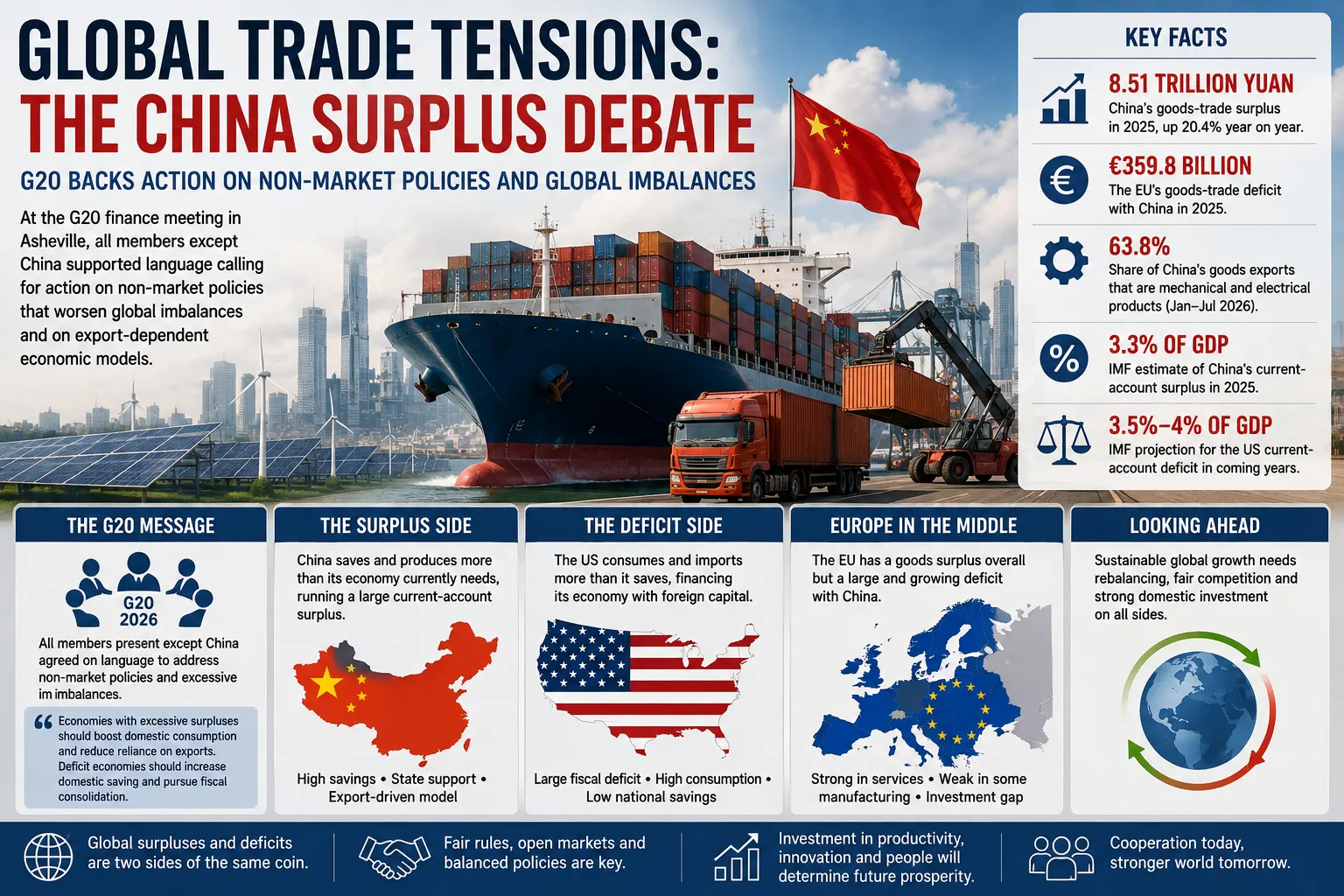
China recorded a goods-trade surplus of 8.51 trillion yuan in 2025, roughly one fifth larger than a year earlier, while European manufacturers faced an accelerating flow of Chinese machinery, vehicles, electronics and other industrial products. At this week’s G20 finance meeting in Asheville, North Carolina, a political threshold was crossed: every G20 member present except China backed language calling for action against non-market policies that exacerbate global imbalances and against economic models excessively dependent on exports.
The disagreement is more complicated than a conventional argument over tariffs. China’s enormous manufacturing capacity is real. So are state subsidies, preferential financing and industrial policies that have helped selected sectors expand. But China has also created highly productive supply chains, world-class factories, intense domestic competition and genuine technological advantages that cannot simply be explained away as government support. At the same time, the United States runs large fiscal and external deficits, European investment and productivity have disappointed, and Western governments themselves increasingly use subsidies, local-content rules, export controls and tariffs to protect industries they consider strategic.
The result is a dispute about the structure of the global economy rather than merely the price of Chinese electric cars. China saves and produces more than its domestic economy currently absorbs. The United States consumes and imports more than its national saving can finance. Europe sits awkwardly between them: it runs a substantial overall goods surplus but an enormous bilateral deficit with China, while some of its most important manufacturing industries face stronger Chinese competition than at any point in recent history.
The G20 statement is significant because it recognises both sides of that equation. It calls on countries with persistent surpluses to remove distortions that suppress domestic consumption and encourage excessive reliance on exports. But it also says countries with persistent deficits should increase domestic saving and pursue fiscal consolidation. That second sentence is particularly relevant to the United States. The emerging trade conflict may be focused politically on Beijing, but the macroeconomic imbalance is not produced by Beijing alone.
8.51 trillion yuan: China’s goods-trade surplus in 2025, up 20.4% from the previous year.
€359.8 billion: the EU’s goods-trade deficit with China in 2025.
63.8%: share of China’s goods exports represented by mechanical and electrical products in the first seven months of 2026.
3.3% of GDP: IMF estimate of China’s 2025 current-account surplus.
About 3.5%–4% of GDP: IMF projection for the US current-account deficit over coming years.
What the G20 Actually Agreed
The meeting on 31 August and 1 September did not produce a conventional consensus communiqué signed without reservation by every participant. Instead, the United States, which holds the G20 presidency in 2026, issued a chair’s statement. A footnote records that all G20 members present agreed to the statement except China, which objected to four paragraphs, including the central sections dealing with global imbalances.
The language is unusually direct. It says excessive and persistent imbalances can create economic distortions, damage growth, increase supply-chain vulnerabilities and contribute to economic tensions. It then calls for the elimination of non-market policies and practices that aggravate those imbalances.
The section aimed most clearly at China says economies with excessive external surpluses should remove policies that constrain domestic consumption and produce excessive reliance on exports. The wording does not name China, but the political target was unmistakable. US Treasury Secretary Scott Bessent said after the meeting that the willingness of the other participants to address the issue demonstrated how widely concern had spread.
Yet the statement also contains a provision that receives less political attention. Deficit economies are told to increase domestic saving and pursue fiscal consolidation. The G20 has therefore not formally adopted the proposition that surplus countries alone are responsible for global trade imbalances.
That distinction is economically important. Every global surplus must mathematically be matched by a deficit somewhere else. The international economy cannot consist entirely of countries exporting more than they import.
A Trade Balance Is Ultimately About Saving and Investment
The simplest way to understand the dispute is to move beyond imports and exports for a moment. In national accounting, a country’s current-account balance is fundamentally connected to the difference between national saving and domestic investment. When an economy saves more than it invests domestically, the excess capital is effectively supplied to the rest of the world and tends to be associated with an external surplus. When an economy invests and consumes more than domestic saving can finance, it relies on foreign capital and tends towards an external deficit.
This is why tariffs alone often fail to eliminate trade deficits. A government can block imports from one country, only to see consumers and companies purchase the same products from somewhere else. Unless underlying saving, consumption and investment behaviour changes, the external imbalance may simply migrate from one bilateral trading relationship to another.
The IMF has made this point central to its 2026 research on global imbalances. It concludes that fiscal policy, household saving, investment, demographics and credit cycles remain more important to persistent current-account positions than tariffs alone. Its modelling suggests that reciprocal tariff increases generally have relatively modest effects on external balances while reducing economic output.
This does not mean individual tariffs are always ineffective. They can protect a particular factory, alter sourcing decisions or prevent subsidised imports from damaging a domestic producer. What they are much less reliable at doing is correcting the aggregate macroeconomic difference between what an entire country saves and what it spends.
China’s Surplus Has Become Too Large to Ignore
China’s official figures explain why the issue has moved so rapidly up the international agenda. Goods exports reached 26.99 trillion yuan in 2025 while imports were 18.48 trillion yuan. The resulting 8.51 trillion yuan goods surplus was 20.4% larger than in 2024.
The current-account surplus is smaller than the goods-trade surplus because services, investment income and other international transactions also matter. The IMF estimates that China’s current account reached approximately 3.3% of GDP in 2025. For an economy of China’s size, even a few percentage points of GDP represent a very large external imbalance in absolute terms.
The composition is also changing. China is no longer merely exporting clothing, toys and inexpensive consumer electronics. Mechanical and electrical products represented 63.8% of exports during the first seven months of 2026. High-technology exports, industrial robots, electric vehicles, batteries, machinery and sophisticated electronics increasingly sit at the centre of the trade relationship.
That development has fundamentally altered the politics. Rich countries were relatively comfortable importing inexpensive consumer products from China when Chinese manufacturing complemented rather than directly challenged many of their most technologically important industries. Competition becomes politically much more difficult when Chinese companies compete with Volkswagen, BMW, Tesla, Siemens, European renewable-energy manufacturers, American semiconductor businesses and advanced industrial suppliers.
China’s Goods Trade in 2025
| Measure | 2025 value | Annual change |
|---|---|---|
| Goods exports | 26.99tn yuan | +6.1% |
| Goods imports | 18.48tn yuan | +0.5% |
| Goods surplus | 8.51tn yuan | +20.4% |
| Mechanical and electronic exports | 16.47tn yuan | +8.9% |
| High-tech exports | 6.78tn yuan | +8.0% |
Source: National Bureau of Statistics of China, 2025 Statistical Communiqué.
The Story Began Long Before Electric Cars
China’s current position is the outcome of an economic transformation lasting more than four decades. Market-oriented reforms beginning in the late 1970s gradually opened parts of the economy to private enterprise, foreign investment and international trade while the state retained extensive influence over land, finance, strategic industries and capital allocation.
China’s accession to the World Trade Organization in 2001 accelerated integration dramatically. Multinational companies moved production into China to take advantage of a large labour force, improving infrastructure and increasingly sophisticated supplier networks. Chinese companies absorbed technologies, developed management expertise and expanded into international markets.
The process lifted hundreds of millions of people out of extreme poverty and helped create one of the largest industrial transformations in modern economic history. China became the central manufacturing hub for products ranging from consumer electronics and furniture to machinery and industrial components.
Foreign consumers benefited substantially. Manufacturing costs fell, supply chains became more efficient and imported products became cheaper. Western companies also benefited from access to Chinese factories and eventually from access to Chinese consumers.
But the adjustment was not evenly distributed. Consumers might save money nationally while individual industrial towns lost factories and employment. Economists studying the first major “China shock” found concentrated labour-market effects in regions exposed heavily to Chinese import competition, particularly in the United States.
That experience now strongly influences political attitudes towards a possible second China shock centred not on labour-intensive manufacturing but on advanced industrial products.
The 2008 Crisis Pushed China Further Towards Investment
A major turning point came with the global financial crisis. When overseas demand collapsed in 2008, Beijing responded with an enormous stimulus programme focused heavily on infrastructure, property, credit and investment.
The strategy succeeded in sustaining economic growth and helped stabilise the world economy. But it also reinforced a model in which investment occupied an unusually large share of economic activity. Local governments financed roads, railways, industrial zones and property-related development, often relying on land sales and debt.
China continued building productive capacity at a remarkable rate. In some industries this created infrastructure and supply chains that later became genuine competitive advantages. In others it contributed to duplication, weak investment returns and excessive capacity.
Household consumption did not rise sufficiently to balance the system. Chinese households save a relatively high proportion of their incomes, partly because of concerns over healthcare, education, pensions, housing and future financial security. The structure of public finances and the social safety net has historically encouraged precautionary saving more strongly than in many advanced economies.
The imbalance between exceptionally strong production and comparatively weaker household consumption would become increasingly important once another major growth engine — property — began to weaken.
The Property Crisis Changed Where China Looked for Growth
For years, residential construction and rising property values supported Chinese growth. Housing was also an important form of household wealth, while land sales provided crucial revenue to local governments. Developers borrowed extensively and construction expanded across the country.
Eventually the model reached its limits. Debt accumulated, housing demand weakened and several major property developers entered severe financial difficulty. Property investment contracted and households became more cautious as confidence in real-estate wealth deteriorated.
The consequences extended far beyond construction companies. Local governments lost part of their land-related revenue. Households whose savings were concentrated heavily in property became more reluctant to spend. Companies linked to housing experienced weaker demand. Deflationary pressure increased.
The IMF and World Bank now identify the continuing property adjustment as one of the principal reasons Chinese domestic demand remains weak. The World Bank expects Chinese growth to slow as the property sector adjusts and consumption rebalancing proceeds only gradually.
For policymakers determined to maintain economic growth, manufacturing provided an alternative. Investment increasingly flowed towards advanced industrial sectors, including electric vehicles, batteries, renewable energy, robotics, advanced machinery and semiconductors.
China consequently entered the middle of the 2020s with both weak domestic absorption and an extraordinarily powerful industrial system. Export growth became an obvious outlet.
Why Chinese Households Do Not Consume Enough to Absorb What China Produces
It is tempting to describe China’s surplus simply as a deliberate export strategy. The actual mechanism is broader. China has built production capacity more quickly than domestic consumption has grown.
One explanation is household saving. Families facing uncertain future healthcare, pension, education and housing costs have incentives to retain more income rather than spend it. Strengthening social insurance could reduce the need for this precautionary saving.
Another factor is the distribution of national income. For decades, policy structures favoured investment, companies and local-government development more strongly than direct transfers to households. Even when the economy grew rapidly, consumption did not rise to the levels that would be expected in a more household-driven economic model.
The property downturn added another restraint. A family worried that its apartment has lost value, that its employer faces weaker demand or that future income is uncertain is less likely to buy an expensive new car or increase discretionary spending.
Demography is beginning to matter as well. China’s working-age population is declining and the country is ageing rapidly. Older societies can generate complex saving patterns, but demographic uncertainty can reinforce caution among households that are unsure how much retirement support they will receive.
The result is an economy capable of manufacturing far more than households currently purchase. If Government investment also produces diminishing returns, foreign markets become increasingly important.
China Now Acknowledges That Consumption Must Rise
Beijing does not deny the need to strengthen domestic demand. China’s 15th Five-Year Plan for 2026–2030 explicitly places greater emphasis on consumption, and the State Council has approved the country’s first dedicated five-year plan focused specifically on expanding consumer spending.
The plan aims to raise retail sales of consumer goods towards 60 trillion yuan by 2030 and increase the contribution of household consumption to the economy. Measures include raising incomes, expanding social security, developing services, supporting childcare and elderly care and reducing barriers to consumer spending.
These policies move in the direction advocated by the IMF and other international institutions. A stronger safety net could allow households to save less for emergencies. Higher household income would give consumers more capacity to absorb Chinese production. More service-sector spending could also reduce the economy’s dependence on manufacturing investment.
The difficulty is scale. Rebalancing an economy of China’s size is much harder than announcing a consumption programme. The existing system supports millions of industrial jobs, local governments, banks, state enterprises and private manufacturers. Moving resources from production and investment towards households creates winners and losers inside China itself.
A serious rebalancing therefore requires more than consumer vouchers or temporary subsidies. It involves changing the distribution of income, taxation, social protection, local-government finance and the incentives directing credit towards industrial investment.
Industrial Policy Is Part of the Story — but It Is Not the Whole Story
Western governments increasingly describe China’s export strength as a consequence of non-market industrial policy. There is substantial evidence behind part of that criticism. China uses direct subsidies, preferential credit, tax incentives, government procurement, state-owned enterprises, local-government support and industrial planning to develop selected sectors.
The IMF’s 2025 Article IV assessment concluded that extensive industrial-policy support has contributed to resource misallocation and excess supply in some tradable industries. Its staff estimates that the broader economic cost from inefficient allocation associated with industrial-policy tools could be substantial.
WTO members have repeatedly complained about insufficient transparency surrounding Chinese subsidies and about the competitive advantages enjoyed by some state-owned enterprises. The European Commission’s investigation into Chinese battery-electric vehicles concluded that producers benefited from countervailable subsidies causing injury to European industry.
But this evidence does not justify the much broader claim that Chinese competitiveness is artificial. Industrial subsidies cannot alone explain why China has built dense supply chains containing battery manufacturers, chemical processors, software developers, component suppliers, machine-tool companies, logistics networks and millions of skilled manufacturing workers.
Scale creates its own productivity. When suppliers and customers operate close together, design changes can be implemented faster, components are easier to obtain and factories learn from enormous production volumes. Competitive pressure between Chinese companies is intense, often forcing prices and profit margins down.
China has also invested heavily in research and development, engineering education, automation and manufacturing technology. Foreign business executives increasingly travel to Chinese technology centres not simply because products are cheap but because they want to understand how quickly Chinese companies turn prototypes into mass production.
The present competitive challenge is therefore the product of state support, market competition, scale, infrastructure, skills and technological progress operating simultaneously.
The Electric-Car Industry Shows Both Sides of the Argument
Electric vehicles are perhaps the clearest example. China deliberately identified electric mobility and batteries as strategic sectors years before the market became globally important. Government policy supported manufacturers, consumers, charging infrastructure and battery supply chains.
Those policies unquestionably accelerated industrial development. But the resulting companies also became highly efficient competitors. Chinese manufacturers now produce vehicles with advanced batteries, software and electronics at prices many Western companies struggle to match.
Domestic competition has become so fierce that China itself is attempting to curb what officials call “involution-style” competition — destructive price wars and duplicated investment that can leave factories producing more vehicles than the domestic market can profitably absorb.
The export consequences are increasingly visible. Chinese vehicle sales have expanded rapidly outside China while domestic demand has weakened. BYD’s overseas shipments have grown dramatically, and international markets are becoming increasingly important to the company’s revenue.
From Beijing’s perspective, selling competitive cars overseas is what successful companies are supposed to do. China also argues that inexpensive electric vehicles help other countries decarbonise transport and that Western accusations of overcapacity are selectively applied to industries in which Chinese companies have become successful.
From Washington and Brussels, the calculation looks different. Governments fear that allowing extremely rapid import growth could destroy domestic EV and automotive production before local manufacturers complete their own technological transition. Once factories close and supply chains disappear, rebuilding them can be extraordinarily difficult.
Europe Has Already Chosen Trade Defence in Electric Cars
The European Union imposed definitive countervailing duties on battery-electric vehicles manufactured in China following its subsidy investigation. Depending on the producer, additional duties range from 7.8% to 35.3%, although the Commission has also opened the door to company-specific price undertakings that can provide alternative arrangements.
The policy is deliberately narrower than a blanket exclusion of Chinese cars. European officials describe it as a trade-defence measure responding to specific subsidisation rather than an attempt to stop all Chinese automotive competition.
China rejects that interpretation and argues that the duties are protectionist. Beijing has responded through WTO procedures and has warned that discriminatory measures can trigger countermeasures.
The dispute illustrates how trade defence can gradually become industrial strategy. Once a country determines that a strategically important industry is threatened by subsidised foreign competition, tariffs become one tool among many alongside domestic subsidies, public procurement and investment incentives.
Europe is increasingly moving in this direction not only for vehicles but across clean technologies, critical infrastructure and strategic manufacturing.
Why China and Its Trading Partners See the Same Export Surge Differently
| Issue | Concern in US and Europe | Chinese position |
|---|---|---|
| Industrial subsidies | Can distort competition and expand capacity | Industrial support is widely used globally |
| Large exports | Threaten domestic manufacturing | Reflect competitiveness and global demand |
| Electric vehicles | Strategic industry could be displaced | Cheap EVs accelerate green transition |
| Trade barriers | Defend against unfair competition | Protectionism restricts efficient trade |
| Rebalancing | China should consume more | Deficit countries must also save more |
Summary of positions expressed by G20 participants, Chinese authorities, the European Commission and international institutions.
The EU’s €360 Billion China Deficit Explains the Political Pressure
The European Union imported €559.4 billion of goods from China in 2025 while exporting €199.6 billion in the opposite direction. The resulting bilateral deficit was €359.8 billion.
Electrical machinery alone accounted for €164.9 billion of EU imports from China. Mechanical machinery added another €106.5 billion, while vehicles represented €29.9 billion. These are no longer peripheral product categories. They overlap directly with industries central to Europe’s economic model.
The historical direction is striking. Between 2015 and 2025, the value of EU imports from China increased by 89%, while European exports to China grew by 37.1%. In physical volume, the bilateral deficit increased more than fivefold across the decade.
At the same time, the EU is not simply a deficit economy. It recorded an overall goods-trade surplus of €128 billion with the rest of the world in 2025. This highlights the danger of interpreting every bilateral deficit as evidence of national economic failure.
Europe sells large quantities of pharmaceuticals, machinery, chemicals, luxury goods, aircraft and other products internationally. Its problem with China is more specific: European producers are losing relative ground in several industrial sectors while Chinese exports into the European market are rising much faster than European sales into China.
Europe’s Weakness Is Not Created Entirely in Beijing
Chinese competition has intensified pressures on European industry, but Europe also has domestic problems of its own. Energy costs increased substantially after the breakdown of the previous relationship with Russian gas. Investment has lagged in some strategic technologies. Capital markets remain fragmented, industrial projects can face lengthy approval procedures and productivity growth has been weak.
European carmakers also made strategic decisions that left some companies slower to develop affordable battery vehicles and software-intensive platforms. German manufacturers built profitable businesses around premium combustion vehicles and relied heavily on the Chinese market. The technological transition towards EVs consequently disrupted both their export market and their domestic competitive position.
Chinese companies did not create every European industrial weakness. In some cases they exposed weaknesses that had accumulated for years.
This distinction matters for policy. A tariff can increase the price of a Chinese competitor, but it does not automatically reduce European energy costs, build a battery factory, train engineers, accelerate planning approval or create more venture capital. Protection can provide time for adjustment; it cannot substitute permanently for adjustment.
The United States Has Chosen a Much Higher Wall
The American approach is substantially more restrictive. Existing Section 301 tariffs on Chinese goods range as high as 100% depending on the product, and Chinese electric vehicles are effectively excluded from the US mass market through a combination of tariffs and national-security restrictions surrounding connected vehicle technology.
The Trump administration has broadened the argument beyond China. In March, the US Trade Representative opened investigations into structural excess production across numerous economies, including China, the European Union, Japan, South Korea and India. The United States has also deployed tariffs for objectives ranging from forced-labour enforcement to supply-chain security and domestic manufacturing.
This is an important development because Washington’s economic philosophy increasingly resembles aspects of the industrial policy it criticises elsewhere. The instruments differ in design, but the United States now actively seeks to direct investment towards domestic production, protect strategic sectors and reduce dependence on foreign supply chains.
China points to this as evidence of a double standard. Beijing argues that Western governments condemn Chinese industrial policy while expanding their own subsidies, tariffs and domestic-content rules.
The counterargument from Washington is that the scale, transparency and institutional structure of Chinese state intervention remain fundamentally different. The dispute is therefore no longer about whether governments should intervene in markets; most major economies now do. It is increasingly about what forms of intervention are considered legitimate and how large their international consequences are allowed to become.
America’s Trade Deficit Has a Domestic Cause Too
The most important weakness in an exclusively anti-China explanation comes from the United States itself. The IMF expects the American current-account deficit to remain around 3.5% to 4% of GDP in coming years. It also expects the federal budget deficit to exceed 6% of GDP over the next several years.
Large government deficits reduce national saving when they are not offset by higher private saving. Strong household consumption and investment can then require capital from abroad. Foreign investors purchase US government bonds, equities, corporate debt and other assets, and the corresponding capital inflow is linked to an external current-account deficit.
The dollar’s special international role reinforces the process. Global investors want dollar assets because US financial markets are deep, liquid and central to international finance. That capital demand can support a stronger dollar, which makes imports relatively cheaper and American exports relatively more expensive.
This does not mean US fiscal deficits mechanically determine the exact trade deficit with China. Bilateral flows depend on supply chains, tariffs, exchange rates and consumer preferences. But at the aggregate level, America cannot eliminate a persistent external deficit merely by blocking goods from one particular country while maintaining the same underlying relationship between national saving, spending and investment.
Chinese central-bank governor Pan Gongsheng made precisely this argument at the G20 meeting. He said deficit countries should reduce fiscal deficits and increase saving while surplus countries should increase consumption and investment. On this point, China’s position is remarkably close to the language ultimately contained in the G20 chair’s statement.
The central economic contradiction is simple: China produces and saves more than it currently absorbs domestically, while the United States spends more than it saves. Tariffs change where trade occurs more easily than they change that underlying relationship.
US Tariffs Can Divert Chinese Exports Rather Than Eliminate Them
The latest G20 dispute was intensified by a consequence of Washington’s own restrictions. When the United States makes Chinese goods more difficult or expensive to sell in America, Chinese companies have stronger incentives to seek customers elsewhere.
Europe, Latin America, Southeast Asia and other markets can consequently experience greater import pressure even if total Chinese manufacturing output has not changed. This is known as trade diversion.
Bessent warned other governments that tougher American restrictions would redirect Chinese exports into their markets. The recent increase in European concern suggests that the prediction has become politically influential.
Trade diversion helps explain why the G20 development matters. Until now, the United States could build high barriers around its own market while other economies maintained more open relationships with China. If a much larger group begins erecting barriers simultaneously, China faces a fundamentally different external environment.
That is the prospect behind talk of a new trade front. The danger for Beijing is not another single American tariff. It is coordination among multiple major markets.
China’s 2026 Export Data Show Both Strength and a Hint of Rebalancing
Chinese trade remains extraordinarily strong this year. During the first seven months of 2026, exports increased by 14% in yuan terms compared with the same period a year earlier. Mechanical and electrical exports increased by 21.2% and represented almost two thirds of total exports.
Imports, however, grew even faster at 22%. In July alone, imports increased by 21.2%, compared with export growth of 17.8%. This is a useful reminder that China’s economy is not moving in only one direction.
Some of the import growth reflects energy, raw materials, components and the unusual conditions created by the Middle East conflict. It is therefore too early to conclude that the structural external imbalance has already reversed. But the numbers show why annual trade balances, domestic consumption and current-account data need to be considered together rather than treating every strong month of exports as proof of a permanently worsening surplus.
The more meaningful question is whether household demand grows persistently faster over several years while industrial investment becomes more disciplined. That would represent genuine rebalancing.
Deflation Made Chinese Exports Even More Competitive
China’s weak domestic demand has affected trade through prices as well as quantities. Consumer inflation was approximately zero on average in 2025, while the broader GDP deflator declined. Prices therefore rose more slowly in China than in many trading partners.
The IMF notes that this produced a real exchange-rate depreciation even without requiring a dramatic nominal currency movement. In practical terms, Chinese production became cheaper relative to goods produced in economies experiencing higher inflation.
This matters because discussions about the yuan often focus narrowly on whether authorities are manipulating the nominal exchange rate. Relative inflation can alter competitiveness even when the currency itself does not move dramatically.
Weak Chinese demand can therefore create an international spillover through several channels at once. It suppresses imports, encourages domestic companies to find foreign customers and reduces relative production costs. Trading partners then experience stronger import competition.
The irony is that the same deflationary forces that create economic difficulties inside China can make its manufacturers more competitive abroad.
Cheap Chinese Products Are Also a Benefit to Consumers
Trade conflicts are politically dominated by producers because factory closures are visible while consumer savings are dispersed across millions of households. Yet the benefits from inexpensive imports are economically real.
Chinese manufacturing has lowered the cost of solar panels, batteries, electronics, household goods and increasingly vehicles. For households facing high living costs, cheaper imports increase purchasing power. For businesses, inexpensive machinery and components can reduce investment costs.
The green transition illustrates the tension especially clearly. Europe wants to build renewable energy rapidly and affordably while simultaneously reducing strategic dependence on Chinese equipment. Those objectives can conflict because China is a major supplier of solar modules, batteries, power electronics and other clean-energy technology.
Tariffs or local-content requirements may help develop European production but can also make projects more expensive. Policymakers therefore face a genuine trade-off between short-term consumer and climate benefits and longer-term industrial resilience.
The answer depends partly on the sector. Dependence on inexpensive toys presents a very different national-security question from dependence on a single foreign supplier for critical minerals, electricity infrastructure or semiconductors.
National Security Has Merged With Trade Policy
This distinction increasingly shapes policy in Washington, Brussels, Tokyo and other capitals. Trade is no longer judged solely by whether consumers receive the lowest possible price. Governments also ask whether a supplier could become a strategic vulnerability during conflict or political confrontation.
Semiconductors are the most obvious example. The United States has imposed extensive restrictions on advanced chip technology supplied to China, arguing that high-end processors and manufacturing equipment have military as well as commercial applications. China has responded by accelerating efforts to develop domestic alternatives.
Critical minerals provide the mirror image. China dominates processing for several materials essential to electronics, defence equipment and clean technologies. Beijing has imposed export restrictions on some critical minerals, including measures introduced during its trade confrontation with Washington.
Japan raised those restrictions directly at the G20 meeting. The final chair’s statement calls on countries to avoid unnecessary export restrictions and preserve functioning supply chains.
Each side consequently sees the other’s controls as justification for becoming more self-sufficient. American semiconductor restrictions encourage Chinese chip investment. Chinese mineral controls encourage Western mining and processing investment. Those responses can improve resilience, but they also reinforce economic fragmentation.
The Subsidy Race Is Becoming Global
Industrial policy is no longer predominantly a Chinese phenomenon. Governments across the world have expanded subsidies and incentives following the pandemic, the energy crisis, Russia’s invasion of Ukraine, US-China tensions and growing concern about supply-chain resilience.
The WTO and IMF have both documented a sharp increase in trade and industrial-policy activity. The WTO’s joint monitoring work shows global trade-policy intervention reaching record levels in early 2026, with subsidies forming a significant part of the increase alongside tariffs and other restrictions.
The United States, European Union, Japan, South Korea and other economies are investing heavily in semiconductors, clean energy, batteries, defence production and critical materials. Governments increasingly describe these programmes as strategic resilience rather than protectionism.
China can reasonably ask why its subsidies are condemned while Western support programmes are defended. The answer offered by Western policymakers generally concerns scale, transparency, market access and the degree of state influence, but there is no simple line separating acceptable industrial strategy from distortion.
The international trading system was designed in an era when governments were expected to reduce many such interventions. It is now being asked to govern an era in which nearly every major power wants an industrial strategy.
The Term Overcapacity Needs Careful Use
Overcapacity is becoming one of the most politically charged words in international economics. It can describe a genuine economic condition in which production capacity persistently exceeds commercially sustainable demand. But it can also become a political label attached to any foreign industry that exports successfully.
A trade surplus by itself does not prove overcapacity. Germany, Japan and other manufacturing economies have historically exported far more in particular product categories than they consumed domestically. International trade exists partly because countries specialise in producing goods for foreign customers.
The stronger case for overcapacity arises when companies continue expanding despite weak profitability, falling prices and low utilisation because government financing or other support protects them from normal commercial discipline. China’s intense automotive price war and policy efforts to control excessive “involution” suggest that Beijing itself recognises unhealthy competition in some sectors.
But even there, the distinction between excessive capacity and technological disruption can be difficult. A highly productive new manufacturer may appear to create overcapacity because it is replacing less efficient competitors. Global production does not necessarily need to remain distributed according to the industrial structure that existed before Chinese companies became competitive.
Policy therefore needs sector-specific evidence. Declaring the entirety of Chinese manufacturing excessive would be analytically weak. Examining subsidies, utilisation rates, profitability and investment behaviour in individual industries is considerably more defensible.
China Says the Overcapacity Argument Is a Double Standard
China’s Ministry of Commerce rejects the broad Western overcapacity narrative. It argues that production should be assessed through global demand rather than domestic consumption alone and points out that Europe also exports large quantities of cars, pharmaceuticals, luxury goods and other products.
Beijing further argues that industrial support is used throughout the world and that barriers against Chinese companies are increasingly designed to protect less competitive domestic producers. Chinese officials warn that such measures ultimately raise costs, weaken supply chains and slow technological adoption.
The Chinese argument is strongest where criticism confuses competitive success with subsidy. A firm should not be considered unfair merely because it produces at lower cost.
It is weaker where governments can demonstrate specific subsidies or preferential treatment that materially affect competition. The EU’s electric-vehicle case, for example, followed a formal investigation and company-specific subsidy calculations rather than relying solely on political assertions of overcapacity.
The future trade system will increasingly depend on whether such disputes remain evidence-based and legally reviewable or shift towards broad geopolitical exclusion.
The WTO Is Under Pressure From Both Directions
The World Trade Organization was built around principles including non-discrimination, predictable tariffs and rules governing subsidies. Its dispute-settlement and notification systems were intended to prevent trade disagreements from escalating into unilateral retaliation.
Those mechanisms are now under strain. Western governments argue that existing rules do not deal effectively with large-scale state capitalism, opaque subsidies and strategic economic coercion. China argues that the United States and Europe increasingly ignore the same rules when they protect their own industries.
WTO members have repeatedly asked China for greater transparency over government support and state-owned enterprises. China, meanwhile, has filed WTO complaints against Western subsidy and trade measures.
There is an important consequence if governments lose confidence in multilateral rules. Trade policy becomes increasingly determined by economic size. Large economies can threaten access to their markets to obtain concessions, while smaller countries have less bargaining power.
The G20 disagreement is therefore also a test of whether major powers can update economic rules without abandoning the rules-based system altogether.
Emerging Economies Are Becoming the Next Battleground
The effects extend well beyond the United States and Europe. If wealthy markets restrict Chinese goods, manufacturers will search more aggressively for customers in Latin America, Southeast Asia, Africa and the Middle East.
For consumers in those regions, access to inexpensive cars, solar panels, machinery and electronics can be highly attractive. Developing economies often need affordable capital goods to expand infrastructure and industrial production.
Domestic manufacturers may see the situation differently. A local carmaker or steel producer can struggle to compete with the scale and pricing of Chinese imports. Governments including Brazil, Türkiye and others have therefore explored tariffs, local-production requirements or investment agreements designed to encourage Chinese companies to manufacture domestically rather than simply export.
This may become one of the principal forms of globalisation during the next decade. Chinese companies could increasingly build factories abroad to preserve market access, transferring part of the supply chain with them.
Such localisation does not necessarily represent economic decoupling. In some cases it produces deeper integration: Chinese capital finances factories employing local workers inside countries that simultaneously impose barriers on direct Chinese imports.
Tariffs Can Move the Factory Instead of Removing the Competitor
This phenomenon is sometimes called tariff jumping. When a market is large enough, foreign companies may respond to import duties by building the product inside the protected market.
Chinese battery and vehicle producers are already increasing manufacturing investments outside China. Southeast Asia, Latin America and Europe are all potential destinations. Local production can help companies avoid tariffs while satisfying governments seeking jobs and domestic supply chains.
For Europe, that could produce an outcome very different from simply excluding Chinese industry. Chinese companies might become European manufacturers, employing European workers and using increasing amounts of locally produced content.
Whether that strengthens or weakens strategic autonomy depends on ownership, technology, data, critical components and supply-chain structure. A factory located in Europe can still depend heavily on batteries, software or materials from China.
The same logic has shaped Japanese and American manufacturing for decades. Trade barriers against Japanese vehicles in earlier periods encouraged Japanese companies to build factories in the United States and Europe. What began as a trade conflict eventually produced deeply integrated production systems.
Why a Global Tariff Wall May Not Solve the Imbalance
If the United States, Europe and other major economies all erect higher barriers simultaneously, Chinese exports would face greater difficulty finding alternative markets. That could put real pressure on Beijing to stimulate household consumption and reduce industrial investment.
But it could also produce a less benign adjustment. Factories could cut prices further, companies could fail, unemployment could rise and Chinese domestic demand could weaken even more. Beijing might respond with additional stimulus, subsidies or currency flexibility rather than the household-centred reforms trading partners want.
Retaliation would create another layer. China could impose tariffs, restrict critical-material exports, target foreign companies or accelerate substitution of Western technology. Trading partners would then respond again.
The IMF’s 2026 modelling provides a warning. A scenario of widening global imbalances followed by reciprocal tariffs produces relatively little improvement in current accounts while lowering global output. The reason is that trade barriers affect bilateral commerce more easily than they change the saving and spending patterns causing the aggregate imbalance.
Protection can therefore be justified for specific national-security or trade-defence reasons without being a reliable macroeconomic cure.
The IMF’s Alternative Requires Changes in Washington as Well as Beijing
The IMF’s preferred rebalancing scenario is considerably less politically simple. China would strengthen social spending, stabilise property, increase household consumption and reduce economically inefficient industrial support. The United States would reduce its fiscal deficit and ultimately save more while reducing trade-policy uncertainty. Europe would strengthen productivity and investment.
Those policies attack the domestic roots of the imbalance. Stronger Chinese consumption would increase imports and absorb more domestically produced goods. Higher US public saving would reduce the excess demand financed from abroad. Stronger European investment would use more of Europe’s own saving while improving competitiveness.
The IMF finds that simultaneous domestic reforms could narrow global imbalances while increasing total economic output. In contrast, reciprocal tariffs reduce output.
This conclusion does not settle every dispute over unfair competition. A specific Chinese subsidy can still justify a specific trade response. The macroeconomic point is different: even perfectly designed anti-subsidy tariffs cannot substitute for reform of the underlying saving and investment structures of the world’s largest economies.
What Rebalancing Would Require
| Economy | Structural problem | Potential rebalancing |
|---|---|---|
| China | Weak consumption, high saving, industrial overinvestment | Higher household income and consumption |
| United States | Large fiscal and external deficits | Fiscal consolidation and higher saving |
| European Union | Weak investment and productivity in key sectors | More productive investment and integration |
Framework based on IMF analysis of global imbalances. Policies shown are analytical recommendations rather than agreed G20 commitments.
Rebalancing China Is Politically Harder Than It Sounds
Calls for China simply to “consume more” underestimate how deeply the existing model is embedded in political and economic institutions. Manufacturing provides employment, technological capability and national security. Local governments have developed extensive relationships with industrial companies and investment projects. Banks have experience lending against assets and state-supported projects rather than financing household consumption.
Industrial policy is also tied to Beijing’s strategic objective of reducing dependence on foreign technology. Semiconductor restrictions imposed by the United States have strengthened the political case inside China for investing even more aggressively in domestic technological capacity.
Reducing industrial support during a period of geopolitical competition can therefore look to Chinese policymakers less like economic rebalancing and more like unilateral disarmament.
Household-centred reform also has fiscal consequences. More generous pensions, healthcare and social support require sustainable sources of public revenue. Local-government finances are already under pressure from property weakness and debt.
China’s leadership may therefore prefer gradual rebalancing, while its trading partners increasingly believe gradual change is no longer fast enough.
The West Faces Its Own Political Obstacles
American fiscal consolidation sounds straightforward in economic models but is exceptionally difficult politically. Federal spending pressures include pensions, healthcare, defence and interest costs, while tax increases and spending reductions face strong resistance.
The IMF expects the US federal deficit to remain above 6% of GDP over the next few years. That scale of borrowing is difficult to reconcile with demands that other countries alone correct the global imbalance.
Europe faces a different problem. Stronger investment requires capital, faster approval procedures and often difficult decisions over infrastructure, energy, defence and public spending. Individual member states also have different fiscal positions and industrial interests.
Consumers everywhere create another political constraint. Voters may support protecting domestic manufacturing in principle but object when tariffs raise the price of cars, electronics or household goods.
Rebalancing therefore requires governments on all sides to ask their own populations to accept changes that can create visible short-term costs in exchange for uncertain long-term benefits.
A New China Shock Would Be Different From the First
The first major surge of Chinese exports largely reflected labour-cost advantages and China’s integration into global manufacturing. The current wave increasingly reflects technology, automation, scale and supply-chain integration.
This difference matters. Western wages cannot realistically compete with low labour costs through wage reductions, but advanced economies might reasonably expect technology and productivity to offset higher labour costs. Chinese factories are now challenging that assumption by combining lower costs with sophisticated automation and engineering.
The competition also increasingly affects industries considered strategically important. Electric vehicles determine a significant part of the future automobile industry. Batteries are critical for transport and electricity storage. Solar panels affect energy security. Semiconductors and AI equipment affect military as well as civilian capabilities.
Governments are consequently much less willing to allow market forces alone to determine where these industries are located.
That is why the new dispute is unlikely to be resolved merely by agreeing on another tariff percentage. The fundamental issue is how much industrial dependence major powers are prepared to accept in sectors they consider essential.
The G20 Statement Is a Political Signal, Not a Global Tariff Agreement
The Asheville statement should not be exaggerated. G20 declarations do not automatically create tariffs, sanctions or legally enforceable obligations. No common schedule of trade barriers against China was agreed.
The significance is political rather than legal. China increasingly faces criticism not only from the United States but from governments whose relationships with Washington differ substantially and which themselves have disagreements with American trade policy.
European participants explicitly criticised US tariff conflicts at the same meeting. German Finance Minister Lars Klingbeil warned that American tariff disputes also create damaging uncertainty. Canada has sought a more pragmatic relationship with China while maintaining strategic safeguards. Britain continues to favour engagement alongside measures to reduce risks.
There is therefore no unified anti-China economic bloc. What is emerging instead is a broader overlap of concern about the scale of Chinese industrial exports and the sustainability of persistent global imbalances.
That distinction matters for what happens next. Governments may agree that a problem exists while choosing very different remedies.
The Most Likely Future Is Managed Fragmentation
A complete economic separation between China and the rest of the G20 would be enormously costly and is not the most plausible near-term scenario. China remains deeply integrated into global manufacturing, while multinational companies depend on Chinese suppliers and consumers.
A more realistic path is selective fragmentation. Countries protect sectors considered strategically important while continuing large-scale trade in less sensitive products. Semiconductor controls become stricter while clothing remains open. Governments subsidise domestic battery production while still importing Chinese consumer electronics. Chinese companies build factories abroad to preserve access to protected markets.
This creates a world with more duplicated supply chains. Europe, America and China each maintain greater domestic capacity in areas such as batteries, chips, energy equipment and critical minerals even when producing everything in the cheapest location would be more economically efficient.
The duplication functions partly like insurance. It raises normal costs but reduces dependence during crises.
Whether that insurance premium is economically justified depends on the probability and severity of the disruption governments are attempting to avoid.
Scenario One: China Successfully Rebalances Towards Consumers
The most economically favourable scenario would involve China implementing a substantial shift towards household consumption over the remainder of the decade. Social benefits improve, household incomes rise, the property market stabilises and industrial investment becomes more selective.
Chinese consumers would purchase more services and imported goods, while manufacturers would depend less heavily on foreign demand. The external surplus could narrow without requiring a collapse in production.
This would also create opportunities for foreign companies. A more consumer-oriented China could import more food, healthcare products, services, luxury goods, technology and other products from the rest of the world.
The transition would not mean the end of Chinese manufacturing strength. China could remain the world’s largest industrial producer while relying less on net exports to support aggregate growth.
The major uncertainty is whether reforms can occur rapidly enough to satisfy trading partners already preparing additional protection.
Scenario Two: Tariffs Force Chinese Production Overseas
A second scenario involves continued Chinese industrial expansion combined with increasingly restrictive import barriers. Companies would respond by moving more production abroad.
Chinese vehicle, battery and technology companies could build factories in Europe, Latin America, Southeast Asia and the Middle East. Host governments would demand local employment, local suppliers and technology investment in exchange for market access.
This could soften political opposition because Chinese capital would increasingly create jobs inside importing countries rather than simply compete with local factories from abroad.
It would also make the definition of a Chinese product more difficult. A vehicle designed by a Chinese company, assembled in Hungary or Brazil, using locally produced steel but Chinese battery technology does not fit neatly into traditional trade statistics.
Globalisation would continue, but ownership and production geography would separate.
Scenario Three: A Wider Tariff and Subsidy War
The more dangerous scenario is a cycle in which each trade restriction generates another. Western governments impose additional duties on Chinese industrial products. Beijing retaliates against European and American exports. Restrictions on critical minerals and technology expand. Governments then subsidise domestic replacement industries.
Companies respond by duplicating factories and holding larger inventories. Investment decisions become determined increasingly by geopolitical alliances rather than comparative advantage. Consumer prices rise and productivity suffers.
The WTO’s influence could weaken further if countries increasingly justify restrictions on national-security grounds outside normal trade disciplines.
The IMF’s analysis suggests that such a path would probably reduce global economic output without reliably correcting the aggregate imbalances that started the dispute.
It could nevertheless become politically attractive because the costs of fragmentation are widely distributed while the benefits to protected industries are highly visible.
Scenario Four: A New Multilateral Bargain
A more ambitious possibility would involve governments using the current confrontation to negotiate clearer rules for industrial subsidies, state-owned enterprises, critical minerals, export restrictions and strategic technologies.
China could provide greater transparency around state support and strengthen household consumption. The United States could address its fiscal imbalance and reduce indiscriminate tariffs. Europe could use targeted trade-defence instruments while remaining open to competitive Chinese investment.
Sector-specific agreements could establish minimum standards without requiring countries to abandon industrial policy altogether. The EU’s willingness to consider price undertakings for individual Chinese EV exporters provides a small example of how negotiated arrangements can substitute for simple tariff escalation.
Such a bargain would be difficult because trade disagreements have become inseparable from national security and geopolitical rivalry. But it remains the route most consistent with preserving a genuinely global trading system.
The Biggest Risk Is Misdiagnosing the Problem
The new G20 consensus will matter only if policymakers distinguish symptoms from causes. Chinese exports are a visible symptom. Weak Chinese household demand, high saving and heavy industrial investment are deeper causes. American fiscal deficits and low national saving sit on the opposite side of the same global balance. European industrial weaknesses determine how disruptive Chinese competition becomes.
If governments treat every Chinese export as proof of unfair behaviour, they risk protecting inefficient domestic companies and raising consumer costs. If Beijing dismisses every foreign complaint as protectionism, it risks underestimating how difficult it is for the rest of the world to absorb manufacturing surpluses generated by an economy of China’s scale.
Both mistakes could accelerate fragmentation.
A functioning trading system requires countries to accept competition, including competition that eliminates some domestic producers. But it also requires confidence that competition is occurring under sufficiently comparable rules and that no economy systematically shifts the costs of its internal imbalances onto others.
That confidence is now weakening.
The Real Question Is Who Adjusts
Global trade imbalances cannot persist indefinitely without someone absorbing them. If China continues saving and producing far more than it consumes, other economies must collectively run corresponding deficits. If those countries no longer accept that role, adjustment has to occur somewhere.
One possibility is constructive adjustment: Chinese consumption rises, American public saving improves and European investment strengthens. Trade remains relatively open and imbalances decline gradually.
Another is forced adjustment through tariffs, factory closures, currency movements and weaker growth. The numerical trade balance may eventually change, but at a much higher economic cost.
The reason the Asheville G20 meeting could become historically significant is therefore not that finance ministers agreed on another criticism of China. Similar criticisms have been made for years. The change is that concern about China’s industrial surplus is becoming broad enough to support collective language even among governments that remain deeply divided about American trade policy.
China is correct that it does not bear sole responsibility for the world’s imbalances. The United States cannot sustainably demand external adjustment while maintaining enormous fiscal deficits. Europe cannot protect its way to higher productivity. Western governments cannot condemn every foreign subsidy while expanding their own industrial policies.
But China also confronts a mathematical and political constraint created by its own success. An economy representing such a large share of global manufacturing cannot indefinitely solve weak domestic demand by selling an ever larger volume of industrial production abroad without creating resistance.
The next phase of the trade conflict will therefore be determined less by who wins the argument over the word “overcapacity” than by whether the world’s largest economies change the domestic policies that produced the imbalance. If they do not, tariffs are likely to continue rising — even though the economic evidence suggests they are a costly way of treating a problem whose deepest causes lie at home.
Sources
Reuters — G20 Finance Chiefs Except China Back Action on Distorted Trade
Reuters — China Says It Does Not Deliberately Pursue a Trade Surplus
National Bureau of Statistics of China — Economic and Trade Data for January to July 2026
International Monetary Fund — 2025 Article IV Consultation With China
International Monetary Fund — External Sector Report 2026
International Monetary Fund — Global Imbalances: Old Questions, New Answers?
International Monetary Fund — 2026 Article IV Mission to the United States
World Bank — Rebalancing Growth: China Economic Update
Eurostat — Trade in Goods With China in 2025
European Commission — EU Trade Relations With China
European Commission — Anti-Subsidy Measures on Battery Electric Vehicles From China
World Trade Organization — China Trade Policy Review, Concluding Remarks
World Trade Organization — Global Trade Policy Activity in 2026
State Council of China — Plan to Expand Consumption During 2026–2030
Ministry of Commerce of China — China’s Position on Industrial Overcapacity and EU Trade Measures
Source & Transparency
This article is published by Ireland Newspaper for editorial and informational purposes.
Published: 3 September 2026 · Updated: 3 September 2026

Newsroom Ireland Newspaper
Ireland Newspaper editorial team prepares daily news coverage for readers in Ireland and abroad.



Market data, financial news and economy content on Ireland Newspaper are provided for editorial and informational purposes only. They do not constitute financial advice, investment advice, trading advice or a recommendation to buy, sell or hold any financial product. Always verify live prices and consult a qualified professional before making financial decisions.