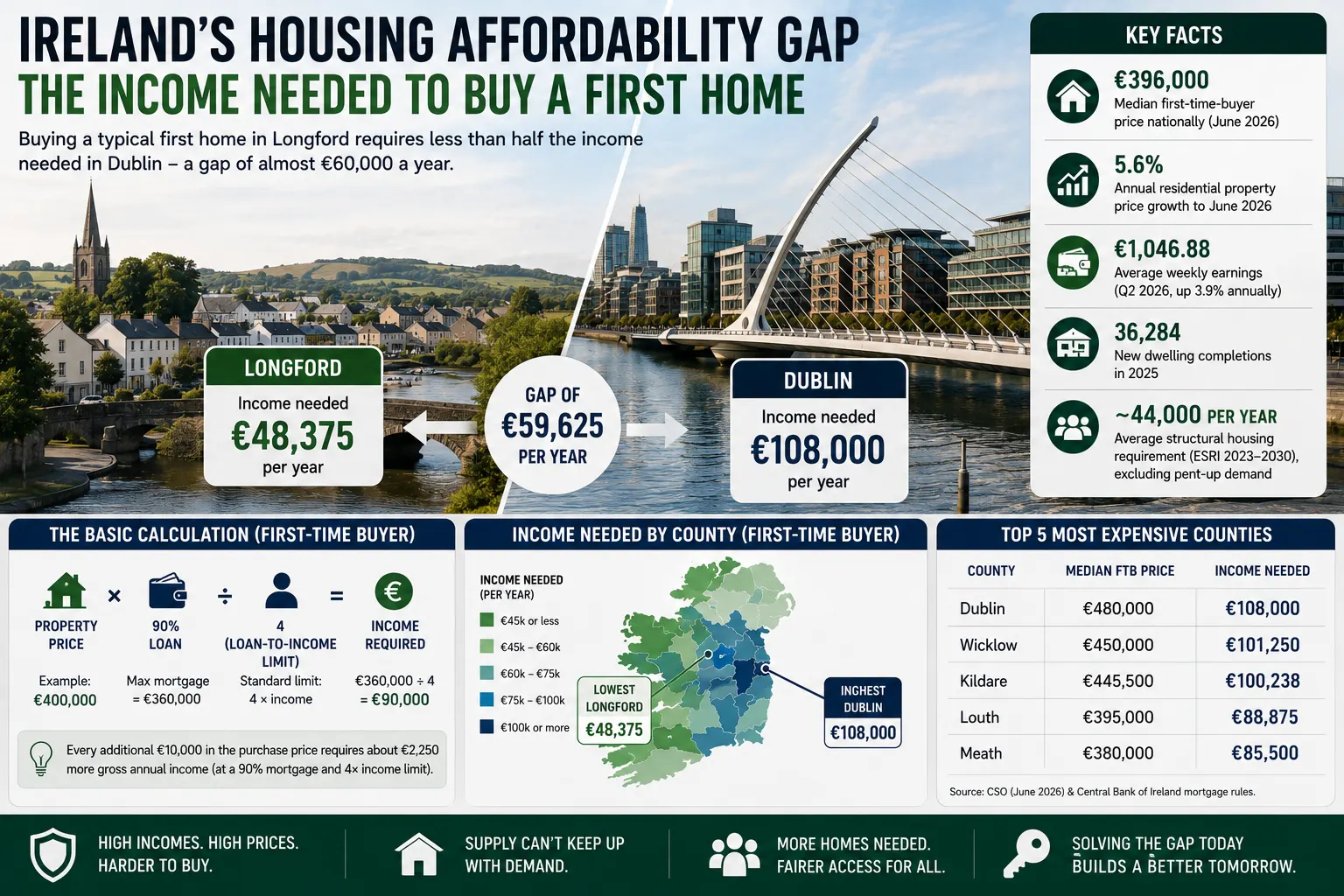
The difference between buying a first home in Longford and buying one in Dublin can now amount to almost €60,000 a year in the gross income needed to satisfy standard mortgage limits. Using June 2026 first-time-buyer prices and the Central Bank of Ireland’s normal lending framework, a single purchaser would need approximately €48,375 in annual income to finance the median first-time-buyer home in Longford, compared with €108,000 in Dublin. Wicklow and Kildare have also crossed the €100,000 threshold, illustrating how Ireland’s housing affordability problem has spread well beyond the capital.
The calculation itself is straightforward. A first-time buyer can generally borrow no more than four times gross annual income, while a principal-home mortgage is normally limited to 90% of the property’s value. A buyer purchasing a €400,000 home with the minimum 10% deposit therefore needs €40,000 in cash and a €360,000 mortgage. Under the standard four-times-income limit, that mortgage requires gross annual income of €90,000.
That number is a lending ceiling rather than a guarantee that a bank will approve the mortgage. Lenders must separately decide whether repayments are affordable after considering expenses, other debts, dependants, employment security, the mortgage term and the borrower’s age. A household that technically fits within the Central Bank limit can therefore still be offered less, while a limited proportion of mortgages may be written above the standard macroprudential limits at a lender’s discretion.
The basic first-time-buyer calculation
Property price × 90% = standard maximum mortgage.
Mortgage ÷ 4 = gross annual income required under the standard first-time-buyer loan-to-income limit.
That means every additional €10,000 in the purchase price requires approximately €2,250 more gross annual income if the buyer provides only a 10% deposit.
Three Different Numbers Determine Whether a Buyer Can Afford a Home
House prices receive most of the attention, but a mortgage application is governed by three separate constraints. The first is the purchase price. The second is the amount of equity or cash the buyer can contribute. The third is the maximum debt the bank is prepared and permitted to advance relative to income.
For first-time buyers, the standard Central Bank loan-to-income limit is four times gross annual income. For second and subsequent buyers it is 3.5 times income. Principal-home mortgages are generally subject to a 90% loan-to-value limit for both groups, although individual lenders can apply stricter standards and the regulatory framework permits a limited proportion of lending above the normal limits.
Consider a first-time buyer with gross income of €50,000. Four times that income produces a standard maximum mortgage of €200,000. With a 10% deposit, that mortgage supports a property worth approximately €222,222. A couple earning €50,000 each has combined gross income of €100,000 and therefore a standard borrowing ceiling of €400,000, sufficient to finance a €444,444 property with a 10% deposit, assuming the lender accepts the application.
This explains why Irish housing has increasingly become a two-income market in expensive regions. The mortgage rules do not require two borrowers, but prices can make two incomes mathematically necessary. In Dublin, for example, the €108,000 income requirement for the median first-time-buyer property could theoretically be met by one €108,000 salary, two equal salaries of €54,000, or any other combination producing the same qualifying household income.
The County-by-County Affordability Map
The following figures use an analysis of Central Statistics Office data for median first-time-buyer property prices in the twelve months to June 2026. The deposit column assumes the buyer contributes exactly 10%, while the income column assumes the remaining 90% is financed under the standard Central Bank limit of four times gross income. It is therefore a comparable affordability benchmark rather than a personalised mortgage quotation.
Income Needed for a Typical First Home in Every Irish County
| County | Median FTB price | 10% deposit | Income required |
|---|---|---|---|
| Carlow | €318,000 | €31,800 | €71,550 |
| Cavan | €280,000 | €28,000 | €63,000 |
| Clare | €330,000 | €33,000 | €74,250 |
| Cork | €409,299 | €40,930 | €92,092 |
| Donegal | €254,750 | €25,475 | €57,319 |
| Dublin | €480,000 | €48,000 | €108,000 |
| Galway | €380,000 | €38,000 | €85,500 |
| Kerry | €301,000 | €30,100 | €67,725 |
| Kildare | €445,500 | €44,550 | €100,238 |
| Kilkenny | €348,530 | €34,853 | €78,419 |
| Laois | €366,002 | €36,600 | €82,350 |
| Leitrim | €245,000 | €24,500 | €55,125 |
| Limerick | €350,000 | €35,000 | €78,750 |
| Longford | €215,000 | €21,500 | €48,375 |
| Louth | €390,000 | €39,000 | €87,750 |
| Mayo | €255,000 | €25,500 | €57,375 |
| Meath | €429,999 | €43,000 | €96,750 |
| Monaghan | €286,000 | €28,600 | €64,350 |
| Offaly | €292,000 | €29,200 | €65,700 |
| Roscommon | €280,000 | €28,000 | €63,000 |
| Sligo | €328,750 | €32,875 | €73,969 |
| Tipperary | €298,065 | €29,806 | €67,065 |
| Waterford | €346,013 | €34,601 | €77,853 |
| Westmeath | €340,000 | €34,000 | €76,500 |
| Wexford | €325,000 | €32,500 | €73,125 |
| Wicklow | €450,000 | €45,000 | €101,250 |
Source: Chill Insurance analysis of CSO first-time-buyer property data for the 12 months to June 2026, with Ireland Newspaper deposit calculations using standard Central Bank mortgage limits.
The national divide is stark. Dublin requires the highest income at €108,000, followed by Wicklow at €101,250 and Kildare at approximately €100,238. Meath is close behind at €96,750, while Cork is the most demanding county outside Leinster at just over €92,000.
At the other end of the market, Longford requires approximately €48,375, Leitrim €55,125, Donegal €57,319 and Mayo €57,375. These numbers are much lower than those around Dublin, but even the lowest remains above the latest national median annual earnings figure of €44,816 available from the CSO’s county earnings analysis.
Even the Cheapest County Is Difficult for a Typical Single Earner
The most revealing comparison is not between Dublin and Longford but between house prices and actual earnings. The latest detailed CSO distributional data put national median annual earnings at €44,816 in 2024. Dublin recorded the highest county median at €49,224, while Kildare stood at €48,431, Wicklow at €46,527, Cork at €46,416 and Meath at €46,272.
Those figures are considerably below the borrowing income needed for a typical first home in the same counties. In Dublin the gap between the county median income and the standard income requirement is approximately €58,776. In Wicklow it is around €54,723, in Kildare approximately €51,807 and in Meath about €50,478.
Even Longford, where the median first-time-buyer property is €215,000, illustrates the problem. The county’s median annual earnings were €38,857 in the CSO data, compared with €48,375 required under the standard mortgage calculation. A buyer on the local median income would therefore need either a larger deposit, another income, a cheaper property, an approved exception or some other source of financial support.
There is an important limitation in comparing 2024 earnings with 2026 property prices: wages have continued to rise since the earnings reference period. The comparison nevertheless shows the structural scale of the gap. Property prices would have to stagnate while earnings caught up for several years, or housing supply would have to rise sufficiently to change the balance between buyers and available homes, before the affordability relationship materially normalised.
The National Median Home Requires Roughly €89,000 in First-Time-Buyer Income
The CSO’s broader Residential Property Price Index release put the median price of all dwellings purchased by households in the twelve months to June 2026 at €396,000. That figure is not the same as the county-specific first-time-buyer medians above, but it offers a useful national benchmark.
A 10% deposit on €396,000 is €39,600. The remaining €356,400 mortgage requires gross annual income of €89,100 under the standard first-time-buyer four-times-income rule. For a second or subsequent buyer subject to the 3.5-times-income limit, the same €356,400 loan would correspond to gross income of approximately €101,829.
The difference illustrates an important point about Ireland’s mortgage measures. First-time buyers have somewhat greater permitted leverage because their standard income multiple is four rather than 3.5. That helps entry into the market, but it does not eliminate the underlying gap created by high property prices.
A Larger Deposit Can Reduce the Salary Requirement
The 10% deposit is a regulatory maximum loan-to-value assumption, not a requirement that every buyer must borrow 90%. A larger deposit can reduce both the mortgage and the income necessary to support it. This is why family assistance, inheritance, long-term savings or proceeds from another asset can dramatically change a buyer’s position even when annual income remains unchanged.
Take the €480,000 median first-time-buyer property used for Dublin. With a 10% deposit of €48,000, the mortgage is €432,000 and the standard income requirement is €108,000. If the buyer instead contributes €100,000, the mortgage falls to €380,000 and the corresponding four-times-income requirement falls to €95,000. A €150,000 contribution would reduce the mortgage to €330,000 and the income threshold to €82,500.
This explains why headline comparisons based solely on salary do not capture every purchaser’s circumstances. Two people earning identical salaries can have completely different purchasing power if one has accumulated €150,000 in savings or family equity and the other is starting with the minimum deposit.
It also helps explain the increasingly important role of intergenerational wealth in the Irish housing market. High house prices have created substantial equity for many established homeowners. Some of that wealth can be transferred to younger family members, giving them purchasing power that does not appear in salary statistics.
The Deposit Is Not the Only Cash a Buyer Needs
A 10% deposit should not be confused with the entire cash requirement for buying a home. Buyers must also budget for transaction costs such as Stamp Duty, legal fees, valuation expenses and, depending on the property, a structural survey or other professional costs.
For standard residential property, Stamp Duty is currently charged at 1% on the first €1 million of consideration, 2% on the portion above €1 million and up to €1.5 million, and 6% on the portion above €1.5 million. All median first-time-buyer prices in the county table fall below €1 million, so a typical buyer using those values would face Stamp Duty equal to 1% of the purchase price.
A €480,000 Dublin property therefore carries €4,800 in Stamp Duty in addition to the €48,000 minimum deposit. A €215,000 Longford property would carry €2,150. Legal, valuation, survey, insurance, moving and furnishing costs would come on top of those amounts and vary according to the transaction.
Mortgage Interest Rates Determine the Monthly Reality
The income multiple determines how much debt a buyer can ordinarily obtain, but the interest rate determines how expensive that debt is to service. The Central Bank reported that the weighted average rate on new Irish mortgage agreements was 3.49% at the end of June 2026. Fixed-rate mortgages represented 93% of the volume of new agreements, with the average fixed rate at 3.46%, while the average variable rate was 3.96%.
Using 3.49% purely as a modelling rate and assuming a 30-year repayment term, the €432,000 mortgage associated with the Dublin first-time-buyer example would produce principal-and-interest repayments of approximately €1,937 a month. In Cork, a 90% mortgage on the €409,299 median first-time-buyer price would be approximately €368,369 and would produce a model payment of around €1,652 a month. Galway’s equivalent €342,000 mortgage would be around €1,534, while Longford’s €193,500 mortgage would be approximately €868.
These are mathematical examples rather than actual mortgage offers. Real repayments depend on the lender, product, fixed-rate period, mortgage term and individual circumstances. Mortgage protection, home insurance, property tax, maintenance and other ownership costs are also excluded.
Illustrative Monthly Mortgage Cost at 3.49% Over 30 Years
| County example | 90% mortgage | Model monthly payment |
|---|---|---|
| Longford | €193,500 | €868 |
| Galway | €342,000 | €1,534 |
| Cork | €368,369 | €1,652 |
| Kildare | €400,950 | €1,798 |
| Dublin | €432,000 | €1,937 |
Model calculation using the Central Bank’s weighted average rate on new Irish mortgage agreements at end-June 2026. Actual mortgage terms and rates vary.
Interest rates also create a second affordability constraint that is separate from the four-times-income rule. A mortgage can technically fit within the regulatory income multiple while still producing monthly repayments that a lender considers too high after examining the applicant’s other expenses. Banks therefore perform their own affordability and credit assessments rather than automatically lending the maximum permitted amount.
The effect of rate changes can be substantial on large loans. On a €356,400 mortgage over 30 years, a model rate of 3.49% produces a payment of roughly €1,598 a month. At 4.49%, the same mortgage would cost approximately €1,804, around €205 more every month. At 2.49%, the payment would be approximately €1,406.
Why a Bank May Lend Less Than Four Times Income
The Central Bank limits are sometimes interpreted as an entitlement to borrow four times salary. They are not. The regulations establish boundaries for the mortgage market, but individual lenders remain responsible for deciding whether a particular borrower can sustainably repay a loan.
A lender may consider existing personal loans, car finance, credit-card balances, childcare, dependants, employment type, probationary status, variable income, previous credit behaviour and the term available before retirement. A €100,000 household income therefore does not automatically produce a €400,000 mortgage approval.
Property valuation also matters. The loan-to-value ratio is based on the lender’s accepted property value. If a purchaser agrees to pay more than the bank’s valuation, the buyer may have to provide additional cash because the lender may not finance 90% of the higher contract price.
Conversely, lenders are permitted to issue a limited amount of mortgage lending above the standard macroprudential limits. For first-time and subsequent principal-home buyers, up to 15% of the value of new lending can fall outside the standard limits. That flexibility belongs to the lender rather than the borrower and does not create a general alternative income multiple available on request.
Irish House Prices Have Changed Dramatically Since 2020
County affordability today reflects a much longer price movement. Property Price Register analysis shows that the median achieved sale price has risen strongly in every county since 2020, although the extent varies substantially. Lower-priced counties have in many cases experienced the largest percentage increases because they started from a much smaller base.
The figures below use annual median sold prices calculated from the Property Price Register rather than the official CSO Residential Property Price Index. The distinction matters. A median can change because the mix of homes sold changes, while the CSO index attempts to measure like-for-like price movement. The 2026 figures are also part-year figures and recent registrations can still be added.
County Median Sold-Price Development: 2020 to 2026
| County | 2020 median | 2026 median | Change |
|---|---|---|---|
| Carlow | €175,000 | €295,000 | +68.6% |
| Cavan | €140,000 | €250,000 | +78.6% |
| Clare | €178,000 | €318,000 | +78.7% |
| Cork | €250,000 | €384,999 | +54.0% |
| Donegal | €125,000 | €207,000 | +65.6% |
| Dublin | €370,000 | €499,999 | +35.1% |
| Galway | €230,000 | €381,500 | +65.9% |
| Kerry | €165,000 | €295,000 | +78.8% |
| Kildare | €310,000 | €450,000 | +45.2% |
| Kilkenny | €195,500 | €350,000 | +79.0% |
| Laois | €180,000 | €349,975 | +94.4% |
| Leitrim | €102,595 | €225,000 | +119.3% |
| Limerick | €192,000 | €307,000 | +59.9% |
| Longford | €104,000 | €185,000 | +77.9% |
| Louth | €200,000 | €373,320 | +86.7% |
| Mayo | €129,000 | €230,000 | +78.3% |
| Meath | €280,000 | €425,000 | +51.8% |
| Monaghan | €130,000 | €232,000 | +78.5% |
| Offaly | €162,500 | €295,500 | +81.8% |
| Roscommon | €101,000 | €240,000 | +137.6% |
| Sligo | €121,005 | €265,000 | +119.0% |
| Tipperary | €147,500 | €265,000 | +79.7% |
| Waterford | €182,368 | €310,410 | +70.2% |
| Westmeath | €184,000 | €325,000 | +76.6% |
| Wexford | €186,000 | €315,000 | +69.4% |
| Wicklow | €326,500 | €478,000 | +46.4% |
Source: HousePrice.ie analysis of Property Price Register annual median sale prices. 2026 is part-year and provisional; percentage changes are calculated from the published medians and are not an official CSO house-price index.
The pattern is important. Dublin remains by far one of the most expensive markets, yet its median transaction price has increased by a smaller percentage since 2020 than many lower-cost counties. Roscommon’s median in this dataset rose from €101,000 to €240,000, Leitrim from approximately €102,595 to €225,000 and Sligo from about €121,005 to €265,000. These very large percentage changes partly reflect the much lower starting prices and potentially changes in the mix of homes sold.
Laois, Louth, Offaly, Kilkenny and much of the west and border region have also experienced substantial increases. This supports a broader trend already visible in official CSO data: housing pressure is no longer concentrated exclusively in Dublin. Buyers searching for cheaper properties farther from the capital can themselves increase demand in commuter and regional markets.
The Official Price Index Shows Faster Growth Outside Dublin
For measuring actual property-price inflation, the CSO warns that median prices should not be treated as the definitive measure because the type, size and location of properties sold can change from period to period. Its Residential Property Price Index adjusts more effectively for those differences.
The national RPPI increased by 5.6% in the twelve months to June 2026. Dublin residential property prices increased by 4.6%, while prices outside Dublin rose by 6.4%. Looking specifically at houses, Dublin house prices rose 3.9%, compared with 6.0% outside Dublin.
The regional differences were even larger. House prices in the Border region, comprising Cavan, Donegal, Leitrim, Monaghan and Sligo, rose 10.5% over the year. The Midlands region of Laois, Longford, Offaly and Westmeath recorded 10.0% growth, while the South-West region of Cork and Kerry recorded a much lower 3.7% rise.
The data therefore show a market in which Dublin remains expensive in absolute terms but some less expensive regions are recording faster percentage growth. If that pattern persists, moving farther from Dublin may continue to save money in absolute terms while becoming progressively less advantageous relative to the past.
Why the Required Salary Is Rising Faster Than Many Buyers Expect
The mortgage formula creates a mechanical connection between property prices and required income. If a county’s typical first-time-buyer property rises from €300,000 to €350,000 and the buyer still contributes only 10%, the mortgage rises from €270,000 to €315,000. The standard income requirement therefore moves from €67,500 to €78,750.
A €50,000 increase in the property price has created an €11,250 increase in the gross salary needed to borrow 90% of the purchase price. The buyer must simultaneously save an additional €5,000 because the 10% deposit has risen from €30,000 to €35,000.
This double effect is one reason affordability can deteriorate surprisingly quickly. A first-time buyer may receive a salary increase and save more money during the year but still move farther away from the market if property prices rise by enough to increase both the deposit requirement and the mortgage income threshold.
Why Ireland Does Not Simply Raise the Mortgage Limit
One apparent solution would be to allow buyers to borrow five or six times their salaries. That could immediately enable many households to bid more for homes, but it would not immediately increase the number of homes available. In a supply-constrained market, substantially increasing purchasing power can therefore translate partly into higher house prices.
The Central Bank introduced mortgage measures in 2015 after Ireland’s experience during the previous credit and property boom. Their purpose is to prevent an unsustainable relationship between mortgage credit and house prices and to increase the resilience of borrowers and lenders. The first-time-buyer income limit was subsequently increased from 3.5 to four times income from 2023.
The regulations therefore deliberately trade some purchasing power today for greater financial resilience later. A borrower carrying a smaller debt relative to income is better placed to absorb unemployment, interest-rate changes or a fall in property values. The policy does not make homes cheaper, but neither is its primary purpose to solve the housing shortage.
The deeper affordability problem must therefore be addressed primarily through the price and supply side of the housing market rather than continuously increasing leverage. If supply expands enough that prices grow more slowly than wages, the same mortgage rules become progressively less restrictive relative to household incomes.
Help to Buy Can Reduce the Deposit Barrier for New Homes
First-time buyers purchasing or self-building a qualifying new home can potentially use the Help to Buy scheme. Under the enhanced version currently in force, the relief can be worth up to €30,000 for qualifying transactions through the end of 2029.
The amount is the lowest of €30,000, 10% of the purchase price or approved self-build valuation, or the eligible Income Tax and DIRT paid during the relevant previous four years. The qualifying property’s value cannot exceed €500,000, and the mortgage must generally represent at least 70% of the property’s value.
This can materially change the deposit calculation. A qualifying purchaser of a €300,000 new home could potentially receive up to €30,000, equal to the entire 10% deposit, if sufficient qualifying tax had been paid. A buyer of a €450,000 property could still receive no more than €30,000, leaving at least another €15,000 required to reach a 10% deposit before transaction costs.
Help to Buy does not apply to an ordinary second-hand purchase. It also does not automatically increase the maximum amount a bank will lend relative to income. Its principal function is to help eligible first-time buyers assemble the equity contribution required for qualifying new homes.
The First Home Scheme Can Bridge a Larger Affordability Gap
The First Home Scheme operates differently. It is a shared-equity arrangement that can provide eligible buyers with funding in return for an equity share in the property. Subject to its rules and local price ceilings, the Scheme can provide up to 30% of the property purchase price or qualifying build cost.
If the buyer also uses Help to Buy, the maximum First Home Scheme contribution is reduced to 20%. A minimum 10% deposit is still required, although Help to Buy can contribute towards that deposit where the conditions are satisfied.
The Scheme can therefore bridge a gap that cannot be solved simply by a larger mortgage. A household may have the maximum mortgage available under the four-times-income rule and a 10% deposit but still be short of the asking price. Shared equity can potentially fill part of that difference without requiring the bank to increase the mortgage beyond normal limits.
There are important limitations. Property-price ceilings vary by local authority, participating-lender requirements apply, and the equity share has long-term financial implications because the amount ultimately required to buy back that share is linked to the property’s value. Service charges also begin after the initial period specified by the scheme.
State Supports Help Individual Buyers but Do Not Eliminate the Supply Problem
Buyer supports can be decisive for an individual household, particularly one close to qualifying. But they cannot on their own make an entire housing market affordable. If large numbers of buyers receive additional purchasing power while the number of available homes remains constrained, sellers can face stronger demand for the same supply.
This is why Ireland’s long-term affordability challenge remains closely connected to housing output. Government’s current Delivering Homes, Building Communities plan targets approximately 300,000 homes by the end of 2030, including substantial social and affordable delivery and investment in infrastructure intended to unlock additional private construction.
The Economic and Social Research Institute has estimated structural housing demand averaging approximately 44,000 homes per year between 2023 and 2030 across a range of demographic scenarios. That estimate does not include all accumulated pent-up demand created when households were unable to form independently in previous years.
If Ireland merely builds enough homes to satisfy newly arising demand, the existing shortage can persist. Sustained affordability improvement is more likely if supply remains above new structural demand for long enough to reduce the backlog as well.
Location Can Change the Required Income by Tens of Thousands of Euro
The county table demonstrates why national averages can be misleading for prospective buyers. A household earning €70,000 may be far below the standard requirement for a median first-time-buyer property in Dublin, Wicklow, Kildare, Meath, Cork, Louth, Galway, Laois, Limerick, Kilkenny or Waterford. The same income could theoretically support the typical first-time-buyer price in several lower-cost counties.
That does not mean relocation is a simple solution. A cheaper house can come with longer commuting distances, fewer employment opportunities, greater dependence on a car or reduced access to childcare, schools and services. Housing affordability therefore has to be considered alongside transport and employment geography.
The spread of price growth into the Midlands and Border counties also means that some of the traditional affordability advantage outside the main cities is being eroded. Remote and hybrid working can make regional living possible for more workers, but it can simultaneously bring higher-income demand into markets with relatively limited housing supply.
Buying as a Couple Changes the Arithmetic More Than Almost Anything Else
The county income requirements in the main table are expressed as total gross income. They therefore apply equally to one applicant or multiple applicants whose incomes can be combined for the mortgage. This is important because the difference between buying alone and buying jointly is often larger than the difference created by small changes in interest rates.
A €92,092 income requirement in Cork could theoretically be satisfied by two buyers earning about €46,046 each. Galway’s €85,500 requirement could be met by two equal incomes of €42,750. A Dublin requirement of €108,000 becomes €54,000 each if divided evenly between two borrowers.
Individual lenders still assess the household’s combined expenses, dependants and debts, so the simple split does not guarantee approval. Nevertheless, the arithmetic explains why home ownership has become particularly difficult for single buyers even when they earn what would traditionally have been regarded as a good salary.
What Happens if House Prices Continue Rising Faster Than Wages?
The future income requirement follows directly from the relationship between prices and earnings. If first-time-buyer prices rise by 5% while wages rise by only 3%, the affordability gap widens even before changes in interest rates or living costs are considered.
A €400,000 home rising by 5% becomes €420,000. With a 10% deposit, the mortgage requirement increases from €360,000 to €378,000, and the standard gross-income threshold rises from €90,000 to €94,500. A buyer whose salary increased from €45,000 to €46,350 has therefore received a 3% wage rise but has fallen farther behind the income needed to purchase alone.
This process becomes particularly important in counties where income requirements are already close to major thresholds. Meath currently requires roughly €96,750. A further increase of around 3.4% in its median first-time-buyer price, with all other assumptions unchanged, would push the standard income requirement above €100,000.
Cork is already above €92,000. Galway is above €85,000. Continued house-price increases materially faster than local earnings could therefore spread the six-figure income requirement to additional counties without any change in Central Bank rules.
What if Mortgage Rates Fall Instead?
Lower interest rates can improve monthly affordability considerably, but they do not automatically change the Central Bank’s four-times-income limit. A household that cannot borrow enough because of the loan-to-income ceiling may therefore remain constrained even if mortgage rates fall.
Lower rates can nevertheless help in three ways. They reduce monthly repayments, improve a lender’s affordability assessment and increase the amount of disposable income remaining after mortgage costs. They can also increase demand because more households become comfortable purchasing at prevailing prices.
That final effect means falling rates are not necessarily synonymous with falling housing costs. If lower borrowing costs increase demand faster than new supply becomes available, some of the benefit can be capitalised into higher property prices. The overall result therefore depends on both monetary conditions and housing construction.
Three Plausible Paths for Irish Home Buyers
Gradual improvement: housing completions continue increasing, infrastructure constraints begin to ease and wage growth remains reasonably strong while house-price inflation moderates. Under this scenario, nominal home prices do not necessarily fall, but incomes slowly catch up. Required mortgage-income multiples remain unchanged while affordability improves over several years.
Continued affordability deterioration: population and household demand remain strong, construction struggles to expand sufficiently and prices continue rising faster than earnings. Additional counties move towards or above the €100,000 income requirement for single first-time buyers, while lower-priced regional markets gradually converge towards current urban price levels.
Economic downturn: weaker employment and reduced demand slow or reverse property-price growth. This could make homes cheaper in nominal terms, but declining prices would not automatically improve access if unemployment increased or banks tightened lending standards. Ireland’s post-2008 experience demonstrates that cheaper property during a recession can coexist with extremely difficult access to credit.
The first scenario would be the least disruptive route to improved affordability: more housing supply, slower price growth and continued income gains. It would not deliver an immediate return to the prices of a decade ago, but it could gradually reduce the share of household earnings needed to buy a home.
The Most Important Number Is Not the House Price Alone
A €300,000 home may sound affordable compared with a €500,000 property, but affordability only becomes meaningful once price is connected to deposit, income and financing costs. For a first-time buyer providing 10%, a €300,000 home requires a €30,000 deposit, a €270,000 mortgage and approximately €67,500 in gross qualifying income. A €500,000 property requires a €50,000 deposit, a €450,000 mortgage and €112,500 in gross qualifying income.
The difference is therefore not merely €200,000 in the purchase price. It is an additional €20,000 in minimum deposit, €180,000 in mortgage debt and €45,000 in annual qualifying income. Higher interest payments then compound the difference throughout the mortgage term.
This is why the question of how much a person needs to earn to buy in Ireland has no single national answer. For a first-time buyer with a 10% deposit, the current county-level benchmark stretches from below €50,000 in Longford to above €100,000 in Dublin, Wicklow and Kildare. The same household can therefore be mathematically excluded from one market while fitting within the standard mortgage limits in another.
The deeper question is whether those differences will widen or narrow. That will depend less on changes to mortgage arithmetic than on whether Ireland can build sufficient housing in the locations where people need to live. If supply expands faster than demand and wages continue rising, the required incomes in today’s table can gradually become easier to achieve. If prices continue outpacing earnings, the thresholds will keep moving upwards — and the definition of a high enough salary to own a home in Ireland will continue to change with them.
Sources
Central Statistics Office — Residential Property Price Index June 2026
Central Bank of Ireland — Mortgage Measures
Central Bank of Ireland — Retail Interest Rates June 2026
Central Statistics Office — Distribution of Earnings by Gender and County 2024
Chill Insurance — How Much a First-Time Buyer Needs to Earn in Every County
HousePrice.ie — Irish Property Price Trends Using Property Price Register Data
Revenue — Help to Buy: How Much Can You Claim?
Revenue — Help to Buy: Qualifying Property
Revenue — Residential Stamp Duty Rates
First Home Scheme — Eligibility and Funding
First Home Scheme — Property Price Ceilings
Economic and Social Research Institute — Population Projections and Structural Housing Demand
Department of Housing — Delivering Homes, Building Communities 2025–2030
Source & Transparency
This article is published by Ireland Newspaper for editorial and informational purposes.
Published: 3 September 2026 · Updated: 3 September 2026

Newsroom Ireland Newspaper
Ireland Newspaper editorial team prepares daily news coverage for readers in Ireland and abroad.




Market data, financial news and economy content on Ireland Newspaper are provided for editorial and informational purposes only. They do not constitute financial advice, investment advice, trading advice or a recommendation to buy, sell or hold any financial product. Always verify live prices and consult a qualified professional before making financial decisions.