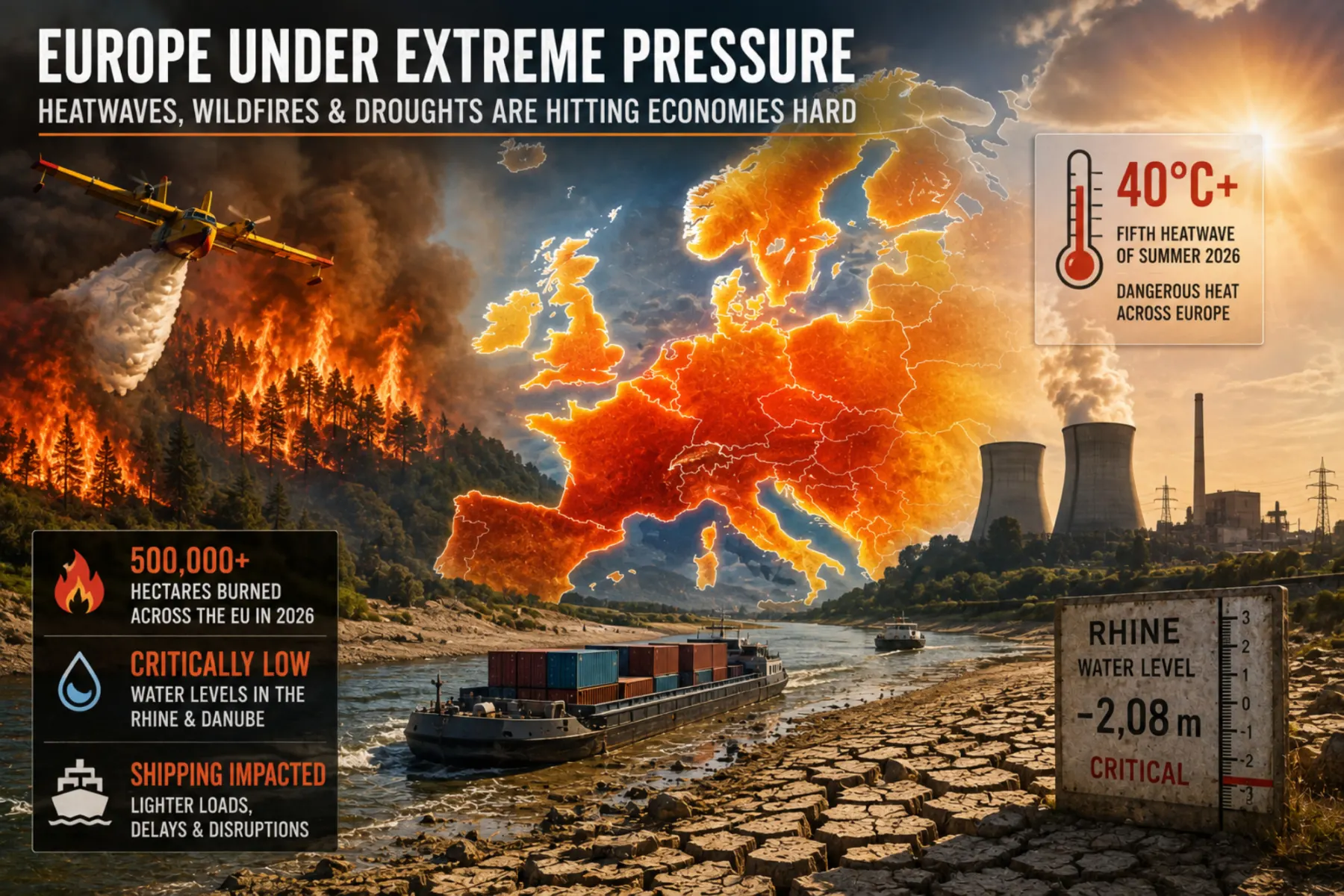
Europe’s current heatwave can be seen in thermometers, satellite images and fire maps. But one of the clearest signs of what is happening may be found much lower down — at the edges of its rivers. Along sections of the Rhine, exposed banks have widened as water levels have fallen. Cargo vessels that normally move large quantities of chemicals, fuel, minerals and industrial materials through the heart of western Europe are carrying lighter loads or suspending some journeys.
Farther east, the Danube has fallen to extraordinary levels. Its declining flow has affected cargo transport, river tourism, hydropower and even nuclear electricity generation. At the same time, firefighters continue to confront fires from the Iberian Peninsula and France to parts of Italy, Greece and the Balkans. These are different events.
They are nevertheless connected by the same underlying physical system. Prolonged heat accelerates evaporation from soils and vegetation. Dry soils provide less natural evaporative cooling, which can intensify subsequent heat. Vegetation loses moisture and becomes easier to burn. Rivers receive less runoff. Water temperatures rise. Irrigation demand increases just as available water declines.
What begins as an atmospheric event can therefore become a problem for forests, farms, electricity grids, shipping companies, factories and households. Summer 2026 is providing Europe with an unusually clear demonstration of that chain.
Western Europe Has Already Experienced Its Hottest June–July Period on Record
The scale of this summer becomes clearer when individual hot days are separated from the longer trend. Copernicus Climate Change Service data show that western Europe experienced its hottest June–July period on record in 2026. The regional average for those two months reached 21.62°C, around 2.79°C above the 1991–2020 average, surpassing the previous record from 2022. July brought the third and fourth western European heatwaves since May, while another heatwave is now affecting parts of Europe in August.
June had already been extraordinary. Western Europe’s average temperature for that month reached 20.74°C, 3.05°C above the 1991–2020 average, making it the region’s warmest June on record. Germany, France, Austria, Hungary, Poland and other countries experienced exceptional or record temperatures during the early summer heat. The significance is not simply that Europe has experienced very hot days.
It is the persistence. When extreme heat arrives repeatedly, soils and vegetation have less opportunity to recover between events. Reservoirs and rivers continue losing water. Buildings retain heat.
Energy systems remain under elevated demand. And the environmental conditions under which wildfires can become large and difficult to control progressively worsen.
August Has Brought Another Heatwave
By 11 August, western Europe was moving through what has been described as its fifth heatwave of the summer. France is among the countries again facing intense heat, with temperatures forecast to reach roughly 35°C to 39°C across many regions between Wednesday and Friday before conditions are expected to ease. Elsewhere, the summer has already produced remarkable extremes. Italy placed its monitored major cities under the highest heat alert during the latest episode, while Austria and Slovakia recorded exceptional temperatures during early August. Parts of the Balkans have also experienced severe heat and drought.
But Europe is not uniformly hot. Copernicus data for July showed a strong geographical contrast: western Europe experienced exceptional warmth, while parts of eastern Europe and Scandinavia were cooler than average. That distinction matters. “Europe’s heatwave” should not be interpreted as meaning every European country is experiencing identical conditions at the same moment.
The current crisis is regional, shifting and uneven. Its economic consequences are similarly uneven.
Heat Alone Does Not Start Every Wildfire
The relationship between heat and wildfire requires careful explanation. A hot day does not automatically ignite a forest. Fires can begin through human activity, accidents, deliberate ignition, electrical infrastructure, machinery or lightning. But the weather and condition of the landscape influence what happens after ignition.
When vegetation is moist, a small fire may remain limited. When grass, shrubs and forests have experienced weeks of heat and moisture loss, the same ignition can spread much more rapidly. Wind can then carry burning material ahead of the main fire front and produce additional outbreaks. This is why scientists distinguish between the cause of ignition and the conditions that make a large wildfire possible.
Copernicus reported that the prolonged hot and dry conditions of July created conditions conducive to exceptional wildfire activity in western Europe, both in terms of area burned and emissions.
More Than Half a Million Hectares Have Burned in the EU
The latest European Forest Fire Information System data show how severe the season has become. As of 10 August 2026, 542,926 hectares had burned across the European Union in fires tracked by the system. EFFIS had detected 1,599 fires since the beginning of the year. The figure is below the 631,119 hectares recorded by the same date during 2025 — ultimately the EU’s worst fire year in the EFFIS record — but it remains far above the roughly 197,000-hectare long-term average for this stage of the year.
That comparison provides important perspective. 2026 is not currently exceeding every previous record. It is nevertheless an exceptionally severe fire year. The current fire-danger outlook also stretches much farther north than the Mediterranean.
EFFIS reports very extreme conditions across parts of southern Britain and north-western France, extending through the Alps and towards the Balkans. Extreme conditions cover wider areas of the Iberian Peninsula, central and southern France and parts of the western Balkans. The old assumption that large wildfire risk is predominantly a southern European problem is becoming increasingly difficult to maintain.
Spain Has Been Fighting One of the Summer’s Most Visible Fire Battles
Spain offers one of the clearest examples of how heat, wind and dry vegetation can combine. Major fires have affected different parts of the country during the summer, including large incidents in Huelva, Segovia, Castellón and elsewhere. A major fire near Niebla in south-western Spain had spread across close to 20,000 hectares by 10 August, with hundreds of residents evacuated while firefighters confronted heat, difficult terrain and wind-driven spotting. Spain is now facing another unusual challenge.
Tomorrow’s total solar eclipse is expected to attract very large numbers of visitors to parts of the country at precisely the time when wildfire danger remains high. Spanish authorities have prepared hundreds of controlled observation sites and extensive security arrangements partly to reduce the chance that human activity associated with the event creates additional fire risk. It is an unusual collision between astronomy, tourism and climate risk. It also illustrates the changing practical consequences of hotter, drier European summers.
France Has Seen Fire Risk Move Close to Major Population Centres
France has also experienced a difficult wildfire season. Large fires in the south-west forced extensive evacuations during July, while fires also affected the Mediterranean Var region. The European Union activated significant cross-border assistance for both France and Spain during the most intense phase of the July fires. For France, European assistance included firefighting aircraft and helicopters supplied by several countries. Spain received aircraft, personnel and vehicles from European partners and participating states.
This cross-border response is becoming increasingly important because major fire seasons can overwhelm national resources precisely when neighbouring countries may simultaneously be facing their own emergencies. The EU entered the 2026 fire season with its largest pre-positioning programme to date: 777 firefighters from 14 countries, alongside 22 firefighting aircraft and five helicopters available through the European response system. That expansion reflects a fundamental change in European risk planning. Wildfire response is increasingly being treated as continental infrastructure.
The Drought Beneath the Fires Is Just as Important
Wildfires are visually dramatic. Drought is quieter. It can nevertheless affect a much larger part of the economy. The European Drought Observatory reported that by late July, drought conditions remained critical across western, central and parts of eastern Europe, the Balkans and Italy, while conditions had worsened in Britain and Ireland.
Alert conditions were present in parts of France, southern Germany, Switzerland and northern Italy and across much of the Danube basin, including areas of Hungary, Austria, Czechia, Slovakia, Serbia and Romania. Copernicus also found that western European surface soil moisture in July was significantly lower than during July 2022 — itself remembered as one of western Europe’s severe drought summers. This is where the consequences move from the landscape into the economy. Dry soil affects agriculture.
Low runoff affects rivers. Low rivers affect transport and energy. High water temperatures affect cooling systems. And high temperatures increase electricity demand at the same time.
The Rhine Is Europe’s Industrial River
Few rivers demonstrate the economic importance of water levels better than the Rhine. From Switzerland through Germany and towards the Netherlands, the river connects some of Europe’s most important industrial regions with the ports of Rotterdam and Antwerp.
Cargo transported through this system includes:
- chemicals
- petroleum products
- coal
- ores
- construction materials
- containers
- industrial raw materials
River transport is particularly efficient for heavy bulk cargo. One large barge can replace many trucks. But barges require sufficient depth. When the Rhine falls, operators do not necessarily stop immediately.
Instead, they reduce the amount of cargo loaded onto each vessel so that it sits higher in the water. That sounds like a simple adaptation. Economically, it is expensive.
A Ship Can Sail — and Still Become Uneconomic
Imagine a vessel capable of carrying 2,500 tonnes under normal water conditions. If low water means it can safely carry only 1,000 tonnes, the ship still requires a crew. It still requires fuel. It still occupies the same amount of time on the river.
It still incurs many of the same operating costs. But it delivers much less cargo. To move the original 2,500 tonnes, a company now needs more voyages or more vessels. Transport cost per tonne rises.
And when many companies need additional vessels simultaneously, available shipping capacity becomes scarce. Freight rates rise again. This is the mechanism through which centimetres of river level can eventually appear in the cost of chemicals, fuels, raw materials and manufactured goods.
The Rhine Has Reached Critically Low Levels Again
That process is occurring now. German authorities reported extremely low Rhine levels this week, with some operators halting sailings on particularly difficult southern sections and others substantially reducing loads. Official German waterways forecasts for Kaub, one of the most important reference points on the Middle Rhine, show extraordinarily low gauge readings continuing through this week. The German Federal Institute of Hydrology’s forecast available on 11 August indicated levels remaining in the low-teens centimetre range over the following days.
A gauge reading should not be confused with the actual physical depth of the entire river — gauge zero is a reference datum rather than the riverbed. For shipping companies, however, the trend and its relationship to navigable depth are critical. By late July, cargo volumes moving between the Rhine and the Port of Rotterdam were already around 10 per cent below normal, according to figures reported by the port. Deep-draught chemical tankers, petroleum vessels and dry-bulk carriers were particularly exposed.
The economic effect therefore extends far beyond river shipping companies.
Germany Learned This Lesson in 2018
Europe has seen this mechanism before. During the severe Rhine low-water period of 2018, vessels had to reduce their loads dramatically and freight prices rose. The Central Commission for the Navigation of the Rhine later reported research estimating that low water reduced German industrial production by around €1.9 billion in the third quarter of 2018, with further direct and delayed losses estimated for the fourth quarter. Freight rates in some Rhine cargo markets rose to multiples of normal levels during the worst period.
Another major low-water episode occurred in 2022. Across inland-waterway market segments, average freight rates were estimated to have increased by 42.5 per cent compared with 2021, with low water playing a major role in the increase. History therefore provides a warning for 2026. A river does not have to dry up completely to have an economic impact.
Long before navigation stops, transport becomes less efficient.
The Danube Is Facing an Even Broader Crisis
If the Rhine is western Europe’s industrial artery, the Danube is one of central and eastern Europe’s great economic corridors. It crosses or borders ten countries on its route towards the Black Sea. The river carries grain, fuels, ores and industrial goods. It supports tourism.
It provides water. It feeds hydroelectric plants. And several large thermal and nuclear power stations depend on it directly or indirectly. This summer, Danube water levels have fallen to extraordinary lows.
Copernicus identified the Danube alongside the Rhine and Seine as one of the major European rivers experiencing exceptionally low flows during July. The consequences are now appearing in sectors that normally seem unrelated to river transport.
The Danube Has Become an Electricity Problem
Hungary’s Paks nuclear power station illustrates the connection. Paks normally provides close to half of Hungary’s electricity and uses Danube water as part of its cooling system. During the recent low-water period, output had to be cut drastically. A subsequent modest rise in the river allowed one turbine to begin returning to operation on 10 August, but authorities continued to warn that the recovery could be temporary.
Romania faces an equally serious problem. One reactor at the Cernavodă nuclear plant has already been taken offline, while the continued decline of the Danube threatens operation of the remaining unit. As of 11 August, the flow of the Danube at Romania’s border had fallen to a reported record low of around 1,370 cubic metres per second. Authorities have undertaken exceptional engineering measures to maintain cooling-water access, while the remaining reactor could face shutdown if conditions deteriorate further.
The plant normally supplies roughly a fifth of Romania’s electricity. This is where drought becomes a macroeconomic problem.
Hydroelectricity Suffers for an Even More Obvious Reason
Hydropower depends directly on moving water. Less water normally means less electricity. At Serbia’s Djerdap 1 hydropower station, production fell to around 20 per cent of capacity during the severe late-July conditions. Low water also affected cooling at Serbian thermal power plants.
When hydroelectric or nuclear production declines during a heatwave, countries may need to import more electricity. But neighbouring countries may be experiencing the same weather at the same time. That reduces the amount of spare power available regionally. And high temperatures simultaneously increase demand as homes, offices, hotels and businesses use fans and air conditioning.
The result can be a powerful squeeze: less available generation on one side, greater electricity demand on the other.
France Shows How Heat Can Affect Nuclear Power Even When Rivers Still Flow
France demonstrates another mechanism. Its nuclear reactors require large quantities of cooling water. During a heatwave, the problem is not always insufficient volume. Sometimes the river itself becomes too warm.
Environmental rules restrict how much additional heat power stations may discharge into rivers because excessively warm water can damage aquatic ecosystems. On 11 August, French day-ahead electricity prices rose 21.8 per cent to €142.50 per megawatt-hour, while German prices increased 22.8 per cent. French nuclear output was expected to face restrictions of up to 7.3 gigawatts, equivalent to roughly 12 per cent of the nuclear fleet, around the peak of the current heatwave. Two reactors were expected to be fully unavailable because of high water temperatures, several others constrained, and another affected by low river levels.
This illustrates one of the central challenges of climate adaptation. Infrastructure designed around historical environmental conditions may still function technically — but the conditions under which it can operate safely are changing.
The Weather Can Hit Several Energy Sources at Once
Heatwaves are frequently associated with persistent high-pressure systems. Those conditions often produce relatively weak winds. Germany therefore faces another difficulty during the current episode. Wind generation is expected to fall sharply, forcing the electricity system to rely more heavily on other sources at the same time that neighbouring French nuclear generation is constrained.
German wind output was forecast to fall to around 4.7 GW, roughly 60 per cent below the seasonal average, during the latest heat episode. Solar power can perform strongly during hot sunny weather. But solar output declines in the evening, while demand from cooling may remain high. The electricity challenge is therefore not simply producing enough energy over an entire day.
It is producing enough electricity at the correct hour and moving it across borders when individual countries experience shortages.
Low Rivers Can Reach Supermarket Shelves Too
The Danube is a major route for agricultural commodities. When barges cannot reach loading points or have to carry smaller quantities, farmers and grain traders need alternatives. During the current low-water period, some Danube ports have become difficult or impossible for normal barge operations. That can force crops onto trucks or railways.
But road and rail capacity is not unlimited. When everybody seeks alternative transport simultaneously, prices can increase. The farmer may receive less for a crop if the buyer has to absorb unusually high logistics costs. Alternatively, the higher transport cost may eventually be passed along the chain.
The economic consequences therefore do not remain beside the river. They can appear in agricultural markets, industrial production and ultimately consumer prices.
Agriculture Faces the Problem Before the Harvest Reaches a Barge
Farmers are exposed even earlier. High temperatures increase water loss from plants and soils. Crops require additional irrigation precisely when rivers and reservoirs are under pressure. Livestock require more water and protection from heat.
Grass growth can slow. Some crops are particularly vulnerable when extreme heat occurs during flowering or grain-filling stages. The full harvest impact of Europe’s 2026 summer cannot yet be measured reliably because the season is still under way and effects differ substantially between countries and crops. But the European Drought Observatory already reports widespread warning and alert conditions across major agricultural regions.
That is an important distinction between observation and forecast. The drought is measurable now. Its final effect on European agricultural output will only become clear later.
Wildfires Create an Economic Bill of Their Own
A large wildfire produces several different forms of economic loss.
The most obvious is physical destruction.
- Homes
- Businesses
- Farm buildings
- Vehicles
- Roads
- Power lines
- Forests
- Agricultural land
But direct damage is only the beginning. Firefighting operations cost money. Evacuations disrupt businesses. Road closures interrupt deliveries.
Smoke affects tourism and outdoor work. Hotels may lose bookings. Insurance claims increase. Forest land may require years to recover.
Municipalities face debris removal and reconstruction costs. Air quality can deteriorate far beyond the actual fire perimeter. Copernicus notes that large high-intensity fires can inject smoke higher into the atmosphere, enabling it to travel much farther and affect regions thousands of kilometres from the flames themselves. The economic boundary of a wildfire is therefore much larger than the blackened area visible from a satellite.
Tourism Faces a Complicated Relationship With Heat
Tourism presents one of Europe’s most difficult economic questions. Southern Europe depends heavily on summer visitors. Warm, dry weather has historically been part of the product. There is therefore no simple relationship in which higher temperature automatically means lower tourism revenue.
But at extreme levels, the calculation changes. Temperatures around or above 40°C can make sightseeing uncomfortable or unsafe. Wildfires can close roads and beaches. National parks may restrict access.
Smoke can degrade air quality. Visitors may cancel trips or move to different destinations. Others may shift travel towards spring and autumn. Northern European destinations may become relatively more attractive during periods of extreme Mediterranean heat.
This does not mean southern European tourism is about to disappear. It suggests that the timing and geography of tourism demand could gradually change if extreme summer heat becomes more frequent.
The Economic Danger Comes From Events Happening Together
A single day of 40°C weather may be manageable. A low river may be manageable. One fire may be manageable. A weak wind week may be manageable.
The more difficult problem emerges when several events occur simultaneously.
Consider the chain visible in 2026:
High temperatures ↓
greater evaporation and drier soils ↓
lower river flows and drier vegetation ↓
higher wildfire risk and greater irrigation demand ↓
reduced barge loading and constrained electricity production ↓
higher transport and energy costs ↓
pressure on factories, farms, tourism and households
At the same time, air-conditioning demand rises. Emergency services require more resources. Workers become less productive in extreme outdoor heat. Health systems face additional demand.
This is what economists mean when they describe compound climate risks. The economic impact of several simultaneous stresses can be greater than the sum of each problem considered separately.
Europe Has Seen Low Water Before — but the Economic Exposure Has Grown
European rivers have experienced severe low-water periods for centuries. It would therefore be incorrect to claim that drought or low Rhine levels are entirely new phenomena. What has changed is the economic system surrounding them. Modern European industry operates through highly integrated supply chains.
Factories minimise inventories. Energy markets are interconnected. Large industrial plants depend on predictable deliveries. River vessels are larger.
Millions of people and businesses expect uninterrupted electricity. A disruption in one location can therefore travel through an economic network. At the same time, Europe is warming faster than any other continent, and scientific assessments show that extreme heat has become more frequent and intense. The relevant question is therefore not whether Europe experienced drought in the past.
It is whether infrastructure built around past conditions remains sufficiently resilient for the conditions now emerging.
2025 Had Already Provided a Warning
The preceding year was itself exceptional. According to the European State of the Climate assessment, around 70 per cent of European rivers experienced below-average annual flows in 2025, while river flows were below average during 11 months of the year. Wildfires burned around 1.03 million hectares, the largest annual area then recorded. In other words, 2026 did not begin from a period in which Europe could treat low water and extreme fire seasons as distant anomalies.
The continent entered this summer after another year that had already tested the same systems. That repeated exposure matters for insurers, governments and businesses because recovery from one event may not be complete before the next begins.
Why Climate Change Matters — Without Explaining Every Fire
The scientifically careful conclusion is not that climate change directly ignited every European wildfire. It did not. Nor does climate change determine the precise weather on every individual day. What it changes is the background on which weather events occur.
Europe is warming. Extreme heat events are becoming more frequent and intense. Hotter air increases evaporation. Long hot spells can dry vegetation and soils.
Those conditions increase the probability of severe drought and create environments in which fires, once ignited, can spread more rapidly and burn more intensely. Copernicus describes the heat–soil moisture interaction visible this summer particularly clearly: high temperatures increase moisture loss; declining soil moisture reduces evaporative cooling; the land then heats more easily, reinforcing the heat. It is a feedback loop. And it is one reason repeated heatwaves matter more than isolated records.
What Happens Next Depends Heavily on Rain
There is an unusual feature of drought economics. Conditions can improve rapidly at the surface but recover slowly underneath. Several days of rain may lower air temperatures and reduce immediate wildfire danger. River levels may rise.
Vegetation can recover. But depleted soil moisture, reservoirs and groundwater can take substantially longer to rebuild. The current EFFIS outlook for the week of 10–16 August forecasts particularly strong positive temperature anomalies stretching from France across the Alps and into the Balkans. That means immediate relief is unlikely to occur uniformly across the continent.
Some regions may receive rain. Others may remain dry. The future cannot be predicted simply by extending today’s river level forward in a straight line. But the broader vulnerability will remain after the current heatwave ends.
Europe Is Already Changing Its Fire Strategy
One response is straightforward: more firefighting capacity. Europe has been expanding exactly that. The 2026 rescEU system includes aircraft and helicopters available for countries whose national resources become overwhelmed. A permanent fleet is also under development.
The European Commission plans 12 new firefighting aircraft to be based in Portugal, Spain, France, Italy, Croatia and Greece, alongside additional helicopters. The first aircraft are expected to begin arriving from 2028. But aircraft attack the fire after it starts.
The larger adaptation challenge lies in prevention.
- Forest management
- Removal or management of combustible vegetation where appropriate
- Firebreaks
- Restoration of wetlands
- Urban planning in fire-prone zones
- Public warnings
- Restrictions during extreme fire conditions
- communities designed so that firefighters can defend them
Europe increasingly needs both.
Rivers Will Require Their Own Adaptation Strategy
The Rhine and Danube pose a different engineering problem. One solution is developing vessels capable of operating with shallower draughts. Another is maintaining alternative rail and road transport capacity for critical cargo. Companies can increase inventories before the highest-risk summer period.
Industrial plants can diversify suppliers and transport routes. Ports can improve forecasting and logistics coordination. Dredging and river engineering may help in particular locations, although interventions have ecological consequences and cannot simply manufacture water during prolonged drought. The Danube Commission was already examining growing low-water navigation challenges before the most extreme phase of the 2026 summer, including dredging arrangements and navigation management across member states.
The underlying lesson is simple. A logistics system relying heavily on one river needs a plan for the days when that river cannot carry its usual load.
Electricity Systems Will Also Have to Assume Hotter Water
Power generation faces a similar transition.
Future resilience may involve:
- greater geographic diversity of renewable generation
- stronger electricity interconnectors
- more storage
- flexible demand
- cooling systems less dependent on vulnerable river conditions
- grids capable of transferring much larger quantities of electricity between regions
Nuclear power can remain an important low-carbon source, but plants dependent on river cooling may need adaptation where high water temperature and low flow increasingly coincide. Hydropower planning must account for greater variability. Solar output can help during hot sunny periods. But storage becomes more important when solar generation falls in the evening while cooling demand remains high.
There is no single technology capable of solving the problem. Resilience comes from diversity.
Farmers Will Need More Than Emergency Irrigation
Agriculture cannot respond simply by extracting progressively more water from progressively drier rivers.
Longer-term adaptation could include:
- more efficient irrigation
- improved soil moisture retention
- different planting dates
- crop varieties better suited to heat and drought
- water storage
- precision agriculture
- changes in the geographical distribution of particular crops
Not every adaptation will work equally well in every European region. Northern Germany and southern Spain do not share the same climate. Romanian grain farming and Italian vineyards have different vulnerabilities. The future of European agricultural adaptation will therefore be regional rather than uniform.
The Most Important Economic Question Is No Longer Whether Adaptation Costs Money
It does. The more useful question is what happens when investment is postponed. A low-water-adapted cargo vessel costs money. So does a reinforced electricity grid.
So does forest management. So do additional firefighting aircraft. So do water-storage projects. So does redesigning a power plant’s cooling system.
But an industrial shutdown also costs money. Emergency electricity imports cost money. A destroyed forest costs money. A cancelled tourism season costs money.
A failed crop costs money. Emergency firefighting costs money. The economic debate is therefore increasingly shifting from whether Europe can afford adaptation to which adaptation investments cost less than repeatedly absorbing the damage.
This Summer Is Not One European Crisis but Several Connected Ones
The fires in Spain do not have exactly the same causes as the low Rhine. The reduced output of a Hungarian nuclear station is not the same problem as drought in France. A hot afternoon in Rome is not automatically related to a cargo vessel travelling half-empty towards Rotterdam. But all of these events operate inside an increasingly interconnected physical and economic system.
That is what makes the summer of 2026 significant. Weather is no longer remaining in the weather section.
It is appearing in:
- electricity prices
- freight costs
- industrial production
- agricultural markets
- insurance
- tourism
- public health
- government budgets
The rivers make that connection particularly visible.
Europe’s Rivers Are Becoming Economic Indicators
For decades, investors watched interest rates, oil prices and industrial orders for clues about the direction of Europe’s economy. Increasingly, they may also need to watch the water level at Kaub. The flow of the Danube. Soil moisture in France.
River temperatures around nuclear power stations. Wildfire danger across Spain. Those measurements describe environmental conditions. But they are also beginning to describe economic capacity.
When the Rhine falls, a factory hundreds of kilometres away can lose access to raw material. When the Danube falls, electricity production can decline. When water becomes scarce, farms compete with cities, industry and ecosystems for a limited resource. When forests become tinder-dry, billions of euros of property and infrastructure can become exposed to fire.
That is the deeper story of Europe’s current heatwave.
The Immediate Heat Will Eventually Break — the Structural Problem Will Not
No European heatwave lasts forever. The current episode will eventually weaken. Rain will return to some of the affected regions. River levels will recover.
Fires will be extinguished. Electricity systems will move away from emergency conditions. But the summer of 2026 has already demonstrated something important.
Europe’s economy was built around assumptions about the natural environment:
- how much water rivers normally carry
- how hot summer days usually become
- how frequently forests burn
- how much cooling water power stations can access
- how reliably cargo can move along inland waterways
Those assumptions are becoming less reliable. The answer is not to treat every hot summer as an unprecedented catastrophe. Europe has always experienced heat, fire and drought. Nor is the answer to attribute every individual fire, crop failure or low-water event to one cause.
The more important conclusion is systemic. Europe is experiencing a climate in which extreme heat, drought, wildfire and low river flow can increasingly occur together — and its economy has to be designed for that possibility. As of 10 August, more than 542,000 hectares had burned across the EU. Western Europe has already experienced its hottest June–July period on record. The Rhine is restricting commercial shipping. The Danube is interfering with electricity generation and freight. French nuclear reactors face heat-related constraints while electricity prices rise.
None of those developments alone defines the European economy. Together, however, they point towards one of its most important challenges for the coming decades. Europe has spent centuries learning how to use its rivers, forests, agricultural land and energy systems to create prosperity. The next stage will be learning how to preserve that prosperity when the environmental conditions surrounding those systems become less predictable.
The summer of 2026 is making clear that climate resilience is no longer only an environmental objective. It is becoming economic infrastructure.
Source & Transparency
This article is published by Ireland Newspaper for editorial and informational purposes.
Published: 11 August 2026 · Updated: 14 August 2026

Newsroom Ireland Newspaper
Ireland Newspaper editorial team prepares daily news coverage for readers in Ireland and abroad.